
八年级英语上册 Module 6 A famous story考点剖析+典题精讲 外研版
矿产资源开发利用方案编写内容要求及审查大纲
矿产资源开发利用方案编写内容要求及《矿产资源开发利用方案》审查大纲一、概述
㈠矿区位置、隶属关系和企业性质。
如为改扩建矿山, 应说明矿山现状、
特点及存在的主要问题。
㈡编制依据
(1简述项目前期工作进展情况及与有关方面对项目的意向性协议情况。
(2 列出开发利用方案编制所依据的主要基础性资料的名称。
如经储量管理部门认定的矿区地质勘探报告、选矿试验报告、加工利用试验报告、工程地质初评资料、矿区水文资料和供水资料等。
对改、扩建矿山应有生产实际资料, 如矿山总平面现状图、矿床开拓系统图、采场现状图和主要采选设备清单等。
二、矿产品需求现状和预测
㈠该矿产在国内需求情况和市场供应情况
1、矿产品现状及加工利用趋向。
2、国内近、远期的需求量及主要销向预测。
㈡产品价格分析
1、国内矿产品价格现状。
2、矿产品价格稳定性及变化趋势。
三、矿产资源概况
㈠矿区总体概况
1、矿区总体规划情况。
2、矿区矿产资源概况。
3、该设计与矿区总体开发的关系。
㈡该设计项目的资源概况
1、矿床地质及构造特征。
2、矿床开采技术条件及水文地质条件。
最新-八年级英语上册 Module 6 A famous story课中强
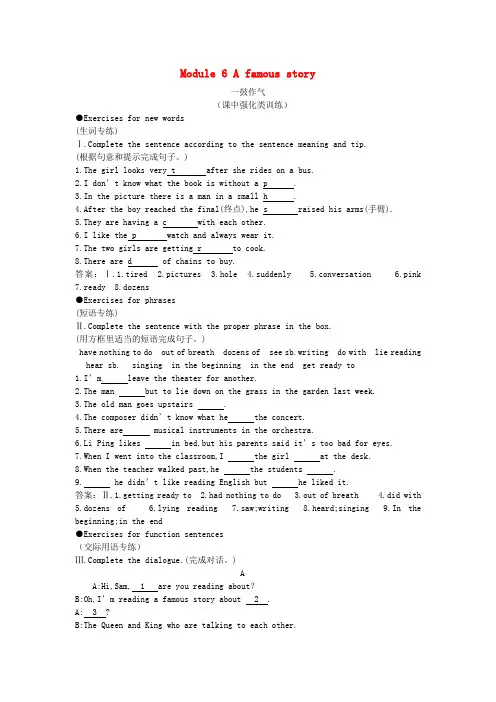
Module 6 A famous story一鼓作气●Exercises for new words(生词专练)Ⅰ.Complete the sentence according to the sentence meaning and tip.(根据句意和提示完成句子。
)1.The girl looks very t after she rides on a bus.2.I don’t know what the book is without a p .3.In the picture there is a man in a small h .4.After the boy reached the final(终点),he s raised his arms(手臂).5.They are having a c with each other.6.I like the p watch and always wear it.7.The two girls are getting r to cook.8.There are d of chains to buy.答案:Ⅰ.1.tired 2.pictures 3.hole 4.suddenly 5.conversation 6.pink7.ready 8.dozens●Exercises for phrases(短语专练)Ⅱ.Complete the sentence with the proper phrase in the box.(用方框里适当的短语完成句子。
)have nothing to do out of breath dozens of see sb.writing do with lie readinghear sb.singing in the beginning in the end get ready to1.I’m leave the theater for another.2.The man but to lie down on the grass in the garden last week.3.The old man goes upstairs .4.The composer didn’t know what he the concert.5.There are musical instruments in the orchestra.6.Li Ping likes in bed,but his parents said it’s too bad for eyes.7.When I went into the classroom,I the girl at the desk.8.When the teacher walked past,he the students .9. he didn’t like reading English but he liked it.答案:Ⅱ.1.getting ready to 2.had nothing to do 3.out of breath 4.did with 5.dozens of 6.lying reading7.saw;writing8.heard;singing9.In thebeginning;in the end●Exercises for function sentences(交际用语专练)Ⅲ.Complete the dialogue.(完成对话。
八年级英语外研版上册达标测试 Module 6 A famous story(附详细解析)

达标测试我夯基我达标Ⅰ.词汇与短语A.用所给单词的适当形式填空1.Look at the book.It’s about a girl (call>Alice.2M0vRZsK4f答案:called2.The girl was sitting by the river with a book. (sudden> a white rabbit ran past her.2M0vRZsK4f答案:Suddenly3.A cat was sitting in a tree and it was (smile> at everyone.2M0vRZsK4f答案:smiling4.Shall I read the text once or (two>?答案:twice5.Mr.Zhang has gone to America on (busy>.答案:businessB.英汉互译6.look into答案:浏览;研究7.处置;处理答案:do with8.grow up答案:长大;成长9.与……一起玩答案:play with10.from... to...答案:从……到……11.属于答案:belong to12.at the bus stop答案:在公共汽车站13.爆炸;响起答案:go out14.in bed答案:躺在床上15.某人发生……答案:happen to sb.Ⅱ.句型转换<每空一词)16.Mike has already seen the film.<改为一般疑问句并作肯定回答)Mike the book ?Yes,he .答案:Has;seen;yet;has17.Miss Wang bought her bike three years ago.<对画线部分提问)2M0vRZsK4fMiss Wang her bike?答案:When did;buy18.My mother has lunch at home every day.<用at eleven yesterday morning作为时间状语改写句子)2M0vRZsK4fMy mother lunch at home at eleven yesterday morning.2M0vRZsK4f答案:was having19.The Greens have lived in Beijing since ten years ago.<对画线部分提问)2M0vRZsK4fthe Greens in Beijing?答案:How long have;lived20.The boy has to stop eating ice cream, ?<完成反意疑问句)2M0vRZsK4f答案:doesn’t heⅢ.单句改错21.They have come here for two weeks.答案:come→been22.How have you done with the boy?答案:How→What23.Several days late they got there by air.答案:late→later24.How many times have you been in Beijing?答案:in→to25.Let’s go to school together,will we?答案:will→shallⅣ.根据所给汉语提示完成句子<每空一词)26.一天艾丽丝拿着一本书坐在河边。
外研社八年级英语Module 6 A famous story0
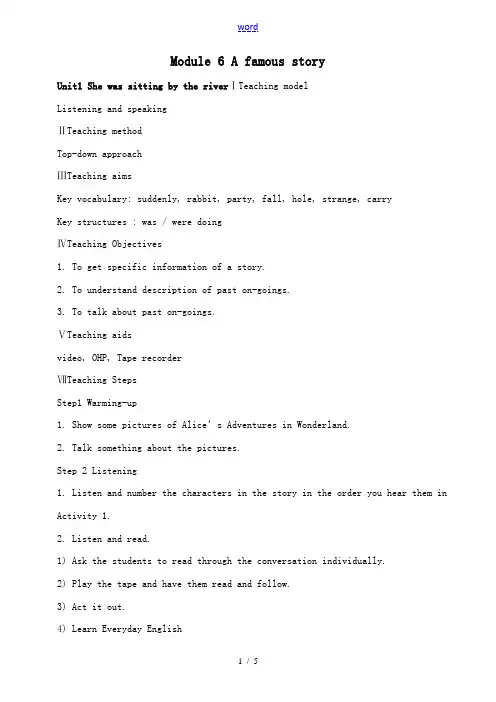
Module 6 A famous storyUnit1 She was sitting by the riverⅠTeaching modelListening and speakingⅡTeaching methodTop-down approachⅢTeaching aimsKey vocabulary: suddenly, rabbit, party, fall, hole, strange, carryKey structures : was / were doingⅣTeaching Objectives1. To get specific information of a story.2. To understand description of past on-goings.3. To talk about past on-goings.ⅤTeaching aidsvideo, OHP, Tape recorderⅦTeaching StepsStep1 Warming-up1. Show some pictures of Alic e’s Adventures in Wonderland.2. Talk something about the pictures.Step 2 Listening1. Listen and number the characters in the story in the order you hear them in Activity 1.2. Listen and read.1) Ask the students to read through the conversation individually.2) Play the tape and have them read and follow.3) Act it out.4) Learn Everyday EnglishStep 3 Exercise1. Write notes about what the people in Activity 2 were doing.2. Find words and expressions in the box for3. plete the sentences with words in the box in Activity4.Step 4 Explain the important and difficult pointsGrammar : The Present Continuous & The Past ContinuousStep 5 Pronunciation and speaking1. Listen and repeat.2. Think about what you were doing at these times.3. Work in pairs. Ask and say what you were doing at these times.Step 6 ExerciseFinish the exercise in the workbook Ex. 1, 2&3Unit 2 The white rabbit was looking at its watch.ⅠTeaching modelReading and writingⅡTeaching methodTop-down approachⅢTeaching aimsKey vocabulary: tired , nothing ,once , pink , by , pocket , across ,field ,under Key structures: was / were doingⅣTeaching Objectives1. To understand a story concerning its details , especially what , who , when , where and why .2. To write a story of past on-goings.ⅤTeaching aidsvideo, OHP , multi-mediaⅥTeaching StepsStep1 Warming-up1. Show some pictures of Alice’s Adventures in Wonderland.2. Show some pictures of Snow White and Cinderel .3. Talk something about the pictures .Step 2 PresentationLook at the picture in Activity 1 and what you think is strange.Step 3 Reading1. Read the start of Alice’s Adventures in Wonderland2. Answer the questions.3. Play the tape and have them read and follow.4. Learning to learnStep 4 Writing1. Match the notes about Lewis Carroll and Alice Liddell with the questions in Activity 3.2. Culture box : Talk something about Charles Dodgson3. Write the story of Lewis Carroll and Alice Liddell. Join some sentences with O ne day…Then… and Finally.Step 5 Explain the important and difficult points1. The using of take2. The using of across & throughStep 6 ExerciseFinish the exercise in the workbook Ex. 4, 5, 6 &7Unit 3 Language in use ⅠTeaching modelRevision and applicationⅡTeaching methodGrammar practice and application , and municative approach to grammar instruction .ⅢTeaching aimsKey vocabulary : go off, storm, outside, jump, during, noon, bookshop, wear,clap, cheer, gold, ring, hall, stopKey structures : was / were doingⅣTeaching ObjectivesTo practise and apply past continuous tense .ⅤTeaching aidsTape recorder , video , OHPⅥTeaching StepsStep 1 RevisionReview the text of Unit 2Step 2 Language practice1. Read through the example sentences in the box with the whole class .2. Ask them what language point they illustrate . ( Past continuous tense to talk about continuing activities which were pleted in the past . ) Step 3 Exercise1. Underline the correct form of the verbs in Activity 1.2. Read and choose the correct answers in Activity 2.3. Write sentences about what you were doing in Activity 3 .Step 4 Play games1. Work in groups. Play a chain game.2. Play the game in Activity 5 . Work in groups of six . Find the thief .3. Grammar : The using of when & while4. Write down what each member of your group was doing.Step 5 Listening1. Listen and answer the questions in Activity 7 .2. Wb. Ex. 8 & 9Step 6 Exercise1.plete the passage with the correct form of the words and expressions inActivity 8 .2. Match 1―4 with a-d in Activity 9 .3. Make a sentence with each of the phrases.Step 7 Around the world: Famous books in English1. Read through the box with the students .2. Ask them if they know anything about the books listed in the box . Step 8 Module task:Writing a short story about your past experience.1.Make notes. Think about :what was happening at the time?what were you doing?what happened?what happened next?what happened finally?2. Use your notes to write the story.3. Work in groups. Read your story to your classmates.Step 9 HomeworkFinish the exercise in the workbook Wb. Ex. 10 &11。
module6《afamousstory》同步测试(外研版初二上)
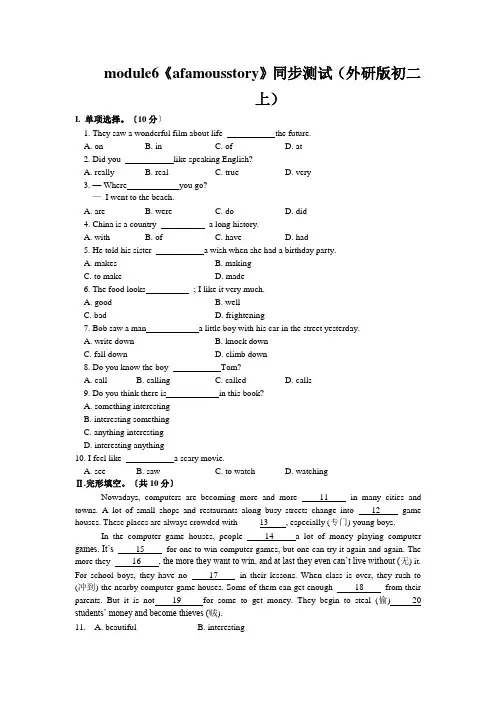
module6《afamousstory》同步测试(外研版初二上)I. 单项选择。
〔10分〕1. They saw a wonderful film about life the future.A. onB. inC. ofD. at2. Did you like speaking English?A. reallyB. realC. trueD. very3. — Where you go?—I went to the beach.A. areB. wereC. doD. did4. China is a country a long history.A. withB. ofC. haveD. had5. He told his sister a wish when she had a birthday party.A. makesB. makingC. to makeD. made6. The food looks ; I like it very much.A. goodB. wellC. badD. frightening7. Bob saw a man a little boy with his car in the street yesterday.A. write downB. knock downC. fall downD. climb down8. Do you know the boy Tom?A. callB. callingC. calledD. calls9. Do you think there is in this book?A. something interestingB. interesting somethingC. anything interestingD. interesting anything10. I feel like a scary movie.A. seeB. sawC. to watchD. watchingⅡ.完形填空。
外研版英语八年级上册Module 7《A famous story》主题阅读 综合能力提

外研版英语八年级上册Module 7《A famous story》主题阅读综合能力提主题阅读Ⅰ. 阅读理解AA man went to a fast-food restaurant to buy his lunch. “Hi,”a worker said.“May I help you?”“I'd like a hamburger, large chips, and a Coke,”the man said.“Anything else?”the worker asked.“No,”the man answered.”That's it.”“Is that for here or to go?”The worker asked.“To go,”the man said.The worker put the man's lunch in a bag. The man took out his money and paid for his lunch.“Thank you,”the worker said. “Have a nice day.”The man took the bag and walked to a park. He sat down and opened the bag. He was surprised. There was no hamburger in the bag. There were no chips. There was no Coke. There was only money in the ba g—a lot of money! The man counted the money. Two thousand dollars! Why was the money in the bag? Where was the man's lunch?The manager of the fast-food restaurant needed to go to the bank. He put two thousand dollars in an envelope (信封). He put the envelope in a bag and put the bag down. The worker gave the manager's bag to the man by mistake. So the manager had a hamburger, chips and a Coke, and the man had two thousand dollars. What should the man do?.()1. The man went to a restaurant to__________.A. b uy his lunchB. have a restC. sell drinksD. cook food()2.The man wanted to have his lunch __________.A. in a hotelB. in a shopC. in a restaurantD. in a park()3. When the man opened the bag, he found __________ in it.A. foodB. drinkC. moneyD. nothing()4._________ couldn't find his money.A. The manB. The managerC. The workerD. Nobody()5. Where was the man’s lunch?A. in the bankB. in the restaurantC. in the man’s handD. in an envelopeBHavin g Fun “Growing” and “Stealing”?“farm”on a piece of land and “grow”, “sell”or even “steal”vegetables,flowers. And fruit on the net. They can earn some e-money and buy more seeds, pets and even houses.Huang Lin interviewed some young people. Here are their opinions.Wang Hua:I don't quite understand why they are so mad about the childish game. Maybe they are just not confident enough to face the real world.Zhang Ming: I enjoy putting some bugs in my friends’ gardens and we’t.Li Ming: You know, people in the city are longing for(渴望) the life in the countryside. It reduces my work pressure(压力); besides, it gives me the exciting experience of being a thief.Zhou Xiao Jun: Well. It’s just a waste of time. Teenagers playing the game spend so many hours on it that they can not focus on (专注于)their study.( )6. According to the passage, peoplecan’t _______things in this game.A. growB. borrowC. stealD. sell( )7. Among the people Huang Lin interviewed, _______ likes the game while_______ dislikes the game.A. Li Ming; Zhang MingB. Zh ang Ming; Wang HuaC. Li Ming; Zhou Xiao JunD. Zhou Xiao Jun; Zhang Ming( )8. From Li Ming’s words, we can guessthat he’s most probably_________A. a studentB. an office workerC. a farmerD. a thief( )9. Which is NOT the reason why peoplelike the game?A. They are longing for country life.B. They can have fun with friends.C. The game can relax people and give them a new experience.D. They are confident enough to face the real world.( )10. here can you find this passage?A. In a car magazine.B. In an advertisement.C. In a newspaper.D. In a science book.Ⅱ. 完形填空An old man has a cat. The cat now is very old. She can’t run quickly, and she can’t bite1 .One day the old cat saw a mouse, she jumped and2 it. But she couldn’t bite it. So the mouse got out of her 3and ran away. The old man got very 4and beat the cat. The cat said to him. “Don’t beat your servant. Don’t be unkind to the5 .When they are young, they can dogood work.”()1. A. too B. also C. either()2. A. catch B. caught C. catches()3. A. mouth B. eyes C. hands()4. A. sad B. satisfied C. angry()5. A. young B. old C. sick综合能力提升Ⅰ. 单项选择()1. Tom _________ his space model at 7 pm yesterday.A. madeB. was makingC. makesD. will make()2. Two old men were playing chessthe tree at that time yesterday.A.onB. inC. underD. over()3. I _ ____ an adventure book last night and __ ___ the time.A. was reading; forgetsB. read; forgetC. was reading; forgetD. was reading; forgot()4. You must look left and right when you go the street.A. aroundB. throughC. acrossD. into()5. Lucy was walking down the street when suddenly a car accident________.A. will happenB. was happeningC. happenedD. happens()6. Please don’t leave until yourteacher back.A.()7. Mother when I got homeyesterday evening.A. is cookingB. was cookingC. cooksD. has cooked ()8. The teacher came in, asmile his face.A. with; onB. on; witC. with; inD. in; on()9. I don’t like the book because there isn’t in it.A. something newB. new somethingC. anything newD. new anything()10.——Thanks. I .A. doB. didC. will()11. The little boy his pencileverywhere,but he couldn’tit.A. was looking for; findB. was looking for; look forC. finds; findD. find; look for()12. Everyone should theirfuture and study hard.A. hear ofB. look afterC. write downD. think about ()13. —Could you lend me thebook Treasure Island?—________A. Yes,I could.B. Of course.C. How is it going?D. No,I couldn’t.()14. Sally was sleeping sheheard a knock at the door.A. whileB. afterC. whenD. since()15. —When did you leave theclassroom yesterday?—I _________ leave _________I finished my homework.A. didn’t; afterB. didn’t; untilC. don’t; beforeD. don’t; untilⅡ. 完形填空Once upon a time, a rich man wanted to make a trip (旅行) to another town. He tried not only to take things to sell but also to take money to 1 things with. He 2to take ten servants with him. They would3 the things to sell and the food to__4 on their trip. Before they started, a little boy ran up to _5_ and asked to6 with them.The rich man said to the little boy, “Well, 7 may go with us. 8 you are the smallest, the thinnest and the weakest of all my 9 . Y ou can’t carry a 10 load (担子). You must 11 the lightest one to carry.” The boy thanked his master and chose the biggest load to carry. That was bread.“You are 12 .” said his master, “That is the biggest and the heaviest one.” The boy said 13 and lifted the load gladly.On the trip they walked for days and at last they got to the town. All the servants were tired 14 the little servant. Do you know 15 ? Most of the bread was eaten during the trip and a little was left when they arrived at the town.( )1. A. eat B. buyC. changeD. get( )2. A. decided B. likedC. hopedD. tried( )3. A. take B. bringC. carryD. borrow( )4. A. cook B. eatC. buyD. drink( )5. A. them B. the servantsC. the roadD. the rich man( )6. A. stop B. StayC. goD. talk( )7. A. you B. h eC. ID. they( )8. A. Since B. IfC. BecauseD. But( )9. A. family B. guestsC. servantsD. things( )10. A. heavy B. lightC. smallD. difficult( )11. A. eat B. chooseC. pick upD. understand( )12. A. brave B. rightC. cleverD. foolish( )13. A. sorry B. nothingC. angrilyD. goodbye( )14. A. besides B. ofC. exceptD. with( )15. A. who B. himC. thatD. whyⅢ. 阅读理解A man hated his wife’s cat and decided to throw it away.One day, he drove it over one mile from his home and left it in a park. But when he got home, he saw that his wife was playing with the cat.The next day he drove the cat about three miles away. He put the cat out of the car and went home. Driving back his driveway(私人车道), the cat was there already.The man keep taking the cat further and further away and the cat would always get home before him. At last he decided to drive more than ten miles away. He turned right, then left, past a bridge, then right again and another right until he thought he was far enough from home and left the cat there.Hours later the man was still driving home. He was lost! He called home and asked his wife, “Jen, is the cat there?”“Yes,” his wife answered, “why do you ask?”The man answered, “Put it on the phone. I’m lost and need directions.”( )1. The first time the man drove out, he_______.A. sold the catB. took the cat homeC. left the cat in the park( )2. Which of the following is TRUE?A. The man liked his wife’s cat and often played with it.B. Every time the man threw the cat away, it came home earlier than the man.C. The last time the man thre w the cat away, it lost its way and didn’( )3. Why did the man call home?A. Because he was lost.B. Because he missed his wife very much.C. Because he wanted to know if the cat was at home.( )4. How far away did the man take the cat the last time?A. Over 1 mile.B. About 3 miles.C. More than 10 miles.Ⅳ. 用括号中所给单词的适当形式填空。
人教版八年级英语上册Unit6 SectionA知识点练习

Section A一、单项选择1.Mina is________eighteen-year-old girl. She is from China.A. aB. anC. the2.---What does your aunt do?----She is a(n)________and she often flies the plane to different countries.A.doctorB. pilotC. engineerD. scientist3.What is John going to be when he_______up?A.growB. grewC. growsD. is going to grow4.As the saying goes, “One is never too old to learn.” So, everyoneshould________studying.A.get onB. keep onC. put onD. turn onrry hopes_______his English, so he keeps practicing it every day.A.to solveB. solvingC. to improveD. improving6. There________great changes in Tianshui in next ten years.A. areB. wereC. will beD. are going to have7. Neither the headmaster nor the teachers________take a vacation next week.A. were going toB. is going toC. was going toD. are going to8. Do you think________a meeting tomorrow afternoon?A. is thereB. there isC. there wasD. there is going to be二、按要求改写句子1.The boy wants to be a pilot when he grows up.(对画线部分提问)________ ______ the boy want_______ ________when he grows up?2.My brother is good at writing stories.(改为同义句)My brother________ _____ ________writing stories.3.I’m going to live in Shanghai.(对句子画线部分提问)________ _____you going to live?4.I am going to make some dumplings tomorrow morning.(改为一般疑问句)_______you going to make______dumplings tomorrow morning?三、根据汉语意思完成句子1.我打算长大后当一名飞行员。
[全]人教版八年级英语上Unit6全考点总结+练习含答案
人教版八年级英语上Unit6全考点总结+精练含答案词汇全解be able tobe able to意为"能够做某事",可用于各种时态,有人称、时态和数的变化。
Will you be able to come to my birthday party tomorrow?易混辨析be able to/ can( 1 ) be able to 有人称、时态和数的变化,可用于现在、将来、过去等多种时态。
表示"通过努力成功地做成某事",要用be able to, 而不能用can。
He is able to catch the early bus.( 2 ) can无人称和数的变化,只能用于现在时和过去时。
can可以表示猜测,be able to 则不可。
That can't be Lily---- She's in Henan.promisepromise用作动词,构成如下短语:( 1 ) promise sb. sth. = promise sth. to sb. 许诺给某人某物I promised him a nice gift.( 2 ) promise ( sb. ) to do sth. 答应(某人)去做某事He promised ( me ) to help me with my English.( 3 ) promise + that从句He promised that he would study hard.归纳拓展:promise可以用作名词,构成短语如下:make a promise 约定;许诺keep one's promise 遵守诺言break one's promise 不守诺言;违约at the beginning ofat the beginning of 表示"在.......之初",其后通常接表示时间、事件或其他意义的名词,其反义词组为at the end of。
外研版八年级英语上册课件 Module 6 A famous story
Now listen again and check.
Listen and answer:
1. Why was the rabbit running in the story?
2. Where was the rabbit going?
Find words and expressions in the box for.
Look at the following picture and tell us the story.
Alice’s Adventures in Wonderland
One day Alice was sitting by the river with a book, but she wasn’t reading it. Suddenly a white rabbit ran past her. It was looking at its watch. Because it was going to a tea party. Then Alice fell down a rabbit hole and went into their strange world.
Look for was /were doing sentences in the passage.
1. Alice was getting very tired.
2. She was sitting with her sister by the river and her sister was reading a book.
Listen and write notes about what the people in Activity 2 were doing.
the Mad Hatter and the March Hare
【初二英语试题精选】Module 6 A famous story练习题及答案
Miss Nobody
Author Tomek Tryzna
Main idea At the age of fifteen, Marysia moves with her parents to the nearest big city Then she meets two girls, Kasia and Eva, and they begin to teach her the secrets of life
A which to do B what to do
C how to do D why to do
( )10 When Miss Green began to the story, the children stopped and became quiet
A speak; telling B say; speaking
( )6 —Look, what’s _____ the tree?
—A bird It is _____ there
A on; singing B in; singing
C from; singing D to; singing
( )7 You must look around when you go the street
Price 330 yuan
31 Who is the author of the book Little Bull?
A Ellen James B Barbara Calamari
C talk; saying D tell; talking
( )11 —Granny Let me help you to ____ the box
—Thank you
矿产
矿产资源开发利用方案编写内容要求及审查大纲
矿产资源开发利用方案编写内容要求及《矿产资源开发利用方案》审查大纲一、概述
㈠矿区位置、隶属关系和企业性质。
如为改扩建矿山, 应说明矿山现状、
特点及存在的主要问题。
㈡编制依据
(1简述项目前期工作进展情况及与有关方面对项目的意向性协议情况。
(2 列出开发利用方案编制所依据的主要基础性资料的名称。
如经储量管理部门认定的矿区地质勘探报告、选矿试验报告、加工利用试验报告、工程地质初评资料、矿区水文资料和供水资料等。
对改、扩建矿山应有生产实际资料, 如矿山总平面现状图、矿床开拓系统图、采场现状图和主要采选设备清单等。
二、矿产品需求现状和预测
㈠该矿产在国内需求情况和市场供应情况
1、矿产品现状及加工利用趋向。
2、国内近、远期的需求量及主要销向预测。
㈡产品价格分析
1、国内矿产品价格现状。
2、矿产品价格稳定性及变化趋势。
三、矿产资源概况
㈠矿区总体概况
1、矿区总体规划情况。
2、矿区矿产资源概况。
3、该设计与矿区总体开发的关系。
㈡该设计项目的资源概况
1、矿床地质及构造特征。
2、矿床开采技术条件及水文地质条件。