
牛津译林版八年级英语上册Unit 7 Reading课件
a
d. brown leaves fall on the summer ground
farmers harvest crop
Amy’s cousin Shirley wrote down her conversation with Amy about the seasons, but she made six mistakes in Amy’s answers. Help her underline the mistakes and write the correct word above each one.
Shirley: Why do we seldom see birds in
winter, Amy?
Amy: Because most of them fly away to a
warm and windy place. sunny
Shirley: Can you describe the weather in
花一样美丽,感谢你的阅读。 5、一寸光阴一寸金,寸金难买寸光阴。Sunday, July 5, 2020July 20Sunday, July 5, 20207/5/2020 6、路遥知马力日久见人心。2时47分2时47分5-Jul-207.5.2020 7、山不在高,有仙则灵。20.7.520.7.520.7.5。2020年7月5日星期日二〇二〇年七月五日 8、有花堪折直须折,莫待无花空折枝。14:4714:47:527.5.2020Sunday, July 5, 2020
2. When trees and flowers forget to grow. forget to do sth. 忘记做某事 forget doing sth. 忘记做过某事 e.g. Don’t forget to turn off the light. 别忘了关灯。
I forgot reading the book. 我忘记了以前读过这本书。
根据句意和首字母提示补全单词,使句 子完整、通顺。
1. There are many bees and b_u_t_te_r_f_li_e_s_ among flowers.
2. In summer, there are a lot of s_h_o_w_e_r_s_.
3. Those sweet m_em__o_r_i_es__ of summer days, are all about quiet s_tr_e_a_m__s and trees and shade.
Millie is drawing pictures of the four seasons. Help her write the correct seasons in the blanks. Then match each season with the descriptions in the poem. Write the correct letters in the boxes.
cream.
lazy
Shirley: How does the weather change
when autumn comes?
Amy: The leaves turn green and the temperature rises quicbkrlyo.wn
drops
Millie is writing about seasons of the year. Help her complete her article with the words in the poem on page 82.
4. The autumn leaves fall in p_il_e_s__ upon the ground.
5. The days are shorter and the t_em__p_e_r_a_t_u_r_e_ drops in autumn.
Which season do you like best? Why ?
c
a. quiet streams, trees spring and shade
eat ice cream源自db. full of snow
autumn birds fly far away
c. a perfect time to fly a
b
kite/bees and butterflies
winter play among flowers
2、书是人类进步的阶梯。二〇二〇年七月五日2020年7月5日星期日
这醉人芬芳的季节,愿你生活像春天一样阳光,心情像桃 3、会当凌绝顶,一览众山小。14:477.5.202014:477.5.202014:4714:47:527.5.202014:477.5.2020 4、纸上得来终觉浅,绝知此事要躬行。7.5.20207.5.202014:4714:4714:47:5214:47:52
5. Fall in piles upon the ground. 一堆堆地掉在地面上。 pile n. 堆 e.g. We put the books in piles on the floor. 我们把书在地板上堆起来。
10. Farmers work to harvest crops. harvest crops 收获庄稼
spring?
windy
Amy: Yes. It’s cloudy and bright, and in
April,
showers
the wind may come suddenly.
Shirley: How do people feel on a hot summer
Amy: They feel busy and like to eat ice
eat _i_c_e_c_r_e_a_m_. They like to play by quiet _s_tr_e_a_m__s or under the _s_h_a_d_e__ of trees. When autumn comes, the _l_e_a_v_e_s_ turn brown and ___fa_l_l___ into piles upon the ground. Farmers are busy harvesting __c_ro_p__s _. Soon it will be a new year once again.
spring autumn
summer winter
butterfly n. 蝴蝶
shower n. 阵雨, 阵雪
stream n. 小河, 溪流
shade n. 阴凉处, 树荫处
harvest
crop
vt./vi. 收割, 收获 n. 庄稼, 收成
temperature n. 温度
1. Recite this poem. 2. Remember the new words and
expressions in this lesson.
亲爱的读者:
春去燕归来,新桃换旧符。在那桃花盛开的地方,在 1、三人行,必有我师。20.7.57.5.202014:4714:47:52Jul-2014:47
Seasons of the year In winter, white __s_n_o_w___ covers the whole earth. It is often very cold and
the _te_m__p_e_r_a_tu_r_e_ can drop below zero. The weather is nice in spring. A windy day is _p_e_r_f_e_ct__ for flying kite. __B_e_e_s_ and butterflies play among flowers. Then they _h_i_d_e_ away when the April showers come. People often have sweet _m__e_m_o_r_i_e_s_ of summer days. They go swimming and
3. The days of spring are windy and bright. the days of spring / summer / autumn / winter 春天/夏天/秋天/冬天的日子 e.g. The days of summer are sunny.
4. Those sweet memories of summer days, sweet memories of … ……的甜蜜的记忆 e.g. She has many sweet memories from her childhood. 她的童年有许多美好的回忆。
1. Winter days are full of snow. be full of = be filled with 充满
e.g. The library are full of students. = The library are filled with students. 图书馆里学生满满的。
drop vt./vi.下降, 落下
rise vi. 上升, 升起
Some of the words in a poem often rhyme. Help Millie complete the sentences .
1. Snow rhymes with __g_r_o_w_____. 2. Away rhymes with __d_a_y______. 3. Bright rhymes with __k_i_t_e____.
4. Flowers rhymes with _s_h_o_w_e_r_s_.
5. Days rhymes with __s_h_a_d_e__. 6. Pool rhymes with ___c_o_o_l___. 7. Brown rhymes with _g_r_o_u_n_d_. 8. Crops rhymes with __d_r_o_p_s__. 9. Begin rhymes with __a_g_a_in___.
牛津深圳八年级英语上册unit 7 Reading 课件

❖ b. Because they want to help students improve their memory.
❖3 What way does Henry’s article mention to help students remember something?
❖ Robin: I know you’re very busy, but it’s __w_o_r_t_h___the time. If you want to practise your English , you should go.
❖Tony: OK. I will see you there.
❖5. If you wish to get a good job, there are many important ___s_te_p_s_ you should take. (things that happen in a process) ( line 23)
❖C2 Complete the conversations below with the words from the box.
❖1 Young people usually have better memories than old people T/ F
❖2. When we make new memories,
we lose old ones . T / F
3. We can remember pictures better than words. T / F
Notes
❖1. They have written the short articles below to help students improve their memory.
牛津译林版八年级英语上册Unit 7 Reading (I) 示范课教学设计

本节课的语篇内容为介绍一年中的四个季节,形式为诗歌。按照冬春夏秋的顺序进行描写,通过描写一年四季的景色以及具有鲜明季节特征的活动,呈现出诗歌的意境之美;通过使用每两行句末相同的韵脚,展示出诗歌的音韵之美;通过运用拟人手法令诗歌语言形象生动,体现出诗歌的行文之美。
三、学情分析
学生们对与自然和美有关的话题比较感兴趣。通过前一课时的学习,他们已经知道如何描述天气、季节和一些相关活动。然而,他们对于如何通过英文诗歌描述四季的特征及变化等方面的信息,存在一定的困难。
活动层次
学习理解之感知与注意、获取与梳理
效果评价
观察学生对图片的描述及回答情况,了解学生已知及对新词的掌握情况。
教学活动
3.Studentslookand predict.
活动层次
学习理解之感知与注意
效果评价
观察学生反馈,了解学生根据已知信息进行读前预测的能力。
环节设计意图:
通过看图说话活动,帮助学生熟悉话题。通过预测活动,进一步帮助学生了解话题,培养学生读前预测的意识和习惯,有效降低阅读难度。
四、教学目标
通过本课时的学习,学生能够:
1.读懂描写四季特征及变化的英语诗歌。
2.识别英文诗歌中的押韵及拟人手法。
3.描述不同季节的气候及特征。
4.在诗歌中感受四季之美。
五、教学重难点
【重点】
1.读懂描写四季特征及变化的英语诗歌。
2.识别英文诗歌中的押韵及拟人手法。
【难点】
1.读懂描写四季特征及变化的英语诗歌。
环节五:创设情境,运用本课语言知识。(9 mins)
教师创设语境,引导学生灵活运用本课学到的内容进行口语表达。
教学活动
15.Students have a discussion and make notes.
牛津译林版英语八年级上册《Unit 7 Seasons Reading 1 A poem about

牛津译林版英语八年级上册《Unit 7 Seasons Reading 1 A poem about seasons》教学设计6一. 教材分析本课选自牛津译林版英语八年级上册《Unit 7 Seasons Reading 1 A poem about seasons》,主要介绍四季的特点。
文章以诗歌的形式,生动描绘了春夏秋冬的景色和活动,让学生在欣赏诗歌的同时,了解四季的变化。
通过本课的学习,学生能够提高阅读理解能力,学习描述四季的词汇和句子结构,并能运用所学知识进行表达。
二. 学情分析八年级的学生已经具备一定的英语基础,对于四季的概念也有清晰的认识。
但学生在描述四季时,可能会缺乏具体的词汇和句式。
因此,在教学过程中,教师需要帮助学生拓展四季相关的词汇,并提供适当的句式结构,以便学生能够更好地表达自己的观点。
三. 教学目标1.知识目标:–能够理解诗歌中描述四季的词汇和句子结构。
–能够运用所学知识,描述四季的特点。
2.能力目标:–提高学生的阅读理解能力。
–提高学生的口语表达和写作能力。
3.情感目标:–培养学生对大自然的热爱,增强环保意识。
四. 教学重难点•掌握描述四季的词汇和句子结构。
•能够阅读并理解诗歌内容。
•运用所学知识,进行口语表达和写作。
五. 教学方法1.情境教学法:通过设置四季的场景,让学生在真实的情境中学习词汇和句子。
2.互动式教学法:引导学生进行小组讨论,提高学生的参与度和积极性。
3.任务型教学法:通过完成具体任务,培养学生运用英语进行交流的能力。
六. 教学准备1.教师准备:–熟悉教材内容,明确教学目标。
–准备相关的四季图片、视频等教学资源。
2.学生准备:–预习教材内容,了解四季的基本概念。
七. 教学过程1.导入(5分钟)教师通过展示四季的图片或视频,引导学生谈论四季的变化,激发学生的学习兴趣。
2.呈现(10分钟)教师带领学生一起阅读诗歌,引导学生关注描述四季的词汇和句子结构。
在阅读过程中,教师适时提问,帮助学生理解诗歌内容。
牛津译林版八年级英语上册Unit 7 Seasons Reading I (共25张PPT)
Winter days are full of snow, …
be full of 充满 Champagne (香槟酒) is full of bubbles (气泡). 香槟酒有很多气泡。
He must check his work more carefully — it’s full of mistakes. 他检查工作时必须要再仔细一些——到 处是错。
II. 完成句子。
1. 这个地区布满了警察。 The area w__a_s_f_u_l_l _o_f police.
2. 别忘了喂猫。 D__o_n_'_t _fo_r_g_e_t_t_o_f_e_e_d_ the cat.
3. 叶子一到秋天就黄了。 Leaves _tu__rn__b_r_o_w_n__i_n_a_u_t_u_m__n_.
n. 转向;拐弯
You can't do a right-hand turn here. 你不能在这里右转弯。 n.(情况的)变化
The situation took a new turn over the
weekend. 这一情况在周末时发生了新的变化。 n.(多人依次)轮到的机会
Tonight it's my turn to cook. 今晚轮到我做饭。
•
11、只有让学生不把全部时间都用在学习上,而留下许多自由支配的时间,他才能顺利地学习……(这)是教育过程的逻辑。21.8.1401:37:0501:37Aug-2114-Aug-21
•
12、要记住,你不仅是教课的教师,也是学生的教育者,生活的导师和道德的引路人。01:37:0501:37:0501:37Saturday, August 14, 2021
沪教牛津版八年级英语上册课件Unit 7 Reading

spell letter
improve one’s memory 提高某人的
记忆力
water cycle
水循环
have trouble doing sth 做……有困难
for example
例如
Do you always remember to turn off the lights before you leave the classroom?
C2 Complete the conversation below with the words from the box.
list silly spelling trouble worth
1. Emily: Shall we walk to the park tomorrow? Flora: Don’t be _si_ll_y_. It’s too far from here. Let’s take a bus.
3. Tony: I can’t go to English corner tonight. I have a lot of homework to do.
Robin: I know you’re very busy, but it’s _w__o_r_th__ the time. If you want to practise your English, you should go.
A2 How much do you know about human memory? (P 98)
1. Young people usually have better memory than old people.
2. When we make new memories, we lose old ones.
译林版英语八年级上册Unit7reading1说课稿
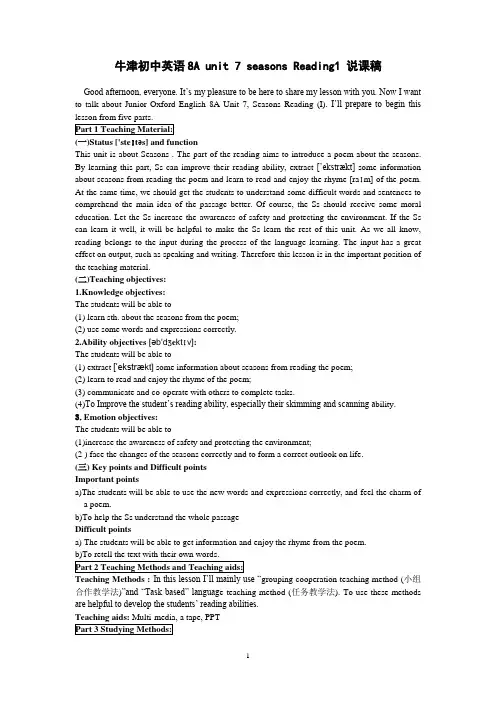
牛津初中英语8A unit 7 seasons Reading1 说课稿Good afternoon, everyone. It’s my pleasure to be here to share my lesson with you. Now I want to talk about Junior Oxford English 8A Unit 7, Seasons Reading (I). I’ll prepare to begin thisThis unit is about Seasons . The part of the reading aims to introduce a poem about the seasons. By learning this part, Ss can improve their reading ability, extract [’ekstrækt] some information about seasons from reading the poem and learn to read and enjoy the rhyme [raɪm] of the poem. At the same time, we should get the students to understand some difficult words and sentences to comprehend the main idea of the passage better. Of course, the Ss should receive some moral education. Let the Ss increase the awareness of safety and protecting the environment. If the Ss can learn it well, it will be helpful to make the Ss learn the rest of this unit. As we all know, reading belongs to the input during the process of the language learning. The input has a great effect on output, such as speaking and writing. Therefore this lesson is in the important position of the teaching material.(二)Teaching objectives:1.Knowledge objectives:The students will be able to(1) learn sth. about the seasons from the poem;(2) use some words and expressions correctly.2.Ability objectives [əb'dʒe ktɪv]:The students will be able to(1) extract [’ekstrækt] some information about seasons from reading the poem;(2) learn to read and enjoy the rhyme of the poem;(3) communicate and co-operate with others to complete tasks.(4)To Improve the student’s reading ability, especially their skimming and scanning a bility.3.Emotion objectives:The students will be able to(1)increase the awareness of safety and protecting the environment;(2 ) face the changes of the seasons correctly and to form a correct outlook on life.(三)Key points and Difficult pointsImportant pointsa)The students will be able to use the new words and expressions correctly, and feel the charm ofa poem.b)To help the Ss understand the whole passageDifficult pointsa) The students will be able to get information and enjoy the rhyme from the poem.Teaching Methods :In this lesson I’ll mainly use “grouping cooperation teaching method (小组合作教学法)”and “Task-based” languag e teaching method (任务教学法). To use these methods are helpful to develop the students’ reading abilities.Many students are lack of the cultural background of the foreign countries. Some students are not active in class, and some students don’t like English. therefore, I’ll have Ss study in a relaxed atmosphere and teach the Ss how to be successful language learners. I’ll use different teaching methods to arouse students’ learning emotion. Let S s get the knowledge actively by probe [prəʊb]Step1: Lead-in1. Enjoy a song called “ How is the weather”.2. Revise different weather.Step2: Presentation1. Present some pictures about different seasons and help the students learn some new words and phrases.2. Read the new words and pay attention to the pronunciationsStep3: Pre-reading (Skimming\Scanning)(快速浏览全文,回答问题, 重点理解文章大意,学生默读,独立思考)A: Answer some questions.(1. Why do the birds fly away in winter ?(2. Which season is the perfect time to fly kites?(3. How does the weather change when autumn comes?(4. What is the main idea of this passage?A. A poem about the seasons of the yearB. A perfect time to fly a kiteC. A warm and sunny dayD. Farms work to harvest crops(5.What does the phrase “April showers ” mean in paragraph2?A. 四月的阵雨B. 四月洗澡C. 四月的淋雨D. 四月下雨B: Listen and read ,Tell what each paragraph is about, try to match them.Step4:While-reading (细读文章各段,回答问题。
牛津上海版英语八年级上册课件:Unit 7 Nobody wins (II) Reading (共17张PPT)
Circle the differences in the pictures
Picture 1: Para 1 – Para 5 Picture 2: Para 6 – Para 10 Picture 3: Para 11 – Para 12 Picture 4: Para 13 – Para 14
牛津译林版八年级英语上册Unit 7 Seasons Comic strip示范公开课教学课件
Name
Favourite season
Weather
Activities
…
Report
Summary
Homework
1. Ask your friends or family about their favourite seasons and make notes.2. Preview Reading.
Listen and answer
If you answer about your favourite seasons, you can say:
Read and circle
Amy: Which season do you like best, Simon?Simon: I like autumn. Amy: Why do you like it?Simon: Because it’s always sunny. It’s the best time to play football outside. Which is your favourite season? Amy: I like summer.Simon: Why? Summer is hot.Amy: In summer, I can go swimming and enjoy ice cream every day!
Watch and answer
What’s the weather like today?
Look and say
What’s the weather like?/How is the weather?
Think and talk
What season is it?
spring
牛津译林版八年级上册英语Unit7Reading说课稿
3.写作任务:编写一篇关于节日的短文,要求运用所学词汇和语法知识。
4.阅读理解:设计相关练习,让学生进一步理解课文内容,提高阅读能力。
(四)总结反馈
在总结反馈阶段,我将采取以下措施:
1.让学生自我评价:回顾本节课所学内容,让学生自我评估在词汇、语法、阅读等方面的掌握情况。
-使用不同颜色粉笔,突出重点和层次;
-在课后及时总结,确保板书内容的完整性和系统性。
(二)教学反思
在教学过程中,我预见到以下可能的问题或挑战:
1.部分学生对一般现在时的掌握可能不够熟练;
2.学生在阅读理解方面可能存在困难;
3.课堂互动中可能出现部分学生参与度不高的情况。
应对措施:
1.对于语法掌握不足的学生,我将提供更多例句和练习,加强个别辅导;
2.同伴互评:组织学生相互评价,提出建议和意见,促进相互学习。
3.教师评价:针对学生的表现,给予积极的反馈和鼓励,指出不足之处,并提出改进建议。
(五)作业布置
课后作业布置如下:
1.复习本节课所学词汇和语法,完成课后练习。
2.撰写一篇关于自己最喜欢的节日的短文,要求运用一般现在时。
3.预习下一节课的内容,提前了解相关知识点。
过程与方法目标:1.通过小组合作,培养学生的合作意识;2.提高学生的阅读理解能力,培养学生运用阅读策略的能力;3.培养学生独立思考、总结归纳的能力。
情感态度与价值观目标:1.培养学生对英语学习的兴趣,提高学习积极性;2.增进学生对世界各国文化的了解,培养跨文化交际意识;3.培养学生的爱国情怀,弘扬中华优秀传统文化。
二、学情分析导
(一)学生特点
牛津译林版英语八年级上册Unit7Reading1优秀教学案例
3.语法讲解:讲解文章中的一般过去时和现在完成时的运用,让学生掌握时态的用法。
(三)学生小组讨论
1.设计讨论问题:提出讨论问题,如“地震发生时我们应该如何应对?”“你认为母爱是什么?”等,引导学生在小组内进行讨论。
4.培养批判性思维:通过设计问题引导学生深入思考,鼓励学生提出问题,培养他们的批判性思维和独立思考能力。
5.情感态度与价值观的培养:通过学习地震发生时的自救方法,提高学生的安全意识,珍爱生命。同时,让学生感受母爱的伟大,培养他们的感恩情怀,学会关爱他人。
这些亮点体现了本案例在教学内容、教学方法、学生参与度和情感态度与价值观培养方面的优势,有助于提高学生的学习效果和综合语言运用能力。同时,本案例注重个体差异,给予每个学生充分的关注和指导,确保他们在课堂上能够充分参与,提高他们的综合语言运用能力。
牛津译林版英语八年级上册Unit7Reading1优秀教学案例
一、案例背景
本案例背景以牛津译林版英语八年级上册Unit7 Reading 1《The Taiwan earthquake》为教学内容。文章主要讲述2002年台湾地区发生地震时,一位母亲为了保护自己的女儿与死神搏斗,展现母爱的伟大。通过本节课的学习,让学生掌握地震发生时的自救方法,同时感受母爱的力量,培养学生的感恩情怀。
四、教学内容与过程
(一)导入新课
1.开场白:以地震发生时的真实新闻报道作为导入,引发学生的兴趣和关注。
2.引导学生思考:提问学生对地震的了解和经历,激发他们的思考和分享欲望。
3.展示课文标题:揭示本节课的主题《The Taiwan earthquake》,让学生对课文内容产生好奇心。