
人教版九年级英语unit13课时1教学设计
教学内容 Section A( 1a—2c) 课时 Period 1 教学对象 九年级学生 提供者 一、教材内容分析 本节课是九年级英语Unit13的第一课时。本课主要通过一定的听说训练复习现在进行时、现在完成时、被动语态、情态动词和used to的用法,使学生能够掌握有关环境污染词汇、能够描述目前环境现状并针对环境问题提出自己的观点和建议。同时通过谈论环境污染,让学生了解保护环境的重要性,增强他们保护环境的意识,使他们能够关注自己日常行为并投入到保护环境的行动中。【 二、教学目标(知识,技能,情感态度与价值观) (一)知识目标: 1) 学习掌握下列词汇和词组: litter,bottom,fisherman,coal,ugly,used to,play a part in 等。 2)复习掌握现在进行时、现在完成时、被动语态、情态动词和used to的用法。 3)能够用简单的句子描述目前环境现状并针对环境问题提出自己的观点和建议。 (二)能力目标: 1.训练学生说的能力。 2.训练学生的听力技能。 (三)情感态度: 通过谈论环境污染,让学生了解保护环境的重要性,增强他们保护环境的意识,使他们能够关注自己日常行为并投入到保护环境的行动中。 三、重点难点 重点:1) 学习掌握下列词汇和词组,达到熟练运用的目标。 2)复习掌握现在进行时、现在完成时、被动语态、情态动词和used to的用法。 3)能够用简单的句子描述目前环境现状并针对环境问题提出自己的观点和建议。 难点:1)复习掌握现在进行时、现在完成时、被动语态、情态动词和used to的用法。 2)能够用简单的句子描述目前环境现状并针对环境问题提出自己的观点和建议。 四、教法选择与学法指导 英语教学要紧密联系学生的生活实际,采用“任务型”教学模式让学生在教师的指导下,通过感知、体验、实践、参与和合作等方式,实现任务的目标,感受成功。同时,教师在教学过程中通过丰富的、动态的英语资源,创设情境,训练学生用英语进行交际的能力。 五.资源准备 多媒体课件、教室及相关教学资源 六、教学过程 教学过程 教师活动 学生活动 设计意图 Task 1 Lead-in (2minutes)
1.Play the video.And ask: What did the little girl see? What did the little girl hear? 2.After watching,lead students to answer the two questions. (She saw more cars and much black smoke in the air.And she heard much noise.)Then lead to this class. 1.Students watch the videos. 2.Try to answer the questions. 通过观看视频并回答问题,引出地球环境污染问题,直接导入新课。
Task2 Presentation (11minutes) 1.Ask:What kinds of pollution do you know? And ask students to try answer. Then teacher show : air pollution, water pollution, noise pollution, land pollution. 2.Show some pictures about different kinds of pollution. Point to each picture and ask: What’s the pollution? What caused the…pollution? How should it be solved? And teach the new words. 3.Lead students to look at each picture and try to answer the questions. Then ask students to master new words and the sentences. 1. Students to try answer: air pollution, water pollution, noise pollution, land pollution. 2. Students look at each picture and try to answer the questions. 3. Students read andmaster the sentences. 首先通过学生试者回答他们知道的污染类型,再通过展示关于不同种类污染的图片,并让学生回答问题,并在句子当中学习新单词,同时使学生初步了解不同种类的环境污染问题及解决办法,直观易懂。并为后面完成听力和其他练习奠定基础。
Task 3 1a (2minutes) 1.Ask students to finish 1a. 2.Check the answers. 1.Students finish 1a . 2.Students read the words. 通过单词归类,检测学生对环境污染种类的掌握情况。
Task 4 Listening 1.1b Teach students to read“bottom”“fishermenStudents listen and finish 通过听力练习加强学生对本节课重点1b,2a,2b (12minutes) ”Ask students to read the sentences by themselves in 1b. Then play the tapes twice. (告诉学生在听第一遍时仅仅写出每个单词的前两个字母,第二遍时补充完整) 2. 2a Play the tapes. Check the answers. 3.2b Teach “ugly”“turn…into”. And play the tapes. Then check the answers. 1b,2a,2b. 内容的训练和掌握,并在听力过程中渗透一定的听力技巧,提高学生的听力技能。
Task 5 Pairwork (8minutes) 1.Give a modal to student.Ask them to have a summary about “used to”. 2.Ask students to read the modal by themselve. 3.Ask students to make the conversation like the modal in pairs. 4.Ask students to act out. 1. Students have a summary about “used to”. 2.Students read the modal together. 3.Make the conversation like the modal in pairs. 4.Two pairs act out. 学生通过利用听力内容进行对话,加强对听力内容的理解,同时进一步练习本节课的重点内容,提高学生的口语表达能力。
Task 6 Help finish the poster. (6minutes) 1.Show the poster to students.And tell students :This is a poster about saving our earth.But it is not perfect.You have to add something to finish it. 2.Ask students to read the poster together. 3.Explain “play a part in”and some sentences that 1. Read the poster together. 2. Each student can only say one sentence.
这是关于倡导大家拯救的地球的海报,在海报当中教师补充了一些其他的关于如何拯救地球的句子,但是它又是不够完整的,要求学生利用本节课所学的或者是自己认为可以拯救地球的句students may can not understand. 4.Ask students to add something to finish it.(Each student can only say one sentence.) 子来完成它。这一环节是对课堂内容的拓展,同时让学生每人说出 一个句子,降低难度,且给多数学生提供说的机会,使他们积极参与到活动中来。
Task 7 Exercises. (2minutes) Show the exercises to students and check the answers. Students finish the exercises. 这个环节有2道习题。填空题检测学生对本节课的单词掌握情况。选择题训练和检测学生对各种时态和重点词组的掌握。
Task 8 Summary (1minutes) 1.Ask some students to have a summary . 2.Teacher add some key points. Students have a summary . 学生参与总结,加深学生记忆,同时再一次提出本节课的重点内容,明确本节课的重点内容。
Task 8 Homework And emotional education (1minute) 1.Show the homework to students. 2. Tell students:We only have one earth!Let’s play a part in loving and saving it! Students finish it after class. 作业一:记住本节课的新单词和重点词组。作业二:写出5个关于自己家乡环境污染的句子并给出解决办法。进一步巩固本节课的重点内容。最后对学生进行情感教育,增强他们保护环境的意识,使他们能够关注自己日常行为并投入到保护环境的行动中。 教学流程 视频导入——呈现学习——合作交流——巩固提高——归纳小节——情感教育。
人教版九年级英语unit13教学评一体化教学设计
人教版九年级英语unit13教学评一体化教学设计Integrated teaching design for Unit 13 of the 9th grade English textbook in the People's Education PressIntroduction:Unit 13 of the 9th grade English textbook in the People's Education Press focuses on the theme of technology and the future. It covers topics such as artificial intelligence, robot technology, and the impact of technology on society. In order to comprehensively teach the content of this unit, an integrated teaching approach is needed to maximize student understanding and engagement.Lesson 1: Introduction to the unitObjective:- To introduce students to the main themes and topics of Unit 13- To engage students in a discussion about the impact of technology on societyActivities:1. Start the lesson by showing a short video clip about artificial intelligence and robot technology.2. Lead a class discussion on the benefits and drawbacks of technological advancements.3. Have students work in pairs to discuss their opinions on whether robots will replace humans in the future.4. Assign homework reading on the history of artificial intelligence.Lesson 2: Reading comprehensionObjective:- To improve students' reading comprehension skills- To enhance their understanding of the text on artificial intelligenceActivities:1. Begin the lesson with a vocabulary review of key terms related to artificial intelligence.2. Have students read the text on artificial intelligence in groups and answer comprehension questions.3. Conduct a class discussion on the ethical implications of using artificial intelligence.4. Assign a writing task for homework on the advantages and disadvantages of artificial intelligence.Lesson 3: Speaking and listening practiceObjective:- To improve students' speaking and listening skills- To provide opportunities for students to practice using technology-related vocabulary in contextActivities:1. Start the lesson by playing a short audio clip about technological advancements.2. Divide students into pairs and have them discuss the impact of technology on their daily lives.3. Conduct a role-playing activity where students pretend to be a robot and a human having a conversation.4. Assign a speaking task for homework on the future of technology.Lesson 4: Writing taskObjective:- To develop students' writing skills- To encourage students to express their opinions on a technology-related topicActivities:1. Begin the lesson with a writing prompt on the future of robotics.2. Have students brainstorm ideas and outline their arguments before writing a persuasive essay.3. Provide feedback on students' writing and encourage them to revise and improve their essays.4. Conduct a peer review session where students exchange feedback on each other's essays.Conclusion:By implementing an integrated teaching approach for Unit 13 of the 9th grade English textbook in the People's Education Press, students will have a comprehensive understanding of the themes and topics covered in the unit. Through a variety of activities focused on reading, speaking, listening, and writing, students will improve their language skills and critical thinking abilities. This integrated teaching design will not only enhance student engagement but also prepare them for future challenges in a technology-driven world.。
人教英语九年级Unit13SectionB(1a~1e)教学设计
(四)课堂练习
1.教师设计不同类型的练习题,如填空、选择、改错等,让学生巩固所学知识。
2.学生进行小组合作,完成练习题,教师巡回指导,解答学生疑问。
3.对练习结果进行反馈,针对学生的错误进行讲解,巩固提高学生的英语运用能力。
5.通过课后作业,巩固所学知识,提高学生的实际运用能力。
(三)情感态度与价值观
在本章节的学习过程中,学生将:
1.培养对世界不同地区文化的兴趣和尊重,增强国际视野。
2.了解人类在科技、文化、艺术等方面的伟大成就,培养学生的自豪感和自信心。
3.培养学生的团队合作精神,学会倾听、尊重他人意见。
4.培养学生积极向上的生活态度,鼓励他们追求自己的梦想。
在本节课的学习中,学生具有较强的合作意识和表现欲望,喜欢通过小组讨论、分享观点等方式参与课堂活动。因此,教师应充分利用学生的这一特点,设计丰富多样的教学活动,激发学生的学习兴趣,提高他们的课堂参与度。
同时,学生正处于青春期,对于新奇事物充满好奇,教师可结合本节课的内容,引导学生关注人类文明的发展,培养他们的创新意识和探索精神。在此基础上,关注学生的情感需求,营造轻松、愉快的课堂氛围,使学生在愉悦的情感体验中学习英语,提高学习效果。
(1)结合课文内容,引导学生关注人类文明的发展,培养学生的自豪感和自信心。
(2)通过课堂讨论,激发学生对未来世界的探索欲望,培养他们的创新意识。
(3)关注学生的情感需求,营造轻松、愉快的课堂氛围,使学生在愉悦的情感体验中学习英语。
四、教学内容与过程
(一)导入新课
1.教师以图片展示世界各地的伟大建筑,如埃及金字塔、中国长城、美国自由女神像等,引导学生猜测并说出这些建筑的名称。
人教版九年级英语全册Unit13SectionB1a~1e教学设计
2.通过学习课文中的冒险经历,引导学生认识到在追求梦想的过程中,需要付出努力、克服困难,培养他们的拼搏精神和毅力。
3.鼓励学生学会关心他人,培养团队合作意识,学会在集体中发挥自己的作用。
4.培养学生对自然环境的热爱和保护意识,让他们认识到在冒险活动中,要尊重自然,保护环境。
人教版九年级英语全册Unit13SectionB1a~1e教学设计
一、教学目标
(一)知识与技能
1.学生能够掌握并运用本章节所学的词汇和短语,如"adventure", "opportunity", "explore", "achieve", "take risks"等,并能将这些词汇和短语运用到日常交流中。
4.利用多媒体教学资源,如图片、视频、动画等,丰富课堂教学,激发学生的学习兴趣,提高课堂参与度。
5.注重分层教学,针对不同学生的学习需求,设计难易适度的教学活动,使每个学生都能在课堂上获得成功的体验。
6.强化课堂互动,教师要以学生为中心,关注学生的情感需求,鼓励学生提问、发表观点,营造积极、轻松的课堂氛围。
6.预习作业:预习下一课的内容,提前了解将要学习的知识点,为新课的学习做好准备。
作业布置要求:
1.学生按时完成作业,注意书写规范,保持卷面整洁。
2.家长督促学生完成作业,关注学生的学习进度,鼓励学生积极完成作业。
3.教师在批改作业时,要关注学生的错误,及时给予反馈,帮助学生改正错误,提高学习效果。
三、教学重难点和教学设想
(一)教学重难点
1.重点:本章节的重点在于让学生掌握一般过去时态的用法,特别是动词过去式的变化规律,并能将其运用到实际情境中进行描述和表达。
人教版英语九年级全册Unit13词汇reduce、reuse、recycle教学设计
(二)过程与方法
1.通过小组讨论、互动交流等方式,培养学生合作学习的能力。
2.运用多媒体教学资源,创设生动有趣的语境,让学生在实际应用中掌握词汇。
3.引导学生观察、思考生活中的环保实例,将所学词汇与实际情境相结合,提高学生的观察力和思辨能力。
2.学生回答问题,教师继续提问:“But do you know that our earth is facing many serious environmental problems? Today we are going to learn about some ways to protect our environment.”
利用图片、视频等资源,展示生活中的环保实例,引导学生关注环保问题,激发学习兴趣。
2.环节二:词汇学习
(1)教师展示reduce、reuse、recycle三个词汇,引导学生猜测词义。
(2)学生通过查词典、讨论等方式,掌握词汇的意思。
(3)教师给出例句,让学生模仿造句,巩固词汇。
3.环节三:课堂活动
(1)小组讨论:每组选择一个环保主题,运用所学的词汇进行讨论。
2.学生分享自己在课堂上的收获,以及如何在生活中实践环保行动。
3.教师强调环保的重要性,鼓励学生积极参与环保活动,为保护地球做出贡献。
4.教师布置课后作业:运用所学的reduce、reuse、recycle三个词汇,写一篇关于环保的英语小作文。
五、作业布置
为了巩固本节课的学习内容,培养学生的环保意识和英语表达能力,特布置以下作业:
1.词汇练习:完成课后练习册中关于reduce、reuse、recycle的练习题,提高词汇运用能力。
人教版九年级英语全一册Unit13单元整体教学设计

4.ห้องสมุดไป่ตู้The qualities and influence of celebrities.
此外,教师还应对学生的课堂表现进行评价,鼓励他们在课后继续关注名人的事迹,将所学知识运用到实际生活中。同时,提醒学生树立正确的价值观,努力学习,成为对社会有贡献的人。
(二)过程与方法
1.通过小组合作、讨论、分享等形式,激发学生的学习兴趣,培养合作精神。
2.利用多媒体教学资源,如:视频、图片、音频等,丰富课堂教学,提高学生的学习积极性。
3.引导学生运用阅读策略,提高阅读效率,培养良好的阅读习惯。
4.创设真实的语言环境,让学生在实际语境中运用所学知识,提高语言运用能力。
2. Translate sentences about the celebrity's achievements.
3. Write a short passage about a celebrity you admire.
4. Role-play a conversation about a famous person.
(二)讲授新知
本阶段,教师将结合教材内容,系统地讲解本章节的核心词汇、短语和语法。首先,学习与名人相关的词汇,如:fame, achievement, contribution等,通过例句、图片等形式让学生理解和记忆。接着,讲解一般现在时、一般过去时和现在完成时在描述名人成就时的运用,让学生掌握时态的用法。此外,通过阅读课文,分析文章结构,学习如何描述名人的生平和成就。
8.家校合作:与家长沟通,共同关注学生的学习进展,鼓励家长参与学生的英语学习,形成良好的学习氛围。
湖南省长沙市人教版九年级英语全册Unit13教学设计
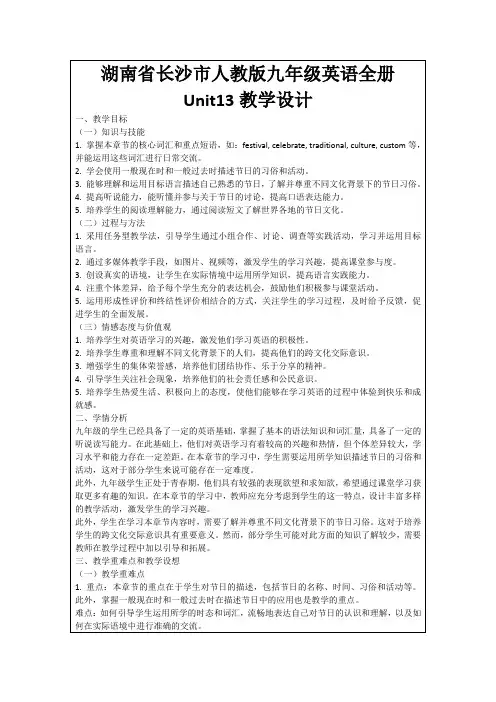
三、教学重难点和教学设想
(一)教学重难点
1.重点:本章节的重点在于学生对节日的描述,包括节日的名称、时间、习俗和活动等。此外,掌握一般现在时和一般过去时在描述节日中的应用也是教学的重点。
难点:如何引导学生运用所学的时态和词汇,流畅地表达自己对节日的认识和理解,以及如何在实际语境中进行准确的交流。
2.重点:培养学生对文化差异的敏感性和尊重,使他们能够理解并接受不同文化背景下的节日习俗。
难点:如何帮助学生克服文化差异带来的理解障碍,提高他们的跨文化交际能力。
(二)教学设想
1.针对教学重点,设计多样化的课堂活动,如小组讨论、角色扮演、节日庆典模拟等,让学生在实际语境中练习和运用目标语言。
3.针对教学难点,采用分层教学策略,为不同水平的学生提供适当难度的任务,确保每个学生都能在课堂上得到有效的学习和提高。
-对于基础薄弱的学生,设计简单的问题和对话,鼓励他们大胆开口;对于基础较好的学生,则提供更具挑战性的讨论和写作任务。
4.创设互动式的学习环境,鼓励学生提问和分享,通过师生互动、生生互动,促进知识的内化和吸收。
3.互动环节:教师挑选部分练习题,让学生相互问答,提高口语表达能力。
(五)总结归纳
1.教学内容:教师带领学生回顾本节课所学的主要知识点,包括词汇、语法、句型等。
2.学生反馈:教师邀请学生分享他们在课堂上的收获和感受,了解他们对知识点的掌握情况。
3.教师总结:教师对本节课的教学内容进行总结,强调了解和尊重不同文化的重要性,并鼓励学生在课后继续关注和学习英语国家的节日文化。
新人教版九年级英语下册《Unit13We’retryingtosavetheearth》教案
Unit 13 We’re trying to save the earth!教案知识导航语言目标谈论污染和环境保护。
Section A 重点单词1. litter v.乱扔n.垃圾2. bottom n.底部3. coal n.煤4. ugly adj.丑陋的 5. cost v.花费n.花费 6. wooden adj.木制的(wood n.木材) 7.plastic adj.塑料的n.塑料8. method n.方法9. cruel adj.残酷的10.harmful adj.有害的(harm n.害处) 11. industry n.工业12. law n.法律13. afford v.承担得起重点短语1.make a difference 起作用;有影响2. take part in 参加3. turn off 关掉4. pay for 付费;付出代价5. cut down 减少6. lead to 导致7. hear of听说8. cut off 切除重点句型1.We’re trying to save the earth. 我们在努力拯救地球。
2. The rive used to be so clean. 这河流过去是如此的清澈。
3. The air is badly polluted. 空气被严重污染。
4. The method is not only cruel, but also harmful to the environment. 这种方法不仅残酷,而且对环境也有害。
Section B +Self Check 重点单词1. recycle v.回收利用2. gate n.大门3. bottle n.瓶子4. president n.负责人 5. work n.作品 6. metal n.金属重点短语1. throw away 扔掉2. put sth. to good use 好好利用3. put … down 拆下 4. upside down 上下颠倒 5. bring back 恢复重点句型1. And the gate in front of her house is made of rocks and old glass bottles.她房子的前门是由岩石和旧玻璃瓶子制成的。
九年级unit13教案
九年级unit13教案教案标题:九年级Unit 13教案教案目标:1. 通过本单元的学习,学生将能够掌握和运用有关旅行和文化交流的词汇和表达方式。
2. 培养学生的听说读写能力,提高他们的综合语言运用能力。
3. 培养学生的跨文化交流意识和能力,增进对不同文化的理解和尊重。
教学重点:1. 学习和掌握有关旅行和文化交流的词汇和表达方式。
2. 提高学生的听说读写能力,尤其是听力和口语表达能力。
3. 培养学生的跨文化交流意识和能力。
教学难点:1. 学生在听力和口语表达方面的提高。
2. 学生对不同文化的理解和尊重。
教学准备:1. 教材:九年级英语教科书Unit 13部分。
2. 多媒体设备:投影仪、音频设备等。
3. 教学素材:有关旅行和文化交流的图片、视频等。
4. 学生练习册和作业本。
教学步骤:Step 1: 导入(5分钟)通过展示有关旅行和文化交流的图片或视频,引起学生对本单元主题的兴趣。
可以提问学生是否喜欢旅行、是否有过文化交流的经历等,激发学生的思考和参与。
Step 2: 预习(10分钟)让学生预习本单元的课文和词汇,了解本单元的主要内容和目标。
可以让学生自主阅读课文或进行小组讨论,然后提问学生他们对本单元的预期和期望。
Step 3: 听说训练(20分钟)播放本单元的听力材料,让学生听取关键信息并回答问题。
可以设计一些听力练习,如听取旅行计划或文化交流活动的对话,然后让学生进行口头表达。
可以采用小组讨论、角色扮演等形式,鼓励学生积极参与。
Step 4: 读写训练(20分钟)让学生阅读本单元的课文,并进行相关的阅读理解练习。
可以设计一些填空、选择题或简答题,帮助学生理解课文内容和提高阅读能力。
同时,让学生进行写作练习,如写一篇关于自己旅行经历或文化交流活动的短文,培养他们的写作能力。
Step 5: 综合训练(15分钟)设计一些综合性的练习,让学生综合运用本单元所学的知识和技能。
可以设计一些情景对话、角色扮演或小组讨论,让学生在实际情境中运用所学的词汇和表达方式。
2017-2018新人教版初中初三九年级英语第十三单元unit13教学设计-教案 (1)(7页)备课教案教学设计教学反思
Unit13-We-are-trying-to-save-the-earth-教学设计教学准备1. 教学目标1.掌握下列单词:litter,bottom,fisherman,coal,ugly,advantage,cost,wooden,plastic,takeaway,bin2.理解并掌握下列句子:But it used to be so clean!The air has become really polluted around here.So together, our actions can make a difference and lead to a better future!3.复习一些语法:现在进行时、一般现在时、used to表示的一般过去时、现在完成时、一般过去时的被动语态。
2. 教学重点/难点【教学重点】1.本课时的重点单词和短语2.时态复习【教学难点】1.训练学生的听力理解能力。
2.训练学生的语言交际能力。
3. 教学用具多媒体设备4. 标签教学过程Step 1Warming up1.Check homework.2.New words(1)Read the new words together.(加强读音训练)(2)Ask some individuals to read the new words.(发现读音问题,正音)(课前朗读可使学生快速进入学习状态,养成良好的学习习惯。
)Step 2Leading inShow the students some pictures about pollution.What kind of pollution do you know?What causes the pollution? (通过问题导入,激发学生兴趣。
)Here are some words related to different kinds of pollution.Write them in the box below.Then add more words.Step 3ListeningBefore listeningNowadays many rivers have become polluted.What do you think can cause river pollution?What should we do to stop the rivers being polluted?(大脑风暴,打开学生思维,初步感知目标语言。
人教版九年级英语全一册Unit13单元整体教学设计
3.分析课文中的重点句子和语法结构,让学生在实际语境中感受英语语言的魅力。
(三)学生小组讨论
1.教师将学生分成小组,每组选择一个社区活动主题,如环境保护、关爱老人等。
2.各小组讨论如何运用所学词汇和语法,描述和分析他们所选择的社区活动,并准备进行口头汇报。
难点:培养学生对文章深层含义的把握能力,以及批判性思维能力。
3.重点:培养学生的英语口语表达能力,使他们能够在讨论社区活动和志愿者工作时,流畅地运用所学知识进行交流。
难点:学生在口头表达时,容易出现词汇搭配错误、语法结构混乱等问题。
(二)教学设想
1.针对词汇和语法难点,采用以下教学策略:
-利用图片、实物等直观教具,帮助学生形象记忆词汇。
人教版九年级英语全一册Unit13单元整体教学设计
一、教学目标
(一)知识与技能
1.学生能够掌握并运用本单元的词汇和短语,如"community", "contribution", "volunteer", "charity", "fundraising"等,并能运用这些词汇进行主题相关的讨论和写作。
-结合教材内容,引导学生关注社区活动,培养他们的社会责任感。
-通过课堂讨论和课后实践活动,让学生认识到参与志愿者工作的重要性,激发他们热爱社区、关爱他人的情感。
-鼓励学生分享自己的经验和观点,尊重他人的不同看法,培养包容、合作的精神。
四、教学内容与过程
(一)导入新课
1.教师通过展示一组社区活动的图片,如志愿者清洁环境、慈善义卖等,引导学生观察并思考这些活动的意义。