
剑桥雅思9 test3 阅读词汇测试版
矿产资源开发利用方案编写内容要求及审查大纲
矿产资源开发利用方案编写内容要求及《矿产资源开发利用方案》审查大纲一、概述
㈠矿区位置、隶属关系和企业性质。
如为改扩建矿山, 应说明矿山现状、
特点及存在的主要问题。
㈡编制依据
(1简述项目前期工作进展情况及与有关方面对项目的意向性协议情况。
(2 列出开发利用方案编制所依据的主要基础性资料的名称。
如经储量管理部门认定的矿区地质勘探报告、选矿试验报告、加工利用试验报告、工程地质初评资料、矿区水文资料和供水资料等。
对改、扩建矿山应有生产实际资料, 如矿山总平面现状图、矿床开拓系统图、采场现状图和主要采选设备清单等。
二、矿产品需求现状和预测
㈠该矿产在国内需求情况和市场供应情况
1、矿产品现状及加工利用趋向。
2、国内近、远期的需求量及主要销向预测。
㈡产品价格分析
1、国内矿产品价格现状。
2、矿产品价格稳定性及变化趋势。
三、矿产资源概况
㈠矿区总体概况
1、矿区总体规划情况。
2、矿区矿产资源概况。
3、该设计与矿区总体开发的关系。
㈡该设计项目的资源概况
1、矿床地质及构造特征。
2、矿床开采技术条件及水文地质条件。
可粘贴复制word版本的剑桥雅思9Test3

Test 3LISTENINGSECTION 1 Questions 1-10Questions 1-5Complete the table below.Write ONE WORD AND/OR A NUMBER for each answer.Complete the table below.Write ONE WORK AND/OR A NUMBER for each answer.Questions 11-13Choose the correct letter, A, B or C.Winridge Forest Railway Park11Simon’s idea for a theme park came fromA his childhood hobby.B his interest in landscape design.C his visit to another park.12 When they started, the family decided to open the park only whenA the weather was expected to be good.B the children weren’t at school.C there were fewer farming commitments.13 Since opening, the park has hadA 50,000 visitors.B 1,000,000 visitors.C 1,500,000 visitors.Questions 14-18What is currently the main area of work of each of the following people?Choose FIVE answers from the box and write the correct letter, A-H, next to questions 14-18.14 Simon (the speaker) _______15 Liz _______16 Sarah _______17 Duncan _______18 Judith _______Questions 19 and 20Complete the table below.Write ONE WORK AND/OR NUMBERS for each answer.Complete the notes below.Write NO MORE THAN TWO WORDS AND/OR A NUMBER for each answer.Study Skills Tutorial-Caroline Benning Dissertation topic: the 21______Strengths: ●22______● computer modeling Weaknesses: ● lack of background information● poor 23 ______ skills● Read all notes 29 ______Next tutorial date: 30 ______ JanuarySECTION 4 Questions 31-40Questions 31 and 32Choose the correct letter, A, B or C.31 The owners of the underground houseA had no experience of living in a rural area.B were interested in environmental issues.C wanted a professional project manager.32 What does the speaker say about the site of the house?A The land was quite cheap.B Stone was being extracted nearby.C It was in a completely unspoilt area.Questions 33-40Complete the notes below.Write ONE WORD AND/OR A NUMBER for each answer.READING PASSAGE 1You should spend about 20 minutes on Questions 1-13, which are based on Reading Passage 1 below.Attitudes to languageIt is not easy to be systematic and objective about language study. Popular linguistic debate regularly deteriorates into invective and polemic. Language belongs to everyone, so most people feel they have a right to hold an opinion about it. And when opinions differ, emotions can run high. Arguments can start as easily over minor points of usage as over major policies of linguistic education.Language, moreover, is a very public behaviour, so it is easy for different usages to be noted and criticized. No part of society or social behaviour is exempt: linguistic factorsinfluence how we judge personality, intelligence, social status, educational standards, job aptitude, and many other areas of identity and social survival. As a result, it is easy to hurt, and to be hurt, when language use is unfeelingly attacked.In its most general sense, prescriptivism is the view that one variety of language has an inherently higher value than others, and that this ought to be imposed on the whole of the speech community. The view is propounded especially in relation to grammar and vocabulary, and frequently with reference to pronunciation. The variety which is favoured, in this account, is usually a version of the ‘standard’ written language, especially as encountered in literature, or in the formal spoken language which most closely reflects this style. Adherents to this variety are said to speak orwr ite ‘correctly’; deviations from it are said to be‘incorrect’.All the main languages have been studied prescriptively, especially in the 18th century approach to the writing of grammars and dictionaries. The aims of these early grammarians were threefold: (a) they wanted to codify the principles of their languages, to show that there was a system beneath the apparent chaos of usage, (b) they wanted a means of settling disputes over usage, and (c) they wanted to point out what they felt to be common errors, in order to ‘improve’ the language. The authoritarian nature of the approach is best characterized by its reliance on‘rules’ of grammar. Some usages are ‘prescribed’, to be learnt and followed accurately; others are ‘proscribed’, to be avoided. In this early period, there were no half-measures: usage was either right or wrong, and it was thetask of the grammarian not simply to record alternatives, but to pronounce judgement upon them.These attitudes are still with us, and they motivate a widespread concern that linguistic standards should be maintained. Nevertheless, there is an alternative point of view that is concerned less with standards than with the facts of linguistic usage. This approach is summarized in the statement that it is the task of the grammarian to describe, not prescribe-to record the facts of linguistic diversity, and not to attempt the impossible tasks of evaluating language variation or halting language change. In the second half of the 18th century, we already find advocates of this view, such as Joseph Priestley, whose Rudiments of English Grammar(1761) insists that ‘the custom of speaking is the original and only just standard of any language’. Linguistic issue, it is argued, cannot be solved by logic and legislation. And this view has become the tenet of the modern linguistic approach to grammatical analysis.In our own time, the opposition between ‘descriptivists’ and ‘prescriptivists’ has often become extreme, with both sides painting unreal pictures of the other. Descriptive grammarians have been presented as people who do not care about standards, because of the way they see all forms of usage as equally valid. Prescriptive grammarians have been presented as blind adherents to a historical tradition. The opposition has even been presented in quasi-political terms — of radical liberalism vs elitist conservatism.Questions 1-8Do the following statements agree with the claims of the writer in Reading Passage 1?In boxes 1-8 on your answer sheet, writeYES if the statement agrees with the claims of the writerNO if the statement contradicts the claims of the writerNOT GIVEN if it is impossible to say what the writer thinks about this1 There are understandable reasons why arguments occur about language.2 People feel more strongly about language education thanabout small differences in language usage.3Our assessment of a person’s intelligence is affected by the way he or she uses language.4 Prescriptive grammar books cost a lot of money to buy in the 18th century.5 Prescriptivism still exists today.6 According to descriptivists it is pointless to try to stop language change.7 Descriptivism only appeared after the 18th century.8 Both descriptivists and prescriptivists have been misrepresented.Questions 9-12Complete the summary using the list of words, A-I, below. Write the correct letter, A-I, in boxes 9-12 on your answer sheet.The language debateAccording to 9______, there is only one correct form of language. Linguists who take this approach to language place great importance on grammatical 10 ______.Conversely, the view of 11 ______, such as Joseph Priestly, is that grammar should be based on 12 ______.Choose the correct letter, A, B, C or D.Write the correct letter in box 13 on your answer sheet.What is the writer’s purpose in Reading Passage 1?A.to argue in favour of a particular approach to writingdictionaries and grammar booksB.to present a historical account of differing views oflanguageC.to describe the differences between spoken and writtenlanguageD.to show how a certain view of language has beendiscreditedREADING PASSAGE 2You should spend about 20 minutes on Questions 14-26, which are based on Reading Passage 2 below.Tidal PowerUndersea turbines which produce electricity from the tides are set to become an important source of renewable energy for Britain. It is still too early to predict the extent of the impact they may have, but all the signs are that they will play a significant role in the futureA.Operating on the same principle as wind turbines, thepower in sea turbines comes from tidal currents whichturn blades similar to ships’ propellers, but, unlikewind, the tides are predictable and the power input isconstant. The technology raises the PROSPECT of Britain becoming self-sufficient in renewable energy anddrastically reducing its carbon dioxide emissions. If tide, wind and wave power are all developed, Britain would be able to close gas, coal and nuclear power plants andexport renewable power to other parts of Europe. Unlike wind power, which Britain originally developed and then abandoned for 20 years allowing the Dutch to make it a major industry, undersea turbines could become a bigexport earner to island nations such as Japan and New Zealand.B.Tidal sites have already been identified that will produceone sixth or more of the UK’s power-and at pricescompetitive with modern gas turbines and undercutting those of the already ailing nuclear industry. One sitealone, the Pentland Firth, between Orkney and mainland Scotland, could produce 10% of the country’s electricity with banks of turbines under the sea, and another atAlderney in the Channel Islands three times the 1,200megawatts of Britain’s largest and newe st nuclear plant, Sizewell B, in Suffolk. Other sites identified include theBristol Channel and the west coast of Scotland,particularly the channel between Campbeltown andNorthern Ireland.C.Work on designs for the new turbine blades and sites arewill ad vance at the University of Southampton’ssustainable energy research group. The first station isexpected to be installed off Lynmouth in Devon shortly to test the technology in a venture jointly funded by thedepartment of Trade and Industry and the EuropeanUnion. AbuBakr Bahaj, in charge of the Southamptonresearch, said: ‘The prospects for energy from tidalcurrents are far better than from wind because the flows of water are predictable and constant. The technology for dealing with the hostile saline environment under the sea has been developed in the North Sea oil industry andmuch is already known about turbine blade design,because of wind power and ship propellers. There are a few technical difficulties, but I believe in the next five to ten years we will be installing commercial marine turbine farms.’ Southampton has been awarded £215,000 over three years to develop the turbines and is working with Marine Current Turbines, a subsidiary of IT power, onthe Lynmouth project. EU research has now identified106 potential sites for tidal power, 80% round the coasts of Britain. The best sites are between islands or around heavily indented coasts where there are strong tidalcurrents.D. A marine turbine blade needs to be only one third of thesize of wind generator to produce three times as muchpower. The blades will be about 20 metres in diameter, so around 30 metres of water is required. Unlike windpower, there are unlikely to be environmental objections.Fish and other creatures are though unlikely to be atrisk from the relatively slow-turning blades. Each turbine will be mounted on a tower which will connect to thenational power supply grid via underwater cables. Thetowers will stick out of the water and be lit, to warnshipping, and also be designed to be lifted out of thewater for maintenance and to clean seaweed from theblades.E.Dr Bahaj has done most work on the Alderney site,where there are powerful currents. The single undersea turbine farm would produce far more power than needed for the Channel Islands and most would be fed into the French Grid and be re-imported into Britain via the cable under the Channel.F.One technical difficulty is cavitation, where low pressurebehind a turning blade causes air bubbles. These cancause vibration and damage the blades of the turbines.Dr Bahaj said: ‘We have to test a number of blade types to avoid this happening or at least make sure it does not damage the turbines or reduce performance. Anotherslight concern is submerged debris floating into theblades. So far we do not know how much of a problem it might be. We will have to make the turbines robustbecause the sea is a hostile environment, but all thesigns that we can do it are good.’Questions 14-17Reading Passage 2 has six paragraphs, A-F.Which paragraph contains the following information?Write the correct letter, A-F, in boxes 14-17 on your answer sheet.NB You may use any letter more than once.14 the location of the first test site15 a way of bringing the power produced on one site back into Britain16 a reference to a previous attempt by Britain to find analternative source of energy17 mention of the possibility of applying technology from another industryQuestions 18-22Choose FIVE letters, A-J.Write the correct letters in boxes 18-22 on your answer sheet.Which FIVE of the following claims about tidal power are made by the writer?Questions 23-26Label the diagram below.Choose NO MORE THAN TWO WORDS from the passage for each answer.Write your answers in boxes 23-26 on your answer sheet.An Undersea TurbineWhole tower can be raised for 23 ______ and the extraction of seaweed from the bladesSea life not in danger due to the fact that blades are comparatively 24 ______Air bubbles result from the 25 ______ behind blades. This is known as 26 ______READING PASSAGE 3You should spend about 20 minutes on Questions 27-40, which are based on Reading Passage 3 below.Information theory-the big ideaInformation theory lies at the heart of everything-from DVD players and the genetic code of DNA to the physics of the universe at its most fundamental. It has been central to the development of the science of communication, which enables data to be sent electronically and has therefore had a major impact on our livesA.In April 2002 an event took place which demonstratedone of the many applications of information theory. The space probe, Voyager I, Launched in 1997, had sent back spectacular images of Jupiter and Saturn and thensoared out of the Solar System on a one-way mission tothe stars. After 25 years of exposure to the freezingtemperatures of deep space, the probe was beginning to show its age. Sensors and circuits were on the brink of failing and NASA expers realized that they had to dosomething or lose contact with their probe forever. The solution was to get a message to Voyager I to instruct it to use spares to change the failing parts. With the probe12 billion kilometers from Earth, this was not an easytask. By means of a radio dish belonging to NASA’sDeep Space Network, the message was sent out into the depths of space. Even travelling at the speed of light, it took over 11 hours to reach its target, far beyond theorbit of Pluto. Yet, incredibly, the little probe managed to hear the faint call from its home planet, and successfully made the switchover.B.It was the longest-distance repair job in history, and atriumph for the NASA engineers. But it also highlighted the astonishing power of the techniqu4es developed by American communications engineer Claude Shannon,who had died just a year earlier. Born in 1916 inPetoskey, Michigan, Shannon showed an early talent for maths and for building gadgets, and madebreakthroughs in the foundations of computertechnology when still a student. While at BellLaboratories, Shannon developed information theory, but shunned the resulting acclaim. In the 1940s, he single-handedly created an entire science of communicationwhich has since inveigled its way into a host ofapplications, from DVDs to satellite communications to bar codes-any area, in short, where data has to beconveyed rapidly yet accurately.C.This all seems light years away from the down-to-earthuses Shannon originally had for his work, which began when he was a 22-year-old graduate engineering student at the prestigious Massachusetts Institute of Technology in 1939. He set out with an apparently simple aim: to pin down the precise meaning of the concept of‘information’. The most basic form of information,Shannon argued, is whether something is true of false —which can be captured in the binary unit, or ‘bit’, of the form 1 or 0. Having identified this fundamental unit, Shannon set about defining otherwise vague ideas about information and how to transmit it from place to place.In the process he discovered something surprising: it is always possible to guarantee information will get through random interference —‘noise’— intact.D.Noise usually means unwanted sounds which interferewith genuine information. Information theory generalizes this idea via theorems that capture the effects of noisewith mathematical precision. In particular, Shannonshowed that noise sets a limit on the rate at whichinformation can pass along communication channelswhile remaining error-free. This rate depends on therelative strengths of the signal and noise travelling down the communication channel, and on its capacity (its‘bandwidth’). The resulting limit, gi ven in units of bits per second, is the absolute maximum rate of error-free communication given singal strength and noise leve. The trick, Shannon showed, is to find ways of packaging up —‘coding’— information to cope with the ravages of noise, while staying within the information-carryingcapacity —‘bandwidth’— of the communicationsystem being used.E.Over the years scientists have devised many such codingmethods, and they have proved crucial in manytechnological feat. The Voyager spacecraft transmitteddata using codes which added one extra bit for everysingle bit of information; the result was an error rate of just one bit in 10,000-and stunningly clear pictures ofthe planets. Other codes have become part of everydaylife-such as the Universal Product Code, or bar code,which uses a simple error-detecting system that ensures supermarket check-out lasers can read the price even on, say, a crumpled bag of crisps. As recently as 1993,engineers made a major breakthrough by discovering so-called turbo codes-which come very close to Shannon’s ultimate limit for the maximum rate that data can betransmitted reliable, and now play a key role in themobile videophone revolution.F.Shannon also laid the foundations of more efficient waysof storing information, by stripping out superfluous(‘redundant’) bits from data which contributed littlereal information. As mobile phone text messages like ‘I CN C U’ show, it is often possible to leave out a lot ofdata without losing much meaning. As with errorcorrecting, h owever, there’s a limit beyond whichmessages become too ambiguous. Shannon showed how to calculate this limit, opening the way to the design ofcompression methods that cram maximum information into the minimum space.Questions 27-32Reading Passage 3 has six paragraphs, A-F.Which paragraph contains the following information?Write the correct letter, A-F, in boxes 27-32 on your answer sheet.27 an explanation of the factors affecting the transmission of information28 an example of how unnecessary information can be omitted29 a reference to Shannon’s attitude to fame30 details of a machine capable of interpreting incomplete information31 a detailed account of an incident involving information theory32 a reference to what Shannon initially intended to achieve in his researchQuestions 33-37Complete the notes below.Choose NO MORE THAN TWO WORDS form the passage for each answer.Write your answers in boxes 33-37 on your answer sheet.The Voyager 1 Space Probe●The probe transmitted pictures of both 33______ and______, then left the 34 ______.●The freezing temperatures were found to have a negativeeffect on parts of the space probe.●Scientists feared that both the 35 ______ and ______ wereabout to stop working.●The only hope was to tell the probe to replace them with36 ______ — but distance made communication with theprobe difficult.● A 37 ______ was used to transmit the message at thespeed of light.●The message was picked up by the probe and theswitchover took place.Questions 38-40Do the following statements agree with the information given in Reading PassGE 3?In boxes 38-40 on your answer sheet, writeTRUE if the statement agrees with the informationFALSE if the statement contradicts the informationNOT GIVEN if there is no information on this38 The concept of describing something as true or falsewas the starting point for Shannon in his attempts tosend message over distances.39 The amount of information that can be sent in a giventime period is determined with reference to the signalstrength and noise level.40 Products have now been developed which can conveymore information than Shannon had anticipated aspossible.WRITINGWRITING TASK1You should spend about 20 minutes on this task.WRITING TASK2You should spend about 40 minutes on this task.Write about the following topic:examples from your own knowledge or experience. Write at least 250 words.SPEAKINGPART 1The examiner asks the candidate about him/herself, his/her home, work or studies and other familiar topics. EXAMPLETelephoning●How often do you make telephone calls? [Why/Why not?]●Who do you spend most time talking to on thetelephone?[Why?]●When do you think you’ll next make a telephonecall?[Why?]●Do you sometimes prefer to send a text message insteadof telephoning? [Why/Why not?]PART 2the topic for one to two minutes.You have one minute to think about what you are going to say.You can make some notes to help you if you wish.PART 3Discussion topics:Reasons for daily travelExample questions:Why do people need to travel every day?What problems can people have when they are on their daily journey, for example to work or school? Why is this?Some people say that daily journeys like these will not be so common in the future. Do you agree or disagree? Why? Benefits of international travelExample questions:What do you think people can learn from travelling to other countries? Why?Can travel make a positive difference to the economy of a country? How?Do you think a society can benefit if its members have experience of travelling to other countries? In what ways?。
剑9 Test3 Reading passage 3解析

sea has been developed in the North Sea oil industry and much is already known about turbine blade design, because of wind power and ship propellers.(C段第4 句)
be designed to be lifted out of the water for maintenance and to clean seaweed from the blades.(D段最后一句)
定位词:raise,extraction
答案:maintenance
题目解析 题干中fish and other creatures就是sea life, unlikely to be at risk替换了not in danger。
定位词:another industry,applying technoligy 答案:C
题目解析 题干中的wind power在A段出现得比较多,仔细阅读便能发现跟题干相似的意思——
wind在此句中以原形出现,而reliable被替换为predictable和constant。
(A段第一句)
从解析来看很多答案出现在某段的段首或段尾不妨我们以后可以在理解文章大意的基础上再去这些地方寻找到答案能节省不少时间
Reading Passage 2
全文概括:潮汐能(Tidal Power)对于英国的作用及重要性,还有关于潮汐能的介绍。 题型:Question 14-17是段落信息匹配题
Question 18-22是多选题
定位词:location,first 答案:C
题目解析 题干中说的是一种把生产在某处的能源带回英国的方式,很明显能对应到E段。
雅思真题阅读词汇 剑桥雅思9 test 3 passage 2 潮汐发电.doc
雅思真题阅读词汇剑桥雅思9 test 3 passage 2 潮汐发电今天我们雅思真题阅读词汇的文章来研究下剑桥雅思9 test 3 passage 2。
这篇雅思阅读的主题为潮汐发电。
文章内容包括:潮汐发电的优势,潮汐发电可以用于解决能源问题,英国潮汐发电实验项目,水力涡轮机的有点,潮汐发电的前景,以及潮汐发电的弊端等。
按照惯例,我们总结下其中出现的雅思阅读常考词汇。
引言turbine n. 涡轮机。
“海面下的涡轮机从潮汐中产生电力。
它希望成为英国可再生能源的重要来源”。
自然段Aoperate v. 运转。
“与风力涡轮机的运转原理相同,海洋涡轮机的能源来自于潮汐流”。
blade n. 叶片,刀片。
“潮汐流像推动轮船螺旋桨那样推动叶片”。
predictable adj. 可预测的,可预见的。
“然而,不像风力,潮汐流是可以预测的,并且动力输入也保持稳定”。
self-sufficient adj. 自给自足的。
“这一技术使英国有可能未来在可再生能源上面实现自给自足”。
drastically adv. 大大地,彻底地。
“并且极大的减少其二氧化碳的排放”。
abandon v. 放弃,丢弃。
“英国最初开发了风力发电,然后将其放弃了20年”。
自然段Bidentify v. 确定。
“潮汐发电站被确定将会产生英国电力的六分之一或者更多”。
自然段Ccommercial adj. 商业的。
“我认为在未来的5到10年里,我们将安装商业海洋涡轮机”。
“欧盟研究机构现在已经确定了106个潮汐发电站潜在的站点”。
potential adj. 潜在的。
自然段Dgenerator n. 发电机。
“海洋涡轮机的叶片只需要是风力发电机的三分之一,就雅思能够产生其三倍的电力”。
diameter n. 直径。
“叶片直径大约为20米”。
grid n. 电网。
“高塔会通过水下电缆与国家电力供应网络连接”。
maintenance n. 维修,保养。
剑桥雅思9 test3阅读真题词汇汇总
D段
interfere v.干扰
genuine adj.真实的
capacity n.容量
ravage n.毁坏,破坏
cope with处理,应对
E段
devise v.设计,发明
revolution n.革命
feat n.功绩,壮举
F段
strip v.剥去,脱去
beneath prep.在……之下
dispute n.争论
accurately adv.准确地,精确地
alternative n.供代替的选择
第五段
motivate v.激发
variation n.变化,改变
advocate n.提倡者,支持者
logic n.逻辑
analysis n.分析
diversity n.多样性
halt v.停止,阻止
original adj.最初的;独创的
legislation n.立法;法律
第六段
opposition n.反对
valid adj.有效的
extreme adj.极端的
C9T3R2 Tidal Power
A段
turbine n,涡轮
current n.(水,气,电)流
constant adj.恒定的,经常的
C9T3R1 Attitude to Language
第一段
objective adj.客观的
debate n.争论,辩论
linguistic adj.语言的,语言学的
deteriorate v.衰退;恶化,变坏
第二段
criticise v.批评,批判
social status社会地位
剑桥雅思真题9-阅读Test 3(附答案)

剑桥雅思真题9-阅读Test 3(附答案)Reading Passage 1You should spend about 20 minutes on QUESTIONS 1-13 which are based on Reading Passage 1 below.Attitudes to languageIt is not easy to be systematic and objective about language study. Popular linguistic debate regularly deteriorates into invective and polemic. Language belongs to everyone, so most people feel they have a right to hold an opinion about it. And when opinions differ, emotions can run high. Arguments can start as easily over minor points of usage as over major policies of linguistic education.Language, moreover, is a very public behaviour, so it is easy for different usages to be noted and criticised. No part of society or social behaviour is exempt: linguistic factors influence how we judge personality, intelligence, social status, educational standards, job aptitude, and many other areas of identity and social survival. As a result, it is easy to hurt, and to be hurt, when language use is unfeelingly attacked.In its most general sense, prescriptivism is the view that one variety of language has an inherently higher value than others, and that this ought to be imposed on the whole of the speech community. The view is propounded especially in relation to grammar and vocabulary, and frequently with reference to pronunciation. The variety which is favoured, in this account, is usually a version of the Standard* written language, especially as encountered in literature, or in the formal spoken language which most closely reflects this style. Adherents to this variety are said to speak or write ’correctly; deviations from it are said to be 'incorrect!All the main languages have been studied prescriptively, especially in the 18th century approach to the writing of grammars and dictionaries. The aims of these early grammarians were threefold: (a) they wanted to codify the principles of their languages, to show that there was a system beneath the apparent chaos of usage, (b) they wanted a means of settling disputes over usage, and (c) they wanted to point out what they felt to be common errors, in order to ‘improve’ the language. The authoritarian nature of the approach is best characterised by its reliance on 'rules' of grammar. Some usages are ‘prescribed’, to be learnt and followed accurately; others are 'proscribed’, to be avoided. In this early period, there were no half-measures: usage was either right or wrong, and it was the task of the grammarian not simply to record alternatives, but to pronounce judgement upon them.These attitudes are still with us, and they motivate a widespread concern that linguistic standards should be maintained. Nevertheless, there is an alternative point of view that is concerned less with standards than with the facts of linguistic usage. This approach is summarised in the statement that it is the task of the grammarian to describe, not prescribe -to record the facts of linguistic diversity, and not to attempt the impossible tasks of evaluating language variation or halting language change. In the second half of the 18th century, we already find advocates of this view, such as Joseph Priestley, whose Rudiments of English Grammar (1761) insists that ‘the custom of speaking is the original and only just standard of any language’. Linguistic issues, it is argued, cannot be solved by logic and legislation. And this view has become the tenet of the modem linguistic approach to grammatical analysis.In our own time, the opposition between 'descriptivists’ and 'prescriptivists’ has often become extreme, with both sides painting unreal pictures of the other. Descriptive grammarians have been presented as people who do not care about standards, because of the way they see all forms of usage as equally valid. Prescriptive grammarians have been presented as blind adherents to a historical tradition. The opposition has even been presented in quasi-political terms -of radical liberalism vs elitist conservatism.Question 1-8Do the following statements agree with the claims of the writer in Reading Passage 1?In boxes 1-8 on your answer sheet, writeYES if the statement agrees with the claims of the writerNO if the statement contradicts the claims of the writerNOT GIVEN if it is impossible to say what the writer thinks about this1. There are understandable reasons why arguments occur about language.2. People feel more strongly about language education than about small differences in language usage.3. Our assessment of a person's intelligence is affected by the way he or she uses language.4. Prescriptive grammar books cost a lot of money to buy in the 18th century.5. Prescriptivism still exists today.6. According to descriptivists it is pointless to try to stop language change.7. Descriptivism only appeared after the 18th century.8. Both descriptivists and prescriptivists have been misrepresented.Question 9-12Complete the summary using the list of words, A-I, below.Drag the correct letter, A-I, into boxes 9-12 on your answer sheet.According to 9………..., there is only one correct form of language. Linguists who take this approach to language place great importance on grammatical 10 ………… .Conversely, the view of 11…………., such as Joseph Priestley, is that grammar should be based on 12 ………… .Choose the correct letter, A, B, C or D.Write the correct letter in box 13 on your answer sheet.13. What is the writers purpose in Reading Passage 1?A. to argue in favour of a particular approach to writing dictionaries and grammar booksB. to present a historical account of differing views of languageC. to describe the differences between spoken and written languageD. to show how a certain view of language has been discreditedReading Passage 2You should spend about 20 minutes on QUESTIONS 14-27 which are based on Reading Passage 2 below.Tidal PowerUndersea turbines which produce electricity from the tides are set to become an important source of renewable energy for Britain. It is still too early to predict the extent of the impact they may have, but all the signs are that they will play a significant role in the futureA Operating on the same principle as wind turbines, the power in sea turbines comes from tidal currents which turn blades similar to ships' propellers, but, unlike wind, the tides are predictable and the power input is constant. The technology raises the prospect of Britain becoming self-sufficient in renewable energy and drastically reducing its carbon dioxide emissions. If tide, wind and wave power are all developed. Britain would be able to close gas, coal and nuclear power plants and export renewable power to other parts of Europe. Unlike wind power, which Britain originally developed and then abandoned for 20 years allowing the Dutch to make it a major industry, undersea turbines could become a big export earner to island nations such as Japan and New Zealand.B Tidal sites have already been identified that will produce one sixth or more of the UK's power - and at prices competitive with modem gas turbines and undercutting those of the already ailing nuclear industry. One site alone, the Pentland Firth, between Orkney and mainland Scotland, could produce 10% of the country's electricity with banks of turbines under the sea, and another at Alderney in the Channel Islands three times the 1,200 megawatts of Britain's largest and newest nuclear plant, Sizewell B, in Suffolk. Othep sites identified include the Bristol Channel and the west coast of Scotland, particularly the channel between Campbeltown and Northern Ireland.C Work on designs for the new turbine blades and sites are well advanced at the University of Southampton's sustainable energy research group. The first station is expected to be installed off Lynmouth in Devon shortly to test the technology in a venture jointly funded by the department of Trade and Industry and the European Union. AbuBakr Bahaj, in charge of the Southampton research, said: The prospects for energy from tidal currents are far better than from wind because the flows of water are predictable and constant. The technology for dealing with the hostile saline environment under the sea has been developed in the North Sea oil industry and much is already known about turbine blade design, because of wind power and ship propellers. There are a few technical difficulties, but I believe in the next five to ten years we will be installing commercial marine turbine farms. Southampton has been awarded £215,000 over three years to develop the turbines and is working with Marine Current Turbines, a subsidiary of IT power, on the Lynmouth project. EU research has now identified 106 potential sites for tidal power, 80% round the coasts of Britain. The best sites are between islands or around heavily indented coasts where there are strong tidal currents.D A marine turbine blade needs to be only one third of the size of a wind generator to produce three times as much power. The blades will be about 20 metres in diameter, so around 30 metres of water is required. Unlike wind power, there are unlikely be environmental objections. Fish and other creatures are thought unlikely to be at risk from the relatively slow-turning blades. Each turbine will be mounted on a tower which will connect to the national power supply grid viaunderwater cables. The towers will stick out of the water and be lit, to warn shipping, and also be designed to be lifted out of the water for maintenance and to clean seaweed from the blades.E Dr Bahaj has done most work on the Alderney site, where there are powerful currents. The single undersea turbine farm would produce far more power than needed for the Channel Islands and most would be fed into the French Grid and be re-imported into Britain via the cable under the Channel.F One technical difficulty is cavitation, where low pressure behind a turning blade causes air bubbles. These can cause vibration and damage the blades of the turbines. Dr Bahaj said: ‘We have to test a number of blade types to avoid this happening or at least make sure it does not damage the turbines or reduce performance. Another slight concern is submerged debris floating into the blades. So far we do not know how much of a problem it might be. We will have to make the turbines robust because the sea is a hostile environment, but all the signs that we can do it are good.'Questions 14-17Reading Passage 2 has six paragraphs, A-F.Which paragraph contains the following information?Write the correct letter, A-F, in boxes 14-17 on your answer sheet.NB You may use any letter more than once.14. the location of the first test site15. a way of bringing the power produced on one site back into Britain16. a reference to a previous attempt by Britain to find an alternative source of energy17. mention of the possibility of applying technology from another industryQuestions 18-22Choose FIVE letters, A-J.Write the correct letters in boxes 18-22 on your answer sheet.Which FIVE of the following claims about tidal power are made by the writer?Label the diagram below.Choose NO MORE THAN TWO WORDS from the passage for each answer.Write your answers in boxes 23-26 on your answer sheet.An Undersea TurbineReading Passage 3You should spend about 20 minutes on QUESTIONS 27-40 which are based on Reading Passage 3 below.Information theory-the big ideaInformation theory lies at the heart of everything —from DVD players and the genetic code of DNA to the physics of the universe at its most fundamental. It has been central to the development of the science of communication, which enables data to be sent electronically and has therefore had a major impact on our livesA In April 2002 an event took place which demonstrated one of the many applications of information theory. The space probe, V oyager I, launched in 1977, had sent back spectacular images of Jupiter and Saturn and then soared out of the Solar System on a one-way mission to the stars. After 25 years of exposure to the freezing temperatures of deep space, the probe was beginning to show its age. Sensors and circuits were on the brink of failing and NASA experts realised that they had to do something or lose contact with their probe forever. The solution was to get a message to Voyager I to instruct it to use spares to change the failing parts. With the probe 12 billion kilometres from Earth, this was not an easy task. By means of a radio dish belonging to NASA's Deep Space Network, the message was sent out into the depths of space. Even travelling at the speed of light, it took over 11 hours to reach its target, far beyond the orbit of Pluto. Yet, incredibly, the little probe managed to hear the faint call from its home planet, and successfully made the switchover.B It was the longest-distance repair job in history, and a triumph for the NASA engineers. But it also highlighted the astonishing power of the techniques developed by American communications engineer Claude Shannon, who had died just a year earlier. Born in 1916 in Petoskey, Michigan, Shannon showed an early talent for maths and for building gadgets, and made breakthroughs in the foundations of computer technology when still a student. While at BellLaboratories, Shannon developed information theory, but shunned the resulting acclaim. In the 1940s, he single-handedly created an entire science of communication which has since inveigled its way into a host of applications, from DVDs to satellite communications to bar codes - any area, in short, where data has to be conveyed rapidly yet accurately.C This all seems light years away from the down-to-earth uses Shannon originally had for his work, which began when he was a 22-year-old graduate engineering student at the prestigious Massachusetts Institute of Technology in 1939. He set out with an apparently simple aim: to pin down the precise meaning of the concept of 'information’. The most basic form of information, Shannon argued, is whether something is true or false - which can be captured in the binary unit, or 'bit', of the form 1 or 0. Having identified this fundamental unit, Shannon set about defining otherwise vague ideas about information and how to transmit it from place to place.In the process he discovered something surprising: it is always possible to guarantee information will get through random interference – ‘noise’, - intact.D Noise usually means unwanted sounds which interfere with genuine information. Information theory generalises this idea via theorems that capture the effects of noise with mathematical precision. In particular, Shannon showed that noise sets a limit on the rate at which information can pass along communication channels while remaining error-free. This rate depends on the relative strengths of the signal and noise travelling down the communication channel, and on its capacity (its ‘bandwidth’). The resulting limit, given in units of bits per second, is the absolute maximum rate of error-free communication given signal strength and noise level. The trick, Shannon showed, is to find ways of packaging up – ‘coding’, - information to cope with the ravages of noise, while staying within the information-carrying capacity -'bandwidth* -of the communication system being used.E Over the years scientists have devised many such coding methods, and they have proved crucial in many technological feats. The Voyager spacecraft transmitted data using codes which added one extra bit for every single bit of information; the result was an error rate of just one bit in 10,000 - and stunningly clear pictures of the planets. Other codes have become part of everyday life - such as the Universal Product Code, or bar code, which uses a simple error-detecting system that ensures supermarket check-out lasers can read the price even on, say, a crumpled bag of crisps. As recently as 1993, engineers made a major breakthrough by discovering so-called turbo codes -which come very close to Shannon's ultimate limit for the maximum rate that data can be transmitted reliably, and now play a key role in the mobile videophone revolution.F Shannon also laid the foundations of more efficient ways of storing information, by stripping out superfluous (‘redundant’) bits from data which contributed little real information. As mobile phone text messages like ‘I CN C U’ show, it is often possible to leave out a lot of data without losing much meaning. As with error correction, however, there’s a limit beyond which messages become too ambiguous. Shannon showed how to calculate this limit, opening the way to the design of compression methods that cram maximum information into the minimum space. Questions 27-32Reading Passage 3 has six paragraphs, A-F.Which paragraph contains the following information?Write the correct letter, A-F, in boxes 27-32 on your answer sheet.27. an explanation of the factors affecting the transmission of information28. an example of how unnecessary information can be omitted29. a reference to Shannon's attitude to fame30. details of a machine capable of interpreting incomplete information31. a detailed account of an incident involving information theory32. a reference to what Shannon initially intended to achieve in his researchQuestions 33-37Complete the notes below.Choose NO MORE THAN TWO WORDS form the passage for each answer.Write your answers in boxes 33-37 on your answer sheet.•The probe transmitted pictures of both 33______ and ______, then left the 34 ______.•The freezing temperatures were found to have a negative effect on parts of the space probe.•Scientists feared that both the 35 ______ and ______ were about to stop working.•The only hope was to tell the probe to replace them with 36 ______ —but distance made communication with the probe difficult.•A 37 ______ was used to transmit the message at the speed of light.•The message was picked up by the probe and the switchover took place.Questions 38-40Do the following statements agree with the information given in Reading Passage 3?In boxes 38-40 on your answer sheet, writeTRUE if the statement agrees with the informationFALSE if the statement contradicts the informationNOT GIVEN if there is no information on this38 The concept of describing something as true or false was the starting point for Shannon in his attempts to send messages over distances.39 The amount of information that can be sent in a given time period is determined with reference to the signal strength and noise level.40 Products have now been developed which can convey more information than Shannon had anticipated as possible.参考答案1 YES2 NO3 YES4 NOT GIVEN5 YES6 YES7 NO8 YES9 H10 F11 A12 C13B14C15E16A17C18-22 (IN ANY ORDER) ADEFJ23 maintenance24 slow (turning)25 low pressure26 cavitation27D28F29B30E31A32C33 (IN EITHER ORDER; BOTH REQUIRED FOR ONE MARK) Jupiter; Saturn34 Solar System35 (IN EITHER ORDER; BOTH REQUIRED FOR ONE MARK) sensors; circuits36 spares37 radio dish38 TRUE39 TRUE40 FALSE。
剑9阅读真题3生词版
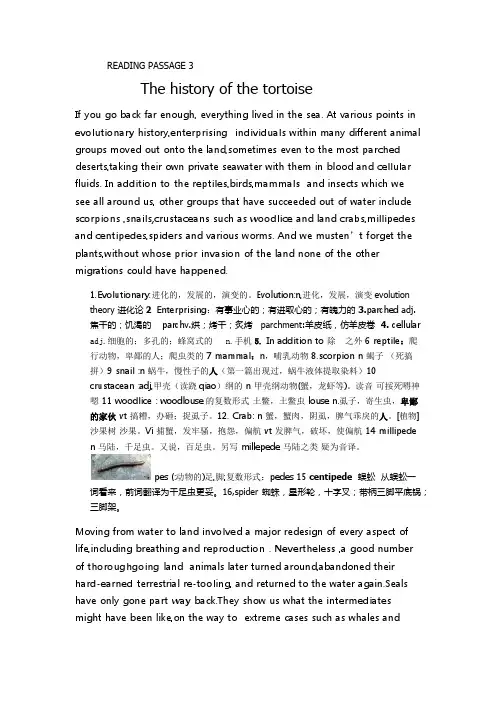
READING PASSAGE 3The history of the tortoiseIf you go back far enough, everything lived in the sea. At various points in evolutionary history,enterprising individual s within many different animal groups moved out onto the land,sometimes even to the most parched deserts,taking their own private seawater with them in blood and cellular fluids. In addition to the reptiles,birds,mammals and insects which we see all around us, other groups that have succeeded out of water includescorpion s ,snail s,crustaceans such as woodlice and land crab s,millipede s and centipede s,spider s and various worms. And we musten’t forget the plants,without whose prior invasion of the land none of the other migrations could have happened.1.Evolutionary:进化的,发展的,演变的。
Evolution:n,进化,发展,演变evolutiontheory 进化论2 Enterprising:有事业心的;有进取心的;有魄力的3.parched adj.焦干的;饥渴的parch v.烘;烤干;炙烤 parchment:羊皮纸,仿羊皮卷4. cellular adj.细胞的;多孔的;蜂窝式的 n.手机5. In addition to除之外6 reptile:爬行动物,卑鄙的人;爬虫类的7 mammal:n,哺乳动物8.scorpion n 蝎子(死搞拼)9 snail :n 蜗牛,慢性子的人(第一篇出现过,蜗牛液体提取染料)10 crustacean :adj,甲壳(读跷qiao)纲的 n 甲壳纲动物(蟹,龙虾等)。
剑桥雅思9Test3 Pessage1参考译文:对语言的态度
雅思为各位考生推荐复习材料-剑桥雅思9Test3 Pessage1阅读译文,相应的解析,请点击:剑桥雅思9Test3阅读Passage1答案解析。
PASSAGE 1 参考译文:对语言的态度对于语言进行系统、客观的研究并不容易。
语言学上的普通争论通常会升级为谩骂和论战。
语言属于所有人,所以大多数人认为他们有权保留自己对语言的看法。
而当看法出现分歧时,人们可能变得情绪激动。
语言用法方面的一点小事,就能像语言学教育政策中的重大问题一样很容易引起争论。
另外,语言是一种非常公开的行为,所以语言的不同用法很容易引起人们的注意与批评。
所有社会组成部分或者社会行为无一例外。
语言因素影响我们如何判断一个人的个性、智力、社会地位、教育程度、工作能力以及许多关于身份与社会生存的其他方面。
因此,当无意间发生语言攻击时,人们很容易伤害他人或受到伤害。
就其最通常的意义而言,规定主义认为某种语言向来就比其他语言具有更高的价值,并且这一点应该适用于整个语言社会。
该观点是特别针对语法和词汇而提出的,但也经常涉及发音。
这里提到的具有更高价值的语言通常指的是“标准”书面语言,尤其是在文学作品或最能体现这一特点的正式口语中。
该语言的支持者其说话或者写作的方法被称为“正确的”方法,而任何偏差都被认为是“错误的”。
对所有主要语言的研究都是约定俗成的,尤其在18世纪对语法与词典的编写过程中。
这些早期的语法学家有以下三个目标:(a)他们想把语言规则编写成文,证明看起来混乱的用法有其系统性;(b)找出一种方法来解决关于语言用法的争论;(c)指出他们所认为的普遍错误,以便“改善”语言。
该方法对语法“规则”的依赖最能体现出其独裁的本质。
其中一些用法是“约定俗成的”,要严格学习和遵守;而另外一些用法则是“禁止”的,是要避免的。
在早期,没有折中的衡量方法:语言用法非对即错,而语法家的任务不只是记录不同的语法,还要对其进行判断。
这些态度现在仍然伴随着我们,并且引起人们对保留语言标准的广泛关注。
矿产
矿产资源开发利用方案编写内容要求及审查大纲
矿产资源开发利用方案编写内容要求及《矿产资源开发利用方案》审查大纲一、概述
㈠矿区位置、隶属关系和企业性质。
如为改扩建矿山, 应说明矿山现状、
特点及存在的主要问题。
㈡编制依据
(1简述项目前期工作进展情况及与有关方面对项目的意向性协议情况。
(2 列出开发利用方案编制所依据的主要基础性资料的名称。
如经储量管理部门认定的矿区地质勘探报告、选矿试验报告、加工利用试验报告、工程地质初评资料、矿区水文资料和供水资料等。
对改、扩建矿山应有生产实际资料, 如矿山总平面现状图、矿床开拓系统图、采场现状图和主要采选设备清单等。
二、矿产品需求现状和预测
㈠该矿产在国内需求情况和市场供应情况
1、矿产品现状及加工利用趋向。
2、国内近、远期的需求量及主要销向预测。
㈡产品价格分析
1、国内矿产品价格现状。
2、矿产品价格稳定性及变化趋势。
三、矿产资源概况
㈠矿区总体概况
1、矿区总体规划情况。
2、矿区矿产资源概况。
3、该设计与矿区总体开发的关系。
㈡该设计项目的资源概况
1、矿床地质及构造特征。
2、矿床开采技术条件及水文地质条件。