
英语人教版八年级下册Unit2SectionA 1a-1c
Lesson plan for Unit 2I’ll help to clean up the city parks. Section A (1a-1c) 设计者:吴旅漫 单位:陆川县良田镇第二初级中学 The analysis of textbook The content of this lesson is from Go For It, Grade eight, Book 2, Unit Two. This unit is about volunteering and charity. In section A , it is about offering help. Students will learn some verbs and phrases such as: clean up, cheer, cheer up, give out, volunteer. While section 1a-1c is leading part in this unit, it needs to lead out how to offer help, which is a difficult part in this unit. By studying of this lesson, students are able to learn target language: “I hope to work outside. You could help to clean up the city parks. I’d like to help homeless people. You could ask hospitals to let you visit the kids and cheer them up.” Students are able to offer help to others when it is necessary. Also, this content is related to students’ life, they will be interested in this lesson. Also, for this lesson is the first lesson of this unit, it is very important for students. If students can master it well, it will be helpful for them to learn the rest of this unit. Teaching aims 1. Knowledge aims :(1) Ss are able to master some useful words and phrases: clean up cheer, cheer up, give out, volunteer (2)Ss are able to master some sentences: I hope to work outside. You could help to clean up the city parks. I’d like to help homeless people. You could ask hospitals to let you visit the kids and cheer them up 2. Ability aims :(1)Ss are able to learn how to use modal verb could. (2) develop students’ ability of listening and speaking. (3)Ss are able to offer help actively in real life. 3.Emotion aims : (1)It’s helpful for the Ss to cultivate the spirit of helping others. (2) It’s helpful for Ss to develop their sense of loving life. Teaching important points 1.Ss are able to master some useful words and phrases: clean up , cheer ,cheer up, give out, volunteer 2.Ss are able to master some sentences: I hope to work outside. You could help to clean up the city parks. I’d like to help homeless people. You could ask hospitals to let you visit the kids and cheer them up. 3. learn to master how to offer help. Teaching difficult points
1. Students learn to use the new phrasal verbs. 2. Students learn to express offering help with target language. 3. Students learn to make communications with target language. Teaching methods I will choose Communicative Approach in my lesson plan. In order to train students’ ability of speaking, I will use Communicative Approach in pair work. Teaching aids Blackboard , multi-media Teaching arrangement One lesson. (45minutes ) Teaching procedures Step 1 lead in(5minutes). 1. .Enjoy a song, and then ask students a question. 2. A free talk. Tell us something about last time you helped others. 3. How to offer help?From this, teacher can guide students to know the title of Unit2 I’ll help to clean up the city parks.
Step2 presentation (10 minutes) 1.Play a video to Ss and ask students two questions. “who are they?” “what do they do?” 2.Present new words with the help of PPT. volunteer v. 义务劳动,自愿做 volunteer to do sth. 义务自愿做某事 e.g. We volunteer to help the old people.我们自愿帮助老人。 clean up 打扫;清除 e.g. The students clean up their classroom every day. 学生们每天打扫教室。 cheer v. 欢呼; 喝彩 e.g. Cheer up. The news isn’t too bad. 振作起来,消息还不算太坏。 give out 分发;散发 e.g. We could help give out these food. 我们可以帮忙分发这些食物。 2.Ask Ss “How could we help people?” and show some pictures to Ss. Step3 discussion (8minutes) 1.guide Ss to read 1a. 2.Ask Ss to discuss with their partners and write the ways one could help others. 3. Ask Ss “What else could we do to help people?” Ste4 practice(15minutes) 1.Students listen and number the ways the boy and girl could help others in 1b. 2. listen again and ask Ss to complete the sentences . I’d like to ____ _ outside. You could help clean ___ __ the city parks. I’d like to ___ __ homeless people. You could give ___ __ food at the food bank. I’d like to cheer __ ___ sick kids. You could ____ _ them in the hospital. I’d like to help kids ____ _ their schoolwork. You could _______ in an after-school study program. 3.Ask Ss work in pairs to practice the conversation in the picture in 1a and then let Ss make other conversations using the information in 1b.
Step 5 Exercises(5minutes) ( )1. Let’s help ___ food at the food bank. A. to give out B. give up C. giving out ( )2. The boys volunteer three hours ___ up the park near their school. A. cleaning B. to clean C. cleaned ( )3.My best friend Alex failed in the math competition. I’d like to ___. A. dress him up B. pick him up C. cheer him up ( )4. My friend Tom volunteered ______ in the countryside two years ago. A. to work B. work C. working D. works ( )5. —Excuse me, I ______ find my hotel. —You could ask the policeman. A. can’t B. mustn’t C. needn’t D. shouldn’
人教版英语八年级下册 Unit 2 Section A 1a-2d

打扫(或清楚)干净 v. 欢呼;喝彩 (使)变得更高兴;(使)振奋起来
分发;散发 v. 义务做;自愿做 n. 志愿者
come up with put off
想出;提出(主意、 计划、回答等) 推迟
sign notice
n. 标志;信号 n. 通知;通告;注意 v. 注意到;意识到
hand out
分发
be volunteers in China (Taiyuan) International Coal & Energy New Industry Exposition
1 Listen and number the ways the boy b and girl could help others.
Offer your seat to the old, the children, or the woman holding a baby.
Make the old who are spending their rest laugh.
Any others?
1. Where’s Helen going to work this summer? She’s going to work in an old people’s home.
2. Did Tom volunteer in the old people’s home? Yes. He did that last summer.
A: We need to come up with a plan for the City Park Clean-Up Day.
B: Let’s have lunch first. A: No, we need to start now. Clean- Up Day
人教版英语八年级下册 Unit2 Section A 课时练习(有答案)
Unit2 I’ll help to clean up the city parkSection A (1a—2d)【基础训练】Ⅰ.要点词汇1.欢呼;喝彩2.志愿者3.标志;信号4.通告;注意5.孤独的;寂寞的Ⅱ.短语互译6.打扫(或清除)干净7.变得更高兴;振奋起来8.想出;提出9.曾经……;过去……10.分发;散发11.hope to do sth.12.help out 13.care for14.put off 15.call up16.put up 17.make a plan18.hand outⅢ.根据汉语意思完成句子19.他看起来很悲伤,我们来让他高兴起来。
He looks sad.Let’s him .20.你可以分发食物。
You could food.21.他们去年建立了一所学校。
They a school last year.22.我们需要提出一些想法。
We need some ideas.23.我希望见到我的笔友露西。
I my pen pal,Lucy.24.我们不能推迟召开这次会议。
We can’t the meeting.25.好多老人是孤独的。
A lot of old people .【综合运用】Ⅰ.用所给词的适当形式填空1.I hope (go) to Taiwan one day to enjoy the beautiful sights2.James used to (be) a shy boy.3.The boy sang a song (cheer) the sick girl up.4.They can’t put off (make) the plan for the party.5.Our teacher often asks us (discuss) questions in groups.6.Now people hope (eat) healthily and begin to care about the safety of food.7.When I was walking past the window,I noticed Wang Fei (copy) my homework.I really got annoyed.8.I used to (eat) dumplings,but these days I’m used to having bread and milk.Ⅱ.用方框中所给短语的适当形式填空1.Look! Lots of college students are cards on the street.2.He a plan for the meeting just now.3.Alice is helping her mother to the kitchen.4.The children quickly when I agreed to help them.5.She be thin,but now she is a little fat.Ⅲ.单项选择( )1.We can ask our parents us finish the work.A.helpB.helpingC.helpedD.to help( )2.You are not allowed to advertisements on this wall without special permission(允许).A.put downB.put onC.put upD.put off( )3.—Are you all ?—Yes.We always to help sick people in the hospital.A.volunteers,volunteerB.volunteer,volunteersC.volunteers,volunteersD.volunteer,volunteer( )4.At the party,I noticed her behind me.A.standingB.stoodC.to standD.stands( )5.I to school by bike,but now I .ed to go,used to walkinged to go,am used to walked to going,am used to walked to go,am used to walkingUnit 2 Section A (3a—4c)【基础训练】Ⅰ.要点词汇1.几个;数个;一些2.强烈的;强壮的3.感觉;感触4.满足;满意5.物主;主人6.独自;单独7.募集;征集8.joy journeyⅡ.短语互译10.参加……选拔;试用11.实现12.停止做某事13.在……岁时14.同时15.放弃16.be busy with sth. 17.try to do sth.18.would like to do sth. 19.work forⅢ.根据汉语意思完成句子20.我不知道如何关心动物。
人教版英语八年级下册Unit2 Section B (1a-1c)
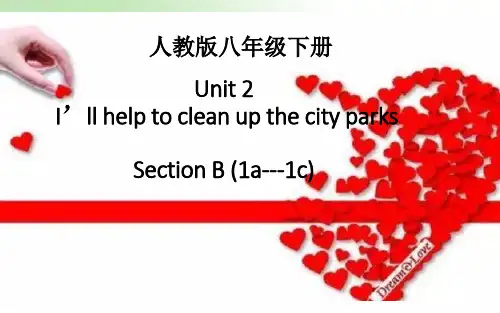
Role---play:
A: What dou you do,Jimmy? B: I fix up ...
.......
Fill in the blanks with the appropriate phrasal verbs or infinitives.
Jimmy is a good boy.He likes _________very much.he often finds or buys _________ bikes that nobody wants. Then he ____________ up the bikes and gives them ______to kids who don’t have enough money to buy their own bikes.The reason why he does this his father often ________ to help people and Jimmy takes _______his father.Jimmy’s parents are __________ of him.Now he has _________out of money so he can’t buy any ________ old bikes.He needs to come up ________ some ways of getting money,or he will have to stop.
Make sentences
run out of take after fix up give away
my bike money my father old clothes
1. I gave away my bike to a children’s home.
初中英语人教版八年级下册unit 2 Section A 1a-2d

help to give out food at the food bank
city n. 城市
e.g. The library is in the north of the city. 图书馆在城市的北部。
notice n. 公告牌; 通告;布告
e.g. Please read the list on the notice board. 请读公告板上的名单。
or just talking to them. They told me stories about the past and how things used to be. Helen: That sounds interesting. Tom: Yeah, a lot of old people are lonely. We should listen to them and care for them. Helen: You’re right. I mean, we’re all going to be old one day, too.
___ 4 The girl could volunteer in an after-school study program to teach kids. ___ 1 The boy could help to clean up the city parks.
1c
Practice the conversation in the picture above. Then make other conversations using the information in 1b.
Who are they? They’re volunteers. They usually volunteer to help others.
人教版英语八年级下册Unit1What’s the matterSection A 1a-1c课件
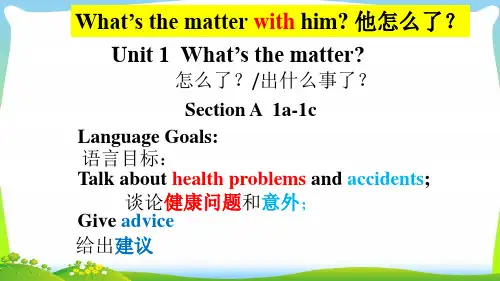
手臂
背部
耳朵
_i_ eye _b_ foot _a_ hand
眼睛
_j_ head
脚(复数feet) 手
_l_ leg _c_ mouth
头
腿
嘴
_d_ neck m__nose _k_ stomach
脖颈 鼻子 胃;腹部
_f_ tooth
牙齿(复数:teeth)
What’s the matter with him/her?
Homework
1. 听力材料抄一遍 2. U1单词matter-hurt,三英一汉抄一遍。
for the first time. 8. If you agree, you can nod(点头) your _h_e_a_d_.
Learning Goals: 1、听录音, 完成相应练习; 2、翻译听力材料,熟读并role-play; 3、能用英语谈谈自己哪里不舒服:
—What’s the matter? —I have a cold.
have a cold 得了流感
have a sore back 背疼
What’s the matter with him/her?
get a stomachache 胃痛
have a toothache 牙疼
What’s the matter with him/her?
have a fever 发烧
New words
matter sore stomachache foot neck
n. 问题;事情 adj. 疼痛的;酸痛的 n.胃痛;腹痛 n. 脚;足 n. 颈;脖子
stomach throat fever lie rest cough
八年级英语下册Unit2SectionA1a_2d词句梳理新版人教新目标版
11. _p_u_t_o_f_f_d_o_i_n_g_s_t_h_._推迟做某事 12. ____h_e_l_p_…__o_u_t____帮助……某人摆脱(困境) 13. _____u_s_e_d__to______曾经……;过去…… 14. _____c_a_r_e_f_o_r_____照顾;非常喜欢→ ____l_o_o_k_a_f_t_e_r____照顾
Unit2 I’ll help to clean up the city parks.
单元词句梳理 Section A(1a-2d)
必背单词
1. cheer (v.) 欢呼;喝彩→ _c_h_e_e_r_u__p_(使) 变得更高兴;(使) 振奋 起来
2. volunteer (v.) 义务做;自愿做(n.) 志愿者 3. sign (n.) 标志;信号 4. notice (n.) 通知;通告;注意→ __n_o_t_ic_e_d__ (v.) 注意到;意识到 5. lonely (adj.) 孤独的;寂寞的
必背短语
6. __h_e_lp__to__d_o_s_t_h_.__帮助做某事 (to 可以省略) 7. ____c_l_e_a_n_u_p_____打扫(或清除)干净 8. _____g_iv_e__o_u_t____分发;散发→ ____h_a_n__d_o_u_t____分发 9. __c_o_m__e_u_p__w_i_th___想出;提出(主意、计划、回答等) 10. _____c_a_ll_u_p______打电话给(某人);征召
八年级下册英语人教版 Unit 2 习题课件
八年级下册 人教版
Unit 2 I'll help to clean up the city parks.
第一课时 Section A (1a2d)
、根据句意及汉语提示完成下列句子。每空一词。 1.I didn't see these ____n_o_ti_c_e_s(通知) on the wall. 2.Look at the ____s_ig_n_(标志)!It shows us that we can turn left at this
Jim is a middle school student.He adopted (收养) three homeless dogs three months ago.He 16. cared for them and the dogs became heavier and healthier.Jim loved them very much,but now he feels 17. worried .He has some problems.First,he has run out 18. of his money to buy food for dogs.Second,the dogs are too big and there isn't enough 19. space for them in his house.Third,the dogs are very 20. noisy ,so Jim's parents can't stand
Jane wants to study English and she's going to study French ____a_t__th_e__s_a_m_e__ti_m.e
Unit2SectionA(1a-2d)教案人教版英语八年级下册
Unit 2 I’ll help to clean up课时1Section A(1a2d)课时教学目标1. 能听懂有关志愿活动话题的听力材料,并能抓住关键词。
2. 能恰当地表达自己志愿服务哪些场所,志愿帮助哪些人和志愿从事哪些公益活动。
3. 能正确运用sb. could do 来表达志愿服务意愿。
教学重点:1. Key vocabulary:cheer, volunteer, sign, notice, lonelycheer up,clean up,e up with, put off, hand out, call up, used to, care for, give out2. Key sentences:a. The girl could visit the sick kids in the hospital to cheer them up.b.The girl could volunteer in an after school study program to teach kids.c.We need to e up with a plan to tell people about the city park cleanup.d. We can’t put off making a plan.e. We could each call up 10 students and ask them to e.f. I’m making some plans to work in an old people’s home this summer.3. Structure:a. put off doingb. to do/ not to do...教学难点:The students could get the usages of to do/ not to do.教学过程Step 1 LeadinThe teacher shows a video of International V olunteer Day (December 5th) and asks students to find what people do to help others. At last, theteacher tells students that they give people help without hope of reward. Step 2 Work on 1a1. Ask students to look at the ways they could help people in the picture.2. Ask students to list other ways they could help people.3. Give students more volunteer jobs to choose.Textbook Answers Answers will vary. Sample answers:coaching/teaching kids in a sport or hobby; donating clothes/toys/food to people who need them; helping disabled/elderly people withchores/shopping; teaching the elderly to use puters/email, etc.Key points1. clean up 打扫干净2. volunteer n. 志愿者volunteer work 志愿工作;v. 自愿做volunteer to do sth. 主动要求做某事Step 3 Listening (1b)1. Play the tape and ask students to listen and number the ways the boy and the girl could help others.2. Choose one student to read the sentences in order to check the answers. Textbook Answers 3, 2, 4, 1Key points1. cheer v. 欢呼,喝彩;cheer for 为……欢呼/ 喝彩;cheer on(赛跑、比赛等中)以喝彩声鼓励,为(某人)加油;cheer (sb.) up(使某人)变得高兴起来;振奋起来2. give out 分发,散发;用完,耗尽;发出,放出(热、光等)Step 4 Conversation (1c)1. Let students work in pairs and practice the conversation in the picture in 1a.2. Show the activities in 1b to students and let students make conversations.3. Ask some students to act them out.Key points1. I hope to do sth. 我想做某事(表意愿)2. sb. could do sth. 某人可以做某事(表建议)Step 5 Listening(2a&2b)Work on 2a1. Let students listen and check the pictures.2. Ask students what other things they can do.Textbook Answers b, c, eWork on 2b1. Let students listen again and fill in the blanks.2. Show some phrases and sentences used in 2b to let student match themwith pictures in 2a.Textbook Answers 1. e up with 2. put off 3. put up 4. hand; out 5. call up Key points(针对训练习题见上课课件PPT)1. e up with 提出,想出(主意、计划、回答等)2. put off 推迟put off doing sth. 推迟做某事3. sign n. 标志,信号,指示牌;v. 签(名);sign in/out 签到/ 退;signup for 报名(参加课程)4. notice n. 注意;通告;通知put up notices 张贴通知v. 意识到,注意到notice sb. doing sth. 注意到某人正在做某事;notice sb. do sth.注意到某人做某事5. hand out 分发6. call up 打给(某人);征召,召集Step 6 Conversation(2c&2d)Work on 2c1. The teacher makes a conversation as B with all the students as A;2. Ask students to work in pairs to roleplay more conversations.Work on 2d1. Let students work in pairs. Ask students to read and roleplay theconversation.2. Choose some pairs to present the conversation in class.Key points(针对训练习题见上课课件PPT)1. make plans to do sth. 制订计划做某事2. help out with 帮助解决困难3. used to do sth. 过去经常做某事【拓展】be/get used to doing sth. 习惯做某事4. lonely adj. 感到孤独的【拓展】alone adj. 单独的;独自的【辨析】lonely 和alone:lonely 强调主观上的孤独感;alone 侧重说明独自一人,只表示客观状态。
人教版英语八年级下册Unit 1 Section A (1a-2c)同步课件
Listen again and fill in the blanks.
Name Problem Sarah has a cold
Reason/Result
didn’t put on her jacket (when it got windy).
_____ _______ when playing soccer.
(我牙疼). It’s terrible! I can’t really eat anything either. It hurts a lot.
Fill in the blanks according to the Chinese.
Nurse: What's the matter, Judy? Judy: I'm sorry, but it's very difficult for me to talk. Nurse: Oh, dear. What's the matter? Judy: I _t_a_l_k_e_d_t_o_o_m__u_c_h__ (讲了太多话) yesterday and didn’t _d_r_in_k__e_n_o_u_g_h__w_a_t_er
八年级下
学 习目标
1
能听懂健康问题与事故的英文表达,并能根据内容成相关练习。
2
通过听力理解,使用相关词汇和表达谈论身体健康与急救的话题。
3 能简单地谈论健康问题与事故,能就健康与安全问题提出简单的建议。
Lead in
I had a big meal ! What do you think of the meal ?
but I didn’t __p_u_t_o_n__ (穿上) on my jacket. Now __I_h_a_v_e__a_c_o_ld__ (感冒了).
2014新人教版八年级英语下unit2 1a-2c
四川汶川大地震重灾区绵竹东汽小学、东汽幼儿 园6月1日迎来了一位特殊客人,这位穿着迷彩 服、戴着红十字会会标、身体壮健的年轻男子, 轻声问小朋友们儿童节想要什么礼物。 “我要书包、我要文具盒、我要花裙子、我要房 子……”在地震中受灾的孩子们没有失去天真。年 轻男子当场表态:“你们的心愿我都会满足,叔 叔会回来帮你们建震不塌的房屋。” 这位年轻男子就是南京黄埔投资集团董事长陈光 标,2007年,他以捐赠1.81亿元被称为 “中国首善”。汶川大地震发生后两小时,他第 一时间将公司原本打算北上的60台重型工程设 备运送至四川灾区。他自己参加营救幸存者,亲
在给出可行建议时,我们可以使用:
You could…
1a. Look at the ways you could help people in the picture. Then list other ways. The ways : help clean up the city parks visit sick children in the hospital help stop hunger Other ways you could help people: help children with their schoolwork visit old people at the old people’s home
hand them out
Call up
And we could each call up 10 students and ask them to come.
Let’s learn some new words: come up with 想出,提出(主意,计 划,回答等 。 put off doing推迟(做)某事 sign 标志,信号 notice: n.通知,通告,注意。 V. 注意到;意识到 hand out: 分发 call up: 打电话给(某人);征召。