
非限定性定语从句与限制性定语从句讲解与练习
定语从句知识点讲解一
一、定语从句的概念
在复合句中,修饰某一名词或代词的从句叫定语从句。被修饰的名词或代词叫先行词,定语从句一般放在先行词的后面。
二、定语从句的关系词
引导定语从句的关系词有关系代词和关系副词,常见的关系代词包括that, which, who(宾格whom,所有格whose)等,关系副词包括where, when, why等。关系代词和关系副词放在先行词及定语从句之间起连接作用,同时又作定语从句的重要成分。
三、定语从句的分类
根据定语从句与先行词的关系,定语从句可分为限制性定语从句及非限制性定语从句。限制性定语从句紧跟先行词,主句与从句不用逗号分开,从句不可省去,非限制性定语从句主句与从句之间有逗号分开,起补充说明作用,如省去,意思仍完整。
四、关系代词的用法
1. that 既可以用于指人,也可以用于指物。在从句中作主语或宾语,作主语时不可省略,作宾语可省略。
例如:
Mary likes music that is quiet and gentle.玛丽喜欢轻柔的音乐。(that作主语)
The coat (that) I put on the desk is blue.我放在桌子上的那件外套是蓝色的。(that作宾语)
2.which用于指物,在句中作主语或宾语,作主语不可省略,作宾语可省略。
例如:
The building which stands near the train station is a supermarket.位于火车站附近的那座大楼是一家超市。(作主语)
The film (which) we saw last night was wonderful. 我们昨天晚上看的那部电影很好看。(作宾语)
3.who, whom用于指人,who 用作主语,whom用作宾语。在口语中,有时可用who代替whom, 也可省略。
例如:The girl who often helps me with my English is from England.经常在英语方面帮助我的那个女孩是英国人。(作主语)Who is the teacher (whom) Li Ming is talking to? 正在与李明谈话的老师是谁?(作宾语)
注意:
(1)当定语从句中含有介词,介词放在句末时,who, that, which可省略,但介词在关系代词前时,只能用“介词+which/whom”结构。
例如:This is the house in which we lived last year.这是我们去年居住的房子。
Please tell me from whom you borrowed the English novel.请告诉我你从谁那借的这本英文小说。
(2)含有介词的固定动词词组中,介词不可前置,只能放在原来的位置上。
例如:This is the person whom you are looking for. 这就是你要找的那个人。
(3)that 作介词的宾语时,介词不能放它的前面,只能放在从句中动词的后面。
例如:The city that she lives in is very far away.她居住的城市非常远。
(4)关系词只能用that的情况:
a. 先行词被序数词或形容词最高级所修饰,或本身是序数词、基数词、形容词最高级时,只能用that,而不用which.例如:
He was the first person that passed the exam. 他是第一个通过考试的人。
b.被修饰的先行词为all, any, much, many, everything, anything, none, the one等不定代词时,只能用that,而不用which.例如:
Is there anything that you want to buy in the shop? 你在商店里有什么东西要买吗?
c.先行词被the only, the
very, the same, the last, little, few
等词修饰时,只能用that,而不用which.例如:
This is the same bike that I lost.这就是我丢的那辆自行车。
d. 先行词里同时含有人或物时,只能用that, 而不用which.例如:
I can remember well the persons and some pictures that I saw in the room.我能清楚记得我在那个房间所见到的人和一些照片。
e.以who或which引导的特殊疑问句,为避免重复,只能用that.例如:
Who is the girl that is crying? 正在哭泣的那个女孩是谁?
f.主句是there be 结构,修饰主语的定语从句用that,而不用which. 例如:There is a book on the desk that belongs to Tom. 桌子上那本书是汤姆的。
(5)关系词只能用which,而不用that 的情况:
a.先行词为that, those时,用which, 而不用that.
例如:What’s that which is under the desk? 在桌子底下的那些东西是什么?
b.关系代词前有介词时,一般用which,而不用that.
例如:This is the room in which he lives. 这是他居住的房间。
c.引导非限制性定语从句,用which, 而不用that.
例如:Tom came back, which made us happy. 汤姆回来了,这使我们很高兴。
五、关系副词的用法
(1)when指时间,其先行词表示时间,在句中作时间状语。
例如:This was the time when he arrived.这是他到达的时间。
(2)where指地点,其先行词表示地点,在句中作地点状语。
例如:This is the place where he works.这是他工作的地点。
(3)why 指原因,其先行词是原因,起原因状语作用。
例如:Nobody knows the reason why he is often late for school. 没人知道他为什么上学总迟到。
六.限制性定语从句
1. 限制性定语是指定语从句紧跟它所修饰的中心名词或代词之后,没有逗号分开。
2. 引导词:分为关系代词和关系副词。
(1) 关系代词引导的定语从句:
that:指代人、事物,作主语、宾语,做宾语时可以省略
who:指代人,做主语
whom:指代人,做宾语,可以省略。它在口语和非正式用语中常用who代替,可以省略
The man who\whom you met just now is my brother.
which:指代事物,做主语、宾语。做宾语可以省略
whose:指代人、物,做定语,其后直接加名词
He has a friend whose father is a doctor.
The classroom whose door is broken will soon be repaired.
指物时常用以下结构代替:
The classroom whose door is broken will soon be repaired.
——The classroom the door of which is broken will soon be repaired
(2) 关系副词引导的定语从句:
where:指地点,在定语从句中做地点状语
Shai hai is the city where I was born\
The house where I live ten years ago has been pulled down
when: 指时间,在定语从句中做时间状语
I still remember the day when I first came to the school
why: 指原因,在定语从句中做原因状语
Please tell me the reason why you missed the plane
注意:
关系副词引导的定语从句都可以用“介词+关系代词”引导的定语从句来代替
Shai hai is the city where\in which I was born
I still remember the day when\on which I first came to the school
Please tell me the reason why \ for which you missed the plane
3. 注意
(1) 限制性定语从句中只能用that的几种情况:
A
当先行词是anything, everything, nothing (something 除外), few, all, none, little, some等代词时,或者是由every, any, all, some, no, little, few, much等代词修饰时 ,要用that
Have you taken down everything that Mr. Li has said? There seems to be nothing that seems impossible for him in the world.
All that can be done has been done.
B 当先行词是序数词或被序数词修饰,如:first\last\next等
The first place that they visited in London was the Big Ben.
C 当先行词是形容词最高级或被形容词最高级修饰时
This is the best film that I have seen.
D 当形容词被the very, the only 修饰时
This is the very dictionary that I want to buy,
After the fire in his house, the old car is the only thing that he owned.
E 当先行词前面有who, which等疑问代词时
Who is the man that is standing there?
Which is the T-shirt that fits me most?
F 当先行词既有人,也有动物或者物体时
Can you remember the scientist and his theory that we have learned?
(3) 以the way为先行词的定语从句通常由in which, that引导,而且通常可以省略。
The way in which/ that/./ he answered the question was surprising
高中语法难点-限制性定语从句和非限制性定语从句的判断

限制性定语从句和非限制性定语从句的判断
一.限制性定语从句在意义上有“涉他性”,而非限制性定语从句在意义上有“唯一性”
试比较 :
I have a brother who works in a chemical works.
我有一个在化工厂工作的哥哥。
(言外之言:我还有别的哥哥,他或他们不在化工厂工作)
I have a brother, who works in a chemical works.
我有一个哥哥,他在化工厂工作。
(暗示再没有别的哥哥了)
All the books there which have pictures in them, were written by them.
那儿所有有插图的书都是他们写的。
(言外之言:那儿还有没有插图的书,而那些书不是他们写的)
All the books there, which have pictures in them were written by them.
那儿所有的书都是他们写的,书中有插图。
(暗示那儿没有别的书了)
二.当先行词为专有名词时其从句通常是非限制性的因为专有名词是某人、地方、机构等特有的名称,无需再加限定
例如 :
Abraham Lincoln, who led the United States through these years, was murdered on
April 14, 1865 at a theatre in Washington.
亚伯拉罕·林肯领导美国度过了这几个年头,可他却于1865年4月14日在华盛顿的一家戏院被暗杀了。
One of the most colourful figures in boxing history was Daniel Mendoza who was
born in 1764. 但尼尔孟多亚是拳击史上最引人注目的人物之一,他生于1764年。
如果专有名词前有定冠词,其后的定语从句可能是限制性的,因为这时有可能特指两个或两个以上同名的专有名词中的一个。
限制性定语从句与非限制性定语从句的区别
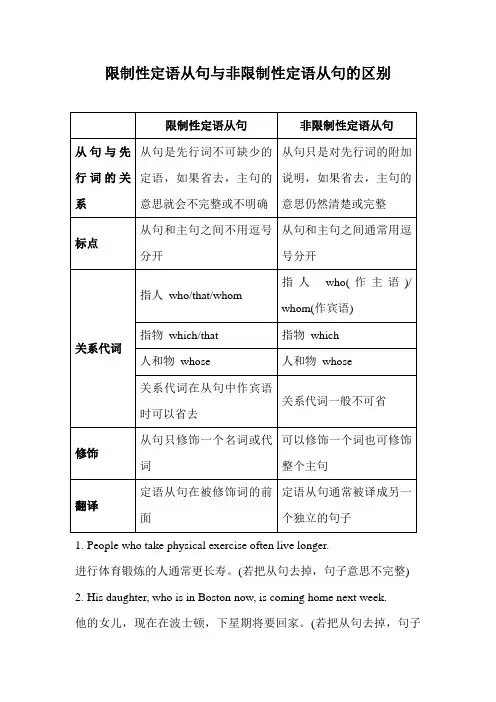
限制性定语从句与非限制性定语从句的区别
限制性定语从句 非限制性定语从句
从句与先行词的关系 从句是先行词不可缺少的定语,如果省去,主句的意思就会不完整或不明确 从句只是对先行词的附加说明,如果省去,主句的意思仍然清楚或完整
标点 从句和主句之间不用逗号分开 从句和主句之间通常用逗号分开
关系代词 指人 who/that/whom 指人 who(作主语)/
whom(作宾语)
指物 which/that 指物 which
人和物 whose 人和物 whose
关系代词在从句中作宾语时可以省去 关系代词一般不可省
修饰 从句只修饰一个名词或代词 可以修饰一个词也可修饰整个主句
翻译 定语从句在被修饰词的前面 定语从句通常被译成另一个独立的句子
1. People who take physical exercise often live longer.
进行体育锻炼的人通常更长寿。(若把从句去掉,句子意思不完整)
2. His daughter, who is in Boston now, is coming home next week.
他的女儿,现在在波士顿,下星期将要回家。(若把从句去掉,句子意思仍然完整)
3. I have a sister who is a doctor. 我有一个当医生的姐姐。(姐姐可能不止一个)
4. I have a sister, who is a doctor. 我有一个姐姐,她是一名医生。(只有一个姐姐)
5. Peter drove too fast, which was dangerous.
彼得开车太快了,这是很危险的。(which 指代整个主句)
6. He changed his mind, which made me very angry.
他改变了主意,这使我很生气。(which 指代整个主句)
7. Her father, who has a lot of money, wishes her to study abroad.
2022高考英语语法讲解-限制性和非限制性定语从句的区别
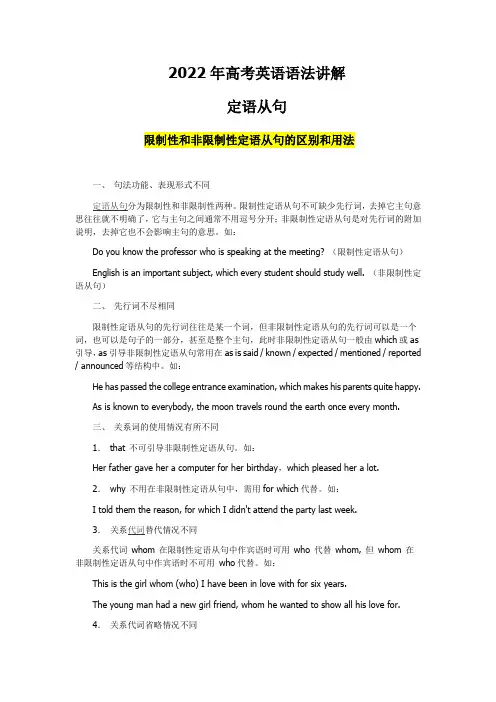
2022年高考英语语法讲解
定语从句
限制性和非限制性定语从句的区别和用法
一、 句法功能、表现形式不同
定语从句分为限制性和非限制性两种。限制性定语从句不可缺少先行词,去掉它主句意思往往就不明确了,它与主句之间通常不用逗号分开;非限制性定语从句是对先行词的附加说明,去掉它也不会影响主句的意思。如:
Do you know the professor who is speaking at the meeting? (限制性定语从句)
English is an important subject, which every student should study well. (非限制性定语从句)
二、 先行词不尽相同
限制性定语从句的先行词往往是某一个词,但非限制性定语从句的先行词可以是一个词,也可以是句子的一部分,甚至是整个主句,此时非限制性定语从句一般由which或as引导,as引导非限制性定语从句常用在as is said / known / expected / mentioned / reported
/ announced等结构中。如:
He has passed the college entrance examination, which makes his parents quite happy.
As is known to everybody, the moon travels round the earth once every month.
三、 关系词的使用情况有所不同
1. that 不可引导非限制性定语从句。如:
Her father gave her a computer for her birthday,which pleased her a lot.
2. why 不用在非限制性定语从句中,需用for which代替。如:
I told them the reason, for which I didn't attend the party last week.
定语从句详解 练习
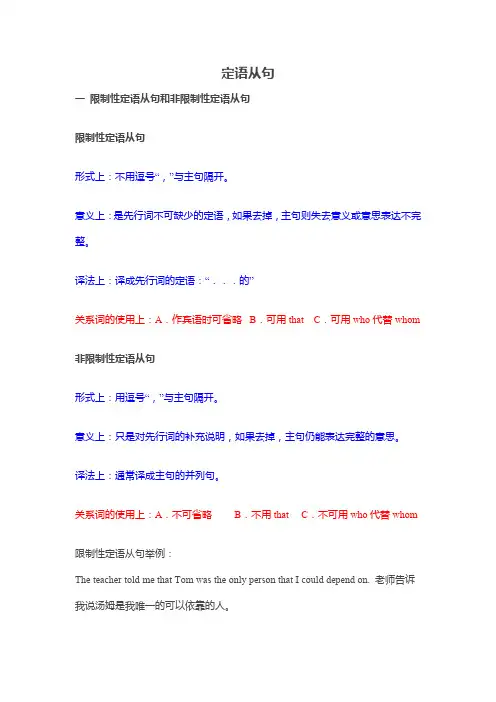
定语从句
一限制性定语从句和非限制性定语从句
限制性定语从句
形式上:不用逗号“,”与主句隔开。
意义上:是先行词不可缺少的定语,如果去掉,主句则失去意义或意思表达不完
整。
译法上:译成先行词的定语:“...的”
关系词的使用上:A.作宾语时可省略B.可用thatC.可用who代替whom
非限制性定语从句
形式上:用逗号“,”与主句隔开。
意义上:只是对先行词的补充说明,如果去掉,主句仍能表达完整的意思。
译法上:通常译成主句的并列句。
关系词的使用上:A.不可省略B.不用thatC.不可用who代替whom
限制性定语从句举例:
TheteachertoldmethatTomwastheonlypersonthatIcoulddependon.老师告诉我说汤姆是我唯一的可以依靠的人。Chinaisacountrywhichhasalonghistory.中国是一个历史悠久的国家。
InthestreetIsawamanwhowasfromAfrica.在街上我看到一个来自非洲的人。
非限制性定语从句举例:Hismother,wholoveshimverymuch,isstrictwithhim.他妈妈十分地爱他,对他要求很严格。China,whichwasfoundedin1949,isbecomingmoreandmorepowerful.中国是1949年成立的,现在正变得越来越强大。IhavebeentoHangzhou,whichisaverybeautifulcity.我去过杭州,它是一个非常美丽的城市。
二关系代词as和which引导的定语从句
as和which引导非限制性定语从句时,其用法有相同之处,也有不同之处。具体情况是:
1.as和which都可以在定语从句中做主语或宾语,代表前面整个句子。如:
Hemarriedher,as/whichwasnatural.他跟她结婚了,这是很自然的事。
Heishonest,as/whichwecansee.他很诚实,这一点我们看得出来。
备战高考英语 考点一遍过 专题23 限制性定语从句与非限制性定语从句(含解析)
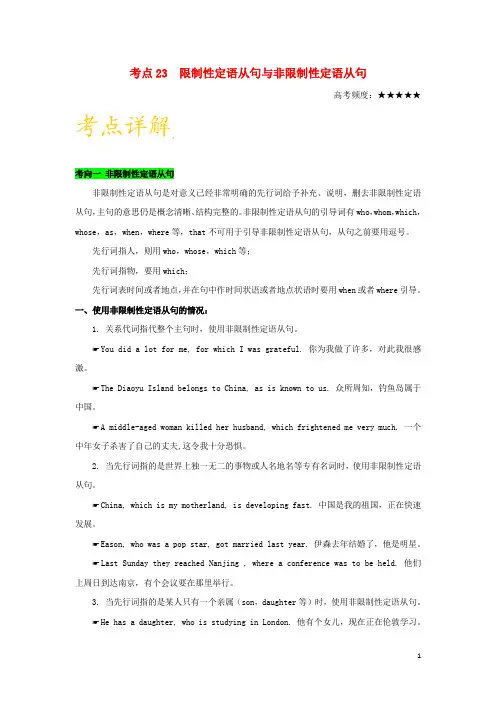
1 考点23 限制性定语从句与非限制性定语从句
高考频度:★★★★★
考向一 非限制性定语从句
非限制性定语从句是对意义已经非常明确的先行词给予补充、说明,删去非限制性定语从句,主句的意思仍是概念清晰、结构完整的。非限制性定语从句的引导词有who,whom,which,whose,as,when,where等,that不可用于引导非限制性定语从句,从句之前要用逗号。
先行词指人,则用who,whose,which等;
先行词指物,要用which;
先行词表时间或者地点,并在句中作时间状语或者地点状语时要用when或者where引导。
一、使用非限制性定语从句的情况:
1. 关系代词指代整个主句时,使用非限制性定语从句。
☛You did a lot for me, for which I was grateful. 你为我做了许多,对此我很感激。
☛The Diaoyu Island belongs to China, as is known to us. 众所周知,钓鱼岛属于中国。
☛A middle-aged woman killed her husband, which frightened me very much. 一个中年女子杀害了自己的丈夫,这令我十分恐惧。
2. 当先行词指的是世界上独一无二的事物或人名地名等专有名词时,使用非限制性定语从句。
☛China, which is my motherland, is developing fast. 中国是我的祖国,正在快速发展。
☛Eason, who was a pop star, got married last year. 伊森去年结婚了,他是明星。
☛Last Sunday they reached Nanjing , where a conference was to be held. 他们上周日到达南京,有个会议要在那里举行。
限制性定语从句和非限定性定语从句
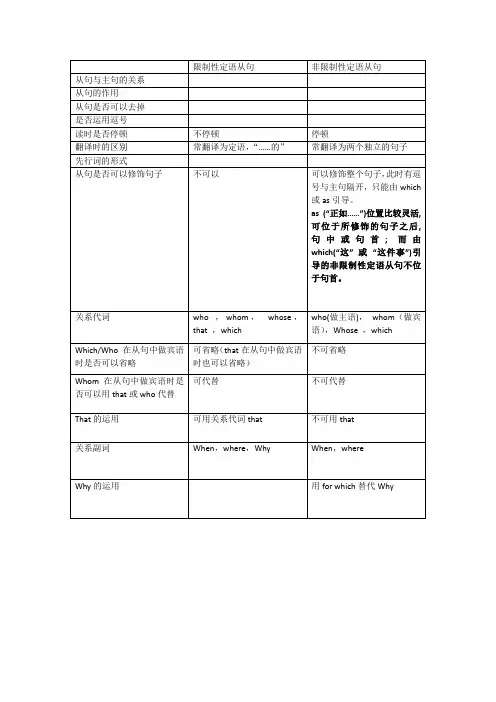
限制性定语从句 非限制性定语从句
从句与主句的关系
从句的作用
从句是否可以去掉
是否运用逗号
读时是否停顿 不停顿 停顿
翻译时的区别 常翻译为定语,“……的” 常翻译为两个独立的句子
先行词的形式
从句是否可以修饰句子 不可以 可以修饰整个句子,此时有逗号与主句隔开,只能由which或as引导。
as (“正如……”)位置比较灵活,
可位于所修饰的句子之后,
句中或句首; 而由
which(“这” 或 “这件事”)引导的非限制性定语从句不位于句首。
关系代词 who ,whom, whose,
that ,which who(做主语), whom(做宾语),Whose ,which
Which/Who 在从句中做宾语时是否可以省略 可省略(that在从句中做宾语时也可以省略) 不可省略
Whom在从句中做宾语时是否可以用that或who代替 可代替 不可代替
That的运用 可用关系代词that 不可用that
关系副词 When,where,Why When,where
Why的运用 用for which替代Why
高中英语:限制性与非限制性定语从句
高中英语:限制性与非限制性定语从句
考向一 非限制性定语从句
非限制性定语从句是对意义已经非常明确的先行词给予补充、说明,删去非限制性定语从句,主句的意思仍是概念清晰、结构完整的。非限制性定语从句的引导词有who,whom,which,whose,as,when,where等,that不可用于引导非限制性定语从句,从句之前要用逗号。
先行词指人,则用who,whose,which等;
先行词指物,要用which;
先行词表时间或者地点,并在句中作时间状语或者地点状语时要用when或者where引导。
一、使用非限制性定语从句的情况:
1. 关系代词指代整个主句时,使用非限制性定语从句。
☛You did a lot for me, for which I was grateful.
你为我做了许多,对此我很感激。
☛The Diaoyu Island belongs to China, as is known to us.
众所周知,钓鱼岛属于中国。
☛A middle-aged woman killed her husband, which frightened
me very much.
一个中年女子杀害了自己的丈夫,这令我十分恐惧。 2. 当先行词指的是世界上独一无二的事物或人名地名等专有名词时,使用非限制性定语从句。
☛China, which is my motherland, is developing fast.
中国是我的祖国,正在快速发展。
☛Eason, who was a pop star, got married last year.
伊森去年结婚了,他是明星。
☛Last Sunday they reached Nanjing , where a conference was
to be held.
他们上周日到达南京,有个会议要在那里举行。
3. 当先行词指的是某人只有一个亲属(son,daughter等)时,使用非限制性定语从句。
理解限制性与非限制性定语从句的区别
- 149
-校园英语 / 基础教育
理解限制性与非限制性定语从句的区别
广东省佛山市第一中学/冯艳华定语从句是英语三大类从句中最难的一类,原因主要在于英语中的定语从句与英语中普通的定语不同,更不同于汉语中的定语。学生学习定语从句有很多难点,其中之一就是正确区分限制性与非限制性定语从句。一、巧辨区别根据定语从句与先行词之间关系的紧密程度,定语从句被分为限制性定语从句和非限制性定语从句。具体我们可以从形式、作用、意义及关系词方面去理解其区别。下面试比较一组句子。①His wife who is a doctor is not at home at the moment.(限制性定语从句)②His wife, who is a doctor, is not at home at the moment. (非限制性定语从句)1.形式上的区别。句1中的从句为限制性定语从句,从句与主句不用逗号隔开;句2中的从句为非限制性定语从句,从句与主句用逗号隔开。2.作用上的区别。句1中的限制性定语从句是先行词不可缺少的定语,起修饰或限制先行词的作用。从句不可去掉,否则主句不完整或不明确。句子中的他可能有几个妻子,其中做医生的妻子现在不在家中。从句不可去掉,否则不知道指的是哪个妻子。句2中的非限制性定语从句对先行词起附加的补充解释说明。对整个句子的意义并不重要,即使去掉,原句仍有意义。句子中的他只有一个妻子,从句只是补充说明她妻子是做医生的。3.意义上的区别。限制性定语从句通常翻译为先行词的定语“……的”,非限制性定语从句通常译为与主句并列的分句。因此句1译为“他的那个做医生的妻子现在不在家中。”句2译为“他的妻子是做医生的,她现在不在家中。”4.关系词上的区别。句1中的限制性定语从句中的关系词who是可以换成that的,句2则不行。也就是说,非限制性定语从句的关系词是不能用that的(先行词是物也不行)。除此之外,大家要注意,在非限制性定语从句中,关系词作宾语时是不可省略的,如One of the friendliest people in our village is Mr. Johnson, whom we all love very much. (whom不能省略);还有在非限制性定语从句中which可以指代整个主句内容,限制性定语从句中的which却不行。如 “The fire lasted for a whole night, which caused great damage.”(which 指代整个主句内容“The fire lasted for a whole night”)。二、错误例析学生在使用定语从句中会出现一些错误,其中就是限制性和非限制性定语从句的误用,以下是一些例子。1.故宫是很多年前建的,现在闻名于世。误:The Forbidden City which was built many years ago is known all over the world.分析:故宫此处并不需要限制性的定语来说明是哪个故宫,因为故宫只有一个,非常明确。所以此处应改为非限制性定语从句,进行补充说明。这个句子应该为“The Forbidden City, which was built many years ago, is known all over the world.”2.我就读的学校是佛山最好的学校,而且离我家不远。误:My school which is the best middle school in Foshan is not far away from my home.分析:此句中的学校有“My”修饰,所指已经非常明确,定语从句只是对其进行补充说明,去掉句意也完整。因此此处应该用非限制性定语从句。这个句子应该为My school, which is the best middle school in Foshan, is not far away from my home.3.这就是我第一次遇见她的地方。误:This is the place, where I met her for the first time.分析:此处去掉定语从句后,句子不完整,“the place”所指的地点不明确,因此应该用限制性定语从句来限定性修饰the place。这个句子应该为This is the place where I met her for the first time.4.他考试没及格,这让他父母很失望。误:He failed the exam which made his parents very disappointed.分析:which引导的定语从句在这里修饰的不是先行词the game,而是整个句子He failed the exam,因此要用非限制性定语从句。这个句子应该为“He failed the exam, which made his parents very disappointed.”其中which指代前面整个句子。f的形状就像围巾围在脖子上的形状,脖子上有疤,故而要围围巾;handkerchief(hand:手,chief:主要的,手帕主要是用来擦手的。)这样联想,以旧带新,实践证明,事半功倍。在英语教学中要达到拓展学生创新思维的目的,我认为必须把新的教育理念渗透到每一个教学环节中,这样高中语法教学上才会找到新的出路。综上所述,为了让学生达到用英语来交际这一目的,在高中英语教学中老师们不能“淡化”语法教学,而是要如何“优化”语法教学。老师们应更新传统的语法教学观念,寻找到一种既有利于拓展学生的发散性思维,又有利于培养学生总结语言规律的能力的新式的语法教学方法。我深信:只要每位教师在高中语法教学上多动脑筋,大胆创新,一切问题都会迎刃而解
定语从句第五讲:限制性和非限制性定语从句
定语从句第五讲:限制性定语从句与非限制性定语从句
限制性定语从句 非限制性定语从句
形式上 不用逗号和主句隔开 用逗号和主句隔开
意义上 是先行词不可缺少的定语,起“指定是哪一个”的作用,去掉后句意不完整 是对先行词的补充说明,删除后句子意思仍完整
译法上 翻译成先行词的定语,“„„的„„” 通常翻译成主句的并列句
关系词的使用上 A. 作宾语时可省略; B.可用that;
C. 可用who代替whom;
D.可用why
A. 不可省; B. 不用that;
C. 不用who代替whom;
D. why要换为for which
a) This is the house which we bought last month. 这是我们上个月买的那幢房子。
b) The house, which we bought last month, is very nice. 这幢房子很漂亮,是我们上个月买的。
当先行词是专有名词或由物主代词和指示代词所修饰时,其后的定语从句通常是非限制性的。如:
Charles Smith, who was my former teacher, retired last year.
My house, which I bought last year, has got a lovely garden.
This novel, which I have read three times, is very touching.
练习
翻译下列句子,注意体会限制性定语从句和非限制性定语从句在表达意思上的区别。
He has a brother who is a physicist.
He has a brother, who is a physicist.
He returned all the books which are written in English.
英语中限制性定语从句和非限制性定语从句讲解和练习
1 定语从句讲解和练习
一、概念: He is the boy who often goes to school late.
先行词 关系词 定语从句
They have a clever son.
Do you know the man over there?
I know the man who wrote the book.
二、原则: a.定语从句必须紧紧地跟在先行词后面,限制修饰先行词。
b.定语从句必须用关系词来引导。
c.关系词在定语从句中作一个句子成分.
三、扩大. She is the old woman whom I saw this morning.
Mary is the girl whose parents work in Japan.
Is this the key which you are looking for?
October 1, 1949 is the day when New China was founded.
This is the house where the great man was born.
I don’t know the reason why she looks unhappy today.
四、下列定语从句只能用that来引导:
1.先行词为形容词最高级所修饰
This is the longest bridge that I have ever seen.
2.先行词为序数词所修饰
This is the first composition that he has ever written in English.
3.先行词既包括人又包括物