
外研版(三年级起点)四年级下册第八模块
1was/were is/are 2young/thin old/fat were ___ are old We___ young then. We ___ ___ now.
小学新标准英语第四册
Module 8 Unit 1
I was two.
Let’s play a game
who
grandparents
then
me
hair
so
It’s me.
I was 2,then.
那时 ,我两岁。
I am 30 now. 现在,我30岁
My hair was short,then. My hair is le was fat then. He was short then.
He is thin now.
He is tall now.
then
now
She was cute then.
She is beautiful now .
Do you know ?
now then ★am/is→was was was I was was was she was was was he was
was were _ was were were was_
Wang Fei
Cheng Long
Chant :
Tall, tall. I am tall. Short,short. You are short. Fat,fat. Thin,thin. Old,old. Young,young. He is fat. She is thin. They are old. We are young.
grandma
grandpa
grandparents
Then
Now
They were young,then.
Now,they are old.
now then are→were
Were were they were Were were you were
play a game
Model: now now then now now then now am is was am_ was _ _was_ are are were _ _were_ are were
2.cute/short/tall/cool
is tall was short He ___ ___ then. He ___ ___ now.
1was/were/ is/are
2small/short/thin/big/tall/fat Theywere smallthen. They___ ___ now. ___ ___ are big
Naughty,naughty.It is naughty.
then
now
1was/were/is/are
2short/fat/tall/thin
Shewas __then. __ fat
short
She __ __ now. is thin
tall
then
now
1.was/were /is/are
外研版小学(三起)四年级英语下册第八模块测试题含答案
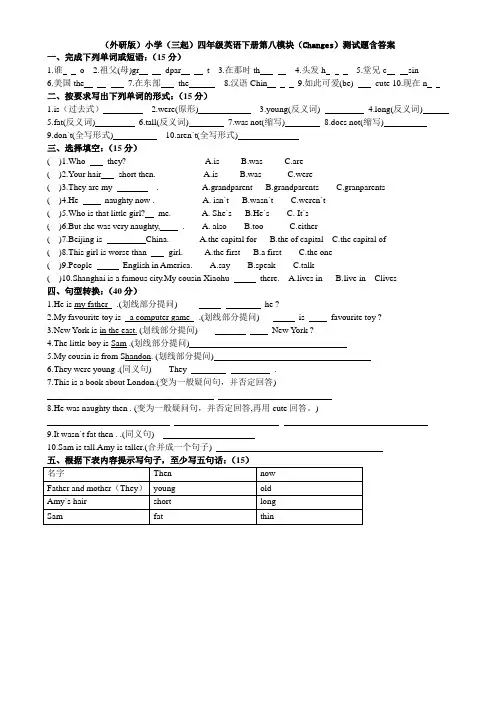
(外研版)小学(三起)四年级英语下册第八模块(Changes)测试题含答案一、完成下列单词或短语:(15分)1.谁o2.祖父(母)gr dpar t3.在那时th4.头发h5.堂兄c sin6.美国the7.在东部the8.汉语Chin9.如此可爱(be) cute 10.现在n二、按要求写出下列单词的形式:(15分)1.is(过去式)2.were(原形)3.young(反义词)4.long(反义词)5.fat(反义词)6.tall(反义词)7.was not(缩写)8.does not(缩写)9.don`t(全写形式) 10.aren`t(全写形式)三、选择填空:(15分)( )1.Who they? A.is B.was C.are( )2.Y our hair short then. A.is B.was C.were( )3.They are my . A.grandparent B.grandparents C.granparents( )4.He naughty now . A. isn`t B.wasn`t C.weren`t( )5.Who is that little girl? me. A. She`s B.He`s C. It`s( )6.But she was very naughty, . A. also B.too C.either( )7.Beijing is China. A.the capital for B.the of capital C.the capital of( )8.This girl is worse than girl. A.the first B.a first C.the one( )9.People English in America. A.say B.speak C.talk( )10.Shanghai is a famous city.My cousin Xiaohu there. A.lives in B.live in Clives四、句型转换:(40分)1.He is my father .(划线部分提问) he ?2.My favourite toy is a computer game .(划线部分提问) is favourite toy ?3.New Y ork is in the east. (划线部分提问) New Y ork ?4.The little boy is Sam .(划线部分提问)5.My cousin is from Shandon. (划线部分提问)6.They were young .(同义句) They .7.This is a book about London.(变为一般疑问句,并否定回答)8.He was naughty then . (变为一般疑问句,并否定回答,再用cute回答。
外研版英语三起点四年级下册Module 8大 单元整体教学设计
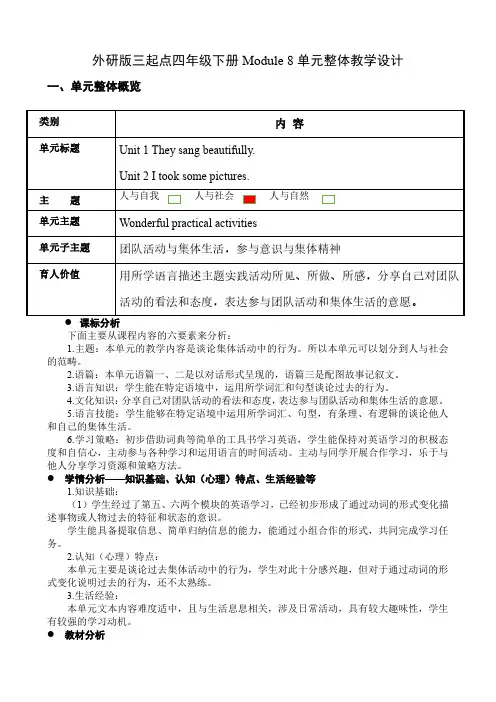
外研版三起点四年级下册Module 8单元整体教学设计一、单元整体概览下面主要从课程内容的六要素来分析:1.主题:本单元的教学内容是谈论集体活动中的行为。
所以本单元可以划分到人与社会的范畴。
2.语篇:本单元语篇一、二是以对话形式呈现的,语篇三是配图故事记叙文。
3.语言知识:学生能在特定语境中,运用所学词汇和句型谈论过去的行为。
4.文化知识:分享自己对团队活动的看法和态度,表达参与团队活动和集体生活的意愿。
5.语言技能:学生能够在特定语境中运用所学词汇、句型,有条理、有逻辑的谈论他人和自己的集体生活。
6.学习策略:初步借助词典等简单的工具书学习英语,学生能保持对英语学习的积极态度和自信心,主动参与各种学习和运用语言的时间活动。
主动与同学开展合作学习,乐于与他人分享学习资源和策略方法。
●学情分析——知识基础、认知(心理)特点、生活经验等1.知识基础:(1)学生经过了第五、六两个模块的英语学习,已经初步形成了通过动词的形式变化描述事物或人物过去的特征和状态的意识。
学生能具备提取信息、简单归纳信息的能力,能通过小组合作的形式,共同完成学习任务。
2.认知(心理)特点:本单元主要是谈论过去集体活动中的行为,学生对此十分感兴趣,但对于通过动词的形式变化说明过去的行为,还不太熟练。
3.生活经验:本单元文本内容难度适中,且与生活息息相关,涉及日常活动,具有较大趣味性,学生有较强的学习动机。
●教材分析本单元内容围绕Wonderful practical activities这一主题展开,涉及三个语篇,包括两组对话和一篇配图故事记叙文。
其中教材中呈现了两组对话。
为了更好的凸显主题意义以及更充分挖掘核心素养的育人价值,我们以Wonderful practical activities为主线对本单元教材内容及板块进行统整、改编和补充,我们自行增加了第三个语篇,它属于配图故事记叙文。
语篇一是一组日常生活对话。
Sam和Amy在家中向爸爸讲述他们和同学一起去公园野餐的经历。
四年级下册英语教案-Module 8 外研版(三起)

Module 8Unit 1 They sang beautiful.教学目标:知识与技能:Words and phrases: better worse voice think first agree quietSentences: I think this girl is better than the first girl.grammar: adj. comparison过程与方法:单词、课文和造句情感、态度和价值观:用形容词比较级不规则形式进行对比德育目标:在任何时候都不能欺骗别人、撒谎是最可耻的行为重点:better worse voice think first agree quiet难点:Sentences: I think this girl is better than the first girl.grammar: adj. comparison教学方法:讲授、领读、对话教学过程:(一)导入:songs: Polly’s hair-Free talk: talk about the things on the map.(二)探究新知new concepts:(Step 1).Let a girl sings an English song, and writes “the girl is good.” on the blackboard.Then write “better bad-worse I think I agree voice first” on the blackboard. And learn how to pronounce and how to use.Make sentences with every word.(Free talk): Let another girl sing a song, and say “the girl is better than the first girl.” Please talk about them, and then answer the questions:1. “Who is better?”2. What do you think?3. Do you agree?Listen to the tape and practise reading this lesson.(三)巩固新知(Step 2)Look at the Activity Book and complete it. (Practise using better and worse)(Step 3).A game: Draw and talk. (Let two Ss draw pictures on the blackboard and we talk about them like step 1.(四)作业布置:(五)小结: 用形容词比较级不规则形式进行对比板书设计Module 8Unit 1 They sang beautiful.good—better I think_____________.bad---worse I agree. voiceBe quiet.I think this girl is better than the first girl.Unit 2 I took some pictures.教学目标:知识与技能:Words and phrases: zither guitar drums pop musicSentences: the new song过程与方法:不规则形容词比较级讲授情感、态度和价值观:激发学生对音乐的爱好德育目标:任何人都有他的优点和缺点、因此不要泄气、也不要骄傲重点:Words and phrases: zither guitar drums pop music难点:Sentences: the new song教学方法:讲授、对比教学过程:(一)导入:Songs: London Bridge is falling down.Free talk: let 2 students sing songs, and talk about them.(二)探究新知new concepts:(Step 1) Ask students: “Do you like music?” Today we will learn about music.Write the title “Unit 2 Lingling is better than Daming.”on the blackboard.Write“ Chinese music and pop music” on the blackboard.Talk about“ what is Chinese music and what is pop music.”Write them on the blackboard. (erhu zither and piano guitar drums violin)Let Ss make sentences and act. For example: I can play the erhu. (The student do the actions and say.) (Must write “the”before the instrument)Then ask Ss: “What music do you like?”“What can you play?”“Can you play the zither?”Choose two Ss whom can play the same instrument, Let them play or act and then we talk about “who is better? and who is worse?”Listen to the tape and practise reading this lesson.(三)巩固新知(Step 2) Listen to the tape and learn to sing the new song.Listen to music more times, and then try to sing the song together.(Step 3) Free talk. Let Ss sing the song in groups, and we talk which group is better.Let Ss do the actions for the song, and we talk which group is better or worse.(四)作业布置:(五)小结:不规则形容词比较级讲授、主要是better和worse的用法板书设计Unit 2 I took some pictures.Chinese music Pop musicerhu guitarzither drumsPianoViolin课后反思:。
四年级下册英语外研版第八模块单词

四年级下册英语外研版第八模块单词Module 8 of the fourth grade English textbook "New Standard Edition" focuses on introducing new vocabulary words to students. These words are essential for building a strong foundation in English language learning. In this module, students will learn a variety of new words related to different topics such as animals, colors, and adjectives.Let's start with the animal vocabulary introduced in this module. Students will learn the names of various animals such as rabbit, bear, squirrel, and tiger. They will also learn related words like zoo, sea, jungle, and farm. This unit aims to help students expand their animal vocabulary and understand the different habitats these animals live in.Next, students will learn about colors. They will be introduced to common colors such as red, blue, yellow, green, and purple. Additionally, they will learn how to describe objects using these colors, such as a red apple or a blue sky. This unit will help students develop their ability to describe things around them in English.In the following section, students will learn about adjectives. They will learn how to use adjectives to describe people, objects,and places. Some of the adjectives introduced in this module include big, small, fast, slow, happy, and sad. This unit will help students improve their descriptive skills and enhance their ability to communicate effectively in English.Overall, Module 8 of the fourth grade English textbook "New Standard Edition" is designed to help students expand their vocabulary and improve their language skills. By learning new words related to animals, colors, and adjectives, students will be better equipped to express themselves in English. This module offers a fun and engaging way for students to learn and practice their English language skills.。
外研版(三年级起点)四年级英语下册Module 8 模块课件
Try to choose.
1. What did they do last Sunday?
A. They had a picnic. B. They went to school.
2. Was it fun?
A. No, it wasn’t.
B. Yes, it was.
3. How did they go there?
Dad, we had a picnic last Sunday.
Was it fun?
Yes, it was. We went
there /by bus.
And we saw some birds. They sang
b/eautifully
We ate some food and
drank some drinks.
(F ) (T ) (F ) (F ) (T )
go: 去
过去式:went
My mother and I went for a walk yesterday.
eat: 吃 过去式:ate I ate a bowl of rice last night.
drink: 喝 过去式:drank She drank a cup of tea.
Free talk.
Guess: what did I do last
Sunday?
Last Sunday today
Free talk.
I went to Hainan last Sunday.
go to Hainan go-went
Free talk.
I went there by plane.
Summing up.
重点单词和词组:sang, saw, went, had, ate, drank, beautifully, game, last, fun, there, drink, time, have a good time 重点句型:一般过去时句型。
四年级下册英语教案-Module 8 外研版(三起)
四年级下册英语教案-Module 8 外研版(三起)
教学目标
1.了解表示方位的词汇和短语。
2.学会询问和表达方位。
3.能够理解简单的方向指示。
教学重点
方位词汇和短语的掌握、方位询问和表达的运用。
教学难点
语言运用和地图阅读的结合。
教具准备
图片、地图、小板书、单词卡片。
教学步骤
Step 1. Warm-up
1.观看短片“City of Kites”,呈现地标,如“河流”、“桥梁”、“广场”、“市场”等,并询问学生知道的地标名称,运用新词汇。
2.教师由实际场景引入方位词汇和短语。
如:老师手里拿着笔走到大门口,向学生问:Where am I? Students: You’re at the door. 以此引入单词 door。
Step 2. Presentation
从外部环境到室内环境展示不同地点的地图,运用地图顶部图标实现单词和图像的联系。
Step 3. Practice
教师将单词卡片分发给学生,要求他们将单词放到地图上相应的位置,教师在指导学生的过程中多问询。
Step 4. Production
小组内学生互相表述房间及地点的名称和位置。
如:Where is the bag?
It’s on the bed.
Step 5. Homework
为学生们留下复习任务,包括记忆新词汇、感性理解和巧妙运用语言,让他们自主、自我充实。
教学评估
这份教学材料旨在帮助学生了解方位词汇和短语,并学会表达询问方位,及能理解简单的方向指示,通过教学和评估活动的参与,学生可以巩固和加强他们的语言和地图阅读技能。
外研社版三起英语四年级下册第八单元教案
一般过去时的构成,以及肯定否定的变化。
单元
课时
安排
Unit 1 2课时
Unit 2 2课时
第一课时
课题
Unit 1
主备人
张晓燕
授课班级
四年级
授课人
授课时间
教学目标
1.掌握单词Who,grandparent,then,me,hair,so
2.学会用I was... \They were...句型描述过去的事情
4.教师集体订正
5.教师领读,正音
6.讲解一般过去时的否定句型。例句:
I wasn’t two.
She wasn’t very naughty.
You weren’t so cute.
We weren’t young.
There weren’t young.
7.反馈练习
1.学生听录音跟读学习新课文。
She was very naughty.
You were so cute.
We were young.
There were young.
教学反思
第一课时
课题
Unit 2
主备人
张晓燕
授课班级
四年级
授课人
授课时间
教学目标
1.学习课文:There were young,并且熟读课文。
2.学习过去时的否定句型
4.教师领读课文,学生读三遍,找一个学生领读。
三、巩固
练习
1.学生齐读课文。
2.用英语描述一下两岁的自己和现在的自己。
用英语与同桌交流。
四、小结
说说今天有什么收获?
学生自由谈感想
五、作业
记忆单词、重点句型。
英语外研新标准(三起)四年级下册-module 8 Unit 1 They sang beautif
英语外研新标准(三起)四年级下册-module 8 Unit 1 Theysang beautifully 说课稿一、教材分析本单元是《英语外研新标准(三起)四年级下册》教材中的第八个单元,包含两个课时,学习主题为“They sang beautifully”。
本单元旨在培养学生对听、说能力的综合提高,在课程中学习和运用一些音乐方面的词汇。
二、教学目标本课的教学目标如下: 1. 能够听懂有关音乐的句子并回答教师提问; 2. 能够掌握并运用有关音乐的动词和形容词,描述音乐; 3. 能够自信地讲述自己喜欢的音乐,表达自己的感受; 4. 能够通过课堂活动培养合作意识和团队精神。
三、教学重点和难点本单元的教学重点是有关音乐的词汇和句子,包括动词、形容词和描述音乐的句子。
教学难点是让学生更好地理解并使用描述音乐的句子,让他们能够自信地讲述自己喜欢的音乐并表达自己的感受。
四、教学过程第一课时1.导入(5分钟)为了回顾上一课的内容并引入本课的主题,可以播放一些有关音乐方面的视频,并讨论学生们是否看过这些视频以及对这些视频的感受。
2.学习音乐动词和形容词(10分钟)介绍一些有关音乐的动词和形容词,如sing beautifully、play well、dance gracefully、happy、sad等,并通过教师模仿来学习这些动词和形容词的用法。
3.听音乐并表达感受(15分钟)播放一首优美的音乐,并要求学生在听歌的过程中,想象自己是在哪里,介绍自己听到这首歌的感受和想法。
然后,让学生分组,表演自己的想象,并分享自己喜欢的音乐和作曲家。
4.巩固音乐动词和形容词(10分钟)通过动图和图片展示,再次回顾和巩固音乐动词和形容词。
5.课堂小结(5分钟)让学生再次分享自己的想法,并对本课的学习内容进行小结。
第二课时1.导入(5分钟)为了回顾上一课的内容并引入本课的主题,可以播放一些有关音乐方面的视频,并讨论学生们是否看过这些视频以及对这些视频的感受。
外研版(三起)小学英语四年级下册Module 8模块知识点汇总
外研版(三起)小学英语四年级下册Module8知识点汇总重点单词:sang(sing的过去式)唱歌beautifully优美地,动听的saw(see的过去式)看见game游戏;比赛last最近过去的fun有趣的事went(go的过去式)去there在那儿,往那里ate(eat的过去式)吃drank(drink的过去式)喝,饮drink饮料time一段时间have a good time玩得开心busy忙的,忙碌的took(take的过去式)拍摄tell告诉,告知great非常好的,令人愉快的delicious美味的,可口的made(make的过去式)做,制作poster海报,招贴画动词过去式(不规则)sing——sang have——had go——went see——saw eat——ate drink——drank take——took make——made短语:1.have a picnic进行野餐2.go there去那儿3.see some bird看见一些小鸟4.sing beautiful唱歌动听5.eat some food吃一些食物6.drink some drinks喝一些饮料7.play games玩游戏8.have a busy day度过忙碌的一天9.take some pictures拍一些照片10.sing sangs唱歌11.make a poster制作一张海报重点句型:1.They sang beautifully.它们唱得很动听。
2.You had a good time!你玩得真开心!3.We walked in the park,we listened to the music,we sang and danced.我们在公园里散步,听音乐,我们又唱又跳。
4.I took some pictures and drank some drinks.我拍了一些照片并制作了一张海报。
Module8(教案)外研版(三起)英语四年级下册
五、总结回顾:教师总结本节课所学内容,强调颜色、形状、天气等词汇的重要性,以及一般现在时的运用。鼓励学生在日常生活中多运用所学知识,并提出问题解答。
学生学习效果
1.掌握并运用颜色、形状、天气等日常生活中的常用词汇,提高词汇量。
2.理解并运用一般现在时的语法规则,提高语法运用能力。
Module 8(教案)外研版(三起)英语四年级下册
学校
授课教师
课时
授课班级
授课地点
教具
教学内容
本节课选自外研版(三起)英语四年级下册Module 8。本节课的主要内容包括:
1.词汇:包括颜色、形状、天气等日常生活中的常用词汇。
2.语法:一般现在时的使用,包括主语、谓语和宾语的构成。
3.句型:询问对方喜欢什么颜色、形状、天气等,并能够回答。
1.掌握并运用颜色、形状、天气等日常生活中的常用词汇,提高他们的词汇量。
2.理解并运用一般现在时的语法规则,提高他们的语法运用能力。
3.通过情景对话,提高他们的口语表达能力和交际能力。
4.培养他们对不同文化的认识和尊重,提高他们的跨文化交际意识。
学习者分析
1.学生已经掌握了哪些相关知识:
学生在之前的学习中已经接触过一些基本的颜色、形状和天气词汇,如red、blue、square、sunny等。他们也已经学习过一般现在时,能够理解和运用其基本结构。此外,学生在日常对话中已经能够运用一些简单的句子来表达自己的喜好和需求。
14.学生将能够将所学知识运用到日常生活中,提高实际应用能力。
15.学生对颜色、形状、天气等生活话题产生浓厚的兴趣,激发进一步学习的动力。
16.学生辑关系