
五年级下册英语-全册知识点归纳译林版
5B知识点大纲
Unit 1 Cinderella单词
prince王子 fairy仙女
clothes
衣服 let让
try on试穿 have to不得不;必须
mushroom 蘑菇 late迟的,晚的
be bad for有害的 why为什么 because 因为
put on穿上 before在 .... 以前
fit合适,合身 take off 脱下
understand明白,理解 pick摘,拾
leave ... behind 留下,丢下
重点词组
I. at the prince ' s在王U子的房子
3. go to the party 参加舞会
5. come back 回来
7. at the party 在聚会
9. try on 试穿
II. leave …behind留下,丢下 13. un der a tree 在一棵树下
2.so sad如此伤心
4.visit every house 拜访每一间屋子
6.have a good time 过得愉快
15.look so nice看起来很漂亮 16.be bad for us对我们有害的18.read a story about ...读一个有关 ............... 的故事
重点句型
1. Come and help me.过来帮我。
2. Why are you so sad, dear?亲爱的,为什么你这样伤心?
3. Because I don ' t have any nice clothes or sho因为我没有任何漂亮的衣服和鞋子。
4. Hurry up!快点!
5. We can eat them.我们可以吃它们了。
6. What a pity!真可惜!
7. Why can ' t you go to the party?你为什么不能去参加舞会?
8. My foot hurts!我的脚受伤了!
9. I like readi ng stories about the Mo nkey King and Nezha. 我喜欢读猴王和哪吒的故事。
10. Many girls try on the shoe, but it does not fit.许多女孩试穿这只鞋,但是不合适。
11. Why is Ya ng Ling not at school today? 杨玲为什么今天不在学校?
12. Why does Nancy take off her coat?南希为什么脱下她的外套?
13. She leaves a shoe beh ind.她留下一只鞋。
语法
1. --Why are you so sad? --Because I can ' t go to the party.
why(特殊疑问词)对原因提问时使用 where (对"地点”提问) who (对"人”提问)
what (对"什么”提问) when (对"时间”提问) whose (对"谁的”提问)
2. C in derella has a good time at the party.
The prince visits every house./F in ally, Cin derella tries it on.
一般现在时:当主语是第三人称单数时,动词有所变化
3.1 like reading fairy tales.
I like read ing stories about the Mon key King and Nezha.
like doing sth.喜欢做某事
4.1 have to go now. 8.take off 脱下
10.have to go 必须走
12.in the forest 在深林里
14.pick a big red mushroom 摘一个大红色的蘑菇
17.Mo ney King 美猴王
19.be at school在学校学习 have to do sth.不得不做某事
Unit 2 How do you come to school?
单词
bus公交车 metro地铁
plane飞机 ship轮船
bike 自行车 on foot 步行
moon 月亮 far from 离 ..... 远 taxi出租车,的士
train火车 street街道 city城市 basket篮子
show给 .... 看
you ng年幼的
by ...乘(汽车、火车等)
重点词组
1.your new home
你的新家 2.far from school
离学校远
3.live on Moon Street住在月亮街上 4.n ear City Library 在城市图书馆附近
e to school 来学校 6.by bus乘公共汽车
7.n ear school在学校附近 8.on foot 步行
9.by metro坐地铁 10.by taxi乘出租车
11.a taxi driver 一位出租车司机 12.in the park在公园里
13.live in Sunshine Town 住在阳光城里 14.show his bike to Sam 展示他的自仃车给山姆
15.too you ng 太小(年龄) 16.sit in the basket 坐在篮子里
17.think so认为如此 18.wa nt to do sth. 想要做某事
19.get there 到那儿 20.work on a big ship 在一艘大轮船上工作
重点句型
1. Do you like your new home, Su Hai? 苏海,你喜欢你的新家吗?
2. Where do you live now? 你现在住在哪里?
3. How do you come to school? 你是怎么来上学的?
4. I come to school by bus. 我骑自行车来上学。
5. I live near school.我住在学校附近。
6. What about you?你呢?
7. I live in Moo n Street.我住在月亮街。
8. I live in Su nshi ne Tow n.我住在阳光城。
9. He likes ridi ng it in the park. 他喜欢在公园里骑着它。
10. I can fly now.我现在能飞了。
11. Can I go to school by bike?我可以骑车去上学吗?
12. How does Sam go to school?萨姆怎么去学校?
13. Bobby ' s dad does not think so波比的爸爸不这么认为。
14. Bobby wants to show his bike to Sam.波比想把他的自行车展示给萨姆看。
语法
1. --Where do you/they live? --I /We/They live ...
--Where does he/she live?--He/She lives ...
where是特殊疑问词,用来引导特殊疑问句,其回答不能简单地回答 yes或者no,而是要根
据具体所问来回答,比如这里可以用 “I live+表示方位的词语”来回答。当主语是第三人称单
数时,则用“ Where does…live?来提问,回答时谓语动词也相应地使用其第三人称单数形式
...lives 。…
2. --How do you/they come to school? --I/We/They come ...
--How does he/she come to school? --He/She comes ... 这里提问的是交通方式, 回答一般用by+交通工具来回答,例如:by bus, by train等;注意:当表示步行这种交通方式时不用 by,用on foot。当主语是第三人称单数时,用 “How
does…come to school?来提问,回答同样用第三人称单数来回答。
3. Do you like your new home?
do是助动词,其第三人称单数形式是 does,否定形式分别为:don '和doesn'。助动词开头
的句子是一般疑问句,一般用 “Yes,…do/does或“No,…don。t/doesn来回答。
4. Bobby wan ts to show his bike to Sam.
want to想要做某事,想要某物是 want后面直接加某物,想要做某事 “ want+to动词原形”
Unit 3 Asking the way
2. get to 到达
4. get off 下车
6. walk to 走到
8.on the street 在街上
10. ask a policeman for help 向一位警察求助
12.on your right 在你的右侧
14. wait for the bus 等公交车
16.be over 结束
18.turn left 向左转
20.so many这么多
22.go by bus 乘公交去
24.excuse me 打扰了
26.get in a taxi上了一辆出租车
重点句型
1. Yang Ling wants to visit Su Hai ' s n杨玲ho要去参观苏海的新家。
2. How do I get to your home? 我怎么样到你家?
3. How does Yang Ling get to Su Hai '杨玲怎样到苏海家?
4. You can take the metro.你可以乘地铁。
5. You can get on the metro at Park Stati on and get off at City Library Stati on. 你可以在公园
站上地铁,在市图书馆下车。
6. The n, walk to Moo n Street.然后,步行去月亮街。
7. My home is next to it.我家就在听旁边。
8. Yang Ling comes out from City Library Statio n. 杨玲从市图书馆站出来。
9. She asks a policeman for help.她向一位警察求助。
10. Excuse me, how do I get to the bookshop on Moo n Street? 打扰一下,我怎样达到月亮街 上的图书馆?
11. Tur n right at the traffic light. 在交通灯处向右转。
12. You can see the bookshop on your right.你可以看见书店在你的右边。单词
bookshop 书店 cinema电影院
zoo动物园 stop车站
supermarket 超市 shop商店
Unit 1 Cinderella 重点知识归纳(素材)译林版(三起)英语五年级下册
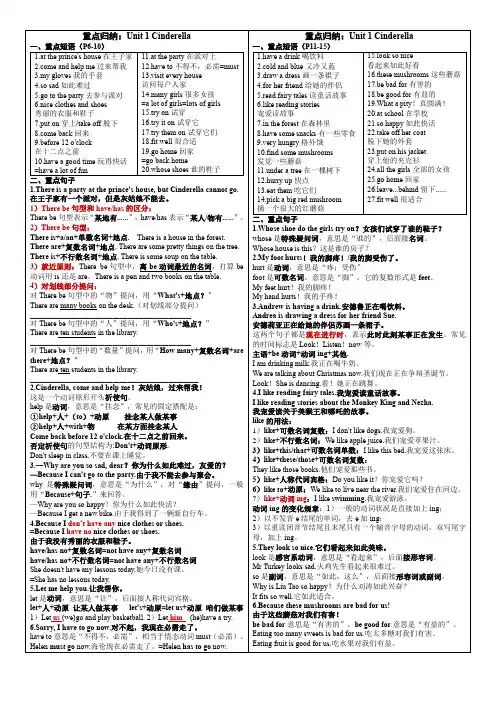
重点归纳:Unit 1 Cinderella
一、重点短语(P6-10)
1.at the prince's house在王子家
e and help me过来帮我
3.my gloves我的手套
4.so sad如此难过
5.go to the party去参与派对
6.nice clothes and shoes
秀丽的衣服和鞋子
7.put on穿上/take off脱下
e back回来
9.before 12 o'clock
在十二点之前
10.have a good time玩得快活
=have a lot of fun 11.at the party在派对上
12.have to不得不,必需=must
13.visit every house
访问每户人家
14.many girls很多女孩
=a lot of girls=lots of girls
15.try on试穿
16.try it on试穿它
17.try them on试穿它们
18.fit well很合适
19.go home回家
=go back home
20.whose shoes谁的鞋子
二、重点句子
1.There is a party at the prince's house, but Cinderella cannot go.
在王子家有一个派对,但是灰姑娘不能去。
1)There be句型和have/has的区分:
There be句型表示“某地有......”,have/has表示“某人/物有......”。
2)There be句型:
There is+a/an+单数名词+地点. There is a house in the forest.
There are+复数名词+地点. There are some pretty things on the tree.
There is+不行数名词+地点. There is some soup on the table.
(译林版)五年级英语下册Unit1-4知识点整理
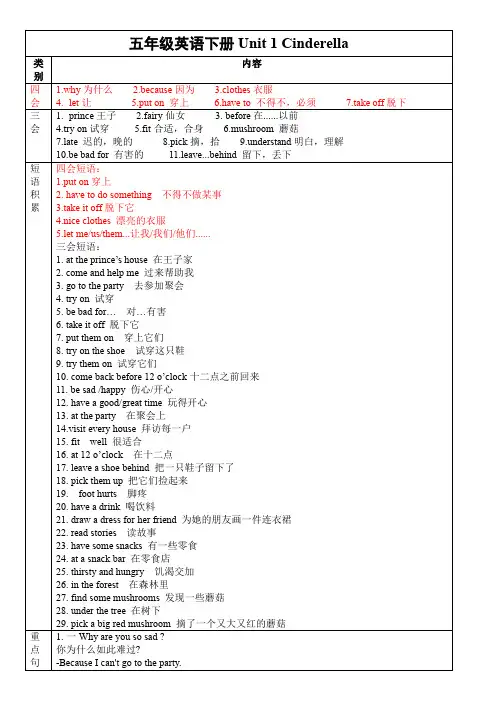
五年级英语下册Unit 1 Cinderella
类别 内容
四会 1.why为什么 2.because因为 3.clothes衣服
4. let让 5.put on 穿上 6.have to 不得不,必须 7.take off脱下
三会 1. prince王子 2.fairy仙女 3. before在......以前
4.try on试穿 5.fit合适,合身 6.mushroom 蘑菇
te 迟的,晚的 8.pick摘,拾 9.understand明白,理解
10.be bad for 有害的 11.leave...behind 留下,丢下
短语积累 四会短语:
1.put on穿上
2. have to do something 不得不做某事
3.take it off脱下它
4.nice clothes 漂亮的衣服
5.let me/us/them...让我/我们/他们......
三会短语:
1. at the prince’s house 在王子家
2. come and help me 过来帮助我
3. go to the party 去参加聚会
4. try on 试穿
5. be bad for… 对…有害
6. take it off 脱下它
7. put them on 穿上它们
8. try on the shoe 试穿这只鞋
9. try them on 试穿它们
10. come back before 12 o’clock十二点之前回来
11. be sad /happy 伤心/开心
12. have a good/great time 玩得开心
13. at the party 在聚会上
14.visit every house 拜访每一户
15. fit well 很适合
苏教版译林版英语五年级上下两册知识点汇总整理归纳
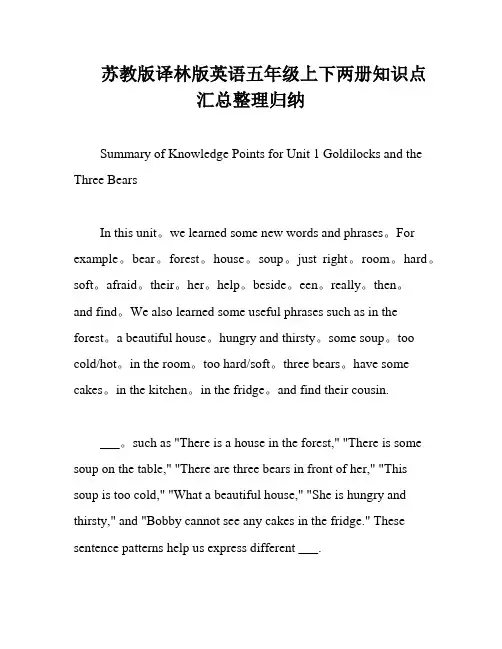
苏教版译林版英语五年级上下两册知识点汇总整理归纳
Summary of Knowledge Points for Unit 1 Goldilocks and the
Three Bears
In this unit。we learned some new words and phrases。For
example。bear。forest。house。soup。just right。room。hard。soft。afraid。their。her。help。beside。een。really。then。and find。We also learned some useful phrases such as in the
forest。a beautiful house。hungry and thirsty。some soup。too
cold/hot。in the room。too hard/soft。three bears。have some
cakes。in the kitchen。in the fridge。and find their cousin.
___。such as "There is a house in the forest," "There is some
soup on the table," "There are three bears in front of her," "This
soup is too cold," "What a beautiful house," "She is hungry and
thirsty," and "Bobby cannot see any cakes in the fridge." These
sentence patterns help us express different ___.
Finally。we learned about the "There be" sentence pattern。which is used to express the existence of something。We learned
译林版五年级英语下册语法知识点总结

译林版五年级英语下册语法知识点总结五年级下册知识点一、名词(单数,复数,不可数) 1.单数a fairy , a toothache (two fairies )an art room/ English teacher / idea / umbrella an art room/ English teacher / idea / umbrella ( a( a、e、i、o、u) 2.复数1、一般直接+s:trains,students, 2、以s、 x x、、 sh sh、、ch结尾结尾,,加es:bus-buses,class-classes, 3、以“辅音字母+y”结尾以“辅音字母+y”结尾,,变y为i,i,加加es:libraryes:library——libraries hobby---hobbies city——cities family——families4、以o结尾的,加es:potato,tomato ,mango,黑人(Negro),英雄(hero)5、不规则名词复数: man-men, woman-women, policeman-policemen child-children foot-feet,tooth-teeth3、不可数bread,meat,soup, milk,juice,tea , rice …二、人称代词1、主格:I we you you he she he it they ★2、宾格:me us you you him her him it them try it/them on help me/him/her WhatWhat’’s wrong with him/her/them? eat them be bad for us Let me/us…、do(动词原形) give it a cake come to see him Fit me well (非常适合我,这里不用very,用well即可,其她场合的很/非常要加very) 3、形容词性物主代词: my our your your his her its their ★三、介词1、表示时间的: ①in +月份: in January , in April ②in the morning /afternoon/evening ③in +季节: in winter ④on +具体日期on the 23rd of June ⑤at +具体时刻at five o’clock 2、表示节日的: ①at Spring Festival at Christmas / Halloween ②on Mother’s Day (单数) on Children’s Day 在儿童节(复数) 3、表示地点的:(far from/near/next to/beside/behind/between/under/in/on/at) ①at the party / at the prince’s house / at the traffic lights / at the bus stop at Park Station / at home/school ②on your left ③on Moon Street on Moon Street / / in Sunshine Town ★四、季节与月份Spring is in March,April and May、warm Summer is in June,July and August、hot Autumn is in September,October and November、cool Winter is in December,January and February、cold★五、基数词与序数词基数词:one two three four five six seven eight nine ten 译林版五年级英语下册语法知识点总结 eleven twelve thirteen fourteen fifteen sixteen seventeen eighteen nineteen twenty twenty-one thirty ······ 序数词:first second third fourth fifth sixth seventh eighth ninth tenth eleventh twelfth thirteenth fourteenth fifteenth ········· twentieth twenty-first thirtieth thirty-second 序缩写: 十九nineteen,九十ninety, 第十九nineteenth,第九十ninetieth; 六、哪些情况加动词原形: 1、can /should /would 2、 let 3、助动词 do/does 4、to 练习:1、Su Hai should ______(take) some medcine、 2、LetLet’’s go and ______(have)a party、 3、______(do)Nancy ______ (like) _______(dance) ? 4、Cinderella has to ______(come) back before 12 o’clock、 七、哪些情况加动词ing 1、be 2、 go 3、be good at 4、like 5、what /how about 注意:动词ing形式也叫作动词的现在分词(-ing),变化规则: (1)直接加ing:draw——drawing play——playing (2)以不发音的e结尾的,去e加ing:dance——dancing skate——skating make——making have——having write——writing live——living come------coming ride -------riding drive------driving (3)以重读闭音节结尾,呈现“辅元辅”结构的,双写末字母加ing: swim——swimming run——running chat——chatting sit——sitting put ——putting shop——shopping get-----getting 练习:1、LetLet’’s go ________(swim) this afternoon、 2、ouYou’’re really good at _________(skate)、 3、_____(be) your uncle ______(read) books now? 4、How about ________(watch) a film? ★八、现在进行时 表示:正在进行的动作或存在的状态。(now/listen/look) 构成: be(is/am/are) + 动ing 例:特殊疑问句 1、 What are you doing? I am sweeping the floor、 2、 Where are you going? I am going to the playground、 一般疑问句 1、Are you cooking tomato soup? Yes,I am、/No, I’m not、 2、Is he looking for some juice? Yes, he is、/No,he isn’t、 九、一般现在时 表示:经常发生的动作或存在的状态,常与表示频率的时间状语连用。常与表示频率的时间状语连用。 (always 总就是;usually 通常;often经常;sometimes有时候) 例:What do you (usually) do on your birthday? What do you eat at Spring Festival? ★注意主语就是三单时,动词要变为动三单形式,变化规则如下: 1) 一般情况下,动词后面直接加动词后面直接加 -s、 : climbs / takes/ picks 2) 以ch,sh,s,x 或 o 结尾的动词,在后面加在后面加 -es、 例: teaches , watches, does , goes, catches ,brushes 译林版五年级英语下册语法知识点总结 3) 以辅音字母以辅音字母 + y结尾的动词,把 y变为变为 i 再加再加 -es、 try--tries 十、 辨析 2、与、与 ① and (Su Yang and I) are helping her、 ② with ( We )often have a big dinner with (our parents) 、 3、也、也 ① too ItIt’’s Su Yang’s birthday too、 (句末) ② also ItIt’’s also Su Yang’s birthday、 (句中) ③ either They should not eat or drink either、 (否定句) 4、Be动词动词 (is/am/are)① I am / you are ② 单数/不可数不可数 is / 复数复数 are ★5、想要 ① want =would like + 名词 She wants a big cake、= ② want to=would like to +动原 She wants to buy a big cake、= (注意:不要瞧到like就跟doing,like doing就是喜欢做某事) ★6、就是······的时候了。ItIt’’s time to have lunch、 (to +动原) ItIt’’s time for lunch、 (for+名词) ★7、 look for 寻找(过程) Liu Tao is looking for some milk、 find 找到(结果) Yang Ling cannot find the bookshop、 8. or (通常用于否定句通常用于否定句) and (通常用于肯定句通常用于肯定句) 十一、易错词汇与词组 1、whowho’’s (就是谁) whose(谁的) hehe’’s(她就是) his (她的) there are有 theythey’’re 她们就是她们就是 these 这些这些 pretty 漂亮的漂亮的 present 礼物礼物 parent 父或母父或母 read 读 ride 骑 2、 play basketball play the piano play with Kitty the cat 3、 sweep the floor (区分:扫,洗,擦) 4、 clean the car / table clean the classroom / library 5、 wash clothes / the dishes / some vegetables 6、 give … to / / sendsend……to / write…to / show…to / buybuy……for 7、 fit / hear well 、work on a big ship、 too young/late/many sweets 8、 what / where / when / who / whose / how many/ how old /which(哪个) 十二、文化板块 1、I like reading fairy talestales、、 I like reading stories about(about(关于关于关于) ) the Monkey King and NezhaNezha、、 2、In the UK , we ask "Where's the toilet?" In the US , we ask "Where's the restroom?" 3、You have a feverfever、、 Your temperature is 102°F、102°F、 102? 102? It's 39°C、39°C、 4、I eat with chopstickschopsticks、、 (Chinese) I eat with a knife and forkfork、、 (Western) (Western)西方人西方人西方人 5、Halloween is on the thirtythirty––first of OctoberOctober、、Children usually dress upup、、 They knock on people's doors and shout "Trick or treat?" for sweetssweets、、 6、People in the West usually open their presents as soon as they receive themthem、、
新版译林英语五年级下册知识点整理
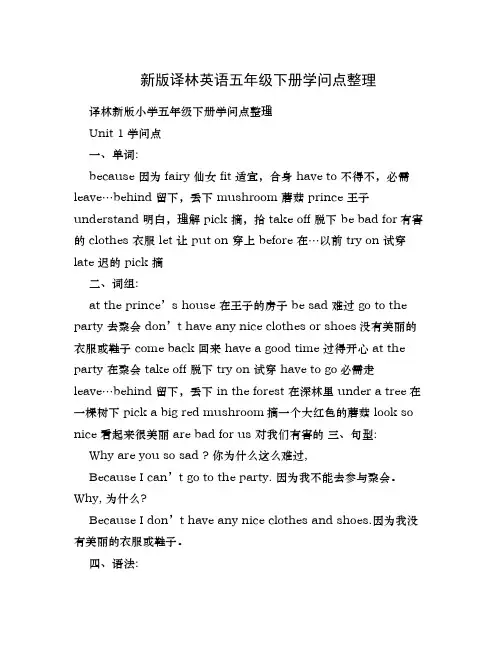
新版译林英语五年级下册学问点整理
译林新版小学五年级下册学问点整理
Unit 1学问点
一、单词:
because 因为 fairy 仙女 fit 适宜,合身 have to 不得不,必需
leave…behind 留下,丢下 mushroom 蘑菇 prince 王子
understand 明白,理解 pick 摘,拾 take off 脱下 be bad for有害的 clothes 衣服 let 让 put on 穿上 before 在…以前 try on 试穿
late 迟的 pick 摘
二、词组:
at the prince’s house 在王子的房子 be sad 难过 go to the
party 去聚会 don’t have any nice clothes or shoes没有美丽的衣服或鞋子 come back 回来 have a good time 过得开心 at the
party 在聚会 take off 脱下 try on 试穿 have to go必需走
leave…behind 留下,丢下 in the forest 在深林里 under a tree在一棵树下 pick a big red mushroom摘一个大红色的蘑菇 look so
nice 看起来很美丽 are bad for us 对我们有害的 三、句型:
Why are you so sad ? 你为什么这么难过,
Because I can’t go to the party. 因为我不能去参与聚会。
Why, 为什么?
Because I don’t have any nice clothes and shoes.因为我没有美丽的衣服或鞋子。
四、语法: can’t = can not don’t =do not
Unit 2学问点
一、单词:
far from 离……远 near 在……旁边 by … 乘…… bus 公共汽车 ,大巴士 on foot 步行 metro 地铁 taxi 出租车,的士 bike自行车 plane 飞机 ship轮船 train 火车 ride 骑车 show 给……看
译林版五年级英语下册语法知识点总结 2
实用文档
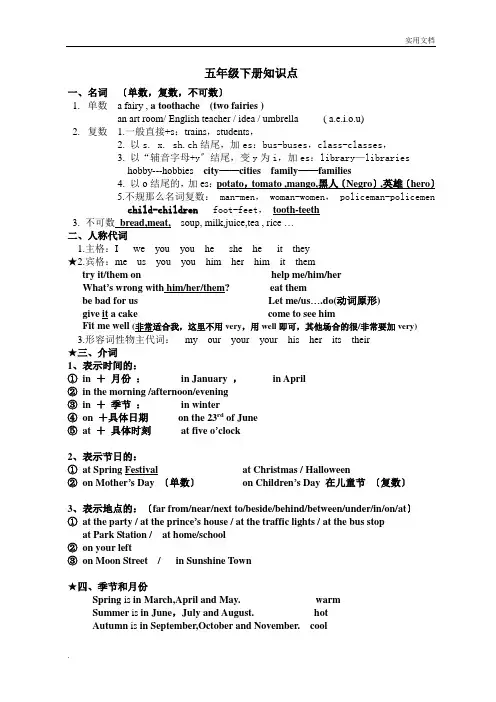
. 五年级下册知识点
一、名词 〔单数,复数,不可数〕
1. 单数 a fairy , a toothache (two fairies )
an art room/ English teacher / idea / umbrella ( a.e.i.o.u)
2. 复数 1.一般直接+s:trains,students,
2. 以s. x. sh.ch结尾,加es:bus-buses,class-classes,
3. 以“辅音字母+y〞结尾,变y为i,加es:library—libraries
hobby---hobbies city——cities family——families
4. 以o结尾的,加es:potato,tomato ,mango,黑人〔Negro〕,英雄〔hero〕
5.不规那么名词复数: man-men, woman-women, policeman-policemen
child-children foot-feet, tooth-teeth
3. 不可数 bread,meat, soup, milk,juice,tea , rice …
二、人称代词
1.主格:I we you you he she he it they
★2.宾格:me us you you him her him it them
try it/them on help me/him/her
What’s wrong with him/her/them? eat them
be bad for us Let me/us….do(动词原形)
新译林版英语五年级下册语法知识归纳
新译林版英语五年级下册语法知识归纳
一、名词
1. 名词是指表示人、事、物、地点等具体或抽象概念的词语。
2. 可数名词可以和数词连用表示数量,如one cat、three apples。
3. 不可数名词不可以和数词连用,表示具体或抽象的事物,如milk、water。
二、动词
1. 动词是指表示动作、状态或存在的词语。
2. 动词分为及物动词和不及物动词。
- 及物动词需要有宾语才能构成完整的谓语,如She likes
apples。
- 不及物动词可以独立构成谓语,如I swim every day。
三、形容词
1. 形容词是用来修饰名词或代词的词语。 2. 形容词可以表示人或物的特征、性质、状态等。
3. 形容词可以用来比较大小,常用词尾+er表示比较级,如taller、bigger。
4. 形容词可以用来最高级,常用词尾+est表示最高级,如tallest、biggest。
四、副词
1. 副词是用来修饰动词、形容词或其他副词的词语。
2. 副词用来描述动作的方式、程度、时间等。
3. 副词可以用来比较程度,常用more或less表示比较级,如more beautiful、less careful。
4. 副词可以用来最高级,常用most或least表示最高级,如most beautiful、least careful。
五、代词
1. 代词是用来代替名词的词语。
2. 代词可以替代人或物,在句子中充当名词的角色。
3. 代词包括人称代词、物主代词、指示代词、疑问代词等。
六、介词
1. 介词是用来表达名词与其他单词(如动词、形容词等)之间的关系的词语。
2. 介词可以表示位置、方向、时间、原因等。
3. 常用的介词有in、on、at、from、to、with等。
七、连词
1. 连词是用来连接词语、词组、句子等的词语。
2. 连词可以连接并列词语、并列词组或并列句子。
3. 常用的连词有and、but、or、so等。
(完整版)新版译林英语五年级下册知识点整理.docx
林新版小学五年 下册知 点整理
Unit 1 知 点
一、 :
because 因 fairy 仙女 fit 合适,合身
have to 不得不,必 leave⋯behind 留下, 下
mushroom 蘑菇 prince 王子 understand 明白,理解
pick 摘,拾 take off 脱下 be bad for 有害的
clothes 衣服 let put on 穿上 before 在⋯以前
try on 穿 late 的 pick 摘
二、 :
at the prince s house’ 在王子的房子 be sad 心
go to the party 去聚会 don’t have any nice clothes or shoes没有漂亮的
衣服或鞋子 come back 回来 have a good time 得愉快
at the party 在聚会 take off 脱下 try on 穿 have to go必 走
leave⋯behind 留下, 下 in the forest 在深林里
under a tree在一棵 下 pick a big red mushroom摘一个大 色的蘑菇
look so nice 看起来很漂亮 are bad for us 我 有害的
三、句型:
Why are you so sad ? 你 什么 么 心?
Because I can’t go to the party. 因 我不能去参加聚会。
Why? 什么 ?
Because I don’thave any nice clothes and shoes.因 我没有 漂亮的衣服或鞋子。
四、 法:
can’t= can not don’t=do not
Unit 2 知 点
译林版五年级英语下册语法知识点总结 3
译林版五年级英语下册语法知识点总结
五年级下册知识点
一、名词(单数,复数,不可数)
名词有单数、复数和不可数三种形式。
单数形式:a fairy。XXX。an art room。an English XXX。an idea。an XXX.
复数形式:
1.一般直接在单数后面加上“s”:trains。students.
2.以“s。x。sh。ch”结尾的单词,在单数后面加上“es”:bus-buses。class-classes.
3.以辅音字母“y”结尾的单词,将“y”变成“i”,再加上“es”:library—libraries。hobby—hobbies。city—cities。family—families.
4.以“o”结尾的单词,在单数后面加上“es”:potatoes。tomatoes。mangos。Negroes。heroes. 5.不规则名词复数:man—men。woman—women。policeman—policemen。child—children。foot—feet。XXX.
不可数名词:bread。meat。soup。milk。juice。XXX。rice等。
二、人称代词
人称代词分为主格、宾格和形容词性物主代词。
主格:I。we。you。he。she。it。they.
宾格:me。us。you。him。her。it。them.
形容词性物主代词:my。our。your。his。her。its。their.
三、介词
介词主要用于表示时间、地点、方式等。
表示时间的介词有:
1.in + 月份:in January。in April. 2.XXX.
3.in + 季节:in winter.
4.on + 具体日期:on the 23rd of June.
5.at + 具体时刻:XXX o’clock.
表示节日的介词:
During Spring Festival。Christmas。and Halloween。people
新版译林英语五年级下册知识点整理 2
新版译林英语五年级下册知识点整理
译林新版小学五年级下册知识点整理
Unit 1 知识点
一、单词 :
because 由于 fairy 仙女 fit 适合,称身
have to 不得不,一定 leave behind 留下,丢掉
mushroom 蘑菇 prince 王子 understand 理解,理解
pick 摘,拾 take off 脱下 be bad for 有害的
clothes 衣服 let 让 put on 穿上 before 在 从前
try on 试穿 late 迟的 pick 摘
二、词组:
at the prince ’s house 在王子的房屋 be sad 悲伤
go to the party 去聚会 don ’t have any nice clothes or shoes
没有美丽的衣服或鞋子 come back 回来 have a good time 过
得快乐
at the party 在聚会 take off 脱下 try on 试穿 have to go
一定走
leave behind 留下,丢掉 in the forest 在深林里
under a tree 在一棵树下 pick a big red mushroom 摘一个大红色的
蘑菇
look so nice 看起来很美丽 are bad for us 对我们有害的
三、句型:
Why are you so sad ? 你为何这么悲伤?
Because I can ’t go to the party. 由于我不可以去参加聚会。
Why? 为何 ?
Because I don’thave any nice clothes and shoes. 由于我没有 漂