
人教版六年级英语上册全册教案
人教版六年级上册英语全册教案下载 see there? How do you go there?”问同组其他三名学生以上几个问题。学生仍以四人一小组的形式展开活动,用问题:“Do you go to…by…? 测某一小组成员到达表格中目的地的方式。一人只有一次猜测机会,不对,大家再一起问:“How do you go there?”该学生回答。每小组选一名代表描述自己曾去过的某个地方,可以在表格内容的基础上适:当发挥,比如:I go to Hainan by plane.The sea there is clean and nice.I can eat a10t Of sea food and many kinds Of fruit there .I like Hainan very much . (2)Good to know 教师询问学生课本上各个交通标志的意思:“What's the meaning?”然后帮助学生回答:“Turn right.Crosswalk.One way.”等。再让学生完成图与文字搭配的练习。鼓励学生展示课前绘制的交通标志图并寻找更多交通标志与其他同学进行交流. (3)学生听录音、跟读对话。 (4)学生完成本部分活动手册配套练习。
第四课时 一、教学目标与要求 1. 能够听、说、认读以下短语:Stop at a red light.Wait at a yellow light.Go at a green light.能够听、说、读、写短语和单词:stop,wait,traffic lights,traffic rules。 2. 能够了解基本的交通规则,即红灯、黄灯、绿灯的功能;并能听懂英语指令做出 相应的动作。 二、教学重、难点分析 1. 本课时的教学重点是掌握四会短语和单词:stop,wait,traffic lights,traffic rules。 2. 本课时的教学难点是书写短语traffic light,traffic rule和理解动词stop,wait的含义。 三、课前准备 1. 教师准备兔子舞的音乐和录音机、本课时的录音带及教学挂图。 2. 教师自制教具模拟红绿灯:即在一块板上挂红黄绿三张圆形纸卡。 3. 学生准备本课时的单词卡片。 四、教学步骤和建议 1.热身(Warm-up) “兔子舞”游戏 教师放兔子舞的音乐,全班学生排成长队,后面学生把手搭在前面学生的肩膀上,随着音乐的指令“Left-Right-Go-Turn around-Go,g。,go”,队伍开始向前慢慢移动,教师最好也参与游戏。 2.预习(Preview) (1)师生一起吟唱Let's chant的歌谣。 (2)教师从歌谣中引出问题:“How d。you go to school?”请学生根据实际情况回 答,复习A部分主要句型。 3.新课呈现(Presentation) (1)教师指着教室里的日光灯说:I like the lights because I can see things clearly at night .Can we see lights in different colours in our city ? Yes!Neon light , traffic lights.… (2)教师边画简笔画,边说:“We have red,yellow,and green ligh◆您现在正在阅读的PEP人教版六年级上册英语全册教案下载 - 小学英语教案 - 文章内容由收集, 请记住本站网址:www.fydaxue.com.以便下次访问!本站将为您提供更多的免费小学教学资源!http://www.fydaxue.com/thread-35022-1-1.htmlts. We call them traffic lights.,教师板书traffic fights,然后问学生:“What do they mean,do you know?,,学生可能会用汉语回答,教师点头表示肯定,再请学生回答:“When do we stop/wait/go?’’引导学生回答:We stop at a red light...- (3)教师出示自制红绿灯,请一名学生随意指向不同的颜色,教师示范动作,比如:看见绿灯,教师一边向前走一边说:“It is a green light. I can go. Go-go。go!,,看见黄灯,停住不动但摆动双臂示意要走:“It is a yellow light. I must wait.Wait-wait-wait! I can go in a moment.”看见红灯,提问学生:“The light is red。Call I go? No,no,no! It's dangerous !I must stop.Stop-stop-stop!” (4)教师板书stop,wait,go在相应的交通灯旁。为了帮助学生区别stop与wait,可以适当使用汉语解释词义。 (5)Let's play 教师请出若干名学生,根据指令做相应的动作,连续做错两次动作的学生将被淘汰,如:教师说red light,学生停着不动,教师说yellow light,学生做好走的准备,教师说green light,学生往前走。然后换一组学生再做这个游戏,由其中一名学生来发指令。也可让全班学生分成六人一组分别进行小组活动。最后教师小结:"Stop at a red fight.Wait at a yellow light-Go at a green light Red light.yellow fight,green light.These are traffic lights.”教师再指着以上三句话总结说:These are traffic rules. (6)教师继续提问:“What does the‘ traffic rule ’mean?”板书并解释traffic rule, 鼓励学生说出Let's learn部分的三个句子。然后教师说.Yes.These are traffic.rules.You must remember the traffic rules.”通过手势帮助学习理解remember的意思。 (7)教师放Let's learn部分的录音,学生跟读。 (8)教师引导学生以竞赛的形式书写四会单词和短语。可先引导学生利用学生卡片背面的灰体词进行单词描红,学生边描边拼读单词。 4.巩固和延伸(Consolidation and extension) (1)师生讨论不同的出行方式及其应当遵循的交通规则。下列问题可供参 How do you go to school? I go to school On foot.Can you tell me any traffic rules? You must watch the traffic 1ights. I go to school by bus.Can you tell me any traffic rules? Don't run in the bus. Don't stick your head Or arms out Of the window. I go to school by bike.Can you tell me any traffic rules? Don't go too fast. Never go into the sideways. (2)学生做B Let's learn部分活动手册配套练习。 (3)学生背诵并抄写四会词语。 (4)学生画一张从家到学校(或从学校到家)的简单路线图,准备下一他同学进行交流。 第五课时 一、教学目标与要求 1. 能够听懂、会说并能书写句型:“How Can I get to Zhongshan Park? You can go by the No.15 bus.”能够在情景中正确运用。 2. 能够在对话中正确使用礼貌用语,比如:“Excuse me.Thank you.You're welcome.”等。 二、教学重、难点分析 1. 本课时的教学重点是四会掌握句型:How Can I get to Zhongshan Park? You can go By the No.15 bus. 2. 本课时的教学难点是学生能够在实际情景中恰当地表达使用某一交通工具到达某一 目的地。 三.课前准备 1. 教师准备录音机和本课时的录音带。 2. 教师准备一张简易地图,要能够呈现本校附近的一些建筑物。 四、教学步骤和建议 1.热身(Warm-up) (1)教师将全班学生分为两组,每组选派一名代表上讲台发指令。如:Green/red/yellow light,各组学生在座位上做动作,做错者坐下,即被淘汰,最后站着的人数多的组胜出。 (2)教师让学生用自己的话描述交通规则,表述正确者为小组争得一分,描述有新意者得三分,如:It's a yellow light,I must wait.Now the light is green,I can gO.Don't go at a red light,a car may hit you. 2.预习(Preview) Let's try 教师放Let's町部分的录音,学生听录音选择相应的图片。 录音内容如下: Man:Excuse me.how can I get tO Dongfang Primary School? Zhang:You can g0 by the No.14 bus.It's next t0 the nature park.
人教版PEP小学英语六年级上册英文教案全集(92页)
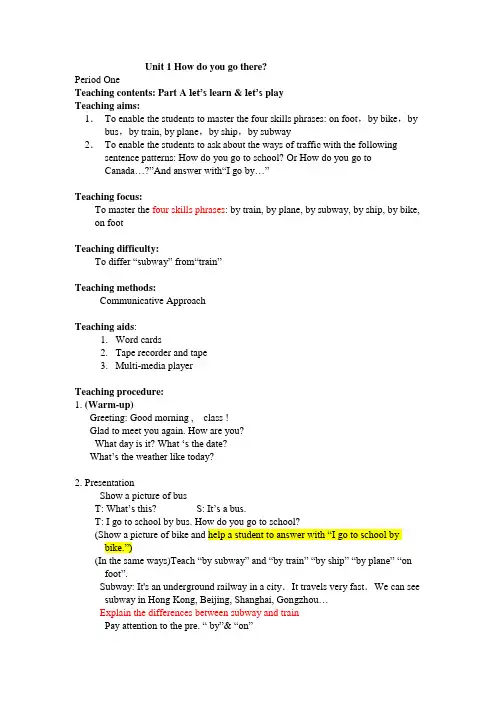
Unit 1 How do you go there?Period OneTeaching contents: Part A let’s learn & let’s playTeaching aims:1.To enable the students to master the four skills phrases: on foot,by bike,by bus,by train, by plane,by ship,by subway2.To enable the students to ask about the ways of traffic with the following sentence patterns: How do you go to school? Or How do you go toCanada…?”And answer with“I go by…”Teaching focus:To master the four skills phrases: by train, by plane, by subway, by ship, by bike, on footTeaching difficulty:To differ “subway” from“train”Teaching methods:Communicative ApproachTeaching aids:1.Word cards2.Tape recorder and tape3.Multi-media playerTeaching procedure:1. (Warm-up)Greeting: Good morning , class !Glad to meet you again. How are you?What day is it? What ‘s the date?What’s the weather like today?2. PresentationShow a picture of busT: What’s this? S: It’s a bus.T: I go to school by bus. How do you go to school?(Show a picture of bike and help a student to answer with “I go to school bybike.”)(In the same ways)Teach “by subway” and “by train” “by ship” “by plane” “onfoot”.Subway: It's an underground railway in a city.It travels very fast.We can see subway in Hong Kong, Beijing, Shanghai, Gongzhou…Explain the differences between subway and trainPay attention to the pre. “ by”& “on”3.Play gamesAsk one S to the front and stick the word cards next to the phrases written on the Bb when T read the new phrases quickly and the other Ss put up their cards. The one who reflect fastest and correctly is the winner.4.Listen to the tape of Part A Let’s learn and follow it.Pay attention to the tone and pronunciation5.Practice: Let’s playT Offer many places (the USA. England Australia Hong Kong ShanghaiGuangzhou the moon…) and traffic ways (by car/ taxi/ bus… on foot)Ss practice with above places and ways in pairs:A: How do you go to school?B: I go to school on foot.Encourage the Ss to make up as many sentences as they can.6.Spelling competitionDivide the class into tow groups. Show the pictures of traffic tools and ask Ss to spell the phrases. The first one who puts up hand gets the chance to spell. The group spell out more phrases are the winners.HomeworkCopy the new words and phrasesFinish Page1 of the ABBb design:Unit One How do you go there?How do you go to school/ Canada?I go to school on foot/ by subway/ bus/ train/ taxi…Teaching reflection:Unit1 How do you go there?Period TwoTeaching contents: Let’s try & let’s talkTeaching aims:1.To master the four skills sentence: “How do you go to school? Usually I go toschool on foot.Sometimes I go by bike.”2.To enable the Ss to ask and answer about traffic ways and explain the simplereason why he or she chose this traffic way.I go to school on foot, because my home is near.3.To make the Ss understand the listening material in “Let’s try”情感目的Teaching focus:文中的新句子To use and write the following key sentences:How do you go to school?Usually I go to school by bike. Sometimes I go on foot.Teaching difficult points:To write the key sentences: How do you go to school?Usually I go to school on foot.Sometimes I go by bike.To use Adverbs of frequency: usually, sometimesTeaching aids:Tape recorder Teaching cards a piece of paperTeaching procedure:1. (Warm-up)T: Good morning! How do you go to school today? What about you? Do you go by bus,too?”2. Have a dictationAsk the Ss to dictate the new words learnt in the last lesson.On foot、by bus、by train、by plane、by subway…3. Let'stryGuide the Ss to look at the pictures and askWho’s the boy? He’s Mike.How does Mike go to school?Play the tape and listen:John:How do you go to school,Mike?Mike:I usually go to school by bike.Sometimes I go 0n foot.John:Is your home near our school?Mike:Yes.it is.J0hn:That's fine!4. (Presentation)Let's talkT: How do I go to school,do you know? Ask me,please!Draw a bike, a bus, a taxi on the Bb and write the price by each picture. Bus 1 yuan taxi 10 yuanEncourage the Ss to ask “How do you go to school?T: Usually I go to school by bike, because it's good exercise.Sometimes I go by bus,because it's cheap.It costs l yuan. Sometimes I go by taxi,because it'sfast,but it's too expensive.It costs 1o yuan.Explain that we use usually and sometimes to express frequency.T: “How does Sarah go to school? Listen.”Ask the S to imitate Sarah’s tone to answerSarah: Usually I to go school on foot. Sometimes I go bike.Ss read after the tape. Then practice in pairs to make up the new dialogueaccording to each picture.Ask several pairs to act out the dialogue.5. Group workRead the dialogue .Then practice in groups of four. They can expand theirdialogue like the following:A:How do you go to school/ hometown?B:Usually I go by bus.A:Can you go by bike?B: Yes,I can,but it's too far.Sometimes I go by taxi,because it’s fast, but it's expensive. What about you?A:I go to school on foot,because my home is near.6. Play finding order gamesShow the following word cards and ask Ss to form correct sentences.How, do, go, to, school, youI, usually, on, go, school, to, footSometimes, by, bike, go, IHomework:Finish AB Page2Bb designUnit1 How do you go thereHow do you go to school?Usually I go to school on foot, because it’s near.Sometimes I go by bike, because i t’s fast.Period ThreeTeaching contents: Let’s readTeaching aims:1.To improve reading skill2.To consolidate the traffic ways3.To improve understanding ability.Teaching focus:How do we go to the park?It’s easy.How to finish answering the questions in the bookTeaching difficult points:How to express the different ways to a placeTeaching aids:Tape recorder a piece of paper masks of Zhang Peng and Sarah Teaching procedure:1.ReviewFree talk2.Dictation 复习上节课学过的句子和词语How do you go to school?Usually I go to school on foot.Sometimes I go by bike. What about you?3.Review different placesT: This is a very nice place. There are many students and teachers. There are many rooms, such as classroom, art room, music room… What’s it?It’s a beautiful place. Many people like to play in it. There are nice flowers, trees and grass. There are toys. What is it?It’s a park.4.PresentationT: Where is my home? Do you want to know?Describe with different traffic ways and use “first” “next” “then” .It’s a little far from here. First I go to Zenbu bus stop on foot. Then I can go bythe No.74 bus to the East Bus Station... We live on the ninth floor,Room902.Explain “then”5.T ask individual :Where is your home?Is it near the park? Which floor?In pairs practice above questions6.Play the tape and students follow it.Ask: How can we go to Sarah’s home?How can they go to the park?Finish answering the questions, and then check the answers.7.PracticeRead the text. Boys to be Zhang Peng ,and girls to be Sarah. 男女分组朗读Work in pairs to read the dialogue.Ask several pairs to act out.8.Make up new dialoguesHomework:Do Page 5 in ABMake a survey and fill in the following formBb design:How do we go to the park?It’s easy.Which floor?The fifth floor, Room 5APeriod FourTeaching contents: Let’s learn and let’s playTeaching aims:1. To master the phrases: Stop at a red light. Wait at a yellow light. Go at a greenlight.2. To know some traffic rules about traffic lightsTeaching focus:To understand the traffic lights commands and do the action:Stop at a red light.Wait at a yellow light.Go at a green light.Teaching difficult points:To understand the meaning of the three traffic lights and do the correct actionof the commandsTeaching aids:Tape recorderA flash card of traffic lightsWord cardsTeaching procedure:1.Free talk2.ReviewHow do you go …?Ss should make a true answer and give the reason.3.Warm-upAsk Ss to do actions when they hear the orderStand up, touch your ears,Turn Left, right, go, turn around…4.Revise the words of colours5.T: ( show traffic lights)What are they?They are traffic lights.T: How many colour?What colours are they?What do they mean?T Show a red light and say:It’s a red light. I must stop at a red light.It’s a yellow light. I must wait at a yellow light.It’s a green light. I can go at a green light.Do you know the traffic rules?Draw three traffic lights on the Bb and write the traffic rules next to themStop at a red light.Wait at a yellow light.Go at a green light.6.Play the tape and Ss follow it.Explain “remember” by doing gesture.7.Let’s pla yAsk ten students to the front to do actions of traffic lights commandsFive girls are Group A. The other boys are Group B. When T show the yellow light they must wait. If not the one who disobeysShould get back to the seat. In the end the group with more people win the game.8. Consolidation and extension巩固和拓展(难点)Discuss the different traffic ways and rulesHow do you go to school?I go to school On foot.Can you tell me any traffic rules?You must watch the traffic 1ights.I go to school by bus.Can you tell me any traffic rules?Don't run in the bus.Don't stick your head Or arms out Of the window.I go to school by bike.Can you tell me any traffic rules?Don't go too fast.Never go into the sideways.Homework:Copy the traffic rules written on the BbFinish AB Page4Bb design:Traffic lights traffic rulesRed light Stop at a red light.Yellow light Wait at a yellow lightGreen light Go at a green light.Teaching reflection:Period 5Teaching contents: Let’s readTeaching aims:1.To improve reading skill2.To consolidate the traffic rules and know different countries have differenttraffic rules.3.To improve understanding ability and make Ss get right information from thereading material.Teaching focus:Understanding the the meaning of the text and finishing the “tick or cross”Teaching difficult points:To improve the reading skillsTo understanding the following sentences:In China/the US,drivers drive on the right side Of the road.In England and Australia,however,drivers drive On the 1eft side Of the road.Teaching aids:Tape recorder flash card of traffic lightsA photo of Singapore StreetTeaching procedure:1.Free talk2.ReviewStop at a red light.Wait at a yellow light.Go at a green light.Let the Ss do the actionsDictate the above sentences.3.T: (put up the right hand) This is my right hand. Show me your right hand! Thenshow me your left hand.Do actions as I tell you:Turn left. Tu rn right. Turn back. Touch your left ear…4.Discuss traffic rulesT: Red means “stop” .if the light is red, you must stop.Yellow means________ ,if the light is yellow you must ______.Green means _________, if the light is green you can ________.5.Show a photo of Singapore Street and ask the Ss to find out the differences.T: The traffic lights are the same in every country. But what about other traffic rules? Look at the picture. It’s in Singapore. what‘s the differences.Help the Ss to answer:In Singapore, the driver is on the left side. In China the driver is on the right side.6.ReadAsk the Ss to read the passage and do the exercises.Check the answer together.Teach new words:Find difference every countryAlways drive if mustKnow England Australia howeverExplain the following sentences:In China, drivers drive on the right side of the road.In England and Australia, however, drivers drive on the left side of the road.Read the text again and put up any questions.HomeworkAsk Ss to find more traffic rulesBb designThe same every country alwaysMean drive right side England Australia However if must knowTeaching reflectionPeriod 6Teaching contents: Part B Let’s try & Let’s talkTeaching aims:1.To enable the students to master the four skills sentences: “How Can I get to Zhongshan Park? You can go by the No.15 bus.2.To enable the students to use polite words in dialogue:Excuse me. Thank you. You’re welcome.3.To Review the names of places: post office , supermarket, cinema, bank, hospital,fast food shop…Teaching focus:How can I get to Zhongshan Park?You can go by the No.15 bus.Teaching difficulty:How to use “how can I get to …?””you can go by…”correctlyThe meaning of “If you like”Teaching methods:Communicative ApproachTeaching aids:1. Tape recorder and tape2. Multi-media player3. A map of Dongguan city.Teaching procedure:1.Free talk2.What day is it today?How many students are there in your class?Who is No.1/2…?3. Go over the traffic rules:It's a yellow light,I must wait.Now the light is green,I can go.Don't go at a red light. A car may hit you.4. Go over the numbers from 1-100.Pay attention to 30, 13 40, 14, 50, 15, 16, 60, 70, 17, 18, 80, 90, 195. Let’s tryPlay the tape of this part and students listen and tick.Man:Excuse me, how can I get to Dongfang Primary School?Zhang:You can go by the No.14 bus.It's next to the nature park.Man:Thank you.Zhang:You're welcome.Play again and Ss repeat.6. PresentationLet's talkShow a traffic map of Dongguan and askWhere is (place/ bus number)?Show the map in the bookWhat’s near the bus stop?Teach: supermarket, cinema, bank, hospital, fast food shop, bookstore, school Let’s the students find the places on the map.Play the tape of this part and get the Ss read after it.Explain: If you like.Ask:T: I want to buy some fruit and clothes. Where should I go?Where is the supermarket?How can I get to the supermarket?Show the traffic map of Dongguan.Get the Ss ask and answer:A: Excuse me, How can I get to Walmarket?B: You can go by the No….bus.Ask several pairs to act out. 对话都可以请一组人表演Homework:Do Exercise 3& 4 of Ab Page5Bb design:How can I get to zhongshan Park?You can go by the No.15 bus.If you like.Period Seven●Teaching contents: Good to know, let’s sing,●Teaching aims:1.To recognize some usual traffic signs.2.To improve the student’s traffic consciousness3.To understand and sing the song “How do you go to school?●Teaching focus:Ss can say these traffic rules according to the traffic sings:Crosswalk No entry、Turn right、NO bikes、One way、No left turn●Teaching difficult points :To recognize the traffic signs●Teaching methods: Read and perform●Teaching aids:Tape recorder Powerpoints●Teaching procedure:Step 1.Review1.Duty report: Good morning, everyone. I’m on duty today. Today is Monday,September 19th.It is sunny today .Everyone is here .Thank you!Step 2.DictationDictate the new words we have learned last week.Step 3.Review the traffic rules1Ask some students: “How do you go to school? Why?”Get Ss to talk freely.2.Review the traffic rules.Show the traffic lights, ask “What are these? What colors are they? What does it mean?”Get Ss to answer.3.T: The traffic lights are the same in every country, but the traffic rules aredifferent.For example: In China, drivers drive on the right side of the road? What about in England and Australia? Get Ss to answer: Drivers drive on the left side of the road.Step4. Presentation1. T: If you go by car, by bike or on foot, you must know some traffic rules.What other rules do you know?Encourage Ss to say some traffic rules.2. Show some traffic signsT: Where can you see there pictures? (In the street. /On the road.)Do you know what they mean?Show the pictures one by one and tell them the traffic rules:Crosswalk: If you cross the road, you must walk on the crosswalk.Turn right : You can turn right if you see this picture .Turn left : You can turn left if you see this picture.One way : In one directionNo entry :Don’t come in .No bike : Don’t ride a bike .No left turn : Don’t turn left .No right turn: Don’t turn right .Step 5 .PracticeGet Ss to match the signs with the words.Ss can make some other traffic signs by themselves.Step 6.Sing a songPlay the tape, Ss listen and try to sing the song “How do you go to school?”Homework:Finish Exercise 5 on page3 of the activity book.Make a survey .Ask the classmates: How do you go to school ?And complete the form on page 10.Bb design:Crosswalk No entry Turn right Turn leftNo bikes One way No left turn No right turnTeaching reflection:The eighth lessonTeaching contents: Story timeTeaching aims:To understand the story of this part, and Ss can perform the story.To train the Ss to obey the traffic rules.Teaching focus:Ss can understand the story and train their good reading habit.Teaching difficulty:1.Students can perform the story in roles.Teaching methods: Read and performTeaching aids:1.Tape recorder and tape2.The head portraits of Zip ,Zoom and policeman3.Some pictures of bike ,car ,taxi and traffic lightsTeaching procedure:Step 1. Review1.Duty report2.Make a survey .做个调查Ask: How do you go to school? Get Ss to answerand make a statistics. How many Ss go to school by car /by bus /on foot.3.Review the traffic rules.Step 2. Presentation1. Show a picture of a people who is walking, ask: What is he doing? (He is walking.)Do you like walking? I like walking .Because it’s a good exercise.Write good exercise on the Bb.2. Play the game of let’s play.Ask a student say: stop, wait, go .The other Ss do the actions.T: You are good children because you know the traffic rules .Let me do it.I make some wrong actions, when the Ss remind me, write be against the trafficrules on the Bb. Say .I am against the traffic rules.Step 3.ReadAsk Ss to look at the pictures on page 13, introduce Zip and Zoom to them.Then play the tape and Ss read after it.Then try to ask then some questions: 1.How many dollars do they have?2. Where are they going?3. Do the go by taxi? Why not?If they cannot answer, give them some help.Step 4.PerformanceSs read the story again .Then get them perform the story.If someone does very well, give them praise cards.Step 5 .ExtensionAsk the Ss, if you are Zip and Zoom, How you go to the restaurant.Get Ss to discuss this question.Homework :Finish Part 5 on page 6 of the activity book.Bb design:Good exerciseBe against the traffic rulesTeaching reflection:The ninth lesson●Teaching contents: Let’s start. Task time●Teaching aims :1.To master the important sentences: How do you go to school?I go to school ... Ss can use by bike, by car, by bus, on foot to answer.How can I get to...? You can go by the No. bus.2. To finish the task of task time.3. To understand the contents in let’s try.●Teaching focus :Ss can use these two sentences correctly:How do you go to school? I go to school by bike, by car ,by bus .How can I get to...? You can go by No. bus .●Teaching difficulty:Finish the task in Task time.●Teaching methods:Ask and answer.●Teaching procedure:1 .Review1.Duty report.2.Dictate the new words and phrases in Unit one.by bike by bus by subway by train by ship on footgo to school traffic lights traffic rules stop wait get to2. Look at the pictures of Let’s start, say; there are many ways to go somewhere,do you know what they are. Ss point out the ways in the pictures. Tell them the first one is by horse .3. Show the flashcards in Let’s learn and review the words .such as on fo ot bybike by car by bus by ship by plane by ship4. Open the books on page3 ,show the picture to the students ,Get students to look at the pictures and ask and answer in pairs .5Let’s chant .Play the tape ,students listen and rea d after it .Make sure they can understand the meaning of the sentences .6Make a survey.Ss can ask four students in the class :How do you go to school ? Completethe form on page 10 . Write down the names and tick the ways the go toschool .Make sure t hey can use on foot /by bike /by bus /by car /… to answer.7. Make a chart .According to the information of part one .Finish the work of part two .Then get them to make a summary : A goes to school on foot.B andC go to school by bus.D goes to school by car .E goes to school by subway.HomeworkRead the phonetic symbols they have learned last week.Bb design:How do you go to school ?I go to school on foot /by bike /by bus /by car .Teaching reflection :The tenth lesson●Teaching contents : Pronunciation, Let’s check●Teaching aims :1.To recognize and read the phonetic symbol /i: / / i/ /p / /b / /t / /d /2.To read the syllable that these phonetic symbol make up.3.Ss listen to the passage in let’s check and tick.●Teaching focus :Recognize the phonetic symbols.●Teaching difficulty :Ss can read the syllables include the phonetic symbols have in this lesson●Teaching methods :Read and listen●Teaching aids :Tape recorder and tapeSome cards of phonetic symbolsMulti-media playerSome word cards.●Teaching procedure:1 Review.Duty report.Ask the Ss freely: How do you go to school ?2 The phonetic teaching and practice(1) Write two houses on the Bb, one is high, the other is low.The teacher points to the first house, say: This is Miss Eagle’s house .How do you go to Miss Eagle’s house? We can go by plane.Show a word card with peak and say: Hello,I’m Peak.I’m in Miss Eagle’s house .Then put this word in the house .Then show other words cards, and get students put them in the right places.Then get students to read these words and the phonetic symbols/p / /b / /t / /d / /i: /Tell the Ss, in a word, the letters ee and ea usually sound /i: /(2) Then show the house of Mr Pig and use the same way to teach / i/(3) Play the tape, get students read the phonetic symbols and words after the tape.(4) Match the phonetic symbols with the right words.(5) Read some wordsbe bean beef bee dean deed teach pea tea eatbid bit did dig dip pick till tick tip pink(6) Read some tongue –twisters1. This is a big pink pig, a big pink pig .Is it a big pink pig? Yes, it is, Yes, it is.2. P .P. P, can we eat some peas? Please, please, please, eat some peas!3. Teacher, teacher, teacher. Can we eat the pizza? No, no, no, please eat green beans!3. ListeningPlay the tape, get students to listen and do the exercise.① John: How do you go to school, Amy?Amy: I usually go to school on foot .My home is not far from school.② John: How can I get to the post office, please?Zhang: You can go by bike .It just in front of our school.③Liu: Where is the zoo, please?Mike: It’s near my home.You can go by the No.4 bus.Liu: Can I go by subway?Mike: Sure, If you like.④ Chen: Is the park far from here?Amy: Yes, it is .You can go by the No.5 bus.Chen: Can I go by bike?Amy: No, that’s too far.Homework:1.Read the tongue-twisters after class.2.Finish the exercises on page 7 of the activity book.Teaching reflection:The eleventh lesson●Teaching contents: Review the words and sentences in Unit one.●Teaching aims:1.Review the words in this unit: by foot bike bus train plane shipsubway how go to school traffic traffic light traffic rule stop wait get to2.The main sentences :How do you go to school ? I go to school …How can I get to …? You can go by No. bus .3. Review the traffic rules .a. Stop at a red light .b. Wait at a yellow light .c. Go at a green light .d. Drivers drive on the right side of the road in China.Drives drive on the left side of the road in England ,Australia and HongKong.4. Review the phonetic symbols /i: / / i/ /p / /b / /t / /d /●Teaching focus:Ss can master the words and sentences .●Teaching difficulty:Ss can use the words and sentences to make a dialogue .●Teaching methods:Read and practice●Teaching procedure:1. T: Today we will review what we learned in this unit .Show the powerpoints of Let’s learn and ask How do you go to school ?Get Ss to answer :I go to school by bike /by car /by bus /on foot.Write the sentences and words on the Bb .The twelfth lesson●Teaching contents:Do some exercises.●Teaching aims:To review the words and sentences in Unit One .●Teaching focus:To practice the words and sentences they have learned .●Teaching methods:Students do the exercises by themselves .●Teaching aids:Multi-media player●Teaching procedure:Do the exercises1.Read and fill in the blanks .阅读,填空1._______ do you go to Hainan? I go by ship .2.I usually go to visit my grandma ___ foot .________ (有时) I go ___ bike .3 I am a student ,____ ____ you ? I’m a student too .4.---Let’s go to the park this afternoon .--- Ok ,see you ____ 3 o’clock .--- _______ _______ then .2.Read and choose .选择填空( ) 1. Go _____ a green light . A. to B. at C. in( ) 2. The ______ are the same in every country .A.traffic lightsB.traffic rules C . traffic( ) 3. In the Us, drivers drive ______ the right side.A. in B . on C. to( ) 4 . Look at the lights .Yellow ______ “ wait”.A. means B meaning C . mean( ) 5. Now I am standing on the left side ____ the road .A. inB. onC. of( ) 6. ______ can you get to the zoo ? By bus.A. How B . What C. Where3. Read and write .朗读,填空1. Look at me ! I _______ (经常) go to school _____ _____.2. Please remember the _____ _____ (交通规则). ______ at a green light .3. I go school _____ bike .But _____(有时) I go ______ taxi.4. _____ at a red light .5.Look at the ______ ______ (交通灯)。
最新人教版六年级上册英语全册教案(精编版)
最新人教版六年级上册英语全册教案(精
编版)
介绍
本教案是为最新人教版六年级上册英语全册(精编版)编写的教学指南。
它旨在帮助教师有效地组织和实施课堂教学,提升学生的英语研究效果。
教案内容
教案包含了全册的所有课程内容,共分为几个单元。
每个单元都有详细的教学步骤和教学目标。
教案中还包含了相关的教学材料和活动建议,以帮助教师更好地引导学生研究。
教学目标
通过使用本教案,教师可以达到以下教学目标:
1. 帮助学生掌握本册课程的主要语言知识和技能。
2. 培养学生的英语听、说、读、写能力。
3. 培养学生的合作研究和自主研究能力。
4. 培养学生的英语研究兴趣,激发他们研究英语的动力。
使用方法
教师可以根据教案中的指导,结合自己的教学经验和学生的实际情况,有针对性地进行课堂教学。
教案中提供了丰富的教学资源和活动建议,教师可以根据需要自行选择和调整。
注意事项
教师在使用本教案时应注意以下几点:
1. 熟悉每个单元的教学内容和教学目标。
2. 通过多种教学方法和形式,调动学生的积极性和参与度。
3. 注重培养学生的英语思维和表达能力。
4. 根据学生的实际情况,适度调整教学进度和难度。
结语
最新人教版六年级上册英语全册教案(精编版)是一份实用的教学工具,它能够帮助教师有效地进行英语课堂教学。
相信通过教案的引导,学生能够更好地掌握英语知识和技能,提高英语学习的效果。
希望教案能够对广大教师在教学中起到积极的指导作用。
人教PEP版六年级英语上册《Unit 1》全单元教案教学设计小学优秀公开课
人教PEP 版六年级英语上册教学设计Unit 1 How can I get there?单元整体分析本单元是人教版英语六年级上册的第一单元,单元的话题是“How can I get there?”本单元通过不同的场景,提供了表达地点、问路的句型结构。
教学中三个版块:A 部分,B 部分和C 部分。
A 部分包括重点词汇和情景对话,共两个课时。
第一课时呈现了吴一凡和Robin 的谈话,引出表示地点的词汇。
.第二课时吴一凡和Robin 的谈话,引出句型Where is the...? It’s…A部分重点掌握词汇和询问地点并回答的句型。
B 部分包括重点词汇、情景对话和读和写,共三个课时。
第一课时呈现Mike 问路的对话,引出关于路线的一些词汇。
第二课时吴一凡和Mike 看完电影讨论吃饭地点在哪,呈现了问路并回答的句型How can we get there? Turn left/right....,并进一步表达句型Where is the ...? It’s next to...第三课时通过图片了解辨别方位的方法。
通过吴一凡、Mike 和Robin 寻找意大利餐馆,拓展本单元所学句型。
B 部分重点是掌握词汇和问路及回答的句型How can we get there? Turn left/right... C 部分包括听力测试、介词词组的总结和故事,共一课时。
重点是复习巩固本单元所学重点词汇和句型。
在课堂教学中,首先要整体把握本单元教学内容,教学重点和教学难点,了解学生学情。
然后围绕本单元主题“How can I get there?”展开教学设计。
本单元的教学内容与学生的生活相关,在组织语言教学时要注意设计生活化,充分利用教材已经设定的情境展开教学,引导学生在合作学习中表达和语用所学句型。
鼓励学生自编对话巩固所学知识。
同时还要引导学生自己归纳介词词组,启发学生的思维。
本单元所需要掌握的词汇中science, post office 中的office,在四年级、五年级的教材中已经学过。
PEP人教版小学六年级英语上册全册教案

小学英语六年级上册全册教案1第〔1〕课时教学内容 A ’s ’s ’s教学目的1、学会’s 部分的几个新单词。
2、会娴熟运用….进展问话。
重点、难点:新单词的学习。
教学打算单词卡片录音机和磁带教学过程1、新课打算音标拼读练习。
2、导入新课(1) 在黑板上画一辆自行车。
引出.I .I .I .I .I .〞引出,, , ’s .(2) 利用上面的句子编一首.(3) 各种形式读(4) 老师不失时机地提出问题:引导学生利用学过的句子答复。
3、练习(1) 听录音。
(2) 出示单词卡片,让学生依据单词卡片组织对话。
4、作业(1) 英语作业本。
修改意见第〔2〕课时教学内容’s C部分’s教学目的1、能听、说、读、写四会驾驭句子:I . I . 并能在情景中正确运用。
2、可以表述自己以何种方式上学并简洁陈述缘由。
教学重点难点重点:听、说、读、写句型:I …难点:学生书写四会句子并能简洁陈述选择某种交通方式上学的缘由教学打算录音机和磁带单词卡片教学过程1、热身〔1〕复习上一课时对话〔2〕放’s 的歌曲2、预习〔1〕老师出示单词卡片,提问:〔2〕做’s 的题目。
3、新课呈现’s老师提问学生,通过体温,一步步地呈现课文内容。
并在黑板上重点板书以下单词:(由此引出) 〔由此引出〕四会句子的书写〔老师在课前打算四会单词的打乱词卡〕让学生把打乱的词卡的依次排列整齐。
老师让学生四人一组,通过提问:理解同学用何种交通方式上学,并激励学生简洁阐述缘由,如:. ’s . ’s . ’s …3、稳固和延长〔1〕完成作业本中的练习。
〔2〕完成抄写本中四会句子的书写作业。
修改意见第〔3〕课时教学内容 A ’s C教学目的1、可以充分理解并正确朗读对话,能完成文后答复下列问题的练习2、可以理解辅音及元音的发音规那么,并能读出相关例词3、理解部分的内容,可以识别常见的交通标记。
教学重点难点重点:学生可以充分理解并正确朗读对话。
难点:如何指引别人在不同地点换用不同的交通工具到达某一目的地。
人教PEP版英语六年级上册《Recycle 2》教案
人教PEP版英语六年级上册《Recycle 2》教案一. 教材分析《Recycle 2》是人教PEP版英语六年级上册的一个单元,主要围绕日常生活中的活动展开。
本单元的主要内容包括动词的过去式形式,以及如何运用这些动词描述过去发生的活动。
通过本单元的学习,学生能够进一步掌握动词的过去式形式,并能够运用所学知识进行简单的交流。
二. 学情分析六年级的学生已经掌握了基本的英语语法知识和词汇,对于动词的过去式形式有一定的了解。
但是,他们在实际运用中可能会存在一定的困难,例如时态的运用和动词过去式的构成。
因此,在教学过程中,需要结合学生的实际情况,采取合适的方法进行教学。
三. 教学目标1.能够听懂、会说、会读本单元的主要词汇和句型。
2.能够运用动词的过去式形式描述过去发生的活动。
3.能够用英语进行简单的交流,提高语言运用能力。
四. 教学重难点1.动词的过去式形式的正确运用。
2.如何运用所学知识进行简单的交流。
五. 教学方法1.任务型教学法:通过设计各种任务,让学生在实际操作中运用所学知识,提高学生的语言运用能力。
2.情境教学法:创设各种生活情境,让学生在真实的环境中学习英语,提高学生的学习兴趣。
3.小组合作学习:鼓励学生进行小组讨论和合作,培养学生的团队精神和自主学习能力。
六. 教学准备1.教学课件:制作与本单元主题相关的课件,帮助学生更好地理解和学习。
2.教学素材:准备与本单元主题相关的生活情境素材,用于教学操练和巩固环节。
3.教学卡片:制作动词过去式的卡片,用于学生操练和巩固环节。
七. 教学过程1.导入(5分钟)通过播放一段与本单元主题相关的视频,引导学生进入学习状态,激发学生的学习兴趣。
2.呈现(10分钟)利用课件呈现本单元的主要词汇和句型,引导学生进行观察和思考,为新课的学习做好铺垫。
3.操练(10分钟)通过各种操练活动,让学生练习动词的过去式形式,例如:填空、连线、模仿等。
在活动中,教师应及时纠正学生的错误,确保学生能够正确掌握。
最新人教版六年级上册英语教案(全册)
Unit 1 How can I get there?单元教学目标:1、能力目标(1)能够简单描述城市、城镇或社区内公共设施的大致位置,如:“Where is the cinema, please? It’s next to the hospital.”等。
(2)能够询问线路并简单回答,如:How can I get to the …? Turn left at the …, then go straight. It’s on the left.(3)能够掌握四会单词hospital,cinema,post office,bookstore ,Turn ,left,go straight.(4)能够听懂、会唱歌曲“Where is the hospital?”。
2、知识目标(1)掌握A,B部分Let’s learn, Let’s talk中的四会短语和句子。
(2)能够听、说、认读A,B部分Let’s learn的三会单词和Let’s talk, read and write中出现的三会句型。
(3)能够理解read and write, Let’s check, Let’s wrap it up等部分的内容。
(4)能够了解tips for Pronunciation中音标的音与形,并能正确读出例词。
(5)了解Story time等部分的内容。
3.情感、策略、文化等有关目标情感目标:培养学生团结友爱,乐于助人的良好品质。
学习策略;引导学生在学习过程中注重合作学习。
文化目标:简单了解国外地图的主要标识。
教学重点: 问路以及指点方向。
教学难点:问路的用语以及AB部分read and write中的对话。
第一课时一、教学内容:A Let’s learn / Make a map and talk二、教学目标与要求:1.能够听、说、读、写单词或短语:hospital,cinema,post office,bookstore2.能够听、说、认读短语science museum。
人教版小学英语六年级上册教案全册
2. 课本个性化书写活动(1) Discuss with your partner. What are you going to do for Mid-autumn Festival?➢先让学生同桌口头交流。
➢教师将最后一位学生的回答在投影仪下示范书写,然后提出一星和两星要求,请学生个性化书写。
Step five: homework课后作业Write down your plan.For Mid-Autumn Festival, I’m going to ___________ ___________________. My partner is going to _________________________ ___________________.板书设计反思重建第 3 单元第 6 课时备课课题Unit 3--6课时安排1教学目标1.复习一般将来时态的三个核心问句以及回答:What are you going to do? When are you going? Where are you going?2.巩固一般将来时的句法要点,能够用不同的主语进行be going to的造句以及自由表达。
3.能理解、听懂并讲Story time中的故事。
学生能够用正确语音语调朗读语篇,并能够知道日记的格式。
培养自主学习能力重点难点重点:一般将来时的语法要点复习。
难点:能在实际情景中灵活运用以及正确的回答课前准备教师自制课件。
词卡,录音机,磁带基本环节集体资源个人增减教学过程Step One: warming up1. Free talks: What are you going to do? When are you going?Where are you going?Step Two: Wrap it up1.教师将提到的三个问题写到黑板上,并询问一般将来时的特点。
(1)be going toPractice: I _____ going to…He ____ going to see a film.They ____going to watch TV.(2)时间状语:this morning this afternoon this evening tonight tomorrow next week2. How many sentences can you make?(1) Talk about it in pairs.(2) Feedback.Step Three: Story Time1. Watch the video and answer the questions:2. Watch it again and learn some new words授课时间:。
人教版六年级英语的上册教案(精选6篇)
人教版六年级英语的上册教案(精选6篇)人教版六班级英语的上册教案(精选篇1)学问点名称:How to write down your friend,学科类型与教学对象:新版PEP Book 7 Unit4 作文课型教学,学校六班级同学估计上课时间长度:5分56秒教学目标:能从人物的外貌特征、性格和爱好三方面学习描述和写作“我的伴侣”。
教学资源与环境:PPT课件。
教学过程:1.Warm—up形式:音乐与主题文字共同呈现。
目的:创设轻松的学习氛围,关心同学进入学习状态。
2.Presentation形式:从伴侣的外貌特征、性格和爱好三方面直接切入主题,教学内容一目了然。
目的:提出教学问题,引导同学整体感知学习目标。
3.Practice(1)形式:利用图片、单词和句子复习有关外貌特征、性格和爱好三方面的内容。
目的:学习这三种人物特点的区分。
(2)形式:阅读一篇范文,读读和选择的操练活动。
目的:关心同学在情景中操练,巩固操练目标词型的运用。
4.Sum up形式:通过范文归纳总结学习写作文“ My friend ”的基本结构和内容。
目的:关心同学轻松归纳所学,加深学习印象。
5 . Writing形式:同学完成“ My friend ”的作文书写。
目的:巩固学习学问点,加强运用。
设计理念与特色:依据学校英语课程标准的要求,依据同学已有学问点进行教学设计,在教学活动中融入了情景教学等教学形式,图文并茂调动同学的学习爱好与乐观性,赐予同学运用语言的空间与时间,增加同学学习英语的自主性。
呈现方式:讲授与演示结合。
微反思:整节课主题突出,条理清楚,教学活动设计由易至难,从词到句,活动的设计能培育同学的学习爱好,并能激发他们的英语学习乐观性。
让同学在活动中完成学习目标,并能运用所学,达到教学目标。
微课录制图像稳定,音质清晰,教学效果较好。
从实施的反馈来看,该微课可以作为同学写作文时的巩固材料,也可以作为作文课上演示的课件;观看微课之后,同学基本上把握了怎样描写伴侣的方法,并且能简洁运用。
人教版(PEP)小学六年级英语上册全册教案
科目:英语班级:六年级(上册)执教人:Unit1 How can I get there?课题Unit1 How can I get there? 课时序号 1教学内容 A Let’s try Let’s talk C Let’s wrap it up教学目标1. 帮助学生理解对话,并学会运用句型“Where is the ...? ”问路。
2. 帮助学生学会运用词组“near, next to, behind”等表述方位。
达到简单的交际。
教学重点1. 句型:Where is the ...? It’s near/next to/behind ....2. 运用句型问路,表述方位。
教学难点运用句型问路,表述方位。
教学准备挂图、单词卡片ppt教学过程Teaching procedures :1. Warm---up (热身及预习展示)师生自由问答:T:Hello,nice to meet you!Ss:Nice to meet you!T:What's the weather like today?Ss:It's sunny!T:Good!What's this in English?Ss:A book.T:Yes,It's my book.Where can we buy the book?Ss: The bookstore.2. Presentation and practice(精讲点拨)(1)教师在黑板上画一座房子和一个机器人,指着机器人说:Who’s that? 学生回答:It’s Robin. 再指着房子说:Where can we find Robin? 学生回答:In the museum. 教师出示感叹句:What a great museum!教师出示一张明信片,说:"It’s a post card.Robin wants to sent a post card.Where should he go?”引出单词post office.(2)教师出示一张地图,问学生:“Where is the post office?”出示单词:next to, near, behind.(3)教师利用三个例句结合图片理解next to, near, behind.(4)在学生理解三个方位介词后,小组活动,利用方位介词描述途中各个场馆的位置。
人教版六年级上册英语全册教案【全套】
备课本人教版六年级上册英语全册教案班级______教师______日期______人教版英语六年级上册教学计划一、基本情况本年级一个班,29名学生。
经过三年时间的英语学习,大部分的学生已掌握了良好的英语学习基础,对英语的学习怀着浓厚的学习兴趣,上课认真听讲,积极举手发言,学习的积极性高,语言模仿的能力强,并养成了良好的英语学习习惯和学习方法。
但仍有部分学生的英语底子较差,学习英语的兴趣不高,有时甚至没有按时完成作业。
本学期将继续抓好尖子生的培养工作,同时做好后进生的辅导工作,尽量是他们从思想上重视英语,加强对英语学习的兴趣。
二、教材分析本册教材注重学生语言应用能力的培养,教材在整体构思、内容安排、活动设计和教学方法选用等方面紧密联系学生的生活实际,把知识和技能目标融会完成任务的过程之中充分体现了交际教学的思想。
本册共6个单元,2个复习单元。
每个单元分“ABC”三个部分,共12页,复习单元为6页。
各单元的教学内容安排如下:单元题目话题Unit oneHow do you go there ?Meansoftransportation;traffic rulesUnit twoWhere is the science museum?Locations;directionsUnit threeWhat are you going to do ?Spare time activitiesRecycle oneUnit fourI have a pen palHobbies ;daily routineUnit fiveWhat does she do ?jobsUnit sixThe story of rainWater cycle ; plantsRecycle two与教材配套使用的是活动手册,有6个单元和2个复习单元,每单元的设计以教材中“AB”两部分的内容为主,共7页,一页一课,6 课时完成,其中最后一页CHALLENGE部分是为有余力的学生准备的扩展性练习。