
人教版八年级上册英语课本答案.doc
人教版八年级上册英语课本答案
,,xx人教版八年级英语上册的课本练习是茫茫的汪洋大海,只有
辛苦的努力才能泛舟其上。我整理了关于人教版八年级上册英语课本
习题的答案,希望对大家有帮助!一Unit4二三x,,xx人教版八年级
英语上册的课本练习是茫茫的汪洋大海,只有辛苦的努力才能泛舟其
上。我整理了关于人教版八年级上册英语课本习题的答案,希望对大
家有帮助!一Unit4二三x,,xx人教版八年级英语上册的课本练习是
茫茫的汪洋大海,只有辛苦的努力才能泛舟其上。我整理了关于人教
版八年级上册英语课本习题的答案,希望对大家有帮助!一Unit4二
三x,,xx人教版八年级英语上册的课本练习是茫茫的汪洋大海,只
有辛苦的努力才能泛舟其上。我整理了关于人教版八年级上册英语课
本习题的答案,希望对大家有帮助!一Unit4二三x,,xx人教版八年
级英语上册的课本练习是茫茫的汪洋大海,只有辛苦的努力才能泛舟
其上。我整理了关于人教版八年级上册英语课本习题的答案,希望对
大家有帮助!一Unit4二三x,,xx人教版八年级英语上册的课本练习
是茫茫的汪洋大海,只有辛苦的努力才能泛舟其上。我整理了关于人
教版八年级上册英语课本习题的答案,希望对大家有帮助!一Unit4
二三x,,xx人教版八年级英语上册的课本练习是茫茫的汪洋大海,
只有辛苦的努力才能泛舟其上。我整理了关于人教版八年级上册英语
课本习题的答案,希望对大家有帮助!一Unit4二三x,,xx人教版八
年级英语上册的课本练习是茫茫的汪洋大海,只有辛苦的努力才能泛
舟其上。我整理了关于人教版八年级上册英语课本习题的答案,希望
对大家有帮助!一Unit4二三x,,xx人教版八年级英语上册的课本练
习是茫茫的汪洋大海,只有辛苦的努力才能泛舟其上。我整理了关于
人教版八年级上册英语课本习题的答案,希望对大家有帮助!一Unit4
二三x,,
人教版八年级英语上册的课本练习是茫茫的汪洋大海,只有辛苦的
努力才能泛舟其上。我整理了关于人教版八年级上册英语课本习题的
答案,希望对大家有帮助!
一
Unit4
二
三
人教版八年级上册英语练习册参考答案
Section A
I.1.never 2. full 3.Maybe 4.hardly 5.program
II. 1. (to) cook ually 3.housework 4.shopping 5.practice
III. 1-5 BACCD 6-10 DBCAC
IV. 1.How often 2.helps with housework 3.hardly ever 4.at least twice
8.sport 9.cool 10.want
VII. 1-5 BDBCA
My Vacation to Qingdao
Last summer vacation , my family and I went to Qingdao by train . There was always sunshine and fresh air , whichmade us so fortable .We went to the seaside , the sea was blue , I also picked up a lot of colorful shells with my little sister . There I bought many interesting things for my friends . We ate much delicious food there . Then we lived in a clean and tidyhotel , and the price was not so expensive . I like Qingdao very much , and I hope to e here again .It is such a beautiful and interesting place .
人教版八年级上册英语(新目标)配套练习册答案

山东省人教版八年级上册英语(新目标)配套练习册答案Unit 1 How often do you exercise?Section AI.1. program 2.results 3.Exercise 4.twice 5.InternetII. DBDDC ABCIII.1.helps 2.skateboarding 3.once 4.active 5.shoppingIV. 1. surfs the Internet 2. goes to the movies 3. never arrives late 4.fours times a month 5. How oftenV. 1.How often does go 2. What does do 3. Does go doesn’t 4. What do do 5.What isVI. CDABSection BI.1. different 2. health 3. habit 4.try 5. keep 6.Although 7. for 8. better II.DDCBA ADACDIII.goes 2. eating 3. to esercise 4.get 5. to drinkIV.1. healthy lifestyle 2. Of course,twice a week 3. How many 4.is good for 5. As for mostV.DBDAC ACCABVI.CBDCD BABCAVII.(略)Unit 2 What’s the matter ?Section AI.1. matter 2. foot 3.toothache 3. mouth 5. headache 6. fever 7. rest 8. teethII.DADCA ABAIII. 1. stomachache 2. ill 3. feet 4.better 5.backacheIV.1. What’s matter with 2. should lie down rest 3. have a fever 4. with honer 5. not feiiing well 6. see a dentistV.What’s the matter with 2. shouldn’t eat anything 3. Does have 4.When did it start 5. How is she fellingVI.EGADCSection BI.1. thirsty 2. stressed 3. early 4. problem 5. Traditional 6. weak 7. angry 8. westrnII.DCBBB AADCBIII.1. to have ,to eat 2. exercise 3. enjoying 4. to hear 5. stressedIV.1. go to bed ,to stay healthy 2. too much 3. stressed out,angry 4. western countries 5. shouldn’t studyV.BBADC AACDAVI.DCDCAVII.(略)。
人教版八年级英语上册练习册答案参考2020

人教版八年级英语上册练习册答案参考2020Unit 1SectionAI.1.beaches 2.most 3.myself 4.fed 5.boredII. 1.yourself 2.to be 3.diaries 4.wonderful 5.to doIII. 1-5 CABBDIV. 1.summer camp 2.on vacation ;went to the mountains3.anyone friendly4.anywhere interesting5.quite a fewV.1.Where did ; go 2.didn’t visit 3.What was ; like4.What did ; do5.Did ; doVI. 1-5 ECAGDVII. 1.everyone 2.everything 3.something 4.nothing 5. no one6.anywhere7.anythingSectionBI. 1.below 2.duck 3.hungry 4.traders 5.boringII. 1.buildings 2.to visit 3.activities 4.walking5.differencesIII. 1-5 ACACD 6-10BCBAAIV. 1.tried paragliding 2.rode bikes /bicycles 3.walked up ; the top ;something special 4.umbrella ; was / got wet 5.because ofV. 1-5 DFBEAVI.1.parents 2.On 3.arrived at 4.was 5.lost 6.didn,t7.helped8.sport 9.cool 10.wantVII. 1-5 BDBCAMy Vacation to QingdaoLast summer vacation , my family and I went to Qingdao by train . There was always sunshine and fresh air , which madeus so comfortable .We went to the seaside , the sea was blue , I also picked up a lot of colorful shells with my littlesister . There I bought many interesting things for myfriends . We ate much delicious food there . Then we lived in a clean and tidy hotel , and the price was not so expensive .I like Qingdao very much , and I hope to come here again .Itis such a beautiful and interesting place .Unit 2Section AI.1.never 2. full 3.Maybe 4.hardly 5.programII. 1. (to) cook ually 3.housework 4.shopping5.practiceIII. 1-5 BACCD 6-10 DBCACIV. 1.How often 2.helps with housework 3.hardly ever 4.at least twice5.four times a monthV. 1.How often does ; go 2.What does ; do 3.Does ; go ; doesn’t 4.doesn’t exercise5.What isVI. 1-4CDABSection BI. 1.magazine 2.junk 3.online 4.However 5.together。
人教版英语八年级上册同步练习(全册10个单元,含答案131页)

人教版英语八年级上册同步练习(全册10个单元,含答案)目录U1 Section A (1a—2d) (3)U1 Section B (1a—1e) (7)U1 Section B (2a—2e) (10)U1 Section B (3a—Self Check) (12)U2 Section A (1a—2d) (14)U2 Section A (Grammar Focus—3c) (18)U2 Section B (1a—1e) (20)U2 Section B (2a—2e) (23)U2 Section B (3a—Self Check) (25)U3 Section A (1a—2d) (27)U3 Section A (Grammar Focus—3c) (30)U3 Section B (2a—2e) (35)U3 Section B (3a—Self Check) (39)U4 Section A (Grammar Focus—3c) (44)U4 Section B (1a—1e) (47)U4 Section B (2a—2e) (50)U4 Section B (3a—Self Check) (52)U5 Section A (1a—2d) (54)U5 Section A (Grammar Focus—3c) (57)U5 Section B (1a—1d) (59)U5 Section B (2a—2e) (62)U5 Section B (3a—Self Check) (65)U6 Section A (1a—2d) (67)U6 Section A (Grammar Focus—3c) (70)U6 Section B (1a—1e) (73)U6 Section B (2a—2e) (76)U6 Section B (3a—Self Check) (78)U7 Section A (1a—2d) (82)U7 Section A (Grammar Focus—3c) (85)U7 Section B (1a—1e) (88)U7 Section B (2a—2e) (90)U7 Section B (3a—Self Check) (93)U8 Section A (1a—2d) (95)U8 Section A (Grammar Focus—3c) (98)U8 Section B (1a—1e) (101)U8 Section B (2a—2e) (103)U8 Section B (3a—Self Check) (107)U9 Section A (1a—2d) (109)U9 Section A (Grammar Focus—3c) (112)U9 Section B (1a—1f) (115)U9 Section B (2a—2e) (117)U9 Section B (3a—Self Check) (119)U10 Section A (1a—2d) (121)U10 Section A (Grammar Focus—3c) (123)U10 Section B (1a—1d) (125)U10 Section B (2a—2e) (128)U10 Section B (3a—Self Check) (131)U1 Section A (1a—2d)Ⅰ.根据句意及首字母或汉语提示完成单词1. —I went to the mountains last Sunday.—Did you go with a________?2. —Did you go a________ interesting last month on vacation?—Yes, I went to Qingdao with my family.3. The girl is friendly to others, so she has quite a f________ friends at school.4.Running Man is really a ________(精彩的) reality show.5. I spend ________(大部分) of the time watching TV on Sundays.Ⅱ.用所给词的适当形式填空1. Peter ________(go) to summer camp last month.2. I bought some books, but Grace didn't buy ________ (something).3. The girl doesn't like to play with ________(someone). She only wants to read books.4. I think everything ________(be) possible.5. Mr. Black went to Hainan on vacation ________(relax) last week.Ⅲ.单项选择1. Lucy ________ English last night. She watched a talk show.A. didn't studyB. didn't studiedC. doesn't studyD. don't study2. —Just a minute, Tom. Is this the report you need to hand in today?—Oh, yes, Mum. I thought I had put ________ in my schoolbag. Thank you.A. somethingB. everythingC. nothingD. anything3. ________ there ________ at home?A. Is; someoneB. Are; someoneC. Is; anyoneD. Are; anyone4. —________ your brother ________ volleyball yesterday?—No, he went shopping.A. Does; playB. Did; playedC. Is; playingD. Did; play5. There isn't ________ in his talk.A. something specialB. special somethingC. special anythingD. anything specialⅣ.补全对话在横线上填上适当的句子补全对话。
人教版英语八年级上册单词表默写附答案
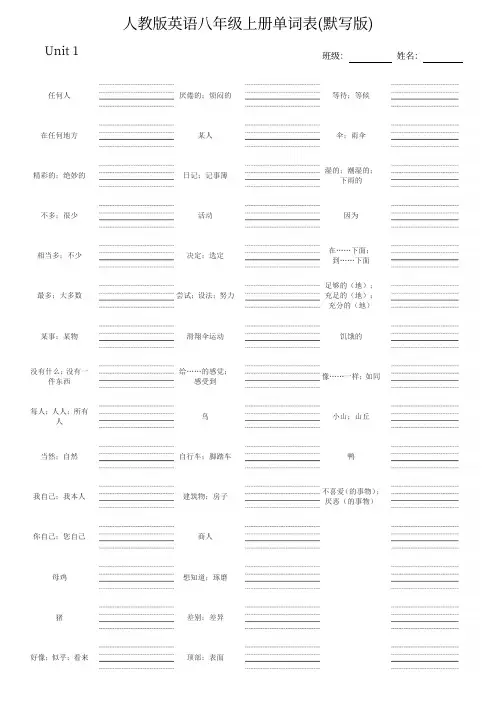
任何人在任何地方精彩的;绝妙的不多;很少相当多;不少最多;大多数某事;某物没有什么;没有一件东西每人;人人;所有人当然;自然我自己;我本人你自己;您自己母鸡猪好像;似乎;看来厌倦的;烦闷的某人日记;记事簿活动决定;选定尝试;设法;努力滑翔伞运动给……的感觉;感受到鸟自行车;脚踏车建筑物;房子商人想知道;琢磨差别;差异顶部;表面等待;等候伞;雨伞湿的;潮湿的;下雨的因为在……下面;到……下面足够的(地);充足的(地);充分的(地)饥饿的像……一样;如同小山;山丘鸭不喜爱(的事物);厌恶(的事物)家务劳动;家务事几乎不;几乎没有在任何时候;从来;曾经几乎从不一次;曾经两次;两倍(国际)互联网;因特网e)节目忙的;满的;充满的动,秋千;(使)摆动,摇摆摇摆舞大概;或许;可能最小,最少;最小的,最少的至少;不少于;起码无用的东西;无价值的东西垃圾食品咖啡健康;人的身体(或精神)状态结果;后果百分之……在线(的);联网(的)电视节目;电视机虽然;尽管;即使以;凭借;穿过头脑;心智身体这样的;那样的;类似的例如:像……这样在一起;共同消失;灭亡;死亡垃圾食品作者;作家牙科医生杂志;期刊然而;不过(用于引出比较的第二部分)比多于几乎;差不多没有一个;毫无较少;较小少于得分;点(用于引出比较的爱交际的;友好的;外向的较好的(地);更好的(地)喧闹地;大声地;响亮地轻声地;轻柔地;安静地努力工作的;辛勤的比赛;竞赛;竞争极好的;了不起的哪一个;哪一些清楚地;清晰地;明白地获胜;赢;赢得不过;可是;然而有才能的;有才干的真正;确实在意;担忧;关心关心;在意严重的;稳重的镜子小孩;年轻人只要;既然必需的;必要的与……不同;与……有差异两个;两个都使显现;使表现出成绩等级;评分等级应该;应当;可以和……相同;与……一致谚语;格言;警语伸手;到达;抵达手感动;触摸工作;职业内心;心脏现实;事实确切地说;事实上;实际上(使)破;裂;碎;损坏手臂;上肢笑;发笑;笑声分享;共享;共用;分摊响亮的;大声的相像的;类似的与……相似的、类似的最初的;最早的小学信息;消息确切地说;事实上;戏剧;剧场使人舒服的;舒适的座位;坐处(如椅子等)银屏;屏幕(在空降、时间上)接近票;入场券最差(的);最坏(的);最糟(的)便宜地;低廉地歌;歌曲(电台、电视台、俱乐部的)音乐节目主持人选择;挑选细致地;小心地;谨慎地记者到目前为止;迄今为止新鲜的;清新的戏剧;剧场舒服地;舒适地更差(的);更换(的);更糟(的)接待;服务相当;十分;很;漂亮的菜单扮演;表演者早(或午、晚)餐;一餐所吃的食物有创造力的;创造性的表演者;演员天资;天赋有相同特征;(想法、兴趣等方面)相同魔术师各种类型的;各种各样的美好地;漂亮地是……的时候;由……决定舒服地;舒适地作用;职能;角色发挥作用;有影响获胜者;优胜者奖;奖品;奖金每人;人人;所有人编造(故事、谎言等)实例;范例例如贫穷的;清贫的严重地;严肃地;认真地认真对待……提供;给人多的;拥挤的;挤满的获胜者;优胜者帽子处处;到处;各个地方总是情景喜剧情景喜剧新闻节目;新闻肥皂剧教育的;有教育意义的打算;计划希望查明;弄清讨论;商量忍受;站立发生;出现也许;可能;可以预料;期待笑话;玩笑喜剧;喜剧片情景喜剧毫无意义的;意思不明确的行动动作影片动画片;卡通片文化;文明著名的;出名的出现开始变得;变成富有的获得成功的;有成就的可能;可以主要的;最重要的原因;理由普通的;常见的电影经受;经历不幸的;不吉利的失去;丢失女朋友愿意的;准备好的愿意迅速做某事人物;角色简单的;易做的装扮;乔装打扮代替;替换陆军;陆军部队干得好愿意迅速做某事长大;成熟;成长计算机程序设计员;编程人员厨师;烹饪;煮医生工程师小提琴手驾驶员;司机飞行员钢琴家科学家确信;对……有把握确保;查明学院;大学;高等专科学校教育药;医学长大;成熟;成长(综合性)大学;高等教育伦敦文章;论文邮寄;发送决心;决定队;组外国的能够能够做某事表示疑问;怀疑;提问;质询意义;意思讨论;商量承诺;诺言;许诺开头;开端在……开始经受;经历改进;改善写下;记录下身体的他(她、它们)自己关于;与……有关系自我改进;自我提高(尤指为消遣)学着做;开始做业余爱好每周的(地)学校作业;功课同意;赞成;应允同意;赞成自己的;本人的个人的;私人的关系;联系改进;改善纸;纸张污染;污染物预言;预测将来;未来污染环境行星地球;世界种植;植树参加;参与;部分参与(某事)和平海洋天空宇航员;航天员纸;纸张公寓套房火箭太空;空间太空站;宇宙空间站人仆人有危险的;不安全的已经;早已工厂多次;反复地相信;认为有可能不同意;持不同意见;有分歧甚至;连;愈加许多;大量形状;外形倒塌;跌倒;掉落突然倒下;跌倒;倒塌在……里面寻找;寻求可能存在或发生的;可能的不可能存在或发生的;不可能一方(的意见、态度、立场)很可能;大概在……期间假期;假日单词;词可能存在或发生摇动;抖动奶昔食物搅拌器接通(电流、煤气、水等);打开剥皮;去皮倒出;倾倒酸奶蜂蜜西瓜勺;调羹锅增加;添加最后;最终食盐食糖摇动;抖动干酪;奶酪爆米花玉米;谷物机器;机械装置掘(地);凿(洞);挖(土)洞;孔;坑夹心面包片;三明治黄油;奶油火鸡莴苣;生菜片;块;段感恩节传统的;惯例的秋天;秋季漂泊者;旅行者;游客英格兰庆祝;庆贺(使)混合;融合甜椒;柿子椒(使)充满;装满烤箱;烤炉盘子;碟子遮盖;覆盖;覆盖物;盖子(调味)肉汁接待;服务;提供温度;气温;体温(使)充满;装满使做准备;把……准备好为……做准备考试流行性感冒;流感有空的;可获得的其他时间;别的时间到……时;直到……为止悬挂;垂下闲逛;常去某处及时赶上;接住;抓住邀请接受拒绝前天后天使做准备;把……工作日(星期一至星期五的任何一天)照料;照顾邀请;请柬拒绝回答;答复转寄;发送;向前;前进删除打印;印刷(令人)悲哀的;(令人)难过的再见去旅行高兴;愿意准备;准备工作胶水没有;不(做某事)惊奇的;感觉意外的盼望;期待接到(某人的)信、电话等乔迁聚会开幕式;落成典礼音乐会;演奏会校长大事;公开活动;比赛项目客人;宾客日历;日程表白天;日间开幕式;落成典礼会议;聚会;会面录像带;录像组织;筹备炸土豆条;炸薯条巧克力难过;失望;沮丧出租车;的士劝告;建议旅行;游历代理人;经纪人专家保守秘密(13-19岁的)青少年正常的;一般的除非;如果不会议;聚会;会面无疑;肯定;当然;行钱包英里发怒的;生气的善解人意的;体谅人的粗心的;不小心的错误;失误他自己小心的;细致的;精心的;慎重的劝告;建议解决;解答步;步骤相信;信任经验;经历分成两半在中途;部分地做(或达到)别的;其他的人教版英语八年级上册单词表(默写版)班级:姓名:附答案(请参照英语课本单词表)Unit1第一单元单词anyone 任何人anywhere 在任何地方wonderful 精彩的;绝妙的few 不多;很少quite a few 相当多;不少most 最多;大多数something 某事;某物nothing 没有什么;没有一件东西everyone 每人;人人;所有人of course 当然;自然myself 我自己;我本人yourself (pl.yourselves)你自己;您自己hen 母鸡pig 猪seem 好像;似乎;看来bored 厌倦的;烦闷的someone 某人diary 日记;记事簿activity 活动decide 决定;选定try 尝试;设法;努力paragliding 滑翔伞运动fee llike 给……的感觉;感受到bird 鸟bicycle 自行车;脚踏车building 建筑物;房子trader 商人wonder 想知道;琢磨difference 差别;差异top 顶部;表面wait 等待;等候umbrella 伞;雨伞wet 湿的;潮湿的;下雨的because of 因为below 在……下面;到……下面enough足够的(地);充足的(地);充分的(地)hungry 饥饿的as 像……一样;如同hill 小山;山丘duck 鸭dislike 不喜爱(的事物);厌恶(的事物)Central Park 中央公园(美国纽约)Huangguoshu Waterfall 黄果树瀑布(贵州)Hong Kong 香港(中华人民共和国特别行政区)Malaysia 马来西亚Malaysian 马来西亚的;马来西亚人Georgetown 乔治市(马来西亚)Weld Quay 海墘街Penang Hill 槟城山(马来西亚)Tian'anmen Square 天安门广场the Palace Museum 故宫博物院Mark 马克(男名)Unit 2第二单元housework 家务劳动;家务事hardly 几乎不;几乎没有ever 在任何时候;从来;曾经hardly ever 几乎从不once 一次;曾经twice 两次;两倍Internet(国际)互联网;因特网program(=programme)节目full 忙的;满的;充满的swing 摆动,秋千;(使)摆动,摇摆swing dance 摇摆舞maybe 大概;或许;可能least 最小,最少;最小的,最少的at least 至少;不少于;起码junk 无用的东西;无价值的东西junk food 垃圾食品coffee 咖啡health 健康;人的身体(或精神)状态result 结果;后果percent(=per cent)百分之……online 在线(的);联网(的)television 电视节目;电视机although 虽然;尽管;即使through 以;凭借;穿过mind 头脑;心智body 身体such 这样的;那样的;类似的such as 例如:像……这样together 在一起;共同die 消失;灭亡;死亡writer 作者;作家dentist 牙科医生magazine 杂志;期刊however 然而;不过than(用于引出比较的第二部分)比more than 多于almost 几乎;差不多none 没有一个;毫无less 较少;较小less than 少于point 得分;点Claire 克莱尔(女名)Sue 休(女名)American Teenager《美国青少年》(文中为虚构的杂志名称Unit 3第三单元单词outgoing 爱交际的;友好的;外向的better(good和well的比较级)较好的(地);更好的(地)loudly 喧闹地;大声地;响亮地quietly 轻声地;轻柔地;安静地hard-working 努力工作的;辛勤的competition 比赛;竞赛;竞争fantastic 极好的;了不起的which 哪一个;哪一些clearly 清楚地;清晰地;明白地win 获胜;赢;赢得though 不过;可是;然而talented 有才能的;有才干的truly 真正;确实care 在意;担忧;关心care about 关心;在意serious 严重的;稳重的mirror 镜子kid 小孩;年轻人as long as 只要;既然necessary 必需的;必要的be different from 与……不同;与……有差异both 两个;两个都bring out 使显现;使表现出grade 成绩等级;评分等级should 应该;应当;可以the same as 和……相同;与……一致saying 谚语;格言;警语reach 伸手;到达;抵达hand 手touch 感动;触摸heart 内心;心脏fact 现实;事实in fact 确切地说;事实上;实际上break (broke)(使)破;裂;碎;损坏arm 手臂;上肢laugh 笑;发笑;笑声share 分享;共享;共用;分摊loud 响亮的;大声的similar 相像的;类似的be similar to 与……相似的、类似的primary 最初的;最早的primary school 小学information 信息;消息Tara 塔拉(女名)Sam 萨姆(男名)Nelly 内莉(女名)Larry 拉里(男名)Unit 4第四单元单词theater (theatre) 戏剧;剧场comfortable 使人舒服的;舒适的seat 座位;坐处(如椅子等)screen 银屏;屏幕close (在空降、时间上)接近ticket 票;入场券worst(bad和badlly的最高级)最差(的);最坏(的);最糟(的)cheaply 便宜地;低廉地song 歌;歌曲DJ (电台、电视台、俱乐部的)音乐节目主持人choose (chose) 选择;挑选carefully 细致地;小心地;谨慎地reporter 记者so far 到目前为止;迄今为止fresh 新鲜的;清新的comfortably 舒服地;舒适地worse(bad和badlly的比较级)更差(的);更换(的);更糟(的)servise 接待;服务pretty 相当;十分;很;漂亮的menu 菜单act 扮演;表演者meal 早(或午、晚)餐;一餐所吃的食物creative 有创造力的;创造性的performer 表演者;演员talent 天资;天赋have...in common 有相同特征;(想法、兴趣等方面)相同magician 魔术师all kinds of 各种类型的;各种各样的beautifully 美好地;漂亮地be up to 是……的时候;由……决定role 作用;职能;角色play a role 发挥作用;有影响winner 获胜者;优胜者prize 奖;奖品;奖金everyboby 每人;人人;所有人make up 编造(故事、谎言等)example 实例;范例for example 例如poor 贫穷的;清贫的seriously 严重地;严肃地;认真地take...seriously 认真对待……give 提供;给crowded 人多的;拥挤的;挤满的Greg 格雷格(男名)Depp 德普(姓)Danny 丹尼(男名)Eliza 伊莉莎(女名)Vera 薇拉(女名)Dennis 丹尼斯(男名)American Idol 美国偶像(文中为电视节目名称)America's Got Talent 美国达人秀(文中为电视节目名称)China's Got Talent 中国达人秀(文中为电视节目名称)Unit 5第五单元单词sitcom 情景喜剧situation comedy 情景喜剧news 新闻节目;新闻soap opera 肥皂剧educational 教育的;有教育意义的plan 打算;计划hope 希望find out 查明;弄清discussion 讨论;商量stand 忍受;站立happen 发生;出现may 也许;可能;可以expect 预料;期待joke 笑话;玩笑comedy 喜剧;喜剧片meaningless 毫无意义的;意思不明确的action 行动action movie 动作影片cartoon 动画片;卡通片culture 文化;文明famous 著名的;出名的appear 出现become 开始变得;变成rich 富有的successful 获得成功的;有成就的might 可能;可以main 主要的;最重要的reason 原因;理由common 普通的;常见的film (movie)电影unlucky 不幸的;不吉利的lose (lost)失去;丢失girlfriend 女朋友ready 愿意的;准备好的be ready to 愿意迅速做某事character 人物;角色simple 简单的;易做的dress up 装扮;乔装打扮take sb's place 代替;替换army 陆军;陆军部队do a good job 干得好Sarah 萨拉(女名)Walt Disney 沃尔特·迪斯尼Minnie 明妮(女名)Mickey Mouse 米老鼠Steamboat Willie迪士尼公司制作的全球第一部有声动画片《威利号汽船》Hollywood 好莱坞;美国电影业the Hollywood Walk of Fame好莱坞星光大道(美国)Unit 6第六单元单词grow up 长大;成熟;成长computer programmer 计算机程序设计员;编程人员cook 厨师;烹饪;煮doctor 医生engineer 工程师violinist 小提琴手driver 驾驶员;司机pilot 飞行员pianist 钢琴家scientist 科学家be sure about 确信;对……有把握make sure 确保;查明college 学院;大学;高等专科学校education 教育medicine 药;医学university(综合性)大学;高等教育London 伦敦article 文章;论文send 邮寄;发送resolution 决心;决定team 队;组foreign 外国的able 能够be able to 能够做某事question 表示疑问;怀疑;提问;质询meaning 意义;意思discuss 讨论;商量promise 承诺;诺言;许诺beginning 开头;开端at the beginning of 在……开始improve 改进;改善write down 写下;记录下physical 身体的themselves 他(她、它们)自己have to do with 关于;与……有关系self-improvement 自我改进;自我提高take up(尤指为消遣)学着做;开始做hobby 业余爱好weekly 每周的(地)schoolwork 学校作业;功课agree 同意;赞成;应允agree with 同意;赞成own 自己的;本人的personal 个人的;私人的relationship 关系;联系Andy 安迪(男名)Ken 肯(男名)Hemingway 海明威(姓)Kelly 凯莉The Old Man and the Sea《老人与海》(美国作家海明威的小说)Unit7第七单元单词paper 纸;纸张pollution 污染;污染物prediction 预言;预测future 将来;未来pollute 污染environment 环境planet 行星earth 地球;世界plant 种植;植树part 参加;参与;部分play a part 参与(某事)peace 和平sea 海洋sky 天空astronaut 宇航员;航天员apartment 公寓套房rocket 火箭space 太空;空间space station 太空站;宇宙空间站human 人servant仆人dangerous 有危险的;不安全的already 已经;早已factory 工厂over and over again 多次;反复地believe 相信;认为有可能disagree 不同意;持不同意见;有分歧even 甚至;连;愈加hundreds of 许多;大量shape 形状;外形fall (fell/fell)倒塌;跌倒;掉落fall down 突然倒下;跌倒;倒塌inside 在……里面look for 寻找;寻求possible 可能存在或发生的;可能的impossible 不可能存在或发生的;不可能side 一方(的意见、态度、立场)probably 很可能;大概during 在……期间holiday 假期;假日word 单词;词Nick 尼克(男名)James 詹姆斯(男名)White 怀特(娃)Unit 8第八单元单词shake 摇动;抖动milk shake 奶昔blender 食物搅拌器turn on 接通(电流、煤气、水等);打开peel 剥皮;去皮pour 倒出;倾倒yogurt (=yoghurt)酸奶honey 蜂蜜watermelon 西瓜spoon 勺;调羹pot 锅add 增加;添加finally 最后;最终salt 食盐sugar 食糖cheese 干酪;奶酪popcorn 爆米花corn 玉米;谷物machine 机器;机械装置dig 掘(地);凿(洞);挖(土)hole 洞;孔;坑sandwich 夹心面包片;三明治butter 黄油;奶油turkey 火鸡lettuce 莴苣;生菜piece 片;块;段Thanksgiving 感恩节traditional 传统的;惯例的autumn 秋天;秋季traveler (=traveller)漂泊者;旅行者;游客England 英格兰celebrate 庆祝;庆贺mix(使)混合;融合pepper 甜椒;柿子椒fill(使)充满;装满oven 烤箱;烤炉plate 盘子;碟子cover 遮盖;覆盖;覆盖物;盖子gravy(调味)肉汁serve 接待;服务;提供temperature 温度;气温;体温Unit 9第九单元单词prepare 使做准备;把……准备好prepare for 为……做准备exam (=examination)考试flu 流行性感冒;流感available 有空的;可获得的another time 其他时间;别的时间until 到……时;直到……为止hang (hung)悬挂;垂下hang out 闲逛;常去某处catch 及时赶上;接住;抓住invite 邀请accept 接受refuse 拒绝the day before yesterday前天the day after tomorrow后天weekday工作日(星期一至星期五的任何一天)look after 照料;照顾invitation 邀请;请柬turn down 拒绝replay 回答;答复forward 转寄;发送;向前;前进delete 删除print 打印;印刷sad(令人)悲哀的;(令人)难过的goodbye 再见take a trip 去旅行glad 高兴;愿意preparation 准备;准备工作glue 胶水without 没有;不(做某事)surprised 惊奇的;感觉意外的look forward to 盼望;期待hear from 接到(某人的)信、电话等housewarming 乔迁聚会opening 开幕式;落成典礼concert 音乐会;演奏会headmaster 校长event 大事;公开活动;比赛项目guest 客人;宾客calendar 日历;日程表daytime 白天;日间Ted 特德(男名)Vince 文斯(男名)Steen 斯蒂恩(姓)Jake 杰克(男名)Susan 苏珊(女名)Unit 10第十单元单词meeting 会议;聚会;会面video 录像带;录像organize (=organise)组织;筹备potato chips 炸土豆条;炸薯条chocolate 巧克力upset 难过;失望;沮丧taxi 出租车;的士advice 劝告;建议travel 旅行;游历agent 代理人;经纪人expert 专家keep...to oneself 保守秘密teenager(13-19岁的)青少年normal 正常的;一般的unless 除非;如果不certainly 无疑;肯定;当然;行wallet 钱包mile 英里angry 发怒的;生气的understanding 善解人意的;体谅人的careless 粗心的;不小心的mistake 错误;失误himself 他自己careful 小心的;细致的;精心的;慎重的advise 劝告;建议solve 解决;解答step 步;步骤trust 相信;信任experience 经验;经历in half 分成两半halfway 在中途;部分地做(或达到)else 别的;其他的Karen 卡伦(女名)Ben 本(男名)Michael 迈克尔(男名)Laura 劳拉(女名)Mills 米尔斯(娃)Robert 罗伯特(男名)Hunt亨特(姓)。
【人教版】最新八年级英语上册:Unit 9 优秀教学案(含答案解析) - 副本
Unit 9 Can you come to my party?Section A (1a-1c)1.重点单词:prepare,exam,flu2.重点短语:prepare for an exam,have the flu3.重点句式:—Can you come to my party on Saturday afternoon? —Sure,I'd love to./Sorry,I can't.I have to prepare for an exam. I'm sorry,too.I must go to the doctor.1.会用“Can you...?”来对别人发出邀请2.学会接受和拒绝对方的邀请1.熟练掌握情态动词can的用法2.学会有礼貌地发出、接受和拒绝对方的邀请一、预习课本P65新单词并背诵,完成下面的汉译英。
1.准备____________ 2.考试____________3.流感____________二、认真预习1a-1c,找出下列短语和句型。
1.准备考试____________________2.患流感____________________3.你能在星期六的下午参加我的聚会吗?当然了,我非常乐意去。
/抱歉我不能。
我必须要准备考试。
/ 我也很抱歉,我必须去看医生。
________________________________________________________________________Step 1情景导入Teacher:I'm very happy today,because it is my birthday tomorrow,and I am going to have a birthday party.Would you like to come to my party?Students:Yes,we'd love to.Teacher:Welcome to my party.But do you know another way of saying “Would you like to come to my birthday party”?You don't need to be worried,today we will learn it.Now let's learn “Unit 9 Can you come to my party?”.环节说明:由过生日邀请学生参加生日聚会引出将要学习的新句型,过渡自然,简洁明了。
人教版英语八年级上册unit1--6单元课文完形填空习题含答案
人教版英语八年级上册unit1--6单元课文完形填空习题专练8A Unit 1 Reading AWe held a meeting after school. Lucy, Tony, Joyce, Jessica and I were①the meeting.First we decided to elect the chief editor.Tony suggested Joyce. He said, “We should choose Joyce because she②experience. She was the editor of her class newspaper last year.”Then we all voted③her. We elected Joyce to be the chief editor.Then Joyce took charge of the meeting. She said, “We④elect a secretary now.” she asked for suggestions.Jessica said, “Ben should be the secretary, because he has experience too. He was the secretary of the Music Club last year.”Then the others voted for me. They elected me to be the secretary. I started⑤notes.Joyce said, “Lucy, Tony, and Jessica, you will be editors of the paper. You will be responsible for different⑥of the paper.”Lucy asked, “Which sections will we have?”Joyce said, “Talk it over⑦yourselves. We will decide at the next meeting.”Then we made a list of some other things to discuss. For example, how often should we publish the paper? Should it be free for⑧, or shouldthey pay for it? What should we call it?We considered the last question quickly. Lucy said, “We ought to⑨it the Mayfield Sun.”“What about the Mayfield Mirror or the Mayfield Star?” Jessica said. Because we all had different ideas, Joyce said, “We would think about this a bit⑩. We will make a decision about the name at the next meeting.”We agreed to conclude the meeting then. We arranged to have the next meeting in one week’s time.()①A. in B. on C. at()②A. have B. has C. had()③A. to B. by C. for()④A. ought to B. need C. must()⑤A. take B. took C. taking()⑥A. sections B. parts C. kinds()⑦A. to B. between C. among()⑧A. students B. teachers C. readers()⑨A. name B. call C. named()⑩A. time B. long C. longer8A unit 1 答案Key: CBCACACCBC8A Unit 1 listening BLast week was a very interesting week.Last Monday, our new music room opened. We have many new instruments and a lot of equipments. It opened with a special concert. The concert included a①and several songs. The school band played many of my favourite songs,②Hey Jude by the Beatles. Many students came to the concert with their parents. Everyone enjoyed the evening.Last Thursday evening, the photo club showed some old photos of Guangzhou③. These photos belonged to a student’s mother. Last Saturday, the club also had the members take photos of the same places as ④in the old photos. It is very interesting to see⑤the places have changed.Last Sunday, our school’s⑥volleyball team played and won their last game. Congratulations everyone! The other team from No.7 Middle School, played very well, but in the end they lost the game. Many⑦fans from both schools watched the game.()①A. play B. game C. match()②A. including B. such as C. for example()③A. in the 1950 B. in 1950s C. in the 1950s()④A. this B. these C. those()⑤A. / B. how C. what()⑥A. girl B. girl’s C. girls’()⑦A. big B. excited C. crazyKey: AACCBCB8A Unit 1 More Practice AZhen Hui was outside the English teacher’s room. She loves English very much. She wanted to discuss①English exercise with her English teacher. She looked a little②nervous.Li Ming left his bag in the playground and he walked back there to③it. When he found it, he looked quite happy.After school, Wang Gang rode out of the school④. He and his best friends planned to go to the cinema. He looked excited.Li Ye felt sick. He went to the⑤. The nurse told him to⑥his mother because he had a high⑦.Sally likes⑧books. She often borrows many books from the school library. She was on her way to the library to return the books.At break, Jia Ming ran to the sports field to play football with his classmates. They⑨practice a lot because they have a match with Class 2 next Wednesday.()①A. a B. an C. the()②A. bit B. more C. /()③A. get B. find C. save()④A. / B. door C. gate()⑤A. clinic B. hospital C. restaurant()⑥A. call B. ask C. phone()⑦A. ill B. sick C. fever()⑧A. read B. to read C. reading()⑨A. need B. have to C. mustKey: BAACACCBB8A Unit 2 Reading ALucy Mr Ken, Why do you like working as a detective?Ken I hope to protect the innocent①find the guilty. Well, let me tell you about a recent case. Mr Li is a rich man. He lives aloneand enjoys②things. He bought a vase③two million dollarsand only showed it to his friends Jill and Jenny. Then he lockedit in the safe inside his house. That night someone stole it, Lireported the④, and I went to his house to look for clues.Lucy Did you find any?Ken Yes, a black pearl earring near the⑤safe. Outside the open window, I also saw a lot of mud on the wet ground. Inside theroom, the carpet was very clean. Then I questions Jill and Jenny.They⑥denied stealing the vase, but I notice Jill wearing ablack pearl necklace. It has the same design as the earring. Luck So Jill was the thief?Ken I wasn’t sure. I needed proof. I showed Jill the earring. She admitted, “I t’s⑦. But someone stole it⑧my house a weekago.” I checked her story. It was true.Lucy I see, so Jill was no longer a suspect. However, what about your⑨clues—the mud outside and the clean carpet inside?Ken They only⑩one thing—no thief broke into Li’s house. So I questioned Li and, in the end, he admitted stealing his own vase.He said, “I bought insurance for the vase. I stole it for theinsurance money.”Li also stole Jill’s earring. He wanted tomake Jill go to jean instead of himself.Lucy Is Li behind bars now?Ken Yes, and Jill is free.()①A. and B. also C. as well as()②A. collect B. to collect C. collecting()③A. for B. about C. more than()④A. thief B. theft C. robbery()⑤A. open B. opened C. opening()⑥A. are B. both C. all()⑦A. me B. my C. mine()⑧A. in B. from C. inside()⑨A. other B. another C. the other()⑩A. mean B. meant C. meaningKey: CCABABCBAB8A Unit 2 Listening BI wanted to see Jill again, so on my way home①work, I stopped at a telephone box and called her. I invited her to the cinema②evening. She agreed to go with me, so we arranged to meet outside the cinema at seven o’clock.At around quarter past six, I put on my jacket and hat and left the house. I locked the door, but I③to turn off the light in the living room.At that time of day, it is very difficult to④a taxi. I could not find one, so I took the bus⑤. I arrived at the cinema around ten minutes early. Next to the cinema is a bookshop, so I went in to look around⑥I waited for Jill. I started reading a book about world-fames crimes. It was really interesting! In fact, it was so interesting⑦I forgot the time. I was late.When I arrived, Jill was really angry. She refused to speak to me at first. How could I make her happy? “I know!” I thought. “I will buy her some ⑧.” I went to the sweet shop and bought a large bar of chocolate. I was right—it did make her happy, and we went in to see the film.()①A. to B. for C. from()②A. in B. at C. that()③A. forget B. forgot C. remember()④A. get B. take C. have()⑤A. instead B. instead of C. to instead()⑥A. / B. when C. while()⑦A. so B. that C. lead to()⑧A. roses B. toys C. chocolateKey: CCBAACBC8A Unit 2 More Practice AYesterday was a very busy day. I solved two cases. The first case was about a bank robbery. A man entered a bank in the city centre with a gun. He took away thousands of①. The bank manager called the police, but it was too late. The robber②away. The suspect in the case was Tim Smith. At first, Tim denied③the robber. He said he was watching a film in the cinema at the time of the robbery. However, I had proof. One of the customers in the bank at that time took a photo. It showed Tim Smith in the bank,④ a gun. I showed the photo to Tim. He⑤admitted his crime.In the second case, a lady called Susan Brown bought a beautiful vase forfifty thousand dollars. The owner of the shop called the police because Susan had used⑥banknotes to pay for the vase. We⑦her to the police station. She said that she got the notes from the bank and that the bank clerk must have⑧her. However, when I searched her flat, I found half a million dollars in forged notes. She kept them in a safe in the wall. Susan then admitted printing the notes herself. I returned the beautiful vase to the shop.()①A. money B. yuans C. dollars()②A. run B. went C. got()③A. making B. being C. having()④A. carry B. carried C. carrying()⑤A. then B. had to C. still()⑥A. forget B. forgot C. forged()⑦A. took B. brought C. called()⑧A. fooled B. joked C. jokingKey: CCBCACBA8A Unit 3 Reading AHidden helpersNot so many years ago, you hardly①saw computers. Now they seem to be everywhere.There are also many hidden “computers” in your home, but you②be unaware of them. For example, there may be one inside your TV set, telephone or washing machine.You are more③on computers than you know.What kind of jobs can a computer do?Computers are probably the best calculators in the world. They are faster ④calculating than people, and they rarely give wrong answers. They can also type, print and draw things like diagrams and graphs. They can teach you many things and also play games with you. More⑤, they can operate railways (⑥the underground) and fly planes and spaceships. For⑦reasons, we sometimes call them “electronic brains”.Is a computer cleverer than I am?The answer to this question is, for the time being, “No”. You have⑧understanding of the meaning of things than computers and can also create new ideas of you own. However, one day computers may be able to do⑨things than a human brain. In the future, they may even be better at doing their jobs than doctors, judges and teachers.This raises interesting questions. How⑩computers change our lives? Will we have nothing to do? Will computers make our lives better or worse in the future?()①A. / B. ever C. even()②A. should B. may C. might()③A. dependent B. interested C. enjoy()④A. in B. on C. at()⑤A. important B . importantly C. useful()⑥A. / B. like C. such as()⑦A. that B. this C. these()⑧A. great B. greater C. greatly()⑨A. more B. many C. much()⑩A. will B. can C. couldKey: BCACBBCBAA8A Unit 3 Reading BHow do we give computer instructions?We give a computer instructions①putting different programs into it. “Computer programmers” write computer programs. It is essential for②people not to make mistakes.③, the computer will not work well.A computer needs different programs to do different④. For example, playing games, writing letters and drawing pictures all need different programs. There are also different languages for different programs.⑤a program, people need to know this language. Sometimes a computer programmer may know many different languages.⑥, computer languages are not spoken languages like Chinese or English⑦writtenlanguages. Also, only the computer and the programmer can understand them!CD-ROMs and DVE-ROMsMany computers have CD-ROM or DVD-ROM⑧. A CD-ROM can hold over 300,000 pages of writing, and may also contain pictures and sounds. A DVD-ROM can hold even more⑨. So, you can use them on you computer to read about the most famous people in the world today. You can also see photographs⑩videos of people, and even listen to them speaking. According to some people, CD-ROMs and DVD-ROMs will become even more popular than books.()①A. by B. with C. in()②A. the B. this C. these()③A. In fact B. However C. Otherwise()④A. things B. jobs C, work()⑤A. Write B. To write C. Writing()⑥A. In fact B. However C. Otherwise()⑦A. but B. it’s C. so()⑧A. / B. driver C. drives()⑨A. letters B. words C. information()⑩A. or B. and C. /Key: ACCBBBACCA8A Unit 3 More Practice BA research team in the USA first had the idea of①computers together in the 1960s. They wanted computers in universities, research departments and the military to communicate with ②and share information. At that time, computers were bigger than fridges. People could not move them③. Computers were also complicated and difficult to use.Slowly, more and more people started to link their computers together. Then businessmen started to use the Internet④. Today, people all over the world are⑤the Internet.There is a wide range of services on the Internet. For example, we can use it to communicate with other people. The most popular way to communicate is through electronic mail, or “e-mail”. We can also use services such as MSN messenger⑥Skype. We can use these services to send instant messages to people near of far away.The Internet⑦us to use to World Wide Web (also⑧as WWW or the Web). The web is many connected pages of information. We can use the Web to read news and learn about our favourite sports stars or singers. The Internet⑨changed our lives. Now we can contact the whole world with the computers⑩our homes.()①A. link B. linked C. linking()②A. each other B. the others C. the other()③A. easy B. easily C. easier()④A. too B. also C. as well()⑤A. use B. used C. using()⑥A. or B. and C. with()⑦A. allow B. allows C. allowing()⑧A. called B. named C. known()⑨A. have B. haven C. has()⑩A. in B. on C. atKey: CABACABCCA8A Unit 4 Listening BGood evening, everyone. Welcome to “History①a minute”. Tonight, we are going to talk about the ancient Olympic Games.The first Olympic Games②thousands of years ago in Greece. People started the Olympic Games to③respect to the gods. They would pray to their gods in the morning and then have the games in the afternoon. The first Olympic Games only④for one day! In modern times, the Olympic Games last for two weeks. In the modern Olympics, we have many different kinds of sports, but in the ancient Olympic Games, there were only⑤ten kinds of sports.One last fact—thousands of years ago,⑥women could not watch the games.⑦, they would be punished! Here is a story about a woman at the ancient Olympic Games in Greece. Her name was Helen. Helen’s son Rodus⑧the competition of running in the Olympic Games. Helen wanted to watch Rodus run, so she made herself⑨like a soldier and entered the stadium. Unfortunately, Helen was found inside the stadium. Rodus won the⑩, but his mother was punished.()①A. in B. for C. with()②A. started B. began C. happened()③A. show B. showed C. showing()④A. last B. lasts C. lasted()⑤A. about B. less than C. more than()⑥A. marry B. married C. marrying()⑦A. Or B. However C. Otherwise()⑧A. join B. join in C. took part in()⑨A. like B. looks C. looked()⑩A. competition B. match C. gameKey: BCACABCCAA8A Unit 4 More Practice BReligion was very important to the ancient Greeks. In①opinion, itwould make their lives better and also the gods and goddesses would take care of them after they②.The Greeks believed in many different gods and③. These gods and goddesses controlled everything in their④and the environment. It was important to make them happy—happy gods and goddesses helped you, but unhappy⑤punished you.Zeus is the⑥of the Greek gods. Zeus is lord of the sky, and the god of rain. Zeus is married to Hera. She is the goddess of marriage and childbirth. Poseidon is the brother⑦f Zeus. He is the god of the sea. Aphrodite is the goddess of love and⑧. Aphrodite rises from the waves of the sea. She makes everyone⑨love.There are also gods and goddesses of the home, of war, of music, of the city and of fire. The Greeks held many festivals to show respect to them. They⑩temples to be the gods and goddesses’homes. People prayed and gave gifts to the gods and goddesses to make their wishes come true—for a good harvest, or for a good journey, or for their children to become beautiful.()①A. my B. his C. their()②A. die B. died C. death()③A. godess B. goddess C. goddesses()④A. life B. live C. lives()⑤A. one B. ones C. once()⑥A. ruler B. king C. queen()⑦A. on B. to C. of()⑧A. beauty B. beautiful C. beautied()⑨A. feel B. fall C. fell()⑩A. build B. built C. buildedKey: CBCCBACAAB8A Unit 5 Reading BIn 1904, Mrs Bess clarke of Washington State, the USA, saw a long, dark tree trunk in a lake. As she moved①, she saw the trunk②in the water. It looked very③. Mrs Clarke described seeing a strange creature. It was black in colour, with a head in the shape of a triangle, round eyes, and a long tail. Based④her description, scientists regarded it as a kind of sea dinosaur, they called it Bess.Since then, many people saw Bess in the⑤lake. They described Bess as a dark, snake-like creature with a long tail. John Lee has studied strange creatures and monsters⑥. In 1990, he set up a video camera near the lake to try to film Bess. One morning john saw the creature swimming near the surface of the lake. The creature appeared suddenly ⑦of the water and had the same appearance as the one nearly 100 years ago. John Lee took a film that day. It showed a creature about 100 metreslong with a very small head.In 1992, Ron Smith reported⑧Bess and three other similar creatures in the same lake. The bodies of the three other creatures were⑨different. They seemed to be another kind of sea creature.According to Dr David Dino, the world-famous expert on strange creatures, it is possible that sea monsters are living in many great lakes ⑩the world.()①A. near B. close C. closer()②A. moving B. moved C. move()③A. frightening B. frightened C. frighten()④A. in B. on C. at()⑤A. / B. same C. different()⑥A. his life B. his live C. all his life()⑦A. out B. went out C. inside()⑧A. see B. saw C. seeing()⑨A. very B. quite C. quiet()⑩A. in B. all C. aroundKey: CAABBCACBC8A Unit 5 More Practice ASally felt frightened when she saw a huge, dead monster on the①inAustralia. It was hairy and very smelly. “It was horrible,” said Sally. “It was in the shape of a tree trunk, and it looked like a monster.” Nobody ②what the monster was.Do you believe that dragons exist? Nobody has③seen a dragon, but there are still many drawings of dragons④the world. They have wings and sharp claws, and they breathe fire. Dragons represent different things in different cultures.⑤, the Chinese dragon lives in the sky and⑥all the water on Earth. One type of dragon lives in the sky and controls all the water on Earth. One type of dragon really does exist and⑦is the Sea Dragon. It is found in the seas of Australia it is about 45 centimetres long. There is a strange thing about this creature—the males⑧the babies. Some males live for more than twenty years and give birth twice a year.Have you ever seen a jellyfish? There is one type of jellyfish called the Sea Wasp. It looks like a harmless sea creature. It has no head, no brain and is 99% water. However, its sting can kill. If you get stung by one of these⑨, you have four minutes to get help, or die!()①A. beach B. road C. lake()②A. know B. knows C. knew()③A. been B. ever C. even()④A. in B. all C. around()⑤A. However B. Otherwise C. For example()⑥A. controls B. controlled C. controlling()⑦A. it B. that C. /()⑧A. give B. gave C. have()⑨A. creature B. dragon C. monsterKey: ABBCCABCA8A Unit 6 Reading AWang Damin sits on the side of the river. He is cooking①, with a large bird on his head. The bird is a cormorant, and Damin is a②. He is over 60 now but still works every day and is still③to control his raft on the river. He lives and works with his cormorants on this river. Cormorants are large black birds, about a metre long. They are good at ④fish because they can swim⑤⑥water. Their large feet are used to push them quickly through the water.Damin does not require nets to catch fish. That is done for him by his twelve cormorants. Damin begins his work on his bamboo⑦with his birds in the late afternoon. The birds swim down and catch fish. A piece of grass is tied around the neck of each bird, so it cannot swallow the fish. They⑧the fish back to the raft. The fish are then removed from the birds’ mouths and thrown into a big basket by Damin. At night, a light is hung from the front of the raft.⑨helps Damin see better, and alsoattracts the fish. Later, some of the fish are sold, and the rest are divided between Damin’s family and the cormorants.Cormorant fishing is a⑩Chinese skill. However, few young people are interested in doing his type of work any more. Modern fishing methods are now widely used.In 50 years, perhaps cormorant fishermen will no longer exist in the world.()①A. meal B. a meal C. dinner()②A. fish B. fisher C. fisherman()③A. enough strong B. strong enough C. strongly()④A. catch B. catches C. catching()⑤A. well B. good C. nice()⑥A. in B. under C. inside()⑦A. raft B. boat C. ship()⑧A. take B. took C. bring()⑨A. It B. This C. That()⑩A. tradition B. traditional C. customsKey: BCBCABACBB8A Unit 6 More Practice AOur company is①a new scientist to join our busy team.About us: We are international company and we are②different types of paint. We hope to create a paint that dries very quickly and has no③smell. If we successful, we will sell this paint around the world.About you: You must have experience④working in a laboratory. You must have the experience of working with⑤.Our laboratory often has a bad smell. It is also very noise. You must be able to work well in this difficult environment. You need to work calmly and not get excited or⑥when there is a lot of work to do. You must have a good sense of humour and⑦g telling jokes. You must have the ability to work alone and also as part of a team.We are looking for a very⑧t person. You need to be able to work quickly and correctly. There is a lot of paperwork. You must like writing reports and be⑨expert in computer technology.The job requires you to travel a lot and sometimes work in the evening and at weekends.If you think you are the right person for the job, contact us today!()①A. looking for B. looking to C. looking forward()②A. research for B. researching for C. researching()③A. pleasant B. unpleasant C. uncomfortable()④A. in B. on C. at()⑤A. print B. paint C. printing()⑥A. sad B. unset C. sadly()⑦A. enjoy B. enjoys C. enjoying ()⑧A. efficient B. interested C. excited ()⑨A. a B. an C. theKey: ACBCBBCAB。
人教版八年级英语上册U2 Section A (1a—2d)基础练习(含答案)
人教版八年级英语上册U2 Section A (1a—2d)基础练习(含答案)Ⅰ. 根据句意及首字母或汉语提示完成单词1. You can send e-mails on the I________.2. My father's favorite p________ is CCTV-News.3. My sister h________ exercises, so she isn't very healthy.4. The box is ________(满的). You can't put the books in it.5.—What do you often do on weekends?—I often help my mother with ________(家务劳动).Ⅱ. 用所给词的适当形式填空1.—How often does your mother exercise?—________(one) a week.2.—When ________ Tom ________(go) to school?—At about 8:00 in the morning.3. I watch TV three ________(time) a week.4. He's very lazy and he hardly ever________(help) his mother on weekends.5. Do you want ________(go) to the movies with me?Ⅲ. 单项选择1. She hardly takes ________,so her mother asks her to do morning ________.A. exercises; exercisesB. exercise; exerciseC. exercises; exerciseD. exercise; exercises2.—________ do you go to the movies, Jack?—Twice a month.A. How soonB. How farC. How oftenD. How long3. I like beautiful nature. I spend ________ in the countryside every year.A. sometimesB. some timesC. some timeD. sometime4.—What about ________?—That's a good idea.A. go fishingB. going fishC. going fishingD. go to fish5.—__________?—French fries.A. How often do you have dinnerB. How about having dinnerC. What's your favorite foodD. How do you like French friesⅣ. 完成句子1.你每周做几次运动?________ ________ ________ do you exercise every week?2.他不经常帮助父母干家务活。
人教版英语八年级上册答案-导学案-1
Unit 1 Where did you go on vacation? Section A【学习目标】1.学习Section A单词2.分析Section A中重点句子结构并掌握所涉及的知识点3.了解一般过去式【要点突破】1.Where did you go on vacation?译:你去哪里度假了?(1)-- Where did you go on vacation? --I went to the mountains.对应练习:①-- Who did you visit? --I visited my uncle.②-- Where did you visit? --I visited museums.(2)on vacation意为在度假;在假期中(holiday)例句:My uncle is in Australia on vacation.2. Did you go with anyone?译:你和别人一起去的吗?(1)不定代词anyone相当于anybody,当作主语时,谓语动词要用单数(单/复数)形式。
例句:Excuse me, is anyone in that seat next to you?(2)anyone与any one的区别:前者只能指人;后者既可指人也可指物,表示某一范围中的任何一个,其后可接of.对应练习:用anyone 和 any one of 填空。
① Anyone in our school knows him.②You can choose any one of the books.3.Did you go anywhere interesting?译:你去了什么有趣的地方了吗?(1)anywhere不定副词,意为“在任何地方”,常用于否定句和疑问句中。
例句:I can’t find my dictionary anywhere.(2)anywhere 与somewhere 的区别:前者用于否定和疑问句,而后者用于肯定句。
人教版英语八年级上册Unit7 SectionB 教材知识详解
Unit7 SectionB 教材知识详解1.They help with the housework and do jobs like working in dirty or dangerous places.他们帮助做家务,并在肮脏的、危险的地方工作。
dangerous adj.有危险的;不平安的指对他人或物构成了危险或威胁。
The tiger is very dangerous.老虎是很危险的。
danger n. 危险,in danger意为“处于危险之中〞,指自身处于危险之中。
Some animals are in danger.一些动物处于危险之中。
【例题】It's ______ to climb(爬) the tall tree. Be careful.A.danger B.dangerousC.bus y D.difficult点拨:根据“小心〞可知“爬那棵高树是危险的〞。
danger是名词,意为“危险〞。
is后接形容词作表语。
答案:B2.Today there are already robots working in factories.现在已经有机器人在工厂里工作了。
本句含有固定句型:There is/are+sb./sth.+doing sth.表示“有某人/某物在做某事〞。
There are some boys swimming in the swimming pool.有一些男孩在游泳池里游泳。
There is a bag lying on the ground.有一个包躺在地上。
【例题】There will be robots ______ with us in the future.A.talk B.will talkC.talking D.talked点拨:句意为“将来会有机器人和我们交谈〞。
There will be+sb.+doing sth.是There is/are+sb./sth.+doing sth.的变形。