
人教版初中英语总复习语法一
C. well D. very much
*4. --- Their school is three times as
___ as ours.
--- That means our school is _______
than theirs
A. big, three times smaller B. small,
2、不规则变化
原级 比较级 Good
Well Better
Bad worse
ill
Many More
Much
最高级
best worst
most
说明 巧记: 特殊形式比较级 共有三对二合一 坏病两多并两好 little意思不是小 一分为二有两个 一是老来二是远
Little Far old
Less
Least
st
fatter wfaetttteesrt Wettest
以重读闭音节结尾的词末尾只有H一appieBHrigadhproipteirest
个或e辅s音t 字母应双写辅音字母再加eNaearrrlireorwthdienrNrifeaatsrwtreoetwarelisetst
以或e辅s音t 字母+y结尾的词变为i再c加leevr,erHeeaarrplcyplyedvryerest
well 等只能放在be动词或其他连系 动词后面作表语,不能作定语.
very, much 这两个副词都可表示“很”,但用法不 同。Very用来修饰形容词和副词的原 级,而much用来修饰形容词和副词的 比较级。例如:
She is a very nice girl
I’m feeling much better now. Much可以修饰动词,而very则不能。 例如:
Farther/further Farthest/furthest
older
oldest
3、形容词,副词比较等级的用法
等
句型
例句
级 1、as+原级+as
She is as kind as her
原 级
2、not + so/as + 原级+ as
mother Lucy didn’t do it so/as
Crusoe was__ on the __island, but he didn’t feel____.
A.alone; alone; alone B. alone; lonely; lonely C. lonely; lonely; alone D. lonely; alone; lonely
I don’t like the idea much.
They did not talk much.
too, either 这两个副词都表示“也”,但 too用于肯定句,either用于否定 句。例如:
She can dance, and I can dance, too. I haven’t read the book and my brother hasn’t either.
2)多数副词作状语时放在 动词之后。如果动词带有宾 语,则放在宾语之后。例如: Mr Smith works very hard. She speaks English well.
南海执信中学初三英语备课组
3)频度副词作状语时,通常放 在行为动词之前,情态动,助 动词和be动词之后。例如:
He usually gets up early.
that everyone liked him./ He was so good that we made him monitor.
当名词前的形容词是表示“多或少”的意 思时,必须用so。这些形容词有:much,
many, (a) little, (a) few等。
already, yet already一般用于语肯定句, yet一般用于否定句。例如: He has already left. Have you heard from him yet? He hasn’t answered yet.
friendly
Care
careful Use
useful
南海执信中学初三英语备课组
3、掌握“系动词+形容词” 用 法
The meat has gone___. Throw it away. A. badly B. bad C. nice D. nicely
常用的连系动词除be外,还有become, get, go, turn, feel, look, sound, smell, taste,seem等。
7、区别hard / hardly, late / lately, near / nearby, alone / lonely, ill / sick too much / much too too / also / either
南海执信中学初三英语备课组
【重点归纳 】
南海执信中学初三英语备课组
★ alone(单独、独自)作表语=by oneself
lonely(孤独的)可作表语、定语
* He lived alone, but he didn’t feel lonely.
* It’s a lonely village.
英语当中的一些形容词如:alone, afraid, able, asleep, sorry, sure,ill
南海执信中学初三英语备课组
二 、副词
1.副词的作用: 用来修饰动词.形容词.其它副词.全句或 名词词组及句子
用法
例
句
作表语 My mother is out
作定语 The girl there is my friend
作状语 He runs fast
作宾补 I found him outside
2.有许多副词是对应的形容词
少或多e数音s以节t e词r,和ow多结数尾双的音双节音词节在词其可前加MmM面eooorrrreeeMmMNcDdslpaieooofrlfivoroifsssecofpruwtttwicludstplulylioaofltfrpwicululyaltr
加more 和most
popular
slowly
加ly构成,
如: Strong
strongly
real
really
词尾是y的要把y变为i再加 ly,
如:busy
busily
happy
happily
以e结尾的,大部分直接加-ly,
如:wide
widely
brave
bravely
有几个特殊的要去e后再加-ly或y, 如:true –truly terrible --terribly
too +(for sb. )+to do sth.表示太… (某人)不能做…;而形容词+enough to do sth.表示足够…可以做….enough放在被修 饰的形容词或副词的后面,名词前后均可.
南海执信中学初三英语备课组
He made __ mistakes in his writing
large C. big, small D. large, twice
smaller
南海执信中学初三英语备课组
【考点直击】
南海执信中学初三英语备课组
1、形容词、副词在结构上和用 法上的主要区别。
2、比较等级的用法。
3、“越来越”、“越------就----
4、倍数的表达方法。
南海执信中学初三英语备课组
that his teacher was angry with him.
A. so much
B. such much
C. so many
D. such many
表示“如此…以致…”的句型是“so …that” ,“such…that…”. So后接 形容词、副词,such后接名词或名词词 组,如:He was such a good student
well as you
比 比较级 + than
较 级
He is taller than lilei
The weather is getting hotter and hotter
最 the+最高级+of /in
高 级
She is the tallest one in her class
4.使用形容词比较级时 注意:
作表语与系 动词连用
作宾 Please keep the room clean 补 I find it very beautiful
南海执信中学初三英语备课组
There must be__ with the machine. A. something wrong B. wrong something C. anything wrong D. wrong anything
形容词和副词的比较级和最高级的构成 是基本相同的,请同学按列项填充表格
走喽! 填 表去喽.
1. 规则变化
词尾变化
原级
比较 最高
TalleTrahlleasrdt ehrard级est 级
单音节词在词尾加-er(比较级)或lar- glearrTgwaelildshetarrdwidest
est(最高级)以字母e接尾B的i词gg加err或Bhiogtgtlaeersrget whiodettest
5、除以“be ”外的link verb+ 形容词的用法。
6、区别-ed和-ing结尾的形容 词的用法. interested / interesting, surprised / surprising, excited / exciting frightened / frightening
人教版初中英语语法知识点归纳总结

人教版初中英语语法知识点归纳总结一、词法名词可数名词与不可数名词:可数名词有单复数形式,如apple(苹果)的复数是apples。
一般在词尾加s 或es。
以辅音字母+ y 结尾的,把y 改i 再加es,如city(城市)的复数是cities。
不可数名词没有复数形式,如water(水)、rice(米饭)等。
常见的不可数名词还有advice(建议)、information(信息)等。
名词所有格:表示所属关系。
一般在名词后加’s,如Tom’s book(汤姆的书)。
以s 结尾的复数名词,在词尾加’,如the students’ desks(学生们的课桌)。
表示两者或多者共有时,只在最后一个名词后加’s;表示各自所有时,则每个名词后都加’s。
例如:Tom and Jerry’s room(汤姆和杰瑞共有的房间);Tom’s and Jerry’s rooms(汤姆和杰瑞各自的房间)。
代词人称代词:主格:I(我)、you(你;你们)、he(他)、she(她)、it(它)、we (我们)、they(他们;她们;它们)。
主格在句子中作主语。
例如:I am a student.(我是一名学生。
)宾格:me(我)、you、him(他)、her(她)、it、us、them。
宾格在句子中作宾语。
Give it to me.(把它给我。
)物主代词:形容词性物主代词:my(我的)、your(你的;你们的)、his(他的)、her(她的)、its(它的)、our(我们的)、their(他们的;她们的;它们的)。
后面需跟名词。
This is my book.(这是我的书。
)名词性物主代词:mine、yours、his、hers、its、ours、theirs。
相当于“形容词性物主代词+ 名词”。
This book is mine.(这本书是我的。
)指示代词:this(这个)、that(那个)、these(这些)、those(那些)。
(完整word版)人教版初中英语语法总结

词类、句子成分和构词法:1.词类:(1)名词(n.):表示人、事物、地点或抽象概念。
如:boy, morning, bag, ball, class, orange.(2)代词(pron.):主要用来代替名词。
如:who, she, you, it .(3)形容词(adj..):表示人或事物的性质或特征。
如:good, right, white, orange .(4)数词(num.):表示数目或事物的顺序。
如:one, two, three, first, second, third, fourth.(5)动词(v.):表示动作或状态。
如:am, is,are,have,see .(6)副词(adv.):修饰动词、形容词或其他副词,说明时间、地点、程度等。
如:now, very, here, slowly.(7)冠词(art..):用在名词前,帮助说明名词。
如:a, an, the.(8)介词(prep.):表示它后面的名词或代词与其他句子成分的关系。
如in, on, from, above.(9)连词(conj.):用来连接词、短语或句子。
如and, but, before .(10)感叹词(interj..)表示喜、怒、哀、乐等感情。
如:oh, well, hi, hello.2.句子成分:(1)主语是句子所要说的人或事物,回答是“谁”或者“什么”。
通常用名词或代词担任。
(2)谓语动词说明主语的动作或状态,回答“做(什么)”。
主要由动词担任。
(3)表语在系动词之后,说明主语的身份或特征。
名词、代词或形容词担任。
My name is Ping ping .(4)宾语表示及物动词的对象或结果,回答做的是“什么”。
通常由名词或代词担任。
双宾语:指物的叫直接宾语,指人的叫间接宾语。
间接宾语一般放在直接宾语的前面。
He wrote mea letter .有时可把介词to或for加在间接宾语前构成短语,放在直接宾语后面,来强调间接宾语。
人教版初二英语语法知识点归纳总结(一)
人教版初二英语语法知识点归纳总结(一)人教版初二英语语法知识点归纳前言初中英语作为基础学科,在英语学习过程中,语法知识的掌握是非常重要的。
本文旨在总结人教版初二英语教材中的语法知识点,帮助广大学生和教师更好地掌握和应用这些知识,提高英语学习的效果和能力。
正文1. 一般现在时(Simple Present Tense)•表示经常性或习惯性的动作、状况或真理等•动词原形作主语时,要使用第三人称单数形式的动词(he, she, it)2. 一般过去时(Simple Past Tense)•表示过去某个时间发生的动作或存在的状态•一般过去时的句子中,动词使用过去式形式3. 一般将来时(Simple Future Tense)•表示将来某个时间将会发生的动作或存在的状态•一般将来时的句子中,使用将来时态的助动词“will”,或表示将来的其他词语,如“be going to”4. 现在进行时(Present Continuous Tense)•表示现在正在进行的动作或瞬间状态•现在进行时使用“be + 动词-ing”构成5. 过去进行时(Past Continuous Tense)•表示过去某个时间正在进行的动作•过去进行时使用“was/were + 动词-ing”构成6. 一般现在时与现在进行时的区别•一般现在时表示经常性或习惯性的动作或状态,现在进行时表示现在正在进行的动作或瞬间状态7. 一般过去时与过去进行时的区别•一般过去时表示过去某个时间的动作或状态,过去进行时表示过去某个时间正在进行的动作8. 一般现在时、一般将来时与一般过去时的比较•一般现在时表示经常性或习惯性的动作或状态,一般将来时表示将要发生的动作或状态,一般过去时表示过去某个时间的动作或状态结尾以上是人教版初二英语教材中的一些重要的语法知识点的归纳。
对于初中英语学习者来说,掌握这些语法知识是非常重要的,能够帮助他们正确理解和表达英语,提高语言水平,并且为进一步学习打下坚实的基础。
(完整版)人教版初中英语语法完整总结
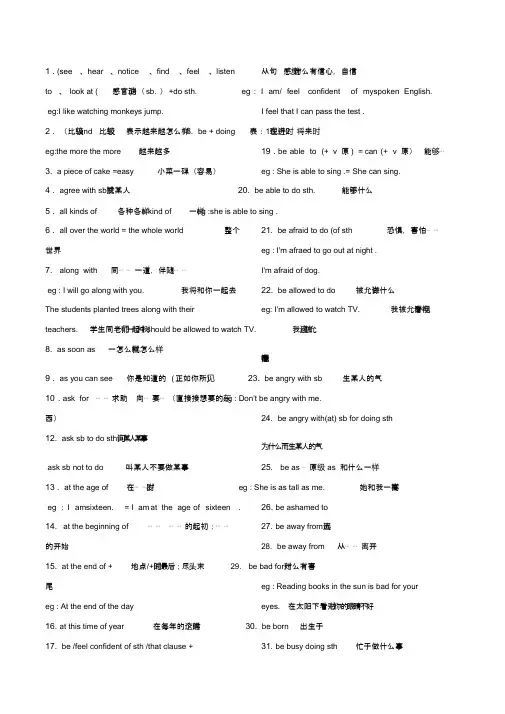
1 . (see 、hear 、notice 、find 、feel 、listen 从句感觉/对什么有信心,自信to 、look at ( 感官动词)+(sb. )+do sth. eg : I am/ feel confident of myspoken English. eg:I like watching monkeys jump. I feel that I can pass the test .2 . (比较级and 比较级)表示越来越怎么样18. be + doing 表:1现在进行时2将来时eg:the more the more 越来越多19 . be able to (+ v 原) = can (+ v 原)能够⋯⋯3. a piece of cake =easy 小菜一碟(容易)eg : She is able to sing .= She can sing.4 . agree with sb赞成某人20. be able to do sth. 能够干什么5 . all kinds of 各种各样a kind of 一样e g :she is able to sing .6 . all over the world = the whole world 整个21. be afraid to do (of sth 恐惧,害怕⋯⋯世界eg : I'm afraed to go out at night .7. along with 同⋯⋯一道,伴随⋯⋯I'm afraid of dog.eg : I will go along with you. 我将和你一起去22. be allowed to do 被允许做什么The students planted trees along with their eg: I'm allowed to watch TV. 我被允许看电视teachers. 学生同老师们一起种树I should be allowed to watch TV. 我应该被允8. as soon as 一怎么样就怎么样许看电视9 . as you can see 你是知道的(正如你所见)23. be angry with sb 生某人的气10 . ask for ⋯⋯求助向⋯要⋯(直接接想要的东e g : Don't be angry with me.西)24. be angry with(at) sb for doing sth12. ask sb to do sth询问某人某事为什么而生某人的气ask sb not to do 叫某人不要做某事25. be as ⋯原级⋯as 和什么一样13 . at the age of 在⋯⋯岁时eg : She is as tall as me. 她和我一样高eg :I amsixteen. = I am at the age of sixteen . 26. be ashamed to14. at the beginning of ⋯⋯⋯⋯的起初;⋯⋯27. be away from远离的开始28. be away from 从⋯⋯离开15. at the end of + 地点/+时间最后;尽头;末29. be bad for对什么有害尾eg : Reading books in the sun is bad for youreg : At the end of the day eyes. 在太阳下看书对你的眼睛不好16. at this time of year 在每年的这个时候30. be born 出生于17. be /feel confident of sth /that clause + 31. be busy doing sth 忙于做什么事be busy with sth 忙于⋯⋯eg: Be late for class 上课迟到32. be careful 当心;小心48. be like 像⋯⋯eg : I'm like my mother .33. be different from ⋯⋯和什么不一样49. be mad at 生某人的气34. be famous for 以⋯⋯著名50. be made from 由⋯⋯制成( 制成以后看不见原35. be friendly to sb对某人友好材料)36. be from = come from 来自51. be made of 由⋯⋯制成( 制成以后还看得见原eg :He is from Bejing. 材料)He comes from Bejing. 52. be not sure 表不确定Is he from Bejing ? Does he come from Bejing ? 53. be on a visit to 参观37. be full of 装满⋯⋯的54. be popular with sb 受某人欢迎be filled with 充满55. be quiet 安静eg: The glass is full of water. 56. be short for ···的缩写The glass is filled with water. eg: 陶is short for 陶俊杰38. be glad+to+do/ 从句57. be sick in bed 生病在床39. be going to + v( 原)将来时58. be sorry to do sth be sorry for sb40. be good at(+doing) = do well in 在某方面eg : I am sorry for you.,善于⋯⋯59. be sorry to hear that善长41. be good for对什么有好处60. be sorry to trouble sbeg : Reading aloud is good for your English. eg : I am sorry to trouble you .42. be happy to do 很高兴做某事61. be strict in doing sth严于做某事43. be helpful to sb对某人有好处e g : He's strict in obeying rules .eg : Reading aloud is helpful to you. 大声朗62. be strict with sb对某人要求严格读对你有好处e g: Some students are not strict withExercising is helpful to your body.锻炼对你themselves.这些学生对自己不严格格某人严的身体有好处63. be strict with sb in sth 某方面对44. be in good health 身体健康64. be supposed to do 被要求干什么45. be in trouble处于困难中65. be sure 表确定eg : She is in trouble. They are in tronble. 66. be sure of doing sth对做某事有信心46. be interested in对某方面感兴趣47. be late for = come late to迟到eg: He is sure of winning. I amsure of learning I begin to go homeEnglish well. 78. between⋯and⋯两者之间67. be sure of sth对做某事有信心79. borrow sth from sb 向⋯⋯借⋯⋯eg: I'm sure of my head. (my teacher 我相信我lend sth to sb ( lend sb sth 借给⋯⋯什么东西(老师)eg : I borrowed a pen from him he lent a pen to的大脑68. be sure that sth对做某事有信心me. ( He lent me a pen. )eg: I'm suer that he can pass the test. 我相80. both = the same(as) = not different(from) 表相同信他能通过考试69. be sure to do sth 一定会做某事81. bother 打扰b other sb to do stheg: We are sure to pass the test. 我们一定会eg : I'm sorry to bother you ,but can you tell通过W e are sure to learn English well. me to way to the station .这次考试我怎么去车站你,但是你能告诉我们一定能学好英语我十分道歉打扰70. be terrified of + 名/动d oing 害怕⋯⋯The problem has been bothering mefor weeks. 这71. be terrified to do sth 害怕做某事了我几个周了扰个问困题72. be the same as ⋯和什么一样H e's bothering me to lend him money .73. be used to doing sth习惯做某事82. by the end of 到⋯⋯为止eg: My father is used to getting up early. 我83. call sb sth eg : We call him old wang. 爸爸习早He is used to sleeping in class. 他84. care 关心惯习惯上课睡觉e g : Don't you care about this country's future ?74. be worth doing值-得做什么什么不关心国家的未来你为75. be(feel) afraid to do sth 害怕做某事85. catch up with sb 赶上某人be afraid of sth 害怕某物86. chat with sb 和某人闲谈be afraid that丛句87. come in 进76. because+ 句子because of + 短语88. come over to过来eg : He was late because he had a headache. 89. come up with 提出He was late because of his headache . eg: Can you come up with a good idea? 你能想77. begin to do = start to do 开始做某事?法吗出一个好办start ⋯with ⋯=begin ⋯with ⋯以什么开始什么90. communicate with sb 和某人交流eg : Let's begin the game with the song. 91. consider + doing 考虑做什么eg : Why not consider going to lu zhou.为什 111. forget to do 没有做而忘了 forgetdoing 做么不考虑去泸州?了而又忘了92. dance to 随着⋯ ⋯ 跳舞eg: Don't forget to go home, I forget closing eg : She likes dancing to the music . 她喜欢随door .着音乐跳舞112. from ⋯ to ⋯ 从某某到某某93. decide to do sth 决定做某事 eg: From me to her94. do a survey of 做某方面的调查 113. get /have sth down做完,被(别人)做⋯95. do better in在⋯ ⋯ 方面做得更好eg: I have my hair cut.我理了发(头发被剪了)96. do wrong 做错T om got his bad tooth pulled out.汤母把他的97. Don't forget to do sth 不要忘了做某事坏牙拔掉了(被牙医拔掉了)98. Don't mind +doing / 从句 / 名词不要介意⋯ ⋯ 114. get a part-time job= find a part-time job99. each + 名(单)每一个⋯115. get along well with sb = get on well witheg : Each student has many books.sb 与某人相处得好每一个学生都有一些书116. get along with sb = get on with sb与某100. end up +doing 人相处101. enjoy +doing 喜欢117. get ready for = be ready for 为什么而准备 102. escape from从⋯ ⋯ 逃跑eg : I get ready for math exam. eg: The prisoners have escaped from the prison.I am ready for math exam.犯人从监狱里逃跑出来118. get sb in to trouble103. expect to do sth 期待做某事给某人制造麻烦,使某人陷入麻烦 104. fall down摔下来 fall off 从哪摔下来119. get sb to do sth105. fall in love with sb /sth 爱上什么 120. get ⋯ from ⋯ 从某处得到某物106. far from离某地远121. give a talk 做报告 eg: He is give a talk.eg : The school is far from my home. 122. give sth. to sb.= give sb. sth.107. find +it +adj. +to do 发现做某事怎么样给某人某物108. find sb/sth +adj.发现什么怎么样123. go fish 钓鱼go swimming 游泳eg : I find the book interesting.124. go on to do去做下一件事 go on doing 继109. finish 完成+doing (名词)续做这件事 110. fit to sb = be fit for sb适合某人125. go out away from =go out of 143. How about(+doing) = What about(+doing)126. go to school 上学(用于专业的)go to the 144. how do you like = what do you think of 你school 去学校(不一定是上学)对什么的看法127. good way to 好方法145. if : 是否=wether128. hate to do讨厌没做过的事eg: I don't know if (wether) I should go to thehate doing讨厌做过的事party . 我不知道我是否应该去参加晚会129. have a party for sb举办谁的晚会He don't know if (wether) we will arrive on time130. have a talk 听报告谈一谈t omorrow morning . 他不知道我们明天早上是否能131. have been doing现在完成进行时到达准时eg : You have been talking You have been 146. if : 如果,假如(全部接一般时态)+条件语sleeping since.态从句132. have been to ⋯( 地方)⋯⋯去过某过地方eg: I'll go to LuZhou if it does't rain. 假如have gone to ⋯(地方)去了某地还没回来州明天不下雨,我就去泸133. have fun +doing 玩得高兴I f they change the plan they will let me know.134. have sth to do 有什么事要做会让我知道的要改变计划,他们假如他们eg: I have a lot of homework to do. 我有很多I'll go to England ,if I have enough money next,我就要去英国的钱要做year . 如果我明年由足够家庭作业I have nothing to do. 我没什么事情做147. in one's opinion = sb think 某人认为135. have to do sth 必须做某事148. in some ways 在某些方面136. have trouble (problem) (in) doing sth 做149. in the end = finally(adv) 最后150. in the north of ⋯什么在什么的北方什么事情有麻烦137. have⋯time +doing ( north 北sowth 南west 西east东)138. have⋯(时间)⋯off 放⋯⋯假151. in the sun 在太阳下eg: I have month off 我请一个月得假152. increase 增加139. hear sb +do/doing 听见某人做某事/ 正在做eg : They've increased the piece of petrol by把石油价增加了3%某事3% . 他们140. help a lot 很大用处T he population has increased from 12 million141. help sb with sth \one's sth 帮助某人某事ten years ago to 18 million now .(某方面)help sb (to) do sth 帮助某人做某事153. instead of + (名)代替142. hope to do sth 希望做某事eg: I'd like an apple instead of a pear. 我想要苹果,而不要梨子166. keep +sb /sth +adj / 介词短语让什么保持I like English instead of math. 我喜欢英语而?什么样数学167. keep out 不让⋯⋯进入不喜欢154. introduce sb to sb 介绍某人给某人168. keep sb adj让⋯⋯保持⋯⋯introduce oneself 自我介绍e g: I want to keep mymother happy/ keep healthy.155. invite sb to do sth 邀请某人做某事保持高兴/健康156. It takes sb sometime to do sth 做某人花169. key to + 名词表示:某物的钥匙或某题的答间案掉某人多少时eg : It took me 5 minutes to do my homework . 170. key to ⋯key 可以是答题或钥匙It takes me half an hour to cook. anser to ⋯157. It's +adj +for sb to do sth对某人来说做171. laugh at ⋯取笑⋯⋯e g : Don't langh at others.某事怎么样158. It's +adj +to do 做某事怎么样W e langhed at the joke.159. It's +adj for sb对于某人来说怎么样172. learn by oneslfe 自学It's +adj of sb对某人来说太怎么样173. learn from sb 向某人学习160. It's +adj(for sb) to do (对某人来说)做eg: We should learn from Lei Feng.174. learn to do sth 学做某事某事怎么样It's +adj of sb to do sth对某人来说做某事太175. let sb do sth让某人做某事176. Let sb down让某人失望怎么样eg : It's nice of you to help mewith myEnglish. eg :We shouldn't let our farents down. 我们161. It's a good idea for sb to do sth对⋯⋯的父母失望我们该让不应是个好主意177. live from : 离某地远来说162. It's important to sb对某人来说很重要178. live in + 大地方/at + 小地方居住在某地eg: It's important to me. eg: I live in LuZhou.She lives at XuanTan .163. It's time to do sth = It's time for sth 179. look after = take care of 照顾照看间180. lose one's way谁迷路去做某事的时到了该eg : It's time to have class It's time for class. eg : Lose your way. 你迷路了该去上课了181. make a decision to do sth 决定做某事164. join = take part in 参加182. make friends with sb 和谁成为朋友165. just now刚才eg : I want to make friends with you. eg: He's not tall at all she doesn't junp far183. make it early 把时间定的早一点at all .184. make on exhibition of oneself让某人出洋202. not ⋯at all 一点都不相203. not ⋯either 表否定,也不185. make sb /n +n 使什么成为什么eg : I don't have sister, either. 我也没有姐eg : I made you my wife.姐186. make sb /sth +adj 使某人(某物)怎么样204. not ⋯until 直到⋯⋯才⋯⋯eg : You must made your bed clean. eg: I didn't sleep until my mother came back.187. make sb /sth adj 使某人/ 某物怎么样T he child didn't stop crying until I give her188. make sb do sth让某人做某事sugar.eg : I made him write. 我以前让他写205. offer / provide sb with sth给某人提供189. make up be made up of ( 被动语态)由⋯⋯206. offer sb sth ( offer sth to sb 提供什么组成东西给某人190. make⋯difference to ⋯eg : I offer you water .(I offer water to you . )191. mind sb to do mind one's doing 介意⋯⋯你提供水我给做什么207. on one's way to ⋯在谁去那的路上192. most + 名most of + 代208. on the one hand 一方面193. much too + 形容词o n the other hand 另一方面194. must be 一定209. on the phone = over the phone 用电话交谈195. need + 名词210. on time 准时i n time 及时196. need sb do sth 需要某人做某事211. one day =some day =someday 一天,有一197. need to do (实义动词)need do ( 情态动词)天198. no /neithr of hate to do no /neithr of hate 212. one of + 可数名词的复数形式doing 213. one to another 一个到另一个199. no + 名词214. over and over agin 一遍又一遍的200. not anymore = no more 再也不⋯⋯eg : He cleaned the floor over and over agin .eg: He didn't cry any more He cried no more. 他215. part-time job 兼职工作fall-time job 全再也不哭职工作201. not ⋯( 形、副)at all 216. pay for ⋯付⋯⋯钱p ay the bill 开钱,付钱217. please +do eg: Please give my best regards to your family.218. please help yourself请带我向你的家人我最好的问候219. pleased with sb I regard you as my friend. 我把你当作我的朋友220. pool into = pore into He shows little regard for others.221. practice +doing练习做某事人关心别他不爱222. prefer sth to sth 相对⋯⋯更喜欢⋯⋯226. remid sb about sth 提醒某人什么事eg : I prefer physics to chemisty. remid sb to do sth 提醒某人做某事物理eg : he remids me about cooking (He remids me在物理和化学中,我更喜欢prefer doing to sth 更喜欢去做⋯不愿意去做⋯to cook. 他提醒我做饭eg: He prefers riding a bike to diving. 227. remid sb of sth 使某人想起什么,不开小车e g : The pictures remind me of my school days.骑自行车他更喜欢prefer to do sth rather than do sth 宁愿做⋯这照片使我想起了我的学校也不愿T he wor ds that (which) the teacher talke toeg: My unde prefers to buy a now car rather than remind me of my mother.repaiv the used one. 我叔叔更喜欢买新的车,也228. return sth to sb还什么东西给某人不去修旧车229. say to oneself对自己说prefer sb not to do sth 更愿意⋯230. say to sb对某人说eg: I prefer her not to come 我不喜欢她不来231. sb spend somemoney on sth 花了多少钱在某223. pretend to do sth 装着去做什么事上pretend that 从句232. sb spend sometime with sb 花了多少时间陪eg : The two cheats pretended to be working very谁hard .这两个骗子装着努力工作233. sb spend sometime(in) doing sth 花了多少He pretended that he did not know the answer .时间做某事他装着不知道答案234. sb with sb +is sb and sb +are224 . rather ⋯than 宁可⋯⋯也不⋯⋯235. see sb do 看见某人做过某事eg : I would rather be a doctor than a teacher. see sb doing 看见某人正在做某事236. seem to do/be +adj显得怎么样我愿肯当医生,也不当老师He likes dogs rather than cats. 他喜欢狗,不eg : You seem to be tired .You seem to be happy. 猫237. send +sb sth 送给某人某物喜欢225. regard ⋯as 把⋯⋯当作⋯⋯238. send⋯to ⋯把什么寄到哪里去?to one's surprise 令某人惊奇239. shock 使⋯⋯震惊253. take classes 上课eg : Oh , It's only you ! You give me a shock . 254. take sb to 把某人带去啊,是你呀!吓我一跳eg : I take you to the hospital.240. show sb sth 向某人展示某物255. take walks = take a walk =go for a walk eg : I show her the book.散步241. show sb sth = show sth to sb 拿什么东西256. ①talk to对谁说e g : I talk to you .给某人看②talk with 和谁说eg : I talk with him .eg: Show me your pen.= Show your pen to me. ③talk of谈到eg : we talked of you.242. show sth to sb 向某人展示某物④talk about谈论关于⋯⋯eg : I show the book to her. 257. talk with sb 和某人说话243. some⋯others ⋯一些⋯⋯另一些⋯⋯258. teach sb sth 教某人做某事244. start ⋯with ⋯从⋯⋯开始259. tell sb do sth 告诉某人做某事begin ⋯with ⋯从⋯⋯开始260. tell sb sth tell sb that245. stay away from远离⋯⋯丛句tell sb not to do sth tell a storyeg : We're told to stay away from the animals 261. tell sb sth 告诉某人某事whe visiting the zoo. 262. tell sb to do sth 告诉某人做什么离动物tell sb not to do sth 告诉要远某人不要做什么参观当我们z oo时,我们If you want to lose weight you'd better stay 263. tell ⋯from⋯auay from the sweet food. 264. thank you for +doing离甜食265. the same + 名词(doing)+as ⋯⋯如果你想减肥,你最好远246. stop doing 停下正在做的事266. the same⋯( 名) ⋯as247. stop sb from doing sth 阻止某人做某事as⋯(adj adv) ⋯as 相同248. stop sb(from) doing 阻止某人做某事267. the way to do sth =the way of doing sth 249. stop to do 停下正在做的事去做下一件事做某方面的方法the way to + 地方去哪的路250. such + 名这样,这种 e g :Do you know the way to learn English.251. suit sb 适合某人Do you know the way of learning English.252. surprise sb 使某人惊奇268. the way to ⋯(地点)到哪的269. too ⋯to ⋯太怎样而不能⋯能⋯⋯⋯adj +enough to 足够so⋯that +丛句eg: He is too young to go to school.= He is so young that he can't go to schoolHe is old enough to go to school .=He is so old that he can go to school .270. transalte ⋯⋯into ⋯⋯把什么翻译成什么eg : Trasalte English into chinese .271. travel with sb 和某人去旅游272. try one's best to do sth 尽某人最大的努力去做某事eg: I will try my best to learn English well.273. try to do sth 想干什么,但没成功try doing sth 想干什么,已经做过了eg :He tried to climb. 他想爬上去( 但没成功) He tried climbing. 他想爬上去( 已经做过了)274. try ⋯试衣服have a try试一下275. turn down 开小←→turn up 开大276. turn off 关上←→turn o n 打开open 拆开277. upside down 倒着278. visit to ⋯参观某个地方279. wait for sb 等某人。
(完整版)人教版初中英语语法总复习

初中英 法 复一、 一 般 在 定 : 常、频频 生的 作或行 及 在的某种状况。
用原形 ( 三人称 加 s / es) ( 句和否认句借用助 do / does) 一 般 去 定 : 去某个 里 生的 作或状 ; 去 性、 常性的 作、行 。
用 去式 ( 句和否认句借用助 did) 在 行 定 :表示 段或 正在 行的 作及行 。
am + -ing is + -ing are + -ing 去 行 定 :表示 去某段 或某一 刻正在 生或 行的行 或 作。
was + -ing were + -ing 一 般 将 来 定 :以 去某个 准,在此从前 生的 作或行 ,或在 去某 作从前达成的行 ,即“ 去的 去” 。
(1)will + 原形 (2)am +going to+ 原形Is +going to+ 原形 are +going to+ 原形 去 将 来 定 :立足于 去某一 刻,从 去看未来,常用于 从句中。
(1)would + 原形 (2)was +going to+ 原形were +going to+ 原形 在 完 成 定 : 去 生或已 达成的 作 在造成的影响或 果,或从 去已 开始,持 到 在的 作或状 。
have + 去分 has + 去分 去完 成 定 :以 去某个 准,在此从前 生的 作或行 ,或在 去某 作从前达成的行 ,即“ 去的 去” 。
had + 去分1. 不定式定 : 由 to + 原形组成。
不定式是一种非限制性 。
而非限制 是指那些在句中不可以 独充任 的 ,可分 不定式, 名 , 在分 和 去分 。
2. 用途:在句中不可以作 。
它拥有 的性 ,自己能够 和状 。
【 不定式】1. 定 : + 不定式2. 用途:不定式在句中能够作句子任何成分。
不定式的被 形式除了一般形式外 有其达成式和 行式。
[ 本段 ][ 不定式的 、] 不定式能够作以上各样成分,但它 竟是 ,所以有 的属性不定式及其短 能够有自己的 、状 , 然 不定式在 法上没有表面上的直接主 ,但它表达的意 是 作, 一 作 必定由使 者 出。
初中英语人教版八年级上册重点短语+句型+常用语法汇总(1-5单元)

八年级英语上册重点知识汇总Unit 1 Where did you go on vacation?【本单元的话题】谈论假期活动内容,复习一般过去时。
【本单元的语法】1复习一般过去时;2.学习不定代词和不定副词的用法。
【不定代词和不定副词的用法】(1)左边的some、any、every、no与右边的body、one、thing构成不定代词,some、any、every、no 与右边的疑问副词where构成不定副词;(2)一般情况下以some开头的不定代词和不定副词用于肯定句,以any开头的不定代词和不定副词用于否定句、疑问句;以no开头的不定代词和不定副词表示否定含义(no one为两个单词);(3)不定代词或不定副词和形容词连用时,形容词放在后面。
He has something important to do.他有重要的事情要做。
(肯定句用something,形容词important放后)Did you buy anything special? (一般疑问句用anything,形容词special放后)Did you go anywhere interesting last month?上个月你去令人感兴趣的地方了吗?(一般疑问句用不定副词anywhere,形容词interesting放后)(4)不定代词和不定副词做主语时,后面的动词用单数形式。
Everone is here today.今天每个人都在这里。
【本单元的短语和知识点】1.go on vacation去度假go to the mountains 上山/进山2.stay at home呆在家go to the beach去海滩visit museums 参观博物馆go to summer camp去参观夏令营3.study for tests为考试而学习\备考go out出去4.quite a few相当多,不少(后跟可数名词复数)take photos照相most of the time大部分时间5.buy sth for sb = buy sb sth为某人买某物6.taste good.尝起来很好taste(尝起来)、look(看起来)、sound(听起来)为感官动词,后跟形容词7.have a good\great\fun time过得高兴,玩得愉快(=enjoy oneself)8.go shopping去购物9.nothing…but+动词原形:除了……之外什么都没有He had nothing to do at home but read yesterday.昨天他在家除了读书无事可做。
人教版初中英语七年级上册语法知识点
have表示“有”时,其否定形式有两种:在其后直接加not,但常用于非正式用语中;利用助动词do加not。
②如果句子的谓语是实义动词,在谓语动词前加don't,doesn't,didn't。
③no,never,seldom,hardly,nobody,little,few,nothing等否定词也可以构成否定形式。
1.表示经常性或习惯性发生的动作2.表示现在存在的状态或情况3.表示正在发生的动作或存在的状态4.表示客观事实、真理和自然现象5.用于表示较固定的、按计划、规定将要发生的动作,但只限于begin,come,go,leave,arrive,stop,return,close,open,take,start,take,place等少数动作,6.用于if,unless,once,even if(即使)等引导的条件状语从句,when,before,until,as soon as,the moment(一……就)等引导的时间状语从句,no matter+wh-/-how-或wh-ever/however等引导的让步状语从句中,代替一般将来时
人教版初中英语
初一上册语法知识点
Grade 7
上
Unit 1 My name’s Gina
人教版初中英语语法大全
⼈教版初中英语语法⼤全 为了⽅便⼤家学习英语更⽅便,更省时,更⾼效,。
⼩编在这⾥整理了⼈教版初中英语语法,希望能帮助到⼤家。
七年级(上册)Unit 1My name is Gina.含有be的⼀般现在时,what questions,物主形容词Unit 2This is my sister.指⽰代词、who、⼈称代词主格、名词复数Unit 3Is this your pencil?名词性物主代词,yes or no questions.Unit 4Where is my schoolbag?Where,介词,andUnit 5Do you have a soccer ball?含有have的⼀般现在时,yes or no questions,性质形容词,butUn it 6Do you like bananas?含有like的⼀般现在时,yes or no questions,肯定和否定陈述,可数及不可数名词Unit 7How much are these socks?How much,this,that,those,theseUnit 8When is your birthday?When,所有格,how old are you?Unit 9My favorite subject is science.What,where,when,who 七年级(下册)Unit 1Can you play the guitar?Can , ⼀般疑问句,whatUn it 2What time do you go to school?What time,when, 频率副词Unit 3How do you get to school?How , how long, how farUnit 4Don’t eat in class.祈使句,can, 情态动词Unit 5Why do you like pandas?Why, what, where, because,形容词Unit 6I’m watching TV.现在进⾏时,What, yes or no questions.Unit 7It’s raining.现在进⾏时,how, whatUn it 8Is there a pose office near here?.There be , where,表地点的介词Unit 9What does he look like?what, 形容词,选择疑问句Unit 10I’d like some noodles.Would like,what, some, any Unit 11How was your school trip?⼀般过去式,how,⼀般疑问句,形容词Unit 12What did you do last weekend?⼀般过去时,what,who ⼋年级(上册)Un Where did you go on vacation?不定代词,⼀般过去式it 1Unit 2How often do you exercise?How often,频率副词Unit 3I’m more outing than my sister.形容词⽐较级Unit 4What’s the best movie theatre?形容词最⾼级Unit 5Do you want to watch a game show?⼀般疑问句,动词不定式Unit 6I’m going to study computer science.⼀般将来时Unit 7Will people have robots?含Will 的⼀般将来时Unit 8How do you make a banana shake?祈使句Unit 9Can you come my party?情态动词Unit 10If you go to the party, you’ll have a great time.If 引导的条件句⼋年级(下册)Unit 1What’s the matter?疾病的表达Unit 2I ’ll help to clean up the city parks.⼀般将来时Unit 3Could you please clean your room?情态动词的⽤法Unit 4Why don’t you talk to your parents?Why don’t 句型Un it 5What were you doing when the rainstorm came?过去进⾏时,when与while引导的时间状语从句Unit 6An old man tried to move the mountains.动词不定式Unit 7W hat’s the highest mountain in the world?形容词/副词的最⾼级Unit 8Have you read Treasure Island yet?现在完成时Unit 9Have you ever been to a museum?现在完成时Un it10I’ve had this bike for three years.现在完成时(延续性和⾮延续性动词)九年级(全册)Unit 1How can we become good learners?动词+by+动名词Unit 2I think that mooncakes are delicious!宾语从句:that,if/whetherUnit 3Could you please tell me where the restaurants are?宾语从句:wh-Unit 4I used to be afraid of the ed toUnit 5What are the shirts made of ?被动语态:⼀般现在时Unit 6When was it invented ?被动语态:⼀般过去时Un Teenagers should be allowed to choose their own clothes.被动语态:含情态动词Unit 7Teenagers should be allowed to choose their own clothes.被动语态:含情态动词Un it 8It must belong to Caral.表推测的情态动词:must,might,could,can'tUnit 9I like music that I can dance to.定语从句:that/which,whoUnit 10You are supposed to shake hands.be supposed to+doUnit 11Sad movies make me cry.make sb. do/make sb.+adj.Un it 12Life is full of the unexpected.综合复习【时态、状语从句】、过去完成时Un it 13We're trying to save the earth!综合复习【时态、被动语态、used to、情态动词】Unit 14I remember meeting all of you in Grade 7.综合复习 相关阅读:初中英语的学习⽅法 ⼀、明确学习动机 同学们要知道,我们学习英语最直接的⽬的是什么?就是为了能考上好⼤学。
人教版初中英语语法大全
人教版初中英语语法大全1 (see 、hear 、notice 、find 、feel 、listen to 、 look at (感官动词)+do eg:I likewatching monkeys jump 2 ,比较级 and 比较级, 表示越来越怎么样3 a piece of cake =easy 小菜一碟,容易,4 agree with sb 赞成某人5 all kinds of 各种各样 a kind of 一样6 all over the world = the whole world 整个世界7 along with同……一道,伴随……eg : I will go along with you我将和你一起去the students planted trees along with their teachers 学生同老师们一起种树 8 As soon as 一怎么样就怎么样9 as you can see 你是知道的10 ask for ……求助向…要…,直接接想要的东西, eg : ask you for my book 11 ask sb for sth 向某人什么12 ask sb to do sth 询问某人某事ask sb not to do 叫某人不要做某事13 at the age of 在……岁时eg:I am sixteen I am at the age of sixteen14 at the beginning of …… ……的起初,……的开始 15 at the end of +地点/+时间最后,尽头,末尾 eg : At the end of the day16 at this time of year 在每年的这个时候17 be /feel confident of sth /that clause +从句感觉/对什么有信心,自信 eg : I am / feel confident of my spoken English I feel that I can pass the test18 be + doing 表:1 现在进行时 2 将来时19 be able to (+ v 原) = can (+ v 原, 能够……eg : She is able to sing She can sing 20 be able to do sth 能够干什么eg :she is able to sing21 be afraid to do (of sth 恐惧,害怕……eg : I'm afraed to go out at night I'm afraid of dog22 be allowed to do 被允许做什么eg: I'm allowed to watch TV 我被允许看电视 I should be allowed to watch TV 我应该被允许看电视23 be angry with sb 生某人的气eg : Don't be angry with me 24 be angry with(at) sb for doing sth 为什么而生某人的气25 be as…原级…as 和什么一样 eg : She is as tall as me 她和我一样高26 be ashamed to27 be away from 远离28 be away from 从……离开29 be bad for 对什么有害eg : Reading books in the sun is bad for your eyes 在太阳下看书对你的眼睛不好30 be born 出生于31 be busy doing sth 忙于做什么事 be busy with sth 忙于…… 32 be careful 当心,小心33 be different from…… 和什么不一样34 be famous for 以……著名35 be friendly to sb 对某人友好36 be from = come from 来自eg :He is from Bejing He comes from Bejing Is he from Bejing ? Does he come fromBejing ?37 be full of 装满……的 be filled with 充满eg: the glass is full of water the glass is filled with water38 be glad+to+do/从句39 be going to + v(原, 将来时40 be good at(+doing) = do well in 在某方面善长, 善于…… 41 be good for 对什么有好处eg : Reading aloud is good for your English42 be happy to do 很高兴做某事43 be helpful to sb 对某人有好处eg : Reading aloud is helpful to you 大声朗读对你有好处 Exercising is helpful to your bady 锻炼对你的身体有好处 44 be in good health 身体健康45 be in trouble 处于困难中eg : She is in trouble They are in tronble46 be interested in 对某方面感兴趣47 be late for = come late to 迟到 eg: Be late for class 上课迟到48 be like 像……eg : I'm like my mother49 be mad at 生某人的气50 be made from 由……制成(制成以后看不见原材料)51 be made of 由……制成(制成以后还看得见原材料)52 be not sure 表不确定53 be on a visit to 参观54 be popular with sb 受某人欢迎55 be quiet 安静 56 be short for 表**的缩写eg: 陶 is short for 陶俊杰57 be sick in bed 生病在床 58 be sorry to do sth be sorry for sbeg : I am sorry for you59 be sorry to hear that 60 be sorry to trouble sbeg : I am sorry to trouble you 61 be strict in doing sth 严于做某事eg : He's strict in obeying noles 62 be strict with sb 对某人要求严格eg: Some students are not strict with them selves 这些学生对自己不严格63 be strict with sb in sth 某方面对某人严格64 be supposed to do 被要求干什么65 be sure 表确定66 be sure of doing sth 对做某事有信心eg: He is sure of winning I am sure of learning English well67 be sure of sth 对做某事有信心eg: I'm sure of my head (my teacher 我相信我的大脑,老师,68 be sure that sth 对做某事有信心eg: I'm suer that he can pass the test 我相信他能通过考试69 be sure to do sth一定会做某事eg: We are sure to pass the test 我们一定会通过这次考试 We are sure to learn English well 我们一定能学好英语70 be terrified of + 名/动doing 害怕……71 be terrified to do sth 害怕做某事72 be the same as … 和什么一样73 be used to doing sth 习惯做某事eg: My father is used to getting up early 我爸爸习惯早He is used to sleeping in class 他习惯上课睡觉74 be worth doing 值得做什么75 be(feel) afraid to do sth 害怕做某事be afraid of sth 害怕某物 be afraid that 丛句 76 because+句子 because of +短语eg : He was late because he had a headache He was late because of his headache77 begin to do = start to do 开始做某事start…with…=begin…with… 以什么开始什么eg : Let's begin the game with the song I begin to go home78 between…and… 两者之间……借…… lend sth to sb ( lend sb sth 借给……什么东西 79 borrow sth from sb 向eg : I borrowed a pen from him he lent a pen to me ( he lent me a pen80 both = the same(as) = not different(from) 表相同81 bother 打扰 bother sb to do stheg : I'm sorry to bother you ,but can you tell me to way to the station我十分道歉打扰你,但是你能告诉我怎么去车站the problem has been bothering me for weeks 这个问题困扰了我几个周了He's bothering me to lend him money 82 by the end of 到……为止83 call sb sth eg : We call him old wang 84 care 关心 eg : Don't you care about this country's future ?你为什么不关心国家的未来85 catch up with sb 赶上某人86 chat with sb 和某人闲谈 take sb to + 地点带某人去某地87 come in 进88 come over to 过来89 come up with 提出 eg: Can you come up with a good idea 你能想出一个好办法吗,90 communicate with sb 和某人交流91 consider + doing 考虑做什么eg : Why not consider going to lu zhou 为什么不考虑去泸州, 92 dance to 随着……跳舞eg : She likes dancing to the music 她喜欢随着音乐跳舞 93 decide to do sth 决定做某事94 do a survey of 做某方面的调查95 do better in 在……方面做得更好96 do wrong 做错 97 Don't forget to do sth 不要忘了做某事 98 Don't mind +doing /从句 /名词不要介意……99 each +名,单,每一个…eg : Each student has many books 每一个学生都有一些书 100 end up+doing101 enjoy +doing喜欢102 escape from 从……逃跑eg: The prisoners have escaped from the prison犯人从监狱里逃跑出来103 expect to do sth 期待做某事104 fall down 摔下来 fall off 从哪摔下来105 fall in love with sb /sth 爱上什么106 far from 离某地远 eg : The school is far from my home107 find +it +adj +to do 发现做某事怎么样108 find sb/sth +adj 发现什么怎么样eg : I find the book interesting 109 finish 完成+doing,名词,110 fit to sb = be fit for sb 适合某人111 forget to do 没有做而忘了 forget doing 做了而又忘了eg: Don't forget to go home I forget closing door112 from…to… 从某某到某某 eg: From me for her 113 get /have sth down 做完,被,别人,做…eg: I have my hair cut 我理了发(头发被剪了,Tom got his bad tooth pulled out 汤母把他的坏牙拔掉了,被牙医拔掉了, 114 get a part-time job= find a part-time job115 get along well with sb = get on well with sb 与某人相处得好 116 get along with sb = get on with sb 与某人相处117 get ready for = be ready for为什么而准备eg : I get ready for math I am ready for math118 get sb in to trouble 给某人麻119 get sb to do sth120 get…from… 从某处得到某物121 give a talk 做报告eg: He is give a tall122 give sth to sb give sb sth 给某人某物123 go fish 钓鱼 go swimming 游泳124 go on to do 去做下一件事 go on doing 继续做这件事125 go out away from go out of126 go to school 上学,用于专业的,go to the school 去学校,不一定是上学, 127 good way to 好方法128 hate to do 讨厌没做过的事 hate doing 讨厌做过的事129 have a party for sb 举办谁的晚会谈一谈 130 have a talk 听报告131 have been doing 现在完成进行时eg : You have been talking You have been sleeping since132 have been to …( 地方,……去过某过地方have gone to …,地方, 去了某地还没回来133 have fun +doing 玩得高兴134 have sth to do 有什么事要做eg: I have a lot of homework to do 我有很多家庭作业要做 I have nothing to do 我没什么事情做135 have to do sth 必须做某事136 have trouble (problem) (in) doing sth 做什么事情有麻烦137 have…time +doing138 have…(时间)…off 放……假eg: I have month off 我请一个月得假139 hear sb +do/doing 听见某人做某事/正在做某事140 help a lot 很大用处141 help sb with sth \one's sth 帮助某人某事,某方面, help sb (to) do sth 帮助某人做某事142 hope to do sth 希望做某事143 How about(+doing) = What about(+doing)144 how do you like = what do you think of 你对什么的看法145 if : 是否,wethereg: I don't know if (wether) I should go to the party 我不知道我是否应该去参加晚会 He don't know if (wether) we will arrive on time tomorrow morning 他不知道我们明天早上是否能准时到达146 if :如果,假如,全部接一般时态,,条件语态从句eg: I'll go to LuZhou if it does't rain 假如明天不下雨,我就去泸州If they change the plan they will let me know 假如他们要改变计划,他们会让我知道的I'll go to England ,if I have enough money next year 如果我明年由足够的钱,我就要去英国147 in one's opinion = sb think 某人认为148 in some ways 在某些方面149 in the end = finally(adv) 最后150 in the north of… 什么在什么的北方 ,north 北 sowth 南 west 西east 东 ,。
完整版人教版初中英语语法完整总结
完整版人教版初中英语语法完整总结人教版初中英语语法完整总结如下:时态:动词的时态分为一般现在时、一般过去时、一般将来时、现在进行时、过去进行时、现在完成时、过去完成时。
一般现在时(Simple Present Tense):表示经常性活动、习惯或客观事实。
一般过去时(Simple Past Tense):表示过去发生的动作或状态。
一般将来时(Simple Future Tense):表示将来发生的动作或状态。
现在进行时(Present Continuous Tense):表示现在正在进行的动作。
过去进行时(Past Continuous Tense):表示过去某个时间点正在进行的动作。
现在完成时(Present Perfect Tense):表示过去发生的动作对现在造成的影响或一直持续到现在的动作。
过去完成时(Past Perfect Tense):表示过去某个时间点或动作之前已经发生过的动作或状态。
语态:英语中的语态分为主动语态和被动语态。
主动语态(Active Voice):主语为动作的执行者。
被动语态(Passive Voice):主语是动作的承受者。
名词:名词主要负责表示事物的名称和概念。
可数名词(Countable Nouns):表示可以计数的名词,可有单数和复数形式。
不可数名词(Uncountable Nouns):表示不可数的名词,只有单数形式。
复数名词(Plural Nouns):表示复数的名词,可通过在名词后加-s或-es形成。
冠词:冠词主要用于限定名词。
不定冠词(Indefinite Article):a/an,表示泛指。
定冠词(Definite Article):the,表示特指。
形容词:形容词用于修饰名词,表示事物的性质、特征或状态。
比较级与最高级:形容词有比较级和最高级形式,用于比较两个或多个事物的程度。
比较级(Comparative):表示两者之间的比较。
最高级(Superlative):表示三者或以上之间的比较。