
山东统招专升本2019年英语真题
试卷类型:公共课科目代码: 201山东省2019年普通高等教育专升本统一考试英语试题本试卷分为第Ⅰ卷和第Ⅱ卷两部分,共12页。
满分100分。
考试用时120分钟。
考试束后,将本试卷和答题卡一并交回。
注意事项:1.答题前,考生务必用0.5毫米黑色签字笔将自己的姓名、考生号、座号填写到试卷定的位置上,并将姓名、考生号、座号填(涂)在答题卡规定的位置。
2.第Ⅰ卷每小题选出答案后,用2B铅笔把答题卡上对应题目的答案标号涂黑;如需动,用橡皮擦干净后,再选涂其他答案标号,答在本试卷上无效。
3.第Ⅱ卷答题必须用0.5毫米黑色签字笔作答,答案必须写在答题卡各题目指定区域相应的位置;如需改动,先划掉原来的答案,然后再写上新的答案;不能使用涂改液、胶带修正带。
不按以上要求作答的答案无效。
第Ⅰ卷Part I Listening Comprehension(1 point each, 20points)Section ADirections: In this section, you will hear 8 short conversations. At the end of each conversation,a question will be asked about what was said. The conversation and the question will be read only once. After each question there will be a pause. During the pause, you muse read the four suggested answers marked A) B) C) and D) and decide which is the best answer. Then blacken the corresponding letter on the Answer Sheet.Short Conversations1. A. His car was hit by another carB. He was hurt while involved in sports.C. He fell down some stairs,D. While crossing a street, he was hit by a car.2. A Satisfied with their price.B. Displeased with their quality.C. Pleased with modern mass- production techniques.D, Dissatisfied with their technological complexities3.A. $33.66. B. $50.00. c. $ 79.95.D. $66.66.4. A. He went mountain climbing last year,B. He hasn't traveled round the world yet.C He's always wanted to climb that mountain.D He definitely does not want to go.5. A She thinks the man is joking.B The man needs to have his eyes examined.C.The man should get some sleep.D.The man is wise to study.6.A.Near an art museum. B. At a science exhibitC. At a news conference.D.Near a paint store.7. A. The homework was very easy.B. The man should go to class,C. The man should sit in the back of the classroom.D. She's further behind in her work than the man is.8. A. In the street. B. Over the telephone.C. At Jack's house.D. At Jack's secretary's apartment.Longer DialoguesDialogue OneQuestions 9 to 11 are based on the dialogue you have just heard.9. A. To ask for a leave.B.To register for his course.C. To bring him some plants.D. To be transferred to another university.10. A. It lasts for two semesters.B. It is too advanced for Jane.C. Too many students have registered for it.D. Jane has registered for too many courses.11. A. Botany B. Biology c. Medicine D. EconomicsDialogue TwoQuestions 12 to 14 are based on the dialogue you have just heard.12. A. The traffic is too heavy, B The man is driving too fast.C. The man does not drive well.D. The man does not listen to her.13. A. A woman knocked down by a van. B. A zebra running after a woman.C. A woman asking for a lift.D. A car running too fast.14. A. They wait until the traffic signal changes. B. They pull the van into the space.C. They drive on without stop.D. They stop the car to help.Section BDirections: In this section you will hear two short passages. At the end of each passage, you will hear a number of questions. Both the passage and the questions will be read only once.After you hear one question, you must choose the best answer from the four choices marked A), B), c) and D). Then blacken the corresponding letter on the Answer Sheet.Passage OneQuestions 15 to 17 are based on the passage you have just heard.15.A. 10%. B.15%.C. From 10% to 50%. D. From 10% to 15%.16. A. Minor damage to the brain.B. The use of drugs during the mothers pregnancy.C. Poor nutrition in a pregnant woman.D. Damage to muscles.17. A .A lack of nutritious foods. B. A balance of certain chemicals.C. Lead in oil D. Alcohol. Passage TwoQuestions 18 to 20 are based on the passage you have just heard.18. A. It means that anyone can enrol in community colleges.B. It means that high school graduates can always receive education at community colleges.C.It means that admission to any community college is fee.D. It means hat admission to any coll is free if you are a high school graduate.19. A. Because students can earn associate degrees if they attend evening classes.B. Because tuition and fees are relatively low for evening classes.C. Because many students have to work during the day.D. Because students find it more interesting to attend cases in the evening.20. A. . Providing advanced educational programs to handicapped people,B. Training personnel the community needs most.C. Helping train community leaders.34. His new appointment takes_ from the beginning of next month.A. placeB. effectC.post D office35. Jim's plans to go to college. _at the last moment.A. fell outB. gave away c. gave off D. fell through36. I left for the office earlier than usual this morning_ traffic. jam.A. in line withB. in case of c for the sake of D. at the risk of37. The boy had a. escape when he ran across the road in front of the bus.A . close B. short C.narrow D. fine38. Dress warmly, you'll catch cold.A. on the contraryB.or ratherC. or elseD. in no waything to say to a friend in a difficult situation? Here are some suggestions:Keep the focus off yourself. When you are with a friend who has suffered a tragedy, remember that you are there to provide support and comfort. Concentrate on his or her feelings rather than your own. Don't use a fiend's tragedy as an excuse to drag out similar experiences you've had .There's nothing wrong with saying: "I've been trough it, I know how you must feel", but youshould not say: "When my mother died, I stopped eating for a week" Not everyone experiences grief in the sane way, so don't impose guilt on a person who doesn't show emotion as openly as you might.Just listen. Many painful people need o mourn, to go through the normal sages of grief and to talk about their feeling and memories. .So just listen, accept your fiend's feelings and be understanding. Some hurting people may not want to say anything and you have to respect that too.One man says that the best phone call he got were from a fiend who call once a day and talked for no more than a minute, letting him know she was thinking of him.Offer help. An emotionally hurt person may be overwhelmed by the details of everyday life.Offer to do something, finish a project or take the kids to their piano lessons.” When I had a broken back, I felt completely out of control," says Joan, a divorced woman with a young daughter. “When my neighbors took turns filling in for me in the car pool, it helped me relax. It was the difference between chaos and order."Be patient. The grief and sorrow can range in intensity and duration and often lasts a few years.Let the person know you're concerned. You might say: “What you're going through must be very difficult, and I don't think you have to do it alone.I'd like to help and would be always here with you."No one can be expected to know what to say or how to act in every difficult situation. But if you begin with common sense and politeness, and focus on being supportive, soon you will know the right way to respond.51. When we have hurt our friends in trouble by improper response, we____A. usually did it on purposeB. would feel regretful for what we had said and doneC. would stay away from themD. should continue get in touch with them52. When you are talking with a hurting friend, the best policy isA. to listen patientlyB. to try to comfort him or herC. to tell him or her something entertainingD. to give him or her a phone call.53. If a find's grief seems to be very intense or long-lasting, we should_A. Let it be since someone can't rush griefB.advise him or her to take the kids out for classesC.let the person know we are concerned and always ready to helpD. help him or her relax and make everything in order54.Which of the following statement is true?A If we follow the suggestions offered in this article, we will know how to behave in every difficult situation.B Acting politely ís always the right way to respond.C.The article offers us the common senses and courses of how to act properly when our friendis in trouble.D. If we don't talk the sensitive subject, we can avoid hurting our friends.Passage TwoMajor companies are already in pursuit of commercial applications of the new biology.They dream of placing enzymes in the automobile to monitor exhaust and send data on pollution to a microprocessor that will then adjust the engine. They speak of what the New York Times calls metal-hungry microbes that might be used to mine valuable trace metals from ocean water". They have already demanded and won the right to patent new life forms.Nervous critics, including many scientists, worry that there is corporate, national, international,and inter-scientific rivalry in the entire biotechnological field. They create images not of oil spills,but of microbe spills" that could spread disease and destroy entire populations. The creation and accidental release of extremely poisonous microbes, however, is only one cause for pletely rational and respectable scientists are talking about possibilities that stagger the imagination.Should we breed people with cow-like stomachs so they can digest grass and hay, thereby relieving the food problem by modifying us to eat lower down on the food chain? Should we biologically alter workers to fit the job requirement, for example, creating pilots with faster reaction times or assembly-line workers designed to do our monotonous work for us?. Should we attempt to eliminate inferior people and breed a super-race? (Hitler tried this, but without the genetic weaponry that may soon issue from our laboratories.) Should we produce soldiers to do our fighting?Should we use genetic forecasting to pre-eliminate "unfit" babies? Should we grow reserve organs for ourselves, each of us having, as it were, a "savings bank" full of spare kidney, livers,e or hands?Wild as these notions may sound. every. one has its advocates (and opposers)in the scientific community as well as its striking commercial application. As two critics of genetic engineering Jeremy Rifkin and Ted Howard, state in their book Who Should Play God?, “Broad scale genetic engineering will probably be introduced to America much the same way as assembly lines, automobiles, vaccines, computers and all the other technologies. As each new genetic advance becomes commercially practical,a new consumer need will be exploited and a market for the new technology will be created.55. According to the passage, the exhaust from a car engine could probably be checked by_A. using metal-hungry microbesB. making use of enzymesC. adjusting the engineD. patenting new life forms56. According to the passage, which of the following would worry the critics the most?A. The unanticipated explosion of population.B. The creation of biological solar cells.C. The accidental spill of oil.D. The unexpected release of destructive microbes.57. Which of the following notions is NOT mentioned?A. Developing a savings bank of one's organs.B. Breeding soldiers for a war.C. Producing people with cow-like stomachs.D. Using genetic forecasting to cure diseases.58. According to the passage, Hitler attempted to_A. change the pilots biologically to win the warB. develop genetic farming for food supplyC. kill the people he thought of as inferiorD. encourage the development of genetic weapons for the warPassage ThreeThere was a time in the early history of man when the days had no names! The reason was quite simple: Men had not invented the week.C.more or less the same as those the Egyptians are usingD. used to count the number of days in a weekSection B Sentence Understanding and MatchingDirections: Match the Chinese sentences in the left column with the English in the right column' mark the corresponding letter on the Answer Sheet.74. But when men began to build cities, they wanted to have a special day on which to trade, a market day.75. When the Egyptians adopted the seven-day week, they named the days after five planets, thesun and the moon.Section B Chinese-English TranslationDirections: Translate the following Chinese sentences into English.76. 他再也不是十五年前的那个他了。
2019年普通高等学校招生全国统一考试(全国卷I)英语真题(附答案)
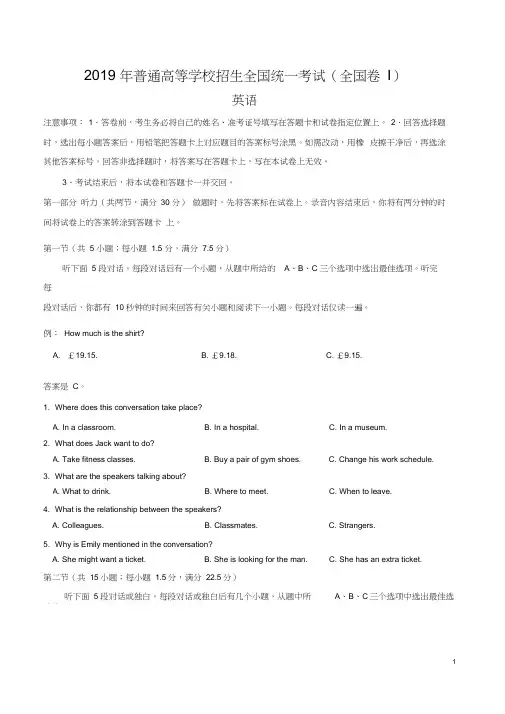
2019 年普通高等学校招生全国统一考试(全国卷 I )英语注意事项: 1.答卷前,考生务必将自己的姓名、准考证号填写在答题卡和试卷指定位置上。
2.回答选择题时,选出每小题答案后,用铅笔把答题卡上对应题目的答案标号涂黑。
如需改动,用橡 皮擦干净后,再选涂其他答案标号。
回答非选择题时,将答案写在答题卡上,写在本试卷上无效。
3.考试结束后,将本试卷和答题卡一并交回。
第一部分 听力(共两节,满分 30 分) 做题时,先将答案标在试卷上。
录音内容结束后,你将有两分钟的时间将试卷上的答案转涂到答题卡 上。
第一节(共 5 小题;每小题 1.5 分,满分 7.5 分)听下面 5 段对话。
每段对话后有一个小题,从题中所给的 A 、B 、C 三个选项中选出最佳选项。
听完每段对话后,你都有 10 秒钟的时间来回答有关小题和阅读下一小题。
每段对话仅读一遍。
例: How much is the shirt?A. £19.15.B. £9.18.C. £9.15.答案是 C 。
1. Where does this conversation take place?2. What does Jack want to do?3. What are the speakers talking about?4. What is the relationship between the speakers?5. Why is Emily mentioned in the conversation?A. In a classroom.B. In a hospital.C. In a museum.A. Take fitness classes.B. Buy a pair of gym shoes.C. Change his work schedule.A. What to drink.B. Where to meet.C. When to leave.A. Colleagues.B. Classmates.C. Strangers.A. She might want a ticket.B. She is looking for the man.C. She has an extra ticket.第二节(共 15小题;每小题 1.5分,满分 22.5分)听下面 5段对话或独白。
山东专升本(英语)历年真题试卷汇编1(题后含答案及解析)

山东专升本(英语)历年真题试卷汇编1(题后含答案及解析)题型有:1. V ocabulary and Structure 2. Reading Comprehension 5. Translation 6. Writing 11. Listening ComprehensionV ocabulary and Structure1.The improvements in technology have ______ the prices of computer considerably in recent months.A.brought backB.brought downC.brought onD.brought up正确答案:B解析:bring back意为“把……拿回来,使恢复”;bring down意为“使下降,击败”;bring on意为“导致,使发生”;bring up意为“抚养,提出”。
注意considerably 意为“很,非常”。
根据句意可知,选B。
2.As the manager’s private secretary, Helen has easy______to all his correspondence.A.accessB.approachC.accentD.response正确答案:A解析:have access to为固定搭配,意为“接近,接触到”;approach意为“靠近,方法”;accent意为“口音”;response意为“反应”。
故选A。
3.The editor asked his journalists not to ______ any details in their reports of the accident.A.leave forB.leave onC.leave offD.leave out正确答案:D解析:leave for意为“去某地”;leave on意为“留在原地,使(灯)亮着”;leave off意为“停止,戒掉”;leave out意为“遗漏,省略”。
山东2019年普通高等教育专升本统一考试
山东省2019年普通高等教育专升本统一考试
大学语文试题及解析科目代码:204
本试卷分为第Ι卷和第Ⅱ卷子两部分,共3页,满分100分,考试用时120分钟,考试结束后,将本试卷和答题卡一并交回.
第I卷
一、单项选择题(本大题共10小题,每小题1分,共10分)
在每小题列出的四个备选项中只有一个是符合题目要求的,请将其选出并将答题卡的相应代码涂黑。
错徐、多涂或未涂均无分。
1.《战国策》是一部_______史书。
A.编年体
B.国别体
C.列传体
D.纪传体
答案:B
解析:著述体例类文学学识考查,经常考查的试题之一,重点考查对象是:《左传》属于编年体,《战国策》属于国别体,《史记》属纪传体。
2,以下不属于《苏武传》中词类活用现象的是
A.羝乳乃得归
B.王必欲降武
C.屈节辱命
D.汉亦留之以相当
答案:D
解析:文言实词词类活用知识的考查。
A项中“乳”是名词活用作动词,生小羊。
B项中“降”属于动词的使动用法,“使...投降”。
C项中:“辱”和“屈”都是动词的使动用法,使得节操受辱,使得使命受玷污。
D项一句没有词类活用现象。
3,“我是月底光,我是日底光,我足一切星球底光”诗句出自郭沫若的
A.《女神》
B.《光的颂歌》
C.《炉中煤》
D.《地球,我的母亲》
答案:A
解析:识记类试题,对课文内容熟悉程度的考察,该句出自郭沫若《天狗》,应熟读重点诗歌作品。
4.关于柳宗元以下描述不正确的是
A.字子厚
B.其作品《钴鉧潭记》是唐代散文中的名篇
C.“唐宋八大家”之一。
普高专升本英语词汇和语法模拟题2019年(25)_真题-无答案
普高专升本英语(词汇和语法)模拟题2019年(25)(总分150,考试时间120分钟)V ocabulary and Structure1. —Hello, could I speak to Mr. Smith? —Sorry, wrong number. There isn' t______Mr. Smith here.A. /B. aC. theD. one2. Because of the nuclear crisis caused by the earthquake in Japan, many people lined up to buy salt ______seeking protection from radiation.A. in the face ofB. in search ofC. in hope ofD. in terms of3. If you are not satisfied with this pair, I will get you______one of the same size and color.A. otherB. anotherC. moreD. less4. I think we should stop arguing and work together, if we want to get ______ near a solution to the problem.A. anywhereB. everywhereC. nowhereD. somewhere5. I wanted to pay for the coffee, but I found that all I had was a couple of______coins.A. worthlessB. pricelessC. invaluableD. inexpensive6. This place, originally a small town, has been______into a modern city.A. transportedB. transferredC. transmittedD. transformed7. His application for the position was______by the employer because of his qualifications.A. turned outB. turned onD. turned up8. The travelers______300 miles a day by car when they were in Africa.A. passedB. tookC. coveredD. brought9. Environmentalists are doing everything within their power to______the impact of the oil spill.A. rejectB. belittleC. minimizeD. reclaim10. At the time of economic crisis, he could only earn a______of $2,000 per month.A. wageB. payC. salaryD. fee11. I would always______buying a good quality car rather than a cheap one.A. appreciateB. approveC. introduceD. recommend12. Many students signed up for the______race in the sports meeting to be held next week.A. 800-meter-longB. 800-meters-longC. 800 meter lengthD. 800 meters length13. I didn' t know anything about any of the books so my choice was quite______.A. arbitraryB. obviousC. evidentD. fortunate14. His aim was to ______ pride in being black and to inspire black Americans to campaign for equal rights.A. respondB. restoreC. restrainD. retreat15. Mary worked here as a______secretary and ended up getting a full-time job with **pany.A. pessimisticB. temporaryC. previousD. cautious16. David is______animal fur, so he won't visit anyone who has cats or dogs in the house.A. curious aboutB. allergic toD. fond of17. The research lacks______evidence, and therefore, its conclusions are doubtful.A. solidB. fierceC. severeD. potential18. People found to their horror that two-thirds of the adult population in that area had______AIDS.A. contactedB. contrastedC. contractedD. compacted19. Though faced with many difficulties, he would not______online learning.A. give upB. get throughC. get byD. give in20. It suddenly occurred to me that we could______the police for help.A. askB. lookC. tellD. meet21. I'd like to______a special seat for the concert of May 5.A. serveB. reserveC. preserveD. conserve22. The manager often requires us never to______till tomorrow what we can do today.A. come upB. put offC. turn onD. give out23. Having heard so much about Mr. Smith, they were______to meet him.A. eagerB. niceC. urgentD. earnest24. Only one little boy______the accident: everyone else was killed.A. survivedB. submittedC. sufferedD. succeeded25. I don't know whether what he said is true, but I' 11 try to______it.A. confineB. confessC. conformD. confirm。
普高专升本英语阅读理解模拟题2019年(14)_真题(含答案与解析)-交互
普高专升本英语(阅读理解)模拟题2019年(14)(总分150, 做题时间120分钟)阅读理解The outside world begins creeping into the school when the children reach the age of 13 and older, the age when they begin to make subject choices and when, according to a careers officer, they knowif they're a scientific lot or more inclined to the arts. Thedifficult part is bringing the outside world to life with all its opportunities and realities. Schools are handicapped because they are staffed by people who only know about schools. Careers services are heavily influenced by what is readily available in the area, which may be sausage-making(香肠制造) in Wiltshire of ship-building in Clydeside. Somewhere out in the world there are snail (蜗牛) geneticists (遗传学家) and landscape gardeners and girls who polish Elizabeth Taylor's diamonds, but the careers officer knows little of them. What he knows about is engineering and hairdressing and opportunities in the Army. It is not surprising that this constant friction between grand aspirations (抱负) and uninspired reality produces cynicism (玩世不恭,愤世嫉俗) in both parties.Wherever they work, sixteen and seventeen-year-olds can find themselves used as cheap labor, picking things up off floors,fetching and carrying. Some are paid a reasonable wage but it is quite possible to be paid only pocket-money. That's in the living-in jobs like hotel work. There is a small breakthrough of girls into traditionally male preserves like agriculture, but that may be because very few boys now would put up with the low wages. Most girls, despite women's liberation, head straight for hairdressing, nursing or office work and dream of being swept off their feet by the boss.SSS_SINGLE_SELIn what sense does the author say the outside world begins "creeping into schools" when children first make subject choices?AChildren begin to become interested in careers possibly open to them.BChildren know what they are good at science or arts.CChildren start to make constant contact with careers officers.DChildren start to be concerned with what occupations they will be able to obtain.分值: 6答案:A文章第一段“the age when they begin to make subject choices and when,according to a careers officer,they know if they’re a scientific lot or more inclined to the arts.”因此正确答案为A。
普高专升本英语阅读理解模拟题2019年(24)_真题-无答案
普高专升本英语(阅读理解)模拟题2019年(24)(总分150,考试时间120分钟)阅读理解The wheel was one of man's first inventions and yet it has also proved one of the most useful. So wide and varied are the uses of wheels, in machines and vehicles of all kinds that it is difficult to imagine what the world would be like without them. It is surprising to hear it said, therefore, that the wheel's importance will perhaps be greatly reduced by the end of the century by an invention so new to be still unnamed.The invention is a machine that floats above any surface on a cushion(垫子) of air. The cushion is formed when air is blown into the bottom of the machine. This part is shaped like a saucer turned upside down. If air is blown into this saucer, the machine rises to a height that may vary from a few inches to a few feet.Industry is already using one form of the invention to deal with heavy loads. It can lift them with ease and since there are no wheels, and therefore no friction, they can be put into motion with the touch of a finger.The new invention, however, is having a great effect on transport. Not only does it make expensive road systems unnecessary, but it enables vehicles to travel equally well over land or water. This unique ability to reach most destinations has given rise to the prediction that wheeled vehicles may be as uncommon at the end of the century as airplanes were at the beginning.1. The first paragraph tells us that______.A. the wheel was man's earliest inventionB. the wheel's usefulness has yet to be provedC. wide wheels have a variety of important usesD. a new invention may make wheels less important2. The phrase "with the touch of a finger" in the third paragraph means______.A. without difficultyB. by electricityC. without frictionD. by hand3. The passage tells us that the new invention______.A. is more important for industry than for transportB. will one day be used instead of airplanesC. makes it possible to travel without using roadsD. will replace wheeled vehicles in a hundred years4. At the end of the century, vehicles using the invention will probably be______.A. rareB. plentifulC. unimportantD. expensive5. According to the passage, the new invention______.A. will soon get a nameB. can go almost anywhereC. is lighter than airD. was uncommon a century agoMost people go to a doctor in their own town or suburb. But people in the Australian outback can't get to a doctor quickly. The nearest doctor is sometimes hundreds of kilometers so they have to call him on a two-way radio. This special doctor is called the "flying doctor". He visits sick people by plane.When someone is very sick, the doctor has to fly to the person's home. His plane lands on a flat piece of ground near the person's house. Sometimes the doctor has to take the patient to hospital. Flying doctors take about 8,600 people to hospital each year.However, most of the time the person isn't very sick, and the doctor doesn't have to visit. He can give advice on the radio from the office at the flying doctor centre. He can tell the patient to use some medicine from a special medicine chest. There is one of these chests in every home in the outback. Each bottle, tube and packet in the chest has a number. The doctor often says something like this: "Take two tablets from bottle number 5 every four hours."A man called John Flynn started the Royal Flying Doctor Service in 1927. He had only one-plane. Today there are 14 flying doctor centres, 29 planes, 14 fulltime doctors and several part-time doctors, nurses and dentists.6. The flying doctors mentioned in this article treat their patients______.A. quicklyB. effectivelyC. over great distancesD. all of the above7. Which happens first?______.A. The doctor flies to the sick person's homeB. The sick person is treated by the doctorC. The plane lands near the patient's houseD. The sick person or his family calls the doctor on a two-way radio8. From the article we can conclude that Australia has a number of______A. remote areasB. good highwaysC. mountainous regionsD. strange animals9. The doctor can give the sick person advice on the radio from his office if______A. the patient has a special medicine chest in his homeB. the patient has got a two-way radioC. the doctor feels very tiredD. the patient is not very sick10. Do doctors at the centre work full time?______.A. All of them doB. Some of them doC. None of them doD. The article does not sayIf we were asked exactly what we were doing a year ago, we should probably have to say that we could not remember. But if we had kept a book and had written in it an account of what we did each day, we should be able to give an answer to the question.It is the same in history. Many things have been forgotten because we do not have any written account of them. Sometimes men did keep a record of the most important happenings in their country, but often it was destroyed by fire or in a war. Sometimes there was never any written record at all because the people of that time and place did not know how to write. For example, we know a good deal about the people who lived in China 4,000 years ago, because they could write and leave written records for those who lived after them. But we know almost nothing about the people who lived eve" 200 years ago in central Africa, because they had not learned to write.Sometimes, of course, even if the people cannot write, they may know something of the past. They have heard about it from older people, and often songs and dances and stories have been made about the most important happenings, and these have been sung and acted and told for many generations, for most people are proud to tell what their fathers did in the past. This we may call "remembered history". Some of it has now been written down. It is not so exact or so valuable to us as written history is, because words are much more easily changed when used again and again in speech than when copied in writing. But where there are no written records, such spoken stories are often very helpful.11. Which of the following ideas is NOT suggested in the passage? ______A. Remembered history, compared with written history, is less reliable.B. Written records of the past play the most important role in our learning of the human history.C. A written account of out daily activities helps us to be able to answer many questions.D. Where there are no written records, there is no history.12. We know very little about the central Africa 200 years ago because ______A. there was nothing worth being written down at that timeB. the people there ignored the important of keeping a recordC. the written records were perhaps destroyed by a fireD. the people there did not know how to write13. "Remembered history" refers to ______A. history based no a person's imaginationB. stories of important happenings passed down from mouth to mouthC. songs and dances about the most important eventsD. both B and C14. "Remembered history" is regarded as valuable only when______A. it is written downB. no written account is availableC. it proves to be trueD. people are interested in it15. The passage suggests that we could have learned much more about our past than we do nowif the ancient people had ______A. kept a written record of every past eventB. not burnt their written records in warsC. told exact stories of the most important happeningsD. made more songs and dancesLike most people, I was brought up to look upon life as a process of getting. It was not until in my late thirties that I made this important discovery: giving-away makes life so much more exciting. You need not worry if you lack money. This is how I experimented with giving-away. if an idea for improving the window display of a neighborhood store flashes to me, I step in and make the suggestion to the storekeeper. One discovery I made about giving-away is that it is almost impossible to give away anything in this world without getting something back, though the return **es in an unexpected form. One Sunday morning the local post office delivered an important special delivery letter to my home, though it was addressed to me at my office. I wrote the postmaster a note of appreciation. More than a year later I needed a post-office box for a new business I was starting. I was told at the window that there were no boxes left, and that my name would have to go on a long waiting list. As I was about to leave, the postmaster appeared in the doorway. He had overheard(无意中听到) our conversation. "Wasn't it you that wrote us that letter a year ago about delivering a special delivery to your name?" I said yes. "Well, you certainly are going to have a box in this post office if we have to make one for you. You don't know what a letter like that means to us. We usually get nothing **plaints."16. From the passage, we understand that______A. the author did not understand the important of giving until he was in late thirtiesB. the author was like most people who were mostly receivers rather than giversC. the author received the same education as most people during his childhoodD. the author liked most people as they looked upon life as a process of getting17. According to the author ______A. giving means you will lack moneyB. the excitement of giving can bring you moneyC. you don't have to be rich in order to giveD. when you give away money, you will be rich18. The author would make the suggestion to the storekeeper______A. in writingB. in personC. in the window displayD. about the neighborhood19. When the author needed a post-office box, ______A. he had to put his name on a waiting listB. he wrote the postmaster a note of appreciationC. many people had applied for post-office boxes before himD. he asked the postmaster to make one for him20. In reply to the postmaster's question, the author said ______A. it was the special deliveryB. it was the post-office boxC. it was the note of appreciation he wroteD. it was he who wrote him a letter a year agoChildren in the United States are exposed to many influences other than that of their families. Television is the most significant of these influences, because the habit of watching television usually begins before children start attending school.Parents are concerned about the lack of quality in television programs for children. The degree of violence in many of these shows also worries them. Studies indicate that, when children are exposed to violence, they may become aggressive or insecure.Parents are also concerned about **mercials that their children see on television. Many parents would like to see **mercials during programs for children. And some parents feel that these shows should not have **mercials at all because young minds are not mature enough to deal with the claims made by advertisers.Educational television has no commercials and has programs for children that many parents approve of. The most famous of these is Sesame Street, which tries to give preschool children a head start in learning the alphabet(字母) and numbers. It also tries to teach children useful things about the world in which they live.Even though most parents and educators give Sesame Street and shows like it high marks for quality, some critics argue that all television, whether educational or not, is harmful to children. These critics feel that the habit of watching hours of television every day turns children into bored and passive(被动的) consumers of their world rather than encouraging them to become active explorers of it.21. Which of the following statements is NOT based on the passage?A. Parents are worried about the influence from television on their children.B. Television has much influence on children.C. Both parents and their children like watching educational television.D. Some critics think that television is no good for children22. In what ways do children suffer from television?A. They become the victims of social violence.B. They spend hours watching television instead of doing school work.C. The programs make the children lose interest in the world.D. The programs make the children spend too much of their parents' money.23. Parents would not like their children to **mercials because ______A. they think that their children are not old enough to handle advertisingB. commercials teach children alphabet and numbersC. commercials help to sell productsD. they don't **mercials24. Educational television is widely appreciated because ______A. it does have the **mercials as othersB. it offers programs for both children and their parentsC. many parents like the programs it offers for their childrenD. children can learn some school subjects before they go to school25. Which of the following can best serve as the title of the passage?A. Watching Too Much Television May Be Harmful to Young Minds.B. Television Is More Harmful than EducationalC. Television's Influence on Children.D. More Educational Television.。
2019年专插本英语真题
2019年专插本英语真题请记住:当动词advise(建议)/suggest(建议)/propose(提议)/insist(坚持)等动词及其变形,后面接(that)+句子,那么句子的谓语必须是should do,且should可以被省略。
例如:I suggest that he (should)go there soon.我建议他早点去那里。
She made a proposal that everyone (should) come back home as soon as possible.她提议每个人早点回家。
其他需要记住的细节:①book a seat 预定座位例如:You had better book a seat by Email before the play starts. 你最好在戏剧开始前用电子邮件预定一个座位。
②in advance 提前例如:You should call me in advance. 你应该提前给我打电话。
获取更多插本英语的知识,你可以:①关注微信/B站/微博:插本英语Kimi酱②私享专插本考纲指定词汇3400个音频,下载“喜马拉雅APP”,搜“高职高专教育英语课程”即可免费获取~ ③积极留言互动。
谢谢大家~专插本英语真题备考的利用方法:(一)按考试模式练习第一遍的时候就要严格按照考试时间,并且创造一个最贴近考试的环境来完成真题。
试题每一部分都要认真做好,包括作文部分也要认真书写。
做完真题后考生可对照参考答案,对自己的做题效果做一个简单的自我评估,并仔细对照。
正确了解自身的英语实力,在此基础上,着手准备相对应的复习计划。
专插本英语真题备考的利用方法:(二)培养解题思维第二遍要在真题复习中分析揣摩命题人的命题思维和命题习惯,并在日常练习中将自己的思维向出题方向靠拢。
在这一边真题复习中大家可以根据《详解真题》的解析中归纳的考点进行分析,从而找到专插本考试最常考的语法点,并针对性的进行复习。
普高专升本英语阅读理解模拟题2019年(36)_真题-无答案
普高专升本英语(阅读理解)模拟题2019年(36)(总分150,考试时间120分钟)Reading Comprehension单选题Why do we laugh? For years scientists have asked themselves this question. No animals laugh and smile—only human beings do. So does laughing help us to live longer? The answer seems to lie in that smiling and laughing help us to become less worried and calm, preventing illnesses that are caused by stress. Laughing is really the best medicine.But if you' re unhappy, it can't do you any good to smile, can it? That' s not true. It is clear that smiling works just in the same way whether you feel like smiling or not. Scientists in California asked a group of students to act five different feelings: happiness, sadness, anger, surprise and fear—just using their faces. Changes in their heart rate, blood pressure and temperature were recorded. Most of the feelings they acted didn' t cause changes, but when the students smiled, their heart rate and their blood pressure went down. That happened even though they were only acting! So even if we feel sad inside, smiling seems to make us feel better.Now, what makes us laugh? It seems that the answer to the question is far from simple. Everyone likes jokes, but we don't laugh at the same ones. It depends largely on how old we are. There are some jokes, for example, that children love but older people might not find funny.1. In the first paragraph, the underlined word "stress" can be best explained as "______".A. surprise and fearB. work and dutyC. happiness and sadnessD. pressure and worry2. Which of the following statements is TRUE based on the passage?A. Laughing helps us to live ten years longer.B. If you are in a bad mood, smiling helps to make you feel relieved.C. Our blood pressure can be influenced by five different facial expressions mentioned.D. People, old and young, are likely to laugh at the same jokes.3. In the passage, the writer seems to pay more attention to______.A. how laughing and smiling are connected with healthB. comparing human beings with animalsC. finding out if any research has been done about laughingD. the degree to which laughing and smiling are helpful4. The passage tells us that smiling and laughing______.A. have nothing to do with one' s heart rateB. do one no good when one is sadC. lower one' s blood pressureD. lower one' s body temperature5. According to the author, ______A. it is **plicated to answer the question "Why do we laugh?"B. it is really simple to answer the question "Why do we laugh?"C. it is not necessary to answer the question "Why do we laugh?"D. scientists have already answered the question "Why do we laugh?"I was only eight years old when the Second World War ended, but I can still remember something about the celebrations in the small town where I lived on the day when the war in Europe ended. We had not suffered much from the war there. But both at home and at school I had become accustomed to the phrases "before the war" and " when the war is over". " Before the war" , apparently, things had been better, though I was too young to understand why, except that there had been no bombs then, and people had eaten things like ice-cream and bananas, which I had only heard of. When the war was over we would go back to London, but this meant little to me. I did not remember what London was like.What I remember now about VE (Victory in Europe) Day was the May evening. After dinner I said I wanted to see the bonfire (大火堆) , so when it got dark my father took me to the end of the street. The bonfire was very high, and somehow people had collected some old clothes to dress the unmistakable figure (人形) with the moustache (胡子) they had put on top of it. Just as we arrived, they set light to it. The flames rose and soon swallowed the " guy". Everyone was cheering and shouting, and an old woman came out of her house with two chairs and threw them on the fire to keep it going.I stood beside my father until the fire started to go down, not knowing what to say. He said nothing, either. He had fought in the First World War and may have been remembering the end of that. At last he said, " Well, that' s it, son. Let' s hope that this time it really will be the last one. "6. Where did the author live before the Second World War?A. In London.B. In a small town.C. In Europe.D. In the countryside.7. What kind of food had the author certainly not eaten during the war?A. Bread.B. Butter.C. Meat.D. Ice-cream and bananas.8. The unmistakable figure with the moustache most probably represents______.A. those who died in the warB. those who had wonC. an imaginary figureD. the most hated person in the war—Hitler9. Which of the following statements is true?A. The author' s father built a bonfire on VE Day.B. The author' s father had fought in the First World War.C. The author' s father had fought in the Second World War.D. The author' s father threw two chairs on the fire to keep it going.10. By saying "Let' s hope that this time it really will be the last one" , the father meant that______.A. he wished people had not built the bonfireB. he hoped people would not build any more bonfiresC. he hoped there would be no more wars in the worldD. he wished the Second World War had not happenedBlind people can "see" things by using other parts of their bodies. This fact may help us to understand our feelings about color. If blind people can sense color differences, then perhaps we, too, are affected by color unconsciously (无意识地).Manufacturers(生产商) have discovered by experience that sugar sells badly in green wrappings, that blue foods are considered unpleasant, and that cosmetics(化妆品) should never be packaged in brown. These discoveries have grown into a branch of color psychology.Color psychology now finds application in everything from fashion to decoration. Some of our preferences are clearly psychological. Dark blue is the color of the night sky and therefore associated with calm, which yellow is a day color with associations of energy and incentive(刺激). For a primitive man, activity during the day meant hunting and attacking, while he soon saw red as the color of blood and anger and the heat that came with effort. And green is associated with passive defense and self-protection.Experiments have shown that colors, partly because of their psychological associations, also have a direct psychological effect. People exposed to bright red show an increase in breath, in heartbeat and in blood pressure: red is exciting. Similar exposure to pure blue has exactly the opposite effect: it is a calming color. Because of its exciting meaning, red is chosen as the signal for danger, but closer analysis shows that a vivid yellow can produce a more basic state of alarm. So fire engines and ambulances in some **munities are now rushing around in bright yellow colors that stop the traffic dead.11. Our preferences for certain colors are______according to the passage.A. associated with the time of the dayB. dependent on our personalitiesC. are linked with our ancestorsD. partly due to psychological factors12. If people are exposed to bright red, which of the following things does NOT happen?A. They breathe faster.B. They feel satisfied.C. Their blood pressure rises.D. Their hearts beat faster.13. Which of the following statements is NOT true according to the passage?A. Color probably has an effect on us which we are not conscious of.B. Yellow fire engines have caused many bad accidents in some **munities.C. People exposed to pure blue start to breathe more slowly.D. The psychology of color is of some practical use.14. Which of the following statements is TRUE according to the passage?A. Manufacturers often sell sugar in green wrapping.B. Dark blue brings people the feeling of being energetic.C. Primitive people associated heat and anger with red.D. Green and yellow are associated with calm and passive defense.15. Which of the following could be the most suitable title for the passage?A. The Branch of Color PsychologyB. Color and Its MeaningsC. The Practical Use of Color PsychologyD. Color and FeelingsHuman needs seem endless. When a hungry man gets a meal, he begins to think about an overcoat: when a manager gets a new sports car, a big house and pleasure boats dance into view.The many needs of mankind might be regarded as making up several levels. When there is money enough to satisfy one level of needs, another level appears.The first and most basic level of needs involves food. Once this level is satisfied, the second level of needs, clothing and some sort of shelter, appears. By the end of World War II , these needs were satisfied for a great majority of Americans. Then a third level appeared. It included such items as automobiles and new houses.By 1957 or 1958 this third level of needs was fairly well satisfied. Then, in the late 1950s, a fourth level of needs appeared: the "life-enriching" level. While the other levels involve physical satisfaction, that is, the feeding, comfort, safety, and transportation, this level stresses mental needs for recognition, achievement, and happiness. It includes a variety of goods and services, many of which could be called "luxury" items. Among them are vacation trips, the best medical and dental care, and recreation. Also included here are fancy goods and the latest styles in clothing.On the fourth level, a lot of money is spent on services, while on the first three levels more is spent on goods. Will consumers raise their sights to a fifth level of needs as their income increases, or will they continue to demand luxuries and personal services on the fourth level?A fifth level would probably involve needs that can be achieved best by community action. Consumers may be spending more on taxes to pay for government action against disease, ignorance, crime, and prejudice. After filling our stomachs, our clothes closets, our garages, our teeth, and our minds, we now may seek to ensure the health, safety, and leisure to enjoy more fully the good things on the first four levels.16. According to the passage, man will begin to think about such needs as housing and clothing only when______.A. he has saved up enough moneyB. he has grown dissatisfied with his simple shelterC. he has satisfied his hungerD. he has learned to build houses17. It can be inferred from the passage that by the end of World War II , most Americans______.A. were very richB. lived in povertyC. had the good things on the first three levelsD. did not own automobiles18. Which of the following is NOT related to "physical satisfaction"?A. A successful career.B. A comfortable home.C. A good meal.D. A family car.19. What is the main concern of man on the fourth level?A. The more goods the better.B. The more mental satisfaction the better.C. The more "luxury" items the better.D. The more earnings the better.20. The author tends to think that the fifth level______.A. would be little better than the fourth levelB. may be a lot more desirable than the first fourC. can be the last and most satisfying levelD. will become attainable before the government takes actions。
2019年山东省春季高考英语试题
山东省2019年普通高校招生(春季)考试英语试题本试卷分卷一(选择题)和卷二(非选择题)两部分,满分80分,考试时间60分钟。
考生请在答题卡上答题,考试结束后,请将本试卷和答题卡一并交回。
卷一(选择题,共50分)一、英语知识运用(本题30个小题,每小题1分,共30分)在每小题列出的四个选项中,只有一项符合题目要求,请将符合题目要求的选项字母代号选出,并填涂在答题卡上。
1. — Excuse me, sir. Are you ready to order now?— Yes. I’d like two _______ and two _______.A. hamburger; cup of juiceB. hamburgers; cup of juiceC. hamburger; cups of juiceD. hamburgers; cups of juice2. — Do you know _______ boy with glasses over there?— Yes, he is Jim, my classmate. He plays _______ volleyball very well.A. a; theB. the; aC. the; /D. the; the3. Not only my parents but also my uncle ________ fond of Peking opera.A. wereB. isC. areD. am4. — Is that girl in red Lucy?— No, she _______ be Lucy. She has gone to Hainan with her grandparents.A. canB. mustC. mustn’tD. can't5. The kids were about the discovery.A. exciting; excitingB. excited; excitedC. exciting; excitedD. excited; exciting6. — Mike, ________ do you go jogging?—Twice a week.A. how farB. how soonC. how oftenD. how long7. — Do you mind if I the light? It's a little dark now.— Certainly not.A. turn offB. turn onC. turn outD. turn down8. Mr. Green is satisfied _______ his students’ progress.A. withB. inC. onD. at9. — Excuse me. Would you please help me carry the box?.A. With pleasureB. No, thanksC. See you thenD. Never mind10. — There is _______ with my car. I can’t start it.— Let me check it.A. something wrongB. wrong somethingC. nothing wrongD. wrong nothing11. — Tom, do you think if Mary _____ to your birthday party this Saturday?— She will come if she _____ free.A. comes; isB. will come; isC. will come; will beD. comes; will be12. — The forecast says that there will be a heavy rain tomorrow.— _____. I planned to go for a picnic with my friends.A. Good ideaB. No problemC. Well doneD. Bad luck13. I’ll never forget the day I went to Shanghai for the first time.A. whenB. whereC. whyD. that14. — Why not see a film with us this Sunday?—______. I can hardly wait for that.A. No, thank youB. Sounds greatC. You are welcomeD. It doesn’t matter15. — Hi, Jack! You look so _______ today.—Yeah, I’ve just passed the skills test with high mark.A.sadB. angryC. happyD. disappointed16. — Could you tell me _____ for the coming summer vacation?— I’ll join a summer camp in Xi’an.A. what did you doB. what you didC. what will you doD. what you will do17. — May I borrow this book?—Of course. This book ______ for two weeks.A. can keepB. can be keptC. can borrowD. can be borrowed18. —amazing the Hong Kong-Zhuhai-Macao Bridge is!— So it is.A. HowB. WhatC. What aD. What an19. — Excuse me. Could I use your dictionary?.A. Sorry, I’m new hereB. Sorry, you’re wrongC. Yes, help yourselfD. Yes, that’s very kind of you20. We should do all ______ we can do to protect the environment.A. whichB. whoC. thatD. where21. Nowadays about 70% of the energy used in this city from oil and gas.A. comeB. comesC. have comeD. had come22. Susan is ______ honest _______ everyone in our class believes her.A. so; thatB. such a; thatC. such; thatD. such an; that23. Finally the forest fire was by the fire fighters.A. put outB. put onC. put offD. put up24. — What skills do you have?.A. I major in computer scienceB. I graduated from Shandong UniversityC. I can write computer programsD. I have worked in a factory for three years25. We should avoid answering the phone ______ in public places.A. quietlyB. loudlyC. heavilyD. quickly26. It’s necessary for people ______ some knowledge of first aid.A. knowsB. knowC. to knowD. knowing27. — Hurry up! The concert will begin _______.—I’m coming.A. in a few minutesB. a few minutes agoC. for a few minutesD. since a few minutes ago28. — Would you like ______ some coffee?—No, thank you. I don’t feel like ______ anything now.A. to have; to drinkB. having; drinkingC. to have; drinkingD. having; to drink29. Mary can’A. her major is nursingC. she can work 5 days a weekD. she has one year’s work experience30. Suppose you have ten dollars now, you can buy in the supermarket.A. one bag and two pensB. one cup and two notebooksC. one pen and two bagsD. one notebook and two cups二、阅读理解(本题10个小题,每小题2分,共20分)在每小题列出的四个选项中,只有一项符合题目要求,请将符合题目要求的选项字母代号选出,并填涂在答题卡上。
普高专升本英语阅读理解模拟题2019年(35)_真题-无答案
普高专升本英语(阅读理解)模拟题2019年(35)(总分150,考试时间120分钟)阅读理解Acting is such an over-crowded profession that the only advice that should be given to a young person thinking of going on the stage is "Don't!". But it is useless to try to discourage someone who feels that he must act, although the chances of his becoming famous are slim. The normal way to begin is to go to a drama school. Usually only students who show promise and talent are accepted, and the course lasts two years. Then the young actor or actress takes up work with a **pany(剧团), usually as an assistant stage manager. This means doing everything that there is to do in the theatre and occasionally action in very small parts. It is very hard work indeed, the hours are long and the salary is tiny. Of course, some people have remarkable chances which lead to fame and success without this long and hard training. Connie Pratt, for example, was just an ordinary girl working in a bicycle factory. A film producer happened to catch sight of her one morning waiting at a but stop, as he drove past in his car. He stopped and got out to speak to the girl. He asked if she would like to go to the film studio to do a test, and she thought he was joking. Then she got angry and said she would call the police. It took the producer twenty minutes to convince Connie that he was serious. The test was successful. And within a few weeks she was playing the leading part opposite one of the most famous actors of the day. But chances like this happen once in a blue moon!1. From the very beginning, the author puts it clearly that acting is a profession ______.A. sought after by too manyB. too difficult for young peopleC. for slim people onlyD. one can go into without special training2. For someone who feels he must act, it is very likely that ______.A. he will become a film star at long lastB. he will become a stage managerC. he will be well paidD. he will end up without any success3. The film producer found Connie Pratt one morning when she was ______.A. at work in a bicycle factoryB. driving past him in her carC. going to a film studioD. waiting for a bus4. A few weeks after the test, Connie Pratt found himseif______.A. the most famous actress of the worldB. playing the leading female role in a playC. as famous as the greatest actor of the worldD. no less famous than the leading actor of the day5. The concluding sentence " But chances like this happen once in a blue moon" means ______.A. this is something which happens once in a whileB. this is a highly profitable chanceC. this is something highly possibleD. this is a very rare chanceSoldiers and other military people wear uniforms with various other symbols to indicate their status. But in the business world everyone wears more or less similar suits, and you cannot tell at a glance who ranks higher or lower than another. So how do people in the business world show their superiority?An attempt to study this was made by two researchers using a series of silent films. They had two actors play the parts of an executive(经理) and a visitor, and switch roles each time. The scene had one man at his desk playing the part of an executive, while the other, playing the part of a visitor, knocks at the door, opens it and approaches the desk to discuss some business matter.The audience watching the films was asked to rate the executive and the visitor in terms of status. A certain set of rules about status began to emerge from the ratings. The visitor showed the least amount of status when he stopped just inside the door to talk across the room to the seated man. He was considered to have more status when he walked halfway up to the desk, and he had the most status when he walked directly up to the desk and stood right in front of the seated executive.Another thing that affected the status of the visitor in the eyes of the observers was the time between knocking and entering. For the seated executive, his status was also affected by the time between hearing the knock and answering. The quicker the visitor entered the room, the more status he had. The longer the executive took to answer, the more status he had.6. The experiment designed by the two researchers aimed at finding out______.A. how business is conducted by an executive and a visitorB. how to tell the differences between an executive and a visitorC. how to tell businessmen at a glanceD. how businessmen indicate status7. Which of the following statements can best sum up the passage?A. The executive has a higher status than the visitor.B. Military people wear uniforms but the businessmen do not.C. A study revealing a set of rules about the status of businessmen.D. It is a good method to use a series of silent film in research.8. Having entered the room, the closer the visitor approaches the executive,______.A. the less it affected his statusB. the lower his statusC. the more it affected his statusD. the higher his status9. The longer the seated man was in answering the knock,______ .A. the higher his statusB. the less it affected his statusC. The lower his statusD. The more it affected his status10. Which of the following statements is not true?A. Soldiers wear uniforms with various symbols so that one can tell their status at a glance.B. In the experiment, one actor played the executive while the other played the seated man.C. Business people wear similar suits.D. The audience watching the film rated the executive and the visitor in terms of status.The resources of the library can be helpful even when we are doing something very informal, such as trying to devise a better way to measure attitudes toward music or looking for a better way to teach mathematics. The library can be equally helpful when we are doing something very formal, such as writing a dissertation(学位论文) or preparing an article for publication in a professional journal. In either case, our goal should be to use the library as a useful tool to help us understand and solve problem.The following sections of this chapter will describe specific resources available in many libraries. In some cases you may already be aware of a resource and may use it frequently and successfully. In other cases you may be completely unfamiliar with a resource. Your goal should be to become aware of what is available and to know how to use each of these resources to help you solve the problem they are designed to solve.When educators have a piece of information that they want to share with their colleagues, they often make this information available in professional journals or at professional meetings. It would often be useful to have access to such information, and this chapter will describe the special services that enable us to locate such information.11. The library resources can be helpful when we ______.A. want to find a better way to measure attitudes toward musicB. are preparing a paper for a professional journalC. are writing a dissertationD. All of the above12. The familiarity of readers with different resources______.A. is more or less the sameB. varies slightlyC. differs greatlyD. should not be different13. The author believes that______.A. library resources should be used frequently **pletelyB. library resources cannot be made good use of if they are not available to usC. one is supposed to be aware of the library resources that are usually not availableD. one is supposed to have good knowledge and make good use of resources14. When educators wish to share some information with their colleagues, they often______.A. publish it in a professional journalB. get it from professional meetingsC. get access to it in the libraryD. make use of some library services15. The chapter where this passage is taken ______.A. mainly deals with the ways of dissertation writingB. presents information on publishing papers in professional journalsC. introduces some library servicesD. describes some professional meetingsAll of us rely on what we see. We say to ourselves, "I know, I was there; I saw it happen" and that seems to settle the matter. Or does it? Can we really trust the evidence of our eyes?**petitive sports. Fans who see the same game will not agree with each other and will disagree with the referee. "He was out of bounds when he caught the pass," says one fan. Says another, "You're crazy. I saw it with my own eyes. He was five feet in bounds. You must be blind." The referee rules that the receiver did step out of bounds. But thousands of fans are still not convinced—because they were there!It's the same story in the courtroom. Trial procedure depends on witnesses giving sworn testimony(证词). But just how reliable is the testimony of a person who reports what he has seen? In a recent study, ten thousand witnesses were asked to describe the man they **mit a crime. The study reveals that, on the average, the witnesses overestimated the man's height by five inches, his age by eight years, and gave the wrong hair color in 83 percent of the cases. These witnesses didn't play tricks on them!What can we do to keep error to a minimum? First of all, don't let your emotions interfere with your vision. Don't see something because you want to see it. Secondly, try to stay relaxed. If you are tense, you are liable to see red when the color is blue. And finally, it helps to make notes of what you see. Don't rely on your memory alone. Take pictures, make recordings, and use any other aid to reduce distortion.16. The best statement of the main idea of this passage is that______.A. all of us rely on what we seeB. sworn witnesses and sports fans rarely give accurate descriptions of what they seeC. we can't completely trust the evidence of our eyesD. eyewitnesses are unreliable17. The passage suggests that fans at sports events______.A. are swayed(支配) by emotionB. are crazy about sportsC. lie about what they seeD. have no respect for the truth18. Statistical studies suggest that______.A. courtroom testimony only confuses the juryB. in 83 percent of the cases, witnesses overestimate age by eight yearsC. witnesses are remarkably accurateD. testimony of people reporting what they see is often unreliable19. The word "them" in the last line of paragraph 3 refers to______.A. the eyes of the witnessesB. the sworn testimony given by the witnessesC. the members of the juryD. the height, age and hair color of the criminal20. To keep visual error to a minimum, all of the following are necessary EXCEPT______.A. to stay calmB. to get close for a better lookC. not to let your emotions interfereD. to make notes of what you seeThree passions, simple but overwhelmingly strong, have governed my life: the longing for love, the search for knowledge, and the pity for the suffering of mankind.I have sought love, first, because it brings happiness and enjoyment—so great that I would often have sacrificed all the rest of life for a few hours of this joy. I have sought it, next, because it relieves loneliness—the terrible loneliness. I have sought it, finally, because in the world of love I have seen the version of the heaven that poets have imagined. This is what I sought, and though it might seem too good for human life, this is what—at last—I have found.With equal passion I have sought knowledge. I have wished to understand the hearts of men.I have wished to know everything about the nature.Love and knowledge led upward toward the heavens. But pity always brought me back to earth. Children in famine, helpless old people and the whole world of loneliness, poverty, and pain make a mockery of what human life should be. I long to destroy the evil, but I can't and I too suffer.This has been my life. And I have found it worth living, and would gladly live it again if the chance were offered to me.21. Which of the following is essential in the author's life?A. Love.B. Knowledge.C. Sympathy.D. All of the above.22. Which of the following is NOT the reason that the author seeks love?A. Love needs sacrifice.B. Love makes the world beautiful.C. Love can relieve loneliness.D. Love brings happiness and enjoyment23. Whom does the author feel sympathy for?A. The sick people.B. The people out of work.C. All the people who are suffering in the world.D. All the people that are relevant to him.24. Why does the author say "I too suffer"?A. Because he can't have enough money to help others.B. Because he can't destroy all the evils that brings pain to people.C. Because he can't obtain the love from others while he loves people so much.D. Because he can't find the cause of evils.25. Which can be used as the title of this article?A. Destroy All the Evils.B. What I Have Lived for.C. Love Conquers All.D. The Beautiful Life.。