
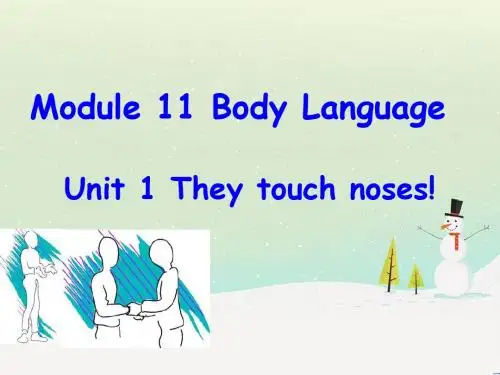
Module 11 Body language Unit 1 They touch noses! 课件 (外研版七年级下)
bow kiss shake smile British German
Japanese
/dʒæ pə'ni:z/日本人;日语 n.
/'rʌʃən/ 俄罗斯人;俄语 n.
俄罗斯人的;俄语的 adj.
Russian visitor Russia what nod head hug
/'vIzItə/ 游客;观光者 n.
Words and expressions
/bau/ /kIs/ /ʃeIk/ /smaIl/ /'brItIʃ/ /'dʒə:mən/
鞠躬;弯腰 v. 吻;亲吻 n. &v. 摇晃 v.
微笑 n. &v.
英国人;英国人的 adj. 德国人;德语 n. 德国人的;德语的 adj. 日本的;日语的 adj.
India together Maori
touch nose
/tə'ɡeðə/
/'mauri/
/tʌtʃ/
/nəuz/
1 Match the pictures with the words and expression from the box.
bow kiss shake hands smile
touch Russia
when they meet _____. visitors
Language points
1. in Russia, people usually kiss three times. “times” 在这里表示次数, three times 表示 “三次” 在英文中, 一次, once 两次, twice 三次以上都用“times” 如: My mother goes shopping once a week. 我妈妈每周购物一次。
2. That’s because people do different things in different countries.
11
Unit 1 They touch noses!
bow
shake hands
hug
touch nose
smile
kiss
Language aims
1. To master the words and expressions in this lesson. 2. To process main information of body language. 3. To talk about body language.
2 Listenand match the pictures with the nationality.
British
1 French
German
3 Japanese 2 Russian
Now work in pairs and check.
—Are they Russian? —Yes, they are.
/'rʌʃə/
/wɔt/
俄罗斯
什么 int. 点(头) v. 头;头部 n. 拥抱;紧抱 v.
/nɔd/
/hed/
/hʌɡ/
/i:tʃ/
each other
/'Indiə/
各个;每个 prep. . 相互;彼此 印度 n. 一起;共同 adv. 毛利人的 adj. 触摸;接触 v. 鼻子 n.
each
Betty: That’s because people do different things in different countries. Lingling: So what do people in the US usually do when they meet? Betty: In the US some people shake hands, and some kiss or hug each other. In India people put their hands together and nod their heads. And do you know what Maori people in New Zealand do when they meet? Lingling: No. What do they do? Betty: They touch noses!
Now complete the table with the correct form of the words from the box.
India kiss Russia together touch visitor In China, people shake hands and smile. American people shake hands and sometimes kiss _____ India together In ______,people put their hands_________ and nod their heads. In ________,people kiss each other three times Maori people _______noses.
Betty: Lingling, you know, in Russia, people usually kiss three times, left, right, left. Lingling: What! No, I didn’t know that. We Chinese often shake hands and smile when we meet visitors, and sometimes we nod our heads. But we never kiss. Only parents and children do that.
—What are they doing?
—They Leabharlann re shaking hands.
Everyday English
What? I didn’t know that.
Then listen and read
Lingling: We’re going to have some Russian teachers at school tomorrow, and I’m welcoming the visitors. How do I do that?
外研英语七年级下册Module11Unit 1(共30张PPT) (1)
Listen Carefully
Can you find out the correct countries?
1. People in __________ usually kiss three times, left, right, left.
2. People in __________ often shake hands, smile and nod heads. 3. People in __________ often kiss and hug. 4. People in __________ put hands together and nod their heads. 5. Maori people in __________ often touch noses.
When you meet_________, please _______________.
In Nepal (尼泊尔), they kiss each other’s feet at important festivals.
In China, nodding heads means “yes”. In India, nodding heads means “no”.
Listen Carefully
Can you find out the correct countries?
1. People in ___R_u_ss_i_a___ usually kiss three times, left, right, left.
2. People in ___C_h_in_a____ often shake hands, smile and nod heads. 3. People in ___t_he__U_S___ often kiss and hug. 4. People in ___I_n_d_ia____ put hands together and nod their heads. 5. Maori people in _N_e_w__Z_e_a_la_n_d often touch noses.
外研版七年级英语下册模块11答案部分
Module11 Body LanguageUnit 1 They touch noses!基础练I. 词汇1. bow2. kiss3. shake4. smile5. British6. German7. Japanese8. Russian9. visitor10. wave 11. fact 12. rude 13. bringⅡ.短语1. shake hands2. in fact3. body language4. stand close to sb5. in the Middle East6.personal space7. not at all8. in some places9. in other countriesⅢ.基本句型及交际用语1. That’s because2. goes for a walk3. face; with a smile4.bow to say5. kiss three times6. to greetⅣ.根据句意及首字母提示补全单词1.bow2. kiss3. smile4. visitors5. nod6. touch7.noseⅤ.单项选择1.D 昨天在值班,所以用yesterday。
2.B 昨晚不在家,wasn’t at home .3.A 其中一个女孩是单数。
4.D 去了某个地方,并呆了三天。
5.B either“也”。
6.B what do you think of 觉得怎么样。
7.C finish + doing。
Ⅵ.用所给词的适当形式填空。
1. Don’t be2. Don’t make3. Don’t speak isn’t4. times5. children语法句型练Ⅰ.根据汉语提示完成句子1. greet2. look somewhere3. kiss4. Indian movies5. GermanyⅡ.按照要求转换句型1. Read it2. Please listen to3. Don’t be4.5. Please don’t sitUnit 2 Here are some ways to welcome them.基础练I.词汇1. Russia2. what3. nod4. head5. hug6. each7. India8. together9. Maori 10. move 11. Britain 12. polite 13. somewhereⅡ.短语1. each other2. not at all3. look somewhere else4. look at each other5. wave to say goodbye6. be careful7. in factⅢ.基本句型及交际用语1. visitors2. shake hands3. help each other4. live together5. talk with Ⅳ.根据所给的首字母,写出所缺的单词,使句子意思完整、语法正确1. foreign2. personal3. hold4. polite5. rude6.wave Ⅴ.单项选择1.A 电视机声音太大,应该关小些。
初中英语外研版七年级下册高效课堂资料M11U1(2) 教学设计
初中英语外研版七年级下册高效课堂资料Module 11 Body languageUnit1 They touch noses!(2)教学设计【.教材分析】第一单元的话题选取了初次见面和表达问候时的身势语为题材。
玲玲所在学校即将迎来一批俄罗斯来访教师,玲玲和贝蒂以此展开对话,讨论了俄罗斯人、美国人、印度人以及新西兰毛利人不同的身势语。
【学情分析】本节课的授课对象是七年级学生,与国外师生的交流互动在中国的很多学校已经越来越普遍了,即使现在没有这样的活动,今后也可能会有,因此这些接待礼仪对学生来说十分实用。
只要多练习,大胆说,相信达到本节课的目标还是非常容易的。
只要多练习,大胆说,相信达到本节课的目标还是非常容易的。
【教学目标】1能够复述对话,并利用对话内容改编对话2.通过听对话练习,能听懂和理解不同国家的问候表达方式,能用简单的句式进行交流。
3.通过了解不同国家的文化,增强国际意识,做到入乡随俗。
【教学重难点】重点:能够复述对话,并改编对话难点:听懂并学会表达不同国家的体态语。
【课时安排】1课时【评价任务】1.通过运用阅读技巧,多次阅读课文,能用能用祈使句提出指示和建议,提高学生捕捉目标句型的能力。
2.通过讨论语言知识点,培养学生捕捉目标语言的能力。
3.通过介绍自己能力的写作,提高语言表达能力。
【教学活动设计】附:板书设计Module 11 Unit1 They touch noses!Chinese shake handsAmericans shake hands and kissIndians put their hands togetherRussians kiss three timesMaori people touch noses【教学反思】。
七年级英语下册 Module 11 Body language练习外研版

Module 11 Body language Unit 1 They touch noses!短语互译1.shake hands (with…)2.nod one's head3.three times4.互相句型在线1.你知道新西兰的毛利人见面时做什么吗?And Maori people New Zealand do they meet?2.那是因为不同国家的人们做法不同。
people do different things in different countries.语音知识/t∫//∫//pl/ /fr/ /br/Ⅰ.汉译英1.俄语教师2.在学校3.接待访客4.在不同的国家5.电影明星Ⅱ.根据句意及首字母提示补全单词1.Don't t the dog! It's dangerous.2.In India, people put their hands t and n their heads when they meet.3.Our teacher came into our classroom, with a s on his face.4. She s hands with her old friend yesterday.5.They looked at e other and laughed.Ⅲ. 根据句意及汉语提示完成句子1.—Where is your new friend from?—(印度), an Asian country.2.There is always a big (微笑) on our teacher's face.3.Mrs Black (亲吻) her son and left home in a hurry.4. (那是因为) you got up late this morning.5.Please the red apples (把……放在一起).6.They often (点头) when they meet.Ⅳ.用所给词的适当形式填空1.They (kiss) each other and said goodbye.2.These two (German) are my new friends.3.Mr Li didn't say anything, but just (nod) his head.4.Thousands of (visit) come to visit the Summer Palace every day.5.I (meet) my pen friend tomorrow.6.Russians speak (Russia).7.Look! The little boy (smile) at his father.8.Tom shakes (hand) with his friend to welcome her coming.9. (hug) is a kind of body language.10.Each (have) his own hobby.11.Can you speak (Japan)?12.There are some differences between American English and(Britain) English.Ⅴ.按要求完成句子1.This teacher comes from Russia.(改为同义句)This is a .2.My father likes Beijing Opera because he thinks it is very interestingW. (对画线部分提问)your father Beijing Opera?3.You should speak English in class.(改为祈使句)English in class.4.We met her at the airportW.(对画线部分提问)Where you her?5.She often takes a walk after dinner. (用last year改写句子)She often a walk after dinner last year.6.Maori people touch noses when they meet. (对画线部分提问)Maori people when they meet?7.I go swimming three times a weekW. (对画线部分提问)you go swimming?8.We're going to have some Russian teachers at school tomorrow. (改为同义句)We some Russian teachers at school tomorrow.9.People put their hands together and nod their heads in this country.(改为否定句)People their hands together nod their heads in this country.10.Body language means different things in different countries. (改为一般疑问句)body language different things in different countries?Ⅵ.根据汉语意思完成句子1.他们正在拥抱彼此。
Module 11 Unit 1 教学设计
Module 11 Body LanguageUnit 1 They touch noses!寿光实验中学王伟【课前朗读】:body, bow, kiss, shake hands, smile, nod head, hug each other, touch nose; British, German, Japanese, Russian, Indian, Maori, American, visitor, together【学习目标】:知识与技能:能听懂对身势语的描述,读懂并了解不同国家初次见面表达问候时的身势语,能根据不同的语境做出适当的身势语言。
过程与方法:采用自学,师生及小组合作学习的策略,注意从他人的演示中汲取知识,关注不同国家的身势语的差异。
情感态度价值观:通过学习,比较不同国家的身势语,提高英语学习的兴趣并了解世界不同地方的风俗习惯,增强国际意识,尊重他国文化。
【学习重难点】:本单元对话选取了初次见面和表达问候的身势语为题材。
重要语言点为不同的国家国籍及不同身势语的动作描述,注意不同国家文化在身势语上体现的差别。
【学习过程】:Unit 1They touch noses!Step 1 Warming –up(1) Game in the start.(2) Let’s learn some body languages! 一起学习吧!bow 弯腰, nod head 点头, smile 微笑,kiss 亲吻, touch nose碰鼻,shake hands握手, put hands together双手合拢, hug each other互相拥抱(3) Let’s know each other! 认识一下吧!Teacher : Where are you from?Student: I’m from….Teacher: So you’re ….Country (国家)Nationality(国籍)China ChineseJapan JapaneseRussia RussianIndia IndianFrance FrenchAmerica AmericanStep 2 Listen and speak(1)What are they doing?(2)What are their nationalities(国籍)?Step 3 ListeningLingling and Betty are talking about their Russian teachers. Listen to the tape and answer Lingling’s questions.(1)Listen part one: fill in the blanks.Q: How do I welcome the Russians?A: In______, people usually ____three times.(2)Listen part two: Choose the right answer.( )We Chinese people_____.A. shake hands and smileB. kiss and hug each other(3)Listen part three: Match with lines.Americans Indians Maoris touch nosesshake hands, kissput hands together, nod headsStep 4 Read by yourselves and finish the table.Tips for help:1.I’m welcoming the visitors! 我将要去迎接来访者们!在这个句子中,be welcoming 现在进行时表将来。
外研七下Module11《Body language》word教案

Module 11 Body language【教学内容分析】本模块以肢体语言为话题。
比较详细的介绍了各国的肢体语言,利用对话等相关内容展示了各国应该遵守的肢体语言规则。
内容充实,且功能性强,学生在语言学习和语言训练的同时可以了解更多的外国文化。
本模块的语法内容是祈使句。
掌握祈使句的定义及特点。
会运用祈使句表达自己的情感、命令和要求。
教师在教学的过程中要运用归纳法来帮助学生形成一个整体的概念。
【学情分析】学生对本模块的中心话题会很感兴趣,握手等身体语言为学生所熟悉,所以便于开展听、说、读、写活动,激发学生的学习热情,积极参加小组活动。
Unit 1 They touch noses!【教学目标】Knowledge objective1. To master some words and expressions: bow, kiss, shake hands, smile, British, German, Japanese, Russian, visitor, Russia, what, nod, head, hug, each, each other, India, together, Maori, touch, nose2. To master the imperative sentence.Ability objective1. To understand a conversation about body language.2. To make a new dialogue about body language.Moral objectiveTo be glad to know about other kinds of culture, and respect the foreign culture.【教学重点】To learn about the different body languages in different countries.【教学难点】To make a new dialogue in pairs.【教学方法】PWP method, task-based method and interactive approach【教学手段】A tape recorder, multimedia and some pictures【教学过程】Teaching Procedures:Step 1 Leading-inSs look the pictures and say what body language they can see.Step 2 Consolidate new wordsLook and say. The teachers shows the pictures of new words and let the students to say as quickly as possible.Step 3 Listen and match the pictures with the nationality1. Look at the pictures and choose the right pictures.2. Work in pairs and check the right answers each other.Step 4 Listen and answerListen and answer the question.Who will come to Linging’s school?What will Maori people do when they meet?Answers: Some Russian teachers.They will touch noses.Step 5 Listen and read1. Complete the table with the correct form of the words from the box.2. Point out the everyday English.3. Point out the language points of the dialogue in Activity 3.Step 6 Learning to learnLet Ss know to understand and respect the body language in other countries.Step 7 Listen and repeatStep 8 Group workMake a conversation to talk about what you do and say when you meet.- What do you do and say when you meet your teacher in the morning?- I smile and say good morning.Step 11 Summary短语。
七年级英语下册Module11BodylanguageUnit1Theytouchnoses练习(新
Unit 1 They touch noses!Ⅰ. 根据句意及首字母或汉语提示完成句子中的单词1. Japanese people often bow to each other to say hello.2. Miss Zhao is really kind and friendly. She's always speaking to others with a smile on her face.3. After so many years, they couldn't help putting out their arms and hugging each other.4. Mr Black shook his head and said no to her invitation.5. American people sometimes kiss when they see their parents or older people.6. On the evening of the Mid-Autumn Festival people always get together(一起) and enjoy a big dinner.7. Remember not to touch(触摸) the dog's tail. It's dangerous.8. The elephant's nose(鼻子) is useful. They can even use it to work for people.9. The teachers over there are Germans(德国人). They came to our school last year.10. His friend es from India(印度). He speaks English very well.Ⅱ. 用括号内所给单词的适当形式填空1. —What are you doing?—I'm weling(wele) the new classmates with my friends.2. In some countries, “nodding(nod) your head” means that you say “yes”.3. Who will e to show these visitors(visit) around our school?4. Russian people usually kiss three times(time) when they meet.5. Parents and children(child) should find more time to spend together.6. My grandfather can speak Russian(Russia) and English.Ⅲ. 单项选择( C ) 1. “Can you guess what's in my hand?” he asked me ________.A. with smileB. in smilesC. with a smileD. in a smile( C ) 2. —Can you speak ________?—Of course. My moth er is a ________.A. Russia; RussiaB. Russia; RussianC. Russian; RussianD. Russian; Russia( B ) 3. —Here's your birthday present.—________! I can't believe my eyes.A. HowB. WhatC. WhyD. When( D ) 4. They met ________ and wrote down ________ exact address.A. each other; each otherB. each other's; each otherC. each other's; each other'sD. each other; each other's( D ) 5. They are in the same grade, but in ________ classes.A. possibleB. impossibleC. interestingD. differentⅣ. 根据汉语意思完成下列句子,每空一词1. 我们必须碰鼻子!我原来不知道那样。
外研社 七年级下册Module 11 Body language Unit 1 They touch noses!教案设计 李涛 高密市夏庄中学
——What do you do and say when you meet your teacher in the morning? ——I smile and say good morning.
Homework: Write down what you do when you meet the people from Step7. Check on the Internet.
Pictures from: /picview/46766/46766/0/fc5e5f344bb1f40d241f1424. html#albumindex=0&picindex=1 /picview/563080/10221000/0/d57e99942613475ed31 b7036.html#albumindex=0&picindex=0 /picview/698259/698259/0/0b907cd91d23751210df9 b14.html#albumindex=0&picindex=0 /picview/56118/56118/0/964b2e4ec49154d9d1c86a8 7.html#albumindex=0&picindex=1
kiss
smile
bow
smile
shake hands
smileTask2: 利用搜索引擎查找表示各个国家人 的英文,加以319.html
French 法国人 Japanese 日本人 Russian 俄罗斯人 German 德国人 American 美国人
Watch and read Task1: Show the gif listening and let students read after it. ( 教师用书附带光盘) Task2: Let students act out conversations according to the pictures in pairs.
Module11BodyLanguage知识点总结七年级英语下册
外研七下M11知识点(单词+短语+语法)M11 Body LanguagePart One Key Words1.Russian (adj.) 俄罗斯的;俄语的;俄罗斯人的(n.) 俄罗斯人,俄语Russia (n.) 俄罗斯【类似单词】Nation——People【拓展】“国人”变复数规律:①大多数是直接在词尾加s eg: IndiaIndianIndians①单复数同形eg:ChineseJapanese①将man改成men eg:FrenchmanFrenchmen2.shake (v.) 摇晃【词形变化】shakeshookshaken【用法】shake hands with sb 和某人握手【原句】We Chinese often shake hands and smile when we meet visitors, and sometimes we nod our heads.(课本P66)3.smile (v.&n.) 微笑【短语】(v.) smile at sb. 对某人微笑(n.) with a smile面带微笑【拓展】辨析smile、laugh【原句】We Chinese often shake hands and smile when we meet visitors, and sometimes we nod our heads.(课本P66)4.time (n.) [C] 次数[U] 时间5.hug (v&n.) 拥抱6.Together (adv.) 一起,共同【短语】① put....together 把...放在一起① get together 聚会7.Each other 互相,彼此【拓展】①所有格形式:each other’s①each (pron.) 每个,各个指两者或两者以上中的每个,在句中作主语、宾语、同位语等①each of .... ....中的每一个,该结构作主语时,谓语动词用单数。
七下英语-WY-课文原文Module-11-Body-language
Module 11 Body languageUnit 1 They touch noses!Lingling: We’re going to have some Russian teachers at school tomorrow, and I’m welcoming the visitors. How do I do that?Betty: Lingling, you know, in Russia, people usually kiss three times, left, right, left.Lingling: What! No, I didn’t know that. We Chinese often shake hands and smile when we meet visitors, and sometimes we nod our heads . But we neverkiss. Only parents and children do that.Betty: That’s because people do different things in dif ferent countries. Lingling: So what do people in the US usually do when they meet?Betty: In the US some people shake hands, and some kiss or hug each other. In India people put their hands together and nod their heads. And do yourknow what Maori people in New Zealand do when they meet? Lingling: No, What do they do?Betty: They touch noses!Unit2 Here are some ways to welcome them.Body language around the worldby Wang LinglingOur new foreign students are going to arrive very soon, and here are some ways to welcome them.How close do you stand when you talk to a friend? You can stand too close to people in the Middle East but don’t stand too close to North American! Give them more personal space.How about touching people? Chinese girls often walk arm in arm with their friends. South American sometimes hold your arm when they talk to you, so you can’t move away! But in Britain many people don’t like other people to touch themat all.Do you look at peo ple when you talk? In some places, it isn’t polite to look at people when they talk, but in other countries it isn’t polite to look somewhere else. In Britain and the US, people usually look at each other when they talk.And how do you say goodbye? That’s easy, wave to say goodbye. But be careful! In Greece, it’s not at all polite! In fact, it’s very rude!内容总结(1)Module 11 Body languageUnit 1 They touch noses(2)Betty: They touch noses。