
新人教版新目标八年级下册英语下Unit 1 What's the matter 全单元教案
Unit 1 What’s the matter?Period 1 Section A (1a-2c)Before class: Listen to an English song.Step 1 Warming-up and check what students have learned before class.1. Greet.T: This song is about our bodies. This class , we‟ll talk about something about our bodies—unit 1 together, go. Unit 1 What‟s the matter?2. We have learned the words before class.Present a picture of a girl . Look at the girl. How many...Now, all the No. 3 and No. 4 stand up ,say the words one by one .You can get two marks for each word.4. Work on Section A 1a students say one by one.Look at 1a. Before class, have you finished1a? Let‟s say the answers like this.T:Good job. You are very careful.Step 2 Presentation .1. Just now , we know the words about our bodies . But sometimes our body may get ill. Howdo we ask and answer about illness?Let‟s watch a video. Follow it and do some actions.From the video. We know we can ask “what‟s the matter with you?”and you can answer “I have a ...”.2.T: We also know some illnesses. Here are the new words about the illnesses. Let’s learn ingroup.A.Demonstrate :No 1 read the sentences one by one. The others follow him/ her. When you read ,please do some actions like me.Let me see which group read best and act best.B. Study in groups.C. Find the rules.D. Group report. Stop studying, look at these words , what can you find?You are good at thinking.Step 3 Guessing game:Have you remember the words? Let‟s play a guessing game. No 6 come here.quickly. You each act an action. (边说边发纸条)Each group have chances toguess the illness. The others answer like this: “He /She has a...”Step 4 Work on 1b.1. T: Now, you know some illnesses . Look at the picture .These students ger ill. Show thepictures one by one and ask.What are their names? Let‟s do 1b.How do we do it? For example, we‟ll hear Sarah has a cold, and No 1 has a cold , so write 1 behind Sarah. What about 2, 3, 4 and 5? When you hear the illnesses , write their numbers behind the names.2. Listen.3. Check the answers.Step 5 Group work.1. T: Why do they get ill? Look at the chart, match the reasons with the illnesses.2. Check the answers.3. Demonstrate .Look at the chart. Let‟s talk about their illnesses in pairs. Here is the example.Boys ask , girls answer.4. Look at the chart and make more similar conversations.When you talk , please talk loudly, correctly and politely, please do some actions and use the nice intonations.5. Let students show their conversations.Step 6 Work on 2a and 2b.1. T: David has a stomachache, what should he do?Show the pictures ,ask and answer. 板书What should …do? …should….T: Your advice is very useful. Let‟s learn more advice from 2a and 2b.2. Listen, finish 2a. What‟s the matter with the people? What advice do they get?3. First , guess the answers to 2b. Then listen and check the answers.OK, you have good listening skills.Step 7 Group work.The advice for illness is very useful . It can help us take good care of ourselves and others.T: If some students are ill, will you give some advice and help them? let‟s act andmake conversations. Let me see who is the kind person? How do we talk?Look at the example.2. Show the example.When you talk , please talk loudly, correctly and politely, please do some actions and use the nice intonations.3. Students work.4. Let students show their conversations.Step 8 Summarize and homework:Period 2 Section A 2d,GrammarKnowledge aims:1. The students will be able to learn the words and phrases: take breaks, hurt,2.Summarize the grammar and practice them.3. Target Language:①What‟s the matter with Ben? –He hurt himself./ He has a sore back.②-Do you have a fever? -Yes, I do./ No, I don‟t.③-Does he have a toothache? -Yes, he does.④You shouldn‟t eat so much next time.⑤What should she do?⑥She should take her temperature.⑦-Should I put some medicine on it? -Yes, you should. / No, you shouldn‟t.Structure: ①“should/ shouldn‟t + verb” for suggestion ②Reflexive pronouns. Ability Object:1.Enable students to talk more about health.2.Learn to give others some advice according to their matters.3.Enable the students to do things using the target language and the grammar. Emotion Object:1.Learn to live in a healthy way.2. Learn to take care of others and themselves.Teaching Key Points:1. How to teach the Ss to learn the names of the illness: toothache, fever andheadache.2. How to give others some advice according to their matters.3. The grammar.Teaching Difficult Points:1.How to give advice using should.2. Use the grammar to do things.Teaching Procedures:Step 1 Review.1. Free-talk. What …s the weather like today? If you don‟t wear warm clothes,what will happen?2.Show the pictures and say.He / She has_______________. He /She should___________.Step 2 Work on 2d.1. Game.Do in the same way2. Listen to the conversation and answer my questions .1). What's the matter with Lisa?2). What did Lisa do on the weekend?3). What should Lisa do ?3. Role-play the conversation.First, have students to role-play the conversation in 2d in groups and choose the best.Step 3 Group work.1. Give more examples. Have students read the conversation in 4c.2. and then ask them to work in groups. One student mimes a problem. The otherstudents in his/ her group guess the problem and give their advice.Step 4 Grammar Focus .Have students to read and remember the sentences of Grammar Focus by themselves, and then have them work in groups to sum up how to talk about health problems and give right advice.Step5 Work on 4a.Ask students to go through each conversation in 4a quickly, and then complete the conversations individually. Move around the classroom and help them ifnecessary.Check the answers.Ask some students to practice every conversation in pairs.Step 6 Work on 4b.Have students choose and circle best advice for the health problems in 4b. Then ask students add their own advice about these health problems.Have some students to report their own advice in class.Step 7 Summary.Health problems and give right advice.Ask one or two students to sum up the key phrases in the passage, and help them to make up more sentences with them.Step 8 Homework .Have students make up conversations to talk about sb.‟s health problems and give them some advice.Period 3 Section A 3aKnowledge aims:The students will be able to learn the words and phrases: passenger, get off, to one‟s surprise, onto, trouble, hit, right away, get into.2.The students will be able to use the expressions:The driver didn‟t think about thinking about himself. He only thought about saving a life. Ability aims:The students can understand the passage.2.To train the students‟ cooperation with their partners.Emotional aims:To train the students to care about others and help others who are on trouble..Teaching important points:The students can understand the passage and use the useful expressions freely.Teaching difficult points:The students can learn from the drivers and do as the driver does if possible.Teaching procedures:Step 1 Warming-up and lead-in.1. Watch a video.2. What is the short sketch about?3.Look at the picture. What can you see? Can you guess what is happening?Step 2 Preparing reading.1. Guess the main idea.What is this passage mainly about?Strategy : The title and pictures can be helpful to understand the text.Title may be the main meaning of the article.2. Read the passage. Do you think it comes from a newspaper or a book?Step 3 While-reading.1.Find the topic sentence(中心句)of each paragraph.1). At 9:00 a.m. yesterday, bus No. 26 was going along Zhanghua Road when the driver sawan old man lying on the side of the road.2). Some passengers helped Mr. Wang to move the man onto the bus.3). Thanks to Mr. Wang and the passengers, the doctors saved the man in time.2. Which sentences touched you? Read them in the way that you like.Step 4 Post-reading.1. Praise the persons.What a great person the driver was!He stopped the bus without thinking twice, when he saw an old man lying on the side of the road.What _______ the _____ was/were!2. Work on 3bAfter checking the answers, have Ss scan the passage and check (√) the things that happened in the story.3. Work on 3c.T: Ask the students to discuss the questions in pairs.Step5 Homework.1. If you are the driver, write a diary about what happened yesterday.2. If you are the passenger, write a diary about what happened yesterday.3. Act the story out in your group.4. Read some messages about good men.Period 4 Section B 1a-1dStep 1 Lead –in and learn the new words.It‟s a beautiful song, I like it very much. Let‟s learn the new words.1. Who can be the teacher? One student teach one word.2. Let’s sing and remember the new words.The teacher teaches to sing, ask some group to sing. Finally sing together.(可以课前教唱,。
人教新目标八年级英语下册Unit1What’sthematterSectionB教学设计
3.对话理解和口语表达:听懂并能够参与关于生病就医场景的对话。
-重难点解析:提高学生对日常医疗对话的理解能力,以及在实际对话中的口语表达能力。
(二)教学设想
1.创设情境:利用多媒体展示生病就医的情境,让学生在真实语境中感知和学习英语。
2.学会使用一般现在时态和一般过去时态描述病情及治疗情况,巩固对两种时态的理解和应用。
3.能够听懂、会说、会读、会写关于看病和诊断的英语对话,提高学生的英语听说读写能力。
4.培养学生运用英语进行实际情境交流的能力,使他们在遇到类似情境时,能够运用所学知识进行沟通。
(二)过程与方法
1.通过小组合作、角色扮演等方式,让学生在实际语境中运用所学知识,提高学生的英语实践能力。
二、学情分析
八年级学生在经过一年半的英语学习后,已经具备了一定的英语基础,能够运用简单的词汇和句型进行日常交流。在此基础上,他们对本节课的学习内容有较高的兴趣和需求。然而,由于生病就医这一话题涉及到专业词汇和特定场景,学生在实际运用中可能会遇到困难。因此,在教学过程中,教师需关注以下几点:
1.学生在词汇和语法方面的掌握程度,特别是对一般现在时态和一般过去时态的运用,以及生病相关词汇的掌握。
c.编写一段关于生病就医的对话,运用一般现在时态和一般过去时态。
设计意图:通过书面作业,让学生进一步巩固词汇、语法等知识,提高写作能力。
2.口语作业:分组进行角色扮演,模拟生病就医的场景,录制一段对话视频。
设计意图:培养学生的口语表达能力,加强团队合作,提高实际情境中的英语应用能力。
3.阅读作业:阅读一篇关于生病就医的英语文章,了解不同文化背景下的医疗观念和治疗方法。
人教新目标八年级英语下册Unit1What’sthematterSectionB写作课教学设计
(三)学生小组讨论
1.教师将学生分成小组,每组选择一个病症,讨论如何用英语描述病症的症状、原因和治疗方法。
2.各小组展示讨论成果,教师给予评价和指导,引导学生关注词汇和语法的准确性。
3.教师组织小组间互评,鼓励学生互相学习、互相借鉴,提高英语表达能力。
3.合作学习,互帮互助:鼓励学生开展小组合作,共同完成写作任务。在合作过程中,学生可以互相学习、互相纠正,提高写作质量。
4.写作指导,逐步提升:在教学过程中,教师应分阶段给予学生写作指导,从词汇选择、句子结构、篇章布局等方面进行讲解和示范,帮助学生逐步提高写作能力。
a.词汇选择:引导学生选择适当的词汇描述病症,注意近义词的辨析和运用。
2.写作能力提升:学生在写作过程中,如何将所学词汇和语法知识灵活运用,构建条理清晰、内容丰富的文章是教学难点。
(二)教学设想
1.创设情境,激发兴趣:通过设计生活化的场景,如角色扮演医生和病人,让学生在实际语境中运用所学词汇和句型,提高学生的口语表达和听力理解能力。
2.分层教学,因材施教:针对不同学生的英语水平,设计不同难度的练习和任务,使学生在各自的基础上得到提高。对基础薄弱的学生,加强词汇和语法知识的讲解;对基础较好的学生,注重提高写作技巧和语言运用能力。
2.学生能够运用一般现在时和一般过去时描述病症及就医经历,提升英语时态运用的准确性。
3.学生能够通过小组合作,运用所学知识编写一段关于病症描述和就医建议的对话或短文,提高写作能力。
(二)过程与方法
1.通过小组合作、角色扮演等活动,培养学生主动参与、积极思考的学习态度,提高学生的口语表达和听力理解能力。
人教版八年级英语下册《Unit1 what's the matter》教学设计(第2课时)
人教版八年级英语下册《Unit1 what’s the matter》教学设计(第2课时)一. 教材分析人教版八年级英语下册《Unit1 What’s the matter?》是本单元的第二课时,主要讲述日常生活中的一些疾病和不适,以及如何询问和描述病情。
本课时通过学习,使学生能够熟练运用所学的词汇和句型,询问和描述他人的病情,并进行简单的交流。
二. 学情分析学生在之前的学习中,已经掌握了基本的日常英语交流,对于本课时的内容,他们需要进一步熟练掌握相关词汇和句型,并能够运用到实际情景中。
同时,学生需要提高听力理解能力和口语表达能力。
三. 教学目标1.知识目标:学生能够掌握本课时的词汇和句型,了解日常生活中的一些疾病和不适。
2.能力目标:学生能够运用所学的词汇和句型,询问和描述他人的病情,并进行简单的交流。
3.情感目标:通过学习本课时,学生能够关心他人,学会用英语表达关心和帮助。
四. 教学重难点1.重点:学生能够掌握本课时的词汇和句型,并能够运用到实际情景中。
2.难点:学生能够正确地询问和描述他人的病情,并进行简单的交流。
五. 教学方法采用情境教学法、交际法、任务型教学法等,通过设定实际情景,引导学生进行听力理解、口语表达和交流。
六. 教学准备1.教具准备:多媒体课件、录音机、磁带、病历卡、图片等。
2.教学环境:教室。
七. 教学过程1.导入(5分钟)通过复习上一课时学过的内容,引导学生进入本课时的学习。
2.呈现(10分钟)教师通过多媒体课件,展示本课时的词汇和句型,引导学生进行学习。
3.操练(15分钟)学生两人一组,进行角色扮演,模拟日常生活中询问和描述病情的情景。
教师巡回指导,纠正发音和表达错误。
4.巩固(10分钟)学生通过听力练习,加深对词汇和句型的理解和运用。
教师及时解答学生的问题。
5.拓展(10分钟)学生分成小组,讨论如何用英语描述他人的病情,并展示给其他同学。
6.小结(5分钟)教师对本课时所学的内容进行小结,强调重点和难点。
最新人教版初二英语下册Unit1Whatsthematter单元教案
最新人教版初二英语下册Unit1Whatsthematter单元教案人教版初中英语八年级下册第一单元What’s the matter?第一课时Section A (1a-2d)教学设计I. Teaching content(教学目标):1a-2dII. Teaching aims(教学目标)1. Talk about health, problems and accidents.2. Give advice.III. Teaching important points(教学重点)1. Words: parts of the body2. Sentences:I have a headache. You should go to bed.He has a stomachache.He shouldn’t go to bed.She has a toothache.She should see a dentist.IV. Teaching difficult points (教学难点)How to talk about health problems and give advice.V. Teaching steps(教学步骤)1. Warm-up and review(课堂热身和复习)(1) New term greetings (新学期问候)T: Nice to see you again, everyone! All of you look so well. Did you enjoy your winter vacation?Ss: Yes.T: Can you tell me something interesting you did during the winter vacation?(老师可以鼓励学生给出尽可能多的答案)T: Oh. What an interesting vacation! I am sure you enjoyedyourselves very much, but I was ill during the holiday. Today, we’ll talk about “Unit 1: What’s the matter?”T: First, let’s review the parts of the body.Have Ss look at the picture and teach the new words.T: Let’s play a game.2. Work on 1aT: Look at the picture. Write the correct letter [a-m] for each part of the body.3. Presentation(呈现新知识)T: Now, they are at the doctor’s. Let’s see. What is the matter with them? We can also ask, What’s wrong with them?T: (help Ss answer) He has a cold.T: What should he do?T: He should take some medicine.教师用同样的方法教授其他疾病及相关的建议:1. 胃/肚子疼2. 脖子疼3 头疼4. 嗓子疼, 喉咙疼5. 背疼 6. 感冒7. 发高/低烧 8.咳嗽9.牙痛4. Work on 1cPresent the picture and have Ss to do the pair work.总结各种疾病及如何给出建议和句型。
八年级下册Unit 1 What's the matter8下unit1写作教案
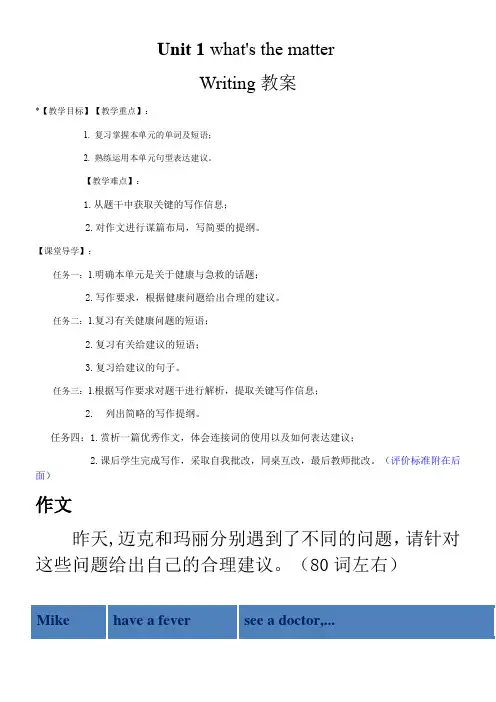
Unit 1 what's the matterWriting教案*【教学目标】【教学重点】:1. 复习掌握本单元的单词及短语;2. 熟练运用本单元句型表达建议。
【教学难点】:1.从题干中获取关键的写作信息;2.对作文进行谋篇布局,写简要的提纲。
【课堂导学】:任务一:1.明确本单元是关于健康与急救的话题;2.写作要求,根据健康问题给出合理的建议。
任务二:1.复习有关健康问题的短语;2.复习有关给建议的短语;3.复习给建议的句子。
任务三:1.根据写作要求对题干进行解析,提取关键写作信息;2.列出简略的写作提纲。
任务四:1.赏析一篇优秀作文,体会连接词的使用以及如何表达建议;2.课后学生完成写作,采取自我批改,同桌互改,最后教师批改。
(评价标准附在后面)作文昨天,迈克和玛丽分别遇到了不同的问题,请针对这些问题给出自己的合理建议。
(80词左右)Mike and Mary had different problems yesterday._________________________________________________________________________________________________ _________________________________________________________________________________________________ _________________________________________________________________________________________________ _________________________________________________________________________________________________ ______________________________________________________________________________________________________________________________________________________________评分表。
人教版初中英语八年级下册Unit1 Whats the matter全单元教案
人教版初中英语八年级下册Unit 1 What’s the matter?Period 1 Section A (1a-2c)Before class: Listen to an English song.Step 1 Warming-up and check what students have learned before class.1. Greet.T: This song is about our bodies. This class , we‟ll talk about something about our bodies—unit 1 together, go. Unit 1 What‟s the matter?2. We have learned the words before class.Present a picture of a girl . Look at the girl. How many...Now, all the No. 3 and No. 4 stand up ,say the words one by one .You can get two marks for each word.4. Work on Section A 1a students say one by one.Look at 1a. Before class, have you finished1a? Let‟s say the answers like this.T:Good job. You are very careful.Step 2 Presentation .1. Just now , we know the words about our bodies . But sometimes our body may get ill. Howdo we ask and answer about illness?Let‟s watch a video. Follow it and do some actions.From the video. We know we can ask “what‟s the matter with you?”and you can answer “I have a ...”.2.T: We also know some illnesses. Here are the new words about the illnesses. Let’s learn ingroup.A.Demonstrate :No 1 read the sentences one by one. The others follow him/ her. When you read ,please do some actions like me.Let me see which group read best and act best.B. Study in groups.C. Find the rules.D. Group report. Stop studying, look at these words , what can you find?You are good at thinking.Step 3 Guessing game:Have you remember the words? Let‟s play a guessing game. No 6 come here.quickly. You each act an action. (边说边发纸条)Each group have chances toguess the illness. The others answer like this: “He /She has a...”Step 4 Work on 1b.1. T: Now, you know some illnesses . Look at the picture .These students ger ill. Show thepictures one by one and ask.What are their names? Let‟s do 1b.How do we do it? For example, we‟ll hear Sarah has a cold, and No 1 has a cold , so write 1 behind Sarah. What about 2, 3, 4 and 5? When you hear the illnesses , write their numbers behind the names.2. Listen.3. Check the answers.Step 5 Group work.1. T: Why do they get ill? Look at the chart, match the reasons with the illnesses.2. Check the answers.3. Demonstrate .Look at the chart. Let‟s talk about their illnesses in pairs. Here is the example.Boys ask , girls answer.4. Look at the chart and make more similar conversations.When you talk , please talk loudly, correctly and politely, please do some actions and use the nice intonations.5. Let students show their conversations.Step 6 Work on 2a and 2b.1. T: David has a stomachache, what should he do?Show the pictures ,ask and answer. 板书What should …do? …should….T: Your advice is very useful. Let‟s learn more advice from 2a and 2b.2. Listen, finish 2a. What‟s the matter with the people? What advice do they get?3. First , guess the answers to 2b. Then listen and check the answers.OK, you have good listening skills.Step 7 Group work.The advice for illness is very useful . It can help us take good care of ourselves and others.T: If some students are ill, will you give some advice and help them? let‟s act andmake conversations. Let me see who is the kind person? How do we talk?Look at the example.2. Show the example.When you talk , please talk loudly, correctly and politely, please do some actions and use the nice intonations.3. Students work.4. Let students show their conversations.Step 8 Summarize and homework:Period 2 Section A 2d,GrammarKnowledge aims:1. The students will be able to learn the words and phrases: take breaks, hurt,2.Summarize the grammar and practice them.3. Target Language:①What‟s the matter with Ben? –He hurt himself./ He has a sore back.②-Do you have a fever? -Yes, I do./ No, I don‟t.③-Does he have a toothache? -Yes, he does.④You shouldn‟t eat so much next time.⑤What should she do?⑥She should take her temperature.⑦-Should I put some medicine on it? -Yes, you should. / No, you shouldn‟t.Structure: ①“should/ shouldn‟t + verb” for suggestion ②Reflexive pronouns. Ability Object:1.Enable students to talk more about health.2.Learn to give others some advice according to their matters.3.Enable the students to do things using the target language and the grammar. Emotion Object:1.Learn to live in a healthy way.2. Learn to take care of others and themselves.Teaching Key Points:1. How to teach the Ss to learn the names of the illness: toothache, fever andheadache.2. How to give others some advice according to their matters.3. The grammar.Teaching Difficult Points:1.How to give advice using should.2. Use the grammar to do things.Teaching Procedures:Step 1 Review.1. Free-talk. What …s the weather like today? If you don‟t wear warm clothes,what will happen?2.Show the pictures and say.He / She has_______________. He /She should___________.Step 2 Work on 2d.1. Game.Do in the same way2. Listen to the conversation and answer my questions .1). What's the matter with Lisa?2). What did Lisa do on the weekend?3). What should Lisa do ?3. Role-play the conversation.First, have students to role-play the conversation in 2d in groups and choose the best.Step 3 Group work.1. Give more examples. Have students read the conversation in 4c.2. and then ask them to work in groups. One student mimes a problem. The otherstudents in his/ her group guess the problem and give their advice.Step 4 Grammar Focus .Have students to read and remember the sentences of Grammar Focus by themselves, and then have them work in groups to sum up how to talk about health problems and give right advice.Step5 Work on 4a.Ask students to go through each conversation in 4a quickly, and then complete the conversations individually. Move around the classroom and help them if necessary.Check the answers.Ask some students to practice every conversation in pairs.Step 6 Work on 4b.Have students choose and circle best advice for the health problems in 4b. Then ask students add their own advice about these health problems.Have some students to report their own advice in class.Step 7 Summary.Health problems and give right advice.Ask one or two students to sum up the key phrases in the passage, and help them to make up more sentences with them.Step 8 Homework .Have students make up conversations to talk about sb.‟s health problems and give them some advice.Period 3 Section A 3aKnowledge aims:The students will be able to learn the words and phrases: passenger, get off, to one‟s surprise, onto, trouble, hit, right away, get into.2.The students will be able to use the expressions:The driver didn‟t think about thinking about himself. He only thought about saving a life. Ability aims:The students can understand the passage.2.To train the students‟ cooperation with their partners.Emotional aims:To train the students to care about others and help others who are on trouble..Teaching important points:The students can understand the passage and use the useful expressions freely.Teaching difficult points:The students can learn from the drivers and do as the driver does if possible.Teaching procedures:Step 1 Warming-up and lead-in.1. Watch a video.2. What is the short sketch about?3.Look at the picture. What can you see? Can you guess what is happening?Step 2 Preparing reading.1. Guess the main idea.What is this passage mainly about?Strategy : The title and pictures can be helpful to understand the text.Title may be the main meaning of the article.2. Read the passage. Do you think it comes from a newspaper or a book?Step 3 While-reading.1.Find the topic sentence(中心句)of each paragraph.1). At 9:00 a.m. yesterday, bus No. 26 was going along Zhanghua Road when the driver sawan old man lying on the side of the road.2). Some passengers helped Mr. Wang to move the man onto the bus.3). Thanks to Mr. Wang and the passengers, the doctors saved the man in time.2. Which sentences touched you? Read them in the way that you like.Step 4 Post-reading.1. Praise the persons.What a great person the driver was!He stopped the bus without thinking twice, when he saw an old man lying on the side of the road.What _______ the _____ was/were!2. Work on 3bAfter checking the answers, have Ss scan the passage and check (√) the things that happened in the story.3. Work on 3c.T: Ask the students to discuss the questions in pairs.Step5 Homework.1. If you are the driver, write a diary about what happened yesterday.2. If you are the passenger, write a diary about what happened yesterday.3. Act the story out in your group.4. Read some messages about good men.Period 4 Section B 1a-1dStep 1 Lead –in and learn the new words.It‟s a beautiful song, I like it very much. Let‟s learn the new words.1. Who can be the teacher? One student teach one word.2. Let’s sing and remember the new words.The teacher teaches to sing, ask some group to sing. Finally sing together.(可以课前教唱,。
人教新目标八年级英语下册教案:Unit 1 What's the matter教案
八年级下册Unit1 What’s the matter?第一课时1a-2d教学设计一、教学目标:1、知识目标单词:运用下列词汇throat, stomach, stomachache, fever, headache表述健康问题。
词组:熟练运用have a fever, have a stomachache , have a headachehave a sore throat, take one's temperature, lie down就健康问题给出合理建议。
句子:运用What’s the matter …? What should she do? 句型在日常生活中进行交流。
2、能力目标培养学生能运用所学语言简单的描述自己的健康状况及如何询问对方的身体健康状况。
提高听、说、读、写的综合能力。
3、情感目标学会关心关爱他人,通过询问他人的健康情况并能给予帮助,增进人与人之间的感情。
二、教学重点、难点重点:学习人体各个部位的名称及如何询问和回答身体的健康状况。
难点:句型“What’s the matter?/ What’s wrong?” “I have a …”在实际生活中的应用。
三、教学准备多媒体课件、微视频、单词卡、医用隔离衣、听诊器、体温计等。
四、教学过程第一教学环节:欣赏英文歌曲“If you are happy…”导入新课。
教师活动学生活动学生学习效果评测工具和方法1.学生的课前报告。
2.播放歌曲“If you are happy…”让同学跟着音乐做动作,活跃气氛,使课堂充满生机与活力,同时让学生产生悬念,这节课将会学习关于怎样1.针对学生的课前报告,进行提问。
2.欣赏歌曲“If you arehappy…”学生能听懂课前报告,并能对相关问题进行提问。
学生伴着音乐边唱边做动作。
的知识?第二教学环节:结合自己的肢体来复习、学习身体部位的单词,以游戏的形式巩固单词。
利用微视频学习使用sore、-ache表达伤病名称。
人教新目标八年级英语下册教案Unit1Whatsthemat教案
Unit1 What’s the matter?复习课教学设计一、设计背景初中英语升学考试所涉及的知识面广,因而复习时需要扎扎实实打好基础,对课本的复习可以说是以“地毯式”搜捕的方式进行的。
教师要在有限的时间内完成如此大容量的复习任务,就必须要想方设法提高复习效率,让学生的复习取得事半功倍的效果。
我在复习中采用“知识递进式”复习法,用话题带动词句的使用,注重知识的综合运用。
二、设计理念本课是以“problems and advice”为话题的复习课,课堂上把主动权交给学生,以听说训练为主线,通过看、听、说、写等一系列教学活动,让学生运用所学知识来完成单词拼写、即时翻译短语、小组合作翻译句子,定时背诵语篇。
使学生获得最基本的英语听、说、读、写能力,并在教学中充分激发学生强烈的学习愿望。
在注重学生知识能力发展的同时,注重提高学生的人格修养,学会关心别人,帮助别人,达到培养学生互助的德育教育的目的。
三、教学目标设计用具体、明确、可操作的行为语言,描述本课的知识、技能、能力、方法、情感、态度、价值观等方面的教学目标。
Objectives: By the end of the session, most students will be better able to acquire the required information. This will be achieved by:1.Knowledge Objectives:1)Be able to master the pronunciation, meaning and spelling of the names of diseases: fever, sore throat, sore back; stomachache, headache, toothache, cold, cough;2) Be able to learn the expressions of giving advice: lie down and rest, drink hot tea with honey, see a dentist, take this medicine;3) Be able to talk about health problems by using “What’s the matter? I have a …” and give advice by using “You should…You shouldn’t…”2. Ability Objectives:1) Be able to talk about one’s health problems and give advice fluently;2) Be able to role play doctor and patient;3. Moral Objectives:1) Improve the cooperative spirit through pair work and role playing2) Care more about yourself and your family members’ health.四、教学重点难点设计由于本节课的话题是谈论健康,根据教学大纲的要求,学生需掌握有关疾病的单词,并能针对疾病提出合理的建议。
人教版八年级英语下册Unit 1 What’s the matter 教案
Unit 1 What’s the matter 教案目标确定的依据1.课程标准相关要求课程标准四级目标要求八年级学生能听懂熟悉话题的简单语段,能引出话题并进行交谈,能在教师的帮助下或根据简单的语音描述自己的经历。
2.教材分析本单元是改版后的八年级下册英语教材的第一个单元。
主要讨论的话题是询问某人的健康状况以及遇到麻烦的表达方法,本单元涉及到大量的表示人体部位的单词以及关于身体某部位不舒服的短语,并会根据不同的病情提出合理化的建议。
3.学情分析学生在小学阶段初步了解了一些人体部位的英文名称,但大部分学生仅能认识和听懂这些名称,不能准确发音和拼写。
本节课主要是对事故及事故伤害的询问及问答,并利用情态动词should提出建议。
目标1.识记本节课所学新单词的读音及拼写。
2.听录音,提取主要信息,学生初步运用下列句型进行对话What’s the matter with…?What should I/ you/ he/ she/they…do? I/ you/ he/ she/they should do…I/You/He/She/They have a headache/stomachache/fever.3.通过角色扮演,灵活应用所学词汇和句型进行简单的口语交际。
评价任务1.识记人体部位的英文名称。
2.运用What’s t he matter with…?I/You/He/She/They have aheadache/stomachache/fever. What should I/ you/ he/ she/they…do?等句型进行简单问答。
3.以角色扮演形式,对事故及事故伤害的询问及问答,并利用情态动词should提出建议。
教学过程:学习目标教学环节教学活动评价要点目标1:识记本节课所学新单词的读音及拼写(8分钟)环节一识记身体部位的英文名称活动1:看视频,图片识记身体部位的英文名称活动2:检测小组4号学生本节课所学新单词的拼写1.单词发音能否基本正确2.单词拼写能否全部掌握目标2:听录音,提取主要信息,学生初步运用下列句型进行对话(15分钟)What’s the matter with …?What should I/ you/ he/ she/they…do? 环节二听录音,取主要信息环节三模仿录音,两人运用句型谈论病情活动3:听录音,提取主要信息,完成听力练习。
人教版八年级下册第一单元Unit1What's the matter 教案
新目标八年级下Unit1 What’s the matter?Period1(sectionA)第一课时一、[教材分析]本单元的话题是健康问题,健康是一切活动的保障,本节课的话题出自Unit1 What’s the matter?(sectionA),主要让学生认知表示身体部位的单词以及部分疾病的表达方法,学会谈论自己及他人的健康状况,能针对健康问题提出合理化建议。
在具体教学中我对教材内容进行了整合,删除了材料中的听力部分,将其用图片的形式展示出来以保持课堂的完整性。
我还对教材做了适当的修改和扩充,使内容更贴近生活,让学生有更多的发挥空间。
二、[学情分析]八年级的学生具有过渡性和动荡性的心理特点,处于两极分化的突出时候,学生差异较大,因此在任务设计上我注重分层,面向全体,充分调动每个学生的积极性。
但由于这个阶段的学生活泼好动,好奇心较强,再加上本节课又是他们从未接触过的有关健康的话题,所以在课堂设计上我十分注意生动活泼但不幼稚,发扬传统但不古板。
三、[教学目标分析]1、Knowledge Objectives(知识目标)(1) Be able to master the pronunciation,meaning and spelling of the names of body parts and diseases.(2) Be able to learn the expressions of giving advice.(3) Be able to talk about health problems by using “What’s the matter? I have a……” and give advice by using “You should ……You shouldn’t……”2、Ability Objectives(能力目标)(1) Be able to talk about one’s health problems and give advice fluently(2) Be able to role play doctor and patient3、Moral Objectives(情感态度目标)(1) Improve the cooperative spirit through pair work and role playing(2) Care more about yourself and others’ health四、[重难点设计]由于本节课的话题是谈论健康,根据课标要求,学生需掌握有关疾病的单词,并能针对疾病提出合理化建议,因此本节课的教学重点设计如下:The teaching focus:1、Master the names of diseases.2、Master the expressions of giving advice3、Talk about health problems by using “What’s the matter? I have a……” and give advice by using “You should ……You shouldn’t……”本节课的话题学生以前接触较少,知识储量有限,让他们在较短的时间内掌握较多的新单词有一定难度,再者,由于学生生活经验的限制,在谈论如何给出合适建议时会出现一定的困难。