
人教版高中英语必修四 unit 4 reading 课件
3. From the passage we know, most international students greet others by ______. A. shaking hands B. bowing C. kissing D. touching shoulders
4. Which of the following is true?
(3).Japanese will bow to others as greeting. ( T)
(4). People from Jordan will move very close to you as you introduce yourself to them. (T)
(5). People from Jordan will shake hands with a woman as she introduces herself to them. ( F) (6). Some body languages in some countries are good while some countries’ body language are bad. (F) (7). People from different countries may have a major misunderstanding while greeting each other. ( T) (8). The physical distance from each other that people are comfortable with generally depends on the culture. (T) (9). All members of a culture behave in the same way. ( F)
woman from France shake hands people she and kiss twice on each knows cheek
Scanning: Read
the passage again and finish--Task 1 Try to divide the whole passage into four parts and match the main idea. Part 1. A.Examples of cultural (para. 1) “_____________________ ”. body language Part 2 (para. 2 &3 ) Part 3. (para. 4 ) B.Different people have different________________ body languages . C.Summary of______________ body language . D.The author was sent (went) to ________________________ the Capital International Airport to meet this year’s international students.
cultural differences well, people may have
communicating (交流) with others difficulties in________________
throughout the world.
Post-reading
Disuss and answer the following question
Name
Description Tony Garcia
Body Language
To Whom
man from Colombia
kiss on the cheek
everyone
Julia woman Smith from Britain no touching everyone Akira man from Nagata Japan bowing everyone
stand, are different kinds of body language.
Reading
Fast reading
Read the passage in P26 as quickly as you can, anaswer the questions: How many international students are there in the story? Who are they and where do they come from? How do they greet each other? Complete the chart with information from the passage in P27
Ahmed Aziz The third group “You” from (China)
He moves very _________to you and close shakes your hand _______________.
move back You ___________ a bit.
A. French people often greet people by kissing each other on both cheeks. B. All people around the world now greet people by shaking hands. C. People from Britain and from South American countries seem to prefer to keep more physical distance from others.
Name Description George Cook Ahmed Aziz Darlene Coulon man from Canada
Body Language shaking hands
To Whom
everyone
to men man from shaking hands nodding to women Jordan
D. Not knowing foreign customs may cause a cultural mistake.
Conclusion:
This text mainly talks about that different countries/cultures/ boby ________________have different ________language.
people
So we should pay attention to : Different countries have ___________( different 不同) cultures,
when people greet each other, they will have
ways 方式). If people don’t know the different_______(
Is the author of this passage male or female? How do you know? The author is male. Ahmed Aziz will not shake hands with women, but he shakes hands with the author.
Body language is one form of nonverbal
communication ______________(交流) without using
words. Eye contact or gaze(注视),
expression facial____________, gestures, and __________ (姿势), or the way you posture
a Japanese The second group George Cook from (Canada)
He ________ bows to Mr. Cook and his nose touches Mr. _________ moving Cook’s _______ ________. hand He ________ reaches ________ _______ his hand ________ to the out Japahe passage carefully , discuss and choose the correct
answers
1. What does the text mainly talk about?
A. Two university students meet the international students in the airport. B. Men and women use different body languages in foreign countries. C. Different cultures have different body languages. D. There are different kinds of cultures in the world.
Revision
Ways of communicating
speaking Spoken language ringing Written language typing writing
facial expression Body gesture language action
What is body language?
Task 3:Decide if the following statements are
true (T) or false (F).
合集下载
人教版高中英语必修四 Unit4 Body Language reading 课件
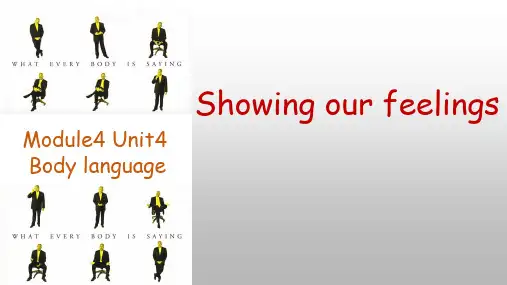
Para1 Body language is one of the most powerful means of communication, often even more powerful than spoken language. People around the world show all kinds of feelings, wishes and attitudes that they might never speak aloud. It is possible to "read" others around us, even if they do not intend for us to catch their unspoken communication. Of course, body language can be misread, but many gestures and actions are universal.
but many gestures and actions are universal. Para7 With so many cultural differences between people, it is great
to have some similarities in body language. We can often be wrong about each other, so it is an amazing thing that we understand each other as well as we do!
Para7 With so many cultural differences between people, it is great to have some similarities in body language. We can often be wrong about each other, so it is an amazing thing that we understand each other as well as we do!
人教版高中英语选择性必修第四册unit4复习课件
巩固内化2
指出下列句子中画线部分所作的成分。
1. This is a subject worthy of careful study. 作 __定__语_____ 2. Our English teacher is very nice and patient. 作 _表__语_____
3. I found it very hard to get along with foreigners. 作宾__语__补__足__语_
4.ripe adj.成熟的;时机成熟的 →ripen vt.& vi.(使)成熟 5.disabled adj.有残疾的;丧失能力的 →disability n.缺陷;障碍 →disable vt.使(某人)残废;使……无能 6.deserve vt.值得;应得;应受 →deserving adj.值得的;应得的
读后续写之手的肢体动作:drag/draw/pull拉;cup one’s hands over... 把手窝成杯状;slide one’s hands into...将手伸进……;put one’s hands to one’s cheeks用双手捂住脸;spread one’s hands摊开双手
3 deserve vi.& vt.应受;应得;值得(deserving adj.值得的;应得的)
deserve sth. 值得/应得某事/物 deserve doing/to be done值得被……(此处用动名词的主动形式表示被动 意义,类似用法的动词还有:need,want,require等) deserve it(口语)活该;自作自受
合作探究1
指出下列句子中画线名词短语所作的句子成分,并注意其组成。 1. These ideas may seem strange to you. 作 __主__语__ 2. We love our great motherland very much. 作 __宾__语__ 3. The man wearing a black coat is our teacher. 作__表__语_
指出下列句子中画线部分所作的成分。
1. This is a subject worthy of careful study. 作 __定__语_____ 2. Our English teacher is very nice and patient. 作 _表__语_____
3. I found it very hard to get along with foreigners. 作宾__语__补__足__语_
4.ripe adj.成熟的;时机成熟的 →ripen vt.& vi.(使)成熟 5.disabled adj.有残疾的;丧失能力的 →disability n.缺陷;障碍 →disable vt.使(某人)残废;使……无能 6.deserve vt.值得;应得;应受 →deserving adj.值得的;应得的
读后续写之手的肢体动作:drag/draw/pull拉;cup one’s hands over... 把手窝成杯状;slide one’s hands into...将手伸进……;put one’s hands to one’s cheeks用双手捂住脸;spread one’s hands摊开双手
3 deserve vi.& vt.应受;应得;值得(deserving adj.值得的;应得的)
deserve sth. 值得/应得某事/物 deserve doing/to be done值得被……(此处用动名词的主动形式表示被动 意义,类似用法的动词还有:need,want,require等) deserve it(口语)活该;自作自受
合作探究1
指出下列句子中画线名词短语所作的句子成分,并注意其组成。 1. These ideas may seem strange to you. 作 __主__语__ 2. We love our great motherland very much. 作 __宾__语__ 3. The man wearing a black coat is our teacher. 作__表__语_
新课标人教版高中英语必修四 Unit 4 Body language-communication no problemReading课件

puzzling/confused amazing/surpried
crazy/very sad/unhappy
What do these faces mean?
grievous/sad complaint
happy/shy
What do these faces mean?
amusing/happy laugh at
(para. 5)
students
• Careful reading para1
• Judge the following sentences T or F
• 1. Yesterday, another student and I, representing our university's student association, went to the Capital International Airport to meet this year's international students. T
__g_e_s_tu_r_e_s_, and__p_o_s_t_u_r_e_s_,
or the
ways you stand, are different kinds of body
language.
Let's play game !
• guess
what is he/she doing ?
Some body languages are different in different countries.
1. Is the author of this passage a man or a woman? How do you know?
A man Ahmed Aziz did not shake hands with women, but he shook with the author.
人教版高中英语选择性必修第四册精品课件 Unit 4 SHARING Section A

We left the village the next morning after many goodbyes and firm 9.__h_an_d_s_h_a_k_e_s_ (handshake).My muscles were aching as we dragged 10.__o_u_rs_e_l_v_e_s_ (we) down the mountain towards home.
Activity 2 Read the text again and match each paragraph with its main idea. Para.1 A.The hard trip to Tombe’s village. Para.2 B.The learning conditions in the school. Para.3 C.The bush school for local students. Para.4 D.Feeling nice to get mail. Para.5 E.The dinner in Tombe’s home. Para.6 F.Their belief about leftover food. Para.7 G.The feeling about the trip. Para.8 H.Tombe’s housing.
3.Why did Tombe throw out of the tin can? A.Because he hated the leftover food. B√.Because he believed leftovers attracted evil spirits. C.Because he believed the can had no use at all. D.Because this is a way for people in Papua New Guinea to store leftovers. 4.How did Jo feel after the visit to Tombe’s family? √A.Happy. B.Sad. C.Worried. D.Upset.
Activity 2 Read the text again and match each paragraph with its main idea. Para.1 A.The hard trip to Tombe’s village. Para.2 B.The learning conditions in the school. Para.3 C.The bush school for local students. Para.4 D.Feeling nice to get mail. Para.5 E.The dinner in Tombe’s home. Para.6 F.Their belief about leftover food. Para.7 G.The feeling about the trip. Para.8 H.Tombe’s housing.
3.Why did Tombe throw out of the tin can? A.Because he hated the leftover food. B√.Because he believed leftovers attracted evil spirits. C.Because he believed the can had no use at all. D.Because this is a way for people in Papua New Guinea to store leftovers. 4.How did Jo feel after the visit to Tombe’s family? √A.Happy. B.Sad. C.Worried. D.Upset.
高中英语人教版必修四unit4_Body_language-reading公开课课件ppt课件
Part 3: (Para 4 )
Part 4: (Para 5)
D) Examples of learned or cultural “body language”.
Matching the people and the different ways of greeting (para2&5)
Tony Garcia (Columbia) Julia Smith (Britain) Akira Nagata (Japan) George Cook (Canada)
Careful reading :
shakes hands and kisses others twice on each cheek Bows
shakes hands approaches others closely and touches their shoulder and kisses them on the cheek does not stand very close to others or touch strangers
Columbia
Britain
Julia Smith
George Cook Akira Nagata
Canada
Japan Jordan
Ahmed Aziz
Darlene Coulon
You
France China
Fast reading:
Which is the main idea of the text?
reading
Come here !
Good ! / Great !
“No,You can not do that"
OK
• She is deaf and dump, so body languagee.
【课件】Unit+4Reading+and+Thinking+课件人教版(2019)选择性必修第四册
ralian, Jo, worked for two years as a volunteer teacher in Papua New Guinea. What challenges do you think she might have faced?
_t_h_e__va_l_le_y__below
Upon reaching Tombe's mother Crying “ieee ieee”
All the villagers Shaking hands with us; Everyone seemed to be related to Tombe.
Are you willing to go to a bush school?
Para 3. Facilities and Challenges
What do students have as learning tools and what do they lack of?
What they have
—— Sam Levenson
当你再成熟有担当一点后,你会发现 你有两只手,一只用来助己,另一只 用来助人。
After reading:think and share
Discuss in groups:
1. Would you like to become a volunteer teacher like Jo?Why or why not? 2. What would you like to share when volunteering? (list at least three points)
Activity 4:Detailed reading
Para 1. A Parcel from Home
_t_h_e__va_l_le_y__below
Upon reaching Tombe's mother Crying “ieee ieee”
All the villagers Shaking hands with us; Everyone seemed to be related to Tombe.
Are you willing to go to a bush school?
Para 3. Facilities and Challenges
What do students have as learning tools and what do they lack of?
What they have
—— Sam Levenson
当你再成熟有担当一点后,你会发现 你有两只手,一只用来助己,另一只 用来助人。
After reading:think and share
Discuss in groups:
1. Would you like to become a volunteer teacher like Jo?Why or why not? 2. What would you like to share when volunteering? (list at least three points)
Activity 4:Detailed reading
Para 1. A Parcel from Home
【单元课件】人教版(2019)新教材高中英语选择性必修第四册第四单元词汇学习PPT
1)I just got a parcel from home! 2)There is a parcel of clothing and
some letters for you. 3)She has parcelled up all the books
on the bookshelf.
jam
traffic jam
1)The teachers, not to mention the students, were confused about the maths problem.
2)He has two big houses in this country, not to mention his villa(别墅) in France.
2. jam [dʒæm]: n. 果酱; 堵塞 a traffic jam: 交通堵塞; 堵车
1)It was so nice to get some sweets and jam from home.
2)The fruit can be made into jam. 3)Her car was delayed in
a three-mile traffic jam. 4)We were stuck in a traffic jam
yesterday morning.
3. mail [meɪl]: n. 邮件; 信件; 邮政 (US)
vt. 邮寄; 发电邮给
post : n. 邮政; 邮递; 邮寄; 邮件 (UK)
3)All other considerations are secondary to his safety.
4)Raising animals was only secondary to other forms of farming.
Unit4单词课件-2022-2023学年高中英语人教版(2019)选择性必修第四册
新人教选择性必修四
Unit 04 Sharing
Words and Expressions
Important words
1. dusty adj.布满灰尘的 【教单击材此原处编句辑】母版标题样式
It takes me only a few minutes to walk to school down a dusty track covered in wee单d击s.此第我处二只编级辑要母版几文分本样钟式就走到学校,路上尘土飞扬,杂草丛生。
anyw单a击y此第.有处二编级时辑候母版,文我本样真式想知道,化学对这些学生究竟有多大用处,很少有人
会成为化学第三家级,并且他们中的大多数人学完八年级以后就要回到他们的村
庄去了。
第四级 第五级
【实例品读】 We have passed all relevanBt. information on to the police.
mou单nt击a此in处f编ro辑m母版w文he本r样e 式we had fantastic views,and then down a shaded path to the valle第y二b第级e三lo级w. 我和另外一个第老四级师走了两个半小时才到了那儿——先爬到了一座山的山顶 ,从那儿我们欣第赏五到级 了优美的风景,然后又沿着一条阴凉的小路下到下面
第二级
the rain ou第t三. 级
第四级
【实例品读】 第五级 She pulled out the plug and let the water drain away. 她拔起塞子放掉了水。 B.
2023/4/15
14
【热点归纳】 plug单击so此m处e编th辑i母n版g 标o题n样T式V 做电视广告
Unit 04 Sharing
Words and Expressions
Important words
1. dusty adj.布满灰尘的 【教单击材此原处编句辑】母版标题样式
It takes me only a few minutes to walk to school down a dusty track covered in wee单d击s.此第我处二只编级辑要母版几文分本样钟式就走到学校,路上尘土飞扬,杂草丛生。
anyw单a击y此第.有处二编级时辑候母版,文我本样真式想知道,化学对这些学生究竟有多大用处,很少有人
会成为化学第三家级,并且他们中的大多数人学完八年级以后就要回到他们的村
庄去了。
第四级 第五级
【实例品读】 We have passed all relevanBt. information on to the police.
mou单nt击a此in处f编ro辑m母版w文he本r样e 式we had fantastic views,and then down a shaded path to the valle第y二b第级e三lo级w. 我和另外一个第老四级师走了两个半小时才到了那儿——先爬到了一座山的山顶 ,从那儿我们欣第赏五到级 了优美的风景,然后又沿着一条阴凉的小路下到下面
第二级
the rain ou第t三. 级
第四级
【实例品读】 第五级 She pulled out the plug and let the water drain away. 她拔起塞子放掉了水。 B.
2023/4/15
14
【热点归纳】 plug单击so此m处e编th辑i母n版g 标o题n样T式V 做电视广告
Unit 4 Reading for Writing语言点(课件)高中英语人教版选择性必修第四册
when taking a test.
14
5. Today, I want to relay to you that I'm proud of the work my mother has done, and I am now supportive of it.
今天我想告诉你们的是,我为我妈妈所做的工作感到骄傲,我现在也
我母亲还到农村巡 回治疗,帮助残疾人,为当地医生提供咨询和 培训。
n. 咨询;咨询会
consult vt.咨询;请教;查阅;商量 ✓concosunlstualnttsbn.. a顾b问ou;t/高on级s顾th问. 关医于师某,事会请诊教医/师咨;询咨某询人者 ✓ consult with sb about/on sth. 与某人协商某事 ✓ consult the dictionary 查字典 ✓ consult....for... 为······查阅(词典、参考书等)
is wet.
③ ____A__s____it was late, we came back soon. ④ We can't go out______b_e_c_a_u_s_e_____ it is too cold.
单句语法填空 Exercise
1. She__h_a_s_r_e_tu_r_n_e_d__(return) from India lately.
我们都想当然地认为他们已经完成了他们的任务。
3) Human beings __to_o__k_it__fo_r_g_r_a_n_t_e_d__ (以为它理所当然) that their brains held all the solutions, but maybe their hearts can be a better guide.(2019江苏高考)
14
5. Today, I want to relay to you that I'm proud of the work my mother has done, and I am now supportive of it.
今天我想告诉你们的是,我为我妈妈所做的工作感到骄傲,我现在也
我母亲还到农村巡 回治疗,帮助残疾人,为当地医生提供咨询和 培训。
n. 咨询;咨询会
consult vt.咨询;请教;查阅;商量 ✓concosunlstualnttsbn.. a顾b问ou;t/高on级s顾th问. 关医于师某,事会请诊教医/师咨;询咨某询人者 ✓ consult with sb about/on sth. 与某人协商某事 ✓ consult the dictionary 查字典 ✓ consult....for... 为······查阅(词典、参考书等)
is wet.
③ ____A__s____it was late, we came back soon. ④ We can't go out______b_e_c_a_u_s_e_____ it is too cold.
单句语法填空 Exercise
1. She__h_a_s_r_e_tu_r_n_e_d__(return) from India lately.
我们都想当然地认为他们已经完成了他们的任务。
3) Human beings __to_o__k_it__fo_r_g_r_a_n_t_e_d__ (以为它理所当然) that their brains held all the solutions, but maybe their hearts can be a better guide.(2019江苏高考)
新课标人教版必修四Book4 Unit4 Reading
Ways to greet each other Approach others closely and are more likely to touch them. Shake hands, do not stand very close to others or touch strangers when they meet. Bow Shake hands. Shake hands and stand quite close to other men. Nod to women but do not shake hands with them.
我的课堂我做主
Assignment(任务分配)
Group1. → Question (3,4). Group2. → Question (5). Group3. → Question (1). Group4. → Question (2). Group5. → Question (6). Group6. → Question (7).
Japan: bow
Some western countries: hug
Russia, France, Arab: kiss
Reading
Communication:
No problem?
Learning aims
• 1、To learn some new words and phrases. • 2、To know different body languages represent different meanings. • 3、To respect other country’s body languages.
Why do we need to study body language?