
外研版七年级英语下册 module 11 Unit 3
Do’s Britain Stand in line. Shake hands. Say “please” and “thank you”. Open doors for others. Look at people when you talk. Be on time.
Don’ts Touch people. Ask a woman’s age. Stand too close. Say anything too personal.
4. You cannot bring food or drink into
the lab.
Don’t bring food or drink into the
lab.
5. You cannot enter the lab alone.
Don’t enter the lab alone.
Answer the questions. Use the words and expressions from the box to help you. all right different point at arm in arm close hold on to kiss three times shake hands with wave
Choose the correct answers. 1. ___ stand too close to North
Americans. A. Do B. You C. Don’t 2. Don’t ____ to say goodbye in Greece.
A. wave
B. to wave
C. waves
祈使句。
e.g. No smoking! 禁止吸烟!
No fishing! 禁止钓鱼!
In China, people greet with each other with head nodding, smile, hand shaking, hug and so on. People kiss each other in public between males and females, which only happens between lovers and couples in private in China. People wave to say goodbye.
祈使句
定义:用于表达命令、请求、劝告、警
告、禁止等的句子叫做祈使句。
祈使句因对象(即主语)是第二人称,所
以通常都省略。祈使句的动词都为一般现
在时,句末则使用句号来表示结束。
用客气的语气表示祈使句时,可在句
首或句尾加上 please,但如果在句尾加
please,那在 please 之前一定要加一个
Complete the sentences. 1. It’s an important meeting. _______ Don’t _____ be (not, be) late. 2. ______ Don’t ______ make (not, make) any noise! Your mother is sleeping. 3. ______ Don’t ______ speak (not, speak) with your mouth full of food and ______ be (be) polite.
5. Is it all right to wave goodbye in Greece? No, it isn’t. 6. How do you usually say goodbye with body language? I wave my hand.
The Japanese bow In Japan, people bow to say “thank you”, “sorry”, “ hello”, “goodbye”, “you’re welcome”, “excuse me” and many other things. Children and young people bow lower when they greet older people. It’s a way of being polite and showing respect.
Stand in line. Don’t touch people when you talk to them. …
Rewrite the sentences. For example: It’s important to listen to the teacher.
Listen to the teacher. You cannot shout in the classroom.
逗号“,”。
肯定结构:
1. Do 型 (即: 动词原形 + 宾语 + 其
பைடு நூலகம்
它成分)。
e.g. Please have a seat here. 请这边坐。
有的祈使句在意思明确的情况下, 动词可
省略。 e.g. This way, please. = Go this way, please.
2. Be 型 (即: Be + 表语 (名词或形容词 + 其它成分)。 e.g. Be a good boy! 要做一个好孩子!
v. bring 的过去式, 带来
Complete the sentences.
1. _____ Give them more personal space. 2. ______ Wave to say goodbye.
Be careful! 3. _____
4. ______ Don’t stand too close to North Americans.
Body language in China
In China, people greet with each other with head nodding, smile, hand shaking, hug and so on. People kiss each other in public between males and females, which only happens between lovers and couples in private in China. People wave to say goodbye.
______ catch (catch) a cold.
7. No _________. parking (park)
Make a poster about body language in America.
Be quite. 安静。
Be careful! 小心!
否定结构:
1. Do 型和 Be 型的否定式都是在句首
加 don’t 构成。
e.g. Don’t forget me! 不要忘记我!
Don’t be late for school!
上学不要迟到!
2. 有些可用 no 开头, 用来表示禁止性的
4. ______ Give (give) us ten years and just
see what our country will be like.
5. __________ Don’t let (not, let) the baby cry.
6. Wear more clothes or you _____ will
Don’t shout in the classroom.
1. It’s important to be careful. Be careful. 2. It’s important to clean and tidy the lab. Clean and tidy the lab. 3. You cannot touch anything if the teacher doesn’t ask you to. Don’t touch anything if the teacher doesn’t ask you to.
3. It’s polite to stand ___ line in a foreign country. A. at B. to C. in 4. Our Chinese sometimes hold on ____ someone’s hands when talking. A. to B. at C. in 5. We often shake hands ____ others when talking. A. from B. in C. with
Stand in line.
Be polite to the teacher.
Stand up when you answer a question in class.
Don’t eat food in class.
Don’t touch others in class.
She brought me some candy.
1. How do the British say hello to each other when they first meet? They shake hands with each other.
2. Does body language mean the same thing in different countries? No, it doesn’t. 3. How do the Russians say hello to each other when they meet? They usually kiss three times. 4. Is it polite to stand close to North Americans? No, it isn’t.
合集下载
外研英语七年级下册Module11 Unit3(共27张PPT)
If you're happy and you know it,clap your hands (clap, clap). If you're happy and you know it clap your hands. (clap, clap). If you're happy and you know it, never be afriad to show it. If you're happy and you know it, clap your hands. (clap, clap).
In China
people shake hands and smile,sometimes nod heads.
Which country may use these body language?
In Russia
people usually kiss three times, left, right, left.
Now work in pairs and check.
— Are they Russian? — Yes, they are. — What are they doing? — They’re shaking hands.
Task 5
We’ll see which 1. All students read the dialogue
Listen to a song
If you are happy
Sing it and do it together.
If you're happy and you know it,clap your hands (clap, clap). If you're happy and you know it clap your hands. (clap, clap). If you're happy and you know it, never be afriad to show it. If you're happy and you know it, clap your hands. (clap, clap).
In China
people shake hands and smile,sometimes nod heads.
Which country may use these body language?
In Russia
people usually kiss three times, left, right, left.
Now work in pairs and check.
— Are they Russian? — Yes, they are. — What are they doing? — They’re shaking hands.
Task 5
We’ll see which 1. All students read the dialogue
Listen to a song
If you are happy
Sing it and do it together.
If you're happy and you know it,clap your hands (clap, clap). If you're happy and you know it clap your hands. (clap, clap). If you're happy and you know it, never be afriad to show it. If you're happy and you know it, clap your hands. (clap, clap).
Module 11-Unit3课件 七年级英语下册课件(外研版)
5. Is it all right to wave goodbye in Greece?
6. How do you usually say goodbye with body language?
Around the world
The Japanese bow In Japan, people bow to say “thank you”, “sorry”, “hello”, “goodbye”, “you’re welcome”, “excuse me” and many other things. Children and young people bow lower when they greet older people. It’s a way of being polite and showing respect.
2. Does body language mean the same thing in different countries?
3. How do the Russians say hello to each other when they meet?
Activity 4
Answer the questions. 4. Is it polite to stand close to North Americans?
祈使句
Look and say!Do 型: _动__词___原__形___+_其___他
Turn left! Turn right! Go upstairs!
祈使句
Look and say! Be 型: B__e_+_表__语__(__a_d_j_.等__)
Be quiet!
Be polite!
6. How do you usually say goodbye with body language?
Around the world
The Japanese bow In Japan, people bow to say “thank you”, “sorry”, “hello”, “goodbye”, “you’re welcome”, “excuse me” and many other things. Children and young people bow lower when they greet older people. It’s a way of being polite and showing respect.
2. Does body language mean the same thing in different countries?
3. How do the Russians say hello to each other when they meet?
Activity 4
Answer the questions. 4. Is it polite to stand close to North Americans?
祈使句
Look and say!Do 型: _动__词___原__形___+_其___他
Turn left! Turn right! Go upstairs!
祈使句
Look and say! Be 型: B__e_+_表__语__(__a_d_j_.等__)
Be quiet!
Be polite!
外研英语七年级下册Module11 Unit3(共15张PPT)
2. Liaison 连读 [liˈeɪzn]
n^od our he^ads
3.Pronunciation语音
Maori Russian India
[ˈmaʊri:] [ˈrʌʃn] ['ɪndɪə]
retell
Countries people do different things when they meet
kiss
smile
nod
hug
touch
people in different countri
do different things
Chinese American Russian
when they meet.
Japanese Indian
Maori
Shake hands and smile
C_h_i_n_e_s_e__p_e_o_p_le_shake hands and smile when they meet.
6. If you meet your friend in New Zealand, what should
you do ? Touch noses
touch noses
listen and read---iii 1. stress 重读
We’re ^going to have some^Russian t^eachers at ^school t^omorrow.
oChtuhtogeur cehFancpohustehosatnhdesr
together
5. Do Indians put their hands together and
nod their heads when they meet?
n^od our he^ads
3.Pronunciation语音
Maori Russian India
[ˈmaʊri:] [ˈrʌʃn] ['ɪndɪə]
retell
Countries people do different things when they meet
kiss
smile
nod
hug
touch
people in different countri
do different things
Chinese American Russian
when they meet.
Japanese Indian
Maori
Shake hands and smile
C_h_i_n_e_s_e__p_e_o_p_le_shake hands and smile when they meet.
6. If you meet your friend in New Zealand, what should
you do ? Touch noses
touch noses
listen and read---iii 1. stress 重读
We’re ^going to have some^Russian t^eachers at ^school t^omorrow.
oChtuhtogeur cehFancpohustehosatnhdesr
together
5. Do Indians put their hands together and
nod their heads when they meet?
2021年外研版七年级英语下册Module11 Unit3 精品课件
all right arm in arm close different hold onto kiss three times point at shake hands with wave
1.How do the British say hello to each other when they first meet? They shake hands with each other.
eg: Please close the door. 请把门关上。
Sit down, please. 请坐。
三、祈使句的结构: ◇肯定形式:以动词原形开头,无时态和数的变
化。 Stop! 停! Hurry up! 快点! Please don’t do it.请不要这么做。
◇否定形式: 1、祈使句的否定形式是在动词原形前加don’t。 2、No+名词或 动词-ing,用来表示禁止性的祈 使句。 Don’t be late again. 不要再迟到了。 No smoking.禁止吸烟!
Don’t touch people. Don’t ask people personal question. Don’t ask women’s age. Don’t talk with food in your mouth. Don’t be late.
3. Rewrite the sentences. Eg. It’s important to listen to the teacher.
练习: 将下列汉语翻译成英语。 1. 请照看好您的包。P_l_e_a_s_e_l_o_o_k_a_f_t_e_r _y_o_u_r_b. ag. 2. 让我们去学校吧! _L_e_t_'s__g_o__to__s_c_h_o_o_l_. __! 3. 亲爱的,高兴点儿! _B_e__g_la_d_,_d_e_a_r________! 4. 不要把书放这儿。D_o__n_'t_p_u_t_t_h_e__b_o_o_k_h__e_re. . 5. 不要让猫进来。D_o_n_'_t _le_t_t_h_e_c_a_t__c_o_m_e__in.
1.How do the British say hello to each other when they first meet? They shake hands with each other.
eg: Please close the door. 请把门关上。
Sit down, please. 请坐。
三、祈使句的结构: ◇肯定形式:以动词原形开头,无时态和数的变
化。 Stop! 停! Hurry up! 快点! Please don’t do it.请不要这么做。
◇否定形式: 1、祈使句的否定形式是在动词原形前加don’t。 2、No+名词或 动词-ing,用来表示禁止性的祈 使句。 Don’t be late again. 不要再迟到了。 No smoking.禁止吸烟!
Don’t touch people. Don’t ask people personal question. Don’t ask women’s age. Don’t talk with food in your mouth. Don’t be late.
3. Rewrite the sentences. Eg. It’s important to listen to the teacher.
练习: 将下列汉语翻译成英语。 1. 请照看好您的包。P_l_e_a_s_e_l_o_o_k_a_f_t_e_r _y_o_u_r_b. ag. 2. 让我们去学校吧! _L_e_t_'s__g_o__to__s_c_h_o_o_l_. __! 3. 亲爱的,高兴点儿! _B_e__g_la_d_,_d_e_a_r________! 4. 不要把书放这儿。D_o__n_'t_p_u_t_t_h_e__b_o_o_k_h__e_re. . 5. 不要让猫进来。D_o_n_'_t _le_t_t_h_e_c_a_t__c_o_m_e__in.
外研英语七年级下册Module11Unit3(共31张PPT)
——祈使句
Pay attention to the following sentences.
祈使句
祈使句是用来表达请求、命令、劝告、 叮嘱、希望或禁止等语气的句子。
祈使句的主语通常为第二人称 you, 且常省略。一般没有时态和语态的变化, 句末用句号或感叹号,读时用降调。
祈使句的基本结构
肯定形式:常以动词原形开头。 (谓语)动词原形+其它成分. Stand up, please! 请起立! Be quiet, children! 孩子们,请安静! Let me have a look. 让我看一看。
由Let引导的句子多是祈使句,即: “Let+宾语+动词原形+其他” →否定形式:
“Don’t+let+宾语+动词原形 +其它” 或“Let+宾语+not+动词原形+其他”
不要让他去那里。 Let him not go there. Don’t let him go there.
1. 为使语气委婉,通常将祈使句与please连用。 例如: 请开门。
_D__o_n_’t_p__la_y__b_a_ll__in the classroom. _P_l_a_y_ ball outside.
A: Can we listen to music in the classroom? B: No, we can’t.
_D__o_n_’t_l_i_st_e_n__to__m_u_s_i_c_ in class.
4. You cannot bring food or drink into the lab. Don’t bring food or drink into the lab.
外研英语七年级下册Module711Unit3
Read one’s mind (察言观色). happy
Read one’s mind (察言观色). I don’t know.
Read one’s mind (察言观色). angry
Read one’s mind (察言观色).
OK / agree / Great.
People around the world have their
You know when we meet others, we often use our body to greet each other. Now, let’s learn about our body.
Can you say the parts of your body?
finger(s) mouth
1. When you talk to a friend, you can stand ×
close in the Middle East and North America.
2. Girls like walking arm in arm with their
friends in China.
√
3. In Britain, people don’t like to touch other
people.
√
4. It isn’t polite to look at people when you talk
in the US and Britain.
×
5. In Greece, it isn’t polite to wave to say
goodbye.
√
Read the passage and answer the questions.
外研版英语七年级下册课件:Module 11 Unit 3(共36张PPT)
body. finger
mouth
eye
knee
leg
foot
Now, let’s play a game!
Touch your …..
Body language in our life.
We put our thumb up to say “ good”
Walk arm in arm
Wave to say goodbye
PPT素材:/sucai/ PPT图表:/tubiao/ PPT教程: /powerpoint/ 范文下载:/fanwen/ 教案下载:/jiaoan/ PPT课件:/kejian/ 数学课件:/kejian/shu xue/ 美术课件:/kejian/me ishu/ 物理课件:/kejian/wul i/ 生物课件:/kejian/she ngwu/ 历史课件:/kejian/lish i/
课时重点回顾
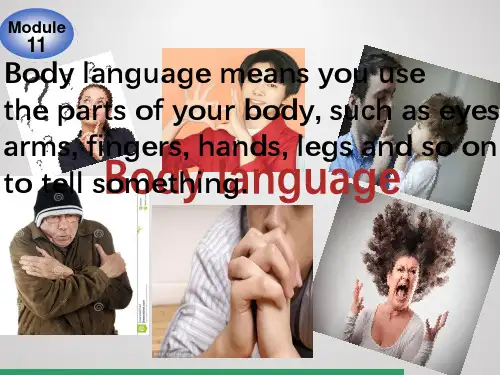
全世界 肢体语言
中东 私人空间 臂挽臂地 移开/移走 一点也不
around the world body language the Middle East personal space arm in arm move away not at all
5 Work in groups. Talk about your class rules.
Language points
Do you look at people when you talk? In some places, it isn’t polite to look at people when you talk, but in other countries it isn’t polite to look somewhere else. In Britain and the US, people usually look at each other when they talk.
外研英语七年级下册Module711Unit3(共24张PPT)
Yes, it is.
3. Do the British like touching people? No, they don’t.
4. Do Americans look at people when they talk?
Yes, they do. 5. Do people in Greece wave to say goodbye?
Some of the South American , Russia, France, Arab …
Shake hands
The US, Britain, China …
In France, it is the custom (习惯) to shake hands with people in the office every morning.
No, they don’t.
Check the body language you can use in different countries and places.
Britain Middle East
Stand close
√
Touch each other
Look at people when
You know when we meet others, we often use our body to greet each other. Now, let’s learn about our body.
Can you say the parts of your body?
finger(s) mouth
Read the passage and answer the questions.
1. Is body language the same in different countries?
3. Do the British like touching people? No, they don’t.
4. Do Americans look at people when they talk?
Yes, they do. 5. Do people in Greece wave to say goodbye?
Some of the South American , Russia, France, Arab …
Shake hands
The US, Britain, China …
In France, it is the custom (习惯) to shake hands with people in the office every morning.
No, they don’t.
Check the body language you can use in different countries and places.
Britain Middle East
Stand close
√
Touch each other
Look at people when
You know when we meet others, we often use our body to greet each other. Now, let’s learn about our body.
Can you say the parts of your body?
finger(s) mouth
Read the passage and answer the questions.
1. Is body language the same in different countries?
Module11Unit3(教案)-2022-2023学年七年级下册英语(外研版)
在实践活动方面,分组讨论和角色扮演活动使学生们能够将所学知识运用到实际情境中,提高了他们的语言表达能力。但在活动过程中,我也发现部分学生参与度不高,可能是因为他们对所学知识掌握不够熟练。为了提高学生的参与度,我考虑在下次活动中,提前为学生提供一些关键词和句型,降低活动难度,增强他们的信心。
关于学生小组讨论,我发现学生们在讨论家庭成员和宠物在日常生活中的应用时,能够积极思考并提出自己的观点。但在引导讨论过程中,我意识到需要更多地关注学生的个体差异,鼓励那些较为内向的学生发表自己的看法。此外,适时给予肯定和鼓励,增强他们的自信心。
(3)对话:学习如何询问和介绍家庭成员及宠物,掌握日常交流中相关的表达方式。
举例:能够进行询问和回答,如:“Do you have a brother?”, “Yes, I do.”
2.教学难点
(1)词汇:对于一些相似词汇的辨析,如brother和sister,dog和cat。学生容易混淆,需要通过对比和练习来加强记忆。
举例:区分brother和sister的用法,如:“He is my brother.”和“She is my sister.”
(2)语法:第三人称单数现在简单时态的构成,尤其是在动词变化上,学生容易犯错。需要通过实例和练习,让学生掌握规律。
举例:正确使用第三人称单数动词变化,如:“He/She/It plays.”
(二)新课讲授(用时10分钟)
1.理论介绍:首先,我们要了解家庭成员和宠物相关词汇及语法。这些词汇和语法帮助我们表达家庭构成和宠物情况,是日常交流的重要部分。
2.案例分析:接下来,我们来看一个具体的对话案例。这个案例展示了如何使用"Have"和"Has"来询问和介绍家庭成员及宠物。
关于学生小组讨论,我发现学生们在讨论家庭成员和宠物在日常生活中的应用时,能够积极思考并提出自己的观点。但在引导讨论过程中,我意识到需要更多地关注学生的个体差异,鼓励那些较为内向的学生发表自己的看法。此外,适时给予肯定和鼓励,增强他们的自信心。
(3)对话:学习如何询问和介绍家庭成员及宠物,掌握日常交流中相关的表达方式。
举例:能够进行询问和回答,如:“Do you have a brother?”, “Yes, I do.”
2.教学难点
(1)词汇:对于一些相似词汇的辨析,如brother和sister,dog和cat。学生容易混淆,需要通过对比和练习来加强记忆。
举例:区分brother和sister的用法,如:“He is my brother.”和“She is my sister.”
(2)语法:第三人称单数现在简单时态的构成,尤其是在动词变化上,学生容易犯错。需要通过实例和练习,让学生掌握规律。
举例:正确使用第三人称单数动词变化,如:“He/She/It plays.”
(二)新课讲授(用时10分钟)
1.理论介绍:首先,我们要了解家庭成员和宠物相关词汇及语法。这些词汇和语法帮助我们表达家庭构成和宠物情况,是日常交流的重要部分。
2.案例分析:接下来,我们来看一个具体的对话案例。这个案例展示了如何使用"Have"和"Has"来询问和介绍家庭成员及宠物。
外研英语七年级下册Module11 Unit3(共22张PPT)
4. You shouldn’t be late for school, Linda! (改为否定祈使句)
___D_o_n__’t_ _b_e__ late for school, Linda.
question in class. 9. __D_o_n_’_t __b_e__ late for class. 10. _D_o_n_’_t _ _e_a_t __ food in class.
______
祈使句
Pay attention to the following sentences.
Open the door, please. / Please open the door. 2. 有时为了指明向谁提出请求或命令,可以加称呼语。 例如:
Tony, please sit down. 3. 祈使句在口语中还可以用到以下几种形式:
Help! No photos/parking! Hands up!
Don’t _l_is_t_e_n_t_o_m__u_s_ic_ in class.
_L__is_t_en__ to music in the music room, please!
______
1. Give them more personal space. 2. Wave to say goodbye. 3. Be careful! 4. Don’t stand too close to North Americans. 5. Be polite to the teacher.
离开时别忘记关灯。
--- I won’t. 不会忘记的。
按要求转换句型,每空一词。 1. Can you open the door, Steven? (改为祈使句) __O_p_e_n_ __th_e_ _d_o_o_r_, Steven. 2. Stand in line. (改为否定句) _D_o_n_’_t _s_ta_n_d__ in line. 3. You must be careful, Susan. (改为祈使句) __B_e_ _c_a_r_e_f_u_l _, Susan.
___D_o_n__’t_ _b_e__ late for school, Linda.
question in class. 9. __D_o_n_’_t __b_e__ late for class. 10. _D_o_n_’_t _ _e_a_t __ food in class.
______
祈使句
Pay attention to the following sentences.
Open the door, please. / Please open the door. 2. 有时为了指明向谁提出请求或命令,可以加称呼语。 例如:
Tony, please sit down. 3. 祈使句在口语中还可以用到以下几种形式:
Help! No photos/parking! Hands up!
Don’t _l_is_t_e_n_t_o_m__u_s_ic_ in class.
_L__is_t_en__ to music in the music room, please!
______
1. Give them more personal space. 2. Wave to say goodbye. 3. Be careful! 4. Don’t stand too close to North Americans. 5. Be polite to the teacher.
离开时别忘记关灯。
--- I won’t. 不会忘记的。
按要求转换句型,每空一词。 1. Can you open the door, Steven? (改为祈使句) __O_p_e_n_ __th_e_ _d_o_o_r_, Steven. 2. Stand in line. (改为否定句) _D_o_n_’_t _s_ta_n_d__ in line. 3. You must be careful, Susan. (改为祈使句) __B_e_ _c_a_r_e_f_u_l _, Susan.