
人教版初中英语七年级上册全册各单元知识点、语法归纳整理
人教版初中英语七年级上册全册各单元知识点、语法归纳整理Unit1 My name’s Gina.重点短语1.your/his/her/my name 你的/他的/她的/我的名词2.first name 名字3.middle school 中学4.telephone number 电话号码st name 姓6.in China 在中国重点句型1.—What’s your name? 你叫什么名字?—Alan 艾伦2.—I’m Jenny. Nice to meet you. 我是珍妮。
见到你很高兴。
—Nice to meet you, too.见到你我也很高兴。
3.—Good morning! I’m Cindy. 早上好!我是辛迪。
—Hello, Cindy! I’m Dale.你好,辛迪!我是戴尔。
4.—My name’s Linda. Are you Helen? 我是琳达。
你是海伦吗?5.—What’s her name? 她叫什么名字?—She’s Jane. 她是简。
6.—Is he Jack? 他是杰克吗?—No, he isn’t. His name’s Mike.不,他不是。
他的名字是迈克。
7.What’s your phone number?你的电话号码是多少?It’s 587-6275. 它是587-6275。
8.My friend is in China.我的朋友在中国。
重点语法1.2.Be动词的一般现在时形式:am, is, areI用am You 用areIs 用于他他它Unit2 This is my sister.重点短语1.family name 姓2.have a good day (表示祝愿)过得愉快!3. a picture of 一张……的照片4.in the first phone 在第一张照片里5.family tree 家庭关系图6.the name of…………的名字重点句型1.That’s my family. Those are my parents. 那是我的家人,那是我的妹妹。
2.—Who’s she? 她是谁?—She’s my sister.她是我的妹妹。
3.Oh, Jane, this is my sister Kate.哦,简,这是我的妹妹凯特。
4.—Are those your parents 那些是你的父母吗?—Yes, they are. 是的,他们是。
5.—Well, have a good day! 好吧,祝你玩得愉快!—Thanks!谢谢!6.That’s my mother. 那是我的妈妈。
7.Here are two nice photos of my family.这儿有两张关于我家人的漂亮照片。
8. These two girls are my sister Cindy and my cousin Helen.这两个女孩是我的妹妹辛迪和我的表姐/妹海伦。
9. My grandfather and grandmother are in the first photo. 我的爷爷和奶奶都在第一张照片里。
重点语法1.2.名词复数可数名词单数变复数规则(1)一般情况下直接加s.如:sisters brothers(2)以s,x,sh,ch结尾的加es.如:box---boxesbus---buseswatch---watches(3)以辅音字母加y结尾的将y变i再加es.如:Boy---boys[注意]以元音字母加y结尾的要直接加s.如:boy-boys(4)以o 结尾的加s或es。
(有生命+es 物生命加s)如:potato ----- potatoestomato-----tomatoesphoto-----photoszoo----zoos(5)以f/fe结尾的名词,先将f/fv变成v再加es。
如:Knife----knives life---lives3.Unit3 Is this your pencil?重点短语1.excuse me 打扰了2.thank you 谢谢你3.in English 用英语puter games 电子游戏5.in the lost and found case 在失物招领箱里6.call sb. at请拨打电话……找某人7.school ID card学生证8.a set of 一套;一副;一组重点句型1.—Is that your school-bag?那是你的书包吗?—No, it isn’t. It’s his.不,不是。
是他的。
2.—Is this your pencil ?这是你的铅笔吗?—Yes, it is. It’s mine. 是的,是我的。
3.—Are these your books? 这些是你的书吗?—No,they aren’t. They’re hers. 不,不是的。
这些是她的。
4.—Excuse me, Grace. Is this your pencil? 打扰了,格雷斯,这是你的铅笔吗?—Yes, thank you.是的,谢谢你!5.—What’s this? 它是什么?—It’s a watch. 它是一块手表。
—How do you spell it?你怎样拼写它?—W-A-T-C-H6.I lost my school ID card. 我弄丢了我的学生卡。
7.Call me at 685-6034. 拨打685-6034找我。
重点语法1.指示代词this, that2.含this, that的一般疑问句及其肯定、否定回答含Be动词(am is are)的肯定句变一般疑问句Be动词提前---首字母大写----加问号This is your pencil.Is this your pencil?Yes, it is. No, it isn’tUnit4 Where’s my schoolbag?重点短语e on 快点儿2.tape player 录音机3.model plane 飞机模型4.under the table 在桌子下面5.on the bed 在床上6.in the schoolbag 在书包里7.talk about 谈论重点句型1.—Where are my books?我的书在哪儿?—They’re on the sofa.它们在沙发上。
2.—The English books are under the radio.英语书在收音机底下3.—Are the keys on the sofa?钥匙在沙发上吗?—No, they aren’t. They’re on the table. 不,它们不在。
它们在桌子上。
4.—Is it on your desk? 在你的桌子上吗?5.—It’s not under the chair. 它不在你的椅子下面。
6.—It’s in your grandparents’ room.它在你祖父母的房间。
7.—I have a clock.我有一个钟8.—The white model plane is hers. 这个白色的飞机模型是她的。
9.—Where are my keys?我的钥匙在哪儿?重点语法1.Where 引导的特殊疑问句2.介词on,in,under 的用法3.连词and/but的用法Unit 5 Do you have a soccer ball?重点短语1.ping-pong ball/bat 乒乓球2.soccer ball 英式足球3.play basketball 打篮球4.watch TV 看电视5.play sports 参加体育运动或比赛6.after class 下课后重点句型1—Do you have a ping-pong bat?你有乒乓球拍吗?2—Yes, I do.是的,我有。
3—And where’s our baseball bat?你有棒球吗?4—Do you have your jacket?你有夹克吗?5—Let me get it.让我来拿它6—We go to the same school and we love soccer.我们去了同一所学校而且我们都热爱足球。
7—I only watch them on TV.我只在电视里看它们。
8—I play ping-pong with my classmates.我和我的同学们打乒乓球。
9—My brother has a soccer ball, but I don’t. 我的哥哥有一个足球,但是我没有。
10—Do they have a baseball?他们有棒球吗?重点语法1.一般现在时态的各种用法2.have 的用法3.do/does 的用法肯定句变一般疑问句(1)含Be动词(am,is,are)-----Be动词提前----首字母大写Am/Is/Are-----加问号回答肯定/否定You are Mike. Are you Mike? Yes, I am. No, I’m not.(2)含实义动词/不含Be动词---借助助动词do/does---首字母大写Do/Does---动词还原--加问号He has a soccer ball.Does he have a soccer ball?Yes, he does. No, he doesn’tUnit6 Do you like bananas?重点短语1.ice-cream 冰激凌2.birthday dinner 生日宴会3.next week下周4.think about 考虑5.volleyball star 排球明星6.have….for breakfast 早饭吃7.sports star 体育明星重点句型1.—Do you/they like salad? 你(你们)/他们喜欢沙拉吗?—Yes, I/we/they don’t.是的,我/我们/他们喜欢。
—No, I/we/they don’t.不,我/我们/他们不喜欢。
2.—Does he/she like pears?他/她喜欢梨吗?—Yes, he/she doesn’t.是的,他/她喜欢。
—No, he/she/doesn’t.不,他/她不喜欢。
3.I like oranges.我喜欢橙子。
4.I love fruit. I think it’s healthy.我爱吃水果。
我认为它有益健康。
5.I don’t want to be fat.我不想长胖。
6.What/How about the fruit? 水果怎么样?7.Sounds good.听起来很好。
(完整版)人教版七年级上册英语全册语法知识点梳理,推荐文档
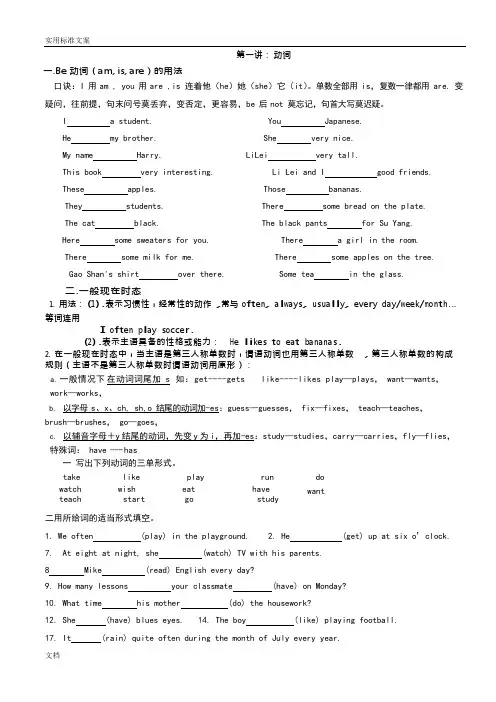
第一讲:动词一.Be 动词(am, is, are)的用法口诀:I 用 am , you 用 are ,is 连着他(he)她(she)它(it)。
单数全部用 is,复数一律都用 are. 变疑问,往前提,句末问号莫丢弃,变否定,更容易,be 后 not 莫忘记,句首大写莫迟疑。
I a student. You Japanese.He my brother. She very nice.My name Harry. LiLei very tall.This book very interesting. Li Lei and I good friends.These apples. Those bananas.They students. There some bread on the plate.The cat black. The black pants for Su Yang.Here some sweaters for you. There a girl in the room.There some milk for me. There some apples on the tree.Gao Shan's shirt over there. Some tea in the glass.二.一般现在时态1.用法:(1).表示习惯性,经常性的动作,常与o f t e n,a l w a y s,u s u a ll y,e v e r y d a y/w ee k/m o n t h…等词连用I o f t e n p l a y s o cc e r.(2).表示主语具备的性格或能力:H e li k e s t o e a t b a n a n a s.2.在一般现在时态中,当主语是第三人称单数时,谓语动词也用第三人称单数, 第三人称单数的构成规则(主语不是第三人称单数时谓语动词用原形):a.一般情况下在动词词尾加 s 如:get----gets like----likes play—plays, want—wants,work—works,b.以字母 s、x、ch, sh,o 结尾的动词加-es:guess—guesses, fix—fixes, teach—teaches,brush—brushes, go—goes,c.以辅音字母+y 结尾的动词,先变y 为i,再加-es:study—studies,carry—carries,fly—flies,特殊词: have --- has一写出下列动词的三单形式。
人教版七年级英语(上册)各单元知识点汇总

新版人教版七年级英语上册各单元知识点Starter unit 11.短语归纳:good morning 早上好 good afternoon 下午好 good evening 晚上好name list an English name 英文名字2.必背典句:(1)Good morning! 早上好!(2)Good afternoon! 下午好!(3)Good evening 晚上好!3.英语中常见的问候语(1)Hello!“你好!”是比较随便、不分时间的一种问候语,通常用于打招呼、打。
表示惊讶或引起对方注意。
对方应答仍用Hello!(2)Hi!“你好!”的使用比hello!更随便,在年轻人中使用更为普遍。
(3)Nice to meet you!“很高兴见到你!”是两个初次见面、经介绍相识的人互相打招呼的用于。
回答时可以说Nice to meet you, too.或者Me, too.表示“见到你很高兴”(4)How do you do?“你好!”用于初次见面,是非正式的打招呼用语。
对方应答语应是“Howdo you do?”(5)How are you? 表示问候How are you? 意为“你好吗?”,为询问对方身体状况的问候语,应答语一般是“I’m fine. Thank you. / I’m very well. Thank you. / I’m OK.How are you? 的其他用法:习惯上回答完别人的问候后,常可反问对方的身体状况,此时可用How are you?也可用And you? “你呢?”4.大写字母的用法:(1) 在英语中,句子的第一个单词的第一个字母都应大写。
Sit down, please. 请坐。
(2)字母I作人称代词时,意为“我”,在句中任何位置都必须大写。
日常用语“OK”在句中任何位置都大写。
I’m a student. 我是一名学生。
Is everything OK? 一切都好吗?(3)人名、地名、国名、某国人或某种语言等专有名词的第一个字母都必须大写。
人教新目标七年级英语上册全册语法知识汇总
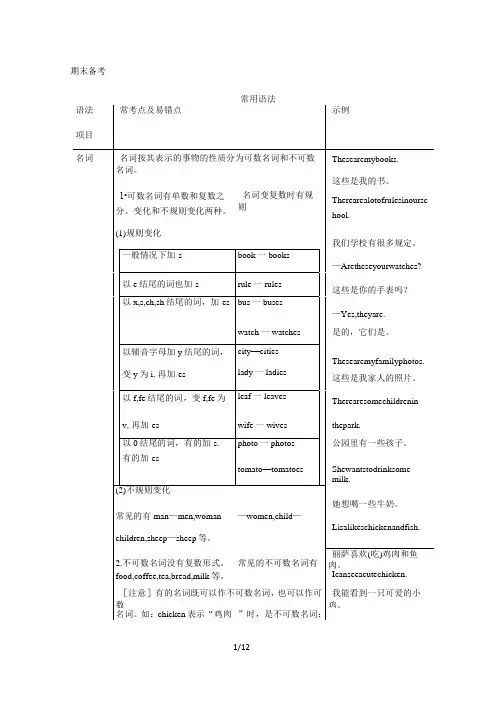
期末备考常用语法代词Icanplaythepiano. 我会弹钢琴。
Therichshouldhelpthepoor. 富人应该帮助穷人。
WewanttovisittheGreat Wall.我们想去游览长城。
Iamastudent. 我是一名学生。
Shelikesswimming.她喜欢游泳。
Welovehimsomuch.我们非常爱他。
Lookatthecat.Ilikeitverymuch.看那只猫,我很喜欢它。
MynameisMike. 我的名字是迈克。
Hisfatherisasinger. 他的爸爸是一名歌手。
Thisismyruler.It'snotyours. 这是我的尺子,不是你的。
Myideaisdifferentfromhers.“一家人”(6) 用在某些形容词之前,表示“某一类人”(7) 用在表示海洋、河流、山脉、群岛、国家以及党派的专有名词之前。
(8)用在一些固定搭配或习惯表达中。
1•人称代词人称代词就是表示“你”、“我”或“他”等的代词。
人称代词有主格和宾格之分。
物主代词就是表示“你的”“我的”或“他的”等的代词。
物主代词有形容词性物主代词和名词性物主代词之分。
3. 指示代词指示代词就是表示“这个”“那个”、“这些”和2•物主代词[注意]名词性物主代词=形容词性物主代词+名一般现在时一般现在时用来描述经常发生的动作或存在的状态。
具体包括:(1)含be动词的一般现在时的构成:(2)含实义动词的一般现在时的构成:该结构的一般疑问句的回答有两种形式:肯定回答:Yes,主语+do/does.否定回答:No,主语+don't/doesn't.Theyareintheclassroom.他们在教室里。
Theyaren'tintheclassroom.他们不在教室里。
—Aretheyintheclassroom?他们在教室里吗?—Yes,theyare.是的,他们在。
人教版初中英语七年级上册语法知识点
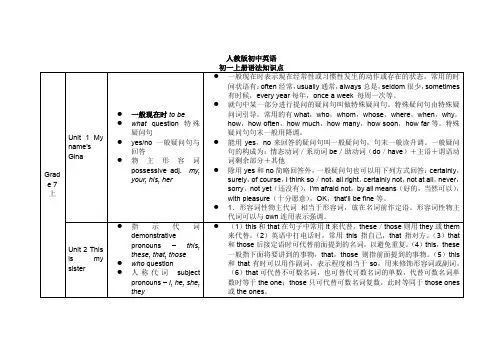
have表示“有”时,其否定形式有两种:在其后直接加not,但常用于非正式用语中;利用助动词do加not。
②如果句子的谓语是实义动词,在谓语动词前加don't,doesn't,didn't。
③no,never,seldom,hardly,nobody,little,few,nothing等否定词也可以构成否定形式。
1.表示经常性或习惯性发生的动作2.表示现在存在的状态或情况3.表示正在发生的动作或存在的状态4.表示客观事实、真理和自然现象5.用于表示较固定的、按计划、规定将要发生的动作,但只限于begin,come,go,leave,arrive,stop,return,close,open,take,start,take,place等少数动作,6.用于if,unless,once,even if(即使)等引导的条件状语从句,when,before,until,as soon as,the moment(一……就)等引导的时间状语从句,no matter+wh-/-how-或wh-ever/however等引导的让步状语从句中,代替一般将来时
人教版初中英语
初一上册语法知识点
Grade 7
上
Unit 1 My name’s Gina
人教版七年级英语上册各单元知识点汇总归纳
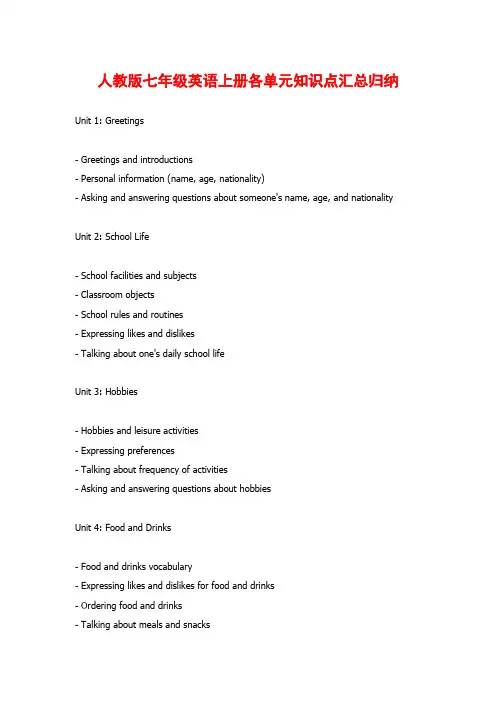
人教版七年级英语上册各单元知识点汇总归纳Unit 1: Greetings- Greetings and introductions- Personal information (name, age, nationality)- Asking and answering questions about someone's name, age, and nationality Unit 2: School Life- School facilities and subjects- Classroom objects- School rules and routines- Expressing likes and dislikes- Talking about one's daily school lifeUnit 3: Hobbies- Hobbies and leisure activities- Expressing preferences- Talking about frequency of activities- Asking and answering questions about hobbiesUnit 4: Food and Drinks- Food and drinks vocabulary- Expressing likes and dislikes for food and drinks- Ordering food and drinks- Talking about meals and snacks- Talking about healthy and unhealthy foodUnit 5: Family and Friends- Family members and relationships- Describing family members- Talking about family activities- Describing friends- Talking about friendship- Discussing family and friends using possessive adjectives Unit 6: Animals- Animal vocabulary- Describing animals- Talking about pets and pet care- Talking about animal characteristics and behavior- Discussing animal conservationUnit 7: Numbers- Numbers 0-1000- Counting objects- Talking about prices and money- Telling time- Expressing ageUnit 8: Colors and Shapes- Colors and shapes vocabulary- Describing objects based on colors and shapes- Talking about preferences for colors and shapes- Describing objects based on their sizes and quantities Unit 9: Clothes- Clothing vocabulary- Describing clothes- Talking about clothes for different occasions- Discussing preferences for clothing styles and colors - Talking about shopping for clothes。
2024 人教版七年级英语上册知识点
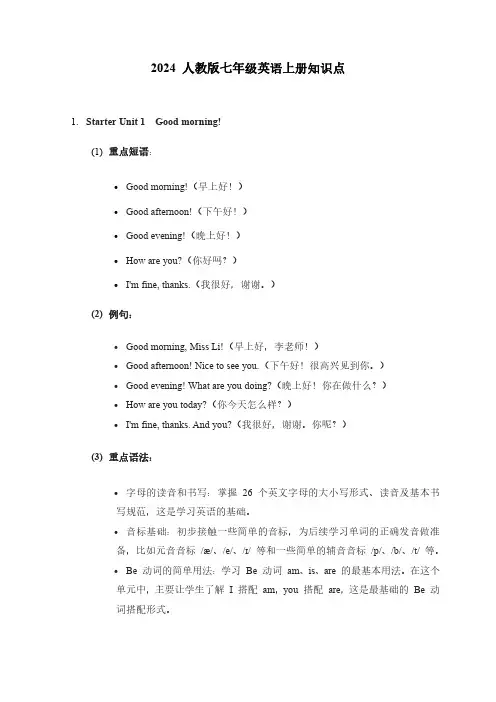
2024人教版七年级英语上册知识点1.Starter Unit1Good morning!(1)重点短语:∙Good morning!(早上好!)∙Good afternoon!(下午好!)∙Good evening!(晚上好!)∙How are you?(你好吗?)∙I'm fine,thanks.(我很好,谢谢。
)(2)例句:∙Good morning,Miss Li!(早上好,李老师!)∙Good afternoon!Nice to see you.(下午好!很高兴见到你。
)∙Good evening!What are you doing?(晚上好!你在做什么?)∙How are you today?(你今天怎么样?)∙I'm fine,thanks.And you?(我很好,谢谢。
你呢?)(3)重点语法:∙字母的读音和书写:掌握26个英文字母的大小写形式、读音及基本书写规范,这是学习英语的基础。
∙音标基础:初步接触一些简单的音标,为后续学习单词的正确发音做准备,比如元音音标/æ/、/e/、/ɪ/等和一些简单的辅音音标/p/、/b/、/t/等。
∙Be动词的简单用法:学习Be动词am、is、are的最基本用法。
在这个单元中,主要让学生了解I搭配am,you搭配are,这是最基础的Be动词搭配形式。
2.Starter Unit2What's this in English?:(1)重点单词:map(地图)cup(杯子)ruler(尺子)pen(钢笔)orange(橙子)jacket(夹克衫)key(钥匙)quilt(被子)what(什么)in(在……里)English(英语;英文)。
(2)重点短语:∙询问物品:What's this in English?(这个用英语怎么说?)、What's that inEnglish?(那个用英语怎么说?)∙回答方式:It's a/an...(它是一个……)。
人教版七年级英语上册各单元重难点知识归纳
人教版七年级英语上册各单元重难点知识归纳UNIT 1 You and MeSECTION A How do we get to know each other?重点单词1. full adj. 完整的;满的2. grade n. 年级;等级3. classmate n. 同班同学4. mistake n. 错误;失误5. country n. 国家6. same adj. 相同的7. twin n. 双胞胎之一;adj. 双胞胎之一的8. both adj. & pron. 两个;两个都9. band n. 乐队10. pot n. 锅11. tofu n. 豆腐词形变换1. full →empty (反义词)2. classmate →classmates (复数形式)3. mistake →mistakes (复数形式)4. country →countries (复数形式)5. same →different (反义词)6. twin →twins (复数形式)7. one →first (序数词)8. China →Chinese (形容词)重点短语1. make friends 交朋友2. get to know 认识;了解3. each other 互相;彼此4. how old 多大年纪;几岁了5. full name 全名6. last name 姓氏7. be from 来自8. in Class 1, Grade 7 在七年级一班9. class teacher 班主任10. first name 名字11. a lot /very much 很;非常12. hot pot 火锅13. personal information 个人信息14. pet cat 宠物猫15. in the school band 在学校乐队16. Chinese food 中国食物17. in the same class 在相同的班18. live with 和……一起住19. Mapo tofu 麻婆豆腐重点句型1. —How old are you? 你多大了?—I'm 12 years old.我十二岁。
七年级人教英语上册单元笔记
七年级人教英语上册单元笔记以下是七年级人教版英语上册的单元笔记,包含了每个单元的重点词汇、短语、句型和语法知识点:Unit 1: My name's Gina重点词汇:nameID cardfamily namegiven namephone numberaddresspen pal重点短语:my name is ...your name is ...his name is ...her name is ...its name is ...their names are ...call sb. at ...have a pen pal in ...重点句型:What's your name?My name is ...Is that ...? (打电话时常用)Can I have your phone number?Here is my address.语法知识点:介绍自己和他人时用主语+be动词+名词的句型。
在电话中询问对方姓名时用What's your name?的句型。
询问对方电话号码和地址时分别用Do you have a phone number?和Do you have an address?的句型。
Unit 2: This is my sister重点词汇:sisterbrothermotherfathergrandparentsuncleauntcousinfamily tree重点短语:these are ...those are ...that is ... (指代单数名词)these are ... and those are ... (指代复数名词)have a family tree (画家谱图)重点句型:This is ... (介绍家人时常用)These are ... (介绍多人时常用)Is that your ...? (询问对方家人时常用)。
人教版七年级上册英语知识点系统归纳
人教版七年级上册英语知识点系统归纳一、单词和短语1. 人称代词- 主格:I, you, he, she, it, we, they- 宾格:me, you, him, her, it, us, them2. 动词- be动词:am, is, are3. 数词- 基数词:one, two, three, four, five, six, seven, eight, nine, ten - 序数词:first, second, third, fourth, fifth, sixth, seventh, eighth, ninth, tenth4. 询问方式和回答- 询问姓名:What's your name? My name is...- 询问年龄:How old are you? I'm ... years old.- 询问国籍:Where are you from? I'm from...- 询问职业:What's your job? I'm a...- 询问日常活动:What do you do on weekends? I usually...5. 学科和科目- 数学:mathematics, math- 英语:English- 物理:physics- 化学:chemistry- 历史:history- 地理:geography- 生物:biology- 音乐:music- 美术:art- 体育:physical education, PE6. 学校设施和地点- 教室:classroom- 图书馆:library- 实验室:laboratory- 操场:playground- 餐厅:canteen- 办公室:office- 停车场:parking lot- 校门:school gate二、语法知识1. 句子结构- 主语 + 谓语:I study English.- 主语 + 谓语 + 宾语:She likes apples.- 主语 + 谓语 + 宾语 + 地点:They play basketball at the playground.- 主语 + 谓语 + 宾语 + 时间:We watch TV on weekends.- 主语 + be动词 + 表语:He is a student.2. 一般疑问句- be动词:Is she a teacher? Yes, she is. / No, she isn't.- 一般动词:Do you like sports? Yes, I do. / No, I don't.3. 物主代词- 形容词性物主代词:my, your, his, her, its, our, their- 名词性物主代词:mine, yours, his, hers, its, ours, theirs4. 形容词和副词- 形容词:big, small, tall, short, old, young, happy, sad, interesting, boring- 副词:well, badly, fast, slowly, often, sometimes, always, never5. 介词- in, on, at, under, over, beside, in front of, behind, between6. 时态- 现在时:I study English. / He likes sports.- 过去时:I studied English. / He liked sports.- 将来时:I will study English. / He will like sports.三、日常用语1. 问候语- 早上好:Good morning!- 下午好:Good afternoon!- 晚上好:Good evening!- 晚安:Good night!2. 表达喜欢和不喜欢- 喜欢:I like swimming.- 不喜欢:I don't like playing basketball.3. 请求和允许- 请求:Can I go to the restroom?- 允许:Yes, you can. / No, you can't.4. 表达时间和日期- 现在时间:It's 8 o'clock.- 日期:Today is Monday, June 1st.5. 表达感觉和状态- 感觉:I'm happy. / She is sad.- 状态:I'm hungry. / He is tired.以上是人教版七年级上册英语知识点的系统归纳,包括单词和短语、语法知识和日常用语等内容。
人教版初中英语七年级上册全册各单元知识点、语法归纳整理
人教版初中英语七年级上册全册各单元知识点、语法归纳整理Unit1 My name’s Gina.重点短语1.your/his/her/my name 你的/他的/她的/我的名词2.first name 名字3.middle school 中学4.telephone number 电话号码st name 姓6.in China 在中国重点句型1.—What’s your name? 你叫什么名字?—Alan 艾伦2.—I’m Jenny. Nice to meet you. 我是珍妮。
见到你很高兴。
—Nice to meet you, too.见到你我也很高兴。
3.—Good morning! I’m Cindy. 早上好!我是辛迪。
—Hello, Cindy! I’m Dale.你好,辛迪!我是戴尔。
4.—My name’s Linda. Are you Helen? 我是琳达。
你是海伦吗?5.—What’s her name? 她叫什么名字?—She’s Jane. 她是简。
6.—Is he Jack? 他是杰克吗?—No, he isn’t. His name’s Mike.不,他不是。
他的名字是迈克。
7.What’s your phone number?你的电话号码是多少?It’s 587-6275. 它是587-6275。
8.My friend is in China.我的朋友在中国。
重点语法1.2.Be动词的一般现在时形式:am, is, areI用am You 用areIs 用于他他它Unit2 This is my sister.重点短语1.family name 姓2.have a good day (表示祝愿)过得愉快!3. a picture of 一张……的照片4.in the first phone 在第一张照片里5.family tree 家庭关系图6.the name of…………的名字重点句型1.That’s my family. Those are my parents. 那是我的家人,那是我的妹妹。