
英语人教版九年级全册unit 10 Section B 1a-1d
Sentence pattern
• 1. be supposed to do sth • 2. be expected to do sth • 3.It is impolite to do sth • 4. It is important to do sth • 5.It is helpful to do sth • 6.be worth doing sth/sth
Let’s play a game.
Look at the following things. Guess if they are right.
T
In India , you’re not supposed to eat with your hands.
T
In China, you’re not supposed to stick your chopsticks into the food.
When you are in Rome, do as Romans do.
T
Listen
• Steve is going to China to study. His friend Yang Ming is telling him about the table manners in China. Listen and number the pictures in the order you hear them.
In Korea, the youngest people is supposed to start eating first.
F
In France, you’ are suppose to put your bread on the table.
T
In China, it’s polite to use your chopsticks to hห้องสมุดไป่ตู้t an empty bowl.
Complete the chart
Ideas and customs Colombia about
Switzerland
Being on time
They ‘re pretty relaxed about time
Visiting a friend’s They often just
house
drop by their friends’ homes.
Unit 10 You’re supposed to shake hands.
Teaching aims: 教学目标
• 1. Review the customs in different countries.
• 复习不同国家的风俗习惯。 • 2. Learn some table manners around the
Summary
1.We have reviewed some customs in different countries when they meet for the first time. We also talk about some ideas and customers in Colombia and in Switzerland. • 2.We have learned some table manners in different countries.
Making plans with They don’t have to
friends
make plans to meet their friends.
It’s very important to be on time.
They never visit a friend’s house without cTahleliyngalfmirosst.t always make plans to see friends.
3. You shouldn’t point at anyone with your chopsticks.
Phrases:
• 1.eat with your hands • 2.stick your chopsticks into your food • 3.be expected to start eating first • 4.put your bread on the table • e your chopsticks to hit an empty bowl • 6.point at • 7.at the table
Writing and report
There are many table manners around the world. But different countries have different culture. In India, ….In France, ….In Korea, ….What about table manners in China? In China, ….It is very helpful to learn about some table manners especially when you travel to other countries.
world. • 学习世界范围内的餐桌礼仪。
Talk about customs.
• What are people in Korea supposed to do when they meet for the first time?
• They are suppose to …. • What about people in Brazil, the United
We have known….
1. You’re not supposed to start eating first if there are older people at the table.
2. It’s impolite to stick your chopsticks into your food.
人教新目标九年级全册 Unit10 Section B 1 1a-1d(共13张PPT)

__a__ 2. It’s impolite b. point at anyone with
to…
your chopsticks.
__b__ 3. You
c. start eating first if
shouldn’t…
there are older
people at the table.
Talk about Chinese table manners in group of four and write down your opinions.
4. It’s impolite to use your chopsticks to hit an empty bowl.
5. You are not supposed to talk when you’re having dinner.
6. It’s not necessary to order too many dishes.
your chopsticks into the food. T F
3. In Korea, the youngest person is
expected to start eating first. T F
4. In France, you’re sthe table.
1. You’re not supposed to start eating first if there are older people at the table.
2. You shouldn’t point at anyone with your chopsticks.
3. It’s impolite to stick your chopsticks into your food.
Unit 10 Section B(1a-1d)九年级全册英语教学课件(人教版)
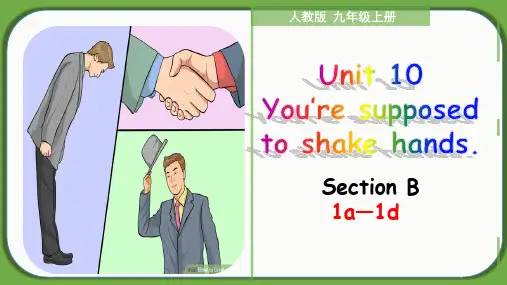
In Japan
You're (not) supposed to...
point at anyone with your chopsticks
start eating first if there are older people at the table
返回
What should we notice in a Western meal?
Chinese Table Manners
It’s rude to stick the chopsticks into the bowl. We’re not supposed to talk aloud at the table.
In China, it’s impolite to
use your chopsticks to hit an empty bow.
• make noise while eating 吃饭时发出声音
• stick the chopsticks into the food 把筷子插在食物里
• point at someone with the chopsticks 用筷子指着某人
• eat while walking down the street 在路上边走边吃
Section B 1a—1d
Let's enjoy a video.
How much do you know about table manners around the world? There are many table manners around the world. But different countries have different customs.
九年级Unit-10-You're-supposed-to-shake-hands-Section--B-1a-1d

2. It’s impolite ______ loudly in public places. A. speak B. to speak C. speaking D. speaks
In China
be (not) supposed to ….
table manners
point at anyone with your chopsticks
In China
It’s (im)polite to…
In Japan
be (not) supposed to ….
table manners
In China
You’re supposed to
put the bread on the …
plate
table manners
In France
You’re supposed to
put the bread on the …
table
Words and expressions
table manners 餐桌礼仪 eat with your hands 用手吃饭 把筷子插入食物里 stick your chopsticks into the food start eating first 开始先吃 hit an empty bowl 敲打空碗 point at anyone 指向任何人 端起饭碗 pick up one’s bowl to eat 喝饮料,喝酒 take a drink 一件重要的事 one important thing 在餐桌上(旁) at the table 做…( 没 )有礼貌 it’s (im)polite to
初中英语九年级 Unit 10 Section B (1a-1d)说课稿
初中英语九年级 Unit 10 Section B (1a-1d)说课稿一. 教材分析本文选自人教版初中英语九年级Unit 10 Section B (1a-1d)。
本节课主要讨论了关于环保的话题。
通过本节课的学习,学生能够掌握如何描述一种现象以及提出相应的建议。
文章内容贴近学生生活,有助于激发学生的学习兴趣,提高他们的环保意识。
二. 学情分析九年级的学生已经具备了一定的英语基础,能够听懂并运用一些基本的英语句型。
但是,对于一些复杂的句子结构和词汇,他们可能还需要进一步的引导和帮助。
此外,学生的学习兴趣和动机对于英语学习来说非常重要,因此在教学过程中,我将注重激发学生的学习兴趣,提高他们的环保意识。
三. 说教学目标1.知识目标:学生能够掌握有关环保的词汇和表达方式,如pollute、protect等;能够理解并运用目标句型描述一种现象并提出相应的建议。
2.能力目标:学生能够听懂、说出一篇关于环保的短文,提高他们的英语口语表达能力。
3.情感目标:通过本节课的学习,学生能够提高环保意识,树立环保观念。
四. 说教学重难点1.重点:学生能够掌握有关环保的词汇和表达方式,能够理解并运用目标句型描述一种现象并提出相应的建议。
2.难点:学生能够听懂、说出一篇关于环保的短文,提高他们的英语口语表达能力。
五. 说教学方法与手段1.交际式教学法:通过小组讨论、角色扮演等方式,让学生在实际语境中练习英语,提高他们的口语表达能力。
2.情境教学法:创设生活情境,让学生在真实的环境中学习英语,提高他们的学习兴趣。
3.任务型教学法:通过完成具体任务,让学生在实践中学习英语,提高他们的学习动机。
六. 说教学过程1.导入:通过展示一些环保的图片,引导学生谈论环保话题,激发他们的学习兴趣。
2.新课呈现:让学生听一篇关于环保的短文,并回答相关问题,帮助他们理解短文内容。
3.操练环节:学生分组进行角色扮演,模拟生活中的一些环保场景,练习英语口语。
初中英语九年级 Unit 10 Section B (1a-1d)教学设计
初中英语九年级 Unit 10 Section B (1a-1d)教学设计一. 教材分析本课选自人教版英语九年级Unit 10 Section B (1a-1d)。
本节课主要讨论了关于保护环境的重要性以及人们应该采取的行动。
通过本节课的学习,学生能够更好地了解环境问题的严重性,提高他们的环保意识,培养他们保护环境的责任感。
二. 学情分析九年级的学生已经具备了一定的英语基础,能够理解和运用一些基本的英语句型和词汇。
但是,对于一些抽象的概念,如环保,可能还需要进一步的解释和引导。
此外,学生的学习兴趣和动机对于英语学习来说非常重要,因此,在教学过程中,需要充分激发学生的学习兴趣,提高他们的学习积极性。
三. 教学目标1.知识目标:学生能够掌握本节课的重点词汇和句型,如“protect theenvironment”,“take action”等,并能够运用它们进行简单的英语交流。
2.能力目标:通过本节课的学习,学生能够提高自己的英语听说读写能力,尤其是听力和口语表达能力。
3.情感目标:学生能够增强环保意识,认识到保护环境的重要性,并愿意为环保事业做出自己的贡献。
四. 教学重难点1.重点:本节课的重点是让学生掌握与环保相关的词汇和句型,并能够运用它们进行英语交流。
2.难点:对于一些抽象的概念,如环保,可能需要进一步的解释和引导,帮助学生更好地理解和运用。
五. 教学方法1.任务型教学法:通过设置一些实际的任务,让学生在完成任务的过程中学习和运用英语。
2.情境教学法:通过创设一些与环保相关的情境,让学生在真实的语境中学习和运用英语。
3.小组合作学习:通过小组合作的形式,让学生相互交流和合作,提高他们的学习效果。
六. 教学准备1.教学材料:教材、多媒体课件、录音机、磁带等。
2.教学环境:教室、黑板、投影仪等。
七. 教学过程1.导入(5分钟)通过一些与环境相关的问题,如“你们认为环保重要吗?为什么?”等,引导学生思考环保的重要性,激发他们的学习兴趣。
人教版九下英语 Unit 10 You’re supposed to shake hands第4课时
Warming up
Revision You are supposed/expected to…
顺路 到朋 友家 穿长 裙
准时 到达
握手
鞠躬 亲吻 脸颊
Table manners around the world In France
Table manners around the world In India
Yang Ming: Oh, I see. Well, one important thing is that you’re not supposed to start eating first if there are older people at the table.
Steve: That’s interesting. In the United States, it doesn’t matter.
一、单项选择
1. You’re ___D____ to type quickly when chatting on the Internet, or the other person will get bored.
A. suggested B. supported C. taught D. supposed
In China
In America
You are not supposed to start eating first if there are older people at the table.
_It_d_o_e_s_n_’_t _m_a_t_te_r_. ____
It’s impolite_t_o_s_t_ic_k_y__o_u_r _c_h_o_p_st_ic_k_s_ No. Use forks and _i_n_t_o_y_o_u_r_f_o_o_d_._________________ knives.
部编人教版PEP新目标 初三九年级英语 上册第一学期秋季 部优公开课堂教学课件 Unit 10 Section B 第一课时
Thank you!
8. You’re not supposed to put your clothes into a bowl or plate when picking up your food with chopsticks.
Summary
Key word: empty Key sentences:
1. In China, it’s impolite to use your chopsticks to hit an empty bowl.
In France/America
You’re not supposed to eat with your hands.
In India, you’re supposed to eat with your hands.
In China, you are not supposed to stick your chopsticks into the food.
country.
A: We are supposed to…
B: Yes, and it’s impolite to…
Talk about Chinese table manners in group of four and write down your opinions.
1. You’re not supposed to start eating first if there are older people at the table.
2. —We’re supposed to… —Yes, and it’s impolite to…
Learned some table manners
Homework
人教版英语九年级全册Unit10SectionB1a1d说课稿
四、教学过程设计
(一)导入新课
为了快速吸引学生的注意力和兴趣,我采用以下方式进行新课导入:
1.情境创设:播放一段关于地球环境现状的视频,让学生直观地感受到环保问题的紧迫性,引发他们对本节课主题的兴趣。
2.问题引导:提出与环保相关的问题,如:“What is the most serious environmental problem in your city?” “What can we do to protect the Earth?”让学生思考并展开讨论。
2.教学难点
(1)正确运用一般将来时描述环境问题的解决方案。
(2)在小组讨论中,运用所学知识分析并解决现实生活中的环保问题。
(3)培养学生的环保意识和团队合作精神,激发学习兴趣。
二、学情分析导
(一)学生特点
本节课面向的是九年级学生,他们的年龄大约在15至16岁之间。这个年龄段的学生正处于青春期,精力充沛,好奇心强,具备一定的独立思考能力和批判性思维。在认知水平上,他们已经掌握了英语的基础知识,能够进行简单的听、说、读、写活动。此外,他们对社会热点问题有一定的关注,学习兴趣主要集中在与生活实际相关的主题上。
2.设计富有挑战性的任务,引导学生主动探究、合作交流,提高他们的学习积极性。
3.利用多媒体教学手段,如视频、图片等,生动形象地展示环保问题,引发学生的思考。
4.开展小组竞赛活动,激发学生的竞争意识和团队合作精神。
5.及时给予学生鼓励和反馈,增强他们的自信心,提高学习动力。
三、教学方法与手段
(一)教学策略
3.教师评价:教师针对学生的课堂表现、作业完成情况等,给予针对性的评价和建议。
人教新目标九年级全册Unit 10 SectionB(1a-1d)(共15张PPT).pptx
SectionB(1a-1d)
Table manners in China stick your chopsticks into the food
You’re not supposed to stick your chopsticks into the food.
Table manners in China eat with hands
Have a safe trip! Yours,
Continue to finish the letter.
Mind your manners when you have meals in your daily life.
1. In India, you’re supposed to eat with your hands. T
2. In China, you’re not supposed to stick your chopsticks into
the food. T
3. In Korea, the youngest person is expected to start eating
Table manners in China
the older people start eating first
It is polite to let the older people start eating first at the table.
Table manners in China hit an empty bowl with the chopsticks
Dear Eric, I am very happy that you will come to China soon.
人教版九年级全册英语课件:Unit 10 Section B (1a1d)
(D )11.When you stay in the US, the common way to greet is to ________. A.bow B.kiss C.hug D.shake hands
( A)12.If you give a weak handshake in America, the other person might think that you're ________.
to ________ the chalk ________ the blackboard before class.
A.clean; off B.clean; up
C.clean; out D.clean; away
( B )10.We should ________ the time we spend with our family and friends. A.support B.value C.provide D.have
( A )8.You shouldn't point ________ others with chopsticks
while eating ________ the table.
A.at; at B.at; on
C.on; on
D.on; at
( A )9.The students on duty are supposed
有古
一人
个云
在:
路“
上读
。万
”卷
从书
古,
至行
今万
,里
学路
习。
和”
旅今
行人
都说
是:
相“
辅要
相么
You made my day!