
仁爱版七年级上英语Unit3 Topic 1 Section A教学课件
Useful expressions.
help sb. with sth./(to) do sth. 帮助某人做某事 e.g. I often help Jane with her Chinese. I often help Jane study Chinese. 我经常帮助Jane学习汉语。
Exercise.
speak 讲、说(某种语言) He can speak English .
Useful expressions.
Could you please tell me your name? —Could you please+动词原形? 你能......吗? — Sure. / Of course. / No problem. 好的,没有问题。 Sorry.不好意思,不行。
T: Excuse me, could you please tell me his angkang.
T: Does he come from China?
S: Yes, he does.
T: Can he speak English?
S: Yes. But his English is not very good.
A: Excuse me, could you please tell…?
B: Sure ...
A: e from...?
B: No,...Canada.
A: Oh,...pen pal ... can ... Chinese ... like...? B: Yes,... But ... not good ... help ... with...? A: No problem.
(录音P56-3a)
调查表
Group one
like English
speak English after class have an English name have a pen pal
two
three
four
five
...
Report like this:
In Group One, we all like English. We each have an English name. We often speak English after class, but Li Hong's English is not good. She needs some help. We can help her with it. And she wants to have a pen pal.
(C )1. We are from England. We _______ English. A. tell B. say C.speak (B )2. —Do you have any friends here? — ________ A. Yes, I am. B. Yes, I do. C. Yes, I have. (C )3. —______ you like English? — Yes, I do. A. Does B. do C. Do ( A )4. Mary’s Chinese is not good. We can help her ______ it. A. with B. and C. to ( B)5. — Do you come from the USA? — No, I _______ from Canada. A. comes B. am C. be
1. —Could you please+动词原形? 你能……吗? —Sure. / Of course. / No problem. 能。 Sorry. 2. tell sb. sth.告诉某人某事 3. come from=be from 4. help sb. with sth. / help sb. (to) do sth. 帮助某人做某事 5. speak +某种语言 6. No problem. = Sure.
Listen to the passage and fill in the blanks. (录音P56-2)
I’m Li Wei. My Chinese
is very good.
I often help my friends with their Chinese. I like English very much. But my English is not very good. I want to have a pen pal. Could you help me with it?
( F ) 3.Li Xiang’s pen pal can speak Chinese very well.
( T ) 4.Li Xiang will help Jane with her Chinese.
(视频P55-1a)
Look at the key words and act out .
T: Could you help him with it? S: No problem.
I have a friend. I’d like to tell you something about him. He is Li Wei. He is from China. He often speaks Chinese. He likes English, but his English is not good. He wants to find a pen pal to help him with it. Could you please help him?
(视频P55-1a)
Do you like Chinese?
Yes, I do.
Listen to 1a and mark T (True) or F (False). ( T ) 1.Jane likes Chinese. ( F ) 2. Li Xiang’s pen pal is from America, too.
仁爱版英语七年级上册Unit3Topic1SectionA教学设计

2.培养学生尊重他人、关爱家人的价值观,让他们学会珍惜亲情、友情。
3.培养学生的团队协作精神,使他们学会与人沟通、交流,共同解决问题。
4.培养学生具有全球意识,了解不同国家文化背景,拓展国际视野。
5.引导学生树立正确的价值观,关注社会现象,提高社会责任感。
三、教学重难点和教学设想
(一)教学重难点
1.重点:本节课的核心词汇和句型,如:friend, family, mother, father, brother, sister等,以及一般现在时的用法。
难点:在实际对话中正确运用所学的词汇和句型,进行流畅的口语表达。
2.重点:学会使用一般疑问句和特殊疑问句进行家庭成员信息的询问。
2.教师提问:“Can you introduce your family members and their jobs?”,让学生尝试用英语介绍自己的家庭成员及其职业,为新课的学习做好铺垫。
3.教师播放一段关于家庭成员的英语歌曲,让学生在欣赏歌曲的同时,感受英语学习的乐趣,进而导入新课。
(二)讲授新知
1.教师呈现本节课的核心词汇,如:friend, family, mother, father, brother, sister等,并通过例句、图片等形式帮助学生理解和记忆。
2.教师讲解一般现在时的用法,结合家庭成员及其职业的例子,让学生学会用一般现在时描述家人及其特点。
3.教师教授一般疑问句和特殊疑问句的构成,如:“Is your father a doctor?”、“What does your mother do?”等,并引导学生进行实际操作,巩固所学知识。
4.关注学生个体差异,实施分层教学,满足不同学生的学习需求。
仁爱版七年级英语上册 Unit 1 Topic 1 《Welcome to China! 》Section A课件(共22张PPT)

— Good morning! — Good morning! I’m Kangkang. Hello! / Hi! — Are you Maria? — Yes, I am. / No, I’m not. I’m Jane. —Nice to meet you. — Nice to meet you, too. _Welcome to China! _Thanks.
Unit 1 Making New Friends
Topic 1 Welcome to China! Section A
昭通市昭阳区洒渔镇中学 余平莲
There are several reasons why we why we should study English.
First, speaking English well is a sign of success. It makes us more fascinating and makes everybody envy us. It also earns us respect. As a result, our status and confidence will increase. In addition, English is fun. We can really enjoy this language because we can learn many things though it. Furthermore, English will make us happier because by being
able to speaking. We will make more friends. English will also open our eyes. We can learn a lot from English films, songs, and literature. They are all so informative. Finally, English is global. The world is getting smaller because of English. English is therefore great for traveling around the world. It’s like a secret weapon
仁爱版英语七年级上册7A_Unit3_Topic1_SectionA_教学设计
Unit3 Topic1 SectionA 教学设计Ⅰ. Material analysis本节课是第三单元的第一课时,主要活动是1a 和3a。
通过Li Xiang 和Jane 的对话,学习“谈论喜好”、“询问、请求”、“结交朋友”等语言功能,同时也抛出实义动词“like”、“want”、“speak”的一般现在时第一人称、第二人称的用法以及人称代词主格和宾格的用法。
语音板块初步掌握元音音素/з:/和/ə/,辅音音素/H/,/E/ ,/C/ 和/_/的发音及发音规律,初步学习连读并了解其规律,并能在歌谣中进行连读和重音的训练。
Ⅱ.Teaching aims1. Knowledge aims能根据已学语音、音标及发音规则,正确朗读下列词汇并运用于情景对话中:could, tell, sure, pen pal, some, with, problem, well, often;能够在教师的帮助和指导下,在单词中朗读和辨别字母和字母组合ir, er, sh, s, ch, ge 的发音:/з:/,/ə/,/H/,/E/ ,/C/ 和/_/并总结其发音规律;能在教师的指引下,了解句子连读及重音,并能够准确地朗读;能结合谈论喜好、提出请求、结交朋友的表达方式,正确使用实义动词like/speak/want 一般现在时第一、第二人称单数的陈述句、一般疑问句及其肯定和否定回答;能正确使用人称代词的主格和宾格形式,如:I like it very much.Could you help me with it?能在真实的语言环境中,运用表达询问、请求和谈论喜好等交际功能的用法,与他人进行真实交流,如:Could you tell me your name?Could you help me with it?Do you like Chinese?I want to find a pen pal.2. Skill aims能听懂有关表达询问、请求、谈论喜好的简单对话或叙述;1能就表达询问、请求、谈论喜好等的话题进行交流;能正确地朗读对话,注意重音和连读;能写出表达询问、请求和谈论喜好的简单句子或者小短文。
Unit3Topic1SectionC课件2022-2023学年仁爱版英语七年级上册
(3)so表示因果,承接关系,意为“因此,所以”。 He comes from America, so his English is very good.
2a Listen, read and learn. A: Jan简e,,d你o y喜ou欢li中ke文C吗hin?ese? B: Ye是s,的I l,ik我e i非t v常er喜y m欢u它ch。. A: What那ab你ou呢t ?y山ou姆, S?am? B: 不No,, I我d一on点't l也ik不e i喜t a欢t a它ll.。
□Jane and Sally are very nice.
□√ We often help each other.
□Jane can speak Chinese very well.
1b Read 1a and circle True or False.
1. Jane, Sally and I are in the same class.
so还可当副词,意为“如此,这么” Its hands is so small.它的手如此小。 She is so beautif
(1)and意为“和;又;并”,表示并列关系,用来连接语法作用相同的 词、短语或句子。如: I'm from Beijing and she is from Shanghai.我来自北京,她来自上海。
他来自美国,所以他英语很好。
Language points
用and,but,so填空 1.I like English __a_n_d___ Chinese. 2.I want to buy a pair of new shoes _b__u_t_ I don’t have enough money. (足够的钱). 3.I often help my classmates ___so__ they think I’m a good student. 4.I’m a Chinese __a_n_d_ she is an American. 5.He likes English very much __b_u_t_ his English is not very good. 6.She likes English a lot __s_o___ she studies hard(努力学习) every day.
Unit 3 Topic 1 Section A-七年级英语上册课件(仁爱版)
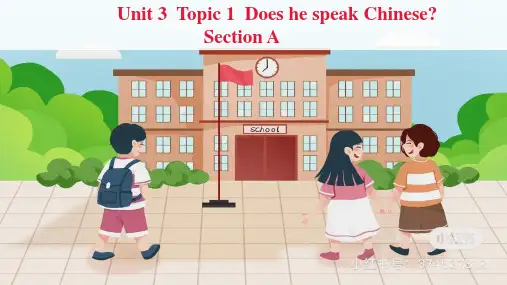
Jane: Sure. My name is Jane.
动宾
Li Xiang : Do you come from America?
Jane : No, I don’t. I come from Canada.
Li Xiang : Oh, I have a pen pal in Canada. He can speak some Chinese .
( 3 ) Do you come from China? ( 6 ) Yes, I can. But my English is not very good. Could you
help me with it?
Key points
Li Xiang : Excuse me, could you please tell me your name?
Watch and read 1a after the video.
Post-listening Group work
1c Work in pairs. Read 1a and practice the conversation.
Then make up a new one.
A: Excuse me, could you please tell…? B: Sure. My name is… A: e from...? B: No, …I come from… A: Oh, I have a pen pal in ...He/She can speak... Do you like...? B: Yes,... But my... not good ... Could you help ...with...? A: No problem.
2 Listen to the passage and fill in the blanks.
仁爱版英语七年级上册Unit 1 Topic 3 How old are you (Section ABCD)教学课件
QQ number
What’s your QQ number?
one
eleven
你 two
twelve
发 three
thirteen
现 four + teen = fourteen
规 five
fifteen
律 six + teen = sixteen
了 seven + te say.
Excuse me, what’s this in English?
(视频P19-1a)
map
eraser
It’s an eraser.
pen pencil desk
A: What’s this in English? B: It’s a pen. A: How do you spell it? B: P-E-N, pen. A: Thank you. B: That’s OK.
(录音P18-3)
Hello, Maria! What grade are you in?
I’m in _G__ra_d_e_ _S_e_v_e_n_.
Are you in Grade Seven, too?
Yes, I am.
Who’s that?
That’s Nancy.
How old is she? What class is she in?
A: What’s that in English? B: It’s a toy. A: Can you spell it, please? B: Yes. T-O-Y, toy. A: Thanks. B: You’re welcome.
It’s __a__b_o_o_k_.
What’s that in English?
教学课件英语人教版(2024版)七年级初一上册Starter Unit 3 Section A
rabbit /ˈræ bɪt/
animals
duck /dʌk/
goose /ɡuːs/ geese
/ɡiːs/
apple tree /ˈæpl triː/
tomato plant番茄植株
/təˈmeɪtoʊ plaːnt/
植物
plants
potato plant
/pəˈteɪtəʊ/
flower /ˈflaʊə/
Helen: What kind of tree is this?
Mr Fu: Nice to meet you too. Welcome to my house. Let me show you around. Helen: Thank you. Oh, what's that, Mr Fu? Is that a goose? Mr Fu:No, it isn't. It's a duck.
Warming up
Look at the video and talk about what you see in it.
Pre-reading
Q:What can you see from this farm?
农场里有什么好玩的?
√
√
√
√
√
While-reading
1b Peter introduces his uncle’s farm to Fu Xing. Read the text and circle the things he talks about in the picture in 1a.
/ʃɪps/
●rabbits /ˈræbɪts/
rabbits /ˈræbɪts/ plants /plaːnts/
仁爱版七年级英语上册Unit1Topic3SectionA教学设计
(一)教学重难点
1.重点:本章节的重点在于让学生掌握家庭成员及相关职业的词汇,并能运用一般现在时介绍家庭成员的职业。
2.难点:
(1)正确运用一般现在时描述家庭成员的职业,注意主语为第三人称单数时动词的变化。
(2)在真实语境中,运用所学词汇和句型进行流畅的口语交流。
(二)教学设想
-教师纠正发音,引导学生跟读。
2.新课内容呈现:利用多媒体课件,呈现本节课的重点句型和词汇。
-教师呈现句型:“My father is a doctor.”,引导学生注意一般现在时的动词变化。
-学生跟读,模仿句型,并进行角色扮演。
3.口语练习:设计“家庭成员职业介绍”的口语活动,让学生在实际情境中运用所学。
五、作业布置
为了巩固本节课的学习内容,提高学生的语言运用能力,特布置以下作业:
1.口语作业:请学生录制一段家庭成员职业介绍的视频,要求使用本节课所学的句型和词汇。学生可以自由选择家庭成员作为介绍对象,注意发音准确、语法正确。
2.写作作业:根据课堂所学的句型和词汇,完成一篇关于家庭成员职业介绍的短文。要求不少于50词,内容完整、结构清晰。
3.交流分享:各小组选派一名代表,汇报本组的讨论成果。其他学生认真倾听,互相学习。
4.教师点评:对各小组的讨论成果进行点评,给予鼓励和指导。
(四)课堂练习,500字
在这一环节中,我将设计一系列课堂练习,帮助学生巩固所学知识,提高语言运用能力。
1.口语练习:设计家庭成员职业介绍的口语练习,让学生两人一组进行练习。
2.句型运用:学生能够运用所学句型介绍自己家庭成员的职业,如:“My father is a doctor.”、“My mother is a teacher.”等。
仁爱版七年级上册英语优秀教学案例:Unit1Topic3SectionA
3.设计一系列与家庭成员相关的趣味游戏,如“家庭成员猜猜乐”,让学生在轻松愉快的氛围中学习英语。
4.通过角色扮演活动,让学生模拟真实场景,运用所学知识进行交流,提高他们的语言运用能力。
(二)问题导向
1.在教学过程中,我提出一系列问题,引导学生思考和探讨,如“你的家庭成员有什么特点?”“他们平时喜欢做什么?”等。
这些亮点体现了本节课在教学内容、教学方法、学生参与度和评价方式等方面的优势,为学生的全面发展和英语学习奠定了基础。同时,这些亮点也展示了作为一名特级教师,在教学设计和实施过程中对学生的关注和对教育事业的热爱。
3.在小组活动中,教师巡回指导,解答学生的疑问,帮助他们克服学习困难。
4.对小组合作成果进行展示和评价,让学生感受到团队合作的重要性,提高他们的自信心。
(四)反思与评价
1.课程结束后,引导学生进行自我反思,总结自己在课堂上的收获和不足,明确今后的学习目标。
2.通过学生自评、互评和教师评价,对学生的学习成果进行多元评价,提高他们的自我认知能力。
2.学生能够运用所学生家庭成员的词汇,进行简单的英语交流,如介绍自己的家庭成员。
3.学生能够理解并运用一般现在时的句型,如“My father is a teacher.”来描述家庭成员的职业。
4.学生能够通过听力练习,理解对话内容,并能运用所学的词汇和句型进行回答。
(二)过程与方法
1.通过图片展示、游戏活动等多样化的教学手段,激发学生的学习兴趣,提高他们的英语学习积极性。
2.鼓励学生互相交流、讨论,培养他们的团队合作能力和沟通能力。
3.在小组活动中,教师巡回指导,解答学生的疑问,帮助他们克服学习困难。
仁爱英语七年上册Unit 3 Topic 1Section B说课稿
Unit 3 Topic 1 Do you like English? Section BGood morning, everyone! My name is Liu Lu. Today, I’d like to talk about my teaching idea about Section B, Topic 1 of Unit 3 in Grade Seven, Project English. The main content of this topic is “Does he/she …?〞I have decided to say the topic from four parts.Part One: Analysis of the Teaching Material1. Status and Function1)To attain “four skills〞request of listening, speaking, reading and writing.2)To help the student learn how to get a pen pals.3)To raise learning interests of students and to improve their spoken English.2. Teaching Aims and DemandsA.Knowledge objects1)Learn some new words and phrases:live, say, visit, great, wall, the Great Wall2)To learn and master the sentence patterns about the simple present tense.--- Does he/she …?--- Yes, he/she does. / No. he/she doesn’t.--- What does he/she say…?--- He/She wants to …B.Ability objects1)To improve the students` abilities of listening, speaking, reading and writing.2)To train the students` ability of working in pairs.3)To develop the students` abilities of communication by learning the usefulstructures.C.Moral objects1)Make the students have successful feeling and achievement.2)Make the students be interested in English study.3)Encourage the students to be more creative.3. Teaching Keys and Difficult Points1)Be able to express words, phrases and sentences in English.2)Let students learn the usage and pronunciation rules of the –(e)s form of verbs inthe simple present tense.3)Let students learn to use simple sentence patterns to talk about pen pals and therelevant information.4. Teaching AidsTape recorder, Power point, one letter, BlackboardPart Two: Teaching Methods and Studying Ways1. Teaching Methods1)Communicative teaching methods;2)Audio-visual teaching methods;3)Task-based teaching methods.Purpose of my designing: I want to make the students the real masters in class while the teacher acts as director. I also hope to combine the language structures with the language functions and let the students receive some moral education while they are learning the English language.2. Studying Ways1) Teach the students how to be successful language learners.2) Make situation and provide meaningful duty, encourage the students to study the text by themselves.Part Three: Teaching ProcedureTask1 Warm-up and Lead-in1. Write down some key words on the blackboard, and ask students to make a dialog out according to these words. If the student can do it well, I will offer him/her a little gift.Key words: could, come from, pen pal. helpPurpose of my designing: In order to review the words and sentence patterns in Section A, at the same time, it will raise learning interests of students.2. Take out a letter to lead to the new lesson. Learn and master the new word “live〞. T: This is a letter. It’s from my friend, Sam. He is my pen pal. Now he lives in England.Purpose of my designing: In order to make the real situation, it is good for the students absorb the new knowledge easily.Task2 Presentation1. Listen to 1a by tape recorder and answer the following questions:1) Does Sam speak Chinese?2) Does Sam live in China now?3) Where does Sam want to visit? (Help students to answer.)Purpose of my designing: To make the students’ get the general idea of the text and also cultivate their ability to study independently.2. Show the picture of the Great Wall and quotes the sentence from the letter by PPT. Learn and master the new words and phrase “say〞, “visit〞, “great〞, “wall〞and “the Great Wall〞. For example:T: Please look at PPT. In the letter, he says he wants to visit the Great Wall. Purpose of my designing: After seeing the photos about the new words, the students can learn them quickly and easily.Task3 Consolidation and Practice1. Listen to 1a again by tape recorder and follow the tape by imitating the pronunciation and intonation. And then ask some students to act it out in pairs. Finish 1a.Purpose of my designing: To help students to get the general idea of the text and practice their abilities of reading.2. Let students discuss with their partner, and complete the conversation in 1b and check the answers. Finish 1b.Purpose of my designing: To cultivate students’abilities of communicating withothers.3. Summarize the sentence patterns by PPT and ask students to master the usage of the –(e)s form of verbs in interrogatives sentences of the simple present tense.1) --- Does he speak Chinese?--- No, he doesn’t.2) --- Does he live in England?--- Yes, he does.3) --- What does he say in the letter?--- He wants to visit the Great Wall.Purpose of my designing: To help students get the main content of this lesson.4. Listen to 2 and ask some students to read the questions and answers aloud. Then check the answer.Purpose of my designing: Let the students have the chance to practice the reading and speaking ability.5. Let students listen to 3 and follow the tape. I will write down the following verbs on the blackboard and compare them with their original forms.speaks →speakknows →knowhelps →helpwants →wantlives →liveAnd then I divide all the students into some groups, and ask every group to make a dialog by using the verbs as follows in the simple present sentence like 4. Finish 3 and 4.“have〞“like〞“want〞“know〞“speak〞“visit〞“help〞and “live〞Purpose of my designing: To develop students’ abilities of communicating with others. And also let students master the usage and pronunciation rules of the –(e)s form of verb in the simple present tense.Task4 Project and Homework1. Make a survey. Ask students to complete a table on the screen about their good friends according their basic information.Purpose of my designing: To develop the students2. HomeworkWrite a passage about the friend with the new sentence learnt this lesson.Purpose of my designing: To improve students’ ability of writing.Part 4 Blackboard DesigningPurpose of my designing: It is good for the students to review the knowledge in this lesson.OK. That’s all. Thanks for your attention.。