
新外研版七年级英语(下)module11-Unit2
Activity3 Check ( ) the body language you can
use in different countries and places.
Stand close Britain Middle East South America
Touch Look at people each other when talking
move /muːv/ v. 移动 not at all 一点也不
polite /pə'laɪt/ adj. 礼貌的 wave /weɪv/ v. 挥(手);招(手);摆(手) in fact 事实上 rude /ruːd/ adj. 粗鲁的;无礼的
1 Match the words with the parts of the body.
Unit 2 Here are some ways to welcome them.
Tantong Middle School Ma Liqing
1.掌握身体部位的词汇. 2.会使用祈使句。 3.了解一些不同的国家不同的肢体
语言。培养对不同文化的兴趣。
Review new words about My Body Parts
Yes,they can.
2.Do the British like touching people?
No,they don’t.
Read Paragraph 4 and 5,complete the questions.
1. Do Americans look at4 people when they talk? Yes, they do.
4. In Greece , it’s not at all polite.(翻译成中文) 在希腊,它一点也不礼貌。
5. __I_n_f_a_c_t__ (事实上),it’s very rude!
After reading
Where is the passage possibly from? A. A novel B. A magazine of English C. A dictionary
US
Fill in the blanks and retell(复述)the text.
You can stand _c_l_o_se__to_(靠近)people in the Middle East. Give them more__p_e_rs_o_n_a_l__s_p_a_c_e(个人空间 ). Chinese girls often walk _a_rm___in__a_r_m_(臂挽臂地)with their friends. Sometimes South Americans_h_o_l_d_ (握住) your
Middle East? Yes, it is.
can’t
2. When you talk to a friend ,you can stand too close to North Americans. ×
Read paragraph 3 and anwer the questions.
1.Can South Americans touch each other when talking?
E.South America F.The US
G.Greece
H.Canada
阅读技巧:带着问题读,快速转动脑筋,从原文中找答案.
Careful-reading
Read paragraph 2 carefully and check the true sentences .
1. Is it all right to stand close to people in the
them.
P5
Do you look ating tip:Pay attention to the first sentence.
Is body language the same in different countries?
Read through the passage ,and answer thequestions.
eye mouth
knee
finger
leg foot
Now, let’s play a game with your partner.
Use “Touch your…” or “Don’t touch your… ”
Imperative sentence
____B__e_ careful. (小心) D__o_n_’t__b_e_late for school.(不要迟到) ___D_o_n_’_t_touch your face.(不要)
1.Who is going to arrive very soon?
Our new foreign students.
2.What countries and places are they from?
A.The Middle East B.North America C.France
D.Britain
finger
fingers
mouth
nose
arm
tooth
two teeth
leg
two feet
knee
foot
foreign /'fɒrɪn/ adj. 外国的
personal /'pɜ ːsnəl/ adj. 个人的 arm in arm 臂挽臂地 hold /həʊld/ v. 握着;使不动
2. Do people in Greece wave goodbye? No, they don’t. It’s not polite.
3. In other countries it is rude to look somewhere else.(找出同义句)
In other countries it isn’t polite to look somewhere else.
1.无主语 2. 动词原形或don’t 开头
P1
How close do you stand when you
talk to a friend?
P2
How do you say goodbye?
P3
How about touching people?
P4
Here are some ways to welcome
外研版七年级下册英语Module11 Unit2 Here are some ways
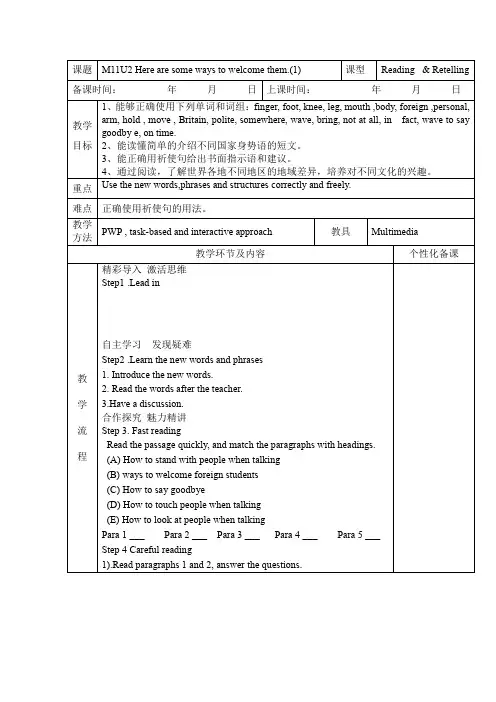
PWP , task-based and interactive approach
教具
Multimedia教学环节及内容个性来自备课教学流
程
精彩导入激活思维
Step1 .Lead in
自主学习发现疑难
Step2 .Learn the new wordsand phrases
1. Introduce the new words.
2. Which picture is right(正确的) for people in the Middle East?
2)Read para3 and choose the right answers.
Like holding your arm
Like walking arm in arm
Don’t like touching at all
2. In Greece , it’s not at all polite.(翻译成中文)
3. _________(事实上),it’s very rude!
Step5Post-reading
Watch the video to learn the passage better and check your pronunciation .
2、能读懂简单的介绍不同国家身势语的短文。
3、能正确用祈使句给出书面指示语和建议。
4、通过阅读,了解世界各地不同地区的地域差异,培养对不同文化的兴趣。
重点
Use the new words,phrases and structures correctly and freely.
难点
正确使用祈使句的用法。
Step6.Retelling
外研版七年级英语下册Module11 Unit2 课件

在谈到火车、汽车等或乘客等到站时,通常用 get in。 如:
The bus gets in at five thirty. 汽车五点半到站。
arrive 和 get 之后均可接 here, there, home 之类 的表地点的副词作状语。如:
There are many places of interest(名胜) in Paris .
Place de la Concorde in Paris协和广场
Arc De Triomphe 凯旋门
Cathedral of Notre Dame 巴黎圣母院
Versailles凡尔赛宫
the Seine River 塞纳河
6. When did they go to the Eiffel Tower? They went to the Eiffel Tower at about three o’clock.
7. How did they get to the Eiffel Tower? They went there by underground.
我想跳舞是个很好的恶消闲方式。 relaxed adj. 感到放松 (跟人有关) He was relaxed when he returned from his vacation last Sunday.
上星期天他度假回来感到很放松。
C
relaxing
relaxe
relaxed
Can you sell me some coffee? v. (sold) 卖;出售
Read Part 1 and answer the questions.
Module 11 Unit 2 课件 初中英语外研版七年级下册(29张PPT)
3.根据你的个人情况,回答下面的问题。 (1)Are you late for class? (2)Do you eat food in class? (3)Do you sleep in class? (4)Do you listen to the teacher carefully? (5)Do you talk in class?
听读练习 1.以小组的形式选出正确的问答语,并进行问答练习。 教师将 全班同学分为A、B两组,对不同地方的身体语言进行问答训练。 Group A: (1)Can you stand close to people in the Middle East? (2)Who sometimes hold your arm when they talk to you? (3)How do you say goodbye?
七年级·英语·外研版·下册
Unit 2 Here are some ways to welcome them.
◎课时重点: 1.熟练运用表示身体部位的单词,能对由不同助动词引导的 一般疑问句作出正确的回答。 2.了解祈使句的构成及其否定句的变化方法。
预习导学
一、填一填 1.全世界 around the world 2.靠近 close to 3.个人空间 personal space 4.……怎么样 how about... 5.臂挽臂地走路 walk arm in arm 6.移开 move away
A:Do the British like touching people? B:No, they don't. A:Do Americans look at people when they talk? B:Yes, they do. A:Do people in Greece wave to say goodbye? B:No, they don't.
外研版英语七年级下册Module 11 Unit 2《Here are some ways to w
外研版英语七年级下册Module 11 Unit 2《Here are some ways to welcome them》教学设计1一. 教材分析外研版英语七年级下册Module 11 Unit 2《Here are some ways to welcome them》主要介绍了如何欢迎新同学。
本节课的内容围绕如何与他人打招呼、介绍自己、询问他人情况等日常交流展开。
通过本节课的学习,学生能够更好地掌握日常英语交流用语,提高他们的口语表达能力。
二. 学情分析七年级的学生已经掌握了基本的英语语法和单词,具备一定的口语表达能力。
但是,他们在实际交流中还存在一定的困难,如不敢开口、发音不标准等问题。
因此,在教学过程中,教师需要关注学生的心理素质,鼓励他们大胆开口,提高他们的口语表达能力。
三. 教学目标1.知识目标:–能够熟练朗读并理解课文内容;–掌握日常英语交流用语,如问候、介绍自己、询问他人情况等;–学会如何欢迎新同学。
2.能力目标:–提高学生的口语表达能力;–培养学生的团队合作精神。
3.情感目标:–增强学生对英语学习的兴趣;–培养学生积极向上的学习态度。
四. 教学重难点•熟练朗读并理解课文内容;•掌握日常英语交流用语。
•如何在实际交流中运用所学知识;•提高学生的口语表达能力。
五. 教学方法1.情境教学法:通过设定真实的生活情境,让学生在实际交流中运用所学知识;2.任务型教学法:通过完成小组任务,培养学生团队合作精神;3.激励评价法:鼓励学生大胆开口,提高他们的自信心。
六. 教学准备1.准备课文相关图片和视频资料;2.准备课堂活动所需道具;3.制作课件。
七. 教学过程1.导入(5分钟)教师通过展示图片和视频,引出本节课的主题——如何欢迎新同学。
激发学生的学习兴趣,营造轻松愉快的课堂氛围。
2.呈现(10分钟)教师朗读课文,学生跟读。
引导学生关注课文中的日常英语交流用语,如问候、介绍自己、询问他人情况等。
外研英语七年级下册Module11Unit 2(共16张PPT)

South America
√
Don't Stand close stand too
close
Touch each other
Don't touch each other
Look at people when talking
Don't wave to say goodbye
Britain
√√
US Greece
Module 11 Body language Unit2 Here are some ways
to welcome them.
What body languages did you do just now?
Game time!
1.Two students each group.
2.One will do body language, the other will guess.
When do we use body language?
Fast reading!
Read the passage quickly and finish Activity 1 in handouts.
Careful reading!
Read the passage aloud ,finish the table in handouts.
哑人),body language is quite
important.
Homework 1.Finish Activity4 on P69. 2.Retell the passage again. 3.Finish your class rules and
make it better.
1.Stand up when you answer a question in class. 2.Be polite to the teacher. 3.Don’t be late for class. 4.Don’t eat food in class.
外研版七年级英语下册Module11 Unit2 Here are some ways to wel

eye finger foot knee
1 eye 2 mouth
3 finger
leg mouth
4 knee
5 leg 6 foot
Fast reading
How many kinds of body languages are mentioned in the passage? What are they?
n. 外国人 北美人
personal arm
arm in arm South American
hold move Britain British
adj. 个人的 n. 臂;手臂 臂挽臂地 南美人 v. (held) 握着;使不动 v. 移动 不列颠;英国
不列颠的;英国的
ห้องสมุดไป่ตู้
not… at all polite
Four.
① stand close or far ② touch people ③ look at people or not look at people ④ say goodbye
Read paragraph 1 and 2
Who is going to arrive very soon?
Lingling’s new foreign students.
--What do people do when they meet in India? --They __p_u_t_ _t_h_e_ir_ _h_a_n_d_s_ _to_g_e_t_h_e_r__ and _n_o_d__th_e_i_r__ _h_e_a_d_s___.
外研版英语七年级下册Module11Unit2Here+are+some+ways+to
语言点精析
要点1:(P68)You can stand close to people in the Middle East but don't stand too close to North Americans!
在中东,你可以站得离人们近些,但是不要站得离北美人 太近!
【重点探究1】 close作副词,意为“接近地”,常用短语:close to意为 “离……近”。
( T )5.In Greece, it isn't polite to wave to say goodbye.
二、请认真阅读教材P68课文内容,把下面的短文补充完 整
Here are some 1.___w_a_y_s__ to welcome new foreign students.In 2.___B_r_i_ta_i_n___,people don't like to touch others, but in South America, they like to 3.___h_o_l_d__ your arm so you can't 4.__m__o_v_e__ away.Remember to 5.___g_iv_e___ someone from North America lots of 6.___p_e_r_s_o_n_a_l__ space.In some countries, it isn't 7.___p_o_li_t_e___ to look at people when you talk.And it isn't polite to 8.___w_a_v_e__ to say goodbye in Greece.In 9.___f_a_c_t __,it's quite 10.__r_u_d_e___.
外研版英语七年级下册Module 11 Unit 2《Here are some ways to w
外研版英语七年级下册Module 11 Unit 2《Here are some ways to welcome them》教学设计一. 教材分析外研版英语七年级下册Module 11 Unit 2《Here are some ways to welcome them》主要介绍了如何欢迎新同学。
通过本节课的学习,学生能够掌握相关词汇和句型,并运用所学知识进行实际交流。
教材内容丰富,实用性强,有利于提高学生的英语应用能力。
二. 学情分析七年级的学生已经具备了一定的英语基础,能够听、说、读、写简单的英语句子。
但部分学生对英语学习仍存在恐惧心理,缺乏自信心。
因此,在教学过程中,教师需要关注学生的情感态度,鼓励他们积极参与课堂活动,提高他们的学习兴趣。
三. 教学目标1.知识目标:学生能够掌握表示欢迎的词汇和句型,如“Here are someways to welcome them.”, “How about…?”, “I think…is a good idea.”等。
2.能力目标:学生能够用英语谈论如何欢迎新同学,并进行实际交流。
3.情感目标:学生能够积极参与课堂活动,提高学习英语的自信心。
四. 教学重难点1.重点:表示欢迎的词汇和句型的运用。
2.难点:如何运用所学知识进行实际交流。
五. 教学方法1.任务型教学法:通过完成具体任务,让学生在实践中学习和运用英语。
2.情境教学法:创设真实的情境,让学生在实际环境中学习和运用英语。
3.情感教学法:关注学生的情感态度,鼓励他们积极参与课堂活动。
六. 教学准备1.教材:外研版英语七年级下册Module 11 Unit 2《Here are someways to welcome them》。
2.课件:教学课件,包括图片、视频等素材。
3.练习册:配套练习册。
七. 教学过程1.导入(5分钟)教师通过向学生介绍一位新同学,引发学生对如何欢迎新同学的思考。
提问学生:“如果你是这位新同学,你希望同学们如何欢迎你?”让学生发表自己的想法。
外研版七年级英语下册Module 11 Unit 2 Here are some ways to w
单词拼写根据句意及首字母或汉语提示完成句子中的单词【1】He hurt one of his f______ when he cut the apple.【2】Betty and Tony are Lingling's f______ friends.【3】The girl quickly h______ the key in her hand when she found it.【4】The earth m______ around the sun and the moon goes around the earth.【5】I can't find my glass. I must put it s______.【6】It's ______ (粗鲁的) to speak to old people like that!【7】In Japan, it's ______ (礼貌的) for people to bow to each other.【8】The nice little dog ______ (挥;摆) its tail happily yesterday, welcoming the owner back home.【9】You'd better put a piece of cloth on your ______ (膝盖) during the dinner.【10】I tried again to speak to him, but no word came out of my______ (嘴).【答案】【1】fingers【2】foreign【3】held【4】moves【5】somewhere.【6】rude【7】polite【8】waved【9】knees【10】mouth【解析】【1】句意:他切苹果时伤到了一根手指。
根据He hurt one of his f___when he cut the apple.结合首字母提示,可知句意为:他切苹果时伤到了一根手指。
外研版七年级下册英语Module11Unit2说课稿
外研版七年级下册英语Module 11 Unit 2说课稿一. 教材分析外研版七年级下册英语Module 11 Unit 2的主要内容是关于野生动物的保护。
教材通过介绍野生动物的生活习性和面临的威胁,引导学生关注野生动物保护的重要性,提高他们的环保意识。
本课的主要语言知识点包括一般现在时态的被动语态、一般过去时态的被动语态以及情态动词must的用法。
二. 学情分析七年级的学生已经掌握了基本的英语语法知识,对一般现在时态和一般过去时态有一定的了解。
但是,他们对被动语态的运用还不够熟练,需要通过练习来提高。
此外,学生对野生动物的了解有限,通过本课的学习,可以拓宽他们的视野。
三. 说教学目标1.知识目标:学生能够掌握一般现在时态的被动语态、一般过去时态的被动语态以及情态动词must的用法。
2.能力目标:学生能够运用所学的语言知识,进行简单的交流和讨论。
3.情感目标:学生能够提高环保意识,关注野生动物的保护。
四. 说教学重难点1.教学重点:学生能够掌握一般现在时态的被动语态、一般过去时态的被动语态以及情态动词must的用法。
2.教学难点:学生能够灵活运用被动语态进行交流和讨论。
五. 说教学方法与手段本课采用任务型教学法,通过小组合作、讨论等形式,激发学生的学习兴趣,提高他们的参与度。
同时,利用多媒体手段,如图片、视频等,帮助学生更好地理解课文内容。
六. 说教学过程1.导入:教师通过展示野生动物的图片,引导学生谈论野生动物,激发学生的学习兴趣。
2.新课呈现:教师通过播放课文动画,让学生整体感知课文内容。
然后,教师带领学生逐句学习课文,讲解新知识点。
3.课堂练习:教师设计不同难度的练习题,让学生进行小组讨论,巩固所学知识。
4.拓展活动:教师学生进行角色扮演,模拟野生动物保护的场景,提高学生的实际应用能力。
5.总结:教师对本课的主要内容进行总结,强调野生动物保护的重要性。
七. 说板书设计板书设计如下:野生动物保护一般现在时态的被动语态一般过去时态的被动语态情态动词must的用法八. 说教学评价教学评价采用形成性评价和终结性评价相结合的方式。