
闽教版小学英语四年级上册Unit 5 Daily-Activities
小学四年级英语上,,Unit5,partB,Daily Activities,全英文面试说课稿(闽教版)
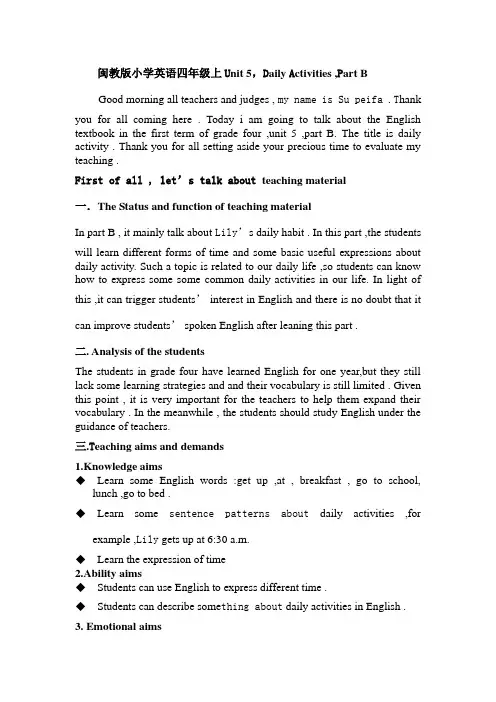
闽教版小学英语四年级上U nit 5,D aily A ctivities ,P art BGood morning all teachers and judges , my name is Su peifa .T hankyou for all coming here . Today i am going to talk about the English textbook in the first term of grade four ,unit 5 ,part B. The title is daily activity . Thank you for all setting aside your precious time to evaluate my teaching .First of all , let’s talk about teaching material一.The Status and function of teaching materialIn part B , it mainly talk about Lily’s daily habit . In this part ,the studentswill learn different forms of time and some basic useful expressions about daily activity. Such a topic is related to our daily life ,so students can know how to express some some common daily activities in our life. In light of this ,it can trigger students’ interest in English and there is no doubt that itcan improve students’ spoken English after leaning this part .二. Analysis of the studentsThe students in grade four have learned English for one year,but they still lack some learning strategies and and their vocabulary is still limited . Given this point , it is very important for the teachers to help them expand their vocabulary . In the meanwhile , the students should study English under the guidance of teachers.三.T eaching aims and demands1.Knowledge aims◆ Learn some English words :get up ,at , breakfast , go to school,lunch ,go to bed .◆ Learn some sentence patterns about daily activities ,forexample ,Lily gets up at 6:30 a.m.◆ Learn the expression of time2.Ability aims◆ Students can use English to express different time .◆ Students can describe some thing about daily activities in English .3. Emotional aims◆ Cultivate students’ ability to work in group◆ Foster students’ awareness of time◆ Enhance students’ interest in learning English四.The difficult and key points of this class◆ The expression of time◆ Use English to express some daily activities五.Teaching aids :computer and clock,chalkSecond ,let’s talk about t eaching and studying methods◆ Student-centering learning:many teachers often ignorestudents’roles in class. As a matter of fact ,it is not right .Teachers should know more about students’ feature and then ask them to give a response in due course.◆ Activity learning:students tend to lack interest in learningenglish . The best way to enhance their motive to learn is activity ,because most of students like activity .◆ Group work : ask students to find partners to make a dialogueby using some related vocabulary and sentence patterns that they have learned in this class . They can have a better understanding of language points by doing so.Third, let’s talk about t eaching procedure sStep one warm-upWhen i come into the classroom , i will sing an english song for students:it is time to go to school. After that ,i will draw a clock in the blackboard and ask students if they know how to say clock in English .If so ,it is indisputable that they will have interest in this topic,which will undeniably arouse students’attention and their efficiency will be also enhanced.Step two lead-in/presentation◆ The teacher will ask students what time it is now . Students will beeager to know how to express time in English. During that t i me i will teach them the correct ways to express different forms of time.◆ Ask some students to look at the picture 1 in page 38 and require themto speak the time that shows in that clock .◆ Learn some useful new words and expressions :get up ,has breakfast,go to school ,go home ,have lunch and so on .◆ The teacher will lead students to read the text in part B ◆ Talk about students’daily habits or activities and then ask them ifthey know how to express it in English . For example,when do they often go to school ?◆ The teacher teach the exact meaning and some useful expressions ofthe text.Step three practice◆ Ask students to listen to radio in page 38 again and then imitate it◆ Ask students turn to page 39 and then fill in the blank according torelated pictures,for example ,Lily gets up at 6:30 a.m. She has breakfast at 6:45/.........................◆ The students will be required to answer the question one by one◆ Learn the pronunciation of ck ,such as duck and clock .Step four consolidation◆ Ask students to look at the the picture in page 38 and make a responseto speak the daily activities of Lily one by one .◆ Ask students to work with their partners and talk about their dailyactivities by using the useful expressions that they have learned in this class.Step 5 general reviewReview what they have leaned in this class and make a conclusion so that they can get a better deeper comprehension of the language.Homework1.Ask them to memorize the new words and useful expressions2.Ask them to review what they have leaned in this class.3.Ask them to find a partner and then make a dialogue . They will be required to practice it in class next time .。
闽教版四年级英语上册:unit_5_《daily_activities》_教案【精品】
Unit 5 Daily Activities 教案教学目标◆语言知识目标1.学习单词bus,car和短语get into,get up,have breafast,go to school。
2.学习句型When do you...?3.学习字母c在单词中的读音。
4.学唱歌曲:It’s Time to Go to School.5.功能:描述日常活动。
◆语言技能目标1.能够认读和正确书写单词bus,car和短语get up,have breafast,go to school。
2.能够用句型When do you...?和At....表达日常活动的时间。
◆情感态度珍惜时间,养成良好生活作息习惯。
教具准备1.单词和词组卡片:bus,car,get up,have breafast,go to school等。
2.时钟、玩具公共汽车和小汽车。
3.录音机或教学光盘。
教学过程Step 1 Warming up1.师生互致问候。
2.欣赏歌曲:It’s Time to Go to School.Step 2 Revision1.复习数字。
(1)游戏——快速抢答。
游戏规则:教师出示单词卡片one至twelve,学生快速并大声地朗读。
先按顺序读,再随机抽取卡片读。
(2)游戏——数字接力。
游戏规则:教师说twenty,学生快速说twenty-one。
教师说twenty-nine,学生快速说thirty。
以此类推。
2.复习时间表达法。
教师出示一个时钟,拨动时钟,问:“What’s the time?”请学生说出钟面上的时间。
Step 3 Presentation(一)导入并揭示课题1.教师将时钟上的时间拨到六点三十分,当学生说出时间后,教师说:“It’s si thirty. I get up at si thirty.”用动作帮助学生理解get up的意思,然后板书:at si thirty。
2.教师将时钟上的时间拨到七点,当学生说出时间后,教师说:“It’s seven o’cloc. I have breafast at seven o’cloc.”用动作帮助学生理解have breafast的意思,然后板书:at seven o’cloc。
新闽教四上Unit 5 《Daily Activities》 教案
Unit 5 Part B 教案教学目标◆语言知识目标1.学习单词bedroom,floor,water,plant,toilet和词组make my bed,clean my room,wash my clothes,water the flowers等。
2.学习句型:Now clean your bedroom.First make the bed.Then pick up the toys on the floor.Please help me clean the toilet.Can you…?Yes,I can.3.学说韵律诗:What Can I Do?4.功能:谈论自己会做的家务事。
◆语言技能目标1.能正确认读和书写有关做家务的语句。
2.能就做家务这一话题做简短叙述。
◆情感态度教育学生在日常生活中要学会做力所能及的家务事,为家长分担日常繁杂的生活重担。
教具准备1.卡片:(1)单词卡片toilet,bedroom,water,plant,floor等。
(2)词组卡片clean the bedroom,clean the toilet,make the bed,water the flowers,water the plants等。
2.“叠被子”“浇花”“浇植物”“玩具”“卫生间”等图片。
3.录音机或教学光盘。
教学过程Step 1 Warming up1.师生互致问候。
2.听录音,齐唱歌曲:Pick Up Your Toys。
3.揭示并板书课题:Unit 5 Housework Part B。
Step 2 Revision1.请学生出示上节课的作业:“用英语写出你所做过的家务”,个别学生口头展示作业。
2.教师将学生所说的语句写在黑板上。
3.学生熟读黑板上的句子。
Step 3Presentation(一)初读课文,理解课文大意。
1.教师出示下面的练习:Sally’s mother Sally Ben Kate2.教师说:“Sally’s family will do some housework today.What do they want to do?Let’s listen and connect.”3.教师播放课文录音,学生认真听,然后完成练习。
闽教版四年级英语上册课件Unit 5 Daily Activities Part A-3
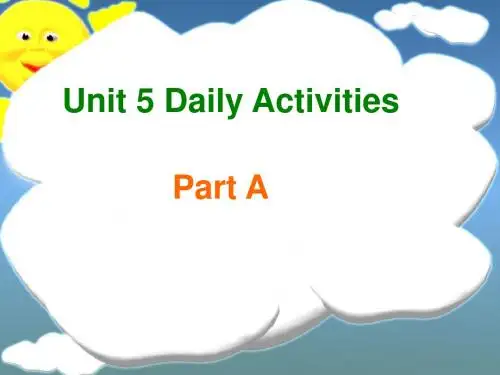
When do you get up?
你什么时候起床?
I get up at six forty-five. 或 At six forty-five.
When do you have breakfast?
你什么时候吃早餐?
When do you go to school?
when:什么时候
你什么时候去上学?
A: I get up at six thirty. When do you get up?
B: I get up at six thirty. When do you get up?
C: …
get up 起床 have breakfast吃早餐 go 下你的日常活动作息时间
I get up at six thirty. I have breakfast…
Listen and learn the English sounds
cat card
cow cake
1.《活》U5PA 2.背U5PA课文、单词 3.准备听写U5PA单词 4.预习U5PB
seven o’clock. breakfast
我7点吃早餐。
have
breakfast吃早餐
12
9
3
6
I go to school at seven twenty-five.go to school
我7点25分去上学。 去上学
bus car
The bus is full. 公交车 满了。
Get into the car. 上车。
Unit 5 Daily Activities Part A
What’s the time?
It’s…
12
四年级上册英语课件Unit5DailyActivities闽教版
have lunch
farmer nurse teacher
dancer
doctor
singer pilot
policeman
单数第三人称 动词 后缀 s / es get --- gets go --- goes 不规则变化 have --- has
Learn to arrange your time.
get up go to school go home
he she 单数第三人称
gets up
6:30
goes to school 7:15
goes home 16:30
go to bed
goes home 21:00
(猜谜语)
砸T or F 金蛋,都会有意
外的惊喜等着你!
( ) 1. She ggooestotosscchhooooll. at 7:15.
T
FF
( ) 2. You get up at 6 a.m.
TT
F
( ) 3. He ggoetsotobbeedd. at 9 p.m
T
FF
( ) 4. I go home at 5 p.m.
TT
F
( ) 5. She gets up at 6 a.m.
TT
F
( ) 6. I ggooees to sscchhooooll. at 7 a.m
Lily goes to school at 7:15 a.m .
LLLilyiillgyyoggesoetehssoumtopebaet d46::3a30t09pa.mp.m.m. . .
goes home goes to bed
Unit5DailyActivities(课件)闽教版英语四年级上册

Read and find
a.m是拉丁语ante meridiem(上午,午前)的缩写。 p.m是拉丁语post meridiem(过午,下午)的缩写。
Unit5 Daily Activities
Sally's daily schedule
Name get up
Sally
6:45
have breakfast
go to school
7:00
7:25
get
get
get up
breakfast breakfast have breakfast
go
go
go to school
Whose daily activities are these?
What activities are in the video?
have lunch
lunch
have lunch 吃午饭 I have lunch at 12:00.
go to bed
go to bed 去睡觉
第三人称单数形式
get-gets go-goes do-does have-has
注意动词的第三人称单数形式: 如果句子的主语是第三人称单数,即:he, she, it或单
数名词时,动词要用第三人称的单数形式。 Lily gets upat 6:30 a.m.莉莉在早上6:30起床。 She has breakfast at 6:45 a.m.她在早上6:45吃早饭。 She goesto school at 7:15 a.m.她在早上7:15去上学。
闽教版英语四年级上册Unit 5《Daily Activities》(Part B)ppt课件1
( ) 1. She ggooestotosscchhooooll. at 7:15.
T
FF
( ) 2. You get up at 6 a.m.
TT
F
( ) 3. He ggoetsotobbeedd. at 9 p.m
T
FF
( ) 4. I go home at 5 p.m.
go to bed 22:30
10:30 p.m
bred a red bed
Schedule
get up
6:50 a.m
go to school 7:20 a.m
go home 17:00 p.m go to bed 22:30 p.m
Lily
???
Schedule
gets up
6:30 a.m
go to bed
have lunch
farmer nurse teacher
dancer
doctor
singer pilot
policeman
单数第三人称 动词 后缀 s / es get --- gets go --- goes 不规则变化 have --- has
Learn to arrange your time.
Schedule
I you
单数第一,二人称
get up go to school go home
he she 单数第三人称
gets up
6:30
goes to school 7:15
goes home 16:30
go to bed
goes home 21:00
(猜谜语)
砸T or F 金蛋,都会有意
四年级英语上册Unit5DailyactivitiesPartA PPT精品课件2(新版)闽教版
1、只要有坚强的意志力,就自然而然地会有能耐、机灵和知识。2、你们应该培养对自己,对自己的力量的信心,百这种信心是靠克服障碍,培养意志和锻炼意志而获得的。 3、坚强的信念能赢得强者的心,并使他们变得更坚强。4、天行健,君子以自强不息。5、有百折不挠的信念的所支持的人的意志,比那些似乎是无敌的物质力量有更强大 的威力。6、永远没有人力可以击退一个坚决强毅的希望。7、意大利有一句谚语:对一个歌手的要求,首先是嗓子、嗓子和嗓子……我现在按照这一公式拙劣地摹仿为:对 一个要成为不负于高尔基所声称的那种“人”的要求,首先是意志、意志和意志。8、执着追求并从中得到最大快乐的人,才是成功者。9、三军可夺帅也,匹夫不可夺志也。 10、发现者,尤其是一个初出茅庐的年轻发现者,需要勇气才能无视他人的冷漠和怀疑,才能坚持自己发现的意志,并把研究继续下去。11、我的本质不是我的意志的结果, 相反,我的意志是我的本质的结果,因为我先有存在,后有意志,存在可以没有意志,但是没有存在就没有意志。12、公共的利益,人类的福利,可以使可憎的工作变为可 贵,只有开明人士才能知道克服困难所需要的热忱。13、立志用功如种树然,方其根芽,犹未有干;及其有干,尚未有枝;枝而后叶,叶而后花。14、意志的出现不是对愿 望的否定,而是把愿望合并和提升到一个更高的意识水平上。15、无论是美女的歌声,还是鬓狗的狂吠,无论是鳄鱼的眼泪,还是恶狼的嚎叫,都不会使我动摇。16、即使 遇到了不幸的灾难,已经开始了的事情决不放弃。17、最可怕的敌人,就是没有坚强的信念。18、既然我已经踏上这条道路,那么,任何东西都不应妨碍我沿着这条路走下 去。19、意志若是屈从,不论程度如何,它都帮助了暴力。20、有了坚定的意志,就等于给双脚添了一对翅膀。21、意志坚强,就会战胜恶运。22、只有刚强的人,才有神 圣的意志,凡是战斗的人,才能取得胜利。23、卓越的人的一大优点是:在不利和艰难的遭遇里百折不挠。24、疼痛的强度,同自然赋于人类的意志和刚度成正比。25、能 够岿然不动,坚持正见,度过难关的人是不多的。26、钢是在烈火和急剧冷却里锻炼出来的,所以才能坚硬和什么也不怕。我们的一代也是这样的在斗争中和可怕的考验中 锻炼出来的,学习了不在生活面前屈服。27、只要持续地努力,不懈地奋斗,就没有征服不了的东西。28、立志不坚,终不济事。29、功崇惟志,业广惟勤。30、一个崇高 的目标,只要不渝地追求,就会居为壮举;在它纯洁的目光里,一切美德必将胜利。31、书不记,熟读可记;义不精,细思可精;惟有志不立,直是无着力处。32、您得相 信,有志者事竟成。古人告诫说:“天国是努力进入的”。只有当勉为其难地一步步向它走去的时候,才必须勉为其难地一步步走下去,才必须勉为其难地去达到它。33、 告诉你使我达到目标的奥秘吧,我唯一的力量就是我的坚持精神。34、成大事不在于力量的大小,而在于能坚持多久。35、一个人所能做的就是做出好榜样,要有勇气在风 言风语的社会中坚定地高举伦理的信念。36、即使在把眼睛盯着大地的时候,那超群的目光仍然保持着凝视太阳的能力。37、你既然期望辉煌伟大的一生,那么就应该从今 天起,以毫不动摇的决心和坚定不移的信念,凭自己的智慧和毅力,去创造你和人类的快乐。38、一个有决心的人,将会找到他的道路。39、在希望与失望的决斗中,如果 你用勇气与坚决的双手紧握着,胜利必属于希望。40、富贵不能淫,贫贱不能移,威武不能屈。41、生活的道路一旦选定,就要勇敢地走到底,决不回头。42、生命里最重 要的事情是要有个远大的目标,并借助才能与坚持来完成它。43、事业常成于坚忍,毁于急躁。我在沙漠中曾亲眼看见,匆忙的旅人落在从容的后边;疾驰的骏马落在后头, 缓步的骆驼继续向前。44、有志者事竟成。45、穷且益坚,不坠青云之志。46、意志目标不在自然中存在,而在生命中蕴藏。47、坚持意志伟大的事业需要始终不渝的精神。 48、思想的形成,首先是意志的形成。49、谁有历经千辛万苦的意志,谁就能达到任何目的。50、不作什么决定的意志不是现实的意志;无性格的人从来不做出决定。我终 生的等待,换不来你刹那的凝眸。最美的不是下雨天,是曾与你躲过雨的屋檐。征服畏惧、建立自信的最快最确实的方法,就是去做你害怕的事,直到你获得成功的经验。 真正的爱,应该超越生命的长度、心灵的宽度、灵魂的深度。生活真象这杯浓酒,不经三番五次的提炼呵,就不会这样可口!人格的完善是本,财富的确立是末能力可以慢 慢锻炼,经验可以慢慢积累,热情不可以没有。不管什么东西,总是觉得,别人的比自己的好!只有经历过地狱般的折磨,才有征服天堂的力量。只有流过血的手指才能弹 出世间的绝唱。对时间的价值没有没有深切认识的人,决不会坚韧勤勉。第一个青春是上帝给的;第二个的青春是靠自己努力的。不要因为寂寞而恋爱,孤独是为了幸福而 等待。每天清晨,当我睁开眼睛,我告诉自己:我今天快乐或是不快乐,并非由我所遭遇的事情造成的,而应该取决于我自己。我可以自己选择事情的发展方向。昨日已逝,
最新四年级英语上册Unit5DailyactivitiesPartA2(新版)闽教版优选教学课件
男孩冷静的和鱼进行拉锯战,但是强大的水流加上大鱼有力地挣扎,孩子渐渐地被拉到布满漩涡的下游深水去的边缘。我知道一但鲑鱼到达深水区就可以轻而易举地逃脱了。孩子的父亲虽然早把自己的钓竿他在一旁,但一言不发,只是站在原地关注着儿子的一举一动。
蕊敏在街上看见叶小天,会跟了过去。也不打招呼,只是不远不近地跟着,看着那背影心里涩涩的。
三 怎么就变成左撇子了
是蕊敏在看蜡笔小新时,叶小天来敲的门。她开门的时候吓了一跳,看了一眼又“咚”的一声把门关上了。心蹦蹦跳,然后冲进洗手间理理头发,再去开门。 叶小天非常严肃地说,杨蕊敏同学你太伤人自尊了吧,上次当我是匪徒,这次又当我是小偷了吗?我不过是你妈妈请来给你补习数学的老师。忘记告诉你,小时候我们住在一个院子里,不过你太小,估计忘记了。
14.在稠人广众之中或者车水马龙的街头,听一首老歌,独自回味自己的心事。 15.在人群中遇到一个和自己喜欢同一个品牌的人,彼此接近,更发现还有很多相同和相通。 16.有一天突然发现自己获得了与环境融洽相处的能力,比如,在给朋友当伴娘的时候,你是新娘之外,显得最出众的女人,不抢朋友的风头又给朋友长了脸,你够仗义;做配角也是最优秀的,你除了称职还不委屈自己。
你会因为一首歌曲,一种颜色,想起他,想起他的真挚,想起他的执着,想起他那曾经一起经历过的风风雨雨。因为有了这样一个朋友,你会更加珍惜自己的生命,热爱自己的生活,因为你知道他希望你过的很好,他希望你能好好的照顾自己,再见面时,他希望你能告诉他你很幸福。
那些世俗的观念,在你的心中,因为他的存在而变的苍白无力,你只是在心底深处为这个人设置了一处小小的空间,静静地固守着那份美好的回忆,从一开始你就知道,在你们之间不会有什么爱情,似乎谈起爱情就亵渎了这份情感,这只能是一种友情。这到底是怎么一回事呢?你想了许多年,却始终没有头绪。
闽教版英语四年级上册 Unit 5 Daily Activities
Unit 5 Daily Activities
Part B
Enjoy the music
Review
get up
5:30
go to school
go home
have breakfast
Review
get up go to school go home have breakfast
起床 去上学 回家 吃早饭
Lily gets up at 6:30 a.m.
Lily has breakfast at 6:45 a.m.
Lily has lunch at 12:00.
Lily goes to school at 7:15 a.m.
主语是
主语是
非L单ily数g第o三e人s 称to时s,ch用o动o词l a原t形7:15 a单.m数.第三人称(he,she,
Ask and answer
你什么时候…?
When do you get up ? When do you go to school ? When do you go home ?
When do you have breakfast ?
Let’s chant
Tick, tock, tick, tock. It’s time to get up. Tick, tock, tick, tock It’s time to go to school.
Let’s learn
bus
The bus is coming!
Let’s learn
car
The car is coming!
Let’s learn
school
When do you go to school ?