
2019-2020学年人教版高中英语必修3教案Unit2Healthyeatingperiod2教案1
Unit2 Grammar
Grammar—Modal Verbs
1. Teaching Analysis 教情分析
1) Teaching objectives
Students will be able to understand and learn to use the following modal verbs: ought to/ ought not to/ have to/
don’t have to/ mustn’t/ needn’t to show duty, possibility, guessing, etc.
2. Student analysis学情分析
1) Knowledge reserve知识储备
Students have learnt the basic usage of several modal verbs in Unit 1, their meanings and how to use them to
show intention, duty, permission, possibility, guessing and ability, which sets foundation for their further
understanding of the targeted modal verbs.
3. Teaching Procedures
Step I Revision: Review what has been learnt in previous lessons. Make clear that we can use modal words
in a sentence to show “intention, duty, permission, possibility, guessing and ability”. Provide some examples if
necessary.
1. can and could
Jim isn’t very good at math or science, but he can speak English very well.
The hunters have been lost for days. They could starve.
Could you please show me the way to Beihai Park.
2. may and might
What award did you get for the sports competition? May I have a look?
Our football team didn’t play very well today, but we might do better tomorrow.
3. will and would
During the Spring festival time the whole family will come for dinner.
My uncle was poor but liked fashion, so he would often dress up as a rich man.
Are you free this Saturday? Would you like to join my family for dinner? 4. shall and should
The harvest festival begins on Sunday. We shall be there with our friends before that.
When going by plane, you should arrive at the airport at least one hour early.
It’s nearly time for class to start. The teacher should be here soon.
5. must and can’t
When you eat fish, you must be careful with bones.
Wang Feng has won the English competition three times. He must be very smart.
A man landed on Mars? You must be joking. That can’t be true.
Step Ⅱ Underline the sentences containing modal verbs in the reading passage and label each sentence with
the function of the modal verbs used—intention, duty, permission, possibility, guessing and ability. (page13,
Exercise 1)
1. Underline the sentences containing modal verbs in the reading passage and use the function words below to
explain the meaning of modal verbs.
Intention Duty Permission Possibility Guessing Ability
Suggested answers:
Then by lunchtime they would all be sold. (possibility)
By now his restaurant ought to be full of people. (possibility)
What could have happened? (possibility)
Something terrible must have happened if… (guessing)
I’ll help you lose weight… (intention)
He could not believe his eyes. (ability)
Perhaps he should go to the library and find out. (duty)
He could not have Yong Hui getting away with telling people lies! (intention)
He had better do some research. (duty)
Even though her customers might get thin after eating Yong Hui’s food. (possibility)
They would become tired very quickly. (possibility)
…could win his customer back. (ability)
Step Ⅲ Explain the meaning and basic usage of the following modal verbs:
Modal verbs Function & Examples
ought to
ought no to In most occasions, ought to means should and ought not to means
shouldn’t.
eg: You ought to (should) finish the paper on time.
You ought not to (shouldn’t) waste all you time playing video games.
have to It shows necessity, which is impersonal but for a rule or a situation while
must usually shows strong order from a person.
eg: I have to go now or I will miss the bus.
don’t have to
don’t need to They show not necessary to do something.
eg: You don’t have to (you don’t need to) read the whole book—you can
read just some chapters if you don’t have time.
mustn’t It shows prohibition.
eg: The little mustn’t play with the knife—it is too dangerous.
Step Ⅳ Using proper modal verbs to fill in the conversations. Exercise 2 and Exercise 1 on page 50.
1. Choose suitable modal verbs from below to compete the following dialogues. There may be more than one
possibilities.
ought/oughtn’t to should/shouldn’t mustn’t
needn’t(don’t have to) will can/can’t
① SAM: How can I grow thinner, Mum?
MUM: Well, you __________ eat food with plenty of fiber that helps you digest better and you __________
stop drinking cola or eating sweet food.
SAM: Does it mean I __________ eat my favorite fried chicken any more?
MUM: Not exactly, if you love fried chicken, you __________ give it up. Just eat it less often. You
__________ worry too much: a little fried chicken __________ do you good!
② DOCTOR: You are sick because you’ve eaten poisonous mushrooms. Where did you get them?
高中英语必修3Unit+2+Healthy+eating7+教案+
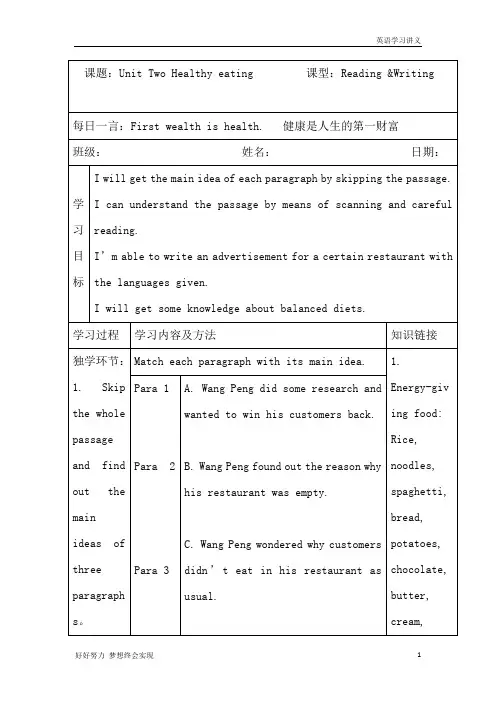
英语学习讲义
好好努力 梦想终会实现 1 课题:Unit Two Healthy eating 课型:Reading &Writing
每日一言:First wealth is health. 健康是人生的第一财富
班级: 姓名: 日期:
学习目标 I will get the main idea of each paragraph by skipping the passage.
I can understand the passage by means of scanning and careful
reading.
I’m able to write an advertisement for a certain restaurant with
the languages given.
I will get some knowledge about balanced diets.
学习过程 学习内容及方法 知识链接
独学环节:
1. Skip
the whole
passage
and find
out the
main
ideas of
three
paragraphs。 Match each paragraph with its main idea. 1.
Energy-giving food:
Rice,
noodles,
spaghetti,
bread,
potatoes,
chocolate,
butter,
cream, Para 1
Para 2
Para 3
A. Wang Peng did some research and
wanted to win his customers back.
B. Wang Peng found out the reason why
高一英语必修三Unit2教案
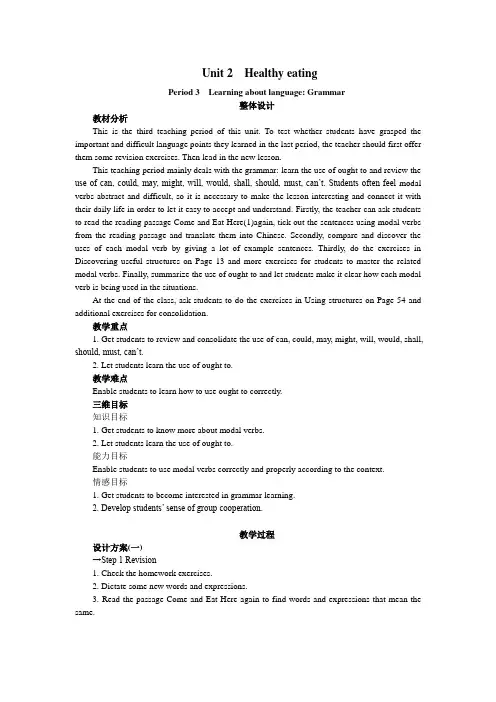
Unit 2 Healthy eating
Period 3 Learning about language: Grammar
整体设计
教材分析
This is the third teaching period of this unit. To test whether students have grasped the
important and difficult language points they learned in the last period, the teacher should first offer
them some revision exercises. Then lead in the new lesson.
This teaching period mainly deals with the grammar: learn the use of ought to and review the
use of can, could, may, might, will, would, shall, should, must, can’t. Students often feel modal
verbs abstract and difficult, so it is necessary to make the lesson interesting and connect it with
their daily life in order to let it easy to accept and understand. Firstly, the teacher can ask students
to read the reading passage Come and Eat Here(1)again, tick out the sentences using modal verbs
高中英语 Unit 2 Healthy eating Period 1 Warming Up Re
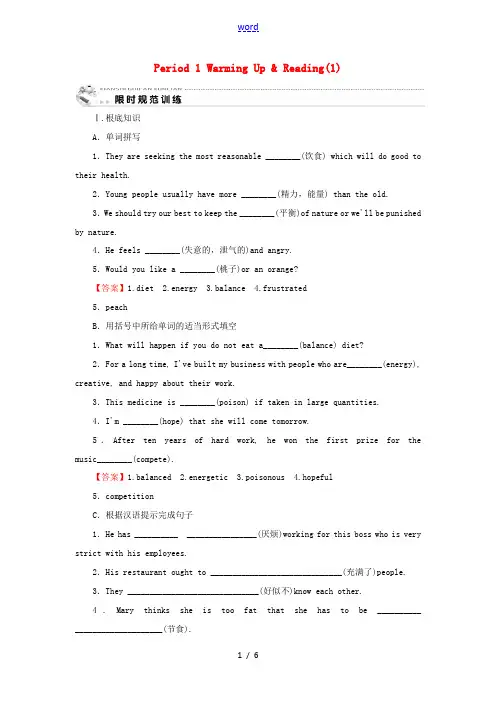
word
1 / 6 Period 1 Warming Up & Reading(1)
Ⅰ.根底知识
A.单词拼写
1.They are seeking the most reasonable ________(饮食) which will do good to
their health.
2.Young people usually have more ________(精力,能量) than the old.
3.We should try our best to keep the ________(平衡)of nature or we'll be punished
by nature.
4.He feels ________(失意的,泄气的)and angry.
5.Would you like a ________(桃子)or an orange?
【答案】1.diet 2.energy 3.balance 4.frustrated
5.peach
B.用括号中所给单词的适当形式填空
1.What will happen if you do not eat a________(balance) diet?
2.For a long time, I've built my business with people who are________(energy),
creative, and happy about their work.
3.This medicine is ________(poison) if taken in large quantities.
4.I'm ________(hope) that she will come tomorrow.
5.After ten years of hard work, he won the first prize for the
人教版高中英语必修三教案:unit2period3.doc

单元(章节)课题 Unit2 Healthy eating
本节课题
Intensive Reading: Language points
课标要求 Learn to use the useful words and expressions correctly.
三维目标 1.Students will be able to learn the important words and expressions..
2.Students will have a better understanding of the passage.
3.Develop students’ awareness of keeping fit.
教材分析 This reading passage introduces the students to two unbalanced diets through the
story of Wang Peng and Yong Hui. Many useful words and expressions are used
in this reading passage. This teaching period will encourage students to learn
these words and expressions correctly.
学情分析 The Ss are very familiar and interested in many kinds of food, as well as the good
habits of keeping fit, but they have trouble in understanding the reading passage
and they actually don’t know how to use the key important words and expressions
人教新课标高中英语必修三Unit 2 Healthy eatingUnit 2 Healthy ea
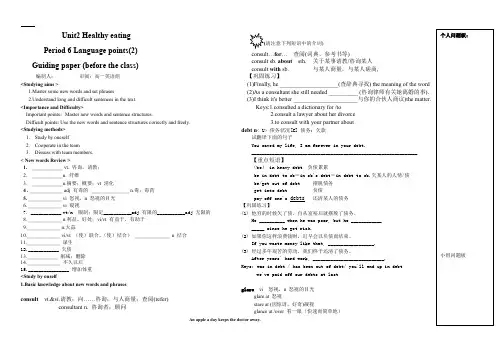
An apple a day keeps the doctor away.
Unit2 Healthy eating
Period 6 Language points(2)
Guiding paper (before the class)
编制人: 审阅:高一英语组
1.Master some new words and set phrases
2.Understand long and difficult sentences in the text.
Important points:Master new words and sentence structures.
Difficult points: Use the new words and sentence structures correctly and freely.
1. Study by oneself
2. Cooperate in the team
3. Dissuss with team members.
< New words Review >
1. ____________ vt. 咨询,请教;
2. ____________n. 纤维
3. ____________n.摘要;概要;vt 消化
4 . _____________ adj 有毒的 _______________ n.毒;毒药
5. _____________ vi 怒视,n 怒视的目光
6. _____________ vi 窥视
7.____________ vt/n 限制;限定___________adj 有限的___________adj 无限的
高中英语必修三unit2 Healthy eating 教学设计

龙源期刊网
高中英语必修三unit2 Healthy eating 教学设计
作者:张微
来源:《神州·中旬刊》2019年第08期
一、教材分析
这单元介绍的是饮食习惯,旨在让学生明白什么是健康的饮食習惯以及健康饮食的重要性。鼓励学生检查日常饮食是否健康。本篇文章词汇量较大,且大部分学生对饮食与健康关系了解较少。因此,本文的学习难度较大。
二、学情分析
本节课的授课对象是高一的学生。他们能够读懂文章的大概意思。但是,要恰当运用英语词汇表达自己的看法,以及通过英语文章的阅读获取相关信息对于高一学生有一定困难。
三、教学目标
1.通过本课时的学习,学生能够读懂课文大意,掌握与将康饮食有关的重点词汇。
2.使学生学会通过略读,寻找文章的主题句,通过查读,捕捉文章的重要细节理解作者的写作意图,从而提高阅读理解能力。 龙源期刊网
3.使学生意识到健康饮食的重要性,只有饮食健康,才能有健康的身体,因此,我们要养成健康且平衡的饮食习惯。
四、教学重点及难点
1.掌握有关营养成分与食物的词汇以及这些营养成分的来源和主要功能。
2.使学生养成科学的阅读习惯,提高阅读理解能力和语言水平。
五、教学方法
1.以任务型教学为主,强调教学方法的灵活性和多样性。
2.采取小组合作的方法,培养学生的合作精神。
六、教学过程
Step 1.Leading-in and Warming-up
1.First show the students some pictures of dishes to introduce the ; ; ; ; topic of this unit.
高中英语-必修3_Unit_2_Healthy_Eating教学设计AqAHwH
必修3 Unit 2 Healthy Eating教学设计
盂县三中 张月英
一、教材分析
本单元的中心话题是 Healthy Eating ,听说读写等语言知识和语言技能主要围绕这一话题展开叙述,反映了现代人对饮食的关注和时尚的追求。文章里不断地提出问题,启发学生的逻辑思维,使学生互相合作,在交流活动中提高获取信息和处理信息的能力。在教学活动中,教师力求使各项活动环环相扣,以符合学生的思维特点和认知水平。在激发学生学习兴趣的基础上,培养学生在现实生活中处理矛盾和解决问题的能力。
二、教学理念
“健康饮食”与学生的生活实际紧密相连,课文内容和练习都与食物有关。在教学过程中要能够关注不同层次的学生,注重学生的个性发展,在课堂上让学生进行探究性的学习,培养学生的创新能力。总之要体现以学生为本,教师高效引导的新课标理念。
三、教学目标
知识目标:
1. Enable the students to master some useful words and expressions.
2. The students will have a better understanding of the meaning and structure of
the text.
3. Let students learn the knowledge of balanced diet and nutrition.
能力目标
1. Develop students’ reading ability and let them learn different reading skills.
2. Enable students to talk about different kinds of food, problems with diet and
高中英语-高一英语必修三Unit2_Healthy_eatingAqAPHH
高一英语必修三 Unit2 Healthy eating
PENG YI(彭 燚)
(吴中)
(一)教学内容分析
COME AND EAT HERE (1) 是一篇介绍“健康饮食”的文章,包括传统饮食习惯的改变。教材通过讲述王鹏和雍慧开饭店的不同风格、经营的不同菜肴以及顾客对不同食品的不同反应,反映了现代人对饮食的关注和对时尚的追求。这篇文章有别于惯常的说明文,让学生读起来引人入胜,学生在趣味盎然的故事情节中轻松学习健康饮食的知识,领悟膳食平衡对身体健康的作用。
(二)教学目标
根据新颁布的普通高中《英语课程标准(实验稿)》关于阅读课主要教学目标的具体描述,结合本课教学内容,具体从语言知识、语言技能、情感态度和文化意识三个方面制定如下教学目标。
1. 语言知识目标:
通过一些词:如 energy-giving food body-building food protective food等使学生了解健康的饮食习惯是健康的保证。
2. 语言技能目标:
a)使学生学会克服生词障碍,通过略读,寻找文章的主题句,理清文章的总体框架与脉络;通过查读,捕捉文章的重要细节,理解作者的写作意图。
b) 使学生学会运用各种猜词技巧,猜测部分生词在具体的语言环境的含义。
c) 使学生能够运用所学知识,用英语为自己所熟悉的一个人设计一份“healthy diet”,并阐明设计的依据。
d)让学生预测本故事的结局,并表演出来,提高学生的学习兴趣。
3.情感态度与文化意识目标:
a)使学生学会审视自己、审视食物,提高养成健康饮食习惯的意识。
b)使学生懂得:健康是做好一切事情的根本。要想有强健的体魄,除了合理安排好一天的生活以外,还需要有科学、卫生的饮食习惯,每天一定量的体育活动和体力劳动。青少年必须有健康的身体,长大以后才能成为一位具有现代科学文化,适合时代要求的合格劳动者。
c)使学生学会关心他人,体贴他人,并养成较强的合作意识。并培养学生遇到困难,要勇敢面对的能力。
高中英语 Unit 2(Healthy Eating)教案人教版必修三 教案
word
1 / 10 Unit 2Healthy Eating
1.Topics:Problems with diet ;Balanced diet and nutrition
2.Words and expressions
3.Functions:
1)Suggestions and advice
You must /must not… ; What should I do?
I think you ought to …; I suppose you had better…
Perhaps you should…
Do you think you could give me some advice?
2)Seeing doctors
What’s the matter? What’s wrong?
What seems to be the trouble?
How long have you been like this?
3)Agreement and disagreement.
I don’t agree. Of cause not. I don’t think so.
All right. That’s a good idea.
No problem. Certainly /sure
Yes, I think so. I’m afraid not.
4. Grammar: The use of ought to
You ought to cook fresh vegetables and meat without too much fat
If you want to stay slim.
You ought not to eat the same kind of food at every meal. word
2 / 10
Period 1.
新人教版高中英语必修3Unit2 Healthy eating教案2
word
1 / 6 Unit 2 Healthy eating
The Third Period
Contents: Reading (We are what we eat)
Teaching Aims:
1.Improve Ss’ reading skills and abilities.
2. Learn how to read about the Argumentative Writing (types of the article).
3.Talk about problems and solutions.
Teaching procedures:
Step 1. Warming up and Pre-reading
Today we’ll learn the topic on “what we eat〞. Before we start the reading,
I’d like you to answer some questions.
1. Which of the following gives you the most energy: a banana, a soft drink
or a bar of chocolate?
2. How many meals do you have every day? Which meal do you think is the most
important? Why?
3. How much water do you drink every day?
4. What kind of snacks do you take?
Teach the new word: snack (an amount of food smaller than a meal; something
eaten informally between meals like candies, fruit and so on.)