
unit3Could you please clean your roomSectionA
《Unit3 Could you please clean your room?》教案
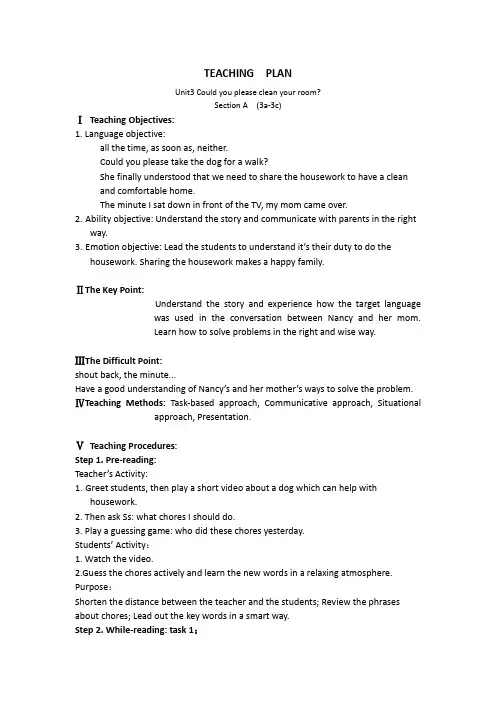
TEACHING PLANUnit3 Could you please clean your room?Section A (3a-3c)ⅠTeaching Objectives:1. Language objective:all the time, as soon as, neither.Could you please take the dog for a walk?She finally understood that we need to share the housework to have a cleanand comfortable home.The minute I sat down in front of the TV, my mom came over.2.Ability objective: Understand the story and communicate with parents in the rightway.3.Emotion objective: Lead the students to understand it’s their duty to do thehousework. Sharing the housework makes a happy family.ⅡThe Key Point:Understand the story and experience how the target languagewas used in the conversation between Nancy and her mom.Learn how to solve problems in the right and wise way.ⅢThe Difficult Point:shout back, the minute...Have a good understanding of Nancy’s and her mother’s ways to solve the problem. ⅣTeaching Methods: Task-based approach, Communicative approach, Situational approach, Presentation.ⅤTeaching Procedures:Step 1. Pre-reading:Teacher’s Activity:1.Greet students, then play a short video about a dog which can help withhousework.2. Then ask Ss: what chores I should do.3. Play a guessing game: who did these chores yesterday.Students’ Activity:1. Watch the video.2.Guess the chores actively and learn the new words in a relaxing atmosphere. Purpose:Shorten the distance between the teacher and the students; Review the phrases about chores; Lead out the key words in a smart way.Step 2. While-reading: task 1:Teacher’s Activity:Lead the Ss to read the story and answer the question:What did Nancy finally understand ?Students’ Activity:Read the story carefully and skim the question.Purpose:Let students grasp the main idea and the ending of the story.Step 3. While-reading: task 2:Teacher’s Activity:1. Ask the students to read the story carefully and complete the mind-map.2. Check the answer.3. Retell the story from the beginning.Students’ Activity:1. Read the story.2.Do the mind-map under the guidance of the teacher.3. Retell the story from the beginning under the guidance of the teacher. Purpose:Help the students to find the answer to the six questions. And help the students understand the importance of the six questions when they read a story.Step 4. While-reading: task 3Teacher’s Activity:State the requirements and help the students to complete the exercises. Students’ Activity:Read the story again and complete the exercises.Purpose:Help students better understand the story.Step5 While-reading: task 4:Teacher’s Activity:Guide the students to experience the emotions of Nancy and Nancy’s mother in the conversation.Students’ Activity:Experience the emotions of Nancy and Nancy’s mother in the conversation and act it out.Purpose:Improve students awareness of duty to share the housework.Step 6.While-reading: task 5:Teacher’s Activity:1.Summary the important words and phrases;2.Review the story.Students’ Activity:1.Review the important words and phrases;2.Review the story.Purpose:Further understand the story.Step 7. post-reading:Teacher’s Activity:1.Free talk the questions all together.2.Make a plan to share the housework. Students’ Activity:1.Think about the questions carefully and talk about them freely.2.Make a plan to share housework in a group of four.Purpose:Let the students further understand the main idea: Sharing the housework makes a happy family.Step 8.Homework:Write down the report .ⅥBlackboard design:。
2014八年级英语下册unit3_could__you_please_clean_your_room SectionA
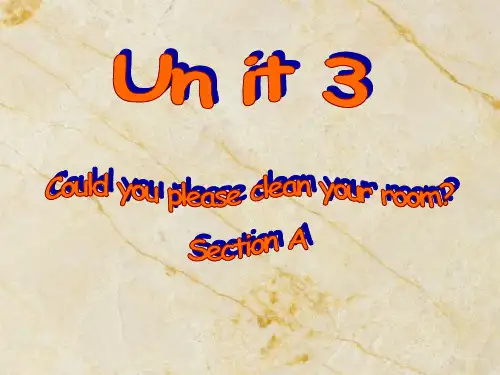
Sure.
/Of course/certainly
Could you please fold your clothes?
Sure.
/Of course/Certainly.
Shitou, could you please clean the living room?
--
Sorry ,I can’t.
• Peter, could you please take out the trash?
--Peter, could you please take out the rubbish? --Sure, Mum. =Of u please make your bed?
注:could是情态动词can的过去式,但在本句中 Could you do…?不表示过去,用以表示礼貌,委婉 或不确定的语气。
2.表示家务的短语
洗餐具 do the dishes take out the rubbish 倒垃圾 fold your clothes 叠你的衣服
家务
sweep 扫地 the floor make your bed 整理床铺
Learn to make a polite request and ask for permissions.
Difficult point
Improve students’ autonomous learning skill and cooperative skill
自主学习
Talk about the housework. A: What kind of chores did you do last weekend? B: I did the washes.
Key points
八年级英语下册Unit3Couldyoupleasecleanyourroom第1课时SectionA1a_2d教案新版人教新目标版_259
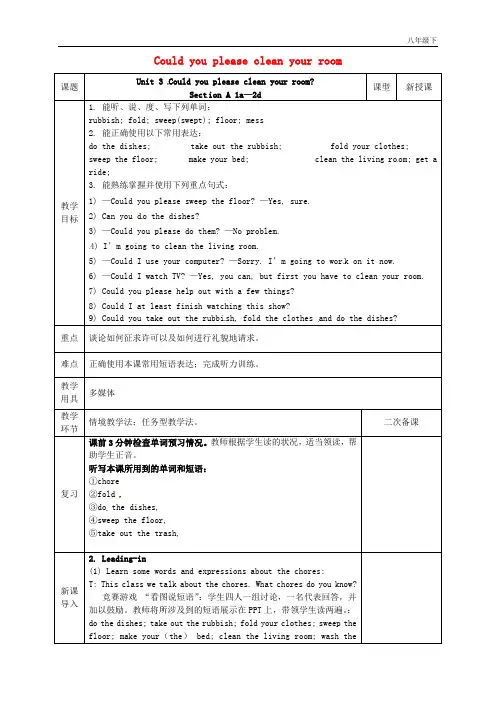
1) 1a First,rea d and translate the phra ses. Then work in pairs. Discuss with your partner.
2.能正确使用以下常用表达:
do the dish es; take out the rubbish; fold your clothes;
sweep the floor; make your bed; clean the living ro om; get a ride;
3.能熟练掌握并使用下列重点句式:
1) —Could you please sweep the floor? —Yes, sure.
2) Can you d o the dishes?
3) —Could you please do them? —No problem.
4) I’m going to clean the living room.
8) Could I at least finish watching this show?
9) Could you take out the rubbi sh, fold the clothes and do the dishes?
重点
谈论如何征求许可以及如何进行礼貌地请求。
难点
正确使用本课常用短语表达;完成听力训练。
Listen and repeat.
Last according to the chart describe the chores that Peter and Peter’s mother do.
⑵Group work
2014人教八年级英语下Unit3_could_you_please_clean_your_room_ppt课件

clean the living room
take out the rubbish make your bed
动词原形 表示委婉的请 1.Could you please后加________. 求。 你能…吗? Sure/Certainly/Of course. 肯定回答常用_________________ Sorry, I can’t. 否定回答常用______________________ 2.表示家务的短语。
(3) as…as结构表示的是同级比较,第一个as后的形容 词或副词必须用原级,比较的对象也须属同类。 eg. She is as tall as her mother. 她和她母亲一样高。 Smith works as hard as you used to. 史密斯和你 从前一样工作努力。 The dinning room was twice as big as the Tom’s. 这个餐厅是Tom的餐厅的两倍大。
1c :Make conversations about
the chores in 1a
A: Could you please sweep the floor? B: Yes, sure. Can you do the dishes? A: Well, could you please do them? I ’m going to clean the living room. B: No problem.
Homework 1“ Tom, f____ your coat and put it away” Mother said 2 Could you please s____ the floor and make it clean? 3 I do the d___ after meals every day 4. He s_____ the floor yesterday. 5 Could you help me clean the living room?(作肯 定回答和否定回答) _______, __________ ______,___________ 6 Mr. Wang would like two ____to eat A dish B dishes C the dish D the dishes
【学练优】(江西专用)春八年级英语下册 Unit 3 Could you please clea
Unit 3 Could you please clean your room?第一课时Section A (1a-2d)学习目标1.掌握重点词汇:do the dishes, sweep the floor, take out the trash. fold your clothes, clean the living room, do chores, have to do sth, like to do (doing) sth, make dinner, make your bed,stay out late, work on the computer, get a ride2.学习提出礼貌的请求和请求允许;3.学会使用句型Could you please...?和Could I...?重难点1.掌握一些家务活动相关的动词短语。
2.掌握情态动词could的用法和助动词do的用法。
自主预习1 试读并记忆本课时单词,2 查阅下面的短语动词1) 出去吃饭_______________ 2)在外面待到很晚_______________3)去看电影_______________ 4)搭车_______________5)完成做某事_______________ 6)干净整洁_______________7)洗餐具_______________ 8)倒垃圾_______________9)叠衣服_______________ 10)扫地_______________合作探究1. —Peter, could you please take out the trash?请你把垃极倒掉好吗?—Sure, Mom.可以,妈妈。
—Could you please do the dishes? 请洗盘子好吗?—Sorry, I can’t. I have to do my homework.抱歉,我不能。
我得做作业。
八下Unit Section A (3a-3c)说课稿
Unit3 Could you please clean your room?Section A (3a-3c)说课稿各位老师好,今天我说课的题目是八年级下册第三单元Could you please clean your room?第二课时的内容。
一教材分析1.教材的地位和作用本单元主题聚焦在家庭生活上,谈论家务琐事和家务互助。
家庭生活是学生生活的重要组成部分,对学生行为习惯的养成和责任感的建立有着至关重要的作用。
因此,从话题角度上看,本单元在本册书以及整个初中阶段的教学中具有特殊的地位和重要性。
本单元围绕“Chores”开展教学活动,学习如何用情态动词could 礼貌地提出请求,如何礼貌地请求允许自己做某事,并做出得体的回答;本课内容是本单元的第二课时,主要任务是通过学生的自主学习和合作探究,巩固第一课时所学的与家务劳动有关的短语以及句型“Could you please…?”并且通过快速阅读、细节阅读、自主阅读和小组合作的方式,提高学生的阅读技能以及从文章中获取有效信息的能力。
2 教学目标1)语言能力目标:掌握并熟练运用本课的单词及短语:throw, neither, shirt, all the time, as soon as;2) 通过阅读训练,提高学生的阅读技巧以及在文章中获取有效信息的能力;3)文化意识和思维品质:让学生体会父母的辛苦。
热爱父母,主动帮助承担家务。
3 教学重点和难点通过阅读训练,提高学生的阅读技巧以及在文章中获取有效信息的能力;二学生学情分析八年级的学生有了一定的英语学习基础,有一定的合作交流能力,不善于表达自己的观点和看法,语言表达能力和逻辑思维能力不强。
虽然学生从学习英语开始,就接触英语阅读,但是在阅读的过程中还有一些学生不懂阅读技巧和阅读方法,在阅读过程中会走进误区。
只有通过英语课上教给学生正确的阅读技巧和方法,培养学生的阅读理解能力,慢慢提高和渗透,以及从文章中获取有效信息的能力。
陕西省延安市延川县第二中学八年级英语下册 Unit 3 Could you please clean your room Section A(3a-3c)
Unit 3 Could you please clean your room第3课时 (Section A 3a-3c)一、自主学习,自我提高Task1快速阅读3a,回答所提问题。
(出示PPT)Task2在文中找出下列短语,并在书中作上记号。
1.welcome sb. ____________2._____________ __放学回家e home from work____________4.____________ 扔下5.sit down ____________e over ___________7.take sb. for a walk ____________ 8.____________一直;总是9.___ ______ 整日/夜 10.____________做家务 11.shout back 大声回应12.walk away ____________ 13.____________分担家务14.___________一个舒适的家 15.____________ 惊讶地二、合作探究、共同提高Task1.小组合作完成3a,3b中的任务。
Task2.利用导学案中的知识点拨,小组合作挖掘文知识点,并在学案上标明重难点。
1.认识词类的转化,了解 clean的用法,填入合适词性词意的的番号。
You should keep the room clean and tidya. clean v.使…干净;打扫b. clean n.打扫;清扫c. clean adj. 洁净的;干净的The house needed a good clean. Who's going to clean up this mess?I spent all day cooking and cleaning. I can't find a clean shirt.2.I threw down my bag and went to the living room.我随手扔下书包,走到客厅。
人教版八下英语Unit3第1课时 (SectionA 1a-2d)
can和could均可用于提出要求或请求,但could 语气更委婉。 Could you please...?是一个礼貌、 委婉地提出要求或请求的句式,意为“请你…… 好吗?”,please后接动词原形。
1c Make conversations about the chores in 1a.
Peter wants to... Peter’s father says... His father’s reasons
go out for dinner. _____ yes _____ no I have to do some work.
go to the movies. _____ yes _____ no
go out for dinner. __√___ yes _____ no go to the movies. __√___ yes _____ no
stay out late. _____ yes __√___ no get a ride. _____ yes __√___ no
I have to do some work.
You have to clean your room.
I need to eat breakfast.
You have a basketball game.
2b Listen again. Why does Peter’s father say“no”? Draw lines to the reasons in the chart in 2a.
the floor. Could you please take out the rubbish?
Unit 3 Could you please clean your room3a-3c优秀教案
Unit 3 Could you please clean your room?Section A 3a -3cLi Linmei from Han’an Middle SchoolTeaching Aims:Language aims: To master words and sentences about doing chores and making polite requests. Ability aims: To understand and be able to talk about doing chores.Teaching importances:do the dishes, make the bed, take out the rubbish, fold the clothes,sweep the floor, clean the living room …1. Could you please take out the rubbish?Sure. / Sorry, I can't. I have to finish homework first.2. Could I use your computer?Sorry. I'm going to work on it now.3. Well, could I watch TV?Yes, you can. But first you have to clean your room.Teaching difficulties:Make polite requests and ask for permissionTeaching procedures:Step 1 ReviewA: Could you please make sentences with these phrases in the past tense?B: Sure. I did so me chores.take out the trash do choresdo the dishes sweep the floormake dinner make the bedfold the clothes clean the living roomhelp out with at leastfinish doing sth. be back from shoppingsee this mess mother cleane.g. 1. A: Could you please......?B: Yes, sure./ All right./No problem./Certainly.Sorry, I can't. I have to do ...Sorry, I can't. I am doing ...2. A: What kind of chores did you do last weekend?B: I did the washes.Step 2 Reading3a Read the passage and answer the following questions.1. Did Nancy do any housework that day?2. Why was Nancy's m om angry with Nancy?3. Did they solve the problem? How?3b. Read the story again and read the sentences below. Underline the sentences from the reading that mean the same thing.1. Neither of us did any housework for a week.2. My mom came over as soon as I sat down in front of the TV.3. You're tired, but I'm tired, too.3c. Decide whether the underlined words in the sentences are verbs or nouns. Then write another sentence using the underlined word in the other form.Could you take the dog for a walk? (noun)2. Could I watch one show first?3. I can't work all day.4. You watch TV all the time.5. “What happened?” she asked in surprise.Step 3 Intensive ReadingPlay the Mp3 and imitate. Underline difficult sentences and key phrases.Step 4 Summary1. New vocabularylast mo nth, come overtake the dog for a walk, watch one showall the time, the next day, neither did I2. The minute I sat down in front of the TV, my mom came over.For one week, she did not do any housework, and neither did I.I'm just as tired as you are!Step 5 Homework1. List all the main phrases of doing chores that you know. (Compulsory)2. Make a conversation between you and your mother, using the sentence pattern “Could you please …? Could I …?”(Elective)。
Unit3 SectionA 2d 2022-2023学年人教版英语八年级下册
She could play the piano when she was five. 2.在表示请求许可时,没有时间区别,在语气上could 更加委 婉客气. can常用于熟人之间或长辈对晚辈,上级对下级的场合。 could常用于非熟人之间或晚辈对长辈,下级对上级的场合。 如: Can I use your pen?
Could we get something to drink after the No, you can’t, you have a
movie?
basketball game tomorrow.
情态动词 could