
高一英语 句子成分 5种句型分析
基本句型四: S + V + IO + O (主+谓+间接宾语+ (主+谓+间接宾语+直接宾语)
1. He brought you a dictionary. 2. I showed him my pictures. 3. I gave my car a wash. 4. I told him that the bus was late.
主语 Subject
1)Walls have ears. 2)He will take you to the hospital. 3)Three plus four equals seven. 4)To see is to believe. 5)Smoking is not allowed in public. 6)Whether or not they will come depends on the weather.
1)The chance may (never) come again. 2)Tom was very sick at heart. 3)Mary has been working at the dress shop since 1994.
谓语动词由实义动词 系动词 实义动词或系动词 实义动词 系动词担任。 助动词或情态动词加其他动词的适当 形式也可以构成谓语动词。
基本句型一: 基本句型一: S + V (不及物动词 )
此种句型 后面可以跟副词、介词短语、状 语从句等。
基本句型二: S + V + P (主语+系动词+表语) 主语+系动词+表语)
1. This is an English-Chinese dictionary. English2. The dinner smells good. 3. He grows tall and strong. 4. The trouble is that they are short of money.
基本句型三: S + V + O (主+谓+宾) (主+谓+
1. Who knows the answer? 2. He enjoys reading. 3. They ate what was left over. 4. I want to have a cup of tea. 5. He admits that he was mistaken.
作定语的有名词、名词所有格、形 名词、名词所有格、
容词、数词、代词、分词短语、 容词、数词、代词、分词短语、 动词不定式、介词短语、 动词不定式、介词短语、定语 从句等。
(6)状语 状语用来修饰动词、形容词、 副词或整个句子。一般表示动 作发生的时间、地点、目的、 原因,比较,结果、条件、让步、 程度、方式、伴随情况等。
1)They are women workers. 2)Tom's father didn't write home until yesterday. 3)Equal pay for equal work should be introduced. 4)The play has three acts. 5)This is her first trip to Europe. 6)China is a developing country. 7)You haven't kept your promise to write us often. 8)My cat has a good nose for milk. 9)Those who want to go to Tibet are to sign their names here.
可作表语的有名词、代词、形容词与 名词、代词、
分词、介词短语、数词、 分词、介词短语、数词、动词不定 动名词、 式、动名词、表语从句等。
(3)宾语 宾语(object)表示动作的对象,是 动作的承受者。 宾语一般放在及物动词之后。 英语中,介词后也会跟宾语。
宾语 Object
1)she covered her face with her hands. 2)We haven't seen her for a long time. 3)Do you mind opening the window? 4)Give me four please. 5)He wants to dream a nice dream. 6)We know what oth副词、介词短语、
短语、动词不定式短语、 短语、动词不定式短语、状语 从句等。
宾语补足语和主语补足语 英语有些及物动词, 英语有些及物动词,除了要有宾语之 还要加上宾语补足语( 外,还要加上宾语补足语(object complement),才能使句子的意义完整。 ),才能使句子的意义完整 complement),才能使句子的意义完整。 宾语和宾语补足语一起构成复合宾语。 宾语和宾语补足语一起构成复合宾语。 如果上述结构变成被动语态,原宾语 如果上述结构变成被动语态, 成为主语, 成为主语,原宾语补足语相应地变为主语 补足语( complement)。 补足语(subject complement)。
状语 (adverbial)
1)China is extremely rich in resources. 2)The best fish swim near the bottom. 3)She sat there doing nothing. 4)We work to make a living. 5)Strike while the iron is hot.
基本句型五: S + V + O + OC (主+谓+宾语+ (主+谓+宾语+宾补)
1. They elected him manager. 2. They left the work unfinished They left the door open. 3. What makes him think so? 4. He asked me to come back soon.
宾语补足语
1)They elected me captain of the team. 2)He made me happy and excited. 3)We found everything there in good order. 4)I should advise you not to miss the chance. 5)I could feel my heart beating fast.
(3)表语 Predicative 表语放在系动词之后,用来说明 主语的特征、性质、身份或状态 等。
1)My father is a professor. 2)Who's that? It's me. 3)Everything here is dear to her. 4)The match became very exciting. 5)The story of my life may be of help to others. 6)Three times five is fifteen. 7)His plan is to seek work in the city. 8)His hobby is swimming. 9)My first idea was that you should hide your feelings.
名词、代词、动名词、 可作宾语的有名词、代词、动名词、 数词、动词不定式、 数词、动词不定式、宾语从句。
(5)定语(attributive) 定语(attributive)
修饰或限制名词或代词的 定语用来修饰或限制 定语用来修饰或限制名词或代词的 词,短语,或句子。 短语,或句子。
定语
(attributive)
主语补足语
#
6)She was elected director of public relations. 7)Some goods are left unsold.
可以担当补足语的有名词、形容词、 名词、形容词、
介词短语、不定式短语、 介词短语、不定式短语、分词短 语等。
主语 名词 代词 形容 词 副词 数词 不定 式 分词
动名词 介词短语
宾语
表语
定语
状语
宾语(主 语)补足 语
5种基本句型
基本句型一: S + V (主+谓) 基本句型二: S + V + P (主+谓+表) 基本句型三: S + V + O (主+谓+宾) 基本句型四: S + V + IO + O (主+谓+间宾+直宾) 基本句型五: S + V + O + OC (主+谓+宾+宾补)
可以担当主语的有: 名词、代词、数词、动词不定式、 名词、代词、数词、动词不定式、 动名词和主语从句
(2) 谓语 谓语动词(predicate verb)是说 谓语动词(predicate verb)是说 明主语的动作、行为、特征或状 态的句子成分。谓语动词的位置 一般在主语之后。
谓语 Verb
Gramma A Journey of Grammar
Sentence Elements 英语句型分析 2 Grammar for Unit
Sentence Elements
句子成份
(1)主语
主语(subject)是一个句子的整体, 主语(subject)是一个句子的整体, 表示所说的对象是“谁”或者是 “什么”。是句子所要说明的人或 事物,是句子的主体。
基本句型一: V(不及物动词 基本句型一: S + V(不及物动词 )
1. The sun was shining. 2. The moon rose. 3. The pen writes smoothly. 4. What he said does not matter. 5. They have been singing and dancing for two hours.
高一英语五大句子基本结构

基本句型 (1) 主+谓:S+V
S+V
1. The sun rises. (rise-rose-risen 是vi,不能带O.)
2. The red sun rises. ( red修饰sun,作定语)
3. The red sun rises in the east. (状语Adverbial)
翻译练习: 1. Johnson 先生去年教我们德语。 2. 奶奶昨晚给我们讲了一个有趣的故事。 3. Mary把钱包交给校长了 4. 请把那本字典递给我好吗? 5. 他把车票给列车员看。
1.Mr Johnson taught us German last year. 2.Grandma told us an interesting story last night. 3.Mary handed the wallet to the schoolmaster. 4.Would you please pass me the dictionary? 5.He showed the ticket to the conductor.
suggest, advise, stop, resist, enjoy, imagine,finish, escape, admit, excuse, delay, practise, consider, keep, mind, understand, avoid, miss, risk succeed in, be busy,be worth, be used to, give up, look forward to
11. 爱丽丝很会游泳。 Alice swims very well.
12. 约翰的父亲昨晚去世了。
John’s father died last night. 13. 秋天有些鸟飞到南方去。
高一英语句子成分
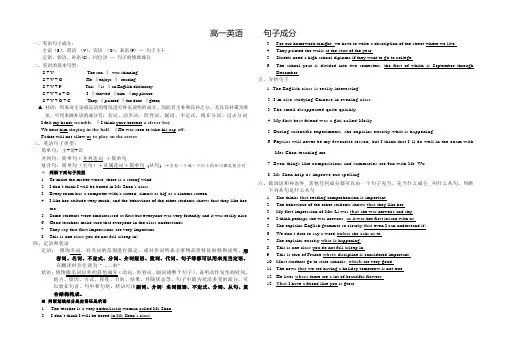
高一英语句子成分一、英语句子成分:主语(S)、谓语(V)、宾语(O)、表语(P) —句子主干定语、状语、补语(C)、同位语—句子的修饰成分二、英语的基本句型:S + V The sun ‖was shinning.S + V + O He ‖enjoys ‖reading.S + V + P This ‖is ‖an English dictionary.S + V + o + O I ‖showed ‖him ‖my picture.S + V + O + C They ‖painted ‖the door ‖green.▲补语:用来对主语或宾语的情况进行补充说明的成分,因此有主补和宾补之分。
尤以宾补最为常见。
可用来做补语的成分有:名词、动名词、形容词、副词、不定式、现在分词、过去分词I felt my hands tremble. ‖I think your brother a clever boy.We hear him singing in the hall. ‖He w as seen to take his c ap off.Father w ill not allow us to play on the street三、英语句子类型:简单句:主+谓+宾并列句:简单句+并列连词+简单句复合句:简单句(主句)+从属连词+简单句(从句) →含有一个或一个以上的从句都是复合句※判断下列句子类型1.To make the matter worse, there is a strong w ind.2.I don’t think I w ill be bored in Ms Shen’s c lass.3.Every room has a computer w ith a screen, almost as big as a c inema screen.4.I like her attitude very much, and the behaviour of the other students shows that they like her,too.5.Some students w ere embarrassed at first but everyone w as very friendly and it was really nic e.6.Good teac hers make sure that everyone in the c lass understands.7.They say that first impressions are very important.8.This is one c lass you do not fall asleep in!四、定语和状语定语:修饰名词,对名词的范围进行限定,或对名词所表示事物品质特征的修饰说明。
高一英语句子成份
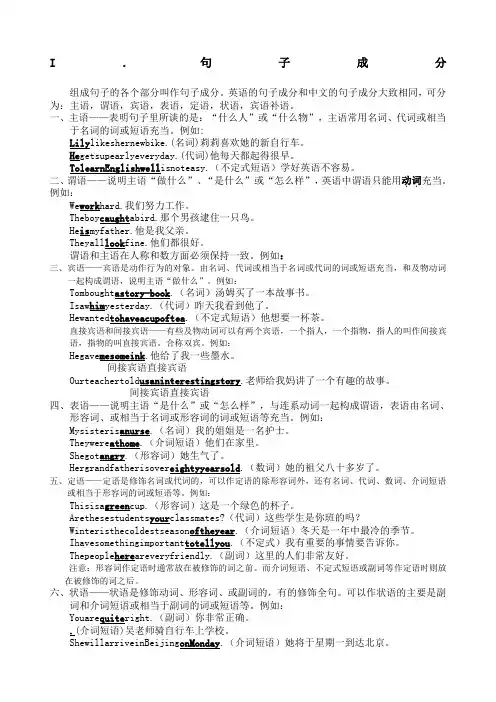
I.句子成分组成句子的各个部分叫作句子成分。
英语的句子成分和中文的句子成分大致相同,可分为:主语,谓语,宾语,表语,定语,状语,宾语补语。
一、主语——表明句子里所谈的是:“什么人”或“什么物”,主语常用名词、代词或相当于名词的词或短语充当。
例如:Lily likeshernewbike.(名词)莉莉喜欢她的新自行车。
He getsupearlyeveryday.(代词)他每天都起得很早。
TolearnEnglishwell isnoteasy.(不定式短语)学好英语不容易。
二、谓语——说明主语“做什么”、“是什么”或“怎么样”,英语中谓语只能用动词..充当。
例如:We work hard.我们努力工作。
Theboy caught abird.那个男孩逮住一只鸟。
He is myfather.他是我父亲。
Theyall look fine.他们都很好。
谓语和主语在人称和数方面必须保持一致。
例如:三、宾语——宾语是动作行为的对象。
由名词、代词或相当于名词或代词的词或短语充当,和及物动词一起构成谓语,说明主语“做什么”。
例如:Tombought astory-book.(名词)汤姆买了一本故事书。
Isaw him yesterday.(代词)昨天我看到他了。
Hewanted tohaveacupoftea.(不定式短语)他想要一杯茶。
直接宾语和间接宾语——有些及物动词可以有两个宾语,一个指人,一个指物,指人的叫作间接宾语,指物的叫直接宾语。
合称双宾。
例如:Hegave mesomeink.他给了我一些墨水。
间接宾语直接宾语Ourteachertold usaninterestingstory.老师给我妈讲了一个有趣的故事。
间接宾语直接宾语四、表语——说明主语“是什么”或“怎么样”,与连系动词一起构成谓语,表语由名词、形容词、或相当于名词或形容词的词或短语等充当。
例如:Mysisteris anurse.(名词)我的姐姐是一名护士。
新外研版高一必修一unit1语法(句子的成分和五种句型)
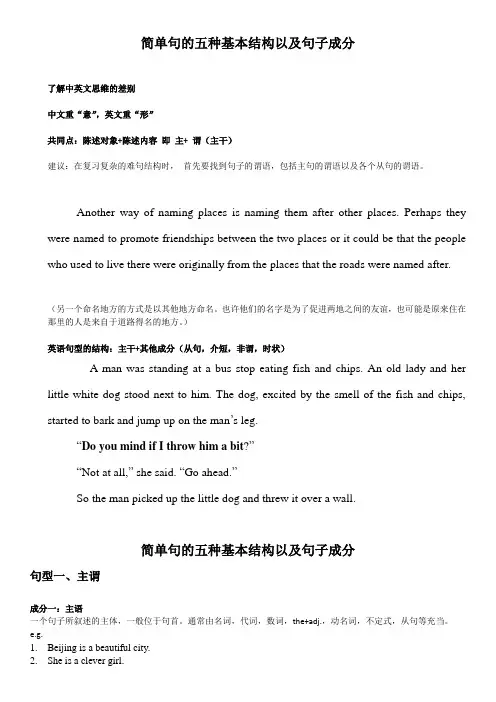
简单句的五种基本结构以及句子成分了解中英文思维的差别中文重“意”,英文重“形”共同点:陈述对象+陈述内容即主+ 谓(主干)建议:在复习复杂的难句结构时,首先要找到句子的谓语,包括主句的谓语以及各个从句的谓语。
Another way of naming places is naming them after other places. Perhaps they were named to promote friendships between the two places or it could be that the people who used to live there were originally from the places that the roads were named after.(另一个命名地方的方式是以其他地方命名。
也许他们的名字是为了促进两地之间的友谊,也可能是原来住在那里的人是来自于道路得名的地方。
)英语句型的结构:主干+其他成分(从句,介短,非谓,时状)A man was standing at a bus stop eating fish and chips. An old lady and herlittle white dog stood next to him. The dog, excited by the smell of the fish and chips, started to bark and jump up on the man’s leg.“Do you mind if I throw him a bit?”“Not at all,” she said. “Go ahead.”So the man picked up the little dog and threw it over a wall.简单句的五种基本结构以及句子成分句型一、主谓成分一:主语一个句子所叙述的主体,一般位于句首。
高一语法——句子成分、句式

to wait another 15 minutes. (2)We liked the dishes ___a_n_d____ we were happy to
learn the English songs. 改错
(4) There are some unique animals not __fo_u__n_d_____ (find) anywhere else. 过去分词found作定语
Conclusion: 考点:谓语(时态/语态/主谓一致);并列谓语;非谓语(成分); 技巧: 分析句子结构,找准谓语
(其他动词为非谓语;注意非谓语做什么成分)
(2) These bagw︿shaicreh(m或a去de掉oafreth)is2k. icnadno前f m加awtehriicahl /cthaant
be easily treated.
(3) All the other students burst into laughter before
状语从句
பைடு நூலகம்
our teacher talked to. 定语从句 (3) ISdhoeusbateiddsvheeryhmadufcihn.ish非ed限h定er从work, __w__h_ic_h__
(4) We improve ourselves while _o_r_g_a_n_i_zi_n_g___
(organize) our micro-blogs. 状语从句省略
He ___w_a_s__g_r_e_e_te_d__(greet) by the city mouse cheerfully. The country mouse was surprised ____h_o_w____ big the house was. The city mouse was
简单的英语句子结构五种句型
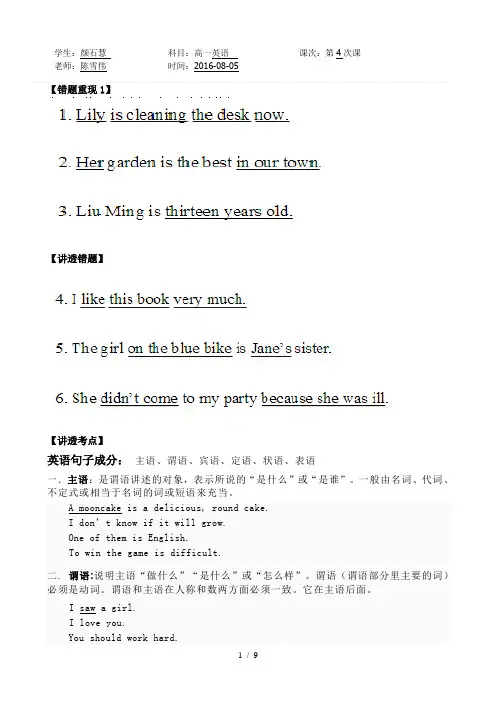
学生:颜石慧科目:高一英语课次:第4次课老师:陈雪伟时间:2016-08-05【错题重现1】【讲透错题】【讲透考点】英语句子成分:主语、谓语、宾语、定语、状语、表语一.主语:是谓语讲述的对象,表示所说的“是什么”或“是谁”。
一般由名词、代词、不定式或相当于名词的词或短语来充当。
A mooncake is a delicious, round cake.I d on’t know if it will grow.One of them is English.To win the game is difficult.二. 谓语:说明主语“做什么”“是什么”或“怎么样”。
谓语(谓语部分里主要的词)必须是动词。
谓语和主语在人称和数两方面必须一致。
它在主语后面。
I saw a girl.I love you.You should work hard.You had better take a bus.三.宾语:是动作、行为的对象,由名词、代词、不定式或相当于名词的词、短语来担任,它和及物动词一起说明主语做什么。
一般放在谓语之后。
(分直接宾语和间接宾语。
直接宾语是及物动词的直接对象,直接宾语指物,间接宾语通常是及物动词的动作所及的人,间接宾语指人。
间接宾语一般放在直接宾语之前。
)I saw a cat in the tree.We think you are right.My father bought me a book.We call him LaoWang.We find the little girl in the hill.四.定语:(是用来修饰名词或代词的。
形容词、代词、数词、名词、介词短语、不等式或相当于形容词的词或短语等。
)单个词作定语时,通常放在它所修饰的名词之前。
That is a beautiful flower.This is my book,not your book.I have a lot of things to do.五.状语:(修饰动词、形容词、副词。
高一英语五种基本句型
英语基本句型-1 主系表结构
8
本结构是由主语+系动词+表语组成,主 要用以说明主语的特征,类属,状态, 身份等。
表语:用来说明主语的性质或状态。一 般由名词或者形容词担任,有时介词短 语和不定式短语或从句也可以。 如:This table is long.
his father is a teacher. The ball is under the tree. my dream is to be a doctor.
5.我们都认为Jack 是一个勤奋的学生。
All of us/ we all believe that Jack is a hardworking boy.
6. 他不知道去说什么好。
He did not know what to say.
7. 我开窗门你在意吗?
Do you mind my opening the door? Would you mind if I open the door?
13
英语基本句型-2 主谓结构
14
本结构是由主语加不及物的谓语动词 构成, 常用来表示主语的动作。
此句型的句子有一个共同特 点,即句子的谓语动词都能 表达完整的意思。
15
1. Time flies. 2. The moon rose. 3. The man cooked. 4. They talked for half an hour. 5. He has gone.
5.她独自一个人在那里坐着。
She sat there alone.
英语基本句型-3 主谓宾结构
18
此句型句子的共同特点是: 谓语动词都具有实义,都 是主语产生的动作,但不 能表达完整的意思,必须 跟有一个宾语,即动作的 承受者,才能使意思完整。 这类动词叫做及物动词。
Welcome Unit语法句子成分和基本句型高一英语(人教版2019必修1)
Welcome Unit语法句子成分和基本句型高一英语(人教版2019必修1)句子成分和基本句型的概念:1. 句子的成分包括:主语、谓语、宾语、表语、定语、状语、宾语补足语和同位语。
(1) 主语:名词、代词主格、数词、动词不定式、动名词等如:I have a stomachache. 我胃痛。
(2) 谓语:动词,一般位于主语之后如:He put the book on the table.他把书放在桌上。
(3) 宾语:名词、代词宾格、数词、动词不定式、动名词等如:I lost my school ID card. 我丢了校园卡。
(4)表语:在连系动词之后的形容词、名词、代词、动词不定式、介词短语等如:My keys are in my schoolbag. 我的钥匙在书包里。
(5)定语:形容词、代词、数词、名词、动名词不定式、介词短语等如:The white model plane is hers. 白色的飞机模型是她的。
(6)状语:副词、介词短语、动词不定式、分词和分词短语等如:Sports star eats well. 运动明星吃得很好。
(7)宾语补足语:形容词、名词、代词、数词、动词不定式、分词等如:The loud music makes me nervous.吵闹的音乐使我很紧张。
(8)同位语:名词、数词、代词或从句如:Mr. Smith, our new teacher, is very kind to us.我们的新老师史密斯先生对我们很好。
(9)连系动词的种类:① be动词类:am,is,are,was,were②表示变化类:become,get,turn③感官动词类:look,sound,smell,taste,feel④表示延续性的动词:remain,stay,keep2. 简单句的五种基本句型英语句子按照结构来分,可以分为简单句,并列句和复合句。
简单句是含有一个主语(或并列主语)和一个谓语(或并列谓语)的句子。
高一英语句子成分分析
一、句子的成分:句子的各个组成部分叫作句子的成分。
句子的成分有主语、谓语、表语、宾语(直接宾语和间接宾语)、宾语补足语、定语和状语。
其中主语和谓语是句子的主体,表语、宾语和宾语补足语是谓语的组成部分,其他成分如定语和状语是句子的次要部分。
1 主语+不及物动词(S+V)二. 主语:主语(subject) 是一个句子的主题,是句子所述说的主体,表示所说的“是什么”或“是谁”。
它的位置一般在一句之首。
可用作主语的有单词、短语、从句乃至句子。
1. 名词作主语。
例如:A tree has fallen across the road. 一棵树倒下横在路上。
Little streams feed big rivers. 小河流入大江。
2. 代词用作主语。
例如:You’re not far wrong. 你差不多对了。
He told a joke but it fell flat. 他说了个笑话,但没有引人发笑3. 数词用作主语。
例如:Three is enough. 三个就够了。
Four from seven leaves three. 7减4余3。
4. 名词化的形容词用作主语。
例如:The idle are forced to work. 懒汉被迫劳动。
Old and young marched side by side. 老少并肩而行。
5. 副词用作主语。
例如:Now is the time. 现在是时候了。
Carefully does it. 小心就行。
6. 名词化的介词作主语。
例如:The ups and downs of life must be taken as they come. 我们必须承受人生之沉浮。
7. 不定式用作主语。
例如:To find your way can be a problem. 你能否找到路可能是一个问题。
It would be nice to see him again. 如能见到他,那将是一件愉快的事。
英语句子成分及基本句型
说明1:宾语是及物动词涉及到的人或物, 宾语一般放在及物动词之后。介词后面 的名词或代词或动名词,称为介词宾语。 名词、代词、数词常在句中做动词宾语 或介词宾语。另外,动词不定式可作动 词宾语;动名词和宾语从句也可用作动 词宾语。
说明2:及物动词作谓语时,后面要跟宾语。
宾语分直接宾语和间接宾语。直接宾语是 及物动词的直接对象,直接宾语指物,间接
间接宾语如果放在直接宾语之后,在表示 “人”的间接宾语之前会出现介词“to” 或“for”。
间接宾语前加“to”的有:
give, show, send, bring, read, pass, lend, leave, hand, tell, return, write, throw, promise(答应), refuse(拒绝)等
a success.
(名词)
Please let him in.
(副词)
We heard her singing a song. (分词短语)
(五)表语
表语说明主语“是什么”或者“怎么样”, 由名词、形容词、副词、介词、不定式及相 当于名词或形容词或短语来担任。它的位置 在系动词后面。
e.g. I am a teacher.
(名词)
He is always happy.
(形容词)
They are on the playground now. (介词短语)
It gets was, were) 表保持(keep, stay, remain) 表改变(get, become, turn)
词、代词、数词、名词、介词短语、不 等式或相当于形容词的词或短语等。
单个词作定语时,通常放在它所修饰 的名词之前。