
2019新外研版高中英语必修二 Unit 1 Period Two
PART 2
互动探究
探究重点 互动撞击思维
大儒诚信教育资源
重点词汇
1 Thanks to this,Dad has come to love hot pot!因为这一点,父亲开始喜欢
上火锅。
thanks to由于,幸亏 表示“由于,因为”的短语还有:because of,owing to,due to,on account of。
(1)Thanks to your help,I am successful in the end. 多亏了你的帮助,我最终成功了。 (2)They moved here because of the baby. 他们为了孩子而搬家到这里。 (3) Thanks to his help,my speech was so successful that everyone cheered for me.多亏了他的帮助,我的演出才如此成功,人人都为我喝彩。
5 We all love roast beef and vegetables,but Mum says we’d better not eat too much roast food as it may make us suffer from heat inside our bodies,according to traditional Chinese medicine.我们都喜欢吃烤牛肉和
Unit 1 Food for thought
Period Two Starting out & Understanding ideas—Language points
PART 1 基础自测 PART 2 互动探究 PART 3 达标检测
PART 1
基础自测
自主学习 落实基础知识
大儒诚信教育资源
[图解助记]
(1)The people in this country have suffered a lot because of the war. 战争让这个国家的人民深受其害。 (2)The patient said that he had suffered from a bad back.那个病人说他患过背疼。 (3)The new plant can’t suffer the cold weather,so the researchers are trying to deal with it.这种新植物不能经受寒冷的天气,所以研究人员正在设法处理。
10.gather v. 11. bite n. 12. cheese n. 13. someday adv. 14. china n. 15. cuisine n. 16. sort n. 17. opinion n. 18. marriage n.
→ marry v.
聚集 咬 干酪,奶酪 将来会有一天,有朝一日 瓷,瓷料 烹饪(法) 种,类 意见,看法 婚姻 嫁;娶;结婚
3.“否定词+比较级”表示最高级 To me, there’s nothing better than a cross-cultural afternoon tea of English biscuits and a cup of Chinese oolong tea in a fine china cup! 对我来说,没有什么比英式饼干和在瓷杯里泡一杯乌龙茶这种跨文化的下午 茶更好的了!
一个可怕的灰色的东西,看起来,闻起来像是烧焦的运动鞋。
deal with对付;处理;安排;涉及,论及,关于;和……做生意 deal with与do with都有“处理”之意,但deal with常与how连用;do with常 与what连用。
(1)He spent an hour sorting out the emails he had received. 他花了一个小时将他收到的电子邮件分类。 (2)We must sort out the good apples from the bad ones. 咱们得把好的苹果拣出来,同坏的那些分开。 (3) Sort out the following messages that are mixed up to make complete sentences containing attributive clauses. 把下面混乱的信息整理成含有定语从句的完整的句子。 (4)There are all sorts of flowers in the garden in the center of the city. 在城市中心的花园里有各种各样的花。 (5)He looked sort of bored with the film and left the cinema without finishing it. 他看上去对这部电影有点厌烦,没看完就离开了电影院。
4 He also does a typical Sunday roast. 他也会做典型的周日烧烤。
typical adj.典型的,有代表性的 ※be typical of典型的,特有的
It is typical of sb. to do sth. 某人做某事是经常的;某人一贯好做某事。 ※typically adv.通常,一般;典型地;果然
3 But I enjoy that sort of food myself. 但是我自己也喜欢那种食物。
sort n.种类;方式v.分类;挑选 ※sort out分类;整理;(从……中)挑选出
sort out...from...把……从……中挑选/辨别出来 ※a sort of一种
all sorts of各种各样的 sort of有点儿,有几分;稍微(作副词用,修饰其后的形容词和动词)
蔬菜,但妈妈说我们最好不要吃太多的烤制食品,因为根据中医的说法,这可能 会让我们遭受体内热量的折磨。
suffer from遭受;忍受;患病 ※suffer vt.& vi.遭受,蒙受;受苦;感到疼痛
suffer loss/pain遭受损失/痛苦 ※suffering n.痛苦,疼痛;苦难;折磨 ※sufferer n.患病者;受苦者
23. symbol n. → symbolic adj.
毒素,毒物,毒药 有毒的 巧记单词 marry(v.嫁,娶,与……结婚)+后缀age→marriage(n.婚姻) 如:short(adj.短的,不足的)+age→shortage(n.缺乏,不足) use(v.使用)+age→usage(n.用法) store(v.贮藏)+age→storage(n.贮藏)
[易混辨析] suffer,suffer from ※suffer指“遭受苦痛、损失,忍受侮辱”等,其宾语通常为pain,loss,
damage,punishment,defeat,hardship,discouragement,disappointment 等抽象名词。 ※suffer from指“遭受战争、自然灾害等带来的苦难及患病之苦”,其后常接 表示疾病或造成不幸或痛苦的事物的名词。 注意:二者一般不用于被动语态。
2 He was even shocked at their wedding when...他甚至对他们的婚礼感到震
惊……
be shocked by/at...对……感到震惊 ※shock vt.& vi.(使)震惊;震动n.休克;打击;震惊
be a shock to...使……震惊 ※shocked adj.感到震惊的
Ⅰ.重点单词 1. pudding n. 2. snack n. 3. spicy adj. 4. dare v. 5. wedding n. 6. butcher n. 7. toast n. 8. roast n.
adj. 9. stinky adj.
布丁 (正餐以外的)小吃,点心 (食物)加有香料的,辛辣的 胆敢,敢于 婚礼 肉贩 烤面包(片),吐司 大块烤肉 烤好的,烤制的 难闻的,有臭味的
10. come across 11. fall in love with 12. feel at home
偶遇,遇到 爱上,喜欢上 感觉自在
大儒诚信教育资源
Ⅲ.经典句式 1.现在分词短语作状语;ever since Growing up in England with a British father and a Chinese mother,I’ve enjoyed food from both countries ever since I was able to hold a knife and fork—and chopsticks. 我在英国长大,父亲是英国人,母亲是中国人,自从我能拿起刀叉和筷子,我 就喜欢上了两国的食物。 2.must have done表示对过去的肯定猜测 He must have thought I was joking.他一定认为我在开玩笑。
be shocked to do sth. 因做某事而感到震惊 be shocked that...对……感到震惊 ※shocking adj.令人震惊的
(1)All of us are shocked at his situation in the company. 我们大家都对他在公司的处境感到震惊。 (2)I was shocked to hear (hear) the news that he had been fired. 听到他被解雇的消息,我很震惊。 (3)The ending of this play is very shocking (shock). 这出戏的结局真令人震惊。 [一句多译] (4)这个消息让会上的人们很是震惊。 ①The news made the people at the meeting very shocked . ②The people at the meeting were shocked at/by the news .
高中英语外研版(2019)必修 第二册1.1 Starting out教学设计
优质资料---欢迎下载【新教材】必修第二册Unit 1 Food for thought 教学设计(外研版)Period 1 Starting out & Understanding ideas本单元的主题语境是“人与社会”,涉及的主题语境内容是多元饮食文化和健康的饮食习惯。
在Starting out部分安排了两个活动:1、呈现一段与饮食主题相关的视频。
该视频介绍了一位美国人在中国的美食之旅,展现了中国的代表性美食,如北京烤鸭、大闸蟹、四川火锅。
2、要求学生看世界地图和各国代表性食物的图片,将这些食物与对应的国家进行匹配,并结合自身经历讲述对世界美食的了解。
在Understanding ideas部分,本板块呈现了一篇反映单元主题的课文,语篇类型为个人故事,讲述了一个中英跨国家庭的饮食故事。
课文以跨国家庭中孩子的口吻介绍了中英两国的代表性食物,以及一家人在饮食习惯的碰撞与融合中发生的一些有趣的故事。
1.Let students know the representative food of China, have a preliminary understanding of the differences between Chinese and English food, their representative food and their English expressions, activate the existing language and background knowledge, enhance cross-cultural awareness, deepen the understanding of unit topics, and generate interest in the topic;2.Students can get the general idea of the text by skimming, and accurately understand and explain the meaning of the title;3.Through intensive reading, students can quickly find out the sentences that express the characters' views on food in the text and sort out the details;4.Students can simply describe and evaluate different kinds of food and different countries in English based on their existing life experience.Importance:1.Guide students to learn about representative Chinese food through video materials;2.Guide the students to complete the matching activities of food and country, and know the representative food of the world;3.Guide the students to understand the main idea of the text through independent reading and groupcooperation, and sort out the structure of the text.Difficulties:1.How to guide students to simply describe and evaluate different foods, which can arouse their thinking on Chinese and foreign food cultures;2.To guide students to pay attention to the characters' emotional attitudes towards different foods and to understand the food culture from a cross-cultural perspective.1.Preview the contents of this section in advance, using the textbook as a clue to understand the representative food in Chinese and English food culture;2.Mark the new words in the textbook, understand the meaning in context, or consult the dictionary to understand the meaning.Step 1 Lead-inTeacher introduces the theme of food culture.Step 2 Watching a videoStarting out—Learning the background of the foodActivity 1Provide theme-related background knowledge for Ss and raise their cultural awareness.T asks Ss to read the questions in Activity 1 and plays the video. Ss watch the video and list the different types of food introduced in the video. Then answer questions:Q1: What different types of food are introduced in the video?Q2: Have you ever tried any of the food in the video? What did you think of it?Activity 2Ss share their answers with the class.T collects answers. T can play the video again if necessary.Then The teacher evaluates the students' answers and finally gives the correct answers:Q1:Beijing duck,dazhaxie and Sichuan hot pot.Q2:Students’ own answers.Activity 31)Pair-work:Match the food to the countries on the map and answer the questions.①Have you ever tried any of the food in the pictures? Which would you most like to try?②What food from other countries have you tried?2)Students share their answers with the class.Then the teacher evaluates the students' answers.Step 3 Pre-readingActivity 4Pair-work: Look at the pictures on Page 2.①Ss discuss and explain their choices.Then tick the food Ss would like to try and see how adventurousthey are.②T walks around and introduces the foreign food if necessary in order to help Ss relate the unit themeto their daily life and raise their interests.③Ss answer the questions, talking about their knowledge of food from different countries. T evaluatestheir activities to help Ss activate their existing knowledge and get familiar with the topic.Step 4 Fast-readingActivity 51)T shows the pictures on Page2-3 and asks Ss to read the title of the passage and share theirunderstanding of it.2)T asks Ss to skim the passage and see if their understanding is correct.3)Answer the question: What’s the main idea of the passage?4)T guide Ss to skim the text(first and last paragraph) and tell the main idea: My father is Britishand my mother is Chinese.Thanks to that,I’ve been able to enjoy food from both countries ever since I was a child.Step 5 Careful-readingActivity 6: Pair-work1)T asks Ss to read the passage carefully and complete the table with information from the passage.2)T can guide Ss to read some key words in the first column in the table, then find the places with thekey words in the passage in order to complete the table. Ss can discuss in pairs and complete the work by cooperating with each other.3)Ss share their answers with the class. T shows the answers on the screen by PPT.4)Ss read the passage again, then understand and underline the new words.T can teach these newwords in several minutes.(pudding, snack,cuisine,spicy,hot pot,dare,marriage,wedding,sort,butcher, super,bacon,sausage,toast,butter,typical,roast,suffer,stinky,tofu,horrible,gather,bite,cheese,someda y, poison,oolong tea,china)Step 6 DiscussionActivity 71)T asks Ss to discuss the two questions in groups and share their opinions. T offers help if needed.①What does the author mean by saying "one mans meat is another mans poison"? Do you know of anysimilar sayings in Chinese?②What food from other regions in China or other countries has made an impression on you? Why?2)Ss discuss the questions in groups and share their opinions in class.3)T help Ss further explore the topic and the unit theme and improve Ss’ critical thinking andproblem-solving ability.Activity 8Learning language points:1.But there are still some dishes that Dad dare not try even after many years of marriage to mymother.some dishes that Dad dare not try =Dad does not have enough courage to try some of the Chinese dishes.dare在此句中是一个情态动词,没有人称和数的变化,dare not表示“不敢”dare作情态动词主要用于否定句和疑问句,形式分别是dare not( daren't)和Dare I/you/he…?等,后面跟动词原形。
Unit 1 Developing ideas 教案-高中英语外研版(2019)必修第二册

课题Unit 1 Food for thought(Developing ideas)Cold Truth教材分析This passage belongs to Book 2 Unit 1 Food for Thought-developing ideas, which talks about lifestyles of four persons. With various pictures and tables to view, students will find the passage interesting and beneficial.学生分析The students have already known some food information about east and west in Understanding ideas, so they are familiar with the text. But they still have difficulty finishing all the tasks.教学目标nguage Competence1) Get familiar with the context and get the main idea.2) Guide students to connect with real life based on the article.2.Cultural Awareness1) Get students to know lifestyles of different people with different jobs.2) Enable students to be aware of the importance of keeping healthy lifestyle3. Learning AbilityEnable to identify some information by viewing pictures.4.Thinking QualityEnable students to think and answer some questions after reading the passage. Meanwhile, students will be able to judge information according to given information.教学重点1. To understand the main idea of the passage.2. To improve students’ awareness of healthy lifestyle.教学难点1. How to guide students to finish the task of speaking after discussion.2. The homework needs students to give suggestions, which is difficult.教学方法Task-based teaching method, cooperation-study method教学辅助PPT, application of pictures教学过程环节教学活动学生活动设计意图教学过程Step1. Lead inAsk ss what do you think ahealthy diet looks like?Step2.Pre-readingT asks students to work inpairs. Talk about what theyusually eat for dinner anddecide who eats morehealthily.Step3.While-reading1.Fast readingT asks ss to read quickly andfind out who the persons are2.Careful reading1)T asks Ss to read thepassage again and match thepictures of the fridges to theirowners.2)T asks students to findevidence to support theirSs look at thepictures and answerSs talk with partnersaccording to givenvocabulary.Ss read and answeraccording to thepicture.Ss need to read andmatch in limitedtime.Ss need to underlinethe sentences thatTo interest studentsLet students connect real lifeto this passage, and alsoknow some vocabularyabout healthy food.To get the main idea andintroduce a tip of viewing.Help Ss further explore thepassageImprove Ss’ critical thinkingand problem-solving ability.answers.3)Ask ss to find out who may say those sentences on textbook.Step4.Post-reading1.Ask students three questions:What do you think the saying “You are what you eat” means?/Do you know of any Chinese sayings about food and health? What is your understanding of them?/ What’s your understanding of the title?2. T asks Ss to work in groups and discuss each person’s lifestyle in the passage.T gets Ss to make comments on each person’s lifestyle and give suggestions.Step 5 SummaryT makes a brief summary of the lesson and assignpost-class tasks. support the answersSs need to read andjudge according tothe passageSs think and share. Ifnecessary, they candiscuss in groupsSs need to finish thetable and discusseach person’slifestyleSs follow T tooverview the mainidea of the passage.This is a good way toimprove critical thinking.To lead students to thinkdeep after reading thepassage.Raise students’ awareness offorming healthy eatinghabits.To get familiar of fourpeople’s lifestyle andmaking comment canpractice their expressiveability.To conclude what they havelearned.Step 6 HomeworkT asks students to make suggestions about how they can improve their lifestyles Write a short passageto make suggestionsTo consolidate and practicewriting.板书设计反思Food for ThoughtCold TruthEllie — eJenny —aTed —cMike —bMax —dVisual informationYou are what you eatAffect your:HealthMoodEnergy levelBehaviourCold Truth:。
(外研版2019课标)高中英语必修第二册 Unit 1单元测试(含答案)

单元测试Ⅰ. 阅读理解(共15小题;每小题2.5分,满分37.5分)AIn the United States, 30 percent of the adult population has a “weight problem”. To many people, the cause is clear: we eat too much. But scientific evidence does little to support this idea. Going back to the America of 1910, we find that people were thinner than today, yet they ate more food. In those days people worked harder physically, walked more, used machines much less, and didn’t watch television.Several modern studies, moreover, have shown that fatter people don’t eat more on average than thinner people. In fact, some investigations(调查), such as a 1970 study of 3,545 London office workers, report that, on balance, fat people eat less than slimmer people.Studies show that slim people are more active than fat people. A study by a research group at Stanford University School of Medicine found the following interesting facts. The more the men ran, the greater loss of body fat. The more they ran, the greater their increase in food intake(吸收). Thus, those who ran the most ate the most, yet lost greatest amount of body fat.1. Based on the statistics given in the article, suppose there are 500 adult Americans, about how many of them will have weight problems?A. 30.B. 50.C. 100.D. 150.2. In comparison with the adult American population today, the Americans of 1910 ________.A. ate more food and had more physical activitiesB. ate less food but had more activitiesC. ate less food and had less physical exercisesD. had more weight problems3. What has modern medical and scientific research reported to us?A. Fat people eat less food and are less active.B. Fat people eat more food than thin people and are more active.C. Fat people eat more food than thin people but are less active.D. Thin people run less, and need less food to eat.BWe live in a world where it’s often not easy to find someone to trust. A smiling person always inspires trust. Even economists consider that smiles are valuable. A smile may increase other people’s trust by about 10%.People may also smile when they are caught doing bad things. According to a study made by LaFrance and Hecht, this can in fact be to their own advantage. We have a tendency to be kinder towards those who make mistakes if they wear a smile while being caught. Even a guilty smile may help you get away pretty easily when you make mistakes.We may also smile when we hear a piece of good news. In this case, women tend to smile more often than men. Smiling can also be a means of reducing the pain caused by a troubling situation. Even if we force ourselves to smile when we don’t want to, this may be enough to lift our spirits just a little bit.When we feel angry or anxious, our attention tends to narrow down. We can no longer see what’s going on around us and we can only notice what is in front of us. But if we smile, we feel better and increase flexibility of our attention and the ability to think. Smiling can help us focus and understand better.“Keep on smiling, and the world will smile with you.” One of the greatest social pleasure is to smile and be smiled to in return, especially because this comes like a natural thing.People who smile often live longer. A study based on some pictures taken of some baseball players suggested that those who used to smile a lot survived about 7 years longer than those who did not smile very often.4. The passage mainly talks about ________.A. the benefits of smilingB. the occasions when you smileC. the ways of smilingD. the reasons why people smile5. When caught doing bad things, people smile to ________.A. admit their mistakesB. show they are excitedC. avoid blame or punishmentD. prove they are kind6. According to the third paragraph, we can learn that ________.A. men seldom smile at a piece of good newsB. smiles can be helpful whatever the situation isC. we should force ourselves to smile whenever it isD. in general, men are more likely to smile than women7. The underlined sentence in the fifth paragraph probably means ________.A. if we smile, it is hard to be smiled toB. if we smile, others will smile to us in returnC. if we want to smile, the world will smile to us in timeD. if we smile sometimes, we will make the world full of smilesCPilates, yoga and the running machine get all the attention when it comes to popular ways to stay healthy. There is, however, a more humble exercise that might not be so attractive, but has all the benefits — walking.Certified fitness professional Jolynn Jaekel explains, “What I love about walking is that anyone can do it at any age and any fitness level. Plus, it is good for your heart, your head and your wallet.”A recent report details the health benefits of walking. The report found that walking regularly to fulfill the 150 minutes of moderate physical exercise every week, recommended by the UK’s chief medical officer, could save 37,000 lives each year. Scientists at the Lawrence Berkeley National Laboratory in California found that quick walking reduces the risk of heart disease more effectively than running. They observed participants aged between 18 and 80 over a six-year period and found that walking reduced the risk of heart disease by 9.3%, while running reduced it by 4.5%. And there is even more good news: 30 minutes of quick walking over five days could help you sleep easily, according to research by Oregon State University. The study by the university showed that walking helped participants sleep better and feel more alert during the day. The sooner you get started, the sooner you’ll notice the differences in your mind and body. So, go out for your 30-minute walk in a nearby park or green space.8. The underlined word “humble” in the first paragraph probably means “________”.A. plainB. relaxingC. popularD. active9. What does Jolynn Jaekel think of walking?A. It’s loved by people of all ages.B. It’s much healthier than running.C. It’s a moneysaving physical exercise.D. It’s becoming more and more popular.10. What did scientists at the Lawrence Berkeley National Laboratory find?A. Walking helps people with sleep problems.B. Walking contributes to curing heart disease.C. Walking 150 minutes per week can save lives.D. Walking is better than running in some cases.11. In which section of a newspaper can we read this text?A. Comment.B. Lifestyle.C. Education.D. Science.DOnce upon a time, when you first attended a youth sporting event, your parents probably weren’t expecting you to become a professional athlete. They signed up for a basketball, football or swimming course for you in the hope that you might learn lessons about winning gentlemanly, losing with dignity(尊严)and insisting on it when things get hard. Yes, playing games is good exercise, but it is the life lessons that matter most.For many of us, instead of looking to improve our minds and spirits, we began judging progress only by the size of our muscles or the numbers on a weighing machine. The thought that athletic competition is about greater life lessons and the building of character has been further undermined(削弱)by headlines about professional athletes.“And yet there’s still strong evidence that sports strongly improve certain personal qualities,” says Angela Lumpkin, Professor of the Department of Health, Sport and Exercise Sciences at the University of Kansas. And that’s true for athletes of any age. Amateur sports(业余体育运动)provide a safe place for competition. They also provide a practice ground for managing stress.The advantages of taking part in a sport can seep(渗透)into your professional life, too. In basketball, for example, “Getting everyone to play the right role on the court is the key to success,” says Alan Arlt, the founder of the Life Time Fitness basketball program Ultimate Hoops. “That is certainly useful in the business world, where everyone understands their own role in the organization.” In athletic events, you go through good and bad times often in the period of two hours,” says former NBA head coach Flip Saunders. “Do you have the calm manner to settle yourself down, or do you totally lose it and get thrown out of the game which hurts both you and your team? All of that on-court experience has a real effect on how you deal with real-life situations.”12. What would parents expect when their children joined in sports?A. To win as many games as possible.B. To improve their health.C. To make more friends.D. To get through difficulties.13. What can we learn from Paragraph 2?A. People play sports to build their character.B. People still hold the idea that sports can keep us fit.C. People keep playing sports to improve minds and spirits.D. People pay more attention to the news of professional athletes.14. Amateur sports are mentioned in Paragraph 3 in order to ________.A. support Lumpkin’s ideaB. introduce the next topicC. show another piece of evidenceD. show the main idea of the paragraph15. According to the last paragraph, the sports experience has a real effect on ________.A. how to succeed in the futureB. how to keep calm in certain situationsC. how to deal with reallife situationsD. how to understand the role on the courtⅡ. 阅读,七选五(共5小题;每小题2.5分,满分12.5分)All of us know that a balanced diet strengthens the immune system. 16 . The following strategies will help you to jumpstart healthy eating habits.Morning must-havesResearchers at Harvard Medical School discovered that people who took daily breakfast were a third less likely to become obese(肥胖的)than those who skipped this meal. To enjoy the most benefits, the researchers recommended eating wholegrain foods for breakfast as they are rich in fiber. 17 .Main meal wisdomIf you need to consume meat, choose fish instead of red meat. Studies have linked high consumption of red meat with cancers such as breast and colorectal cancer as well as heart disease mainly because red meat is very high in saturated(饱和的)fats. 18 .Food preparation19 . As such, cooking methods such as steaming, baking, grilling, boiling or stirfrying are advised.20Some people like to eat a large meal after a hard day’s work. However, large meals late at night can cause indigestion that influences sleep. So it is a very good idea to have a lowcalorie fiber drink just before leaving the office. It is also not a good idea to regularly have a late-night meal as this could overburden the digestive system.Remember, minor changes in our eating habits can lead to major changes in our health.A.Light nightsB.Fewer night snacksC.Fish, in contrast, contains more heart-healthy fatsD. Drinking bean milk supplies the body with plant proteinE. Experts always suggest preparing food with as little oil as possibleF. But most of us fail to obtain adequate nutrients(营养)due to our troubled lifestylesG. Fiber aids in stabilizing blood sugar, controlling appetite and keeping the heart healthyⅢ. 完形填空(共15小题;每小题1分,满分15分)Most children with healthy appetites(胃口)are ready to eat almost anything that is offered to them. A child rarely dislikes food 21 it is badly cooked. The way a meal is cooked and served is most important and 22 served meal will often improve a child’s appetite. Never ask a child 23 he likes or dislikes a food and never discuss likes and dislikes in front of him or allow 24 else to do so. If the father says he hates fat meat or the mother refuses vegetables in the child’s hearing, he is 25 to copy their words. Take it 26 granted that he likes everything and he probably 27 . Nothing healthful should be left out from the meal because of a 28 dislike. At meal times it is a good 29 to give a child a small share and let him 30 back for a second helping rather than give him as 31 as he is likely to eat all at once. Do not talk too much to the child 32 meal times, but let him get on with his food, and do not 33 him to leave the table immediately after a meal or he will soon learn to swallow his food 34 that he can hurry back to his toys. On 35 condition must a child be coaxed(哄骗)or forced to eat.21. A. if B. until C. that D. unless22. A. anxiously B. attractively C. urgently D. eagerly23. A. whether B. what C. that D. which24. A. everybody B. anybody C. somebody D. nobody25. A. willing B. possible C. forced D. likely26. A. with B. as C. over D. for27. A. should B. may C. will D. must28. A. supposed B. proved C. considered D. related29. A. point B. custom C. idea D. plan30. A. ask B. come C. return D. take31. A. much B. little C. few D. many32. A. on B. over C. by D. during33. A. agree B. allow C. force D. persuade34. A. so B. until C. in case D. although35. A. some B. any C. such D. noⅣ. 语法填空(共10小题;每小题1.5分,满分15分)Fast food business 36. ________ (develop)tremendously in the past 50 years. Nowadays people see all kinds of fast food restaurants here and there, which 37. ________ (clear)shows how closely it is related to our daily life. Most people believe that fast food business has become part of our life and its 38. ________ (develop)is good for both society and people.Firstly, the best thing about fast food is being fast. Now everyone lives a busy life, so time is the most 39. ________(value)thing to us all. Fast food offers an efficient way 40. ________ (eat). You will waste no time in waiting or choosing. 41. ________, fast food restaurants provide us with 42. ________ good environment for entertainment and study. Friends come here, chatting or playing cards; students come here, reading books or doing homework, and meanwhile you can enjoy a bag of chips and a bottle of cola 43. ________ will bring more pleasure. Thirdly, youngsters can even find good opportunities of working practice in some fast food restaurants. Working experience helps them understand society 44. ________ (well)and improve their communicating skills.In many ways, we benefit a lot 45. ________ fast food business. Therefore, I think it helpful and important to our life.Ⅰ. 应用文写作(满分15分)假如你是李华,你班的英语老师让你参加你们学校组织的“How to keep healthy”英语作文比赛写一篇参赛作文,请你根据以下信息进行写作。
(2020新教材)外研版英语必修第二册同步练习Unit 1 Period Ⅱ
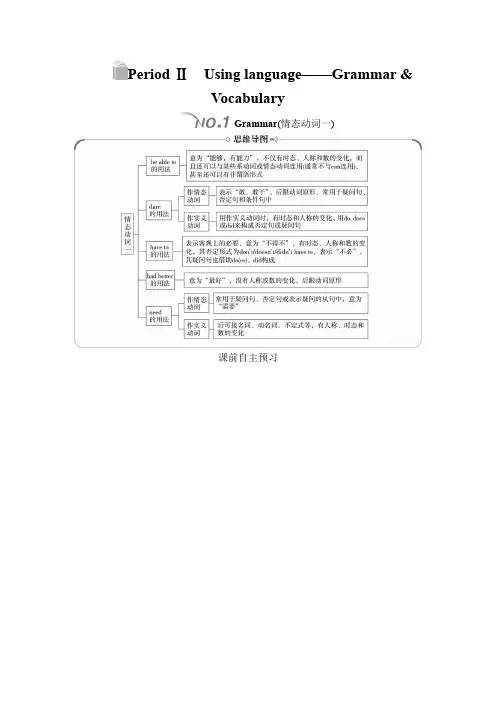
Period ⅡUsing language——Grammar &VocabularyGrammar(情态动词一)课前自主预习[观察句子,总结规律]① ... I was_able_to hold a knife and fork—and chopsticks!②But there are still some dishes that Dad dare not try even after many years of marriage to my mother.③Mum and I just have_to find a way to get him into the kitchen!④... we'd_better not eat too much roast food as it may make us suffer from heat inside our bodies, ...⑤You needn't try it if you don't want to, Mum said, ...[我的发现]以上五个句子都使用了情态动词。
(1)①句中的be able to意为“________”。
(2)②句中的dare意为“________”。
(3)③句中的have to意为“________”。
(4)④句中的'd better为________的缩写,意为“________”。
(5)⑤句中的need意为“________”。
答案:(1)能够(2)胆敢,敢于(3)不得不(4)had better;最好(5)需要精讲课时语法一、be able to的用法be able to意为“能够,有能力”,不仅有时态、人称和数的变化,而且还可以与某些系动词或情态动词连用(通常不与can 连用),甚至还可以有非谓语形式。
He hasn't_been_able_to get in touch with her.他一直未能和她联系上。
外研社2019版新教材 高中英语BOOK2 unit 1 food for thought understanding ideas A child of two cuisines
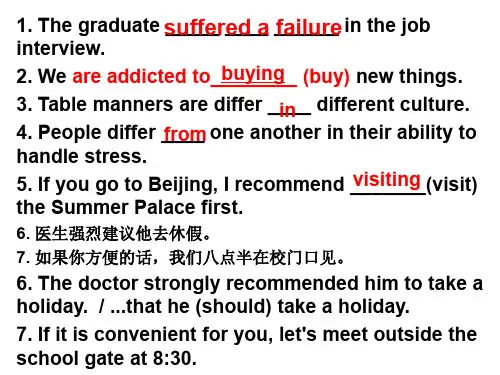
Divide the passage into four parts and match the main idea with each paragraph.
Part 1 (para 1) Part 2 (para 2)
A. I feel at home with food from Britain and China.
1.长大 2.自从(现在完成时) 3.咬一口 4.习惯于...喜欢做... 5.一定做过(表推测) 6.最好(不)做... 7.遭受,患病 8.根据 9.参观,拜访 10.处理 11.偶遇 12.使某人想起... 13.爱上 14.萝卜青菜,各有所爱 15.对...满意 16.没有比...更好的了
1.我在英国长大,父亲是英国人,母亲是中国人。自从我能拿起刀 叉和筷子以来,我就喜欢吃两国的事物。 2.但是仍然有些菜是爸爸在和妈妈结婚多年后也不敢尝试的。 3.有一次他告诉我他第一次去中国探望我母亲的父母时,对餐桌上 看见的东西大吃一惊。 4.“没有, ”屠夫拽着自己的耳朵说, “就这些普通的耳朵”。 5.他一定认为我在开玩笑。 6.我们都喜欢烤牛肉和蔬菜, 但是妈妈说我们最好不要吃太多烤的 食物, 因为根据传统中医的说法,它可能会使我们的身体遭受内热之 苦. 7.但就在我以为我能吃所有的中国菜的时候,我遇到了臭豆腐, 一种 可怕的灰色东西, 看起来与闻起来都像是烧焦的运动鞋。 8.我鼓起勇气咬了一口,并惊讶的发现它并没有那么糟糕。这让我 想起了蓝奶酪, 一种味道很重, 你要么喜欢要么讨厌的食物。
*People walked around in the
castle__w_e_a__ri_n_g__n_i_n_e_t_e_e_n__th__-c__e.ntury clothes
2019外研版高中英语选择性必修二Unit1 understanding ideas_知识点课件

巩固练习
1. We sailed four days and nights __b_e_fo_r_e__ we saw the land. 2. We hadn’t run a mile __b_ef_o_re___ he felt tired. 3. Scientists say it may be five or six years_b_e_fo_r_e__ it is possible to
As an ambulance driver, she's seen a lot of car accidents involving teenagers and thinks the legal age for getting a driving licence should be 21.
作为一名救护车司机,她目睹太多涉及青少年的车祸, 她认为考驾照的法定年龄应该是21岁。
要点突破
have a say 有发言权
have a try
试一试
have a command of 精通,掌握
have a good knowledge of 有好的知识储备
have a good view of 饱览,清楚看到
have a resee climbed up the hill, from which __s_he__co_u_ld__ha_v_e_a_g_o_o_d_v_ie_w__of_t_h_e_w_h_o_le_c_i_ty_. 她爬上山顶,从那里她可以饱览整个城市的风光。
Keys: O; F; F; O
Language Focus
2019-2020学年新外研版高一英语单元测验:必修1 Unit 2 2.2 Using language 练习(2)(解析版)
Unit 2 Exploring EnglishPeriod 2 Using language 练习Part 1 单词拼写或者填入适当单词1.I am looking forward to_______(meet)you soon. Five years have passed since we saw each other last time.2. He thinks highly of the team he support, while we may add negative comments about an _________(oppose)team.3. Remind him not ____(let)the information out to others.4. The man was ____(confuse)and looked into the issue, and finally found out the he told a lie.5. I know he looks very young, but he is _____(actual)45.6. This kind of T-shirt has been sold out. Would you like to exchange it ___something else of the same price?7. This is the first time that he has commented _____my clothes seriously.8. My watch ____(behave)well since it was repaired.9. What should be done to punish people who do harm ___ the animals?10. I ____(entire)agree with you.【答案】1.meeting2. opposing3.to let4. confused5. actually6. for7. on8. has behaved9. to 10. entire lyPart 2话题语法填空To show that English is interesting and __1__(create), the writer uses many examples and expressions that can show the crazy__2__(mad)of English.For instance, as a matter of fact, there is no ham in hamburger and there is no egg in eggplant. Also, there is neither pine__3__apple in pineapple. While we can sculpt a sculpture and paint a painting, we can only take __4__photo. __5__(struggle)among all these usages, one may feel puzzled about why “carsick”means“sick in a car”while “homesick”means“sick far away from home”. Besides, it’s not easy __6__(understand)why while “hard” is the opposite of “soft”, “hardly” and “softly” are not an__7__(pair).More examples are offered to show how mad English can be. When stars are out, they visible, but when lights are out, they are invisible. In addition, when one winds up his watch, it starts; while a passage__8__(wind)up, it ends.【答案】1. creative2. madness3. nor4. a5. Struggling6. to understand7. opposing8. is wound9. why 10.reflectsPart 3 阅读理解A(2019江苏盐城模拟)As businesses and governments have struggled to understand the so-called millennials—born between roughly 1980 and 2000—one frequent conclusion has been that they have a unique love of cities. A deep-seated preference for night life and subways, the thinking goes, has driven the revitalization of urban cores across the U.S. over the last decade-plus.But there’s mounting evidence that millennials’ love of cities was a passing fling(放纵). Millennials don’t love cities any more than pr evious generations.The latest argument comes from Dowell Myers, an urban planning professor at USC.As they age, says Myers, millennials’ presence in cities, will “be evaporating(蒸发) through our fingers, if we don’t make some plans now.” That’s because millennials’ preference for cities will fade as they start families and become more established in their careers.It’s about more than aging, though. Demographer William Frey has been arguing for years that millennials have become ‘stuck’ in cities by the 2008 downturn and the following slow recovery, with poor job prospects and declining wages making it harder for them to afford to buy homes in suburbia.Myers, too, says observers have confused young people’s presence in cities with a preference for cities. Survey data shows that more millennials would like to be living in the suburbs than actually are. But the normal career and family cycles moving young people from cities into suburban houses have become, in Myers’ words, “a plugged-up drain.”But unemployment has finally returned to healthy lows (though participation rates and wages are still largely stagnant), which Myers says should finally increase mobility for millennials.Other trends among millennials, supposedly matters of lifestyle preference, have already turned out to have been driven mostly by economics. What was once deemed their broad preference for public transit may have always been a now-reversing inability to afford cars. Even decades-long trends towards marryinglater have been accentuated a s today’ s young people struggle for financial stability.Investors are already taking the idea that millennials will return to old behavior patterns seriously, putting more money into auto manufacturers and developers. But urban lifestyles, up to and including trendy bars, aren’t just hip—they’re a part of what powers a city’s economic engines, bringing people together to explore new ideas, create companies, and build careers.From the 1960s to the 1990s, we saw that suburbanization(城市郊区化) also means an economic and social hollowing out for cities. Now that the economic shackles are coming off today’s young city residents, cities that want to stay vibrant(充满生机的) have to figure out how to convince them—and their growing families—to stick around.1. Why are Millennials about to leave city?A. It is too expensive for them to buy apartment in cities.B. They find it difficult for to seek a god job in cities.C. It is easier to get married moving to the suburban.D. They are more confident with their economic situation.2. What does the author mean quoting Myer’s “a plugged-up drain"(para 5)?A. Millennials are reluctant to leave attractive cities.B. Millennials are stopped from moving to the suburbs.C. Millennials are unwilling to be cut off from the suburban.D. Millennials are afraid of another economic decline.3. How does the author feel about the suburbanization?A. sign of stable finance.B. A growth of health issuesC. A conflict of new ideas.D. A loss of modem life这是一篇议论文。
外研版2019高中英语选择性必修第一册Unit 2 Onwards and Upwards (2)
advocate倡议 delay推迟 fancy想象 hinder阻碍 mind介意 prevent阻止 risk冒风险
allow允许 deny否认 feel like想要 imagine想象 miss错过 recall回忆 suggest建议
-ing form作宾语的用法二: 在介词后作宾语,如: On leaving school, he went into business. Shall we have a rest or get down to doing our work?(get down to中的to是介词)
be related to 与……有关 adapt to适应 give rise to 引起 devote oneself to 献身于 be opposed to 反对 object to 反对 pay attention to 注意 make contributions to 做出贡献 attend to 照看 see to确保
Period 2 Using Language
1. How to use -ing form as objects 2. How to use -to infinitives as objects 3. The differences between -ing forms and -to infinitives as objects 4. Exercises
appear显得 arrange安排 choose决定 claim声称 endeavor竭力 expect期待 learn学会 manage设法 prepare准备 pretend假装 resolve决心 seem觉得好像 volunteer自愿做 wish希望
to infinitive 作宾语的用法二 动词+疑问词+不定式,如:
高中英语外研版(2019)必修第二册_Unit2_Developing_ideas名师教学设计
Unit 2 Developing ideas & Presenting ideas名师教学设计●课时内容:Developing ideas包含两部分:第一部分介绍了社会热点问题,即春节的庆祝方式。
春节最传统的方式是在家自己做饭聚会,但随着时间的推移,越来越多的人选择在饭店订年夜饭或一家人出去就餐。
对此,不同的人有着不同的看法,有人看重传统的节日情结,也有人主张新的过节方式。
第二部分Writing a letter to express ideas介绍了春节不再局限在中国,而是走向世界。
全世界范围内都有春节的庆祝活动,这种传统文化正在走向更广阔的空间。
Presenting ideas介绍了世界健康日、世界读书日及世界微笑日。
通过对这些节日的了解,让学生们创设一些特殊的节日,并陈述理由和具体活动内容。
●课时目标:1.掌握本课时的重点词汇admit, effort, loss, process, retired, exist, interact及句型,并能熟练运用。
2.通过速读、跳读等方式,快速获取主要信息。
3.通过阅读人们对过春节的不同方式的主张,培养学生辩证分析问题的能力,学会表达自己的观点。
4.通过了解不同节日的文化背景和意义,提高学生的文化素养,激发学习这些文化传统的兴趣,从而提高学生的综合素养。
●重点难点:重点:学会并掌握重点词汇admit, effort, loss, process, retired, exist, interact的用法。
难点:通过整体阅读,获取主要信息和细节信息,进一步提升阅读理解水平。
●教学准备:教师准备:准备好该部分内容的PPT和音频,以及世界各地春节不同庆祝方式的视频。
学生准备:1.用简短的英语描述自己欢度春节的方式。
2.了解不同地方的春节文化。
Step I Lead-inThe teacher asks the students some questions:(1)How do you celebrate the Spring Festival?(2)What else do you know about the festival?【设计意图】通过简短的问答,引发学生思考,让他们简述自已庆祝春节的方式以及春节的背景知识,有利于进一步导入后面的主题。
外研版高二英语选择性必修第二册(2019版)_Unit1_Developing_idea板块教学设计
5.One or two groups share their results with the class.
To help students understand the author’sattitude and learn to find evidenceto support their choice.
2.Teacher invites some students to share their prediction and asks others to make comments.
3.Teacher asks students toread the passage quicklyandcheck their prediction.
2.Teacher invites some students to share their opinions.
3.Teacher asks studentsto think of some examples to support their opinions, make notes and then exchange their views in groups.
1.Studentsread the sentences from the passage and understand the meanings.
2.Studentswork ingroups and answer the two questions in this activity.
3.Some studentsshare the answers with the class andothers make comments.