
牛津译林初中英语七下Unit 4 Finding your way Reading教案
7B Unit4 Finding your way
Reading
Teaching aims and demands:
New words: everybody, straight, bamboo, along, road, king, remember, dangerous,
sound, forest, funny, laugh, giraffe, quite, neck, leaf, north-east, bridge, cross
Teaching methods: task-based approach
Teaching task: 1. Prepositions of movement..
2. Simple future tense with “shall” “will”
Teaching aids: tape recorder, tapes, slide projector, slides
Teaching procedures:
Ⅰ. Warm-up
Ask the Ss to give a free talk. .
Ⅱ.Listening
Now, listen to the text, please answer the question “Where are the students?”
Listen again, Ss read after the tape, and do some exercises.
Ⅲ. Reading
Ss read the articles by yourselves. Do the Exx on PartB2and B3. Check the answers
with the whole class.
Language points:
1. everybody pron.每人,人人
everybody=everyone 是不定代词。
其他的不定代词还有:everything,anything,something,nothing,anybody, somebody,
nobody,anyone,someone等。
[拓展] (1)不定代词作主语时, 谓语动词常用单数。
(2)当有形容词修饰不定代词时,形容词应放在不定代词之后。
2. remember vt. 记得,记住
[辨析]remember to do sth.与remember doing sth.
remember doing sth. 记得做过…事(已做过)
remember to do sth.记住去做…事(还没做)
I will remember to tell her about it. 我会记住告诉她关于那个事的。
Don't you remember telling me the story yesterday?你难道不记得昨天已经给我讲过这
个故事了吗?
[联想] ① forget doing sth. 忘记做过…事(已做)
forget to do sth.忘记该做…事(还未做)
②stop doing sth. 停止做…事
stop to do sth. 停下来做…事
③try doing sth. 试着去做…
try to do sth. 努力做…
3. straight on一直往前走
[点拨] (1)straight adj.直的,笔直的,直接的
Give a straight answer.给予坦率的回答。
a straight line 一条直线
(2)straight adv.径直地,一直地。
straight on 径直走 stand straight 站直
Go straight along the road.沿着这条路一直走。
4. turn right/left 向右/左拐
[点拨] turn在此句中作动词,“转弯”,“转向”。
He turned the car to the left, and stopped it at the corner.他把车左拐,把它停在
角落里。
[拓展] turn作动词还有“旋转”,“转动”,“翻转”,“使变质”,“使变成”等意思。
Please turn to Page 12.请翻到十二页。
The place turns into a park.
这地方变成了一座公园。
5. They like to eat bamboo and lie down all day long. 他们喜欢吃竹子,并整天地躺
着。
[点拨]lie作动词,意思为“躺;摆放;位于”。 其现在分词:lying;过去式:lay; lied;
第三人称单数:lies;过去分词:lain; lied。
Jiangsu Province lies in the east of China.江苏省位于中国的东部。
There is a wallet lying on the ground.有个钱包在地上。
[拓展]lie还可以用作名词,意思为“谎言,谎话”。短语tell a lie“说谎”。
6. They make people laugh. 他们让人们大笑。
[点拨] make用作及物动词,意为“使;让”,在主动语态中其后要跟省略to的不定式作
宾语补足语。短语make sb. do“让某人做某事”。
The music makes me feel good. 这个音乐让我感觉舒适。
The funny story makes all of us laugh. 这个有趣的故事使我们所有人都大笑了。
[拓展] 英语中,类似于make这种用法的动词还有let, have, hear, see, watch, notice,
feel等。如:
I see him put the key into the keyhole, turn it and open the door.
我看见他把钥匙插进锁孔,转动钥匙,然后打开了门。
I hear someone sing in the next room.
我听见有人在隔壁的房间唱歌。
Ⅴ.Discussion (task)
Have a discussion about the story.
Ⅵ.Sum-up
Go through the new words and the language points learnt during this lesson.
Ⅶ. Homework
Review the contents of this lesson.
教后记:
牛津译林版英语七下Unit4《Findingyourway》(第2课时)说课稿

牛津译林版英语七下Unit 4《Finding your way》(第2课时)说课稿一. 教材分析《牛津译林版英语七下Unit 4》是一篇关于寻找到达目的地的文章。
本节课的主要内容是通过阅读理解,学习如何描述路线和地点。
教材通过介绍一个城市地图,引导学生学习如何读懂地图,如何用英语描述路线,以及如何根据地图找到目的地。
教材内容丰富,插图生动,旨在提高学生运用英语描述路线和地点的能力。
二. 学情分析学生在进入七年级下学期时,已经具备了一定的英语基础,能够进行简单的英语交流。
但是,对于描述路线和地点的英语表达,部分学生可能还不够熟练。
此外,学生可能对地图的阅读和理解存在一定的困难。
因此,在教学过程中,需要关注学生的个体差异,因材施教,帮助学生更好地掌握描述路线和地点的英语表达。
三. 说教学目标1.知识目标:学生能够掌握描述路线和地点的常用英语表达,如“gostrght on”,“turn left/right”,“take the second turning on the left/right”等。
2.能力目标:学生能够运用所学的英语表达,描述路线和地点,进行简单的英语口语交流。
3.情感目标:培养学生独立思考、合作交流的学习习惯,提高学生对英语学习的兴趣。
四. 说教学重难点1.重点:描述路线和地点的英语表达。
2.难点:如何准确地运用英语描述复杂的路线和地点。
五. 说教学方法与手段1.教学方法:采用任务型教学法,让学生在完成具体任务的过程中,学习描述路线和地点的英语表达。
2.教学手段:利用多媒体课件、城市地图等辅助教学,帮助学生更好地理解和掌握所学内容。
六. 说教学过程1.导入:教师展示一张城市地图,引导学生谈论自己熟悉的地点和路线,激发学生对描述路线和地点的兴趣。
2.新课呈现:教师通过展示一张地图,向学生介绍如何用英语描述路线和地点。
引导学生学习相关的英语表达,如“go strght on”,“turn left/right”等。
牛津译林版七年级下册Unit4《Findingyourway》(reading1)说课稿

牛津译林版七年级下册Unit 4《Finding your way》(reading1)说课稿一. 教材分析《Finding your way》是人教版牛津译林英语七年级下册Unit 4的一篇阅读文章。
本篇文章主要讲述了一个关于如何在伦敦找到目的地的问题。
文章通过介绍一个叫Daniel的学生在伦敦迷路后,如何借助于地图和问路找到了目的地。
文章内容贴近学生生活实际,既能激发学生学习兴趣,又能培养学生实际运用英语的能力。
二. 学情分析七年级的学生已经具备了一定的英语基础,对于日常生活中的基本交流已经没有问题。
但是,他们在阅读理解方面还存在一定的困难,特别是对于长篇阅读材料的理解和分析。
此外,学生在地图和问路方面的知识也相对匮乏。
因此,在教学过程中,我需要关注学生的阅读理解能力和地图、问路知识的培养。
三. 说教学目标1.知识目标:学生能够掌握文章中的关键词汇和短语,如“get lost”、“ask for directions”、“map”等。
2.能力目标:学生能够理解文章内容,提高阅读理解能力;能够运用文章中的关键词汇和短语,进行实际交流。
3.情感目标:培养学生热爱生活,勇于探索的精神,以及互相帮助、团结合作的意识。
四. 说教学重难点1.重点:学生能够掌握文章中的关键词汇和短语,理解文章内容。
2.难点:学生能够运用文章中的关键词汇和短语,进行实际交流,以及运用地图和问路知识解决实际问题。
五. 说教学方法与手段1.教学方法:采用任务型教学法,让学生在完成任务的过程中,提高英语阅读理解和实际运用能力。
2.教学手段:利用多媒体课件、地图、角色扮演等手段,激发学生学习兴趣,提高课堂参与度。
六. 说教学过程1.导入:通过谈论学生们日常生活中的迷路经历,引出本课的主题。
2.阅读理解:学生自主阅读文章,回答相关问题,检查理解程度。
3.词汇学习:学生通过小组合作,找出文章中的关键词汇和短语,并进行实际运用。
4.角色扮演:学生分组进行角色扮演,模拟文章中的场景,提高实际运用能力。
牛津译林初中英语七下Unit 4 Finding your way Welcome to the unit教案

7B Unit 4 Finding your way Welcome to the unitTeaching aims and demands:New words: follow, path, north, west, south, east, tripTeaching methods: task-based approachTeaching task: 1. To introduce the topic of places and transport.2. To talk about visits and means of transport using mode l sentences. Teaching aids: tape recorderTeaching procedures:Ⅰ. Warm-up (presentation)Ask the students on duty to give us a short report about the Sunshine Town. Ⅱ. ListeningListen to the tape, answer my question, “Did Hobo, in fact, know the way?” Help the Ss t o answer.Listen again, Ss read after the tape recorder, then do some True or False exercises. Ch eck the answers with the whole class.Language points:follow mego up and downe.g. Let’s go down the hill together.Don’t be afraid.e.g. (1) Don’t be late for school.(2) Don’t play in the street. It’s too dangerous.be afraid to do. be afraid of sth.. I’m afraid that+从句e.g. (1) The little girl is afraid to go out in the evening.(2) Little Tom is afraid of dogs.(3) I’m afraid that I can’t go with you. I have a lot of work to do.Ⅲ. Main taskIntroduce the topic of place and transport.Ⅳ. Discussion (task)Tal k about visits and means of transport using the model sentence ‘---Let’s go to the zoo.---OK. We can go by bus.Language points:The zoo is north of Beijing Sunshine Secondary School.north of south, west, no rth-west, south-weste.g. The library is south of the classroom.The playground is west of the classroom.---How do we get there?---We can go by bus.by air/bus/car/bike/undergroundⅤ.Sum-upGo through the new words and the language points during this lesson.Ⅵ. Homework.Review the contents of this lesson. 教后记:。
牛津译林版英语七下Unit 4《Finding your way》(Welcome to the unit)word教案

7B Unit 4 Finding your wayWelcome to the unitTeaching aims and demands:New words: follow, path, north, west, south, east, tripTeaching methods: task-based approachTeaching task: 1. To introduce the topic of places and transport.2. To talk about visits and means of transport using mode l sentences. Teaching aids: tape recorderTeaching procedures:Ⅰ. Warm-up (presentation)Ask the students on duty to give us a short report about the Sunshine Town. Ⅱ. ListeningListen to the tape, answer my question, “Did Hobo, in fact, know the way?” Help the Ss t o answer.Listen again, Ss read after the tape recorder, then do some True or False exercises. Ch eck the answers with the whole class.Language points:follow mego up and downe.g. Let’s go down the hill together.Don’t be afraid.e.g. (1) Don’t be late for school.(2) Don’t play in the street. It’s too dangerous.be afraid to do. b e afraid of sth.. I’m afraid that+从句e.g. (1) The little girl is afraid to go out in the evening(2) Little Tom is afraid of dogs.(3) I’m afraid that I can’t go with you. I have a lot of work to do.Ⅲ. Main taskIntroduce the topic of place and transport.Ⅳ. Discussion (task)Talk about visits and means of transport using the model sentence ‘---Let’s go to the zoo.---OK. We can go by bus.Language points:The zoo is north of Beijing Sunshine Secondary School.north of south, west, no rth-west, south-weste.g. The library is south of the classroom.The playground is west of the classroom.---How do we get there?---We can go by bus.by air/bus/car/bike/undergroundⅤ.Sum-upGo through the new words and the language points during this lesson. Ⅵ. Homework.Review the contents of this lesson.教后记:。
牛津译林版初中英语七下Unit 4 Finding your way reading 2课件
It is quite tall. It has big eyes. It likes eating grass and leaves. It has long legs. It has a long neck.
giraffe
It is clever and funny. It is good at climbing trees. It likes eating bananas. It jumps around. It makes people laugh.
panda
Learning aims
• 1.Know and remember the language points.
• 2.Write an article.
Guide one
• 1. Reflect what you learnt last class. And have a guess.
2. Every day, lots of visitors ___________ c_o_m_e_h_er_e_to__se_e_th_e_g_ir_a_ff_es(来这里看长颈鹿).
3. The birds always ______________________(发 出悦耳的声音) in the World of Birds.
It is colourful. It has two feet. It has a tail. It can fly. It makes beautiful
sounds.
bird
It is tall and big. It has four feet. Its nose is long. It has large ears like open fans.
第7讲 Unit 4 Finding your way(教案)七年级英语下册(译林牛津版)
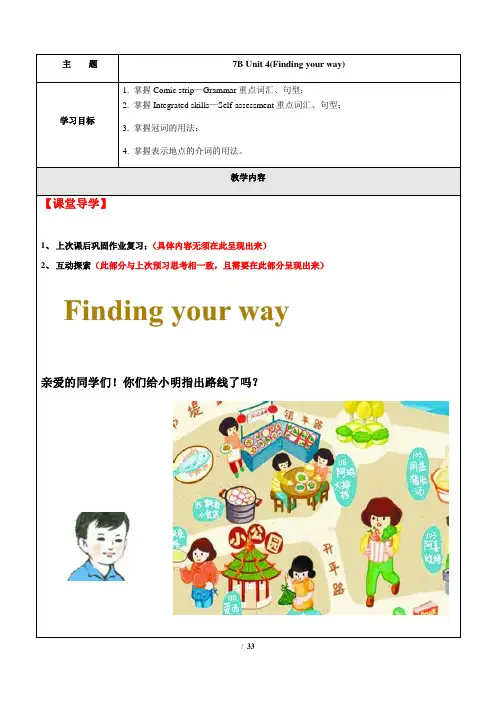
主题7B Unit 4(Finding your way) 学习目标1. 掌握Comic strip—Grammar重点词汇、句型;2. 掌握Integrated skills—Self-assessment重点词汇、句型;3. 掌握冠词的用法;4. 掌握表示地点的介词的用法。
教学内容【课堂导学】1、上次课后巩固作业复习;(具体内容无须在此呈现出来)2、互动探索(此部分与上次预习思考相一致,且需要在此部分呈现出来)亲爱的同学们!你们给小明指出路线了吗?First, go straight on and turn right at the park.Next, walk along the Shengping Road and then turn left at the first turning.At last, you will see the barbecue bar at the end of the road.must “必须”,没有人称、数、时态的变化,否定式mustn ’t 表示“禁止” 表示说话人主观上的看法,强调主观上的需要【知识梳理5】Sunshine Zoo is north of Sunshine Middle School. 阳光动物园在阳光中学的北部。
(1) north 名词,意为 ,固定结构为 ,表示 。
指范围之外,且中间有一段距离。
(2) 方位名词与介词in, on, to 连用时的区别含义 用法 in+方位名词在……之内 强调 on+方位名词在……之外 强调 to+方位名词在……之外 强调 【例题精讲】1. The tree is in the north of the school.2. The hill is on the north of the school.3. The cinema is to the north of the school.答案:(1) north 名词,意为“北,北方”,固定结构为be+方位词+of ……,表示“某地在另一地的……方向”。
牛津译林初中英语七下Unit 4 Finding your way Integrated skills教案 .doc
教学环节
教师活动
学生活动
设计意图
Step 1
Lead in
Step2
Level 1
Learn new words
Step 3
Level 2 describe pictures and
listening
Step4level 3
Listen and put
sentences in the correct order
Tell them they will pass 5 levels,the
best group can get the treasure box.
1.Show pictures and teach ne w words
2.Pk: read the words
1.Show the pictures in Part A1
Recite the dial ogue in Speak up.
Watch a video
Look at the pictures and
Learn new words
Read out the words
describe pictures
In A1.Listen to the tape and finish PartA1.
2. Play the tape, and ask Ss to finish PartA1.
1. Listen to the tape and put the sentences in the correct order in A2. (If necessary, play the tape for a second time. )
To summarize how to ask and answer ways
牛津译林版七年级下册Unit4《Findingyourway》(ReadingI)word学案
Here we re the South Gate.Un it 4 Finding your way Read ing I【学习目标】i. 根据地图识路,掌握方位的基本表达方式 1. 能了解 动物园常见动物的名称及基本习性2. 能为别人指路,能对他人指引的路线作出正确的反应 【学习重难点】1. 会用本课时的四会单词重要词组2. 掌握并能熟练运用以下句型:1. Go straight on ,and youII find the Panda House2. Walk alo ng the road.3. To the n orth of the Panda House , you 【自主学习】(认真阅读课文,完成知识梳理,在课本上做好标注)I 『基础知识』---词汇及句型A 、预习本课单词(P44--46),先根据音标自己拼读,再听磁带核对发音,并熟读。
(同桌互查,小组长检查)并能根据音标写出下列单词及汉语意思:(注意这 些词的词性)1. [li :f] _________________ (n.) _____ ( 复数)2. ['f ?r@t] ______________________ (n.)3. [ ?)?n?)u:] (n.)(复数)4. [sa ?nd](n.)5.[d ??r a :f] (n.)6.[br 朋(n.) 7. [l a :f] (v.) 8 . [r memb?(r)](v.)9. [kr ?s] (v.)10. [?n] (adv.)11. [stre ?] (adv.) 12.[kwa?](adv.)13. [ ?de?id?2?s](adj.)14. ['f ?n?(adj.)15. [n ? 0 i ?st] (adj./adv.) 16. [r??d](n.)17. [????](prep.) 18.[宅vrib ?di](pro n.)B 预习 Readi ng (P44) ,用—划出下列词组,并翻译为中文。
【最新】牛津译林版七年级英语下册Unti4 Finding your way教案
Unti4 Finding your way教案 Period3 Reading (Ⅱ) Teaching objectives: 1.To know the way according to the map. 2.To know the names of the animals and their habits. 3.To know how to show the way and guide route to others to make the right response. Teaching aids: a computer, a projector, a blackboard
Teaching procedures: StepⅠ. Enjoy a video of the animal world.
StepⅡ.Lead-in and free talk. 1. Revise different animals in the zoo. 2. Finish Part B3. 3. Free talk. A: Which animal do you like best? B: I like …best. A: Why? B: Because…And you? 4. Finish Part B4.
StepⅢ. Talk about the way to the zoo. StepⅣ.Activities Activity 1: Help the teacher get to Yancheng Zoo. Activity 2: Look for the supermarket. I want to go to the supermarket. But I don’t know the way. My friend Kate writes the way on the paper for me. Walk along Jiefang Road , and you can see a library first. Turn left and you are on Hongqi Road. Go straight on and pass a post office. Then turn right and you are on Renmin Road. Walk along the road, and you’ll see a park on your left. Then turn left. Now you are on Huanghai Road. Go straight on, you’ll find the supermarket on your right. 根据以上描述,分别写出A、B、C、D所代表地点的名称,并在图中标出道路名称。
牛津译林英语七年级下册 unit4Reading 1 A trip to the zoo-教案
Unit 4 Finding your wayReading (period 1)I、Analysis of the studentsThe students in grade7 have learned some words and simple sentences . However they are lack of the information to show the way to others .Most of them like animals, they will be happy to have a trip to the zoo. Through learning ,they will know how to read the simple maps,and how to give others the way.II、Teaching aims1、Language objectives(1) The students will be able to master the following curriculum words: forest ,bamboo, king, remember, dangerous , sound, funny, laugh, giraffe, quite, leaf.(2) The students will be able to know the phrases:lie down all day long , make people laugh, jump around, makebeautiful sounds(3)The students will be able to use the target language:go straight on , walk along the road, turn left, turn right, cross the bridge.2、Ability objectives:(1) The students will be able to describe some animals.(2) The students will be able to develop the abilities of reading simple maps to find the right ways and give right directions with proper language points.(3) The students will be able to improve their reading skills through grasping the key words.3、Moral objectives:Encourage students to help others find the right ways and give the right directions. Tell them help others to make ourselves happy.IV、Teaching foucs:1.The students will be able to master the key words and target language.2.The students will be able to find out the right position of each animal.V、Difficult pointsThe students might find a little difficult to find the right ways and give right directions with proper language points.VI、Teaching methodsScene teaching method, communicative method and and the task-based language teaching methodVII、Teaching ProceduresStep 1. Lead –in1.Enjoy a cartoon to introduce Snow White.2.Ask students to say the names of animals they found in the cartoon.Step 2. Pre-reading1.Have a free talk with students to introduce target language.2.Show some pictures about animals to learn the new words and phrases.3.Introduce the tour guide.Reading skill1: Before reading the article, pay attention to the instruction.Step 3.Fast-readingSkim and answer the questions:(1)How many animals are there in the zoo?(2)The tour guide introduces the animals in the order of ______?A. timeB. spaceC. ageD. sizeReading skill2: While skimming the passage, focus the first sentences of each paragraph and some key words.Step4: Careful-readingAbout the positions1.Ask the students to read the passage quickly and underline thewords showing the way.2.Match the instructions with the traffic signs.3.Find out the homes of the animals in groups.4.Ask the students to introdu ce the animals’ positions.About the animals1、Read the first paragraph and mark true or false.(1)Pandas like vegetables.(2)Pandas do not like to lie down all day long.(3)Few visitors come to the zoo every year.2、Read the second paragraph and finish.(1)The L ions’ Area is n_______ of the Panda House. Lions are thek________ of the animal world. Remember([rɪˈmembə(r)] v.keep sth in mind 记住) that they are d___________. Never go near them.(2)"Remember that they are dangerous. Never go near them."What does "dangerous" mean?A.有趣的B.危险的C.残忍的Reading skill3: When you meet some new words while reading, you could guess the meaning from the context.3、Read the third paragraph and fill in the blanksAnimals : Things they like to doBirds : They like 1______. They make besutiful 2_________. Monkeys: They are clever and 3_________. They like to 4________ aroundand make people 5_______.4. Read the fourth paragraph and answer the questions.(1)Which word has the same meaning as “very”?(2)What’s the usage(用处) of giraffes’ long necks?5. Make up a dialogue.Step 5. Post-readingActivity Get around Hongshan zooAsk the students to work in the group. One is the tour guide. He(She) will show the way to the visitors. The other members act as animals. And each of the members will introduce its features. The other groups need to draw the route(路线) and circle(圈出) the animals you hear.Step 6. Homework1. To read the text carefully and try to recite.2. Complete the exercises in workbook.Blackboard design.Unit 4 Finding your wayReading 1——A trip to the zoo Useful expressions:Go straight on.Walk along the road.Turn left/right.Cross the bridge.To the north/south/… of, you’ll find…… is east/west of…。