
人教版八年级英语下册知识点归纳总结
Unti1 what’s the matter 短语归纳 1.too much 太多 down 躺下 3.get an X-ray 做个X光检查 one ’s temperature 量体温
5.put some medicine on ......在....上敷药 a fever 发烧 breaks /take a break 休息 thinking twice 没多想 9.get off 下车 sb to the hospital 送某人去医院
for等待 one’s surprise 使.......惊讶的 to多亏于;由于 time及时 15.think about 考虑 a heart problem患有心脏病
17.get into the trouble 遇到麻烦 the right thing做正确的事情事情
down 摔倒 ...... on sth把...放在某物上 21.get hit/sunburned 摔伤/烧伤 interested in 对.....感兴趣
23.be used to 习惯于.... risks/take a risk 挑战 one’s life 失去生命 of 因为 out of 用完 off 切除 out of 从...出来 a decision/decisions 做决定 31.be in control of 掌管;管理 up 放弃 用法归纳 1.need to do sth .需要去做某事 sb doing sth 看见某人正在做某事 3.ask sb sth 询问某人某事 sb to do sth 期望某人做某事 5.agree to do sth 同意做某事 sb (to) do sth 帮助某人做某事 7.want to do sth 想要做某事 sb to do sth 告诉某人做某事 9.have problems(in) doing sth 做某事有困难 sth to do sth用某物去做某事
11.be/get used to doing sth 习惯于做某事 to do sth 好像做某事 13.keep on doing sth 继续做某事 doing sth 介意做某事 语法点 1.询问某人的健康问题及遇到麻烦的表达方法 2.情态动词should的用法 3.不定代词的用法 精细解读 1. What’s the matter (with you) 怎么了出什么事了 What’s the trouble/ the problem / wrong with sb./ sth. 2. I had a cold.我感冒了。 have a cold=catch a cold=have the flu感冒 have a fever发烧 have a cough咳嗽 have a stomachache胃疼,肚子疼 have a toothache牙疼 have a headache头疼 3. 身体部位+ache(疼痛)构成新的复合词 stomach+ache=stomachache head+ache=headache tooth+ache=toothache back+ache=backache后背痛 4. much too+形容词或副词,意为太。。。,too much+不可数名词,意为太多。。。。 5. enough【形容、副词】足够的/地,enough放在名词后,形副后。 good enough足够好,enough money足够的钱 6. lie down躺下, lie 躺,躺着,过去式lay;lie说谎,过去式lied 7. maybe “或许”,常用于句首,表示可能性,后加句子。Maybe you are right. may be,是情态动词+be的结构,意为“可能,也许”,后加名词、代词或形容词。He may be angry. 8. sound like+名词代词和从句:It sounds like you don’t know the truth. It sounds like a good idea. sound+形容词,“听起来,好像”,The music sounds nice. 9. need 需要,实义动词need+名词,需要某物; need to do sth.需要做某事,主语通常是人,表示人主动的动作:You need to listen carefully during class. need doing sth.主语通常是物,表示被动的动作:Your dirty clothes need washing. 10. get off (the bus) 下(公交车) get on 上车 11. agree 同意,赞同;同意做某事agree to do ,同意某人的看法、观点agree with sb。 12. trouble问题,麻烦 ;be in trouble 陷入困境,make trouble 制造麻烦 ,have trouble (in) doing sth. =have difficulties (in) doing sth 做某事有困难 。 13. right away=right now=at once,意为 立刻,马上 。 14. run out用完,用尽 When his water run out, he knew that he would have to do something to save his own life. 物sth. run out. 某物用尽了。 人sb. run out of sth..人用尽了某物。He run out of all his money last night. 15. risk (sb.) to do sth. 冒险去做某事 take a risk=take risks 冒险 16. the importance of (doing) sth.(做)某事的重要性 We students should know the importance of (learning) English. importance n. 重要(性), important adj.重要的,unimportant adj.不重要的 17. decision 【名词】决定;抉择; make a decision 做决定 18. be in the control of …掌管,管理 The headmaster is in the control of this new school. be out of control无法控制,无法管理
重点语法 【反身代词】英语中共有八个反身代词,在使用时应注意和它所指的相应的对象在人称、性别、数上保持一致。 数 人称 第一人称 第二人称 第三人称
单数 myself yourself himself herself itself
复数 ourselves yourselves themselves ? 用在某些固定短语当中。
如: look after oneself / take care of oneself 照顾自己 teach oneself sth./ learn sth. by oneself自学 enjoy oneself 玩得高兴,过得愉快 help oneself to sth 请自用……(随便吃/喝些……). hurt oneself摔伤自己 say to oneself自言自语 leave sb. by oneself把某人单独留下 buy oneself sth.给自己买……东西 introduce oneself 介绍……自己? 【提醒】 1. 反身代词不能单独做主语,但可以做主语的同位语,起强调作用。 如:我自己能完成作业。 (误)Myself can finish my homework. (正) I myself can finish my homework. / I can finish my homework myself. 2. 反身代词表示“某人自己”不能表示“某人的东西”,因为它没有所有格的形式。表达“某人自己的(东西)”时,须要用one’s own. 如:我用我自己的蜡笔画画。(误)I’m drawing with myself crayons. (正) I’m drawing with my own crayons. 【练习】 1. My classmate, Li Ming, made a card for _________ just now. 2. Bad luck! I cut _________ with a knife yesterday. 3. They tell us they can look after_________ very well. 4. My cat can find food by_________ . 5. Help __________to some beef, boys. 6. Jenny enjoyed_________ in the park yesterday afternoon. 7. We can finish our homework by_________ . 8. The blind girl lost_________ in the beautiful music. 9. Xiao Hui, can you introduce _________ to us 10. Bill wants to teach_________ French from now on.?
最全面人教版八年级下册英语第一单元知识点归纳总结
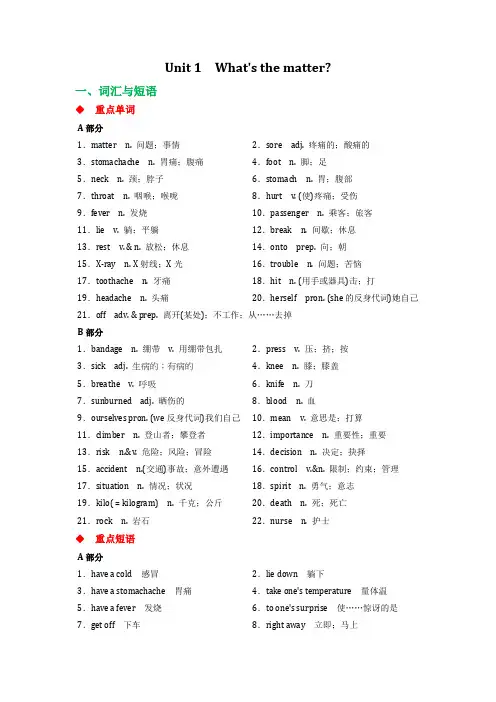
Unit 1 What's the matter?一、词汇与短语◆重点单词A部分1.matter n. 问题;事情2.sore adj. 疼痛的;酸痛的3.stomachache n. 胃痛;腹痛4.foot n. 脚;足5.neck n. 颈;脖子6.stomach n. 胃;腹部7.throat n. 咽喉;喉咙8.hurt v. (使)疼痛;受伤9.fever n. 发烧10.passenger n. 乘客;旅客11.lie v. 躺;平躺12.break n. 间歇;休息13.rest v. &n. 放松;休息14.onto prep. 向;朝15.X-ray n. X射线;X光16.trouble n. 问题;苦恼17.toothache n. 牙痛18.hit n. (用手或器具)击;打19.headache n. 头痛20.herself pron. (she的反身代词)她自己21.off adv. & prep. 离开(某处);不工作;从……去掉B部分1.bandage n. 绷带v. 用绷带包扎2.press v. 压;挤;按3.sick adj. 生病的;有病的4.knee n. 膝;膝盖5.breathe v. 呼吸6.knife n. 刀7.sunburned adj. 晒伤的8.blood n. 血9.ourselves pron. (we反身代词)我们自己10.mean v. 意思是;打算11.climber n. 登山者;攀登者12.importance n. 重要性;重要13.risk n.&v. 危险;风险;冒险14.decision n. 决定;抉择15.accident n.(交通)事故;意外遭遇16.control v.&n. 限制;约束;管理17.situation n. 情况;状况18.spirit n. 勇气;意志19.kilo( = kilogram) n. 千克;公斤20.death n. 死;死亡21.rock n. 岩石22.nurse n. 护士◆重点短语A部分1.have a cold 感冒2.lie down 躺下3.have a stomachache 胃痛4.take one's temperature 量体温5.have a fever 发烧6.to one's surprise 使……惊讶的是7.get off 下车8.right away 立即;马上9.take breaks (take a break) 休息10.talk too much 说得太多11.drink enough water 喝足够的水12.have a very sore throat 嗓子非常疼13.get an X-ray 拍X光片14.see a dentist 看牙医15.drink some hot tea with honey 喝一些加蜂蜜的热茶16.put some medicine on sth.在……上面敷一些药17.feel very hot 感到很热18.sound like 听起来像19.all weekend 整个周末20.in the same way 以同样的方式21.go to a doctor 看医生22.go along 沿着……走23.on the side of the road 在马路边24.shout for help 大声呼救25.without thinking twice 没有多想26.have a heart problem 有心脏病27.thanks to 多亏了;由于28.in time 及时29.save a life 挽救生命30.get into trouble 陷入麻烦31.hurt oneself 受伤32.fall down落下;摔倒B部分1.be used to 习惯于……;适应于……2.in a difficult situation 在困境中3.take risks (take a risk) 冒险4.keep on doing sth. 继续(或坚持)做某事5.run out (of) 用尽;耗尽6.make a decision 作出决定7.cut off 切除8.get hit on the head 撞到头部9.get out of 离开;从……岀来10.be interested in 对……感兴趣11.give up 放弃12.mean doing sth. 意味着做某事13.put a bandage on sth. 用绷带包扎…14.lose one's life 失去生命15.feel sick 感到恶心16.mountain climbing 登山运动17.have problems breathing 呼吸困难18.be in control of 掌管;管理◆重点句子A部分1.What's the matter with you?=What's the trouble with you?=What's wrong with you?你怎么了?2.What should she do? 她该怎么办呢?3.Did you fall down? 你跌倒了吗?4.Should I take my temperature? 我应该量一下体温吗?5.I think I sat in the same way for too long without moving.我想我以同样的姿势一动不动地坐得太久了。
新人教版八年级英语(下册)第三单元知识点总结归纳
新人教版八年级英语(下册)第三单元知识点总结归纳Unit 3: Could you please clean your room?One: "Peter。
could you please take out the rubbish?" - "Sure。
Mom."Could you please do something?" is used to make a request in a polite and indirect manner。
hoping for a positive response。
"Could" is not the past tense of "can," but a more polite way of speaking。
The answer should use "can."Common affirmative responses: "Sure," "Of course," "Certainly," "No problem." Negative responses: "Sorry。
I can't."Two: "Take out" means to remove something (v+adv)。
When using a pronoun as the object。
it goes in the middle。
Witha noun。
it can go in the middle or at the end.Phrases using "take":Take out" means to bring something out or remove it.Please take out a piece of paper."Please take it out."Take。
人教版八年级英语下册第一单元知识点归纳总结

人教版八年级英语下册第一单元知识点归纳总结Unti1 what’s the matter?短语归纳1. too much 太多2.lie down 躺下3. get an X-ray 做个 X 光检查4.take one ’s temperature 量体温5. put some medicine on ...... 在 .... 上敷药6.have a fever 发烧7.take breaks /take a break 休息 8.without thinking twice 没多想9. get off 下车 10.take sb to the hospital 送某人去医院11.wait for 等待12.to one’s surprise 使 ....... 惊讶的13. thanks to 多亏于;由于 14.in time 及时15. think about 考虑 16.have a heart problem 患有心脏病17. get into the trouble 遇到麻烦 18.do the right thing 做正确的事情事情19.fall down 摔倒 20.put ...... on sth 把 ... 放在某物上21. get hit/sunburned 摔伤 / 烧伤 22.be interested in 对 ..... 感兴趣23. be used to 习惯于 .... 24.take risks/take a risk 挑战25.lose one’s life 失去生命 26.because of 因为27.run out of 用完 28.cut off 切除29.get out of 从 ... 出来 30.make a decision/decisions 做决定31. be in control of 掌管;管理 32.give up 放弃用法归纳1. need to do sth . 需要去做某事2.see sb doing sth 看见某人正在做某事3. ask sb sth 询问某人某事4.expect sb to do sth 期望某人做某事5. agree to do sth 同意做某事6.help sb (to) do sth 帮助某人做某事7. want to do sth 想要做某事 8.tell sb to do sth 告诉某人做某事9. have problems(in) doing sth 做某事有困难 e sth to do sth 用某物去做某事11. be/get used to doing sth 习惯于做某事 12.seem to do sth 好像做某事13. keep on doing sth 继续做某事 14.mind doing sth 介意做某事语法点1. 询问某人的健康问题及遇到麻烦的表达方法2. 情态动词 should 的用法3. 不定代词的用法精细解读1. What’s the matter (with you)? 怎么了?出什么事了?What’s the trouble/ the problem / wrong with sb./ sth. ?2. I had a cold. 我感冒了。
人教版八年级下册英语知识点总结(最新最全)
英语知识点Unit 1 What’s the matter?一、重点短语1. have a fever 发烧2. have a cough 咳嗽3. have a toothache 牙疼4. talk too much 说得太多5. drink enough water喝足够的水6. have a cold 受凉;感冒7. have a stomachache 胃疼8. have a sore back 背疼9. have a sore throat 喉咙痛10. lie down and rest 躺下来休息11. hot tea w ith honey 加蜂蜜的热茶12. see a dentist 看牙医13. get an X-ray 拍X 光片14. take one’ s temperature 量体温15. put some medicine on sth. 在……上面敷药16. feel very hot 感到很热17. sound like 听起来像18. all weekend 整个周末19. in the same way ? 以同样的方式20. go to a doctor 看医生21. go along 沿着……走22. on the side of the road 在马路边23. shout for help 大声呼救24. without th inking twice 没有多想25. get off 下车26. have a heart problem 有心脏病27. to one’ s surprise 使.......二、重点句型1. What’ s the matter? What’ s the matter with you? = What’s the trouble with you? = What’ s wrong with you?你怎么了2. W hat should she do?她该怎么办呢?Should I take my temperature?我应该量一下体温吗?主语+ should/shouldn’t + 动词原形. ..①You should lie down and rest.你应该躺下休息一会儿。
期末Units1-10单元知识点总结 人教版八年级英语下册

Unit 1 What’s the matter?一、词形变化1.stomach 名词胃;腹部——stomachache 名词胃痛2.lie 躺lie—lay—lain lying; 说谎lie—lied—lied3.hurt 动词(使)疼痛;受伤hurt—hurt—hurt4.hit 动词击;打hit—hit—hit5.反身代词(oneself):myself 我自己—ourselves 我们自己himself 他自己—herself 她自己—themselves 他们自己yourself 你自己—yourselves 你们自己enjoy oneself 玩得开心hurt oneself 伤害自己by oneself 独自6.climb 动词登;爬——climber 名词登山者7.knife 名词小刀——复数:knives8.mean 动词意思是;打算mean—meant—meant9.important 形容词重要的—importance 名词重要性10.decide 动词决定——decision 名词11.die 动词死——death 名词死亡——dead形容词死亡的die—died—died dying二、短语归纳1.lie down 躺下to one’s (my/his/her...) surprise 令某人惊讶的是2.take one’s (my/your/his/her..) temperature 量体温3.take a break = take breaks 休息take a risk = take risks冒险4.run out 物做主语:The money ran out. 钱用光了。
run out of 人做主语:I ran out of money. 我用光了钱。
5.make a decision = make decisions 做决定6.be in control of 掌管He is in control of the company. 他掌管公司。
八年级人教版英语下册unit1知识点总结
八年级人教版英语下册unit1知识点总结Unit1是八年级英语下册的第一单元,主要围绕“the sentence”这一主题展开。
在学习中,我们需要掌握一些重要的知识点,本文将对这些知识点进行总结。
一、句子的构成句子是表达完整意义的语言单位,主要由主语、谓语和宾语三部分构成。
其中,主语是句子的主要话题或动作的执行者,通常位于句子的最前面;谓语是句子的核心,描述主语的动作或状态;宾语是句子的补充说明,通常位于谓语之后。
句子的构成还包括句子成分和句子成分的分类。
句子成分包括主语、谓语、宾语、表语、定语和状语等。
句子成分的分类主要有三种,即主谓结构、主、谓、宾结构和主系表结构。
二、句子的种类英语中根据句子的用途和表达方式,可以分为陈述句、疑问句、祈使句和感叹句四种。
其中,陈述句用来陈述事实、肯定或否定某种情况,一般语序为主谓宾,常以句号结尾;疑问句用来询问问题,通常以问号结尾;祈使句用来表达请求、命令或建议等语气,通常省略主语,以动词原形开头;感叹句用来表达强烈的情感,常以感叹词或how引导。
三、句子的语态和时态英语中的语态有两种,即主动语态和被动语态。
主动语态表示主语执行动作,而被动语态则表示主语受到动作的影响。
时态是句子非常重要的一部分,用来表示动作发生的时间。
英语中时态主要有现在时、过去时和将来时三种。
其中,现在时表示现在或经常性的动作;过去时表示过去发生的动作;将来时表示将来要发生的动作。
四、句子的修辞手法修辞手法是指用以增强语言表现力的一些技巧或方法,英语中常见的修辞手法包括比喻、拟人、排比、反问、设问、修饰语等。
其中,比喻是常用的一种修辞手法,用来通过两个事物之间的共性来形象地说明某一现象或情况,增强语言的表现力。
拟人则是将非人事物或抽象物质化为人来进行描述,以增强表达的感染力。
以上是八年级人教版英语下册Unit1的知识点总结,希望能够对大家在学习中有所帮助。
最全面人教版八年级下册英语第八单元知识点归纳总结
Unit 8 Have you read Treasure Island yet?一、词汇与短语◆重点单词A部分1.treasure 珠宝;财富n.2.gun 枪;炮n.3.island 岛n.4.mark 迹象,记号,分数n. 做记号,打分v. 5.classic 经典作品;名著n.6.sand 沙滩;沙n.7.page (书刊或纸张的)页,面,张n.8.towards 朝;向;对着prep. 9.hurry 匆忙;赶快v.10.land 陆地;大地n.11.due 预期;预定adj.12.fiction 小说n.13.ship 船n.14.technology 科技;工艺n.15.tool 工具n.16.French 法语n.B部分1.pop 流行音乐;流行乐曲n.2.success 成功n.3.rock 摇滚乐n.4.belong 属于;归属v.5.band 乐队n.6.laughter 几笑;笑声n.7.forever 永远adv.8.beauty 美;美丽n.9.abroad 在国外;到国外adv.10.million 一百万num. 11.actually 真实地;事实上adv.12.record 唱片, 记录n. 录制, 录音v. 13.fan 迷;狂热爱好者n.14.introduce 介绍;引见v. 15.southern 南方的adj.16.line 行;排n.17.modern 现代的;当代的adj.◆重点短语A部分1.hurry up 赶快;急忙2.go out to sea 出海3.science fiction 科幻小说4.an island full of treasures满是金银财宝的岛5.full of 满是……的;大量的;丰富的6.live in the United Kingdom 住在英国7.write about……写下……8.grow up 长大;成长9.put down 放下10.on page 25 在第25页11.at least 至少12.wait for 等待13.the book report 读书报告14.be due in two weeks 两周到期15.bring back 带回;取回16.arrive on this island 到达这座岛17.lose one's life 失去生命18.go out with one's gun 带枪出去19.kill……for……为……杀……20.grow fruit and vegetables 种植水果和蔬菜21.the marks of…………的足迹22.on the sand 在沙滩上23.who else 还有谁24.how long 多长时间25.live with sb. 和某人住在一起26.a broken ship 一艘破船27.run towards……向……跑去28.a piece of land 一块土地29.travel in the sea 在大海中航行30.in the middle of 在……中间31.leave behind 留下B部分1.country music 乡村音乐2.pop music 流行音乐3.one another/each other 互相4.the number of…………的数量5.study abroad 在国外学习6.fight over sth. with sb. 因某事和某人打架7.be full of=be filled with 充满……8.on the radio在收音机上9.ever since 自从10.the home of country music乡村音乐的故乡11.belong to 属于12.bring sb. back to 带某人回到……13.remind sb. that 提醒某人14.in life在人生中15.the beauty of nature 大自然的美16.have been to……去过……17.read a lot about 读很多关于……18.do some research on sth.对某事/某物做研究19.sing live 现场演唱20.introduce……to……把……介绍给……◆重点句子A部分1.—Have you read Little Women yet? 你读过《小妇人》吗?—No,I haven't .Have you? 不, 我没有。
初中英语人教版八年级下册unit6知识点总结
八年级英语下册Unit 6知识点总结一、单词(音标)shoot [ʃu:t] v.投篮,射击,发射stone [ˈstəʊn] n.石头weak [wi:k] adj.虚弱的,柔弱的god [ɡɒd] n.上帝,神remind [rɪˈmaɪnd] v.提醒,使想起bit [bɪt] n.一点,小块a little bit 有点儿,稍微silly [ˈsɪlɪ] adj.& n.愚昧的;傻子,蠢货instead of 代替,反而turn into 变成object [ˈɒbdʒɪkt] n.物体,目标,物品hide [haɪd] v.躲藏,隐藏tail [teil] n.尾巴magic [ˈmædʒɪk] n.魔法,巫术stick [stɪk] n.& v.棍,棒;刺,戳,插excite [ɪk'saɪt] v.使激动,使兴奋Western ['westən] adj.西方的,欧美的once upon 从前stepsister [ˈstepsɪstə(r)] n.继姐(妹)prince [prɪns] n.王子fall in love 爱上,喜欢上fit [fɪt] v.适合,合身couple ['kʌpl] n.(尤指)夫妻,两人smile [smaɪl] n.& v.微笑marry [ˈmæri] v.与某人结婚get married 结婚gold [ɡəʊld] n.黄金,金币emperor [ˈempərə] n.皇帝silk [sɪlk] n.丝绸underwear [ˈʌndəwɛə] n.内衣nobody [ˈnəʊbədi] pron.无人,没有任何人,谁也不stupid ['stju:pɪd] adj.& n.愚蠢的,傻的;傻子cheat [tʃi:t] v.欺骗,愚弄stepmother [ˈstepmʌðə(r)] n.继母wife [waɪf] n.妻子husband [ˈhʌzbənd] n.丈夫whole [həul] adj.全部的,整体的scene [si:n] n.舞台,(戏剧)场景moonlight ['mu:nlaɪt] n.月光shine [ʃaɪn] v.照耀,发光bright [braɪt] adj.& adv.明亮的,发亮的;明亮地ground [graʊnd] n.地面lead [li:d] n.& v.领导,主角;带路voice [vɔis] n.嗓音brave [breiv] adj.勇敢的Claudia 克劳迪娅(女名)Journey to the West 《西游记》the Monkey King 美猴王Sleeping Beauty 《睡美人》Cinderella 《灰姑娘》Little Red Riding Hood 《小红帽》Hansel and Gretel 《韩赛尔与格雷特》(《糖果屋》)二、重点短语1.work on doing sth.致力于做某事2.as soon as ... 一……就…....3.once upon a time 从前4.continue to do sth.继续做某事5.make sth.happen 使某事发生6.try to do sth.努力做某事7.the journey to sp.......之旅8.tell the/a story 讲故事9.put on 穿10.a little bit 有点儿11.keep doing sth.坚持做某事12.give up 放弃13.instead of 代替;反而14.turn...into...使......变成......15.get married 结婚16.the main character 主要人物;主人公17.at other times 在另外一些时候18.be able to 能;会e out (书、电影等)出版20.become interested in...对……感兴趣21.walk to the other side 走到另一边去22.a fairy tale 一个神话故事23.the rest of the story 故事的其余部分24.leave sb.to do sth.让某人做某事25.make a plan to do sth.筹划/计划做某事26.go to sleep 去睡觉27.lead sb.to sp.把某人领到某地28.get lost 迷路29.change one’s plan 改变计划30.tell sb.to do sth.叫某人做某事31.in the moonlight 在月光下32.find one’ s way home 找到某人回家的路33.the next day 第二天34.send sb.to sp.派某人去某地35.so...that...如此.......以致于.......三、重点句型1.So what do you think about the story of Yu Gong? 你觉得愚公的故事怎么样?2.It doesn't seem very possible to move a mountain.把一座山给移掉好像不太可能。
人教版八年级下册英语Unit1知识点语法归纳总结
⼈教版⼋年级下册英语Unit1知识点语法归纳总结Unit 1 What’s the matter?1.短语归纳2.典句必背3.⽤法集萃(1)当别⼈⼼情不好,⾝体不适或遇到⿇烦时,我们可以⽤如下表达表⽰关⼼:?What’s the matter? What’s the matter with youWhat’s wrong with …What’s the trouble\problem with …(2)英语中常⽤have描述⾝体的不适,此时have意为“患有”,常⽤结构:①have a + 疾病例:have a cold 感冒;have a fever 发烧;have a cough 咳嗽②have a + ⾝体部位-ache例:have a headache 头痛;have a toothache ⽛痛③have a sore + ⾝体部位例:have a sore throat 咽喉痛;have a sore back 背痛(3)lie down躺下;tell lies/a lie 说谎(4)maybe & may be①maybe,“或许”,常⽤于句⾸,表⽰可能性,后加句⼦。
例:Maybe you are right.②may be,是情态动词+be的结构,意为“可能,也许”,后加名词、代词或形容词。
例:He may be angry.(5)sound like & sound①sound like+名词/代词/从句例:It sounds like you don’t know the truth. It sounds like a good idea.②sound+形容词,“听起来,好像”,例:The music sounds nice.(6)…when the driver saw an old man lying on the side of the road. ……这时司机看到意为⽼⼈躺在路边。
人教版八年级下册英语Unit5知识点总结
人教版八年级下册英语Unit5知识点总结一、语法知识点A部分知识点1.过去进行时❶ 去进行时的构成及用法过去进行时由“助动词(was/were)+动词-ing”构成,表示在过去某一时刻或某一时间段正在进行的动作。
这一特定的过去时间除有上下文暗示以外,一般用过去的时间状语来表示。
如:then, at that time, at this time yesterday, at 10:00 yesterday morning, all right以及when/while从句等。
❶ 表示过去时间点正在进行的动作。
此时常伴明确的过去时间点等。
eg:She was reading a book at this time yesterday.昨天这个时候她正在看书。
(过去时间点正在进行的动作)I was watching TV then. 那时我正在看电视。
(过去时间点正在进行的动作)❶ 表示过去的某个阶段持续的动作。
eg:She was watching TV when the phone rang.(过去一段时间内持续的动作)她正在看电视,这时电话铃响了。
❶ 表示这一阶段反复发生的动作,带有褒贬感情色彩。
此时常伴有频度副词always等。
eg:The girl was always changing her mind.(过去反复发生的动作,带有感情色彩)这个女孩老是改变主意。
❶ 表示过去动作延迟到以后发生,即用过去进行表过去将来,此类动词是一些位置的变化的词。
eg:He told me that he was going soon.(过去进行表将来)他告诉我他很快就要走了。
❶ 过去进行时的一般疑问句句型:Be(Was/Were)+主语+现在分词+其他?肯定回答:Yes,主语+be(was/were).否定回答:No,主语+be(was/were) not.eg:--Were you cooking at that time? 那时,你在做饭吗?--Yes, I were.是的。