
人教版八年级下册英语unit 3 语法+知识点
人教版英语八年级下册单元知识点总结及同步练习 Unit3--4单元(无答案)

1 人教版八年级下册单元知识点总结及同步练习
Unit3 Coud you please clean your room?
一、单元重点短语
1. work on 从事,忙于 2. have a test考试 3. fold one’s clothes叠衣服 4. do the chores 做杂务
5. get a ride 搭车 6. wash the car 刷车 7. do the dishes洗餐具 8. use one’s computer使用某人的电脑
9. go to the store去商店 10. work on从事,忙于 11. work at学习、致力于
12. do the laundry = do some washing = wash clothes洗衣服 13. take out the trash倒垃圾
14. make breakfast / make dinner = do some cooking 做饭
15. invite sb. to do sth邀请某人做某事 16. make one’s bed铺床 17. sweep the floor清扫地板
二、单元基本知识点
1. Could you please…?意为“你能……吗”,could在此不表示过去,而是表示委婉的语气,please后应接动词原形
Could you please tell me the way tot the bus stop?
以could开头的表示请求的问句,其肯定回答可以用“Sure./Of course./Certainly.”等,也可以用“主语+can/may”,不能用“主语+could”;否定回答可以用“Sorry…”并给出理由,也可以用“主语+can’t/mustn’t”,不能用 “主语+couldn’t”
新人教版八年级英语下册各单元知识点汇总
1 八年级英语下册1-----10单元知识点总结
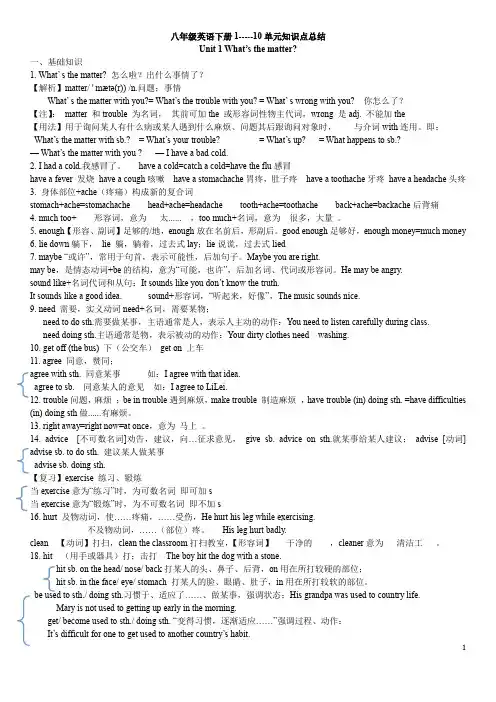
Unit 1 What’s the matter?
一、基础知识
1. What’ s the matter? 怎么啦?出什么事情了?
【解析】matter/ ' mætə(r)) /n.问题;事情
What’ s the matter with you?= What’s the trouble with you? = What’ s wrong with you? 你怎么了?
【注】: matter 和trouble 为名词, 其前可加the 或形容词性物主代词,wrong 是adj. 不能加the
【用法】用于询问某人有什么病或某人遇到什么麻烦、问题其后跟询问对象时, 与介词with连用。即:
What’s the matter with sb.? = What’s your trouble? = What’s up? = What happens to sb.?
— What’s the matter with you ? — I have a bad cold.
2. I had a cold.我感冒了。 have a cold=catch a cold=have the flu感冒
have a fever 发烧 have a cough咳嗽 have a stomachache胃疼,肚子疼 have a toothache牙疼 have a headache头疼
3. 身体部位+ache(疼痛)构成新的复合词
stomach+ache=stomachache head+ache=headache tooth+ache=toothache back+ache=backache后背痛
4. much too+ 形容词,意为 太...... ,too much+名词,意为 很多,大量 。
人教版英语八年级下册Unit 1-5 单元语法知识梳理
Unit 1 单元语法知识梳理
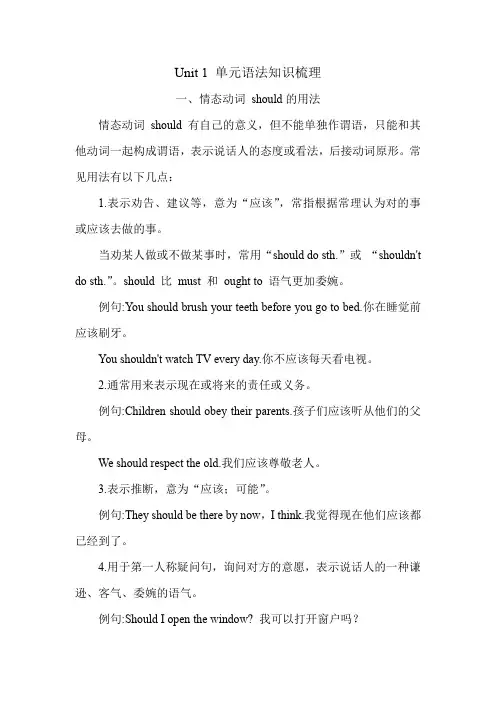
一、情态动词 should的用法
情态动词should有自己的意义,但不能单独作谓语,只能和其他动词一起构成谓语,表示说话人的态度或看法,后接动词原形。常见用法有以下几点:
1.表示劝告、建议等,意为“应该”,常指根据常理认为对的事或应该去做的事。
当劝某人做或不做某事时,常用“should do sth.”或 “shouldn't
do sth.”。should 比 must 和 ought to 语气更加委婉。
例句:You should brush your teeth before you go to bed.你在睡觉前应该刷牙。
You shouldn't watch TV every day.你不应该每天看电视。
2.通常用来表示现在或将来的责任或义务。
例句:Children should obey their parents.孩子们应该听从他们的父母。
We should respect the old.我们应该尊敬老人。
3.表示推断,意为“应该;可能”。
例句:They should be there by now,I think.我觉得现在他们应该都已经到了。
4.用于第一人称疑问句,询问对方的意愿,表示说话人的一种谦逊、客气、委婉的语气。
例句:Should I open the window? 我可以打开窗户吗? What should we do now? 我们现在该干什么呢?
5.表示某种感情色彩,意为“竟会”,常用于以how, why开头引导的特殊疑问句中。
例句:Why should you be so early today? 你今天为什么会如此早?
二、反身代词
1.反身代词的构成反身代词是一种表示反射或强调的代词。它由第一人称、第二人称的形容词性物主代词和第三人称代词的宾格加词尾-self或-selves构成。
其构成如下表:
人教版八年级英语下册各单元语法点汇总
第 1 页 Unit 1 What’s the matter
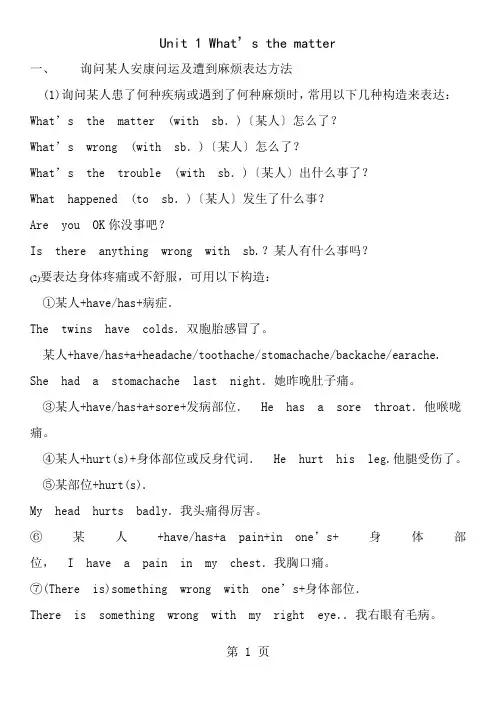
一、 询问某人安康问运及遭到麻烦表达方法
(1)询问某人患了何种疾病或遇到了何种麻烦时,常用以下几种构造来表达:
What’s the matter (with sb.)〔某人〕怎么了?
What’s wrong (with sb.)〔某人〕怎么了?
What’s the trouble (with sb.)〔某人〕出什么事了?
What happened (to sb.)〔某人〕发生了什么事?
Are you OK你没事吧?
Is there anything wrong with sb.?某人有什么事吗?
(2)要表达身体疼痛或不舒服,可用以下构造:
①某人+have/has+病症.
The twins have colds.双胞胎感冒了。
某人+have/has+a+headache/toothache/stomachache/backache/earache.
She had a stomachache last night.她昨晚肚子痛。
③某人+have/has+a+sore+发病部位. He has a sore throat.他喉咙痛。
④某人+hurt(s)+身体部位或反身代词. He hurt his leg.他腿受伤了。
⑤某部位+hurt(s).
My head hurts badly.我头痛得厉害。
⑥某人+have/has+a pain+in one’s+身体部位, I have a pain in my chest.我胸口痛。
⑦(There is)something wrong with one’s+身体部位.
There is something wrong with my right eye..我右眼有毛病。 第 2 页 ⑧其他表达方式
She has a heart trouble.她有心脏病。
人教版八年级英语下册各知识点归纳总结(最新最全)
人教版八年级英语下册各知识点归纳总结
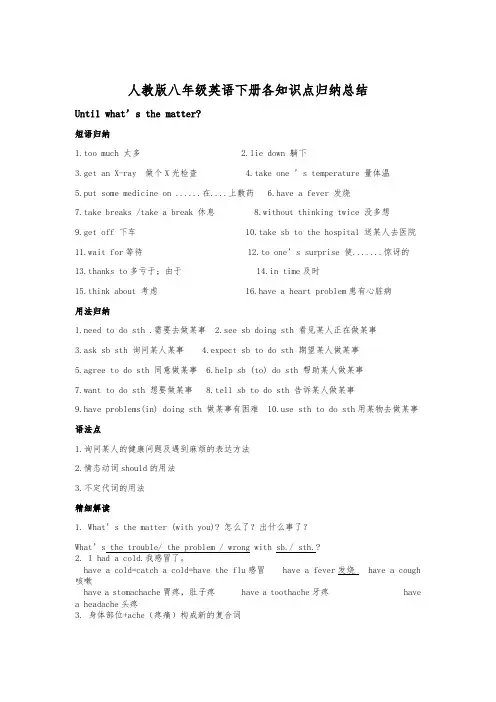
Unti1 what’s the matter?
短语归纳
1.too much 太多 2.lie down 躺下
3.get an X-ray 做个X光检查 4.take one ’s temperature 量体温
5.put some medicine on ......在....上敷药 6.have a fever 发烧
7.take breaks /take a break 休息 8.without thinking twice 没多想
9.get off 下车 10.take sb to the hospital 送某人去医院
11.wait for等待 12.to one’s surprise 使.......惊讶的
13.thanks to多亏于;由于 14.in time及时
15.think about 考虑 16.have a heart problem患有心脏病
用法归纳
1.need to do sth .需要去做某事 2.see sb doing sth 看见某人正在做某事
3.ask sb sth 询问某人某事 4.expect sb to do sth 期望某人做某事
5.agree to do sth 同意做某事 6.help sb (to) do sth 帮助某人做某事
7.want to do sth 想要做某事 8.tell sb to do sth 告诉某人做某事
9.have problems(in) doing sth 做某事有困难 e sth to do sth用某物去做某事
八年级下册英语Unit3单词讲解与语法归纳

八年级下册英语Unit3单词讲解与语法归纳
八年级下册英语Unit3单词讲解与语法归纳
八年级下册英语Unit3单词讲解与语法归纳
1.infrontof在……的前面(外部)inthefrontof在……的前面(内部)
2.inthelibrary在图书馆
3.getoutof/getinto出……之外/进入
4.sleeplate睡懒觉sleepwell睡得好gettosleep=fallasleep睡着
5.walkdown/along沿……走
6.takeoff(飞机)起飞;脱下(衣帽)
7.onSundayevening在星期日晚上
注意:(特指某日如星期、假日、某月某日或某个特定的上、下午、晚上用on)
8.inthetree在树上onthetree在树上
9.takephotos照相
10.atthetrainstation在火车站
11.runaway跑开,逃跑
12.as+adj原形as和…一样…
例如:Sheis(not)asbeautifulashersister.Icanrunasfastashe(him)
13.buy/draw/makesth.forsb.为某人买/画/制作
14.walkhome走回家
15.inhistory在历史上
16.forexample例如
17.inthecityof在……市
18.ontheplayground在操场上 19.tenminutesago十分钟前
20.takeplace发生(强调必然性)
21.happentosth./sb.发生(强调偶然性)
例如:Whathashappenedtoyou?=What’sthematterwithyou?=What’swrongwithyou?
22.ofcourse=sure=certainly当然
23.allovertheworld=aroundtheworld遍及全世界
24.outside/insidethestation在车站外/内
人教版英语八年级下册重点词组、句型及语法点汇总
精品文档
. Unit 1 What’s the matter? 怎么了?一、重点词组
1. have a fever / cough / cold 发烧/咳嗽/受凉;感冒
2. have a toothache / stomachache 牙疼/胃疼
3. have a sore back / throat 背疼/喉咙痛
4. talk too much 说得太多5. drink enough water 喝足够的水
6. take risks (take a risk) 冒险
7. in a difficult situation 在困境中
8. give up 放弃
9. make a decision 做出决定
10. lie down and rest 躺下来休息
11. hot tea with honey 加蜂蜜的热茶
12. see a dentist 看牙医
13. get an X-ray 拍X 光片
14. take one’s temperature 量体温
15. put some medicine on sth. 在……上面敷药
16. feel very hot 感到很热
17. sound like 听起来像
18. all weekend 整个周末
19. in the same way 以同样的方式
20. go to a doctor 看医生
21. go along 沿着……走22. on the side of the road 在马路边
23. shout for help 大声呼救
24. without thinking twice 没有多想
25. get off 下车
26. have a heart problem 有心脏病27. to one’ s surprise 使……惊讶的;出乎……意料
28. thanks to 多亏了;由于
29. in time 及时
30. save a life 挽救生命
人教版八年级英语下册 Units3-4知识点总结及中文背诵版
Unit 3 Could you please clean your room?
重点语法:
Could you please do sth.? Could在这里不是过去时,而表示请求,表示礼貌,委婉,不确定的语气。
这是一个委婉的请求他人帮助的句型。用于向对方委婉的提出请求或征求对方的许可。可以用can代替,但是could更委婉,答语避免使用could来回答。
1. 用于委婉地请求别人做事情
常用句型:Could you (please) do sth.?
肯定答语:OK、Certainly、Of course、No problem、sure、With pleasure
否定答语:Sorry,I can’t. I have to.../ I’m afraid not. I have to...
2. 常用于委婉地请求别人允许自己做事情
常用句型:Could I do sth.?
肯定回答:Yes,you can./Certainly./Yes,please.
否定答语:Sorry,you can’t./I’m afraid you can’t.
补充:
表示请求的结构还有:would you please do sth.? would you mind doing
sth.?
重点短语:
1. take out the rubbish 2. do the dishes 3.fold your clothes 4.fold
folded 5.sweep the floor 6.sweep swept 7.make your bed 8.clean
the living room 9.go out for dinner 10.go to the movies 11.stay out late
stay up late 12.get a ride 13.help out with sth. 14.at least 15.finish
人教版英语八年级下册Unit3知识点总结
Unit 3 Could you please clean your room?
【重点短语】
1. wash/do the dishes 洗餐具 2.take out the trash 倒垃圾 3.fold clothes折衣服
4.sweep the floor 扫地 5.make the bed 整理床铺 6.clean the living room 打扫客厅
7.throw down 丢下 8.in front of 在......的前面 9.all day 整天
10.share housework分摊家务 11.do chores 做家务 12.help sb. with sth.帮助某人做某事
13.have to 不得不 14.go to the movies 去看电影 15.lend me some money 借给我一些钱
16.no problem没问题 17.invite...to...邀请...去... 18.enough stress足够的压力
19.a waste of 浪费...... 20.spend...on /spend ...doing sth.花费....... 19.in order to 为了
20.get good grades 取得好成绩 21.provide sth. for sb.=provide sb. with sth. 为某人提供某物
22.mind doing介意做....... 23.depend on取决于,依赖 24.develop children’s independence发展孩子们的独立性 25.take care of =look after照顾 26.do one’s part尽自己的一份力
八年级英语下册Unit3《Couldyoupleasecleanyourroom》(讲)(含解析)(新版)人教新目标版
Unit 3《Could you please clean your room》
一、教材分析
本单元的主要语言功能是礼貌地请求别人做某事和向他人请求允许做某事,语法项目是Could you please do…?和Could I do …?从教材的整合来说它是Can you do…?(表请求)和Can I do …?(请求许可)的延续,只是表达更委婉,更有礼貌。从本单元来说,它既是本单元的基本语言内容,又为本单元知识扩展和综合语言运用奠定坚实的基础。本单元话题又贴近他们的生活,应该会有话可讲,有话要讲。
二、重、难点知识点提示
重点:让学生掌握词汇的运用以及用Could you please do…? Could I do…?两个句型提出请求和请求许可。
难点:本节课表示家务的动词词组较多,较难记忆和运用。
三、重点知识点讲解:
考点(一)词语辨析
Ⅰ. either/neither /none/ all/ both的用法。
either:
1.否定句中的“也”。如 A:I don't like music.B: Me either.(A说:我不喜欢音乐。B说:我也是)
2.两者其中之一。如:A:Which would you like to drink,water or tea? B:Either of
them is ok.(A说:你喜欢喝水还是茶?B:说哪种都行。)
neither:两者都不。如:Neither of my parents has been to Baijing.(我父母两人都没去过北京)。
特殊句式:neither…nor… Neither you nor me am a doctor.(不论你还是我都不是医生)此结构中be的形式根据临近它的主语而定,即就近原则。
表达“……也不……” 则用 “Neither /Nor + be / V助 / V情 + 主”
—The first one wasn’t bad. — Neither was the second.