
(完整word版)高中英语中六大从句用法总结
英语中六大从句用法总结 1.主语从句 1)主语从句可直接位于主语的位置,如果从句较长,谓语又较短,可用it作形式主语,而将从句放在句末。常见的句型有: *It is a fact\a pity\a question\good news that... *It seems\appears\happened\has turned out that... *It is clear\important\likely\possible that... *It is said\reported\estimated\has been proved that... It is said that comic books create a connection between people of the same generation. It seems that the performance is very useful.
2)what引导的主语从句表示“...的东西时”,一般不用it作形式主语。 What we lack is experience.
3)what,who,when,why,whether等词含有各自的疑问意义,但它们引导的主语从句,都用陈述语序。 How the plan is to be carried out should be discussed again. I did know why I felt like crying.
2.宾语从句 1)宾语从句可位于及物动词、介词和某些形容词后。连词that常可省略。介词后一般接疑问词引导的宾语从句。in that(因为),except that(除了),but that(只是)已构成固定搭配,其他介词后一般不接that引导的宾语从句。 *I promised that I would change the situation. *All this is different from what American young people would say about friendship. *He is certain that watching so much television is not good for children. *This article is well-written except that it is a bit too long.
2)宾语从句后如有宾补,要用形式宾语it来代替,而把宾语从句移至宾补之后。 He has made it clear that he would not change his mind.
3)在think,believe,suppose,expect等动词后的宾语从句中,如果谓语是否定的,一般将否定词移至主句谓语上,宾语从句则变成肯定形式。 He didn't think that the money was well spent.
3.表语从句 表语从句出现在结构为“主语+系动词+表语从句”的句子中。表语从句除可用that,what,when,why,whether,how等引导外,还可由because,as if(though)等引导。that常可省略。如主句主语为reason,只能用that引导表语从句,不可用because. Perhaps the most important thing to remember is that there is no one common type of life in America.
The reason why so many people died there is that there were not enough food supplies. It looks as if successful international cultural communication will make the world smaller. 4.同位语从句 同位语从句用于对前面出现的名词作进一步说明,一般用连词that引导,由于先行名词的意义不同,也可用whether,who,when,where,what,why,how等引导。常见的先行名词有fact,idea,belief,news,hope,conclusion,evidence,suggestion,order,problem,report,decision.有时由于谓语较短,将同位语从句位于谓语之后。
She finally made the decision that she would join the fashion show. I had no idea how many books I could borrow at a time. The news came that their team had won the championship. 5.定语从句 定语从句所修饰的先行词可以是名词或代词,也可以是一个句子。定语从句通常位于先行词之后,由关系代词或关系副词引导。
*限制性定语从句 限制性定语从句修饰先行词,对先行词起修饰作用,紧接先行词之后,无逗号,若省去,原句意思不完整。引导定语从句的关系代词有who,whom,whose,which,that等。who,whom,whose用于指人,whose有时也可指物,相当于of which;which用于指物;that既可指人也可指物,但只用于限制性定语从句中。关系代词除了引导定语从句,替代先行词外,还在从句中担任主语、宾语、定语等。 The computers and cables which make up the Internet are owned by people and organizations.
Those who live alone or who are sick may have trouble in getting close to other people. The girl whose parents died in an accident is living with her grandmother. 1)当先行词是all,anything,everything,something,nothing等不定代词或先行词前有first,last,any,few,much,some,no,only以及形容词最高级修饰时,只能用关系代词that引导从句。 That is all that I've heard from him.
He's the first person that I'm going to interview this afternoon. 2)关系代词的省略 在从句中作宾语的关系代词常可省略。关系代词紧跟介词,作介词宾语时不可用that,只可用which或whom引导从句,并且不可省略,但当介词位于宾语从句句末时,作为介词宾语的关系代词仍可用that,也可省略。 This is one of those things with which we have to put up.
This is one of those things (which\that) we have to put up with. 3)引导定语从句的关系副词有when,where,why等。关系副词在从句中作状语,意义上相当于一个“介词+which”的结构。 Even in comic books where(=in which) there are no words,the stories are fully expressed through the drawings.
No one knows the reason why(=for which) he was so angry that day. 5.定语从句 *非限制性定语从句 非限制性定语从句既可修饰先行词,也可修饰整个主句,起补充说明作用,与主句之间有逗号隔开,若省去,原句意思不受影响。不可用that引导非限制性定语从句。关系词不可省略。
Every object has a gravitational pull,which is rather like magnetism. *“介词+which\whom\whose”引导的定语从句 “介词+which\whom\whose”可引导限制性定语从句,也可引导非限制性定语从句,该结构中介词的选择取决于从句谓语动词的固定搭配,或先行词的习惯搭配。
This is the computer on which he spent all his savings It is written by a person with whom we are all familiar. *as引导的定语从句 as引导的定语从句主要用于“such...as”及“the same...as”的结构中,代替先行词是人或物的名词。as引导非限制性定语从句时,代替整个主句,从句可位于主句之前、之后或中间。
These are not such problems as can be easily solved.(as代替先行词problems) As is mentioned above,no single company or group can control what happens on the Internet.(as代替主语)
6.状语从句 *时间状语从句 引导时间状语从句的从属连词和词组有: 1)when,whenever,while,as,after,before,since,till,until,once等。 We have learnt quite a lot about it since we came here. 2)as soon as,hardly(scarcely)...when,no sooner...than,each(every) time,the moment,immediately(that)等。 As soon as I sent an e-mail message,I received positive responses. The moment he heard the good news,he jumped with joy.
*地点状语从句
(完整word)高中英语从句总结(补充语法备课手册),推荐文档

高中英语从句总结1) 主语从句1. 定义:用作主语的从句叫做主语从句。
2. 构成:关联词+简单句3. 引导主语从句的关联词有三类:(1)从属连词that.如:That they were in truth sisters was clear from the facial resemblanee between them.很明显,她们确是亲姐妹,她们的脸型很相似。
(2)从属连词whether如:Whether he' II come here isn' t clear.他是否会来这里还不清楚。
(3)连接代词who,whom,whose,what,which,whoever,whatever,whichever连接副词where,when,how,why. 如:What she did is n ot yet known她干了什么尚不清楚。
How this happe ned is not clear to an yo n这事怎样发生的,谁也不清楚。
Whoever comes is welcome不论谁来都欢迎。
Wherever you are is my home ----- my only home.你所在的任何地方就是我的家----我唯一的家。
解释:1•主语从句能用it作形式上的主语。
常以it作形式主语的句型有:A. lt+be+ 形容词(obvious,true,natural, surprising, good, wonderful,funny,possible,likely,certain, probable, etc.) +that 从句。
如:It is certai n that she will do well in her exa m 毫无疑问她考试成绩会很好。
It is probable that he told her everythi ng很可能他把一切都告诉她了。
从句的用法归纳总结
从句的用法归纳总结从句是英语语法中重要的一部分,它是指用一个句子来作为另一个句子的一个部分。
从句可以用来表达更复杂的意思,也可以用来让句子更加简洁。
下面将从六个方面来归纳总结从句的用法。
1. 从句类型从句可以分为三大类:名词性从句、形容词性从句和副词性从句。
名词性从句是指用一个句子来作为名词,例如:I think that he will come.(我认为他会来。
)其中that he will come就是一个名词性从句。
形容词性从句是指用一个句子来作为形容词,用来描述主语或宾语的特点,例如:He is a student that always studies hard.(他是一个总是努力学习的好学生。
)其中that always studies hard就是一个形容词性从句。
副词性从句是指用一个句子来作为副词,用来描述主句中的动词或形容词的情况,例如:When he comes, we will go to the party.(当他来的时候,我们会去参加聚会。
)其中When he comes就是一个副词性从句。
2. 从句引导词从句的引导词有很多种,不同的引导词可以引导不同类型的从句。
常用的引导词有:* that:可以引导名词性从句和形容词性从句,但是不能引导副词性从句;* what:可以引导名词性从句;* who:可以引导名词性从句和副词性从句;* whom:可以引导名词性从句;* which:可以引导名词性从句;* where:可以引导副词性从句;* when:可以引导副词性从句;* why:可以引导名词性从句;* how:可以引导名词性从句和副词性从句。
3. 从句语序在英语中,主句和从句的语序一般是不同的。
主句通常采用陈述语序,而从句则可以采用疑问语序或倒装语序。
例如:Do you know where he lives?(你知道他住在哪里吗?)其中where he lives就是一个名词性从句,采用了疑问语序。
(完整word版)英语六大句式及十大从句类型
一、句型1:Subject (主语)+Verb (谓语)这种句型中的动词大多是不及物动词,常见的动词如: work, sing, swim, fish, jump, arrive, come, die, disappear, cry, happen等。
如:1) Li Ming works very hard.李明学习很努力。
2) The little girl cried even harder. 小女孩哭得更厉害了。
3) The accident happened yesterday afternoon.事故是昨天下午发生的.二、句型2:Subject (主语)+ Link。
V(系动词) + Predicate(表语)这种句型主要用来表示主语的特点、身份等.其系动词一般可分为下列两类:(1)表示状态。
这样的词有:be, look, seem, smell, taste, sound, keep等.如:1) This kind of food tastes delicious.这种食物吃起来很可口。
2) He looked worried just now。
刚才他看上去有些焦急。
(2)表示变化。
这类系动词有:become, turn, get, grow, go等.如:1) Spring comes. It is getting warmer and warmer. 春天到了,天气变得越来越暖和。
2) The tree has grown much taller than before. 这棵树比以前长得高多了。
三、句型3:Subject(主语) + Verb (谓语)+ Object (宾语)这种句型中的动词一般为及物动词。
其宾语通常由名词、代词、动词不定式、动名词或从句等来充当.1) He took his bag and left.(名词)他拿着书包离开了.2) Li Lei always helps me when I have difficulties. (代词)当我遇到困难时,李雷总能给我帮助。
英语一共有多少个从句类型与用法总结

英语一共有多少个从句类型与用法总结《英语从句类型与用法总结》一、名词性从句1. 类型- 主语从句:在句子中充当主语的从句。
例如:What he said is very important.(他所说的话非常重要。
)- 宾语从句:在句子中充当宾语的从句。
例如:I don't know where he is.(我不知道他在哪里。
)- 表语从句:在句子中充当表语的从句。
例如:The problem is who can help us.(问题是谁能帮助我们。
)- 同位语从句:用来解释说明前面的名词的从句。
例如:The news that he won the game made us excited.(他赢得比赛的消息让我们很兴奋。
)2. 用法- 主语从句通常用来表达一个句子的主要话题或主题内容。
嘿,你想啊,如果我们要说某个事情或者某个观点是很重要的,但是这个事情或者观点比较复杂,用一个句子来表达它的时候,就可以用主语从句啊。
就像“Whether we can succeed depends on our efforts.”(我们能否成功取决于我们的努力。
)这句子里“Whether we can succeed”就是主语从句,它是整个句子要讨论的关键内容。
- 宾语从句呢,就是当我们想表达不知道某些事情,或者想要表达某个动作涉及到的内容是一个句子的时候就用它。
比如说,你朋友问你某个地方在哪里,你说“I'm not sure how to get to the library.”(我不确定怎么去图书馆。
)这里的“how to get to the library”就是宾语从句,它是“not sure”这个动作所涉及的内容。
- 表语从句用于系动词后面,用来描述主语的特征或者状态等。
想象一下,主语就像一个人,表语从句就像这个人穿的衣服,用来展示这个人的样子。
比如“He looks as if he were ill.”(他看起来好像生病了。
英语中的六大从句
主语从句 宾语从句 表语(补语) 表语(补语)从句 状语从句 定语从句 同位语从句
主语从句
1. Who damaged the computer is yet unknown. 2. How the thief managed to open the safe is being investigated by the police. 3. Whether Tony will come or not doesn't matter much. 4. It is not yet fixed when and where the meeting will be held. 5. It is strange that she should reject the invitation. 注意: 注意:主语从句作主语时谓语形式作单数处 理。
宾语从句
1. She asked me whng in the afternoon. 2. Please tell me where he lives.
表语(补语) 表语(补语)从句
1. The problem is who can help him out of his difficulties. 2. The building is where LuXun once lived.
定语从句
1. This is the village where we once lived. 2. This is the village which we visited last week. 3. They know the hours when restaurants put their leftovers in the garbage cans where they search for food.
(word完整版)高中英语语法-状语从句归纳总结,推荐文档
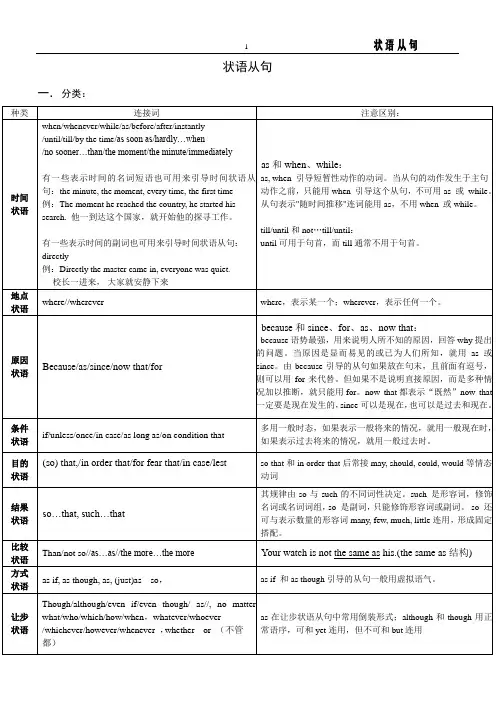
状语从句一.分类:when (当……的时候) while (在……期间) as (当……的时候, 一边……一边……)before (在……之前) since (自从……以来) till/until (直到) hardly…when… (刚……就) as soon as (一……就……)after (在……之后) not…till/until(直到……才)no sooner…than…(刚……就) 地点状语从句:where (在那里) wherever(无论哪里)原因状语从句:because (因为) since (因为,既然) as (由于) for (为了) now that(既然)目的状语从句:(so)that=in order that(以便)so as(not)to (以便[不])in case(以免)lest(以免)结果状语从句:so+adj./adv.+that(如此……以致)so that(结果……)such+n.+that(如果……以致)that(所以,因此)让步状语从句:though/although不可同but连用。
though/although (虽然)however (可是)even though/if(即使)no matter+what/which/where/who/when =whatever/whichever/wherever/whoever/whenever(不论什么/哪一个/哪里/谁/何时)比较状语从句:as (正如)as…as(和……一样)not as/so … as (不如……)than(比……更)the+比较级…+the+比较级(越……越……)条件状语从句:if(假设)unless(如果不)so long as(只要)on condition that (如果)方式状语从句:as(像……那样地)just as(正像)as if(好像)as though(好像)二.各种状语从句的简化方法:1作状语。
英语六种从句的类型
英语六种从句的类型
英语六种从句类型包括:
1、定语从句:用来修饰名词或代词,由关系代词或关系副词引导,例如:That is the man who helped me.
2、状语从句:用来改变句子的时态、语义或解释句子的内容,常由连接副词或连词引导,例如:He went there because he had important business.
3、表语从句:用来修饰主语,经常跟在be动词后面,由连接代词或连词引导,例如:I know that he is a doctor.
4、宾语从句:可以作实义动词或介词的宾语,常由连接代词或连词引导,例如:He said that he was very busy.
5、同位语从句:可以作名词的补充说明,由连接代词或连词引导,例如:Do you know the fact that he is ill?
6、主语从句:可以作谓语动词的主语,常由连接词或连接副词引导,例如:Whether they will come or not is uncertain.。
高中英语从句类型
从句的分类六大从句类型主语从句用作主语.That the earth is round is true.宾语从句用作宾语。
Do you know where he lives?表语从句用作表语.My opinion is that you should not go alone.同位语从句用于解释说明前面的名词,与先行词同位或等同的从句叫作同位语从句。
其关联词多为that。
The fact that the earth is round is true.(that从句用于解释说明the fact)定语从句相当于一个形容词,用于修饰前面的名词。
定语从句一般皆放在被它所修饰的名(代)词之后,这种名(代)词就叫作先行词(Antecedent)。
引导定语从句的关联词为关系代词和关系副词。
关系代词在定语从句中可用作主语、宾语、定语等;关系副词在定语从句中用作状语。
The student who answered the question was John.状语从句相当于一个副词,修饰主句中的动词, 形容词和副词, 通常有从属连词引导, 按其意义和作用可分为时间, 地点, 条件, 原因, 让步, 目的, 结果, 方式, 比较.等When it rains, I usually go to school by bus.If he comes tomorrow, you will see him.He returned home to learn his daughter had just been engaged.You must speak louder so that /in order that you can be heard by all.Since /As the weather is so bad, we have to delay our journey.从句划分技巧主句和从句的划分方法是相同的。
从句的类型及用法总结
从句的类型及用法总结从句是语言中的一种基本成分,它可以扩展句子的信息量,并使句子更加具体和明确。
从句分为几种类型,包括名词性从句、形容词性从句和副词性从句。
本文将对这些从句的类型及其用法进行总结,并举例说明。
一、名词性从句名词性从句可以在句子中充当主语、宾语、表语或宾语补足语。
名词性从句通常由连接词“从属连词”引导,包括“that、whether/if、who、whom、whose、which、what”等。
1. 主语从句主语从句在句子中充当主语,常以“that、whether/if、wh-”为引导词。
例如:- That he has refused to help surprises me. (他拒绝帮助我,让我感到惊讶)- Whether she will come or not is still uncertain. (她是否会来还不确定) - What he said is true. (他说的是真的)2. 宾语从句宾语从句在句子中充当直接宾语或间接宾语,常以“that、whether/if、wh-”为引导词。
例如:- He knows that you are coming. (他知道你要来了)- I wonder if he can finish the task. (我想知道他是否能完成这个任务) - I don't know what he is talking about. (我不知道他在说什么)3. 表语从句表语从句在句子中充当表语,常以“that、whether/if、wh-”为引导词。
例如:- My wish is that you succeed. (我希望你成功)- The fact that he lied shocked everyone. (他撒谎的事实让每个人都感到震惊)4. 宾补从句宾补从句通常跟在某些动词(如“think、believe、find、consider”等)或介词(如“for、on、about”等)后面,充当宾语的补足语,常以“that、whether/if、wh-”为引导词。
高中英语所有从句大全
高中英语所有从句大全从句是语法中的一个重要概念,它用来描述一个句子中含有另一个完整句子的情况。
在英语中,从句可以分为名词性从句、形容词性从句和副词性从句。
本文就高中英语所有从句分类详细介绍,以便广大学生更加深入了解英语语法知识。
一、名词性从句名词性从句是指充当句子中某一成分的从句,即作为名词使用的从句。
名词性从句根据其所承担的成分可以分为主语从句、宾语从句、表语从句和同位语从句。
1. 主语从句主语从句在句中充当整个句子的主语部分,通常以从句引导词 that 或 whether 开头。
例如:That he is guilty is beyond doubt.(他有罪是无疑的)Whether we will win the game is still unknown.(我们是否能赢得比赛还不确定)2. 宾语从句宾语从句在句子中作为动词的宾语,通常以从句引导词that,whether 或连接代词/副词引导。
用 that 引导的宾语从句可以省略 that。
例如:I believe that he will come.(我相信他会来)Do you know whether it will rain tomorrow?(你知不知道明天会不会下雨?)She asked me where I was going.(她问我我要去哪里)3. 表语从句表语从句在句子中作为系动词后的补语,通常以从句引导词 that,whether 或连接代词/副词引导。
例如:My worry is that I may fail the exam.(我的担忧是我可能会考砸了)The fact that he is absent worries me.(他缺课这个事实让我担心)It is important whether he will show up or not.(他是否到场很重要)4. 同位语从句同位语从句修饰一个名词或代词,解释或说明该名词或代词的具体内容,通常以从句引导词 that 开头。