
牛津英语八年级下册8B知识点
1 8B Unit 1
一 掌握下面的短语和句型:
(Comic strip and Welcome to the unit)
1. an hour ago 一个小时前(用于一般过去时)
2. (1) not… any more 不再
(2) want to do sth 想要干某事
(3) play with 和……一起玩,玩弄
3. time (1) “时代”,常用复数。The times are
different. 时代不同了。
(2)“时间”,不可数名词。
短语和句型:
(1) at that time 在那时;at times = from time
to time 有时;all the time 一直;at the same
time 同时; at a time 一次; in time 及时;on time 按时;in no time 立刻,很快;once
upon a time 从前
(2)It’s time (for sb.) to do sth. 是(某人)做某事的时间了。
(Reading, Vocabulary)
1. in fact 事实上
2. marry 结婚,娶,嫁
(1)marry sb. =be/get married to 与……结婚
(2)be /get married 结婚
3. move to 搬到……
4. change a lot 变化很大
5. in the past 在过去
6. Chinese medicine shop 中药店
7. turn into (使)变成
8. play cards 打牌,打扑克
9. play Chinese chess 下棋
10. once 从前
11. take off (飞机等)起飞
land (飞机等)着陆
12. It is … to do sth. 做某事是……。(不定式作主语)
13. lonely (情感上)孤独的,寂寞的。可作表语和定语。 alone (处境上)单独的(地),独立的(地)。可作表语和状语。
14. from time to time = at times = sometimes有时
15. a bit = a little 一点
16. as … as 像……一样……
(Vocabulary)
1. 反义词构词法:
(1). in-: incomplete, incorrect
(2). im-: impolite, impossible
(3). un-: unhealthy, unkind, unlucky,
unpleasant
(4). dis-: dislike
2. have an interview with sb. 采访某人
3. more and more 越来越多
比较级+and+比较级
(Grammar)
1. have been to 去过某地
2. a few times 几次
3. for a long time 很长时间
4. be in service 在使用中=be in use
5. hear about 听说
(Integrated skills and Study skills)
1. Thanks for (doing) sth. 多谢你……。
2. be glad to do sth 做某事很开心
3. go on holiday 去渡假
4. to the north of … 在……的北面(不毗邻)
in the north of … 在……的北部(在内部)
on the north of… 在……的北边(毗邻)
5. over the years 这些年
6. It takes sb some time to do sth. 花费某人……时间做某事。
7. 花费时间和金钱的区别:
sb spend some time (in) doing sth. 某人花费……时间做某事。
=It takes sb some time to do sth.
sb spend some money on sth. 某人花费……钱买某物。
=sb pay some money for sth.
=sth cost sb some money.
2 8. called = named = with the name of 被叫做……的
9. primary school 小学
secondary school 中学
10. on one’s own = by oneself = alone 独立地,独自地
11. after school 放学后;after class 下课后
12. enjoy doing sth. 喜欢做某事
13. chat with sb. 和某人聊天
(Main task)
1. used to do sth. 过去常常做某事(强调过去有但现在没有)
2. no longer 不再=not … any longer
3. provide sth for sb. =provide sb with sth. 为某人提供某物
4. by ferry 乘渡船
5. because of sth 因为……
二 掌握下面的语法:
现在完成时:
(1)用法:
①表示过去发生的动作以现在造成影响或结果。
如:My parents _______ already_____(come)
back from Japan.
答案:has, come
②表示过去某一时刻已经开始一直持续到现在的动作或状态。
如:Mr. Li _______(teach) in this school for ten
years.
答案:has taught。
(2)构成:have / has + 过去分词
肯定:主语+have/ has +过去分词
否定:主语+have/ has + not +过去分词
疑问:have/ has +主语+过去分词
(3)常用时间状语:
① 在第一种用法中所用的时间副词有:
already(用于肯定句), yet(用于疑问句和否定句), just(用于肯定句), ever(用于疑问句), never(用于否定句,表示否定), before, recently, many times
② 在第二种用法中所用的时间是从过去一直延续到现在的一段时间。
有两种基本的表达方式:for + 一段时间
/ since + 过去时间。
如: since an hour ago, since 1989, since he
came here, since last month, for five years,
for two days,in the last (past) few years等。
(4)现在完成时和一般过去时的区别:
现在完成时:强调现在,不能和过去时间连用。
一般过去时:强调过去,可以和过去时间连用。
He has eaten that kind of food many times. 他已经吃过那种食物很多次了。
He ate that kind of food yesterday. 他昨天吃过那种食物。
(5)have / has been to 去过某地(现在已经回来了)
have/ has gone to 到某地去了(现在还没有回来)
--Where is Jim, do you know?
--He has gone to Beijing.
--Oh, I have been to Beijing twice. It is a
beautiful city.
(6)现在完成时跟一段时间连用时,谓语动词要用延续性动词。
常用的短暂性动词和延续性动词有:
begin to study---- study catch a cold --- have a
cold borrow---- keep buy ----- have
begin----- be on close ---- be closed
open ------ be open come back------ be back
die------ be dead end ------ be over
fall ill----- be ill leave ---- be away from
put on ------ be in join ------ be in
(be a member of )
get up------be up; go out------be out;
go there------be there; go to
bed------be in bed
3 arrive in Zhanjiang – be in Zhanjiang;
get married – be married
8B Unit 2
一 掌握下面的短语和句型:
(Comic strip and Welcome to the unit)
1. go on a trip 去旅游
2. must “一定……”,表示可能性。
3. let sb do sth 让某人做某事
make sb do sth 使某人做事
see sb do sth 看见某人做事
hear sb do sth 听见某人做事
4. I don’t think…. 我认为……不……。否定前移。
5. go hiking 去远足
go skiing 去滑雪
6. see the beautiful view 领略美丽的风景
7. take photos 照相
(Reading, Vocabulary)
1. have a great time 玩得很开心= have fun =
enjoy oneself
2. as soon as 一……就……
一般将来时+as soon as / when/ until/ if + 一般现在时
3. excited 感到兴奋的(和人有关),be excited
about 对……感到兴奋
exciting 令人兴奋的(和物有关)
interested 感兴趣的(和人有关) be
interested in 对……感兴趣
interesting 有趣的(和物有关)
surprised / amazed 感到惊讶的(和人有关)
be surprised / amazed at 对……感到惊讶
surprising / amazing 令人惊奇的(和物有关)
bored 感到无聊的 (和人有关) feel bored
boring 令人心烦的 (和物有关)
4. as 作为,是介词。
5. have to do sth 不得不干什么 = must
牛津译林英语8B Unit1--Unit8单词短语知识点(默写版)
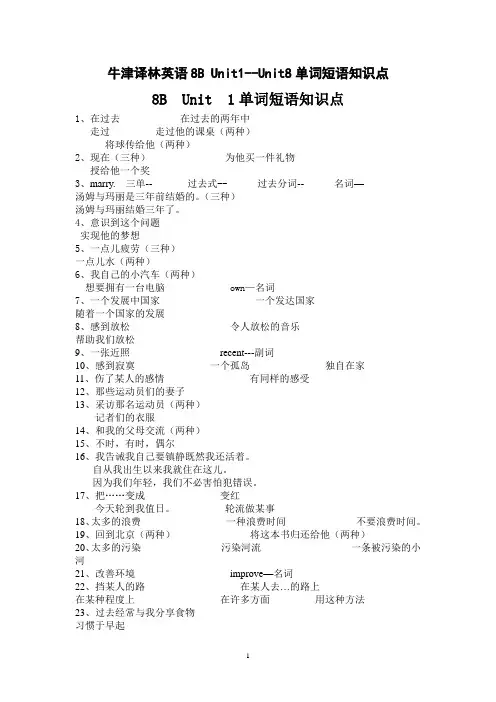
1 牛津译林英语8B Unit1--Unit8单词短语知识点
8B Unit 1单词短语知识点
1、在过去 在过去的两年中
走过 走过他的课桌(两种)
将球传给他(两种)
2、现在(三种) 为他买一件礼物
授给他一个奖
3、marry. 三单-- 过去式-- 过去分词-- 名词—
汤姆与玛丽是三年前结婚的。(三种)
汤姆与玛丽结婚三年了。
4、意识到这个问题
实现他的梦想
5、一点儿疲劳(三种)
一点儿水(两种)
6、我自己的小汽车(两种)
想要拥有一台电脑 own—名词
7、一个发展中国家 一个发达国家
随着一个国家的发展
8、感到放松 令人放松的音乐
帮助我们放松
9、一张近照 recent---副词
10、感到寂寞 一个孤岛 独自在家
11、伤了某人的感情 有同样的感受
12、那些运动员们的妻子
13、采访那名运动员(两种)
记者们的衣服
14、和我的父母交流(两种)
15、不时,有时,偶尔
16、我告诫我自己要镇静既然我还活着。
自从我出生以来我就住在这儿。
因为我们年轻,我们不必害怕犯错误。
17、把……变成 变红
今天轮到我值日。 轮流做某事
18、太多的浪费 一种浪费时间 不要浪费时间。
19、回到北京(两种) 将这本书归还给他(两种)
20、太多的污染 污染河流 一条被污染的小河
牛津译林八年级下册8Bunit5知识点梳理

共5页 第1页 8B unit5
1.drop litter everywhere 到处扔垃圾
2.cut in(on sb./sth.)打断(谈话),插嘴
3.queue for your turn排队等候你的顺序
4.leave the tap running 让水龙头一直开着
5.greet sb.with a kiss 和某人用亲吻打招呼
6.shake sb.'s hand 与某人握手
7.in public 公开地,在别人面前
8.push in插队,加塞
9.bump into someone撞到某人
10.in one's way 挡住某人的路
11.as well(as)也,还有
12.by accident 偶然,意外地
13.join the discussion 参加讨论
14.keep sb.from sth.不让某人做某事,使免受。。。。。
15.risk losing everything 冒着失去一切的危险
16.above all首要的是
1. You're old enough to learn about manners now,Hobo.
霍波,现在你足够大了,该学礼仪了。
2. You're never too old to learn.
活到老,学到老。
3.British people only greet relatives or close friends with a kiss.
英国人只和亲戚或亲密的朋友用亲吻打招呼。
4.They talk about the weather,holidays,music,books or something else.
他们谈论天气、假期、音乐、书籍或其他一些事情。
5. They think it's rude to push in before others.
他们认为在别人前面插队是粗鲁无礼的。
八年级英语下册Unit8Agreenworld知识点总结及测试卷(新版)牛津版
1 八年级英语下册Unit8Agreenworld知识点总结及测试卷(新版)牛津版
8B Unit 8 A green world
单元重点知识点总览
1.We can reduce air pollution by riding bicycles.我们可以通过骑自行车减少污染。
reduce 及物动词,“减少”。如:
Giving up smoking reduces the risk of heart disease.
戒烟会减少得心脏病的风险。
2.We can save water by taking shorter showers.我们可以通过洗更短的淋雨节省水。
save 动词,“节约,节省”,save water “节约用水”。如:
It’s necessary for us to save water.
节约用水对我们来说很有必要。
3.My dad used to drive me to school, but now we take the underground.我的爸爸过去常常开车送我去上学,但现在我们乘地铁。
(1)used to 表示“过去常常”,后接动词原形构成used to do sth “过去常常做某事”。
He used to drink.他过去经常喝酒。
(2)be used to doing sth “习惯于做某事”。如:
The old man is used to living alone.这位老人习惯于一个人生活。
【拓展】be used to 后面也可接动词原形,即be used to do sth,表示“被用于做某事”,是一种被动结构,相当于be used for doing sth。如:
The material is used to make a plane. 这材料是用于制造飞机的。
5.More and more families own cars and this causes serious air pollution.越来越多的家庭拥有汽车,这导致严重的空气污染。
牛津译林版八年级下册8BUnit3知识梳理
八年级下册8BUnit3知识梳理
知识点一 Comic-Reading 部分单词短语讲解
【知识梳理】
1. Have you used this before, Eddie? (P34) 艾迪,你之前使用过这个吗?
What do you usually use your computer for? (P35) 你通常用电脑做什么?
I usually use it to search for information. (P35) 我通常用它寻找信息。
How often do you use your computer for this? (P35) 你用电脑做这个多久一次?
use用法
use /ju:z/ v. 使用 adj. useless(无用的); useful(有用的)
常见的词组有:
① use sth. to do sth 使用某物做某事
e.g.: People use knives to cut things.
② use sth for sth. 为了…使用…
e.g.: He uses the Pad for fun.
③ used to do sth. (用于过去持续或经常发生的事)曾经
e.g.: There used to be a factory here.
He used to go home before 8 o’clock.
④ be/ get used to sth/ doing sth. 习惯于某事/做某事
e.g.: I have been in Nanjing for 8 years, and I am used to the life and climate here.
She is now getting used to going home for dinner.
⑤ be used to do sth 被用来做……
8B Unit2 Grammar 知识点练习八年级英语牛津深圳版(广州沈阳通用)下册
★ 思维导图
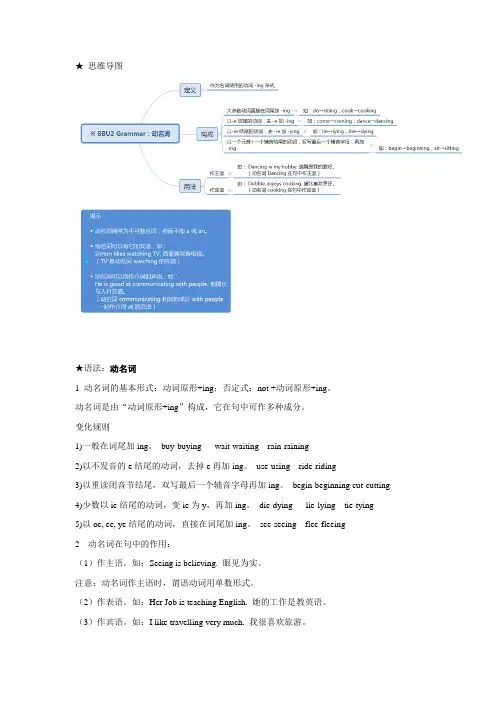
★语法:动名词
1 动名词的基本形式:动词原形+ing;否定式:not +动词原形+ing。
动名词是由“动词原形+ing”构成,它在句中可作多种成分。
变化规则
1)一般在词尾加ing。 buy-buying wait-waiting rain-raining
2)以不发音的e结尾的动词,去掉e再加ing。 use-using ride-riding
3)以重读闭音节结尾,双写最后一个辅音字母再加ing。 begin-beginning cut-cutting
4)少数以ie结尾的动词,变ie为y,再加ing。 die-dying lie-lying tie-tying
5)以oe, ee, ye结尾的动词,直接在词尾加ing。 see-seeing flee-fleeing
2 动名词在句中的作用:
(1)作主语。如:Seeing is believing. 眼见为实。
注意:动名词作主语时,谓语动词用单数形式。
(2)作表语。如:Her Job is teaching English. 她的工作是教英语。
(3)作宾语。如:I like travelling very much. 我很喜欢旅游。 (4)作定语。如:This is our reading room. 这是我们的阅览室。
3 习惯接动名词作宾语的动词有:enjoy, finish, imagine, keep, mind, practise等。如:
My sister enjoys playing tennis. 我姐姐喜欢打网球。
Do you mind opening the window? 你介意开窗吗?
4 动名词也可以在短语动词和介词后作宾语,习惯接动名词作宾语的短语有:be afraid of, be
busy, be good at, be interested in, be worth, feel like, how / what about, look forward to, pay
译林版牛津英语八年级下册8bunit2travelling知识点短语以及练习
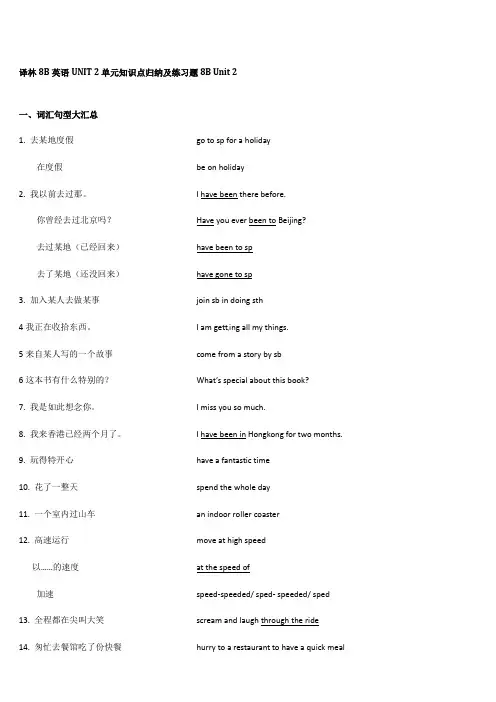
译林8B英语UNIT 2单元知识点归纳及练习题8B Unit 2
一、词汇句型大汇总
1. 去某地度假 go to sp for a holiday
在度假 be on holiday
2. 我以前去过那。 I have been there before.
你曾经去过北京吗? Have you ever been to Beijing?
去过某地(已经回来) have been to sp
去了某地(还没回来)
have gone to sp
3. 加入某人去做某事 join sb in doing sth
4我正在收拾东西。 I am getting all my things.
5来自某人写的一个故事 come from a story by sb
6这本书有什么特别的? What’s special about this book?
7. 我是如此想念你。 I miss you so much.
8. 我来香港已经两个月了。 I have been in Hongkong for two months.
9. 玩得特开心 have a fantastic time
10. 花了一整天 spend the whole day
11. 一个室内过山车 an indoor roller coaster
12. 高速运行 move at high speed
以……的速度 at the speed of
加速 speed-speeded/ sped- speeded/ sped
13. 全程都在尖叫大笑 scream and laugh through the ride
14. 匆忙去餐馆吃了份快餐 hurry to a restaurant to have a quick meal
15. 匆忙去某地 hurry to sp (动词)/ go to sp in a hurry(名词)
牛津英语8B_unit3知识点语法汇总(超级精华).doc
⽜津英语8B_unit3知识点语法汇总(超级精华).doc
(⽜津初中英语总复习) 8B Unit 3⼀.【精选词汇】
㈠重点短语 1. I have no idea.=I’ve no idea.=I don’t know.我不知道。 (p40) 2. turn on the TV →turn on/off打开/关闭…,turn up/down调⼤/调低;都是“动词+副词”。 3. change the channel换台→on Channel…在…台,e.g. on CCTV-5→拓展:theEnglish Channel英吉利海峡
4. different uses of computers计算机的不同⽤途: draw and design, play computer games, search for information, send andreceive e-mails收发电⼦邮件, do word processing进⾏⽂字处理, write computerprograms编写计算机程序 (p41) 5. travel around the world in eight hours⼋⼩时环游地球,educational CD-ROM教育软件 (p42) 6. come out (书等)出版,发⾏,发表,不能⽤于被动语态,可以转化为bepublished。 〈知识链接〉When will her new novel come out?=When will her new novel bepublished? 〈⽤法拓展〉〈⽤法拓展〉⑴(太阳、⽉亮或星星)出现;露出,e.g. The rained stopped andthe sun came out.
⑵(花朵)开放;(草)出芽,e.g. In March flowers and grass come out. 7. learn English and geography at the same time同时学英语和地理→at the sametime同时
牛津译林版八年级英语下册8B Unit7 知识梳理
新8b Unit 7 知识梳理
pocket money 零花钱
have sth left 有……剩下
It’s time for lunch. =It’s time to have lunch. 到了吃午餐的时间了
have a big lunch吃一顿丰富的午餐
I’m too weak to walk any further. 我太虚弱了,走不动了。
come on 加油
know about a charity called UNICEF 了解一个叫联合国儿童基金会的慈善组织
help build a better world for everyone 帮忙替所有人建立一个更好的世界
help (to)do sth 帮助做某事
build sth for sb 替某人建造某物
provide basic education for children in poor areas 为贫困地区的孩子提供基础教育
provide sth. for sb.= provide sb. with sth. 给某人提供某物
work for the equal rights of girls and women 为儿童和妇女获取平等的权利而工作
prevent the spread of some serious diseases防止一些严重疾病的蔓延
an interview with an ORBIS doctor 一份与奥比斯医生的采访
tell us something about blindness 告诉我们一些有关失明的事情
80 percent of these cases 80%的这些病例
can be prevented or cured 能够被预防或治愈 (被动语态)
have money for medical treatment有钱进行医学治疗
have enough money for sth. = have enough money to do sth.有足够的钱干某事
八年级英语下学期期末复习8BUnit4单词牛津版
8B Unit 4单词
1. 慈善,慈善机构
2. 麦克风,话筒
3. 募集资金
4. 作广告,登广告
5. 散页印刷品,传单
6. 猫科动物
7. 照相机
8. 流行音乐的
9. 准时,按时
10. 工作,任务
11. 介绍
12. 责任,职责,义务
13. 活动,事件
14. 迷,狂热爱好者
15. 好象,似乎,看来
16. 企业,商行,工厂
17. 加入,参加
18. 组织
19. 货物,商品
20. 公开的
21. 听众,观众
22. 幕,帷幕
23. 舞台
24. 嗓音
25. 演员
26. 表演,执行,做
27. 悬挂,吊
28. 安排(名)
29. 安排(动)
30. 扬声器,喇叭
31. ]教育
32. 建立,设立,创立
33. 在...中
34. 给…打电话
35. 有雪的
36. 小孩
37. 寂静的
38. 捐赠
39. 休息
40. 演讲
41. 目的
42. 升起
Unit 4
1. 慈善,慈善机构
2. 麦克风,话筒
3. 募集资金
4. 作广告,登广告
5. 散页印刷品,传单
6. 猫科动物
7. 照相机
8. 流行音乐的 9. 准时,按时
10. 工作,任务
11. 介绍
12. 责任,职责,义务
13. 活动,事件
14. 迷,狂热爱好者
15. 好象,似乎,看来
16. 企业,商行,工厂
17. 加入,参加
18. 组织
19. 货物,商品
20. 公开的
21. 听众,观众
22. 幕,帷幕
23. 舞台
24. 嗓音
25. 演员
26. 表演,执行,做
27. 悬挂,吊
28. 安排(名)
29. 安排(动)
30. 扬声器,喇叭
31. ]教育
32. 建立,设立,创立
33. 在...中
34. 给…打电话
35. 有雪的
36. 小孩
37. 寂静的
38. 捐赠
39. 休息
40. 演讲
41. 目的
42. 升起
Unit 4
1. 慈善,慈善机构
牛津英语8Bunit1知识点
====Word行业资料分享--可编辑版本--双击可删====
源-于-网-络-收-集 (牛津初中英语总复习) 8B Unit 1
一.精选词汇
㈠重点短语
1. the changes to Sunshine Town阳光镇的变化→the changes to… …的变化 (p8)
〈知识链接〉change n.变化,常用复数changes。 e.g. Great changes have taken place since 1995.
2. in the southern part of town →in the southern part of…在…的南部→south →southern
〈知识链接〉east东部→eastern东部的, west →western, north →northern
3. in the past在过去→at present现在→in the future未来;将来,注意这些短语中的介词和冠词。
4. turn the place into a park →turn…into…把…变成…
〈知识链接〉①Heat turns water into vapor.热使水变成蒸气。②Turn this sentence into English.
5. play cards and Chinese chess打牌、下象棋,e.g. It’s pleasant to play cards and Chinese
chess.
6. water pollution水污染→air pollution空气污染,noise pollution噪音污染 (p9)
〈知识链接〉Water pollution was a problem before.
7. used to dump its waste into water →used to do sth过去常做某事,注意否定式、疑问式的形式