
新湘少版六年级英语上下册复习资料
六年级上册英语复习资料一、单词:after 在……之后always总是;经常bar条,棒bean 豆子blouse 女式短上衣bottle瓶子bring 带来call 打电话candy糖果Christmas 圣诞节centre中心clay 黏土;泥土clear 晴朗的colourful 彩色的concert 音乐会cough 咳嗽decorate装饰dress up 装扮;穿上盛装drop滴during 在……期间email 电子邮件enough足够的feel 感觉fever 发烧film 电影find out about 发现forecast 预报fresh 新鲜的fruit 水果greet 问候greeting 问候hall 大厅headache 头痛heavy 大量的holiday 假日idea 主意just只是;仅仅learn 学习light 轻柔的;灯lotus莲花medicine 药merry欢乐的mooncake 月饼nearby 附近的never 从不often 经常picnic 野餐plan 计划play 戏剧practice 练习present 礼物rain 雨;下雨receive 收到rest 休息return 返回Santa Claus圣诞老人save 节约search 查找seed种子send 发送should 应该slow 慢的sometimes 有时speak 说taste 尝than比theatre 剧院the Mid-Autumn Festival 中秋节type 类型wait 等待waste 浪费wave 挥手weak 弱的weekday平日well (身体)好的why 为什么world 世界二、句型:Unit 1. What did you do during the holidays?假期中你做了什么?---What did you do during the holidays?假期中你做了什么?---I learnt writing. 我学习写作。
---I read many books. 我看了许多书。
---I practiced listening. 我练习了听力。
---I played games. 我玩了游戏。
Unit 2. Katie always gets up early. 凯蒂一直很早起床。
1. Katie always gets up early. 凯蒂一直很早起床。
2. Katie often does her homework before dinner. 凯蒂经常晚餐后做作业。
3. Katie sometimes plays chess with her father. 凯蒂有时和她爸爸下棋。
4. Katie never takes a walk. 凯蒂从不散步Unit 3 I like my computer. 我喜欢我的电脑。
1. We can email our friends on the computer. 我们可用电脑给朋友们寄电子邮件。
2. We can play games on the computer. 我们可以在电脑上玩游戏。
3. We can search for a lot of things on the computer.我们可以用电脑搜索许多东西。
4. We can send greetings on the computer. 我们可以在电脑上传递问候。
Unit 4. The Mid-Autumn Festival is coming. 中秋节要到了。
1. I’d like a box of lotu s seed mooncakes and a box of red bean mooncakes.我想要一盒莲子月饼和一盒红豆月饼。
2. I enjoy eating mooncakes. 我喜欢吃月饼。
3. I enjoy looking at the moon. 我喜欢赏月。
Unit 5 It will be sunny and cool tomorrow. 明天将是晴朗和凉爽。
1. It will be sunny and warm tomorrow. 明天将是阳光明媚。
2. There will be a light rain next Monday.下周一将降小雨。
3. There will be a strong wind tomorrow.明天将有强风。
4. There will be a light snow next Monday. 下周一将有小雪。
Unit 6 I will bring a big bottle of orange juice. 我将带来一大瓶橙汁。
1. I will bring a few cans of Coke. 我将带几罐可乐。
2. I will bring a few bars of chocolate.我将带来几块巧克力。
3. I will bring some peanuts and candies.我将带来一些花生和糖果。
Unit 7 What can I do? 我可以做什么?1. What can I do for old people? 我可以为老人们做什么?2. I can make tea for them. 我可以为他们沏茶。
3. I can clean their houses. 我可以打扫他们的房子。
4. I can make them happy. 我可以让他们开心。
5. I can help them on the road. 我可以帮助他们过马路。
Unit 8 We shouldn’t waste water. 我们不应该浪费水。
1. We should keep the rivers clean. 我们应该保持河流干净。
2. We should keep the air clean and fresh.我们应该保持空气的干净和清新。
3. We should plant more trees. 我们应该多种树。
4. We should use bikes instead of cars. 我们应该多骑自行车代替开车。
5. We shouldn’t kill wild animals.我们不应该捕杀野生动物。
6. We shouldn’t waste water.我们不应该浪费水。
7. We shouldn’t litter.我们不应该乱扔垃圾。
Unit 9 This bird is bigger than the first one. 这只鸟比第一只要大。
1. This book is smaller than the first one.这本书比那本书要小。
2. Tom is shorter than Mike.汤姆比麦克要矮。
3. Tom’s hair is longer than Mike’s.汤姆的头发比麦克的要长。
Unit 10 I don’t feel well today.我今天不舒服。
1. What’s wrong with you? 你怎么了?2. I feel cold and I have a cough.我感觉冷还咳嗽。
3. I have a fever and I have headache. 我发烧还头痛。
Unit 11 Shall we go to the theatre? 我们一起去剧院好吗?1. Shall we go to the concert hall? Let’s enjoy the music.我们一起去音乐大厅好吗?让我们去享受音乐。
2. Shall we go the theatre? Let’s see a play.我们一起去剧院好吗?让我们去看戏剧。
Unit 12 It’s Chris tmas again!圣诞节又到了!1. Anne’s family celebrates Christmas. 安的家庭庆祝圣诞节。
2. Anne and her mother decorate their Christmas tree. 安和她妈妈装扮圣诞树。
3. Santa Claus gives out presents to children.圣诞老人给孩子们派送礼物。
4. People send Christmas cards to their friends. 人们给朋友们送圣诞贺卡。
动词的三单现和过去式:六年级下册英语复习资料一、单词a piece of 一块afraid 害怕的air 空气aloud 大声地Big Ben 大本钟clever 聪明的close 关cross 穿过difficult困难的drop 落下Earth 地球easy 容易的exercise 锻炼grandparent (外)祖父/母happily 高兴地healthy 健康的its 它的jog 慢跑keep保持kid 小孩land 陆地lose失去meat肉move 移动party 聚会piano钢琴place地方places of interest风景名胜ride 骑(自行车/马等)space 太空step on 踩take care of 照顾the Eiffel Tower 埃菲尔铁塔the Golden Gate Bridge 金门大桥the Great Wall 长城tired 累的;疲倦的together在一起travel旅行Tree Planting Day植树节wood 木头worry 焦虑;担心二、句型Unit 1 A family outing 家庭郊游1. Where are we going today?今天我们去哪?2.We’ll watch a movie.我们将去看电影。
3. We’ll go shopping.我们将去购物。
4. We’ll take/have a walk. 我们将去散步。
5. We’ll look at the flowers.我们将去赏花。
6. Shall we go the park?我们将去公园吗?Unit 2 Some stories are more interesting.一些故事更有趣。
1. That piece of meat is better than mine.那块肉比我的更好。
2. Its meat dropped into the water.它的肉掉进水里了。
Unit 3 We should learn to take care of ourselves.我们应该学会照顾我们自己。
湘少版六年级英语总复习资料
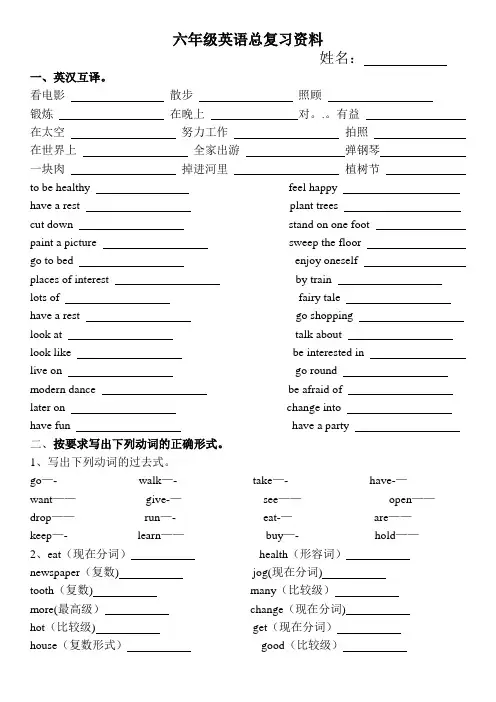
六年级英语总复习资料姓名:一、英汉互译。
看电影散步照顾锻炼在晚上对。
.。
有益在太空努力工作拍照在世界上全家出游弹钢琴一块肉掉进河里植树节to be healthy feel happyhave a rest plant treescut down stand on one footpaint a picture sweep the floorgo to bed enjoy oneselfplaces of interest by trainlots of fairy talehave a rest go shoppinglook at talk aboutlook like be interested inlive on go roundmodern dance be afraid oflater on change intohave fun have a party二、按要求写出下列动词的正确形式。
1、写出下列动词的过去式。
go—- walk—- take—- have-—want——give-—see——open——drop——run—- eat-—are——keep—- learn——buy—- hold——2、eat(现在分词)health(形容词)newspaper(复数) jog(现在分词)tooth(复数) many(比较级)more(最高级)change(现在分词)hot(比较级) get(现在分词)different(反义词) meet(同音词)drink(三单)teach(名词)rain(形容词) heavy(反义词)三、快乐ABC,我会选。
1、——Where are we today?——We will go to the library.A.goingB.go C。
will go2、Dongdong often rides bicycle to school。
A.a B。
新湘少版六下英语Unit2知识点归纳
新湘少版六年级英语下册Unit 2单元知识点归纳重点词汇积累:meat 肉happily 高兴地wood 木头its 它的cross 穿过drop 落下lose 失去better 更好的a piece of 一块fairy tale 童话故事space story 太空故事magic story 魔法故事实用句型集锦:1. One day, a dog went to a meat shop.一天,一只狗去了一家肉店。
2. The man in the shop gave a piece of meat to the dog. 商店里的人给了这只狗一块肉。
3. The dog took it and walked home happily. 这只狗带着它高兴的往家走。
4. The dog walked on a piece of wood to cross the river.这只狗走上一块木板过河。
5. It’s meat dropped into the water. 它的肉掉进了水里。
6. That piece of meat is better than mine.那块肉比我的好。
7. I like swimming more than running. 我喜欢游泳胜过跑步。
8. I like books on science 我喜欢关于科学的书.9. Reading is good for us.阅读对我们是很有益的。
10. We should read more books. 我们应该多读书。
11. I can learn a lot from these books .我从这些书中可以学到很多。
名师精析1. The man in the shop gave a piece of meat to the dog. 商店里的人给了这只狗一块肉。
meat 是不可数名词,所以不能说a meat. ,一块肉要说:a piece of meat ; 两块肉就是:two pieces of meatw W w .X k b 1.c O mgave 是动词give 的过去式,give sb to sth 意为“ 把某物给某人”如:He gave a book to me.他给了我一本书。
湘少版六年级上册英语复习重点(精修版)
湘少版英语精品资料(精修版)小学英语六年级(上)复习资料Unit 1 What did you do during the holidays? 你在假期都做些什么?●词汇:holiday 假期during 在...期间speak 说learn words and sentences 学习单词和句子play games 玩游戏learn writing 学习写作practise listening 练习听力●语法:一般过去时:表示过去某个时间里发生的动作或状态过去时判断标志:句子中有表示过去的时间。
yesterday昨天yesterday morning昨天早上the day before yesterda前天last night 昨晚last week上周last month上个月last year去年just now刚才two days ago两天前in 1990 等…..构成:主语+动词过去式动词过去式的变化规则:1.直接加ed:work—worked look—looked2.以不发音e结尾的单词,直接加d:live---lived hope---hoped use---used3.以辅音字母+y结尾的,变y为i加ed:study—studied carry—carried worry—worried4.以重读闭音节结尾且末尾只有一个辅音字母的,双写最后的辅音字母+ed:stop—stopped plan—planned;重读闭音节体现形式为辅-元-辅结构,例如nod,n为辅音,o为元音,d为辅音。
5.以ic结尾的动词,要把ic变成ick再加ed,如picnic→picnicked,traffic→trafficked6.不规则变化的动词过去式:have---had am/is---was are---were get---got say---said feel---felt do/does---did go---went drink---drank eat--ate bring----broughtthink----thought buy----bought catch----caught teach----taughtwear----wore cut----cut sweep----swept sleep—slept see----sawbecome----became read----read sit----sat●语言结构:What did you do during the holidays?I read many books.I wrote a little storybook.◆乘坐某种交通工具“by+交通工具的名称” 如:乘火车by train 乘公共汽车by bus 但是,有一个特殊,步行on footUnit 2 Katie always gets up early.凯蒂总是很早起床。
湘少版小学英语六年级复习知识点
资料范本本资料为word版本,可以直接编辑和打印,感谢您的下载湘少版小学英语六年级复习知识点地点:__________________时间:__________________说明:本资料适用于约定双方经过谈判,协商而共同承认,共同遵守的责任与义务,仅供参考,文档可直接下载或修改,不需要的部分可直接删除,使用时请详细阅读内容湘少版(湖南少年儿童出版社出版)小学英语教材知识点,使用湘教版小学英语教材六年级的老师应该用得着,这些知识点还是很全面的,希望对您有所帮助。
1.字母:(大小)辨认、书写顺序;元音字母:A a , Ee, Ii, Oo, Uu2. 数字:1~999的基数词和序数词的运用,如计算、购物、时间、日期等。
句型:①What's your number?②What’s the time?③How many pens are there?④How old are you?⑤How much is it?⑥How tall are you?⑦How heavy are you?⑧What time do you get up?⑨When's your birthday?⑩What time did you see him?3. 颜色:单词:red, pink, yellow, brown, blue, purple, orange, black, white, green.句型:①What colour is it? ②What’s your favourite colour?4. 时间:年、季节、月、星期、日、时刻:Season( spring, summer, autumn, winter)Month: January, February, March, April, May, June, July, August, September, October, November, December.Week: Sunday, Monday, Tuesday, Wednesday, Thursday, Friday, Saturday.Day: 1st May (the first of May), May 2nd ( May the second)句型:见话题2。
湘少版六年级上册英语复习资料

湘少版六年级上册英语复习资料Unit 1 What did you do during the holidays?During the holidays。
we had a lot of activities。
We learned words and sentences。
played games。
and practiced listening。
Some of us even learned writing and read many books。
We also took the time to speak and talk with our friends and family。
It was a fun and productive time.Unit 2 Katie always gets up early.Katie is a very punctual person。
She always gets up early and has breakfast before going to school。
She never wants to be late for school。
so she makes sure to do her homework and read a XXX。
XXX weekdays。
she often goes to bed early to prepare for the next day。
When she leaves for school。
she always waves goodbye to her family.Unit 2 My day一、写出下列单词或短语的汉语意思。
起床,做作业,下棋,散步,泡茶1.get up2.do homework3.play chess4.take a walk5.make XXX1.I always wake up early in the morning.2.Before dinner。
湘少版小学英语六年级下册复习重点
湘少版英语六年级下册复习要点Unit 1You’ re good at drawing, Peter. 你善于画画,彼得。
单词: kid 儿童;年青人 good at善于于 good idea 好想法 picture 图画 watch a film 看电影句型: 1. be good at.....善于于....(1)后接动名词 I am good at swimming.(2)后接名词I am good at English.What are you good at?I am good at....What are you not good at?I am not good at....What is your best friend good at? / What is Anne / Peter good at?She / He is good at.......What do you like doing?你喜爱做什么?I like watching films.2. Do you......?如:Do you like fishing?Yes, I do. /No, I don ’ t.Unit 2Anne wanted to skate安.想滑冰单词: learn 学习 skating rink 滑冰场 keep保持 straight 直的 fall over 摔倒句型: ( 1 ) want to .......想要....(后接动词原形What do you want to do?你想要干什么?第三人称What does Peter/she want to do?Peter/She wants to read a book.过去时态What did he want to do?He wanted to play computer games.( 2 ) try to .......努力、试试做.... ( 后接动词原形))I want to fly a kite.Lingling try to skate.Unit 3Have you got enough money?你有足够的钱吗?单词:cover 封面 ;覆盖 enough 足够的 sell 买 bookstore 书店 dictionary 词典 dirty mark 污点useful 实用的 of course 自然句型:( 1) Have you got ........?你有.........?Have you got enough money?你有足够的钱吗?Yes, I have. / No, I haven ’ t.( 2)一般疑问句(过去时态)Was the dictionary small enough?这词典够小吗?Yes, it was./ No, it was not.(3) enough 和 too 的用法enough 用来修饰形容词,放在形容词后边。
XX年六年级上册英语考试复习学习要点资料(新湘少版)
XX年六年级上册英语复习资料(新湘少版)本资料为woRD文档,请点击下载地址下载全文下载地址新湘少版六年级上册英语复习资料Unit1★动词过去式变化规律:.一般情况下,直接在动词词尾加ed.如:talk—talked 说listen—listened听play—played玩climb—climbed爬2.以不发音的e结尾,在动词词尾加d.如:practise—practised练习3.以辅音字母加y结尾的动词,变y为i再加ed.如:study —studied学习,研究4.以一个辅音字母结尾的重读闭音节词,双写最后一个辅音字母,再加ed.如:stop—stopped停止5.不规则动词没有规律,需要特殊记。
如:do-did have—hadgo—wentlearn—learnttake—tookread—readspeak—spoketeach—taughtstand—stoodsit—satsay—saidrun—ranis,am—wasare—werewrite--wrote★单词、短语during在…期间holiday假期learnwordsandsentences学习单词和句子playgames玩游戏learnwriting学习写作practicelistening练习听力★句子时态:一般过去时,表示过去某个时间里发生的动作或存在的状态。
主要有动词的过去式来体现,其标志词是过去的时间。
如:yesterday昨天lastnight昨晚lastweek上周lastyear去年等等。
.whatdidyoudoduringtheholidays?假期间你做了什么?--Ireadmanybooks./Ilearntwriting./Iwrotealittlestor ybookinEnglish./Ivisitedmygrandparents.Unit2★单词、短语weekday工作日after在…之后before在..之前always总是,经常often时常sometimes有时never从不wavegoodbye挥手再见belateforschool上学迟到readanewspaper读报纸playchess下棋takeawalk散步getup起床have/hasbreakfast吃早餐returnhome回家★句子时态:一般现在时:表示经常,反复发生的动作或存在的状态。
最新湘少版英语六年级上册全册精品复习资料
最新湘少版英语六年级上册全册精品复习资料Unit1★动词过去式变化规律:1.一般情况下,直接在动词词尾加ed.如:talk—talked说liten—litened听play—played玩climb—climbed爬2.以不发音的e结尾,在动词词尾加d.如:practie—practied练习3.以辅音字母加y结尾的动词,变y为i再加ed.如:tudy—tudied学习,研究4.以一个辅音字母结尾的重读闭音节词,双写最后一个辅音字母,再加ed.如:top—topped停止5.不规则动词没有规律,需要特殊记。
如:do-didhave—hadgo—wentlearn—learnttake—tookread—readpeak—poketeach—taughttand—toodit—atay—aidrun—rani,am—waare—werewrite--wrote★单词、短语during在…期间holiday假期learnwordandentence学习单词和句子playgame玩游戏learnwriting学习写作practicelitening练习听力★句子时态:一般过去时,表示过去某个时间里发生的动作或存在的状态。
主要有动词的过去式来体现,其标志词是过去的时间。
如:yeterday昨天latnight昨晚latweek上周latyear去年等等。
1.Whatdidyoudoduringtheholiday假期间你做了什么?--Ireadmanybook./Ilearntwriting./IwrotealittletorybookinEnglih./Iv iitedmygrandparent.Unit2★单词、短语wavegoodbye挥手再见belateforchool上学迟到readanewpaper读报纸playche下棋takeawalk散步getup起床have/habreakfat吃早餐returnhome回家★句子时态:一般人称做主语,谓语动词用原型。
湘少版英语六年级上册知识归纳【精校版】
湘少版英语六年级上册知识归纳【精校版】目标
本文档旨在为六年级上册的英语研究提供一个全面的知识归纳
总结,有助于学生复巩固已学知识。
内容
1. 单词词汇
- 列举六年级上册所学的所有重要单词,并加以分类和分类归
纳。
2. 语法知识
- 总结六年级上册所学的常用句型和语法规则,包括但不限于
动词时态、名词变复数、形容词比较级和最高级等。
3. 短文理解
- 总结六年级上册所阅读的短文,提炼出关键信息和主要意思,以便学生更好地理解和回答相关问题。
4. 句子翻译
- 提供一些六年级上册中的句子,并要求学生将其翻译成中文,以加强他们的语言运用能力。
5. 课文要点
- 汇总六年级上册每个课文的要点和重点内容,帮助学生回顾
课文内容和理解教学重点。
使用方法
本文档可以作为学生在复阶段的指导资料,学生可以根据自己
的研究计划,有针对性地选择相应的部分进行复。
根据自己的优势
和需要,可以选择按照单词、语法、短文理解、句子翻译或课文要
点的顺序进行研究。
同时,建议学生结合教材和其他参考资料进行
综合复。
总结
通过本文档,六年级上册的英语学习者将能够更好地回顾和巩固已学知识,并在复习阶段更加有针对性地进行学习。
希望本文档能够对学生的学习有所帮助,提高他们的英语水平。
湘少版六年级上册期末总复习资料及练习
2016湘少版六年级上英语期末复习Unit1 What did you do during the holidays?假期你做什么了?单词:learn words and sentences 学习单词和句子play games 玩游戏learn writing 学习写作practise listening 练习听力句型:what did you do during the holidays?假期你做了什么?I read many books.我看了许多书。
语法:动词过去式的变化规则一、规则动词的过去式变化规则①一般情况动词词尾直接加-ed。
如:work—worked play—played②以不发音的-e结尾的动词,动词词尾加-d。
如:live—lived taste—tasted③以辅音字母+y结尾的动词,把y变为i,再加-ed。
如:study—studied cry—cried④以一个辅音字母结尾的,重读闭音节动词(即Vivi常说的辅元辅结构)双写词尾辅音字母,再加-ed.如:stop—stopped clap—clapped二、不规则变化动词没有变化规律,需要童鞋们好好识记。
如:go—went make—made get—got buy—bought learn—learnt do—did take—took have—had read—read speak—spoke teach—taught say—saidUnit2 Katie always gets up early凯蒂总是很早起床词汇:〔频度副词:always总是、often常常、sometimes有时、never从不〕get up 起床return home 回家take a walk 去散步do her homework 做她的家庭作业have breakfast/lunch/dinner吃早/ 中/ 晚餐play chess 下象棋wave goodbye 挥手再见read a newspaper 读报纸be late for school 上学迟到句型:Peter always gets up at 7:00 a.m。