
选修6 Unit 4 Global warming 全单元教案
Unit 4 Global warming Ⅰ. 单元教学目标 技能目标Skill Goals ▲Talk about global warming, pollution and the importance of protecting the earth ▲Practise expressing agreement, disagreement, blame and complaint ▲How to use“it” for emphasis in a sentence ▲Write an essay on environmental problems Ⅱ. 目标语言
功 能 句 式
Expressing agreement, disagreement, blame and complaint Yes, I agree with you. Yes, I think so. I believe that you’ve got it right. I don’t think so. I don’t think that’s right. I’m afraid you are wrong. I’m sorry to bring this up, but ... I’m sorry to have to say this, but ... They shouldn’t have done it. They are to blame. Why don’t you do something about it? Perhaps they should / ought to do ...
词 汇 1. 四会词汇 compare, graph, phenomenon, fuel, quantity, per, data, catastrophe, climate, consequence, state, range, glance, widespread, decrease, steady, steadily, average, existence, outer, electrical, motor, can (n.), microwave, nuclear, disagreement, title 2. 认读词汇 renewable, greenhouse, Fahrenheit, Sophie, Armstrong, Janice, Foster, methane, Charles Keeling, measurement, Celsius, famine, destruction, George Hambley, speculation, environmental, hectare, emphasis, individual, appliance, heading, imperative 3. 词组 compare to, come about, quantities of, result in, build up, keep on, on the whole, make a difference, put up with, so long as, and so on 4. 重点词汇 data, quantity, catastrophe, climate, consequence, compare, per, range, glance, average, existence 语 法 “It” used for emphasis It is human activity that has caused this global warming.
重 点 句 子
1. There is no doubt that the earth is becoming warmer. P26 2. Without the‘greenhouse effect’, the earth would be about thirty-three degrees Celsius cooler than it is. P26 3. They also agree that it is the burning of more and more fossil fuels that has resulted in this increase in carbon dioxide. P26 4. Together, individuals can make a difference. P30 5. It takes a lot of energy to make things from new materials…. P30 6. Remember — your contribution counts. P30 Ⅲ. 教材分析与教材重组 1. 教材分析 本单元以Global warming 为主线,旨在通过单元教学使学生经过思考、学习,认识到全球变暖的起因和它所带来的种种后果。同时鼓励学生进一步阐述地球所面临的其它严重问题,激发学生的环保意识。引导学生运用所学语言、句式表达自己对这些现象的看法,培养他们为自己的观点辩论的能力,并能运用所学知识写一篇有关环境问题的论文。 1.1 Warming Up通过直观的图片,使学生对能源的用途和种类有一个基本的了解。让学生对当今人们开发和使用能源以及随之而来的种种影响有更深一步的思考和认识,从而为本单元主题Global warming 作了很好的铺垫。 1.2 Pre-reading是Reading的热身活动。通过组织学生对这些问题的讨论、回答, 激活他们头脑中相关的内容模式,为下一步阅读做好准备。由于Global warming 是当今世界的一个热门话题,学生已从多种渠道对此有了很多的了解,因此教师可以在安排预习作业时让学生分组做 a project on global warming , 这样既符合了新课程的要求——体现学生的主体地位,激发学生自主学习的热情,又能得到很好的教学效果。 1.3 Reading是一篇从杂志节选的文章。它讲述了全球加速变暖的原因——人为温室效应,后果以及人们对此的不同观点。要求学生在理解文章大意的同时注意它的写作技巧:提出问题——分析现象——阐述各方面的不同观点——以疑问句作为总结引发读者深思,自行做出判断。这为Comprehending 中Exercise 3的分组辩论活动留出了很大的空间,埋下了很好的伏笔。 1.4 Comprehending包含了三大部分。前两个部分中设计了诸多细节性的问题,旨在检测学生定位、理解细节及对文章大意的总结归纳的能力。最后一项要求学生在读完整篇文章后,仔细思考并树立自己的观点:“We should do nothing about global warming”还是“We should do something to decrease the speed of global warming”,并利用所学知识进行分组辩论。此项活动旨在激发学生的学习热情并体现学生在课堂中的主体位置。 1.5 Learning about Language 分词汇和语法两部分。词汇部分设计了两项练习,一项是具有一定情境的10个句子,引导学生加深对新词汇的理解和记忆。语法部分主要是通过练习加强学生对强调句式的掌握并能真正体会强调句的作用。 1.6 Using Language 部分设计了包括听、读、写的活动。Reading and writing 是Reading的一个延伸。通过读者和杂志社之间的两封信件,学生可以更多地了解如何控制全球变暖。同时通过课后练习可以让学生更多地联系自己的生活习惯,树立从自身做起倡导环保的观念。其中课后练习make a poster 更是激发了学生自主学习的兴趣,而且很有实用性——可将所做的环保内容的海报贴在校园或社区中,将课堂的抽象知识变为了社会实践,实现了真正意义上的学以致用。Listening and speaking 部分是关于能源使用的一篇电台采访。要求学生在理解大意和主要细节的基础上回答听力练习中的几大问题,提高学生的听力水平。 2. 教材重组 2.1 将Warming Up与Listening and speaking 整合在一起,设计为一节听说课。 2.2 将Pre-reading, Reading和Comprehending 整合在一起,设计为一节阅读课。 2.3 将Using Language中的Reading and writing 设计为一节泛读课。 2.4 将Learning about Language 与Workbook 中的USING WORDS AND EXPRESSIONS和USING STRUCTURES 整合在一起,设计为一节语言学习课。 2.5 将Workbook 中的LISTENING,TALKING,LISTENING TASK 和SPEAKING TASK 整合在一起,上一节听、说练习课。 2.6 将Workbook 中的READING TASK 和WRITING TASK 整合在一起,设计为一节写作课。 3. 课型设计与课时分配 1st Period Speaking and Listening 2nd Period Reading 3rd Period Extensive Reading 4th Period Language Study 5th Period Drills 6th Period Writing Ⅳ. 分课时教案 The First Period Speaking and Listening Teaching goals 教学目标 1. Target language 目标语言 a. 重点词汇和短语 energy, light (v.), heat (v.), renewable, non-renewable, fuel, blame, run out b. 交际用语 Expressing agreement and disagreement Yes, I agree with you. Yes, I think so. I believe that you’ve got it right. I don’t think so. I don’t think that’s right. I’m afraid you are wrong.
英语:Unit4 Global warming Period 1优秀教案(新人教版选修6)
英语:Unit4 Global warming Period 1优秀教案(新人教版选修6)Unit 4Global warming单元要览本单元的中心话题是人类当今面临的环境问题,主要探讨了“全球变暖”和“节约能源”等方面的问题。
由于人类过多使用不可再生能源,大气中二氧化碳的含量逐年增加,导致全球气温上升。
通过学习本单元,让学生了解能源分为“不可再生能源”和“可再生能源”,帮助学生树立“节约能源、保护环境”的主人翁意识。
本单元的主要教学内容如下表所示:Period 1Warming Up,Pre-reading,Reading and Comprehending整体设计教学内容分析This is the first teaching period of this unit.The central part of this period is the reading passage with the title of “The Earth Is Becoming Warmer—But Does It Matter?” talking about the global issue which has a great effect on human beings' life.Warming Up gives six pictures to help students list the sources of energy they can think of in our daily life.Then they will be led to discuss which energy source is “renewable” and which is “non-renewable”.This part is designed to help the students to recall their background knowledge about energy and prepares students for the whole unit.Pre-reading provides a picture of a greenhouse and then tells us what a greenhouse is and what “greenhouse gases” are.The students will be led to discuss what they think greenh ouse gases do,leading to the topic of the reading passage.Reading is a passage from an environmental magazine for young people.It puts forward the possible effect of increased carbon dioxide in the atmosphere and different points of view about it.It also analyzes the causes of the earth's increased temperature.It poses questions and encourages students to think about the issues.There are two graphs in it that tell us the “temperature difference from long-term average,1860-2000”and “carbon dioxide content in the atmosphere,1957-1997”.Characters in the passage—Dr Janice Foster,George Hambley and Charles Keeling are all real persons and their views reflect the views of some scientists today.Comprehending consists of three written or oral exercises for the students to do so as to help the students to get a better understanding of the text,that is to say,to help the teacher to check how much the students have understood the text.三维目标设计Knowledge and skills1.To know the meanings of the following new words and phrases:consume(消费;消耗;耗尽),come about(发生;造成),random(胡乱的;任意的),phenomenon(现象),subscribe(同意;捐赠;订阅;签署文件),subscribe to(同意;赞成;订购),fuel(燃料),quantity(量;数量),quantities of (大量的),tend(趋向;易于;照顾),go up(上升;增长;升起),per(每;每一),data(资料;数据),result in(导致),trend(趋势;倾向),catastrophe(大灾难;浩劫),flood(洪水;洪灾),oppose(反对;反抗),opposed(反对的;对立的),be opposed to(反对),consequence(结果;后果),state(陈述;说明),range(种类;范围),even if(即使),keep on(继续),glance(看一下;扫视),steady(平稳的;持续的),steadily(平稳地,持续地)2.To learn about some facts and views about global warming.3.To learn how the information is organized.4.To develop the students' reading ability by skimming and scanning the passage.5.To develop the students' speaking ability by talking about global warming.Process and methods1.While doing Warming Up the teacher can lead in the topic of this unit by showing students some pictures or videos about sources of energy,making the students recall their own knowledge about energy.2.During Pre-reading the teacher can go around the classroom and discuss the questions with several students.This discussion should be student-centered and lead them to the topic of global warming.The teacher should also ask the students to look at the graphs in the reading passage and try to find out the general idea of the text.3.While doing Reading and Comprehending,the teacher may first ask the students to read the text quickly to get the general idea of each paragraph.After reading the passage,students are encouraged to answer some questions and discuss the text structure.4.To consolidate the contents of the reading passage,the students should be required to retell the text in their own words at the end of the class.Emotion,attitude and value1.To make students realize the harm of global warming and the importance of environmental protection.2.To develop students' sense of cooperative learning.教学重、难点1.To enable the students to learn about global warming and to develop their reading ability.2.To enable the students to talk about what we should do to prevent global warming.教学过程Step 1Warming up1.Warming up by reading and talking:Read through the exercise with the class.Put students in groups of four to talk about what we use energy for,what are the sources of these energy and whether the sources are renewable or non -renewable.Suggested answer:The six photos are:windmills;a coal power station;an oil refinery;a nuclear power plant;solar panels;a hydro-electric dam.2.Warming up by discussion:Draw a form on the blackboard as follows:Things that use energy Sources of energy Renewable/non-renewableLet the students have a discussion and collect suggestions from students and write them under the appropriate heading.Suggested answer:Things that use energy Sources of energy Renewable/non-renewablelightsheating television cassette player video recorder computerfridgestovehairdryer...coal non-renewableoil non-renewable natural gas non-renewable wind power renewablesolar energy renewable nuclear energy non-renewable hydro-electricpowerrenewable biomass energy renewable geothermal energy renewable tidal energy renewableStep 2Pre-reading1.Show a picture of a greenhouse to students and ask them what a greenhouse is made of andwhat its purpose is.Suggested answer:It's made of glass and plants can grow in it when it's cold outside.Ask the students how it works.Suggested answer:The glass traps the heat from the sun,making the air warm so that plants grow better.2.Ask students what they think “greenhouse gases” are and what they think greenhouse gases do.Look at the picture above and explain it to their partners.Suggested answer:Greenhouse gases perform the same function as the glass in a glasshouse:they trap the heat of the sun and keep the air surrounding the earth warm.This is called the greenhouse effect.)Step 3Reading and comprehending1.Fast readingAsk students to read the passage quickly so as to get the key words and general idea of each paragraph and answer the following questions:(1)What is the main topic of the article?________________________________________________________________________(2)Who wrote the magazine article?What is the name of the magazine?________________________________________________________________________(3)What are the names of the three scientists mentioned in the article?Do they agree with one another?________________________________________________________________________ Suggested answers:(1)Global warming/the warming of the earth.(2)Sophie Armstrong,Earth Care.(3)Dr Janice Foster,Charles Keeling,George Hambley.They don't agree with each other.2.Detailed reading(1)Read the passage carefully and judge whether the statements are true(T) or false(F).①Janice Foster believes that global warming is caused by the burning fossil fuels.()②Natural gas is a greenhouse gas.()③Carbon dioxide is a byproduct of burning fossil fuels.()④People accept Charles Keeling's data because he took accurate measurements.()⑤Flooding could be one of the effects of future global warming.()⑥George Hambley believes scientists are just guessing about the effects of global warming.()⑦George Hambley is worried about the effects of carbon dioxide on plant growth.()⑧It is clear what the effects of global warming will be.()(Suggested answers:TFTTTTFF)3.Structure analyzingAsk students to read the text carefully and try to find out how many parts they can divide the text into and find out the main idea of each part.Part Main ideaPart 1(Paragraph ______)Part 2(Paragraphs ______ to ______)Part 3(Paragraphs ______ to ______)Part 4(Paragraph ______)Suggested answer:Part Main ideaPart 1(Paragraph 1) To introduce a debate over the issue of global warming.Part 2(Paragraphs 2 to 5) To illustrate how global warming comes about.To list two different attitudes among scientists towards global Part 3(Paragraph 6)warming.It's up to readers to think and decide whether people should do Part 4(Paragraph 7)something about global warming or not.Step 4Language studyDealing with any language problem if any(words or sentences students might not understand)to help the students to have a better understanding of the text.Step 5Listening,reading aloud and underliningAsk students to read the passage aloud to the tape and let them pay attention to the pronunciation of each word and the pauses within each sentence.Tell them to pick out all the useful expressions or collocations from the passage while reading and copy them to the notebook after class as homework.Collocations:come about,There is no doubt that...,subscribe to,due to,greenhouse effect,quantities of,tend to,be trapped in,go up,result in,on the one hand...on the other hand,be opposed to,build up,keep on.Step 6RetellingAsk students to talk about global warming in their own words.Give them some key words and expressions on the blackboard.Then let them try to retell the passage.Step 7Homework1.Learn the useful new words and expressions in this part by heart.2.Try to find some data about global warming on the Internet,and show your class in the next period and talk about them.Step 8Reflection after teaching________________________________________________________________________ ________________________________________________________________________教学参考About Global Warming(关于全球变暖)Global warming is the increase in the average temperature of Earth's near-surface air and oceans since the mid-20th century and its projected continuation.Global surface temperature increased 0.74±0.18℃(1.33±0.32)between the start and the end of the 20th century.The Intergovernmental Panel on Climate Change(IPCC)concludes that most of the observed temperature increase since the middle of the 20th century was very likely caused by increasing concentrations of greenhouse gases resulting from human activity such as fossil fuel burning and deforestation.The IPCC also concludes that variations in natural phenomena such as solar radiation and volcanic eruptions had a small cooling effect after 1950.These basic conclusions have been endorsed by more than 40 scientific societies and academies of science,including all of the national academies of science of the major industrialized countries.Climate model projections summarized in the latest IPCC report indicate that the global surface temperature is likely to rise a further 1.1 to 6.4℃(2.0 to 11.5)during the 21st century.The uncertainty in this estimate arises from the use of models with differing sensitivity to greenhouse gas concentrations and the use of differing estimates of future greenhouse gas emissions.Most studies focus on the period up to the year 2100.However,warming is expected to continue beyond 2100 even if emissions stop,because of the large heat capacity of the oceans and the long lifetime of carbon dioxide in the atmosphere.An increase in global temperature will cause sea levels to rise and will change the amount and pattern of precipitation,probably including expansion of subtropical deserts.Warming is expected to be strongest in the Arctic and would be associated with continuing retreat of glaciers,permafrost and sea ice.Other likely effects include changes in the frequency and intensity of extreme weather events,species extinctions,and changes in agricultural yields.Warming and related changes will vary from region to region around the globe,though the nature of these regional variations is uncertain.Political and public debate continues regarding global warming,and what actions(if any)to take in response.The available options are mitigation to reduce further emissions;adaptation to reduce the damage caused by warming;and,more speculatively,geoengineering(地球工程)to reverse global warming.Most national governments have signed and ratified the Kyoto Protocol aimed at reducing greenhouse gas emissions.。
高中英语选修6Unit+4+Global+warming+(6)+教案+
Unit 4 Global warming学情分析According to the level of students from common class, Learn about the information about the Global Warming and the importance of it in order to know how to protect the earth. 1教学目标1. Understand the passage as a whole and get some detailed information.重点难点【Important points】Understand the passage as a whole and get some detailed information.【Difficult points】Deal with the difficult sentences and how to write a composition .Learn about the information about the Global Warming and the importance of it in order to know how to protect the earth. 4教学过程Step 1.Lead – inAsk students to do the Duty Report and watch a short movie abut Global Warming.Step 2.Previewing case.Ⅰ.Revise the words and Expressions.2.Play a game: word competition.Step 3. Exploring Case :Extensive Reading :Read the passage and find the sentences structure of difficult sentences.Task 1 Fast reading :Ask some questions.1. Who are the writers and what is the purpose of writing the letters?2. What problem does OuyangGuang have?Task 2 Skimming: Try to correct the sentence .1.Ou yang Guang thinks that individuals can make a difference to improve environmental problems at first.2.Many things we do every day may result in the growth of the green house gas.ing things that was made from recycled materials will save a lot of money. Task Task 3 Scanning : Retelling :Fill in the blanks.What can we do about global warming?Ou yang Guang is doing a project on 1______of his school about global warming. He thinks individuals can have little ___ on environmental problems. Individuals can 4____ __ __and we don’t have to put up with ___5_ .They shoulddo something as follows :◆ 1 leave an_______ _____ on so long as you are using it ,if not ___ it __.◆ 2.Put on more clothes instead of turning up the _____.◆ 3. Walk or __________ instead of taking motor vehicles.◆ 4.______ cans, bottles, plastics and newspapers.◆ 5. Buy things made from _______ __________.◆ 6.Buy products that are economical with _______.◆ 7. __________ in your garden or your school yard.◆ 8.Talk with your family and friends about _____________. Task 4: Read the passage and analyze the sentences structure of difficult sentences.Step 4. practice :retell the main points of extensive reading. Step 5: Discussing and WritingWrite a persuasive poster on fighting against the global warming.Step 6. Summary .Step 7.Homework :1.Retell the main points of Extensive reading and recite the three sentences.2.Self-study: learn the language points on Ex 62-64 to do the following exercise about language points on previewing case.英语学习讲义。
英语:Unit4 Global warming Period 1优秀教案(新人教版选修6)
英语:Unit4 Global warming Period 1优秀教案(新人教版选修6)Unit 4Global warming单元要览本单元的中心话题是人类当今面临的环境问题,主要探讨了“全球变暖”和“节约能源”等方面的问题。
由于人类过多使用不可再生能源,大气中二氧化碳的含量逐年增加,导致全球气温上升。
通过学习本单元,让学生了解能源分为“不可再生能源”和“可再生能源”,帮助学生树立“节约能源、保护环境”的主人翁意识。
本单元的主要教学内容如下表所示:Period 1Warming Up,Pre-reading,Reading and Comprehending整体设计教学内容分析This is the first teaching period of this unit.The central part of this period is the reading passage with the title of “The Earth Is Becoming Warmer—But Does It Matter?” talking about the global issue which has a great effect on human beings' life.Warming Up gives six pictures to help students list the sources of energy they can think of in our daily life.Then they will be led to discuss which energy source is “renewable” and which is “non-renewable”.This part is designed to help the students to recall their background knowledge about energy and prepares students for the whole unit.Pre-reading provides a picture of a greenhouse and then tells us what a greenhouse is and what “greenhouse gases” are.The students will be led to discuss what they think greenh ouse gases do,leading to the topic of the reading passage.Reading is a passage from an environmental magazine for young people.It puts forward the possible effect of increased carbon dioxide in the atmosphere and different points of view about it.It also analyzes the causes of the earth's increased temperature.It poses questions and encourages students to think about the issues.There are two graphs in it that tell us the “temperature difference from long-term average,1860-2000”and “carbon dioxide content in the atmosphere,1957-1997”.Characters in the passage—Dr Janice Foster,George Hambley and Charles Keeling are all real persons and their views reflect the views of some scientists today.Comprehending consists of three written or oral exercises for the students to do so as to help the students to get a better understanding of the text,that is to say,to help the teacher to check how much the students have understood the text.三维目标设计Knowledge and skills1.To know the meanings of the following new words and phrases:consume(消费;消耗;耗尽),come about(发生;造成),random(胡乱的;任意的),phenomenon(现象),subscribe(同意;捐赠;订阅;签署文件),subscribe to(同意;赞成;订购),fuel(燃料),quantity(量;数量),quantities of (大量的),tend(趋向;易于;照顾),go up(上升;增长;升起),per(每;每一),data(资料;数据),result in(导致),trend(趋势;倾向),catastrophe(大灾难;浩劫),flood(洪水;洪灾),oppose(反对;反抗),opposed(反对的;对立的),be opposed to(反对),consequence(结果;后果),state(陈述;说明),range(种类;范围),even if(即使),keep on(继续),glance(看一下;扫视),steady(平稳的;持续的),steadily(平稳地,持续地)2.To learn about some facts and views about global warming.3.To learn how the information is organized.4.To develop the students' reading ability by skimming and scanning the passage.5.To develop the students' speaking ability by talking about global warming.Process and methods1.While doing Warming Up the teacher can lead in the topic of this unit by showing students some pictures or videos about sources of energy,making the students recall their own knowledge about energy.2.During Pre-reading the teacher can go around the classroom and discuss the questions with several students.This discussion should be student-centered and lead them to the topic of global warming.The teacher should also ask the students to look at the graphs in the reading passage and try to find out the general idea of the text.3.While doing Reading and Comprehending,the teacher may first ask the students to read the text quickly to get the general idea of each paragraph.After reading the passage,students are encouraged to answer some questions and discuss the text structure.4.To consolidate the contents of the reading passage,the students should be required to retell the text in their own words at the end of the class.Emotion,attitude and value1.To make students realize the harm of global warming and the importance of environmental protection.2.To develop students' sense of cooperative learning.教学重、难点1.To enable the students to learn about global warming and to develop their reading ability.2.To enable the students to talk about what we should do to prevent global warming.教学过程Step 1Warming up1.Warming up by reading and talking:Read through the exercise with the class.Put students in groups of four to talk about what we use energy for,what are the sources of these energy and whether the sources are renewable or non -renewable.Suggested answer:The six photos are:windmills;a coal power station;an oil refinery;a nuclear power plant;solar panels;a hydro-electric dam.2.Warming up by discussion:Draw a form on the blackboard as follows:Things that use energy Sources of energy Renewable/non-renewableLet the students have a discussion and collect suggestions from students and write them under the appropriate heading.Suggested answer:Things that use energy Sources of energy Renewable/non-renewablelightsheating television cassette player video recorder computerfridgestovehairdryer...coal non-renewableoil non-renewable natural gas non-renewable wind power renewablesolar energy renewable nuclear energy non-renewable hydro-electricpowerrenewable biomass energy renewable geothermal energy renewable tidal energy renewableStep 2Pre-reading1.Show a picture of a greenhouse to students and ask them what a greenhouse is made of andwhat its purpose is.Suggested answer:It's made of glass and plants can grow in it when it's cold outside.Ask the students how it works.Suggested answer:The glass traps the heat from the sun,making the air warm so that plants grow better.2.Ask students what they think “greenhouse gases” are and what they think greenhouse gases do.Look at the picture above and explain it to their partners.Suggested answer:Greenhouse gases perform the same function as the glass in a glasshouse:they trap the heat of the sun and keep the air surrounding the earth warm.This is called the greenhouse effect.)Step 3Reading and comprehending1.Fast readingAsk students to read the passage quickly so as to get the key words and general idea of each paragraph and answer the following questions:(1)What is the main topic of the article?________________________________________________________________________(2)Who wrote the magazine article?What is the name of the magazine?________________________________________________________________________(3)What are the names of the three scientists mentioned in the article?Do they agree with one another?________________________________________________________________________ Suggested answers:(1)Global warming/the warming of the earth.(2)Sophie Armstrong,Earth Care.(3)Dr Janice Foster,Charles Keeling,George Hambley.They don't agree with each other.2.Detailed reading(1)Read the passage carefully and judge whether the statements are true(T) or false(F).①Janice Foster believes that global warming is caused by the burning fossil fuels.()②Natural gas is a greenhouse gas.()③Carbon dioxide is a byproduct of burning fossil fuels.()④People accept Charles Keeling's data because he took accurate measurements.()⑤Flooding could be one of the effects of future global warming.()⑥George Hambley believes scientists are just guessing about the effects of global warming.()⑦George Hambley is worried about the effects of carbon dioxide on plant growth.()⑧It is clear what the effects of global warming will be.()(Suggested answers:TFTTTTFF)3.Structure analyzingAsk students to read the text carefully and try to find out how many parts they can divide the text into and find out the main idea of each part.Part Main ideaPart 1(Paragraph ______)Part 2(Paragraphs ______ to ______)Part 3(Paragraphs ______ to ______)Part 4(Paragraph ______)Suggested answer:Part Main ideaPart 1(Paragraph 1) To introduce a debate over the issue of global warming.Part 2(Paragraphs 2 to 5) To illustrate how global warming comes about.To list two different attitudes among scientists towards global Part 3(Paragraph 6)warming.It's up to readers to think and decide whether people should do Part 4(Paragraph 7)something about global warming or not.Step 4Language studyDealing with any language problem if any(words or sentences students might not understand)to help the students to have a better understanding of the text.Step 5Listening,reading aloud and underliningAsk students to read the passage aloud to the tape and let them pay attention to the pronunciation of each word and the pauses within each sentence.Tell them to pick out all the useful expressions or collocations from the passage while reading and copy them to the notebook after class as homework.Collocations:come about,There is no doubt that...,subscribe to,due to,greenhouse effect,quantities of,tend to,be trapped in,go up,result in,on the one hand...on the other hand,be opposed to,build up,keep on.Step 6RetellingAsk students to talk about global warming in their own words.Give them some key words and expressions on the blackboard.Then let them try to retell the passage.Step 7Homework1.Learn the useful new words and expressions in this part by heart.2.Try to find some data about global warming on the Internet,and show your class in the next period and talk about them.Step 8Reflection after teaching________________________________________________________________________ ________________________________________________________________________教学参考About Global Warming(关于全球变暖)Global warming is the increase in the average temperature of Earth's near-surface air and oceans since the mid-20th century and its projected continuation.Global surface temperature increased 0.74±0.18℃(1.33±0.32)between the start and the end of the 20th century.The Intergovernmental Panel on Climate Change(IPCC)concludes that most of the observed temperature increase since the middle of the 20th century was very likely caused by increasing concentrations of greenhouse gases resulting from human activity such as fossil fuel burning and deforestation.The IPCC also concludes that variations in natural phenomena such as solar radiation and volcanic eruptions had a small cooling effect after 1950.These basic conclusions have been endorsed by more than 40 scientific societies and academies of science,including all of the national academies of science of the major industrialized countries.Climate model projections summarized in the latest IPCC report indicate that the global surface temperature is likely to rise a further 1.1 to 6.4℃(2.0 to 11.5)during the 21st century.The uncertainty in this estimate arises from the use of models with differing sensitivity to greenhouse gas concentrations and the use of differing estimates of future greenhouse gas emissions.Most studies focus on the period up to the year 2100.However,warming is expected to continue beyond 2100 even if emissions stop,because of the large heat capacity of the oceans and the long lifetime of carbon dioxide in the atmosphere.An increase in global temperature will cause sea levels to rise and will change the amount and pattern of precipitation,probably including expansion of subtropical deserts.Warming is expected to be strongest in the Arctic and would be associated with continuing retreat of glaciers,permafrost and sea ice.Other likely effects include changes in the frequency and intensity of extreme weather events,species extinctions,and changes in agricultural yields.Warming and related changes will vary from region to region around the globe,though the nature of these regional variations is uncertain.Political and public debate continues regarding global warming,and what actions(if any)to take in response.The available options are mitigation to reduce further emissions;adaptation to reduce the damage caused by warming;and,more speculatively,geoengineering(地球工程)to reverse global warming.Most national governments have signed and ratified the Kyoto Protocolaimed at reducing greenhouse gas emissions.。
选修6 Unit4 Global Warming全单元课件
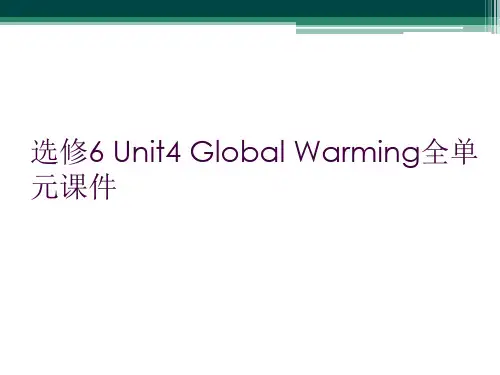
Non-Renewable?
Do you agree?
Energy is necessary in our life.
Sources of energy are endless, so we don’t have to worry about it.
There is no trouble caused when we produce energy from the sources.
photography. 同根Doctors do encourage a quantity of exercises, but they also insist on a balanced diet.
2. Now large quantities of shopping are made through the internet.
incre•aWsehda?t has caused it
Humans
Burn fossil fuels “greenhouse” gases Trap heat from the sun The earth gets warm
energy
“Greenhouse” Effect
True or False
consequence
1. The consequence of long-term air pollution is that more people suffer from lung cancer.
2. Parents and adolescents tends to hold different views. Consequently/As a consequence, they often argue with each other.
人教版英语选修六Unit 4 Global Warming(Listening, Speaking and Writing)教案
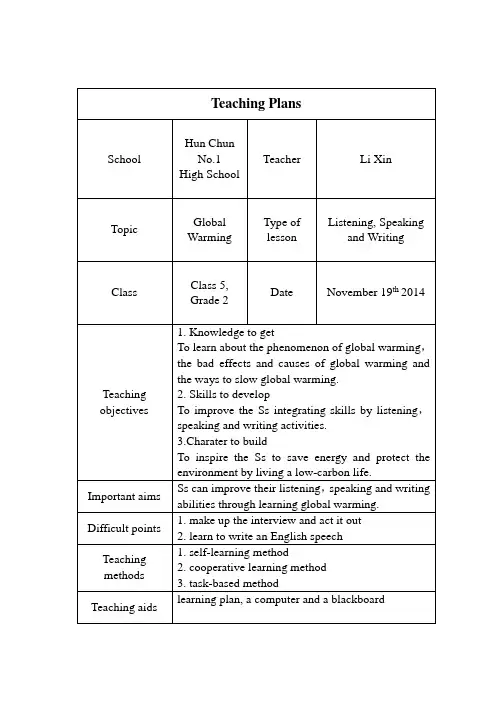
Teaching methods
1.self-learningmethod
2.cooperativelearningmethod
3.task-basedmethod
Teaching aids
learningplan, a computer and a blackboard
Teaching objectives
1. Knowledge to get
To learn about the phenomenon of global warming,the bad effects and causes of global warming andtheways to slow global warming.
Givethem the key words and phrases,help them finish the task and make a comment
Create situations to improve the Ss’speaking ability
11’
Step 5
Writing training
Teaching procedures
Teaching tasks
Students’activities
Teachers’activities
Purposes
Time
Step 1 Lead in
Watch the video and answer two questions.
Play the video and ask two questions
Lead into the topic
高中英语 Unit4 Global warming Period 6优秀教案 新人教版选修6

Period 6 Summing Up,Learning Tip and Assessment整体设计教学内容分析This is the last teaching period of this unit,so the emphasis should be placed on going over and summarizing what has been learned in this unit.It includes the following parts:Summing Up,Learning Tip,Checking Yourself and some other consolidation exercises.Summing Up summarizes the whole unit from the aspects of topics and vocabulary and grammar.The teacher can first use this part to let students sum up what they have learned in this unit and then let them find out what they can't understand very well.Learning Tip gives students instructions on which kind of nouns begin with a capital letter.Let the students think about what they already know about the rules and what new information they will find.Checking Yourself on Page 68 in the Workbook aims at encouraging students to make a self -assessment after they finish learning this unit.It is very important to improve their learning.Of course,a testing assessment is also needed.In this period,the teacher can also provide more practice to consolidate what students have learned in this unit.三维目标设计Knowledge and skills1.To get students to master all the useful new words and expressions in this unit.2.To have students understand the new grammar item “the use of ‘it’(2)” better,and enable them to use the sentence patterns correctly.3.To develop the students' ability to use the important language points in this unit.Process and methodsDesign some additional exercises for students to do in order that they can learn to use and grasp all the contents.Emotion,attitude and value1.To encourage students to learn more about global warming and environmental protection.2.To inspire the students to thin k up more effective measures to prevent global warming.教学重、难点Using what they have learned in this unit to solve real problems.教学过程Step 1Revision1.Check the homework exercises.2.Dictate some useful new words and expressions in this unit.Step 2Lead-inAsk the students to turn to Page 32.Think about what they have learne d in this unit and tick the boxes to see how well they have learned them.Step 3Summing upFive minutes for the students to summarize what they have learned in this unit by themselves.Then check and explain something where necessary.Suggested answers:Write down what you have learned about global warming:(Students' answers may vary.)The temperature of the earth rose about one degree Fahrenheit during the 20th century.It is human activity that has caused this global warming.All scientists subscribe to the view that the increase in the earth's temperature is due to the burning of fossil fuels.Some byproducts of this process are called greenhouse gases,which trap heat and warm the earth.With out the greenhouse effect,the earth would be cooler than it is.But scientists don't agree with each other on the effects of global warming.Some think it will be a disaster,but some others think it's a good thing and we can do nothing to prevent the trend.By reading the second passage,we also know some easy and effective measures we can take to deal with global warming.From this unit you have also learned:Some useful words:tend,oppose,state,glance,quantity,range,tendency,circumstance,opposed,steady,widespread,average,consume,subscribe,advocate,refresh,graph,phenomenon,fuel,data,trend,catastrophe,flood,consequence,existence,commitment,pollution,growth,motor,can,microwave,educator,contribution,presentation,disagreement,random,mild,outer,electrical,casual,nuclear,perSome useful expressions:come about,subscribe to,quantities of,go up,result in,be opposed to,even if,keep on,on the whole,on behalf of,put up with,so long as,and so on,greenhouse effectNew grammar item:the use of “it”—how to use “it” for emphasis in a sentence.Functional items:how to express agreement and disagreement,blame and complaint.Step 4PracticeShow the exercises on the screen or give out exercise papers.Part 1Vocabulary1.Researchers c______ living conditions in London with those in other places.2.Their prices are low c______ to those in other shops.3.I don't think anybody m______ to her apart from herself.4.He prefers q______ to quality when food is concerned.5.The d______ we have collected are not enough to be convincing.6.Everything was in a s______ of disorder.7.What is the a______ ra infall for August in your country?8.Each i______ boy in the class has his own personalities.9.We have been having a few a______ in the committee lately.10.They were p______ in the history of music.11.As a c______ of being in hospital,Shelly decided that she wanted to become a nurse.12.A doctor has the t______ “Dr” in front of his name.13.The number of the children in the school has d______ by 500 this year.14.The cooker isn't working because of an e______ fault.15.The food was cold and the guests quarreled—the whole dinner was a c______.Part 2Useful phrases1.在20 世纪期间____________2.导致____________3.另一方面____________4.通过燃烧化石燃料__________5.大量的____________6.忍受污染____________7.有关系,有影响____________8.大体上,基本上____________9.高达5摄氏度____________10.发生____________Part 3Complete the following sentences according to the texts.1.An energy source is renewable when supplies of it never ______ ______.2.It is a rapid increase ______ ______ ______ ______ ______.3.There is ______ ______ that the earth is becoming warming but there is ______ ______ ______ whether it is ______ ______ ______has caused this global warming or whether it is ______ ______ ______ ______.4.______ the greenhouse effect,the earth ______ ______ about thirty-three degrees Celsius ______ ______ ______ ______.5.The ______ ______ of carbon dioxide ______ that more heat energy is trapped in the atmosphere ______ the ______ ______ ______ ______ ______.6.It was ______ ______ ______ Charles Keeling ______ made ______ ______ ______ the amount of carbon dioxide in the atmosphere from 1957 to 1997.7.They also believe ______ ______ the burning of more and more fossil fuels that is ______ ______ this increase in carbon dioxide.8.There are some very different ______ among scientists ______ ______ ______.9.Sometimes I feel that ______ can't have any ______ ______ ______ huge ______ problems.10.Finally and most ______,talk ______ your family and friends ______ global warming and tell them what you have learned.11.Remember—your ______ ______.Part 4Multiple choice1.Is it ______ to you that the government is having a hard time now?A.of much important B.of muc h consequenceC.of very importance D.of much consequent2.Something must be done to ______ the river from ______.A.stop;being polluted B.stop;pollutingC.prevent;pollution D.keep;polluted3.There ______ quantities of apples in the basket and there was ______ milk in the bucket.A.were;a number of B.was;quantities ofC.was;a good many D.were;a quantity of4.______ we get good weather it will be a successful holiday.Which is wrong?A.So long as B.Provided thatC.So long D.On condition that5.—Go for a picnic this weekend,OK?—______.I love getting clo se to nature.A.I don't think so B.I believe notC.I couldn't agree more D.I am afraid not6.—Now,where is my purse?—______!We will be late for the picnic.A.Come on B.Don't worryC.Take your time D.Take it easy7.It was not until 1999 ______ regular radio broadcast began.A.while B.whichC.that D.since8.Can it be in the restaurant ______ we had dinner last Sunday ______ you left your wallet?A.where;where B.where;thatC.that;where D.that;that9.—What's the matter with you?—______ the window,my finger was cut unexpectedly.A.Cleaning B.To cleanC.While cleaning D.While I was cleaning10.The other day,my brother drove his car down the street at ______ I thought was a dangerous speed.A.as B.whichC.there D.whatSuggested answers:Part 1Vocabulary1.compared pared 3.matters 4.quantity 5.data 6.state7.average 8.individual9.agreements10.phenomena11.consequence12.title13.decreased 14.electrical15.catastrophePart 2Useful phrases1.during the 19th century 2.lead to 3.on the other hand 4.through the burning of fossil fuels/by burning fossil fuels 5.a great deal of/scores of 6.put up with the pollution 7.make a difference8.on the whole9.as much as five degrees Celsius(5 ℃)e aboutPart 3Complete the following sentences according to the texts1.run out pared to most natural changes 3.no doubt;fierce debate over;human activity that;just a natural phenomenon 4.Without;would be;cooler than it is 5.increased amount;means;causing;global temperature to go up 6.a scientist called;who;accurate measurements of7.it is;resulting in8.attitudes;towards this issue9.individuals;effect on such;environmental 10.importantly;with;about11.contribution countsPart 4Multiple choice1~5 BADCC6~10 ACBDDStep 5Learning tipAsk the students to turn to Page 32.Read through the passage and make sure they understand it.Encourage them to do as the passage tells because if they are doing so they will be teaching themselves a useful way of using English words.Step 6Assessment1.Checking yourself(on Page 68 in the Workbook)First get the students to think about these questions individually.Then they can discuss in groups sharing their experience.The teacher can join in and give them advice and suggestions where necessary.2.Testing assessmentMultiple choice1.______ with the size of the whole earth,the biggest ocean does not seem big at all.A.Compare B.When comparingC.Comparing D.When compared2.Please tell me how the accident______.I am still in the dark.A.came by B.came outC.came to D.came about3.The accident ______ the death of two passengers.A.resulted from B.resulted inC.resulted of D.resulted with4.It is in the west of China ______ there is no doubt ______it is going to rain tomorrow.A.where;whether B.that;thatC.that;whether D.where;that5.It was 1969______ the American astronauts succeeded in landing on the moon.A.that B.whenC.on which D.which6.It was ______ back home after the experiment.A.not until midnight did he goB.until midnight that he didn't goC.not until midnight that he wentD.until midnight when he didn't go7.There's some doubt ______he'll keep his promise.A.whether B.ifC.that D.which8.The ______ parents were all ______for the children's safety.A.concerned;concernedB.concerned;concerningC.concerning;concerningD.concerning;concerned9.The students ages ______ 15 to 18.A.range B.rangedC.range from D.ranges from10.______,we'll go camping.A.Weather permits B.If weather will permitC.Weather permitting D.Weather permitted11.______,we would have not finished the work on time.A.If you didn't help us B.Without your helpC.Without you D.With your help12.—I will not come here tomorrow.—______to me,because I don't care.A.It doesn't make any differenceB.It makes much differenceC.It doesn't make no differenceD.It makes a difference13.You can go out,______you promise to be back before 11 o'clock.A.as far as B.so far asC.when D.as/so long as14.—I apologize for not being able to join yo u for dinner.—______.We'll get together later.A.Go ahead B.Not to worryC.That's right D.Don't mention it15.Christmas is ______ special holiday when ______ whole family are supposed to get together.A.the;the B.a;aC.the;a D.a;theSuggested answers:1~5 DDBBB6~10 CAACC11~15 BADBDStep 7Homework1.Finish off the Workbook exercises.2.Review and summarize what you have learned in Unit 4.Step 8Reflection after teaching________________________________________________________________________ ________________________________________________________________________。
英语:Unit4 Global warming Period 4优秀教案(新人教版选修6)
英语:Unit4 Global warming Period 4•优秀教案(新人教版选修6)Period 4Listening and Speaking整体设计教学内容分析The emphasis of this period will be placed on listening and speaking.There are altogether two texts for the students to listen to in this period:one is in the Student's Book and the other is in the Workbook.The first one(on Page 31,Listening and speaking)is a conversation between two people,Li Bin and Professor Keeling,who is a scientist studying global warming.Professor Keeling has been mentioned in the reading passage on Page 26.The listening text is a radio interview about the use of fossil fuels and other sources of energy.It contains examples of the focus function for this unit:agreement and disagreement.While listening to Part 1 for the first time the students are asked to decide which statement in Exercise 1 Professor Keeling does NOT agree with.Then students are required to listen to Part 1 again and tick the energy sources that are mentioned in the text.After listening to Part 2 students are asked to list three things they can do to save energy.At last they should also listen to Part 2 again and fill in the blanks in Exercise 4.The second one(on Page 65,Listening Task)involves an environmental organization.A student,Tom,is giving an oral presentation.As with most oral presentations that students give,Tom has some visual aids to go with his talk.Students will first be required to listen to the whole speech to get the general idea,and then listen again and take some notes about some facts mentioned in the speech.三维目标设计Knowledge and skills1.To understand the meanings of the following key words and expressions while hearing them in the tape:fossil fuels(化石燃料),industrial societies(工业化社会),concentrated(浓缩的),radiation(辐射),economical(经济的),global community(地球村),cigarette butts(烟蒂),commitment(承诺),inspiration(启发).2.To enable the students to understand the listening texts.3.To help the students learn how to express agreement and disagreement.Process and methods1.Smoothing away language problems if any before listening.Before asking the students to listen to the tape,help them to smooth away any language problems such as new words and expressions that they may not understand while listening.2.Listening for needed information.Before asking the students to listen to the tape for the first time,give them one or two questions about the general idea of the text so as to lead the students to concentrate only on the needed information.Then ask them to listen to the tape for a second or even a third time for some specific information by giving them some detailed questions to answer.3.Speaking freely and making conversations.At last the students may be asked to give their own points of view and attitudes towards the subject mentioned in the text.Emotion,attitude and value1.To stimulate students' spirit of communication and cooperation.2.To develop students' ability of enjoying language beauty.教学重、难点1.The understanding of the listening text.2.The expressing of agreement and disagreement.教学过程Step 1Revision1.Retell the text on P26-P27.2.Check the last period's homework and explain the difficulties.Step 2Pre-listening1.Show the following pictures to the students and ask them to tell which kind of energy each picture shows.Picture 1 ____________Picture 2 ____________Picture 3 ____________ Picture 4 ____________Suggested answers:Picture 1:tide;Picture 2:wind power;Picture 3:solar energy;Picture 4:nuclear energy 2.Tell the students to think over and tell which energy is the most widely used now and what are its advantages and disadvantages.________________________________________________________________________ Suggested answers:Solar energy is the most widely used now.Its advantages are environmentally friendly and renewable.Its disadvantage is that the equipment is too expensive.Step 3Listening1.Listen to Part 1 of Text 1(Page 31)and finish the following exercises.(1)How long does Professor Keeling think fossil fuels will last?A.Several years.B.Only a few years.C.Centuries.(2)What is the disadvantage of nuclear energy?A.It is dangerous.B.It produces carbon dioxide.C.There isn't enough for it.(3)What makes it impossible for us to use sun power at present?A.The danger. B.The technology.C.Being clean.Suggested answers:(1)C(2)A(3)B2.Listen to Part 1 of Text 1 again(Page 31)and tick the energy sources that are plete the notes on them.Sources of energy NotesFossil fuelsWind powerEnergy from the sunNuclear powerSuggested answers:Sources of energy Notes3.Listen to Part 2 of Text 1(Page 31)and choose the best answers to the following questions.(1)How many suggestions does Professor Keeling offer?A.2 B.3 C.4(2)Which of the following is to blame for global warming?A.Developing countries. B.Developed countries. C.Poor countries.Suggested answers:(1)B(2)B4.Listen to Text 2(Page 65)for the first time and catch its main idea and then summarize each part.Main idea:_________________________________________________Part 1:______________________________________________________Part 2:_____________________________________________________Suggested answers:Main idea:The talk is mainly about Clean Up Australia Day and its organizer Ian Kierman.Part 1:How Ian Kierman began Clean Up Australia Day.Part 2:Clean Up the World Day and Ian Kierman's contribution to improving the environment.5.Listen to the whole talk again.Ask students to notice the years that Tom mentions,what happened in these years and many other facts.Make notes in the following table.Suggested answers:Year Event Facts about the event1987Ian Kierman competed in a round-the-world yacht race He was shocked at the pollution in the ocean.1989 Clean-up Day for Sydney Harbour 40 000 volunteers;collected old car bodies,plastics,glass bottles,cigarette butts1990 The first Clean Up Australia Day 300 000 volunteers2001 Clean Up Australia DayMost common kinds of rubbish:cigarettebutts,glass bottles and plastic bags 1993 The first Clean Up the World Day 30 million volunteers in 80 countries2001 Clean Up the World Day 40 million volunteers in 128 countries;cleaned streets,beaches,river banks and parksStep 3SpeakingSince the students have learned much knowledge about global warming by both reading and listening.It's necessary for them to talk about it now.Teach them how to express agreements and disagreements,blame and complaint by showing them the following patterns on the screen.(Slide sho w) Agreement:Exactly.You're right.I agree.That's correct/true/right. Disagreement:Blame and complaint:I'm sorry to bring this up,but...?I'm sorry to have to say this,but... They shouldn't have done it.They are to blame.Perhaps/Maybe they should/ought to... Why don't you do something about it?I'm afraid I disagree with you.I'm afraid not.I don't think so.No way.I don't agree.I doubt...Ask students to read again what Professor Keeling and Li Bin say.Then in groups discuss who you agree with and give e some of the expressions listed above or any others they know.Give the students three minutes to prepare and practice,and then ask two groups to demonstrate their dialogues in front of the whole class.Step 4HomeworkWrite a passage to talk about global warming and people's different views on it.Step 5Reflection after teaching________________________________________________________________________________________________________________________________________________________________________________________________________________________教学参考Ⅰ.国际知名环保组织介绍这些国际性的环保组织克服了重重困难,获得了世界范围内的响应和支持,依靠组织手段,将提倡的环保概念普及,并通过各种环保项目的实施,切实推动世界各地的环保进程。
高中英语选修6教案:Unit+4+Global+Warmingperiod9
1. get to know some key expressions and sentences
2. Train the students’ability of writing.
3.How to deal with troubles afterpracticingreading and writing .
教师个性化修改
Step1.Reading
Read inLearning Planto know the topic ,structure and excellentsentencestructures
Step2.Discussion
1.How to finish the outline? How many paragraphs will we divide in the writing passage?
课后作业布置
Finish their writing.
预习内容布置
Do some exercises of newspaper
2.Discuss to finish the part of words andsentences
Step4.Practice
Give students a version to finish thewritingtask.
Step5. Students’show
1. Exchange tct their mistakes with each other.
教学重难点
1. Use the words and phrases which we have learned to make the sentences.
2. How to express in writing
人教版高三英语选修6教案:《Unit 4 Global warming》
第 1 页 共 8 页 人教版高三英语选修6教案:《Unit 4 Global warming》 人的天才只是火花,要想使它成熊熊火焰,哪就只有学习。下面是XX小编为您推荐人教版高三英语选修6教案:《Unit 4 Global warming》。
教学目标 Teaching Aims:
In this class Ss will be able to ① practice skimming and scanning for information needed like what are the two concerns and what are Earth Care s suggestions.
② Master the phrases such as: put up with, so long as, and so on, make a difference, have no effect on , by making sentences or by using them into the post er.
③ become aware of the serious effects of global warming and the importance of saving energy to be environmentally friendly.
④ Summarize the points according to their understanding. ⑤ work together to design a poster by using the suggestions in the article.
教学重难点 第 2 页 共 8 页
Teaching Difficulties: Students may find it hard to add more suggestions about how to save energy in our daily life and to summarize the points according to those suggestions. Students may not know clear what is a poster and how to design an attractive and persuasive poster in short time.
高中英语 Unit4,book6 Global warming教案 新人教版选修6
Unit 4 Global warming by liu jinzeng★Warming up1. Please list as many energy sources as you can.___________________________________________________________________________2. which energy sources on your list are renewable and which are non-renewable? _______________________________________________________________________________★Pre-reading ActivitiesTalk about the picture at the bottom of the page 251. What can you see in the picture? ______________________________________________2. How does it work? _____________________________________________________________3. What do you know about “ greenhouse gases”?_______________________________________________________________________________ ★While- reading ActivitiesFirst reading Glance quickly at the magazine and answer the questions.1. What’s the main topic of the article? _______________________________________________2. Who wrote the magazine article? What is the name of the article? ________________________3. What are the names of the three scientists mentioned in the article? _______________________4. What are the two graphs about? What are they for?_______________________________________________________________________________ Second reading Read the text quickly to get the main idea of each paragraph.1.________________________________________________________________2.________________________________________________________________3.________________________________________________________________4.________________________________________________________________5.________________________________________________________________6.________________________________________________________________7.________________________________________________________________Third reading Read the text quickly to list the ideas and major details.Part I ( paragraph 1) to introduce the topic.(1)_______________________________↓Part II ( paragraph _________) (2) _______________________________ How has global warming come about? ↓(3) ________________________________________________ to make life positive effects _________________ for human Part III ( paragraph _______) __________________ beings bettereffects of global warmingnegative effects __________________________Part IV the last paragraph conclusion of the articleFourth reading Read each paragraph carefully for detailed information, and finish the exercises blow.P a r a g r a p h11. During the 20th century the temperature of the earth rose about one degree Fahrenheit.Notes: Fahrenheit华氏度1714年德国人法勒海特(Fahrenheit)以水银为测温介质,制成玻璃水银温度计,选取氯化铵和冰水的混合物的温度为温度计的零度,人体温度为温度计的100度,把水银温度计从0度到l00度按水银的体积膨胀距离分成100份,每一份为1华氏度,记作“1℉”。