
2016中考英语专项复习反义疑问句
1 中考复习反义疑问句专项练习
单项选择
1." What should I get my mum for her birthday ?” “Why _____ get her a scarf ?"
A. don 't you B. do you. C. are you.
2.--- They have never seen the film, they?
--- Yes, they have.
A. have B. haven’t
C. do D. don’t
3.-Jim had nothing for breakfast this morning , ?
- . He got up too late .
A. had he, Yes. B. hadn' t he , Yes. C. did he , No .
4.— He hasn’t watched the movie “ So Young”, has he?
— ________. He told me it’s very moving and interesting, he’d like to watch it
again.
A. Yes, he has B. Yes, he hasn’t C. No, he hasn’t D. No, he
has
5.There’s little important news in the newspaper today, ______?
A. isn’t there B. is there C. is it D. are there
6.I don’t think the newly-directed film by Zhaowei is as interesting as people
say, _______?
A. do you B. isn’t it C. is it D. don’t you
7.-----You are going to visit the Great Wall,_____?
-----That’s right.
A. are you B. aren’t you C. don’t you
8.---You never have sweet snacks, do you?
---________. Though I know they’re bad for our health.
A. Yes B. No C. Yes, I don’t D. No, I do
9.You went to the concert yesterday, ____ ?
A. do you B. don’t you C. did you D. didn’t you
10.The children had to repeat that story twice, ________they?
A. didn’t B. hadn’t C. did D. had
11.— There is little water left in the bottle, ______?
— No, we need to buy some more before we run out of it.
A. is there B. isn’t there C. is it D. isn’t it
12.There’s little important news in the newspaper today, ______?
A. isn’t there B. is there C. is it D. are there
13.—He’s not married Laura, ____?
—____. They will celebrate their one year of marriage this Sunday.
A. has he; Yes B. is he; Yes
C. has he; No D. is he; No
14.The tall man over there is our new English teacher, _________?
A. is he B. is there C. isn’t he D. isn’t there
15.Let’s go swimming to relax ourselves, _______?
2 A. do we B. will you C. shall we
16.–Taobao is the largest shopping website in China, _________?
–Yes, it is very popular now.
A. is it B. isn’t it C. are they D. aren’t they
17.— Rose, we will start at six tomorrow morning. Don't be late, _______ ?
— _______ . I'll be there on time.
A. won't you; Yes, I will B. will you; Yes, I will C. will you; No,
I won't
18.— Tom’s never done extra work for his class, _______he?
—_______. He is the laziest boy in his class.
A. has; Yes B. is; No C. is; Yes D. has; No
19.Sally has few friends here, ?
A. did she B. doesn’t she C. does she D. hasn’t she
20.I hear the girl wearing glasses is your new classmate. She plays the violin quite
well, _______?
A. isn’t she B. don’t she C. doesn’t she
21.—She’s already back to Nantong, ______?
—______. She is on a visit to Tokyo.
A. isn’t she, No B. hasn’t she, No C. isn’t she, Yes D. hasn’t she, Yes
22.We can hardly tell what life without the Internet will be like in the future,
_________?
A. can we B. can’t we C. will it D. won’t it
23.There was a loud cry from the backstage immediately after the concert ended,
_______?
A. wasn’t there B. was there C. didn’t it D. did it
24.–Mrs. Huang often speaks to foreigners, _________?
–Yes, she wants to practice her spoken English.
A. doesn’t she B. is she C. does she D. isn’t she
25.— My cousin often has nothing for breakfast, ______ she?
— ______. Because she often gets up late and is afraid of being late for school.
A. has; Yes B. doesn’t; No C. does; No D. hasn’t; Yes
26.Tom hardly hurt himself in the accident, ________?
A. didn’t he B. does he C. doesn’t he D. did he
27.She’s never seen such a wonderful film, _______ she?
A. is B. isn’t C. has D. hasn’t
28.— There are still many old city walls in Xi’an, _______?
—Yes, there are.
A. are there B. aren’t there
C. are they D. aren’t they
29.— You haven’t been to the West Lake in Hangzhou, have you?
— _______. How I wish to go there!
A. Yes, I have B. Yes, I haven’t
C. No, I have D. No, I haven’t
30.Lily’s never been to Hainan, ________ she?
3 A. is B. isn’t C. has D. hasn’t
31.——You aren’t a stranger, are you?
—— , don’t you remember me at the school gate ten minutes ago?
A. Yes, to see B. No, seeing C. No, saw D. Yes, seeing
32.You can hardly see anything in the dark room, _____?
英语初中反义疑问句讲解

中考初中反义疑问句讲解
反意疑问句专题
一、基本用法与结构
反意疑问句由“陈述句+简略疑问句”两部分组成,第一部分提出一种看法,第二部分用来质疑或表示证实。
陈述部分与疑问部分的动词时态和动词性质应保持一致,而且肯定和否定形式彼此相反,即陈述部分为肯定式时,疑问部分用否定式,陈述部分为否定式时,疑问部分用肯定式:
He likes English, doesn’t he? 他喜欢英语,是吗?
He doesn’t like English, does he? 他不喜欢英语,是吗?
【注】
1. 若陈述部分含有hardly, never, few, nothing ,little,nobody,seldom等否定词或半否定词,其疑问部分要用肯定式:
He has few friends here, has he? 他在这儿几乎没什么朋友,是吗?
She said nothing, did she? 她什么也没说,是不是?
2. 若陈述部分含有带否定前缀的词,疑问部分仍用否定式:
It is unfair, isn’t it? 这不公平,不是吗?
It is impossible, isn’t it? 那是不可能的,是吗?
3. 当陈述部分为为there be句型时,疑问部分仍用there作“主语”:
There was nothing in the room, was there? 房间里什么也没有,是吗?
4. 当陈述部分的主语是指示代词(this ,that ,these ,those)时,疑问部分用it, they等代词:
That is a new car, isn’t it? 这是一辆新汽车,是吗?
5.当陈述部分的主语是复合不定代词时,若陈述部分的主语为somebody,
someone, everyone, everybody, no one, nobody等复合不定代词,其反意疑问句的主语在正式文体中用he,在口语或非正式文体中通常用they:
中考英语反义疑问句讲解及习题!

中考英语反义疑问句讲解及习题!
如:①Do sit down, won’t you?/ will you?
②You feed the bird today, will you?
③Please open the window, will you? (won’t you?)
(十七)、陈述部分为否定祈使句时,问句部分一般用will you?形式。
如: Don’t make any noise, will you?
(十八)、陈述部分为There (Here) + be + 主语时,问句部分用动词+there
(here)?形式。
①There are two cakes on the plate, aren’t there?
②Here is a story about Mark Twain, isn’t here?
(十九)、陈述部分用had better +原形动词表示建议时,问句部分用hadn’t
+主语?形式。
①You’d better tell him about the matter, hadn’t you?
②We had better do it by ourselves, hadn’t we?
(二十)、陈述部分用used to +主语时,问句部分用didn’t + 主语?或usedn’t +主语?形式。
①He used to live in the country, didn’t he?/usedn’t he?
②They used to be good friends, didn’t they?/usedn’t they?
(二十一)、陈述部分用must (may, might) + have + V-ed表示推测时,若句中带有明显的过去时间的状语,问句部分动词用过去时形式。如:
初中中考英语反义疑问句和祈使句详细讲解
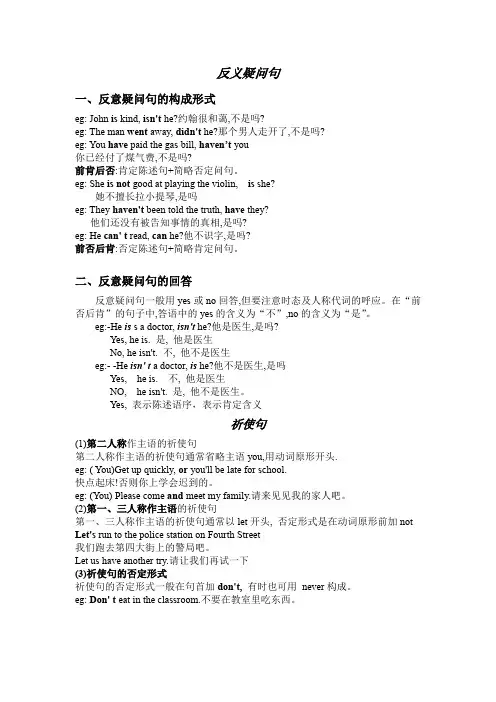
反义疑问句
一、反意疑问句的构成形式
eg: John is kind, isn't he?约翰很和蔼,不是吗?
eg: The man went away, didn't he?那个男人走开了,不是吗?
eg: You have paid the gas bill, haven’t you
你已经付了煤气费,不是吗?
前肯后否:肯定陈述句+简略否定问句。
eg: She is not good at playing the violin, is she?
她不擅长拉小提琴,是吗
eg: They haven't been told the truth, have they?
他们还没有被告知事情的真相,是吗?
eg: He can' t read, can he?他不识字,是吗?
前否后肯:否定陈述句+简略肯定问句。
二、反意疑问句的回答
反意疑问句一般用yes或no回答,但要注意时态及人称代词的呼应。在“前否后肯”的句子中,答语中的yes的含义为“不”,no的含义为“是”。
eg:-He is s a doctor, isn't he?他是医生,是吗?
Yes, he is. 是, 他是医生
No, he isn't. 不, 他不是医生
eg:- -He isn' t a doctor, is he?他不是医生,是吗
Yes, he is. 不, 他是医生
NO, he isn't. 是, 他不是医生。
Yes, 表示陈述语序,表示肯定含义
祈使句
(1)第二人称作主语的祈使句
第二人称作主语的祈使句通常省略主语you,用动词原形开头.
eg: ( You)Get up quickly, or you'll be late for school.
快点起床!否则你上学会迟到的。
eg: (You) Please come and meet my family.请来见见我的家人吧。
中考英语专题复习 反义疑问句知识讲解

1 反义疑问句
反义疑问句(The Disjunctive Question
或 Question tags)
即附加疑问句。它表示提问人的看法,没有把握,需要对方证实。 反义疑问句由两部分组成:前一部分是一个陈述句,后一部分是一个简短的疑问句,两部分的人称时态应保持一致。
主要形式:陈述部分肯定式+疑问部分否定式 ;陈述部分否定式+疑问部分肯定式 。
陈述部分和疑问部分要么前肯后否,要么前否后肯。这类反义疑问句有时带有感情色彩,表示惊奇,愤怒,讽刺,不服气等。例如:You call this a day's work,don't you?你说这就叫一天的活儿,不是吗?
目录 1什么是反义疑问句
2反义疑问句的答案
3句子结构 4速记方法
5主语一般词语
6重点归纳 7其他信息
什么是反义疑问句
1.英语中,反义疑问句是由陈述句和附在其后的附加疑问句组成。其中附加疑问句是对陈述句所说的事实
或观点提出疑问,起证实作用,一般用于证实说话者所说的事实或观点。翻译为
“是吗"
句子结构
1.陈述部分肯定句+疑问部分否定句(可记为前肯后否).
例:They work hard, don’t they?
Let's go to the supermarket ,shall we?
2.陈述部分否定句+疑问部分肯定句(可记为前否后肯).
例:You didn't go, did you?
句子类型
一种是反义的附加疑问句;一种是非反义的附加疑问句。
简单来说,就是“前肯后否”或“前否后肯”。
反义疑问句的答案
1.前肯后否:回答时,如果情况属实,用Yes加上反问句的倒装肯定句;如果情况不属实,则用No加上反问句的倒装否定句。
例如You were moved by your students, weren’t 反义疑问句you?
情况属实:Yes, I was. 情况不属实:No, I wasn't
中考初中英语反义疑问句及问答 (2)

中考初中英语反义疑问句及问答
反义疑问句(The Disjunctive Question)
组成部分:前一部分是一个陈述句,后一部分是一个简短的疑问句,两部分的人称时态应保持一致。
主要形式:陈述部分肯定式+疑问部分否定式 ;
陈述部分否定式+疑问部分肯定式 。
反义疑问句有时带有感情色彩,表示惊奇,愤怒,讽刺,不服气,疑惑,嫉妒等。
eg: Let’s go to the supermarket, shall we?
They work hard, don’t they?
不定代词
当陈述部分的主语是
(1)one时,后面的疑问句可用one/he.
(2)no one时,后面附加疑问句中主语用they。
(3)everything, anything, nothing, something等表示物的不定代词时,附加疑问句中主语用it
Something is wrong with your watch, isn’t it?
(4)this, that,或those, these时,附加疑问句中主语用it或they.
(5)everyone,everybody,someone,somebody,anyone,nobody等时,附加疑问句中主语一般用they(口头语,非正式文体)/he(正式文体)。
Everyone in your family is a teacher, aren’t they\isn't he?
(6)不定式时,动名词,其他短语,附加疑问句中主语一般用it。
(7)there be句型时,附加疑问句中一般用be/情态动词/助动词+there。
否定意义的词
(1)当陈述部分有never,seldom, hardly,few,little,barely, scarcely, nothing,none,
rarely ,no, not, no one, nobody, neither等否定意义的词汇时,后面的反意疑问句则为肯定形式:
反义疑问句专题训练

反义疑问句专题训练
反意疑问句由两部分构成:
前一部分是陈述句,后一部分是一个简短的疑问句,前后两部分在时态、人称和数上都要保持一致。
1.肯定式陈述部分+否定式疑问部分
He looks like his father, doesn' t he ?
他长的像他爸爸,不是吗?
She was ill yesterday, wasn ' t she ?
她昨天病了,不是吗?
2.否定式陈述部分+肯定式疑问部分
He doesn' t need to work so late , does he?
他不需要工作到那么晚,对吗?
He can' t ride a bike , can he?
他不会骑自行,是吗?
规则
1.前肯后否,前否后肯。
2.表示否定的词hardly, seldom, little, few等
3.解题技巧
回答部分:看后面,根据事实回答,符合事实回答用yes,不符合用no。
例1:Your brother’s never careless, ______ he? --__________, he often makes mistakes.
A. has, Yes B. has, No C. is, Yes D. is, No
解析:前半句“Your brother’s never careless”是否定句,故反义部分“______ he”用肯定。
答句:“he often makes mistakes.”表明他确实粗心,故答句用Yes, my brother is careless.
答案:C
中考复习反义疑问句专项练习
1.--- They have never seen the film,
they?
英语初中反义疑问句讲解 2
中考初中反义疑问句讲解
反意疑问句专题
一、基本用法与结构
反意疑问句由“陈述句+简略疑问句”两部分组成,第一部分提出一种看法,第二部分用来质疑或表示证实。
陈述部分与疑问部分的动词时态和动词性质应保持一致,而且肯定和否定形式彼此相反,即陈述部分为肯定式时,疑问部分用否定式,陈述部分为否定式时,疑问部分用肯定式:
He likes English, doesn’t he? 他喜欢英语,是吗?
He doesn’t like English, does he? 他不喜欢英语,是吗?
【注】
1. 若陈述部分含有hardly, never, few, nothing ,little,nobody,seldom等否定词或半否定词,其疑问部分要用肯定式:
He has few friends here, has he? 他在这儿几乎没什么朋友,是吗?
She said nothing, did she? 她什么也没说,是不是?
2. 若陈述部分含有带否定前缀的词,疑问部分仍用否定式:
It is unfair, isn’t it? 这不公平,不是吗?
It is impossible, isn’t it? 那是不可能的,是吗?
3. 当陈述部分为为there be句型时,疑问部分仍用there作“主语”:
There was nothing in the room, was there? 房间里什么也没有,是吗?
4. 当陈述部分的主语是指示代词(this ,that ,these ,those)时,疑问部分用it, they等代词:
That is a new car, isn’t it? 这是一辆新汽车,是吗?
5.当陈述部分的主语是复合不定代词时,若陈述部分的主语为somebody,
someone, everyone, everybody, no one, nobody等复合不定代词,其反意疑问句的主语在正式文体中用he,在口语或非正式文体中通常用they:
中考英语反义疑问句的14种常考特殊用法
中考英语反义疑问句的14种常考特殊用法
一、反意疑问句
反意疑问句是由陈述句和附在其后的附加疑问句组成。其中附加疑问句是对陈述句所说的事实或观点提出疑问,起证实作用,一般用于证实说话者所说的事实或观点。
(表示说话者对某事有一定看法,但又不完全确定,需要对方加以证实。)翻译为“是吗”
二、反意疑问句的回答
回答时,事实是肯定的用Yes;
若事实是否定的则用No。
三、反意疑问句的特殊情况
1.反意疑问句中问句部分的动词与陈述部分的动词在语气上成相反的对应关系,即:肯定+否定?否定+肯定?
You can’t do it,can you?
你不能做它,是吗?
They are very late for the meeting,aren’t
they?
他们开会迟到了,是吗?
2.附加问句的主语应与陈述句的主语保持一致,且只能用人称代词替代。
You come from Beijing,don't you?
你来自北京,是不是?
3.当陈述句中含有be动词,助动词,或是情态动词时,反问句部分由这些词加上主语人称代词构成:
Be动词包括:am,is,are,was,were
助动词有:do,does,did,have(用在完成时),has(用在完成时)等
情态动词有:can,could,may,might,must,will,would,shall,should
He will go home,won’t he?
他要回家了,是吗?
She doesn’t like to eat popcorn,does she?
她不喜欢吃爆米花,是吗?
4.have的不同用法,反义疑问句用不同的动词
(1)have表“有”时,反义疑问句谓语动词用have/do都行 He has a new car,doesn’t/hasn’t he?
(2)have表“吃,喝,玩,度过,举办”等是,反义疑问句谓语动词用do
He has supper at home every day,doesn’t he?
中考英语反意疑问句
中考英语反意疑问句
咱们在学习英语的过程中呀,会碰到一种很有趣的语法,叫反意疑问句。啥是反意疑问句呢?给你们举个例子哈,就像“ You like apples, don't you? ” 这句话,前面说“你喜欢苹果”,后面跟着个小尾巴“难道你不喜欢吗”,这就是反意疑问句啦,是不是挺好玩的?
那怎么来构成反意疑问句呢?这有个小规律哟。如果前面的陈述句是肯定的,后面的小尾巴就得是否定的;要是前面陈述句是否定的,后面的小尾巴就得是肯定的。比如说,“She is a student, isn't she? ” 前面说“她是个学生”是肯定的,后面“难道她不是吗”就是否定的啦。再看这个,“He can't swim, can he? ” 前面说“他不会游泳”是否定的,后面“难道他会吗”就是肯定的哦。
还有呀,反意疑问句里的动词要根据前面陈述句里的动词来变哟。像前面用的是“be动词”,后面小尾巴也用“be动词”;前面用的是“情态动词”,后面也用一样的“情态动词”。就像刚才举的例子“ You like apples, don't you? ” 前面用的是一般现在时的实义动词“like”,后面小尾巴就用“don't”啦。
那咱们在回答反意疑问句的时候呢,也要注意哦。不管问题怎么问,咱们都要根据实际情况来回答。比如说,别人问你“ You like ice cream, don't you? ” 如果你喜欢冰淇淋,那就回答“ Yes, I do. ” 要是不喜欢,就回答“ No, I don't. ”
可别搞混啦。
多做一些练习题,多和反意疑问句交交朋友,慢慢地,你们就能轻松掌握它啦!加油哦!
中考英语反义疑问句专项练习题
中考英语反义疑问句专项练习题
中考英语反义疑问句专项练习题
反义疑问句即附加疑问句。它表示提问人的'看法,没有把握,需要对方证实。为了帮助大家更好地理解反义疑问句的用法,店铺为大家带来中考英语反义疑问句的专项练习题,希望能对大家有帮助!
一、选择题
1、My mother has to stay at home to look after my grandma,
_______?
A. hasn’t she B. hasn’t my mother C. doesn’t she
D.doesn’t my mother
2、 He has many friends at school, _____?
A. has he B. does he C. doesn’t he D. isn’t he
3、They have never been to America, _______?
A. have they B. haven’t they C. don’t they D. do they
4、There is little milk in the glass, _______?
A. isn’t it B. isn’t there C. is there D. is it
5、I don’t think he must be sleepy, _______?
A. mustn’t he B. do I
C. must he D. is he
6、It rained hard last night,______?
A. does it B. did it C. doesn’ t it D. didn’ t it
7、 They haven’t found the MH 370, ______________?
A. have they B. haven’t they
C. do they D. don’t they