
译林8B Unit5 GOOD MANNERS教案
备课 日期 2014 年 教学 课题 Unit 5 Good manners 课时 安排
1
4月 15日 Comic strip & Welcome to the unit 7 教 学 目 标
1. 了解各种礼仪知识 2. 用英语谈论如何在公共场所举止得体 3.培养学生良好的学习习惯
重点 1.了解各种礼仪知识 2.用英语谈论如何在公共场所举止得体 3.用英语谈论如何在公共场所举止得体 难点
教学过程设计
集 体 备 课 二 次 备 课 Step1 Lead-in Look at the pictures.Are people doing the right things or wrong things? They discuss in pairs. Step2 Presentation 1. Answering the following questions: What should the boy do when he cross the road? What is the girl doing? What should we do in the library? What are the man and the woman doing? What is the man doing? What did the boy do? 2. Discussing Who is doing right and whi is doing wrong? 3. Finish Part A. Show the 6 pictures (1) What should the boy do when he cross the road? (He should obey the traffic rules.) (2) What is the girl doing? (She is picking the flowers in the park.) (3) What should we do in the library? (We should keep quiet in the library.) (4) What are the man and the woman doing? (They are dropping litter everywhere.) (5)What is the man doing? (He is queuing for his turn.)
Learn the new phrases: 1.drop litter everywhere 2. leave the tap running 3.obey traffic rules 4. queue for your turn 5. old enough to do 6. too… to… 7.share…with… 8. I’m afraid not
(6)What did the boy do? (He left the tap running. ) Who’s doing right and who’s doing wrong? Why? Step2 Comic strip 1.Asking the question:Do you think Hobo will share things with others? What about Eddi? 2. After listening,answer the questions: DO you think Eddie really want to teach Hobo? What does Eddie teach Hobo? What does Eddie really want from Hobo? 4. Organize the whole class to read. Step3 Practise Read loudly Encourage them to act out the dialogue.
Step 3 Practice The Class 1,Grade 8 students are discussing the right and wrong things to do in public places.Look at the pictures in Part A and match them with the phrases.Check the answers. Say something about the pictures. Step 4. Presentation 1Repeat after the tape (Dialogue of Part B) 2设计几个场景,如:马路、公园、教室、电影院、卫生间等,让学生两人一组,模仿B部分新编对话。
Step5 Homework Recite the dialogue.
Encourage them to answer freely.
课后 作业
Remember the new words and useful expressions
Act out the dialogue in pairs Finish the exercises
教学 反思 Some of the bad behaviours are unknown to the students ,they need to practise more. 备课 日期 2014 年 教学 课题 Unit 1 Good manners 课时 安排
2
4月 15日 Reading 1 7 教 学 目 标
1. 能读懂有关英国礼仪习惯的采访。 2. 通过阅读,了解不同国家的礼仪习惯。
重点 1.能读懂有关英国礼仪习惯的采访。 2.通过阅读,了解不同国家的礼仪习惯。 3.通过阅读,了解不同国家的礼仪习惯。 难点
教学过程设计 集 体 备 课 二 次 备 课
Warm up Enjoy the video and know something about manners in the UK. Ask Ss whether they know the saying: When in Rome, do as the Romans do. Step1. Pre-reading Show a picture. Can you tell me what we should and shouldn’t do in these public places? 2 Brainstorm:What customs in China do you know? 3 Do you know any different customs in western countries? 4 Show some pictures:British people shake hands when they meet for the first time. Step 2 Reading Fast Reading Read the conversation and answer the questions: • What is the conversation about? • Who is Daniel talking to? Keys: Good manners in the UK. Jenny.
Make sure the students can find out most answers to the questions.
呈现新词组:shake sb’s Careful Reading Read the conversation carefully and answer the questions. 1. What is the proper way to greet people in the UK? 2. Who do they greet with a kiss? 3. How do British people start a conversation? 4. Do they talk about age? 5. How do they behave in public? 6. Are British people polite at home? 7. What else should we pay attention to in public? Keys: 1. British people say “hello” or “nice to meet you” and shake the other person’s hand when they meet for the first time. 2. They only greet relatives or close friends with a kiss. 3. They talk about the weather, holidays, music, books and something else. 4. No, they do not. 5. They behave politely in public. 6. Yes, they are. 7. We should keep our voice down in public. Find the detailed information and finish the table. Good manners in the UK How to greet people How to start a conversation How to behave in public How to behave at home Post Reading hand Ss work in pairs.
It's better to make their own dialogues.
公开课优质课牛津译林版八年级下册Unit 5 Good manners 教案3
Unit 5 Good manners 教案教学目标:1、学会用enough to 来描述一个人的品质和能力。
2、学会用too…to… 来表达一个否定的结果。
教学重点:1、词汇:discussion, express.2、词组:make everyone laugh, on her own, join the discussion, express himself clearly, all the main points, be busy with.教学难点:句型:1、You are old enough to learn about manners.2、British people are too polite to shout loudly in public.3、The UK is too far away for Jenny to go there on her own.教学过程:Step 1 呈现:1、让学生回忆Comic strip 和reading 部分所学内容,教师问:What does Eddie say to Hobo before he mentions the good manners?What’ll British people do if you’re in their way?让学生尽量用书本上的原句回答,教师板书答案。
2、让学生总结这两个句子的共同点。
教师问:Can you find the similarity between the two sentences? What is it?教师引导学生找出这两句话中的相同的语言结构,并板书:the verb to be + adjective + enough + to3、教师问:What can we use this pattern to describe?鼓励学生仔细读黑板上的两句话并思考问题答案,然后教师完善:We can use this pattern to describe a person’s personality and abilities.教师告诉学生,这个结构经常用来讨论一个人的品质和能力。
最新牛津译林初中八年级英语下册 8B Unit5《Good manners》Integrated skills教学设计
8B Unit5《Good manners》Integrated skillsThe general idea of this period.Learn something about UNICEF二、Teaching Aims1.Read the text, know some information about UNICEF2.Let Ss guess the meaning of the new words according to the text and some pictures.3.Review the words about UNICEF4.Teach the Ss to help children.三.Teaching Important Points1.Encourage the Ss to talk about UNICEF.2. Let the Ss to help others.3.Master the important words, phrases and sentences.四.Teaching Difficult Points1.Ensure every student to have a chance to express himself/herself.2.Make the Ss know the importance of the international charities.3.Make the Ss know the methods of hearing.五.Teaching Methods七、Teaching ProceduresStep1. Lead in.Show some pictures of International c harities.What do you know about UNICEF?Let us listen to a short passage about UNICEF and try to do Exercise A1 on page 86.Check their answers,Explain the main ideas.(show the tapescipt.)Step2.Showing.(Answer the questions.) (A1部分).(1).How does UNICEF raise money?(2).What does UNICEF do for poor children?Step3. .Showing.(Answer the questions.) (A2部分).(1).When was UNICEF set up?(2).What changed chide rn′s lives at that time?(3).How many countries and areas does UNICEF work in?Check the answers.Step4 Reading and acting out the text.Sample conversationS1: I used to spnd all my pocket money on CDs and clothes.S2: Me too. I used to go shopping almost every day.Now I try to save some money to give to charity.S1: Wha t′s your favourite charity?S2: ORBIS,because they teach doctors and nurses all over the world how to cure blindness.I think it would be terrible to be blind.And you?S1: I sometimes donate money to friends of the earth because they work very hard to protect our environment.S2: I read about the work they do to save the wor ld′s rainforests. I agree that it is very important to protect the natural areas where animal live.Step5 Homework.(1).Write a dialogue. (87页B部分).(2).Complete the exercise .(Listening补充习题).。
最新牛津译林初中八年级英语下册 Unit 5 Good manners reading 1教案
Unit 5 Good manners reading 1 教学目标1.to learn some expressions on manners.2.to arouse the Ss’interest in learning this unit重点to learn some expressions on manners.难点to arouse the Ss’interest in learning this unit教学准备Multimedia;教学设计详案二次备课内容Step I呈现l Can you tell me what we should and shoul dn’t do in these publicplaces?2 British people shake hands when they meet for the first time.shake sb’s hand。
StepII阅读l让学生快速阅读文章.并回答两个问题:(1)What is the conversation about? (Good manners in the UK.)(2)Who is Daniel talking to? (Jenny.)2 Part 1 (1ines 1—6)(1) What is the proper way to greet people in the UK?(British people say ‘hello’or “ nice to meet you” andshake the other person’s hand when they meet for the firsttime. )(2) Who do they greet With a kiss?(They only greet relatives or close friends with a kiss.)Part 2 (1ines 7—17)(1) How do British people start a conversation?(They talk about the weather, holidays, musi c, books, etc.)(2) Do they talk about age? (No, they do not. )(3) How do they behave in public? (They behave politely inpublic. )Part 3 (1ines 18—26)(1)Are British people polite at home? (Yes, they are. )(2) What else should we pay attention to in public ?( We should keep our voice down in public.)3Good manners in the UK How to greet peopleHow to s tart a conversationHow to behave i n publicStep III practiceStepⅣ Activities作业设计 I熟读课文。
牛津译林版八年级英语下册精品优质教案 Unit 5 Good manners Period 2 Reading 1教案

Periods2Reading1Teaching aims:After learning this period,the students should be able to◆read and learn the interview about manners.◆get some information about manners in the UK◆identify specific details by answerin g some questions.◆develop the students’ability of guessing new words’meanings from thecontext...Teaching importance:Some key words,phrases&sentences, e.g.◆proper,kiss,close,conversation,avoid,subject,public,push,touch,excuse..◆shake one’s hand,in public,push in,in one’s way,as well,by ac cident,excuseme.◆What’s the proper way to greet people there?British people only gre et relatives or close friends with a kissThey will say“Excuse me”and be polite enough to wait till you move.…Teaching procedures:Step1RevisionTalk about the pictures on Page65.then ask:Step2PresentationLook at the pictures and learn manners in the UK,such as:gr eet relatives or close friends with a kissa void asking age,weight or moneyavoid asking age,weight or moneynever push in othersnever shout or laugh loudlysay“please”or“thank you”all the timeStep3Reading1.Skimming:What is the conversation about?Who is Daniel talking to?2.ScanningHow do people greet others for the firs t time?How do people start a conver sation?How do people behave politely i n public?How do people be polite at homeDo they talk about age?3.Read again and fill in the table:do don’tGreeting say greet others with Shake____________talk about________talk about___________In publicalways________________________beforeotherssayif bumping into someonesayif someone is in theirway.orpast.keep orloudlyAt home sayall the timeStep4Complete Part B1&B2,then check the answers together. Step5Homework◆Read the conversation again and again.◆Finish Period2.in Wb。
牛津译林八年级上册教学设计Unit5GoodmannersReading
4.情感态度与价值观:培养学生遵守社会公德、尊重他人的良好品质,使其认识到文明礼仪的重要性。
设想:结合生活实际,设计情境,让学生在角色扮演中体验文明礼仪。通过课堂讨论、案例分析,引导学生树立正确的价值观。
三、教学重难点和教学设想
(一)教学重难点
1.词汇:本章节涉及一系列与礼仪相关的生词和短语,如“manners”、“polite”、“rude”等,学生需要熟练掌握并能在实际情景中运用。
设想:通过课前预习、课堂讲解和课后巩固,帮助学生记忆和运用词汇。设计丰富多样的练习,如填空、造句、角色扮演等,提高学生的词汇运用能力。
4.结合文章内容,讲解文明礼仪的重要性,引导学生树立正确的价值观。
(三)学生小组讨论
1.教师提出与文章内容相关的问题,如:“What are good manners? Can you give some examples?”,让学生进行小组讨论。
2.学生在小组内分享自己的观点,讨论文明礼仪在日常生活中的具体表现,如:在公共场合、家庭、学校等。
牛津译林八年级上册教学设计Unit5GoodmannersReading
一、教学目标
(一)知识与技能
1.掌握本章节阅读材料中的生词、短语和重点句型,并能熟练运用到实际情景中。
2.能够理解并运用一般现在时、一般过去时和一般将来时描述行为规范。
3.能够运用目标语言,就日常生活中的文明礼仪进行讨论和表达个人观点。
3.各小组汇报讨论成果,教师点评并总结,强调文明礼仪对个人和社会的重要性。
(四)课堂练习
1.设计多样化的练习,如填空、选择、改错等,巩固所学词汇和语法知识。
牛津译林版八年级英语(下)教案 Unit 5 Good manners Reading 1 教案
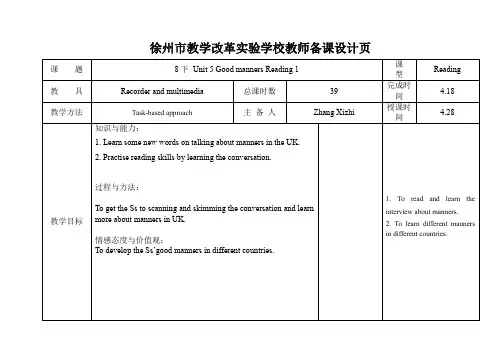
徐州市教学改革实验学校教师备课设计页课题8下Unit 5 Good manners Reading 1 课型Reading教具Recorder and multimedia 总课时数39 完成时间4.18教学方法Task-based approach 主备人Zhang Xizhi 授课时间4.28教学目标知识与能力:1. Learn some new words on talking about manners in the UK.2. Practise reading skills by learning the conversation.过程与方法:To get the Ss to scanning and skimming the conversation and learnmore about manners in UK.情感态度与价值观:To develop the Ss’good manners in different countries.1. To read and learn theinterview about manners.2. To learn different mannersin different countries.教学活动内容活动组织过程改笔【前置学习】1、What can’t we do in a library?What can’t we do in public?What should we do when we see a doctor? /when we drive…?2、自学教材P66-69,了解相关内容。
3、自学检测:Talk about manners in China【自主探究】Step1. Pre-readingShow a picture. Can you tell me what we should and shoul dn’t do in these public places?2 Brainstorm:What customs in China do you know?3 Do you know any different customs in western countries?4 Show some pictures:British people shake hands when they meet for the first time.呈现新词组:shake sb’s handStep 2. While reading1 Skim the text and answer the follow questions:(1)What is the conversation about? (Good manners in the UK.)(2)Who is Daniel talking to? (Jenny.)2 Listen and think:Part 1 (1ines 1—6)(1) What is the proper way to greet people in the UK? Talk about the manners inpublic.Have a preview.Talk about manners in ChinaTalk about some customsin different countries.To learn some newexpressions.Check out the homeworkand preview.Get the Ss to talk aboutcustoms in China thencustoms in westerncountries.(British people say ‘hello’or “ nice to meet you”and shake the other person’s hand when they meet for the first time. )(2) Who do they greet With a kiss?(They only greet relatives or close friends with a kiss.)Part 2 (1ines 7—17)(1) How do British people start a conversation?(They talk about the weather, holidays, music, books, etc.)(2) Do they talk about age? (No, they do not. )(3) How do they behave in public? (They behave politely in public. )Part 3 (1ines 18—26)(1)Are British people polite at home? (Yes, they are. )(2) What else should we pay attention to in public ?( We should keep our voice down in public.)3 Scan the text and fill in the blanks.Good manners in the UKHow to greet peopleHow to start a conversationHow to behave in publicHow to behave at homeStep 3.Post reading1 Finish the exercise of B1and check the answer.2 Finish some exercise of B2 and make some students speak out the British customsEg:They say "hello’” or “nice to meet you" when greeting people. They don’t talk about age, weight or money.3 Read the text and finish exercise of B3, then check the answer.4 Dialogue between Daniel and Jenny, then make cards about customs To skim the conversationthen answer somequestions.Scan the text and fill in theblanks.Finish the exercise of B1andcheck the answer.Use some questions to talkabout customs in westerncountries.Scan the text then fill inthe blanks. 1.How to greetpeople 2. How to start aconversation 3. How to behavein public 4. How to behaveat home.【课堂小结】How do people start a conversation?How do people behave politely in public?【巩固拓展】1 入乡随俗。
2023年牛津译林版八年级英语下册《Unit 5 Good manners》(Period 3)教案
《Unit 5 Good manners》(Period 3)教案学科英语年级八设计人英语备课组课型新课题Unit5 Good manners 总课时 6 第3课时教学目标知识目标To learn the manners in the UK.能力目标To learn the manners in different countries.教学重点The same as the aims教学难点Establish the sympathy for the weak, the helpfulness of consciousnes s 教师活动学生活动备课札记Step 1.Warm upLet Ss talk about the manners in the UK and practice the s hort conversation,using the phrases:Shake ’s handqueuepush inbehave politely in publicbump intoin one’s wayas well (as)2. T says: I often go to the cinema to buy tickets and there are always many people .But I never push in before others.I always queue. If I bump into someone when I’m waiting, I say “sorry”.What about you? What do you do when there are many people?3. Group workAsk Ss to m ake sentences and make dialogues.4. PracticeLet them describe the situation or act in out in class. (or show s ome pictures, let Ss talk about the following action)Step 2: Activity.1. T organize Ss think and talk about the manner in Try to learn the new wordsPractice and actTalk a bout the picture.Listen and answerListen and answerChina .Then Finish the questions in P69Pc. T says:2. let Ss work in groups. Make a card about the manner in China according to Partc .3. Ask several groups to show us their cards.Step 3: DiscussionWork in pairs an d discuss what we should and shouldn’t do in a public place.Step 4. Language pointsStep 5.Homework Practice and act.课堂板书教学反思教师的职务是‘千教万教,教人求真’;学生的职务是‘千学万学,学做真人’。
新译林版8BUnit5GoodmannersReading1市公开课一等奖省优质课获奖课件
keep the voice down
shout or laugh loudly
At home
say“please” or “thank all the ytiomue”
第9页
When in Rome
Choose T or F
T 1. People say “hello” or “nice to meet you” when meeting for
good manners between the UK and China.
第13页
be in public
queue for their turn
never push in others cut in
never shout or laugh loudly
第5页
Talk about manners in the UK
be at home
be polite as well say “please” or “thank you” all the time
Free- talk
1. How do we greet others? 2. How do we start a conversation? 3. Do we greet others with a kiss? 4. Do we always queue in public? 5. Do we shout or laugh in public? 6. Do we push past when someone is in our way? 7. Do we say “sorry” when we bump into someone? 8. Do we say “please” or “thank you” at home?
最新牛津译林初中八年级英语下册 Unit 5 Good manners Task教案
Unit 5 Good manners Task 教学目标1. Complete Amy and Daniel’s web page.2. Learn to wri te a similar talk about other aspects of重点To organize ideas for writing an a rticle abou t good manners.难点Howto get more i nformation together to write an article about good manners.教学准备pictures, recorder, computer教学设计详案二次备课内容Step1 RevisionComplete the following sayings:1. ________ speak louder than words.2. No ______, no _______.3. A friend in need is a friend __________.4. Practice makes ________.5. You cannot burn the ________ at both ends.6. The early bird catches the _______.7. It never rains but it ________.8. Many hands make ________ work.9. Don’t put all your ________ in one basket.10. The grass is always ________ on the other sideStep 2 Read and complete:1. The Class 1, Grade 8 students are going to give a talkon good table manners. They are making a plan for the talk.Read their plan and answer some questions.2. Amy and Daniel are making a web page about their talkon the school website. Read their plan on p age 76 again. Then help them complete the page.Step 3 Language points1. t he purpose of sth. / doing sth. 某事/ 做某事的目的2. take place 举行,发生(一般指有计划性)3. make sure意为“确保;设法保证”,其后常接由介词of引导的短语或that引导的从句。
(译林版)8B Unit 5 Good manners Reading1教学课件
★Do you often say “please” or “thank you” at home? ★Do you think it is necessary(必要的) for you to say “please” or “thank you” all the time at home?
Task4.To be a helpful student
Read & complete(lines7-9)
Daniel: How do people start a conversation? Jenny: They talk about the weather, holidays, music, books or something else. But people avoid subjects like age, weight or money.
Task3.To be a good reader
Read the interviewer's questions carefully
What kinds of manners are mentioned (提及到) in the interview?
Manners in the UK
Lines7-9 how to start a ________ coversation Lines18-19 how to behave ____ _____ at home
Daniel's blog
What's more, British people think it is rude to push in before others. They always queue. They say “sorry” if they bump into you in the street. When they want you to move, they say “excuse me”. They do not like to shout or laugh loudly in public. To my surprise, British people are polite at home too. They say “please” or “thank you” all the time.