
外研版八年级英语下册重要知识点归纳
八年级英语下册重要知识点归纳 1 八年级下册英语重要知识点归纳 重要语法:感官性系统词:feel(摸起来)、look(看起来) 、smell(闻起来)、 taste(尝起来 ) sound(听起来),后接形容词作表语,不能接副词。构成疑问句或否定句要借助助动词。 The silk dress feels soft. The flowers look very beautiful. Does it smell nice? The song doesn’t sound be noisy. 2. What a delicious smell! 多么香啊!
感叹句结构:①What+ a/an+形容词+单数可数名词+(主语+谓语)! What an interesting book it is! ②What+形容词+不可数名词/复数名词+(主语+谓语)! What bad weather it is today! What good students they are!
③ How +形容词/副词+主语+谓语! How fast he is running! How delicious it smells! How I miss the days we spent together!我多么怀念我们一起度过日子! 3.I’m afraid+句子:恐怕…… I’m afraid he has no time today. 4. be done 做好了 Is your homework done?你作业做好了吗? Dinner is done!晚饭做好了! 5. have a try 试一试;尝一尝 6.have a sweet tooth 喜好甜食 7.thanks for=thank you for+名词/动词-ing。因……而感谢你。 Thanks for your help.=Thanks for helping me . Thank you for inviting me to your party. 8. hear from…=get /receive a letter from…收到……的来信 9.can’t wait to do sth.迫不及待去做某事 I can’t wait to see you. 10.人+ spend+时间(in)doing sth.。=It takes +人+时间+to do sth. 某人花费多少时间做某事 He spent two days (in) reading the novel.=It took him two days to read the novel. 11.too也(置于句末,前加逗号) also也(置于居中be或情态动词之后) as well也(置于句末,前不加逗号) 12.be proud of…以……为豪 My parents are proud of me. 13. How do you feel about+名词/动词-ing?=What do you think of+名词/动词-ing?你觉得……怎么样? How do you feel about the film?=What do you think of the film? How do you feel about coming to China?=What do you think of coming to China? 14. be afraid of+名词/动词-ing:害怕…. I am afaid of dog/going out at night. be afraid of doing sth.=be afraid to do sth. 害怕做某事
对名词或名词短语感叹用what 对形容词、副词或动词感叹用how 八年级英语下册重要知识点归纳
2 She is afraid of sleeping alone at night.= She is afraid to sleep alone at night. 15. What does sb. look like?某人长得怎么样(问外表) 答:short/tall/young/pretty… What is sb like?某人性格怎么样?(问性格或品质) 答:quiet/nice/strict/kind.. -What does your English teacher look like? -He is tall with pair of glasses. -What is your English teacher like? -He is strict but friendly. M2 重要语法: 现在完成时(一):描述过去已经、曾经或还没有做过某事的经历或体验,对现在造成的影响。 结构:have/has +动词过去分词——(否定) haven’t/hasn’t +动词过去分词 含义:已经/曾经做过… 还没有做过… 标志词:already、ever、never、yet、just等。 I have seen the movie.我已经看过这部电影。(我现在了解该电影了。) He has already finished his homework.他已经完成了作业。(他可以交作业了) We haven’t had dinner yet. 我们还没有吃晚饭。 (我们现在饿) Have you ever entered a speaking competition?你曾经参加过演讲比赛吗?(变一般疑问句把have/has 提到句首) Yes, I have./No, I haven’t. 2.enter a competition=take part in a competition参加竞赛 3.help sb.(to) do sth.帮助某人做某事 He often helps me learn English. 4. afford sth.买得起某物 I can’t afford the new bike. afford to do sth. 付得起钱去做某事 =have enough money to buy sth. She can’t afford to go to school.她没钱去上学。 5. stop to do sth.=stop and then do sth.停下来去做某事 stop doing sth.停止做某事 I’m tired. Let’s stop to have a rest.我累了。让我们停下来休息一下吧! It’s time for class now. Let’s stop talking.上课时间到了!让我们不要讲话了! 6. make up编写 make up a story编故事 make it/them up (代词要放中间) 7.invite sb. to do sth.邀请某人做某事 8. fifteen-year-old十五岁的(复合形容词中的名词不能加s ,作定语) fifteen years old 十五岁 (短语,不能作定语,常作表语) He is fifteen years old.=He is a fifteen-year-old boy. 9.at the moment =now此刻(常用于现在进行时中) 10. have/has been to+某地:曾经去过某地(人已经回来,常与次数连用) have/has gone to +某地:到某地去了(人未回,不能与次数连用) have/has been in +某地:在某地呆/逗留(常与for +时间段连用) I have been to Hong Kong twice. He isn’t here now. He has gone to the USA. We have been in China for 20 years. 11. be different from…与…..不同 12.find it +形容词+ to do sth. 发现做某事是….的(it 是形式宾语,无义,替代后面不定式)I find it easy to learn maths. 我发现学数学很容易。 Tony finds it hard to speak Chinese. 托尼发现说汉语很难。 八年级英语下册重要知识点归纳 3 13. so far到目前为止(常用于现在完成时)So far I have learnt 3,000 English words. 14. all over the world=around the world 全世界 15.count down 倒数 M3 1. already已经(常用于现在完成时肯定句句中或句末)I have already known him yet尚,还(常用于现在完成时否定句或疑问句句末)Has it arrived yet? just 刚刚(常用于现在完成时肯定句句中)They have just arrived. 2. What are your up to?=What are you doing?你在忙什么? 3.I’m not sure how to make it.= I’m not sure how I can make it. 4. That’s why ….那就是……的原因了。 5. in order to+动词原形:为了… He works so hard in order to get the best score. so that+句子=in order that+句子:为了… He works so hard so that (in order that) he can get the best score. 6. there is——(现在完成时形式)there has been 已经有/存在 there are——(现在完成时形式)there have been已经有/存在 There have been many buildings in our village since 15 years ago. 7.go around围绕……转 8. none of +名词复数/宾格+动词(单/复形):……没有一个(既指人也指物) no one +动词(单)=nobody(仅指人,不与of 连用,常用于who提出的问题) None of the students know(s) the anwer. 没有一个学生知道答案。 -How many people are there in the room? –None.一个也没有(强调数量) No one knows the answer. –Who’s in the classroom?- No one.没有人(强调有没有人) 9. be called…被称为…… 10.a small part of… …….的一小部分 11.communicate with…与……联系 12.finish doing sth.完成做某事 13.write back回信
Module 2课文知识点总结(含语法)-外研版八年级下册英语

2021~2022学年新课标外研版初中英语学习讲义八年级下学期Module 2课文知识点总结笔记Module 2 Experiences语法: 现在完成时(一)一、用法:(1)表示以前某个时间已经发生的动作或做过的事情对现在有影响 Eg: I have seen the film. 我已经看过这部电影了。
(强调电影的内容已经知道)(2)表示到目前为止已经完成的事。
Eg: My sister has learnt English for 3 years. 我的妹妹已经学英语三年了。
二、构成:主语 + have/ has + 动词过去分词三、各种句式肯定句:主语 + have/ has + 过去分词 + 其它Eg: I have watched the match.否定句:主语 + have/ has not + 过去分词 + 其它Eg: I haven’t watched the match.一般疑问句:Have/ Has + 主语 + 过去分词 + 其它肯定回答: Yes, 主语 + have/ has.否定回答: No, 主语 + haven’t/ hasn’t.Eg: Have you watched the match ?Yes, I have./ No, I haven’t.四、动词过去分词的构成:规则动词变化1.大多数动词后直接加ed:work → worked; cook → cooked2.以e结尾的动词加d:lived → lived; like→ liked3.以辅音加y结尾将y变成i加ed:try → tried; study → studied4.在重读闭音节中,双写结尾加ed: stop → stopped; plan → planned5.不规则变化:见教材126页表格1.experience ( Cn.) 经历Eg: Please tell me about your experience in Africa.experience (Un) 经验Eg: Miss Li has 30 years’ teaching exper ience.2.enter a competition 参加比赛enter = take part in 参加;进入3.what kind of …什么种类kind (n.) 种类 all kinds of 各种各样的; a kind of 一种; different kinds of 不同种类的;kind of 有点;kind (adj.) 善良的 Eg: He is a kind boy.4.speaking competition 演讲比赛5.improve speaking 提高口语6.maybe (adv.) “也许;大概”may be 情态动词 + Be动词“也许是;可能是”Eg: She may be angry.= Maybe she is angry.7.win a prize 获奖beat “打败”后接对手或团队等win “赢得”后接比赛、奖品等8.the first prize 一等奖9.dream (n.) 梦寐以求的人或事Eg: That’s my dream s chool.dream “梦;梦想”Eg: My dream is to be a pilot.(v.) 梦到;梦想dream of/ about …“梦见… ”后接名词、代词或动名词Eg: I dream of/ about flying in space.10.ever (adv.) “曾经;从未”用于现在完成时的一般疑问句中,加强语气“Have/ Has sb. ever + 过去分词 + 其它?”用于询问某人是否做过某事11.before(adv.) “以前”与现在完成时连用,也可用于一般过去时中,位于句末。
八年级下册外研版英语知识点
八年级下册外研版英语知识点
以下是八年级下册外研版英语的部分知识点:
1. 动词不定式:在英语中,动词不定式是一种形式,它表示动作或状态,但不定式通常出现在句子的谓语动词之前。
例如,“to go to the movies”表示“去看电影”。
2. 情态动词:情态动词是英语中表示可能性、必要性和意愿的动词,如“can”、“should”、“must”等。
3. 介词:介词用于表示名词或代词与句子其他部分之间的关系,如“in”、“on”、“at”等。
4. 连词:连词用于连接两个或多个句子或从句,以表示它们之间的关系,如“and”、“but”、“or”等。
5. 代词:代词用于代替名词或名词短语,以避免重复,例如“she”、“he”、“it”等。
6. 副词:副词用于描述动词、形容词或其他副词的程度、方式或时间,例如“happily”、“very”、“usually”等。
7. 冠词:冠词用于限定名词,表明其类别或范围,例如“a”、“an”、“the”。
8. 时态:时态是表示动作发生的时间和方式的语法形式,例如“现在进行时”、“过去完成时”、“将来时”等。
9. 被动语态:被动语态是表示动作的承受者而不是执行者的语法形式,例如“The book is written by him.”。
10. 宾语从句:宾语从句是一个完整的句子作为另一个句子的宾语,通常由连词引导,例如“I know that he is a teacher.”。
希望以上内容对您有帮助。
建议查阅课本和练习册获取更多详细和具体的内容。
外研版英语八年级下册module 1重点知识归纳
期中复习巩固-外研版八年级下册module1重点知识归纳【重点词汇】wear glasseswear是及物动词,可用于穿衣、穿鞋、戴帽子、戴手套、佩戴首饰等,强调状态。
例如:I’m going to wear a pair of sunglasses tomorrow.明天我打算戴一副太阳镜。
She is wearing a hat.她戴着一顶帽子。
【拓展】(1)put on表示穿衣服的动作,其反义词是take off。
例如:He quickly put on his shoes and ran out.他迅速穿上鞋,跑了出去。
(2)have on和in 都指穿的状态,但have on不用于进行时态;in是介词可以和表示服装或颜色的名词一起构成介词短语作定语,也可以和be动词连用构成系表结构。
例如:He has a red T-shirt on.=He is in a red T-shirt.他穿一件红色的T恤衫。
穿粉色衣服的那个女孩是我的小妹The girl in pink is my little sister.妹。
proudproud是形容词,常用结构:be proud of sth.意为“以……而骄傲”。
例如:I am very proud of being a Chinese.作为一名中国人我很自豪。
be proud to do sth意为“为做某事而骄傲”。
例如:We are proud to be a league member.我们为成为团员而骄傲。
【拓展】pride是名词,意为“骄傲,自豪”。
常用的结构:take pride in sth.意为“为某事骄傲”。
例如:They take great pride in her daughter who is now a famous scientist.他们为成为科学家的女儿而感到自豪。
He is the pride of our city.他是我们城市的骄傲。
外研版英语八年级下册知识点总结
外研版英语八年级下册知识点总结
本文档总结了外研版英语八年级下册的知识点。
单词研究
- 掌握下册新增的单词,包括词汇的拼写、发音和意义。
- 练使用这些单词,通过造句或语境理解,加深记忆。
语法研究
- 复并掌握动词时态的使用,如一般现在时、一般过去时、将来时等。
- 研究并运用被动语态的结构和用法。
- 熟悉并使用比较级和最高级的形式和比较结构。
- 掌握并运用名词性从句、定语从句和状语从句等复合句的结构。
阅读理解
- 阅读并理解教材和课文中的文章和短文,包括理解关键信息、推测意义、分析文章结构等。
- 运用阅读技巧,如查找文章标题、主题句以及关键词等,提
高阅读效率。
写作能力
- 练写作简短的日记、便条、广告、介绍人物等短文,培养表
达自己观点和思想的能力。
- 研究并运用书信或电子邮件的格式和写作技巧。
- 提高写作的时态准确性和语法的正确性。
口语表达
- 参与课堂口语练,积极回答问题,展示自己的口语表达能力。
- 多听多说,通过模仿和积累常用口语表达,提高口语水平。
- 锻炼语音语调,准确发音,提高语言表达的流利性。
以上是外研版英语八年级下册的知识点总结,希望能帮助您更
好地研究和掌握相关知识。
新外研版英语八年级下册知识点与短语
新外研版英语八年级下册知识点与短语新外研版英语八年级下册知识点与短语,are ,been ,was ,were ,being ),一觉得(feel),一好像(seem),一保持(keep),三变化(turn,become, get ),四起来(smell,sound ,look ,taste),后跟形容词、1、would like =want , would like to do sth=want to do sth 、想要做某事would like sb、 to do sth 、=want sb、 to do sth 想要某人做某事would you like 、、、? 其后用some 不用any 、句子:Would you like to do sth 、肯定回答:Yes ,please 、/sure ,thanks 、/Yes ,I’d like to、/Yes ,I’d love to 否定回答:No, thanks 、/Sorry ,I’m afraid I can’t 、2、try to do sth 、尽力做某事;试图做某事;设法做某事,但不一定成功、否定式:try not to do sth、 try doing sth 、试着做某事,看看会发生什么情况、 have a try 试一试3、a bit 与a little1)两者修饰动词,形容词,副词或比较级,2)a little 可以直接修饰不可数名词,相当于a bit of4、have a try 试试看, have a look 看一看 have a headache头疼 have a rest 休息 have a meeting 开会 have a good time 玩得愉快 have a fever发烧5、lots of =a lot of 很多,大量 ,常用于肯定句中、既可修饰可数相当于many , 又可修饰不可数,相当于much 、 a lot相当于very much ,多与动词连用,修饰形容词,副词的比较级、6、提出建议:1)Let’s do sth、让我们做…吧、2)How about /what about doing sth ?做、、怎么样3)Why not do sth ?为什么不…?4)Would you like to do …?你愿意做…、吗?5)Shall we do …?我们做…好吗?6)You’d better(not)do 、、你最好(不)做某事、7、Thanks for sth、=Thank you for sth、因…而感谢、后V+ing 、 Thanks to 幸亏,由于,归功于、8、leave a message留个口信, take/have a message for sb、给某人带个口信、9、hear from sb、=get /receive a letter from sb 、收到…的来信 hear about /of 得悉,听说Hear out 听完 hear to 同意10、can’t wait to do sth 、迫不及待做某事 wait for 等候…,后接等待的对象,名词或代词wait to do sth 、等着做某事11、三到达 :arrive at (小地方),arrive in (大地方),get to =reach 注意:跟home ,here ,there 等副词时,不加介词、12、quite相当,很,相当于very,区别, quite a 、、/ quite an 、、而very 只能放在a /an 后13、with 有,带有; 和…一起; 使用等、反义词without14、穿:dress ,后跟人,dress oneself, dress sb 、 put on 穿上,强调动作,wear ,穿着,强调状态、15、be sure 确信,相信 be sure of /about sth 、相信/对某事有把握16、四个花费:take:It takes sb、 some time to do sth、/It took sb 、some time to do sth 、 Spend :Sb、 spend some time on sth 、/ Sb spend some time (in)doing sth/ Sb、spend money on sth 、 Pay:Sb、 pay some money for sth、 cost :sth cost sb 、some money 、17、四个也:as well 肯定,句末,不用逗号too,肯定,句末,逗号可有可无、 either:否定句末, also ,肯定句中,行前be 后、18、proud 、adj、 be proud of 为…而感到骄傲 be proud to do sth 、做某事很自豪、 pride、 n、take pride in …、为…感到自豪; the pride of …、的骄傲、19、How do you feel about …?对…感觉如何?与How do you like …?20、at first 起初,开始 ,常位于句首或句末,反义词、at last 最后,终于 first of all ,首先,用作插入语,说明顺序,后接next ,then , at first ,指刚开始做某事的时候,暗示后来的情况有所改变、21、few /a few修饰可数名词,little /a little 修饰不可数名词,有a表示有,没有a 表示没有、22、way 的短语:in this way 用这种方式, in the right way用正确的方法, the way of 做、、的方式in the way 阻碍,妨碍; on the way to …在去…的路上 by the way 顺便说一下、23、be afraid of 害怕,后接名词,代词或动名词be afraid to do sth 、害怕做某事24、each other 互相25、be nervous about 对…感到紧张26、问外貌:What+do/does /did +主语+look like ? 问性格:What +be +主语+like ?27、be friendly to sb、对某人友好-28、be good at =do well in 擅长,后跟doing sth 、或名词。
八年级外研版下册Module 5 Cartoons.重点短语积累及知识点讲解
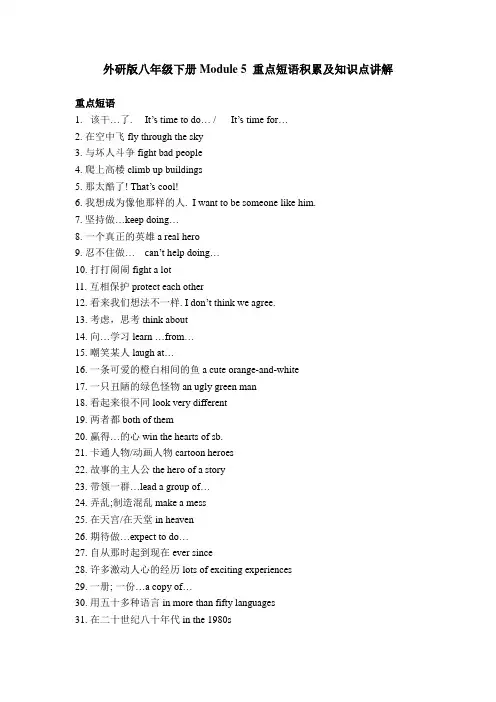
外研版八年级下册Module 5 重点短语积累及知识点讲解重点短语1.该干…了. It’s time to do…/ It’s time for…2. 在空中飞 fly through the sky3. 与坏人斗争 fight bad people4. 爬上高楼 climb up buildings5. 那太酷了! That’s cool!6. 我想成为像他那样的人. I want to be someone like him.7. 坚持做…keep doing…8. 一个真正的英雄a real hero9. 忍不住做… can’t help doing…10. 打打闹闹 fight a lot11. 互相保护protect each other12. 看来我们想法不一样. I don’t think we agree.13. 考虑,思考think about14. 向…学习learn …from…15. 嘲笑某人laugh at…16. 一条可爱的橙白相间的鱼 a cute orange-and-white17. 一只丑陋的绿色怪物an ugly green man18. 看起来很不同look very different19. 两者都both of them20. 赢得…的心win the hearts of sb.21. 卡通人物/动画人物cartoon heroes22. 故事的主人公the hero of a story23. 带领一群…lead a group of…24. 弄乱;制造混乱make a mess25. 在天宫/在天堂in heaven26. 期待做…expect to do…27. 自从那时起到现在ever since28. 许多激动人心的经历lots of exciting experiences29. 一册; 一份…a copy of…30. 用五十多种语言in more than fifty languages31. 在二十世纪八十年代in the 1980s32. 丁丁黑白画册blacck-and-white Tintin books33. 他六十岁生日his sixtieth birthday34. 生活在他自己的私人世界里 live in his own private world35. 现实生活real life36. 发现…很难理解find sth. hard to understand37. 也;和…一样;不仅…而且as well as…38. …和…都…both…and重点句:1.他已经流行了八十多年了》He has been popular for over eighty years.2.丁丁在二十世纪八十年代出现在中国。
(完整版)外研版英语八年级下册知识点总结.docx
最新外研版英八年下册知点Information:信息(不可数名)Module 1Feelingsand impressionsUnit 11. What a delicious smell?Smell: 一股气味(可数名)_____ good advice! It ’ s so helpful to us. (what / How)_____ interesting the story is! (What / How)2.nice:adj. 美味的,友好的,令人愉快的nice weather: 好天气be nice to sb.: 某人友好a nice trip: 一次令人愉快的旅行The cookie tastes nice. 干起来美味。
3.would like 比 want 气更委婉。
----Would you like to stay here with us?---- Yes, I ’ d like / love to.4.lovely: 令人愉快的,可的修人或物 alovely afternoon / girllively: 活的,生的a lively lesson: 一堂生的5.I’ m afraid that +从句 : 恐怕(表示歉意或方失望的情况)I ’ m afraid that I can’ t come to your party tomorrow.6.1)a bit = a little: 有点儿,有点后接 /形容 /副形容 /副的比I feel a bit thirsty now.After the rain, people feel a bit / a little cooler.2)a little + 不可数名:There is a little time left.a bit of + 不可数名:There is a bit of water in the bottle.7.have a try: 一 have a/ an + 名 have a swim:游泳 have a break: 休息 have a shower: 洗沐浴8.I have a sweet tooth. 我喜吃甜食。
新外研版英语八年级下册知识点复习(共50张PPT)
No, I don’t. No, they weren’t. 5) The days get long. I can help you ___ I have time. I usually have eggs for breakfast. He said, “You are younger than I ”.
7. _A__ft_e_r_ getting up, I always listen to the radio for a while. 8. We must be quick, _o_r_ we can’t follow them. 9. To catch the early bus, _s_o_ I got up very early this morning.
collecting stamps/model cars.
回答爱好:
My hobby is
writing. playing basketball.
swimming. running. singing.
5. 提问人的相貌:
What does...look like?
6. 提问人的性格:
What is ... like?
Have you...? Yes, I have . No. I haven’t.
Were they...? Yes, they were. No, they weren’t.
Was he...? Yes, he was. No, he wasn’t.
Has she …? Yes, she has. No, she hasn’t.
四、句型 (及交际用语)
1.对某人来说做某事是怎么样的:
八年级下学期-英语-知识点总结(外研版)
11. If you know him, why not go and meet Jim instead of me, Kate?
6.形容词、副词
形容词 与副词 的转换
在词尾处 + ly y 结尾时 ,去 y + ily
Yes, he is.
No, he isn t’. Do
you ...?
Yes, I do.
No, I don ’t.
Does ...she ? Yes she does . No, she doesn’t.
Did they...? Yes, they did. No, they didn ’. t
6. I can help you if I have time.
用 and, w hen, because, but, or, so, though before, after, if, 填空
7. After getting up, I always listen to the radio for a while.
5. 提问人的相貌:
What does...look like?
6. 提问人的性格:
What is ... like?
7. 到该做什么事的时候了。 It’s time to do sth. It’s time for sth.
8. 提建议用语: Why not do sth...? Why don ’t you do sth...? What/How about sth. / doing sth...? It ’s best to do sth. You’d better do sth. You should do sth.
Module 1 Unit 2、Unit 3 知识点详解-外研版八年级下册英语
外研版英语八(下)Module 1 Feelings and impressions 知识点详解Unit 2 I feel nervous when I speak Chinese.★(A2).【知识点再现】Welcome to China. 欢迎来到中国【知识点1】Welcome to+地点。
意为“欢迎来到某地”。
如:Welcome to Guilin. 欢迎来到桂林。
★(A2).【知识点再现】Thanks for your last message. 谢谢你的上一封邮件。
【知识点2】thanks for意为“因……而感谢某人”,相当于thank you for。
for是介词,意为“因为”,其后接名词、代词或动名词作宾语。
thanks to意为“多亏了,由于”。
如:Thanks /Thank you for your help. 谢谢你的帮助。
Thanks /Thank you for your pencil. 谢谢你的铅笔。
Thanks/Thank you for helping me. 谢谢你帮助我。
Thanks/Thank you for making us see sense. 谢谢你让我明白了道理。
【知识点3】【辨析】message,information与news的用法辨析:①message含义较广,可指书面、口头、无线电等多种渠道传来的信息,因而有“消息、口信、电报”等意思,为可数名词。
message的常用搭配:get/receive a message收到信息;leave a message留言;send a message发送信息;take a message捎口信。
如:He left a message for you. 他给你留言了。
I have an important message for you. 我有一条重要的信息要告诉你。
②information作“信息”解,通常指在阅读、观察、谈话或书信往来中特别关注的消息、情报、资料等。