
人教版八年级英语下册知识点归纳总结
英语:人教版8年级下册知识点总结 Unit 1 What’s the matter? 单元目标 1. 学会谈论健康问题,健康状况(Talk about your health) 2. 能够辨认身体部位。(parts of the body) 3. 能够提供建议(Give advice) 重点词汇 1. head 头 2. neck 颈部 3. back 后背 4. leg 腿 5. arm 手 6. hand 手 7. foot 脚 8. nose 鼻子 9. eye 眼睛 10. ear 耳朵 11. mouth 嘴 12. tooth 牙齿 13. stomach 胃 14. headache头痛15. toothache牙痛 16. stomachache胃痛 17. fever 发烧 18. backache后背痛 19. sore throat 咽部疼痛 20. tired 累的 21. thirsty 口渴的 22. hungry 饿的 23. dentist 牙医 重点短语 1. have a stomachache 胃痛 2. have a cold 感冒 3. lie down 躺倒 4. take one‘s temperature 给某人量体温 5. have a fever 发烧 6. go to a doctor 看医生 7. get off 离开,出发 8. to one‘s surprise 令某人惊讶的是 9. agree to (do sth) 同意做某事 10. get into trouble 陷入麻烦 11. fall down 摔打, 12. thanks to 幸亏,由于 13. in time 及时 14. give up 放弃 15. be interested in 对......感兴趣 16. make a decision 做决定 17. cut off切碎 重点句型 1. What‘s the matter? 怎么了, 2. I have a stomachache. 我胃痛。 3. What should I do? 我应该做什么, 4. I think you should lie down and rest. 我认为你应该躺下休息 5. If your head and neck still hurt tomorrow,then go to a doctor. 如果你的头和脖子明天仍然痛,那么去看医生吧。 6. He hurt himself in P.E class. 他在体育课上伤害了自己。 语法难点 情态动词should (1) should 作情态动词时,表示责任和义务,含义是“应该:应当”,可用于各种人称。 如:What do you think I should do? 你认为我应该做些什么, (2) should 可用来表示推测和估计,常译成“按说应该”。 如:I think she should arrive home by now. 我想她此刻应该回家了。 (3) should 与 how,why,what 等词连用,多表达惊讶、意外等情绪。 如:How should I know? 我怎么知道, 高频考点 1. How to talk about our health?问某人哪儿不舒服。 When we are not feeling well , we often go to see the doctor . The doctor will ask : What’s wrong (with you) ? What’s the matter (with you) ? What’s your trouble ? What happens to you ? (Is there) anything wrong with you ? 叙述病情 There is something wrong with my tooth . 我的牙出问题了。 Doctor , I’m not feeling well . 我感觉不好,医生。 I feel terrible . 我感觉糟透了。 I feel very ill . 我感觉病得很重。 This place hurts . (I’ve got a pain here) 这个地方疼。 My leg hurts . 我腿疼。 I don’t feel like eating . 我不想吃东西。 I have a cold . 我感冒了。 I have a fever . 我发烧了。 I have a headache . 我头疼。 处置或提出建议: 1)Open your mouth , please . 张开嘴。 I want to take your temperature . 我想测测你的体温。 2)Take this medicine three times a day . 这个药一天吃三次。 3) Take three pills before you go to bed . 睡前服用三片。 4) You’d better stay in bed till tomorrow . 最好卧床休息到明天。 5) Drink lots of water and have a good rest . 多喝水,好好休息。 6) You should lie down and rest . 卧床多休息。 7) You should drink hot tea with honey . 你应该喝加蜂蜜的热茶。 8) You should see a dentist . 你应该去看牙医。 9) You should go to bed early . 你应该早点上床(休息)。 2. 关于情态动词should 1) 情态动词 should表“建议、应该”,其否定形式为shouldn‘t . 它用于所有人称。在其后应为动词原形。 You should wait a little more . 你应该再多等一会儿。 He should tell me about it . 他应该告诉我这件事。 2) 在表示要求、命令时,语气由should(应该)、had better(最好)、must(必须)逐渐加强。 在本单元主要是表建议“应当”或“应该”。 3. have a cold感冒,还可以说get a cold . 我得了重感冒:I have a very bad cold . 在这里cold是名词,因此前边可以加冠词“a”、有时也可以说: I have got a very bad cold . 或:I have had a very bad cold . 4. He shouldn‘t eat anything for 24 hours . 他不应在24小时内吃任何东西。 在这里因为是否定句,因而不用something,而用anything,同some和any的区别一样,something用于肯 定句中,而anything用于否定或疑问句中,如: There’s something wrong with him . 他出问题了,或他病了。 Is there anything I can help ? 我能帮忙吗, 又如:Do you have any brothers ? 你有兄弟吗, I have some good friends . 我有一些朋友。 I never have any fun . 我从没什么乐趣。 never是否定词,因此我们用any,不用some 5.What’s the matter with you ? 你怎么了。with是个介词,后边可以跟名词或代词。 What’s the matter with Sonja ? Sonja怎么了, 6.I am not feeling well . feel well well表示“好” ,这里不用“good”。 7.She’s tired . 她很累。 tired是个形容词,可以说feel tired感到很累,或说get tired. She feels tired. 或She gets tired . 8.Traditional Chinese doctors believe we need a balance of cooling yin and hot yang to be healthy . 传统中医认为我们需要通过阴阳调和来保持健康。 其中a balance of„„平衡 keep a balance of保持一个„„平衡 如keep a balance of nature保持自然(生态)平衡。 be healthy,keep healthy,stay healthy都是保持健康的意思。 healthy是个形容词,其名词形式为health . 9. on the other hand 另一方面。经常与on (the) one hand一起连用。表示一方面……另一方面……。 如: On one hand we should study hard , on the other hand we should keep healthy . 我们一方面要努力学习,另一方面应该保持身体健康。 10. too much yang in their lives . too much和too many都表示许多。 too much后接不可数名词,如water , money等。 too many后接可数名词的复数,如students , flowers lives是名词life的复数形式。 11. It’s important to eat a balanced diet . 吃(营养)平衡的饮食是很重要的。balanced在此处是形容词,表示“平衡的”。 It是形式主语,真正的主语是“to eat a balanced diet”,但因主语太长,为了句子平衡,将主语it代替,这是it的又一功能。 12.I’m not feeling very well at the moment . at the moment . 1)用于现在时态中,意思为“此刻”,如: I am busy at the moment . 我此刻很忙。 2)用于过去时中,表示“当时”,如: I was busy at the moment . 我当时很忙。
引领人生 A bad thing never dies.坏事传千年
人教版英语八年级下册第1--2单元知识点总结
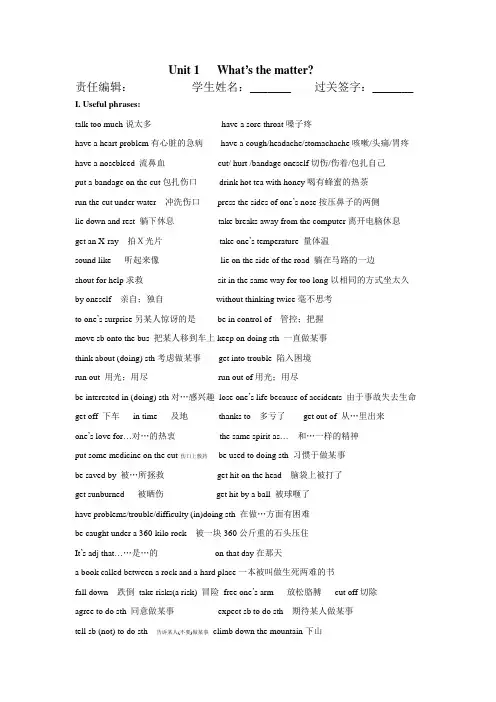
Unit 1 What’s the matter?责任编辑:学生姓名:_______过关签字:_______ I. Useful phrases:talk too much说太多have a sore throat嗓子疼have a heart problem有心脏的急病have a cough/headache/stomachache咳嗽/头痛/胃疼have a nosebleed 流鼻血cut/ hurt /bandage oneself切伤/伤着/包扎自己put a bandage on the cut包扎伤口drink hot tea with honey喝有蜂蜜的热茶run the cut under water 冲洗伤口press the sides of one’s nose按压鼻子的两侧lie down and rest 躺下休息take breaks away from the computer离开电脑休息get an X-ray 拍X光片take one’s temperature 量体温sound like 听起来像lie on the side of the road 躺在马路的一边shout for help求救sit in the same way for too long以相同的方式坐太久by oneself亲自;独自without thinking twice毫不思考to one’s surprise另某人惊讶的是be in control of管控;把握move sb onto the bus 把某人移到车上keep on doing sth 一直做某事think about (doing) sth考虑做某事get into trouble 陷入困境run out 用光;用尽run out of用光;用尽be interested in (doing) sth对…感兴趣lose one’s life because of accidents 由于事故失去生命get off 下车in time 及地thanks to 多亏了get out of 从…里出来one’s love for…对…的热衷the same spirit as…和…一样的精神put some medicine on the cut伤口上敷药be used to doing sth 习惯于做某事be saved by 被…所拯救get hit on the head 脑袋上被打了get sunburned 被晒伤get hit by a ball 被球咂了have problems/trouble/difficulty (in)doing sth 在做…方面有困难be caught under a 360-kilo rock 被一块360公斤重的石头压住It’s adj that……是…的on that day在那天a book called between a rock and a hard place一本被叫做生死两难的书fall down 跌倒take risks(a risk) 冒险free one’s arm 放松胳膊cut off切除agree to do sth 同意做某事expect sb to do sth 期待某人做某事tell sb (not) to do sth 告诉某人(不要)做某事climb down the mountain下山do the right thing 做正确的事情lose too much blood 失血太多find oneself in a dangerous situation发现自己在处于险half his right arm 右胳膊的一部分so that 为了put the head down低头life and death生命与死亡the other day 前几天right now=right away 立刻;马上by accident偶然地run under the hot sun太阳下跑feel sick觉得恶心II. Nice sentences1. It’s sad that many people don’t want to help others because they don’t want any trouble.2.Arin tells of the importance of making good decisions, and of being in control of one’s life.3. His love for mountain climbing is so great that he kept on climbing mountains even after this experience.4.The book means being in a difficult sit Unit2 I’ll help to clean up the city parks.eful expressions.1. work outside在外工作2.clean up the city parks 打扫城市公园3. cheer sb up使某人兴奋4.give out food at the food bank分发食物库中的食物5.volunteer in an after-school study program 在课外学习机构做志愿e up with a plan想出一个计划7. put off 推迟8.put up粘贴9.hand sth out 分发某物10.call up 打电话11.help out with sth 分担某事12. read the newspaper to sb 给某人读报纸13. care for 喜爱,关心14.give up 许诺15.get one’s future dream job得到未来梦想中的工作16. hard work艰辛的工作17.get such a strong feeling of satisfaction 得到如此强烈的满足感18.the look of joy on the owners’ faces主人脸上高兴的表情19.a book lover读书爱好者20. by oneself亲自21. at the age of在...岁时22. try out for参加...的选拔24.in one’s eyes 在某人的眼中25.go on a different journey进行不同寻常的旅行26.be busy with sth忙于某中27. be worried about doing sth担心做某事28. make lots of money挣钱29.think about what to do 考虑做什么30less lucky than sb 不如某人幸运31. a good way to spend our free time 度过空闲时间的好方法32.raise money for homeless people为无家可归的人筹钱33.run out of 用光,用尽...34.take after 与某人想象35. fix...up 修理at once立刻;马上36.give sth away捐赠某物37. broken bike parts 破车子配件38.make a big difference to sb 对某人有重大的影响52.train to do sth 训练做某事39.deaf and blind 聋的和瞎的40. answer the telephone接电话41.open and close the doors 开、关门42. carry things搬东西43. normal things正常的事情44. a friend of mine我的一个朋友45. a special trained dog一只经过特别训练的狗change one’s life 改变某人的生活46.be excited about sth 对某事很激动47. be able to do sth 有能力做某事48.because of one’s kindness 因为你的友善49.give sb orders 指某人下命令II.Sentences.1. -I’d like to help homeless people.- She decided to try out for a volunteer in after-school reading program.2.You could ask hospitals to let you visit the kinds and cheer them up.3.Mario believes it can help him to get his future dream job.4.She volunteers there once a week to help kids lean to read.5.I am making some signs to put up around the school.6.I am making some plans to work in an old people’s home this summer.7.They told me stories about the past and how things used to be .8.We are all going to be old one day ,too.9.V olunteering here is a dream come true for me.10.I can do what I love to do and help others at the same time.11.I a m sure you know this group was set up to help disabled people like me.12.You helped to make it possible for me to have Lucky.uation that you can not seem to get out of.。
八年级人教版英语下册unit1知识点总结
八年级人教版英语下册unit1知识点总结Unit1是八年级英语下册的第一单元,主要围绕“the sentence”这一主题展开。
在学习中,我们需要掌握一些重要的知识点,本文将对这些知识点进行总结。
一、句子的构成句子是表达完整意义的语言单位,主要由主语、谓语和宾语三部分构成。
其中,主语是句子的主要话题或动作的执行者,通常位于句子的最前面;谓语是句子的核心,描述主语的动作或状态;宾语是句子的补充说明,通常位于谓语之后。
句子的构成还包括句子成分和句子成分的分类。
句子成分包括主语、谓语、宾语、表语、定语和状语等。
句子成分的分类主要有三种,即主谓结构、主、谓、宾结构和主系表结构。
二、句子的种类英语中根据句子的用途和表达方式,可以分为陈述句、疑问句、祈使句和感叹句四种。
其中,陈述句用来陈述事实、肯定或否定某种情况,一般语序为主谓宾,常以句号结尾;疑问句用来询问问题,通常以问号结尾;祈使句用来表达请求、命令或建议等语气,通常省略主语,以动词原形开头;感叹句用来表达强烈的情感,常以感叹词或how引导。
三、句子的语态和时态英语中的语态有两种,即主动语态和被动语态。
主动语态表示主语执行动作,而被动语态则表示主语受到动作的影响。
时态是句子非常重要的一部分,用来表示动作发生的时间。
英语中时态主要有现在时、过去时和将来时三种。
其中,现在时表示现在或经常性的动作;过去时表示过去发生的动作;将来时表示将来要发生的动作。
四、句子的修辞手法修辞手法是指用以增强语言表现力的一些技巧或方法,英语中常见的修辞手法包括比喻、拟人、排比、反问、设问、修饰语等。
其中,比喻是常用的一种修辞手法,用来通过两个事物之间的共性来形象地说明某一现象或情况,增强语言的表现力。
拟人则是将非人事物或抽象物质化为人来进行描述,以增强表达的感染力。
以上是八年级人教版英语下册Unit1的知识点总结,希望能够对大家在学习中有所帮助。
最全面人教版八年级下册英语第八单元知识点归纳总结

Unit 8 Have you read Treasure Island yet?一、词汇与短语◆重点单词A部分1.treasure 珠宝;财富n.2.gun 枪;炮n.3.island 岛n.4.mark 迹象,记号,分数n. 做记号,打分v. 5.classic 经典作品;名著n.6.sand 沙滩;沙n.7.page (书刊或纸张的)页,面,张n.8.towards 朝;向;对着prep. 9.hurry 匆忙;赶快v.10.land 陆地;大地n.11.due 预期;预定adj.12.fiction 小说n.13.ship 船n.14.technology 科技;工艺n.15.tool 工具n.16.French 法语n.B部分1.pop 流行音乐;流行乐曲n.2.success 成功n.3.rock 摇滚乐n.4.belong 属于;归属v.5.band 乐队n.6.laughter 几笑;笑声n.7.forever 永远adv.8.beauty 美;美丽n.9.abroad 在国外;到国外adv.10.million 一百万num. 11.actually 真实地;事实上adv.12.record 唱片, 记录n. 录制, 录音v. 13.fan 迷;狂热爱好者n.14.introduce 介绍;引见v. 15.southern 南方的adj.16.line 行;排n.17.modern 现代的;当代的adj.◆重点短语A部分1.hurry up 赶快;急忙2.go out to sea 出海3.science fiction 科幻小说4.an island full of treasures满是金银财宝的岛5.full of 满是……的;大量的;丰富的6.live in the United Kingdom 住在英国7.write about……写下……8.grow up 长大;成长9.put down 放下10.on page 25 在第25页11.at least 至少12.wait for 等待13.the book report 读书报告14.be due in two weeks 两周到期15.bring back 带回;取回16.arrive on this island 到达这座岛17.lose one's life 失去生命18.go out with one's gun 带枪出去19.kill……for……为……杀……20.grow fruit and vegetables 种植水果和蔬菜21.the marks of…………的足迹22.on the sand 在沙滩上23.who else 还有谁24.how long 多长时间25.live with sb. 和某人住在一起26.a broken ship 一艘破船27.run towards……向……跑去28.a piece of land 一块土地29.travel in the sea 在大海中航行30.in the middle of 在……中间31.leave behind 留下B部分1.country music 乡村音乐2.pop music 流行音乐3.one another/each other 互相4.the number of…………的数量5.study abroad 在国外学习6.fight over sth. with sb. 因某事和某人打架7.be full of=be filled with 充满……8.on the radio在收音机上9.ever since 自从10.the home of country music乡村音乐的故乡11.belong to 属于12.bring sb. back to 带某人回到……13.remind sb. that 提醒某人14.in life在人生中15.the beauty of nature 大自然的美16.have been to……去过……17.read a lot about 读很多关于……18.do some research on sth.对某事/某物做研究19.sing live 现场演唱20.introduce……to……把……介绍给……◆重点句子A部分1.—Have you read Little Women yet? 你读过《小妇人》吗?—No,I haven't .Have you? 不, 我没有。
人教版八年级下册英语Unit1知识点语法归纳总结
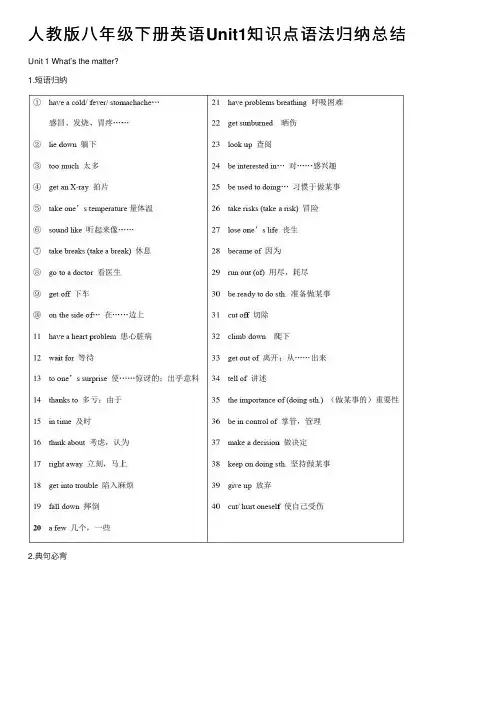
⼈教版⼋年级下册英语Unit1知识点语法归纳总结Unit 1 What’s the matter?1.短语归纳2.典句必背3.⽤法集萃(1)当别⼈⼼情不好,⾝体不适或遇到⿇烦时,我们可以⽤如下表达表⽰关⼼:?What’s the matter? What’s the matter with youWhat’s wrong with …What’s the trouble\problem with …(2)英语中常⽤have描述⾝体的不适,此时have意为“患有”,常⽤结构:①have a + 疾病例:have a cold 感冒;have a fever 发烧;have a cough 咳嗽②have a + ⾝体部位-ache例:have a headache 头痛;have a toothache ⽛痛③have a sore + ⾝体部位例:have a sore throat 咽喉痛;have a sore back 背痛(3)lie down躺下;tell lies/a lie 说谎(4)maybe & may be①maybe,“或许”,常⽤于句⾸,表⽰可能性,后加句⼦。
例:Maybe you are right.②may be,是情态动词+be的结构,意为“可能,也许”,后加名词、代词或形容词。
例:He may be angry.(5)sound like & sound①sound like+名词/代词/从句例:It sounds like you don’t know the truth. It sounds like a good idea.②sound+形容词,“听起来,好像”,例:The music sounds nice.(6)…when the driver saw an old man lying on the side of the road. ……这时司机看到意为⽼⼈躺在路边。
人教版八年级下册英语Unit5知识点总结

人教版八年级下册英语Unit5知识点总结一、语法知识点A部分知识点1.过去进行时❶ 去进行时的构成及用法过去进行时由“助动词(was/were)+动词-ing”构成,表示在过去某一时刻或某一时间段正在进行的动作。
这一特定的过去时间除有上下文暗示以外,一般用过去的时间状语来表示。
如:then, at that time, at this time yesterday, at 10:00 yesterday morning, all right以及when/while从句等。
❶ 表示过去时间点正在进行的动作。
此时常伴明确的过去时间点等。
eg:She was reading a book at this time yesterday.昨天这个时候她正在看书。
(过去时间点正在进行的动作)I was watching TV then. 那时我正在看电视。
(过去时间点正在进行的动作)❶ 表示过去的某个阶段持续的动作。
eg:She was watching TV when the phone rang.(过去一段时间内持续的动作)她正在看电视,这时电话铃响了。
❶ 表示这一阶段反复发生的动作,带有褒贬感情色彩。
此时常伴有频度副词always等。
eg:The girl was always changing her mind.(过去反复发生的动作,带有感情色彩)这个女孩老是改变主意。
❶ 表示过去动作延迟到以后发生,即用过去进行表过去将来,此类动词是一些位置的变化的词。
eg:He told me that he was going soon.(过去进行表将来)他告诉我他很快就要走了。
❶ 过去进行时的一般疑问句句型:Be(Was/Were)+主语+现在分词+其他?肯定回答:Yes,主语+be(was/were).否定回答:No,主语+be(was/were) not.eg:--Were you cooking at that time? 那时,你在做饭吗?--Yes, I were.是的。
人教版八年级下册英语Unit 6 知识点语法归纳总结
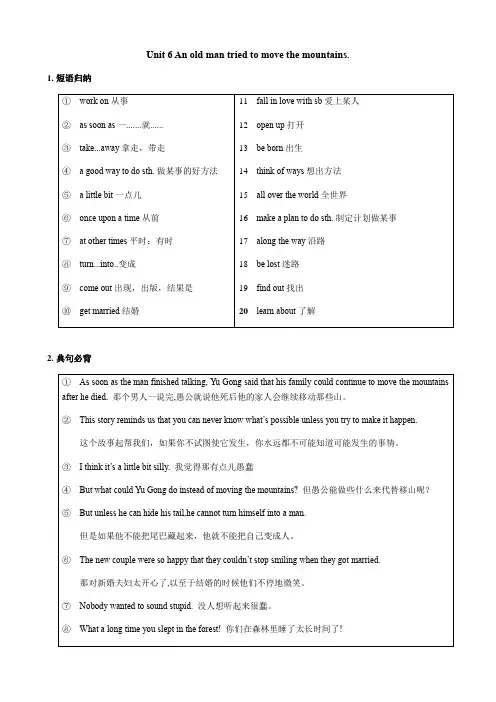
Unit 6 An old man tried to move the mountains.1.短语归纳2.典句必背3.用法集萃(1)As soon as the man finished talking, Yu Gong said that his family could continue to move themountains after he died. 那个男人一说完,愚公就说他死后他的家人会继续移动那些山。
❖as soon as表示“一...就...”,引导时间状语从句。
例:As soon as I went through customs, I jumped in a taxi. 我一过海关就跳上了一-辆计程车。
❖注意:在含as soon as、when等引导的时间状语从句的主从复合句中要遵循“主将从现”的原则,即主句如果用一般将来时,从句要用一般现在时。
(2)This story reminds us that you can never know what’s possible unless you try to make it happen.这个故事起帮我们,如果你不试图使它发生,你水远都不可能知道可能发生的事情。
❖remind作动词,意为“提醒;使想起”。
常见的搭配有:(3)I think it’s a little bit silly. 我觉得那有点儿愚蠢❖ a little bit是固定搭配,意为“有点儿;稍微”,用来修饰形容词或副词。
例:Your bedroom is a little bit dirty. Please clean it up.你的卧室有点儿脏。
请把它打扫干净。
Mike checked the papers a little bit carelessly, so he failed the exam again.迈克在检查试卷的时候有点儿粗心,所以他考试又没有及格。
新人教版英语八年级下册各单元知识点归纳总结
新人教版八年级英语下册各单元知识点归纳总结Unti1 what’sthe matter? 短语归纳1.too much 太多2.lie down 躺下3.get an X-ray 做个X光检查4.take one ’stemperature 量体温5.put some medicine on ......在....上敷药6.have a fever 发烧7.take breaks /take a break 休息8.without thinking twice 没多想9.get off 下车10.take sb to the hospital 送某人去医院11.wait for等待12.to one’ssurprise 使.......惊讶的13.thanks to多亏于;由于14.in time及时15.think about 考虑16.have a heart problem患有心脏病17.get into the trouble 遇到麻烦18.do the right thing做正确的事情事情19.fall down 摔倒20.put ...... on sth把...放在某物上21.get hit/sunburned 摔伤/烧伤22.be interested in 对.....感兴趣23.be used to 习惯于.... 24.take risks/take a risk 挑战25.lose one’slife 失去生命26.because of 因为27.run out of 用完28.cut off 切除29.get out of 从...出来30.make a decision/decisions 做决定31.be in control of 掌管;管理32.give up 放弃用法归纳1.need to do sth .需要去做某事2.see sb doing sth 看见某人正在做某事3.ask sb sth 询问某人某事4.expect sb to do sth 期望某人做某事5.agree to do sth 想要做某事6.help sb (to) do sth 帮助某人做某事7.want to do sth 想要做某事8.tell sb to do sth 告诉某人做某事9.have problems(in) doing sth 做某事有困难10.use sth to do sth用某物去做某事11.be/get used to doing sth 习惯于做某事12.seem to do sth 好像做某事13.keep on doing sth 继续做某事14.mind doing sth 介意做某事语法点1.询问某人的健康问题及遇到麻烦的表达方法2.情态动词should的用法情态动词should的用法表示劝告与建议,也表义务与责任第一人称问句中,征询建议要记清3.不定代词的用法相关阅读方法推理判断阅读法精细解读1. What’sthe matter (with you)? 怎么了?出什么事了?What’sthe trouble/ the problem / wrong with sb./ sth.? 2. I had a cold.我感冒了。have a cold=catch a cold=have the flu have a fever have a cough咳嗽have a stomachache胃疼,肚子疼have a toothache牙疼have a headache头疼3. 身体部位+ache(疼痛)构成新的复合词stomach+ache=stomachache head+ache=headache tooth+ache=toothache back+ache=backache后背痛4. much too+ ,意为实在是太……,too much+ ,意为太多。5. enough【形容、副词】足够的/地,enough放在名前后,形副后。good enough足够好,enough money=money money 6. lie down躺下,lie 躺,躺着,过去式lay;lie说谎,过去式lied 7. maybe “或许”,常用于句首,表示可能性,后加句子。Maybe you are right.
人教版八年级下册英语Unit 7 知识点语法归纳总结
Unit 7 What is the highest mountain in the world?1.短语归纳2.典句必背3.用法集萃(1)China has the biggest population in the world. 在世界上中国拥有最多的人口。
❖population作名词,意为“人口;人口数量”。
表示“人口多”时要用big或large来修饰population;表示“人口少”时要用small来修饰population。
例:Our country has a large population and abundant resources. 我国人口众多,资源丰富。
We have a growing population and therefore we need more food.我们的人口数量在增长,因此我们需要更多的食物。
❖拓展询问“某地有多少人口”时,要用what,即“What’s the population of+地点?”。
注意该句式中的特殊疑问词不能用“how many或how much”。
例:—What’s the population of Hong Kong? 香港有多少人口?—Sorry, I don’t know. Let’s ask Mr. Lee. 对不起,我不知道。
我们问问李老师吧。
(2)Did you know that China is one of the oldest countries in the world?你知道中国是世界上最古老的国家之一吗?❖“one of+the+形容词最高级+复数名词”意为“最...的...之一”例:The Nile is one of the longest rivers in the world. 尼罗河是世界上最长的河流之一。
Miss Wang is one of the most popular teachers in our school.在我们学校,王老师是最受欢迎的老师之一。
人教版初中英语八年级下册全册各单元知识点、语法归纳整理
人教版初中英语八年级下册全册各单元知识点、语法归纳整理Unit1W hat’s the matter?一.重点短语归纳1.foot---feet脚tooth---teeth牙齿2.have a cold感冒3.have a stomachache胃疼4.have a sore back背疼5.have a sore throat喉咙疼6.have a fever发烧7.lie down and(have a)rest躺下休息have a rest休息8.hot tea with honey加蜜的热茶9.see a dentist看牙医see a doctor看医生10.drink lots of water多喝水11.lots of ,a lot of,许多。
大量a lota lot of=lots of,可以修饰可数名词复数和不可数名词,一般用在肯定句中。
:There are lots of(a lot of)books in our library.There is a lot of water on the grounda lot,是一个副词词组,跟动词连用;表示十分,很等意思;Thanks a lot.12.have a toothache牙疼13.That’s a good idea好主意14.go to bed去睡觉go to bed early早上床睡觉15.feel well感到好 feel ill感到不舒服I don’t feel well=I’m not feeling well我感觉不舒服.16.start doing/to do sth开始做某事to do是一件事情完成了,开始做另外一件事情doing是原来的那件事情做到一半,现在又开始做了,是同一件事情。
17.two days ago两天前18.get some rest多休息,休息一会儿19.I think so我认为是这样20.be thirsty口渴21.be hungry饥饿22.be stressed out紧张23.listen to music听音乐24.healthy lifestyle健康的生活方式25.traditional Chinese doctors传统中医26.need to do sth需要做某事I have a toothache.I need to see a dentist.我牙痛,我需要去看牙医.We need to keep our classroom clean.我们需要保持教室的干净.27.too much+不可数名词太多的…much too+形/副实在太…极其,非常too many+可数名词复数太多的…28.be good for sth./doing sth.对什么有益,对什么有好处be bad for sth./doing sth.对什么有害be good to对…好be good at=do well in在……方面好,擅长be good(bad) for、be good at的相关用法1.be good for对......有益Doing morning exercises is good for your health.做早操对你们的建康有益。
人教版八年级英语下册单词,短语,句型和语法总结
Unit1 What’s the matter?【重点单词】matter [ˈmætə] v. 重要,要紧,有关系What’s the matter? 怎么了?出什么事了?sore [sɔ:(r)] adj. 疼痛的,酸痛的have a cold 感冒stomach ['stʌmək] n. 胃,腹部stomachache ['stʌməkeɪk] n. 胃痛,腹痛have a stomachache 胃痛foot(复数feet) [fu:t] n. 脚neck [nek] n. 颈,脖子throat [θrəʊt] n. 喉咙fever ['fi:və] n. 发烧,发热lie [laɪ] v. 躺,平躺lie down 躺下rest [rest] n. 剩余部分,其余;放松,休息cough [kɒf] n. & v. 咳嗽X-ray ['eksreɪ] n. X光,X射线toothache [ˈtu:θeɪk] n. 牙痛take one's temperature 量体温headache [ˈhedeɪk] n. 头痛have a fever 发烧break [breɪk] n. & v. 休息,暂停;打破take breaks (take a break)休息hurt [hə:t] v. 伤害,损害,使受伤passenger ['pæsɪndʒə] n. 乘客,旅客off [ɒf] adv. prep. 离开(某处);从…去掉get off 下车to one's surprise 使…惊讶,出乎…意料onto [ˈɒntə] prep. 向,朝trouble [ˈtrʌbl] n. 麻烦,烦扰,问题hit [hit] n. & v. 碰撞,打,打击right away 立即,马上get into 陷入,参与herself [hə:ˈself] pron. 她自己,她本身(she的反身代词)bandage ['bændɪdʒ] n. & v. 绷带;用绷带包扎sick [sɪk] adj. 患病的,不适的knee [ni:] n. 膝盖nosebleed [ˈnəʊzbli:d] n. 鼻出血breathe [bri:ð] v. 呼吸sunburned [ˈsʌnbɜ:nd] adj. 晒伤的ourselves [ɑ:ˈselvz] pron. 我们自己(we的反身代词)climber [ˈklaɪmə(r)] n. 登山者be used to 习惯于… 适应于…risk [rɪsk] n. & v. 风险,危险;冒险take risks (take a risk) 冒险accident [ˈæksidənt] n. 意外事件;事故situation [ˌsitjuˈeiʃən] n. 状况,形式,情况kg=kilogram [ˈkɪləgræm] n. 公斤,千克rock [rɔk] n. 岩石run out (of) 用尽,耗尽knife [naif] n. 刀,餐刀cut off 切除blood [blʌd] n. 血mean [mi:n] v. 意味着,意思是,意欲get out of 离开,从… 出来importance [ɪmˈpɔ:tns] n. 重要性decision [dɪ'sɪʒn] n. 决心,决定,抉择control [kən'trəʊl] v. 控制,支配,操纵be in control of 掌管,管理spirit ['spɪrɪt] n. 勇气,意志death [deθ] n. 死亡give up 放弃nurse [nə:s] n. 护士【重点短语】1.have a fever 发烧2.have a cough 咳嗽3.have a toothache 牙疼4.talk too much 说得太多5.drink enough water 喝足够的水6.have a cold 受凉;感冒7.have a stomachache 胃疼8.have a sore back 背疼9.have a sore throat 喉咙痛10. take risks 冒险11.hot tea with honey 加蜂蜜的热茶12.see a dentist 看牙医13.get an X-ray 拍X 光片14.take one’ s temperature 量体温15.put some medicine on sth. 在……上面敷药16. give up 放弃17. sound like 听起来像18. all weekend 整个周末19. in the same way 以同样的方式20. go to a doctor 看医生21. go along 沿着……走22. on the side of the road 在马路边23. shout for help 大声呼救24. without thinking twice 没有多想25. get off 下车26. have a heart problem 有心脏病27. to one’ s surprise 另某人惊讶的是28. thanks to 多亏了;由于29. in time 及时30. make a decision 做出决定31. get into trouble 造成麻烦32. right away 立刻;马上33. because of 由于34. get out of 离开;从……出来35. keep on doing sth. 继续或坚持做某事36. put a bandage on sth. 用绷带包扎37. fall down 摔倒38. feel sick 感到恶心39. have a nosebleed 流鼻血40. cut his knee 割伤他的膝盖41. put her head back 把她的头向后仰42. have problems breathing 呼吸困难43. mountain climbing 登山运动44. be used to doing sth. 习惯做某事45. run out (of) 用完;用尽46. so that 以便47. so...that... 如此……以至于...…48. be in control of 掌管;管理49. in a difficult situation 在闲境中【重点句型】1. What's the matter with you?= What'the trouble with you?= What's wrong with you? 你怎么了?2. What should she do? 她该怎么办呢?3.Should I take my temperature? 我应该量一下体温吗?4.You should lie down and rest. 你应该躺下休息一会儿。