
仁爱版九年级英语下册unit5_topic2_sectiona_教学设计
Unit5 Topic2 SectionA 教学设计 Ⅰ. Material analysis 本课是九年级第五单元第二个话题的第一课时,主要活动为1a, 4a和4b。以Susanna向高老师询问孔子的事迹及他留给我们的精神财富作为切入点引出本课的学习,重点学习用who,whom和whose引导的定语从句,了解伟大的教育学家孔子的生平及其著名的教育论著,并通过第四部分的任务详细介绍了秦始皇的历史功绩,使学生对先辈们的奉献有更深刻的了解,能从小树立为人类的幸福而奋斗的远大理想。通过本课的学习,学生在提高分析细节信息能力的同时,会发现积累名言是学习英语的一个好方法,它对写作也有很大的帮助。 Ⅱ.Teaching aims 1. Knowledge aims: 1) Words and phrases: pioneer, wise, influence, whom, pass away, set up, come to an end 2) Grammar: 掌握who,whom和whose引导的定语从句。 3) Functions: 询问更多信息。 2. Skill aims: 1) 能听懂并理解介绍孔子的对话的大意,掌握信息转换能力。 2) 能就熟悉的话题提供信息,表达简单的观点和意见,参与讨论。 3) 能读懂相关的名言,理解其中蕴含的寓意。 3. Emotional aims: 1) 能在小组活动中积极与他人合作,相互帮助,共同完成学习任务。 2) 对著名的历史人物有更深刻的了解,能从小树立为人类的幸福而奋斗的远大理想,传承丰富的历史文化。 4. Culture awareness: 介绍一位外国的或中国现代的教育家,并与中国古代的教育家进行对比,开阔视野,增长知识。 5. Learning strategies: 注意名言的积累,为写作提供素材。 Ⅲ. The key points and difficult points 1. Words and phrases: pioneer, wise, influence, whom, pass away, set up, come to an end 2. Sentences: 1) Confucius, a pioneer in the field of education. 2) He was a great thinker who had many wise ideas about human nature and behavior. 3) He was also a famous philosopher whose wise sayings have influenced many people in different countries. 4) He was really a great man from whom I can learn a lot. 5) He spent the rest of his life teaching. 3. Grammar: attributive clauses (who/whom/whose) Ⅳ. Teaching aids 多媒体课件,或本话题将讨论的历史人物的图片。 Ⅴ. Teaching procedures Stage (time period) Interaction patterns Teacher activity Student activity Remarks
1 Getting students ready for learning (3-5 mins) Class activity 1.Greeting. 2.Show some pictures of famous people in China’s history. Ask students to introduce the famous people according to the pictures and the knowledge they know. At last sum up the 1.Greeting. 2.Students introduce the famous people according to the pictures. They may use Chinese if necessary.
教师用多媒体课件或图片呈现中国的历史人物,可选用将在本话题中出现的人物,为本单元的学习埋下伏笔,并激发学生的学习兴趣。必introduction and offer some information about them.
要时允许学生使用汉语表达,降低难度,使各个水平的学生都能乐于参与到英语学习活动中来。
2 Revision (3 mins) Individual work Check the homework. 1.Retell the famous sayings mentioned in last topic. 2.Report the famous sayings of Confucius they searched before class. They may use Chinese if necessary.
复习上个话题中提到的谚语,引出孔子的至理名言。
3 Pre-listening (3mins) Class activity Show the pictures of Confucius to lead to the new lesson. Introduce something they know about Confucius.
提示学生联系在语文课上曾学过的孔子的生平及作品。
4 While-listening (6 mins) Individual work 1.Guide students to scan 1b. 2.Play the record of the conversation and let students complete the table. 3.Ask two students to tell 1.Read through the table in 1b carefully. 2.Listen to the conversation and write down the answers or the capital letters of the words. Complete 1.强调听前预览的重要性。 2.提醒学生记录简单的相关信息。 the answer. the table. 3.Check the answers with the teacher.
5 Post-listening (14 mins)
Class activity Play the flash of 1a and let students underline the key points. Watch the flash of 1a and mark something important and difficult. Group work Ask students to discuss the key and difficult points in groups. Students discuss in groups to understand the conversation further in groups. Individual work
1.Point out the key and difficult points. 2.Guide students to finish 2. 1.Note the key and difficult points. 2.Put the sentences of 2 in the correct order.
通过排序的形式培养学生分析细节信息的能力。
Pair work Organize students to discuss the meanings of Confucius’ sayings.
Read and talk about
these wise sayings of Confucius with their partners.
告诉学生记忆名言是学习英语的一个好方法。它对写作也有很大的帮助。
6 Pre-listening (3mins) Individual work Show the picture of 4a, and ask students to answer the questions of 4a. Try to answer the questions according to the knowledge you know.
激活语境。
7 While-listening (3 mins) Individual work 1.Play the record and let students finish 4a. 1.Listen to the passage and check 2.Play the record again and let students finish 4b. the answers of the questions in 4a. 2.Listen to the conversation again and fill in the blanks to complete 4b.
8 Post-listening (5 mins) Pair work 1.Ask students to repeat the passage of 4b after the record. 2.Ask students to read 4a by themselves.
1.Repeat after the record.
2.Read by themselves.
在听音的基础上进行仿读,培养学生正确的语音语调。
9 Summarizing and assigning homework (3 mins) Individual work 1.Ask students to sum up the key points according to the blackboard. 2.Repeat the key points. 3.Assign homework. 1.Sum up the main content of this class. 2.Read through what they have learnt after the teacher. 3.Prepare to report Confucius’ life story according to 2 by adding some information from 1a.
仁爱版九年级英语下册说课稿:Unit5Topic2SectionD
(五)作业布置
课后作业将包括以下内容,其目的是巩固学生的知识,并培养他们的自主学习能力:
1. 书面作业:要求学生写一篇关于环保的短文,使用本节课学到的词汇和语法知识。
2. 口语作业:让学生录制一段关于环保话题的口语表达视频,练习发音和语言流畅性。
3. 自主学习任务:要求学生查找并阅读一篇与环保相关的英文文章,提高他们的阅读理解能力。
4. 作业的目的在于巩固课堂所学,同时鼓励学生将所学知识应用到实际生活中,培养他们的环保意识和语言运用能力。
五、板书设计与教学反思
(一)板书设计
我的板书设计注重清晰性和逻辑性。布局上,我会将黑板分为三个区域:左侧为词汇和短语,中间为语法点和例句,右侧为课堂小结和作业布置。板书的主要内容包括本节课的生词、关键句型、语法规则以及重要的讨论点。风格上,我会使用不同颜色的粉笔来区分不同类型的信息,如红色用于强调重点,蓝色用于板书例句。
课后,我将通过学生的课堂表现、作业完成情况和反馈来评估教学效果。具体的反思和改进措施包括:根据学生的反馈调整教学方法和内容,对难点进行针对性讲解,以及增加学生的自主学习和实践机会。我会持续监控学生的学习进度,并根据实际情况调整教学策略,以确保教学目标的实现。
- 运用情态动词should和条件句表示建议和假设,如We should protect our environment.,If we don't protect the environment, we will suffer from pollution.
- 运用过去进行时和现在进行时描述正在进行的动作。
(四)总结反馈
在总结反馈阶段,我会采取以下方式引导学生自我评价并提供有效反馈:
初级中学仁爱版九年级英语《Unit5Topic2SectionB》教案
Many students are using them, and they are doing better in English now.
I’m looking for my purse.
3. Talk about how to borrow things.
S5:Dormitory, library.
…
T:Good job! You are great! Now, what are you doing?
Ss:We are having an English class.
T:What are you doing?(指着S6,示意他/她做一个动作。)
S6:I’m …
(2)(让学生写一份自己的寻物/招领启事。)
T: Suppose you found or lost something, write your own bulletin board message.
5. (让学生听录音,并完成3,选择正确的答案。)
(板书并学习听力部分的生词。)
T: Listen to the dialogs in 3, and choose the right answers. First, let’s learn some new words.
Bye-bye!
6. Thanks
Thank you all the same.
过程与技能
Review, Presentation, Consolidation, Practice, Project
情感态度与价值观
Tell them they should return things that were borrowed from others on time.
新仁爱版高中英语 Unit 5 Topic 2 Section A 课件

( 5 ) D. In his thirties, Confucius began to teach. He spent the rest of his life teaching .
( 8 ) E. Five years later, he passed away.
( 7 ) F. When he was 68 years old, Confucius
A good way to learn English is to memorize famous sayings. Sayings are interesting and full of meanings. They are also well-written, so they can provide you with good patterns for your own writing.
pioneer
thinker
philosopher influencing _____ many people in different countries with his _____ wise sayings.
2 Put the following sentences in the correct order. Then tell about Confucius’ life story in groups by adding some infourned to Lu, his home state .
( 1 ) G. Confucius was born in the state of Lu in
the year 551 B.C.
( 2 ) H. When he was 3 years old, his father died.
仁爱英语九年级下册Unit5Topic2
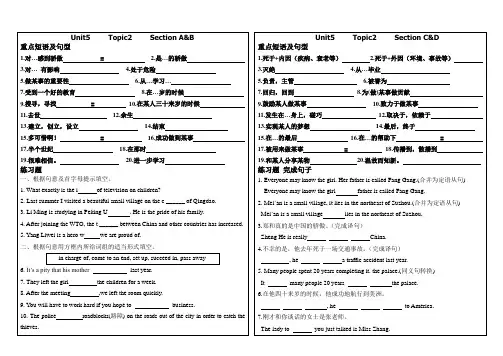
Unit5 Topic2 Section A&B重点短语及句型1.对…感到骄傲 =2.是…的骄傲3.对…有影响4.处于危险5.做某事的重要性6.从…学习…7.受到一个好的教育8.在…岁的时候9.搜寻,寻找 = 10.在某人三十来岁的时候11.去世12.余生13.建立,创立,设立14.结束15.多可惜啊! = 16.成功做到某事17.半个世纪18.在那时19.很难相信。
20.进一步学习练习题一、根据句意及首字母提示填空。
1. What exactly is the i of television on children?2. Last summer I visited a beautiful small village on the c ______ of Qingdao.3. Li Ming is studying in Peking U . He is the pride of his family.4. After joining the WTO, the t ______ between China and other countries has increased.5. Yang Liwei is a hero w we are proud of.二、根据句意用方框内所给词组的适当形式填空。
in charge of, come to an end, set up, succeed in, pass away6. It’s a pity that his mother last year.7. They left the girl the children for a week.8. After the meeting ,we left the room quickly.9. You will have to work hard if you hope to business.10. The police roadblocks(路障) on the roads out of the city in order to catch the thieves.Unit5 Topic2 Section C&D重点短语及句型1.死于+内因(疾病、衰老等)2.死于+外因(环境、事故等)3.灭绝4.从…毕业5.负责,主管6.被誉为7.回归,回到8.为(做)某事做贡献9.鼓励某人做某事10.致力于做某事11.发生在…身上,碰巧12.取决于,依赖于13.实现某人的梦想14.最后,终于15.在…的最后16.在…的帮助下 = 17.被用来做某事 = 18.传播到,散播到19.和某人分享某物20.温故而知新。
仁爱版英语九年级下册unit5_topic2_sectionc_精品课件
3. What contributions did Qian Xuesen make to the development of aerospace in China? In 1956, he set up the first research institute of rockets and missiles. From then on, he was in charge of developing China’s missile, rocket and spacecraft research programs.
n.(大学)学位
He received his Ph.D. degrees in both aerospace and mathematics in the United States.
v.表达,表露
His devotion to his country was expressed in his sayings.
Zheng He died on his way home in 1433. We Chinese people respect him.
Zheng He whom we Chinese people respect died on his way home in 1433.
The ship is about 151.8 meters long and 61.6 meters wide.
PPT素材:/sucai/ PPT图表:/tubiao/ PPT教程: /powerpoint/ 范文下载:/fanwen/ 教案下载:/jiaoan/ PPT课件:/kejian/ 数学课件:/kejian/shu xue/ 美术课件:/kejian/me ishu/ 物理课件:/kejian/wul i/ 生物课件:/kejian/she ngwu/ 历史课件:/kejian/lish i/
仁爱版九下英语 《He is really the pride of China》SectionA
SectionA
ZuChongzhi (429A.D.-500A.D.)
公元
WenTianxiang (1236A.D.-1283A.D.)
LinZexu (1785A.D.-1850A.D.)
QuYuan (340B.C.-278B.C.)
• Sayings:
1. Hewholearnsbutdoesnotthinkislost; hewhothinksbutdoesnot learnisindanger.
学而不思则罔,思而不学则殆。 2. WhenIwalkalongwithtwoothers, Imaybeabletolearnfromthem. 三人行,必有我师。 3. Whatyouknow, youknow; whatyoudon’tknow, youdon’tknow. 知之为知之,不知为不知。 4. Learnthenewwhilereviewingtheold. 温故而知新。 5. Isn’titapleasurethatfriendscometoseeyoufromfaraway? 有朋自远方来,不亦乐乎? 6. Donotdotootherswhatyouwouldnothavethemdotoyou. 己所不欲,勿施于人。
• Readtheconversationin1aaloud.
• PrepareabriefintroductionofConfuciusaccordingto2andy oucanaddsomeinformationfrom1a.
• SearchforsomeinformationaboutZhengHe.
1. WhenIwalkalongwithtwoothers, Imaybeabletolearnfromthem. 三人行,必有我师。 2. Whatyouknow, youknow; whatyoudon’tknow, youdon’tknow.
仁爱版九年级英语下册课堂优秀教学案例:Unit6Topic2SectionA
本节课的教学内容紧密联系学生的生活实际,有利于激发学生的学习兴趣,提高英语实践能力。在教学过程中,我注重创设情境,让学生在真实的语境中感受英语的魅力,从而提高英语学习兴趣。此外,我还注重培养学生的团队协作精神,通过组织小组活动,使学生在互动交流中,共同完成学习任务,提高英语水平。
4.学生在教师的引导下,学会关爱他人,培养良好的道德品质和社会责任感。
(三)情感态度与价值观
1.学生树立正确的人生观、价值观和道德观,明白关爱他人的重要性,自觉践行社会主义核心价值观。
2.学生在参与志愿者活动的过程中,体验到助人为乐的喜悦,培养乐于奉献的精神,提高社会责任感和公民素养。
3.学生学会珍惜友情,懂得与人为善,建立和谐的人际关系,为我国构建社会主义和谐社会贡献力量。
4.学生认识到学习英语的重要性,激发学习英语的兴趣,树立终身学习的理念,为提高国家整体素质做出贡献。
在教学过程中,我将以教材为载体,充分挖掘德育教育资源,将知识传授与思想教育有机结合,注重培养学生的主体意识,使学生在学习英语的过程中,自然而然地接受德育教育,实现全面发展。
三、教学策略
(一)情景创设
1.生活情境:通过展示现实生活中参加志愿者活动的照片或视频,让学生直观地感受志愿者活动的场景,激发学生的学习兴趣和参与欲望。
二、教学目标
(一)知识与技能
1.学生能够掌握一般过去时的被动语态,理解其构成和用法,并能熟练运用到实际情景中。
2.学生能够听懂、会说、会读、会写本节课的核心词汇和句型,如“join in, volunteer, charity, hospital, helped, passed out”等。
仁爱版九年级英语下册Unit5 Topic 2 Section B教案
Section B(11——12课时)Ⅰ. Teaching aims and demands教学目标知识目标:1. Learn so me new words and a phrase:captain, sail, coast, pride, die of, trade, prize能力目标:(1)Learn the attributive clauses which use“whom”:He was a Ming dynasty explorer whom the Chinese people are proud of.(2). Talk about the lif e of Zheng He.情感目标:Learn about the great persons and their events in order to improve the students’sense of national pride.Ⅱ. Teaching aids教具多媒体课件/录音机/幻灯片/图片Ⅲ. Five-finger Teaching Plan五指教学方案Step 1 Review 第一步复习(教师用多媒体或板书展示自己制作的名人档案,呈现历史人物郑和。
)T: I have made a card, too. Please look a t the screen/blackboard.Name: Zheng He (1371-1433)Birthplace: Yunnan ProvinceExperience: From 1405 to 1433, he led seven ocean journeys forthe Ming emperor.(教师口头介绍郑和的个人档案,深入引导,过渡并呈现新词汇。
)T: Zhen He was born in 1371 and unfortunately he died of illness in 1433. As a captain and palace official, he led seven ocean journeys from 1405 to 1433. He even sailed to the east coast of Africa with the help of compasses. He made the ocean journeys in order to develop trade and friendship between China and other countries. He is real ly the pride of China. (板书,并要求掌握captain, sail, coast, pride, die of, trade;理解unfortunately;了解compass。
新仁爱版九年级英语下册Unit 5 Topic 2 Section C教学课件
2. Answer the following questions. 1) What happened after Qian Xuesen graduated from Shanghai Jiao Tong University? He traveled across the Pacific Ocean to the United States for further study. 2) Why did Qian Xuesen come back to his motherland from the USA? Because he loved his motherland and wanted to make contributions to his own country.
2. After he graduated, he became a teacher as well as a researcher who studied rockets and missile theories. 毕业后,他就开始从事火箭与导弹理论的教 学与研究工作。 as well as 意为“既…又…; 除…之外 (也)” 是并列连词。 ① 可以用来连接两个相同的成分,如名词、 形容词、动词、介词短语等。 A: 连接名词: • He gave me money as well as advice.
A: Who is Zheng He?
B: He is an explorer who led
seven ocean journeys.
A: What should we learn from
him?
B: His devotion to our country’s
sailing and trading.
Unit 5 Topic 2 Section B(课件)九年级英语下册(仁爱版)
Journey
______ ocean journeys during____ years sailing to the _______ of ______more than __________ earlier than Columbus’ _____ journey to America
Death died of _____ on his way home from _____ Zheng He is really the _____ of China.
读音
音标
单词
例句
['kæptin] captain n.船长, 舰长;(军 )上校;队 长
The Captain and
crew welcome you aboard.船长和全 体船员欢迎你。
The captain came
ashore and joined
our conversation. 船长上了岸,凑 过来和我们说话
6. Do not do to others what you would not have them do to you. 己所不欲,勿施于人。
Confucius is a great man from whom we can learn a lot.
Confucius
pioneer in the field of ________
Attributive clauses:
1. He was a Ming dynasty explorer whom we Chinese people are proud of. whom 在此引导定语从句,修饰先行词explorer,在 定语从句中作宾语。
2. He was a great thinker who had many wise ideas about human nature and behavior. who 在此引导定语从句,修饰先行词thinker,在定 语从句中作主语,也可以用that来替换。