
牛津版七年级英语下册Unit2 Neighbours welcome and comic strip课件
father
a doctor at Sunshine Hospital
mother
a nurse at Sunshine Hospital
Yang Lin’s family
a student at Sunshine School father
Hobo is in a hurry. Where is Hobo going? 1. Listen and find out the answer. 2. Read and guess: What does Eddie do when he visits his neighbours?
1. Do you think Eddie’s new neighbours will welcome him? Why or why not? 2. If you have a neighbour like Eddie, do you welcome him? 3. What can you do for your neighbours?
waiter
doctor
teacher
nurse student
restaurant hospital school hospital school
1. What’s your neighbour?/ What does your neighbour do? 2.Where does he/she work?
• • • • • •
Do you often talk with your neighbours? Do you often play with your neighbours? Do you like visiting them? Do they often visit your home? Do you think they’re good visitors? What do you think of your neighbours?
office cook postman manager policeman worker police post restaurant restaurant company station office
Listen and answer:
1. How many buildings are there in Simon’s neighbourhood? 2. How many floors do the buildings have? 3. What does Simon have around his neighbourhood? 4. What does Simon think of his neighbourhood?
a postman in the post office
supermarkets a school
ˈneibəhud
restaurants a hospital
Ask and answer about people’s jobs and their working places:
1. What’s your neighbour?/ What does your neighbour do? 2.Where does he/she work?
ˈneibə
Lin Tao’s family
a student at Sunshine Middle School
father an English teacher at Sunshine Middle School mother
an office worker in a company
Li Lei’s family
mother
a cook at Sunshine Restaurant
a manager at Sunshine a waiter at Restaurant Sunshine Restaurant
brother
Mr. Zhang
Mr. Wang
a policeman in the police station
Unit 2 Neighbours
Welcome to the unit & Comic strip
I live in a flat in City Garden in Sunshine Town. Lin Tao’s family live
above me. Li Lei’s family live above me, too. Yang Lin’s family live next to me. Mr. Zhang and Mr. Wang share a flat and live below me.
牛津译林版七年级英语下册Unit2NeighboursWelcometotheUnitandcomicstrip优质教案
Unit 2 Neighbours Welcome to the unit and comic stripTeachi ng aims:1.Master the names of all kinds of jobs and working places.2.Can talk their own towns in English.Tea ching contents:Words: neighbour will visitor like wow waiter neighb ourhoodSente nces: I’m going to visit our neighbours.Teaching steps:Step 1. review1.Present a diary to the students, ask them to fill in the blanks.Tomorrow is Saturday. My family are all free. My parents do not need to work in their and I have no lessons at .So we decide to go outside to enjoy the weekend.In the morning, my father wants to visit the next to our building to have a look at some old things. My mother wants to buy clothes in some new near our home. I want to have a picnic with my friends in a .In the afternoon, my family will watch a film in a and have a big meal in a famous .What a wonderful weekend! Now it is time to go to the to buy something for tomorrow.2. T: Where do you live? What ki nd of home do you have? What’s around your home? Is your home near a park/a school/a restaur ant/a supermarket? Is there a shop/a factory/a cinema/a museum/a hospital near your home? Encourage the students to answer by themselves.Step2. Presentation1.T: Who lives next to your flat/house? Who lives above/blow you? Who’s your neighbour? What’s your neighbour? What’s your neighbour’s name? What does he/she do?Write ‘neighbour’ on the blackboard.2.T: Mr. Lin is my neighbour. He’s a waiter in a big restaur ant. Miss Huang lives above me. She’s a teacher.Write ‘waiter’ on the blackboard.Step 3. Practice1.Ask the s tudents to finish exercise A.T: We have a lot of neighbours. They have different jobs. Look at the pictures. Where do they work? Please match them with the places.2.Make a dialogue with a student.Step 4. Presentation1.Make sure the understand the idea of the dialogue B.T: Amy is asking Simon questions. What are these questions about? Please listen to the tape and tell me.2.Encourage the students to the tape and answer.T: The questions are about Simon’s home and different places arou nd his flat.Present ‘neighbourhood’ and write it.Step5.Practise1.Play the tape ,ask the students to answer more questions. eg:(1)Where’s Simon’s flat?(2)How many buildings are there in neighbourhood?(3)How many floors do the buildings have?(4)What does Simon have around his neighbo urhood?(5)What does Simon think of his neighbourhood?2.Divide the students into two groups to read.3.Ask some students to make a dialogue using part B as a model.4.Ask some students to act.Step 6. Presentation1.T: Do you often talk with our neighbours? Do you often play with your neighbours? Do youlike visiting them? Do they often visit your home? Do you think they’re good visitors?What do you think your neighbours?Write ‘visitor’ on the blackboard.2.ask the students to listen to the tape and find the answer:Where’s Hobo going?3.ask the students to answer more questions according to the tape.Step7.PractiseAsk the students to read the dialogue and act.Step8. Presentation1.Encouage the students to say their ideas according to the comic strip.2.Arrange the students to talk about and discuss:What can you do for your neighbours? Step9.Homework。
Neighbours PPT课件 47(5份) 译林牛津版2
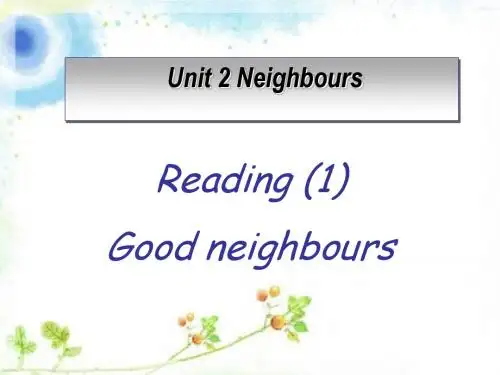
fixing the The man is ______ bicycle girl’s ________.
engineer is The ________ checking the computer _________.
Speed reading
1. Volunteers share their skills and help people in the neighbourhood with different problems. 2. Usually there is a meeting at the weekend.
/kə ’mju:nəti/
Community
My neighbours
What are my neighbours like?(What do you think of my neighbours?)
kind and helpful
volunteers
/vɔlən `tiə/
(have different skills)
3. Simon wants to ask someone to fix computer his bicycle. bicycle is broken. 4. Annie’s computer College help their 5. Parents the children with students their homework. 6. Volunteers also help the old people.
Do you find any problems in your community?
Problems: (work in pairs)
There is something wrong with… ….is broken.
牛津译林初中英语七下Unit 2 Neighbours Grammar课件

【运用】 请根据句意用bring或take填空。 1).B_r_i_n_g__ your brother here tomorrow,
please. 2). The teacher asks Paul to t_a_k_e_ those
books away. 3).T_a_k_e_ this yellow jacket there and
四、一般将来时在使用中的一些注意事项:
1、will用于一切人称,shall只用于第一
人称(I/we)。但现代英语倾向于所有人称 都使用will而不用shall,shall主要出现在 非常正式的英语场合中,或用于口语提 出建议或请求。如: • Shall I go home now? (请求) • Shall we take different routes? (建议)
(3)What are you going to do for poor children the day after tomorrow?
(4)What’s your father / mother to do for your community next week?
Read the table below and ask and answer questions in group of four.
is is going to cook
going to do
Language points
Amy is going to bring water. take和bring take v.“拿走”指把某物从说话人所在 的地方取走,带走。 bring v.“带来”指把某物带到说话人 所在的地方,如:
【结论】
Shall I go home now? (请求) Shall we take different routes? (建议)
牛津译林版七年级下册英语课件:Unit 2 Neighbours reading I

college student The _______ is helping the boy with his homework.
fixing the The man is ______ girl’s ________. bicycle
engineer is The ________ checking the _________. computer
My neighbours
(Part B3, P22)
My neighbours are kind and helpful. Some of them are volunteers. They have _____________ different skills and often help us with ___________ all kinds of problems.
Unit 2 Neighbours
Reading I
Translation
in your neighbourhood 1. 在你居民区里 2. 在你们居民区周围 around your neighbourhood 3. 他们中的大多数 most of them be afraid 4. 恐怕 5. 欢迎像你一样的访客 welcome visitors like you 6. 住在像那样的居民区是好的。 It’s good to live in a neighbourhood like that.
3. Simon wants to ask someone a computer engineer tocheck fix his bicycle. to his computer. bicycle is broken. 4. Annie’s computer 5. Parents help their College students help the children with their homework. 6. Volunteers also help the old people.
牛津译林初中英语七下 Unit 2 Neighbours》Grammar课件

food.
一般将来时simple future tense
• 发生在将来:will/shall do be going to do
• 时间标志词:this afternoon
weekend?
will/shshaalll用l 于第一人 称I/we
I/We
will not /shall not
go.
You/They/He will not
/She/It
肯定句: 主语 + 助动词will + 否定句: 主语 + 助动词will + not +
do动词原形 do动词原形
will not=won’t
• I’ll meet them too. • I’m afraid they won’t welcome
visitors like you. • They’ll help the old people clean their
flats. • I’m going to visit our new neighbours. • Are they going to have a meeting this
Simon: All right. I _w_il_l_/s_h_a_ll_w__a_it_(wait) for your call. Thanks.
Mr Lin: You’re welcome.
will/shall
• things, that are sure to happen in the future 将来会发生的事 It will rain this afternoon.
牛津译林初中英语七下Unit 2 Neighbours Task课件
Different jobs, different activities
Different jobs, different activities
an artist
a manager
Who do you like best?
Different jobs, different activities
• __D_if_fe_r_en_t_a_c_tiv_i_tie_s_________________ ______________________________ __G_o_o_d_e_n_di_n_g____________________ ____________
• ______________________________ ____.
on 12 April!
Looking for a new job?
Fit Club!
Thinking about which job to do? We will help you!
Come and join the Job Group
Do you want to get fit? Then this is the group for you!
an artist
Artists are good at _d_r_a_w_i_n_g_p_ic_t_u_r_es__an_d__d_e_si_g_n_in_g__th_i_n_g_s.__ They know a lot about _s_t_yt_l_es_a_n_d__c_o_lo_u_r_s.____________ay at 7:30p.m. This week, we are going to learn how to
牛津译林版七年级下册英语课件:Unit 2 Neighbours reading II
He is always ready to help others.
ready 还意为“准备好的” 为……做准备 准备好去做某事
be ready to do sth. get ready to do sth.
原句:Some of them often visit the old people and do some shopping for them. do some shopping意思是“买东西,购 物”。do some/the + V-ing短语结构常 用来泛指做某类事情。 打扫卫生
ask an engineer 5. 叫一个工程师来检查一下 to check it 7. 帮助你的作业 help you with your homework
8. 乐于帮助人
of problems
be ready to help
9. 大学生
college students
do some shopping / reading 11. 修理那个女孩的自行车 fix the girl’s bicycle
1. help sb. with sth. 在某一方面帮助某人
v.
那位大学生正在帮助那个男孩做家庭作业。
The college student is helping the boy with his homework. 他经常帮助我学英语。
He often helps me with my English.
谢谢你的帮助。
Thank you for your help.
1. help sb. with sth. 在某一方面帮助某人
v.
2. help sb. do sth. 帮助某人做某事
七年级英语下册unit2Neighbourswelcometothenit课件(新版)牛津版(1)
Where are you going?
1. Where is Hobo going? He’s going to his neighbour’s home.
2. Does Eddie want to go with Hobo?
Yes, he does.
4.What does Simon have around his neighbourhood?
Supermarkets,restaurants,a school and a hospital.
5.What does Simon think of his neighbourhood?
He thinks it’s good to live in a neighbourhood like that.
Task 3 Practice
A: Where do you live? B: I live in… A: How many buildings are there in your neighbourhood? B: There are about…..Most of them have--floors. A: What do you have around your neighbourhood? B: We have… A: Do you like living there? B: …
It’s in City Garden in Ninth Street.
2. How many buildings are there in his neighbourhood?
About 20 buildings.
3. How many floors do the buildings have?
Most of them have 14 floors.
【最新】牛津译林版七年级英语下册Unit2 Neighbours reading2精品课件.ppt
centre and share their different skills.
✓ share sth with sb 和某人分享某
✓ share sth
分享某物
2. They help us with all kinds of problems. ✓ help sb. with sth. ✓ help sb. (to) do sth. ✓ help each other
My car is broken, so I go to work on foot. 我的车坏了,所以我步行去上班。 There’s something wrong with my phone. 我的电话出了点毛病。
there’s sth wrong with sth
否定表达:
There is not anything wrong with my computer.
How can he get help? ▪ (6) Annie’s bicycle is broken. How can she get help? ▪ (7) A boy has some problems with his homework.
How will he get help? ▪ (8) What do volunteers do to help the old people? ▪ (9) What does Amy think of Simon to have such a
✓ It’s lucky for sb to do sth 做某事(对某人来说)很幸运
✓ find sb to do sth 发现某人做某事
6. Some college students are ready to help.
苏教牛津译林版七年级下册英语(7B)unit 2 Neighbours reading 课件
adj. 愿意帮忙的/有用的
n. 志愿者, n. 社区 n. 技能,技巧 帮助某人解决某种困难 n. 问题,难题 pron. 某事,某物 n. 工程师;技师
Words & phrases review
9.check 10.broken 11.someone 12.fix 13.anyone 14.college 15.do some shopping
2. When and where do they often meet ? They often meet at the community centre at the weekend.
3. What do they do to help others?
…check the computer… ; …fix the bicycle…; …help with homework; …help the old people (visit…do some shopping…clean…)
primary school 小学
Junior middle school 初中 Senior middle school 高中
College 学院 University 大学
the day after tomorrow yesterday 昨天 前天我丢了手机。
前天
I lost my mobile phone .....
I’m going to ask a computer_e_n_g_i_n_e_er_ to check it. My cousin Annie’s =bike _b_i_c_y_c_le_ is broken, so she’s going to ask someone to _f_ix__ it. Amy: Can you find _a_n_y_o_n_e_ to help you with your homework?