
小学英语新外研版(一起)六年级上册M8U11
F
2. Amy often tidies her bookshelf.
F
3. Lingling will help Amy tidy her bookshelf.T 4. They want to choose some book to read.T
选择
listen and tick.听一听,勾一勾。
√
√
√ √
Follow and imitate.
跟读,加深文章的理解,同时尽力模仿录音 中的语音和语调,做到声情并茂。
Task
Read in groups and show.
(小组选择自己喜欢的方式展示)
1
1.Read one by one. (一个接一个读)
2.Read together. (齐读)
精品课件
小学英语新外研版(一起) 六年级上册
市实小 清风制作
Module 8 Unit 1
Do you often tidy your room?
• • • • •
tidy 整理,收拾;整洁的 often 经常 bookshelf 书架 choose 选择 week 星期,周
bookshelf来自bookshelf 书架
a tidy room
a messy room
We can’t play in a messy room.
We can play well in a tidy room. We should often tidy our room.
suck your thumb
jump dance swim
2
3. Read and act.(双簧表演)
4. Read and translate. (读并翻译课文)
5. Read in roles.(分角色朗读) 6. Other ways…(其他方式)
Fill in the blanks.
• I’m Amy. I’m tidying my room. I _____ often tidy my room. So we can play well in a _____ tidy bookshelf room. But I don’t often tidy my ________. It’s very ______. messy Lingling is a good girl. She will help me tidy my bookshelf. Then we can ______ choose some book and read books together.
ride a bike
tidy your room
go to the library
draw pictures read books
run
The rules:如果圈的是单词或词组,就快速大声读出来并做动作, 如果圈的是 “手”,就鼓掌四次。若圈的是“脚”,就跺脚四次。
suck your thumb
Homework
To make a survey about your parents' daily life.
A: Do you often…?
read stories tidy your room
Father
Mother
draw pictures
ride a bike play computer games speak English
play the flute, wash your face ,do your homework, play football, cook fish ,send an email, read books…
Have good habits, have a good life.
拥有好的习惯就拥有好的一生。
You should often tidy your room and help your mum.
Listen and answer:
What is Amy doing?
She is tidying her room.
Listen and choose T or F:
1. Amy’s bookshelf is messy tidy.
Do you often(经常)...?
Yes, I do.
No, I don't.
sweep the floor clean the desk wash clothes tidy your bookshelf help your mother …
Do you often
Yes, I do./ No, I don’t.
Let’s chant.
• • • • • • Do you often tidy your room? Yes, I do. Yes, I do. Do you often tidy your bookshelf? No, I don’t. No, I don’t. Do you often help your mother? Yes, I do. Yes, I do.
M8外研社版英语(新标准)(一年级起点)六年级上册课件设计
always总是 often经常 sometimes有时 never从不
I often play football. tidy my room. watch TV.
The room is tidy. The room is messy.
We can live well in a tidy room. 我们生活在整洁的房间里,会很舒服的。
coin
硬币
————
————
Does Tom —e—ve—r tidy his bed?
曾经
No, he doesn't.
read books.
listen to music.
Do you often
?
eat bananas cook dinner send emails
go swimming clean the classroom drink tea
Does he/she often
?
Do you often
?
play basketball play the flute collect stamps tidy the bed read books phone Grandma
She_n_e_v_e_r plays football. Because she doesn't like it. She s_o_m__e_ti_m_e_s_ cleans the blackboard for her teachers.
He _o_f_te_n_reads English books. Because he loves English.
小学英语新外研版(一起)六年级上册单元备课M8
I often … / I don’t often …
b.语言技能目标:能够听懂会说本模块句型,能运用所学语言对日常发生的行为予以肯定或否定的回答,并能根据调查到的情况写出调查报告。
c.情感态度目标:在调查中让学生分清什么是正确的生活习惯,以积极的态度对待美好的生活。
小学英语新外研版(一起)六年级上册
单元备课
单元
Module 8
重点难点
重点:What do you often do ?
I often … / I don’t often …
难点:运用She / he often(单数第三人称动词的变化)。。。
She / he ,也可以分5人小组活动。)
活动3:男女对垒
活动目的:练习用一般现在时和现在进行上时的比较
活动准备:单词或词组的卡片
活动过程:先让学生复习所有的单词或词组。然后教师将一张单词卡片贴在黑板上,先让男同学说:“I often go swimming.”然后,女同学说:“I’m swimming now.”词组练习到一半的时候,男女交换。最后看谁的语句正确,而且速度快。这样反复训练,达到快速反应和语法操练的作用。
教学准备
挂图、卡片、图片、CD-ROM、录音机、多媒体课件、调查表
备课内容
一、模块内容
语言功能:表达自己日常生活中的活动
学习任务:一般现在时的一般形式
运用任务:利用词汇的变化讲述自己的日常活动
模块分析:本模块主要围绕学生本人的日常活动这一主题展开,Unit 1用问答的形式,复习Do you often …? Yes, I do. / No, I don’t. Unit 2则通过个人表达,讲述自己的平时的活动;Unit 3则通过chant的操练,巩固语法和句型。注意一般现在时的时间用法:often, every week, everyday, usually, sometimes等等。可以结合二年级的教材进行复习。
2023外研社小学英语课件(一起点)M8U1课时备课

Beijing is in the ____ of China.
前置
测评 Shanghai is in the _____ of China.
教学过程
课堂 导入
Show the learning aims . 1.会正确认读、听说单词 best rest country speak capital map maybe Los Angeles Washington DC 2.能准确朗读课文。 3.会使用…is in the…of… 和 He lives in the…of....句型描述某一地点或某人居住的具 体位置。
一.Listen and chant.
1. Let’s listen together and try to find out the answer. Which is the best?
2. OK! Let’s chant together. (用活动一的 chant 引出方位词,导入今天的新课)
----It’s Washington DC.
----It’s in the east of the US.
核心问题:Where is Los Angeles?
What’s the capital of the US?
Where is Washington DC?
4. Learn to say the new word New York Washington DC east west speak。
A:能使用 It is in the…
描述某个城市的方位。
Where is New York?
(通过借助指南针,学生能简单感知美国城市的方位,能
使用 It is in the…描述某个城市的方位。)
外研版六年级上册Unit1 Do you often play with dolls说课稿
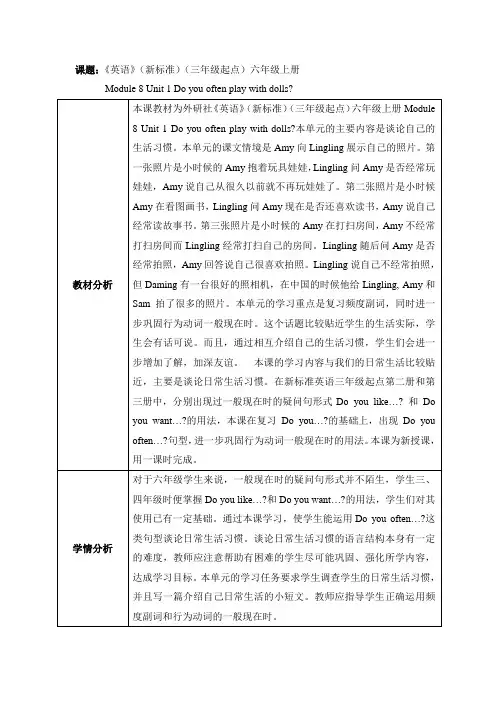
外研版小学英语(三年级起点)六年级上册Module 8 Unit1 Do you often play with dolls?说课稿我展示的课是外研版六年级英语上册Module 8 Unit1 Do you often play with dolls?现在我从教材、学情、教法、学法、教学过程这五个方面说说这节课的设计思路。
一、说教材(一)教材分析本课核心内容是学习stop、show 、camera 、clean等几个单词,重点掌握频度副词often和句型Do you often...?,目的是通过这一节课的学习,让学生在一定的实际情景下能正确使用频度副词often和Do you often...?句型进行交谈。
教材围绕Lingling和Amy看图片展开,谈论自己的喜好和日常行为习惯。
引导学生掌握Do you often...? 句型及肯定与否定回答形式,体现了教材编排“学以致用”的教学思想。
(二)教学目标1【知识目标】1能听、说、读写stop、show 、camera 、clean等几个单词。
②掌握句型“Do you often...? Yes, I do./No, I don’t.并能在实际情境中熟练运用。
2【技能目标】能够听懂会说本节课的句型,并能灵活运用该句型谈论自己的习惯爱好,培养学生听、说、读写和灵活运用语言的综合能力。
3【情感策略目标】通过学习询问喜好的英语表达,可以促进师生,生生,以及学生与朋友、家人的沟通,增进彼此的了解,改善人际关系。
(三)教学重点1.通过学习,使学生能够四会掌握单词often、 clean、stop、 show camera .2. 能使学生在实际生活中正确运用句型:Do you often….? 并能正确给出答语Yes ,I do./No I don’t,/Not really./Not very often等.(四)教学难点在实际情景中能正确运用所学的单词和句型“Do you often…?”的进行问答,会正确使用频率副词often讲述行为、习惯和爱好。
小学英语新外研版(一起)六年级上册Module 1 U1 How long is the Great Wall教案
小学英语新外研版(一起)六年级上册《英语》(新标准)小学一年级起点第十一册Module 1 U1 How long is the Great Wall?第一课时【教材分析】语言功能:对物体的长度进行问答语言结构:Use the structure: How long is… How old is …教学目标:a语言知识目标:学习目标语句:How long is… 运用句型:How old is …能准确找出文中表过去式的单词,并能写出其原形会读写课题句,并能做相关替换练习b.语言技能目标:能够听懂会说本模块句型,能运用所学语言用英语进行物体的描述。
c.情感态度目标:了解中华文化,增强民族自豪感,养成合理的跨文化心态及与各国人民友好相处的意识。
教学重点:学习对物体长度进行问答,部分新单词的发音,如:thousand, kilometre难点:学习对物体长度进行问答,学习描述一些知名建筑物。
【学生分析】学生需要更多的活动来参与,来实践,来运用他们所学的语言。
而小学生仍然以形象思维为主,教学应尽量采取形象、生动、活泼、有趣的活动来激发他们的学习兴趣,树立他们的自信,从而使他们真正成为学习的主人。
【设计理念】英语课程的目标是培养学生的综合语言运用能力。
在本课的设计中,以学生为主体,教师为主导,采用多种教学形式,并与信息技术相整合,吸引他们积极参与,让学生“在玩中学,在学中玩”,有张有弛,循序渐进,引导他们积极主动地投入到学习活动中去。
【教学准备】CD-ROM, word cards.【教学过程】Ⅰ. Warm-up (热身活动)1. Greetings: T:Hello,boys and girls. How are you?Are you happy?what did you do in the summer holiday?Where did you visit?What did you eat there?Did you enjoy your trip?2.Free talk:look at this picture.let’s have a free talk.what can you see in this picture?((英语既然是一门工具,就要运用,让学生针对活动一的图片进行自由畅谈,既调节情绪、活跃气氛,又使学生快速进入英语学习状态,并激活学生已有的知识,为进行新课教学做好铺垫。
小学英语外研新标准六年级上册(2022年新编)Module8M8U1
M8U1A1音频
任务呈现
(1分钟)
Task:
T: In the text, Amy use often to talk about herself.This class we are going to talk about habits. Afterlearning, we’ll do a survey andtalk aboutour classmates’ daily life.OK? So, let’s learn M8U1 Do you often play with dolls? (板题)
语音
感知一般疑问句的语音语调特征。
语言技能
听
全体学生能听懂:Do you often play with dolls?
说
全体学生能说:Do you often play with dolls?
读
全体学生能朗读课文,阅读相关短文。
写
全体学生能按要求完成语句书写。
情感态度
能够运用本课重点,结合自己的日常生活做熟练的对话,介绍自己多彩多姿的生活,进而培养学生热爱学习、热爱生活的情感态度。
S: They are looking at photos.
4. Watch the video, then answer the questions.
T: Look at this photo, is it interesting?
Ss: Yes.
T: Who took it?Let’s watch the video, then answer the questions.
T: Yes. I often watch TV on Wednesdays.
(Teach:“often”.)
小学英语新外研版(一起)六年级上册M8复习教案
I often … / I don’t often … b.语言技能目标:能够听懂会说本模块句型,能运用所学语言对日常发生 的行为予以肯定或否定的回答,并能根据调查到的情况写出调查报告。
c.情感态度目标:在调查中让学生分清什么是正确的生活习惯,以积 极的态度对待美好的生活。
教学准备 挂图、卡片、图片、CD-ROM、录音机、多媒体课件、
教学环节
教学过程
师生活动
二次修改
I、Let the students sum up what we have learned in this 一般现在时
module
标志词:
a、neபைடு நூலகம் words
Always , often ,
b、pharas
教 学 反 思
各种形式后动词
c、Tell why.
用原形。
IV、Summary 肯定句 否定句 一般疑问句(本课重点)
小组合作完成活动任务,及时运用评价鼓励,促进学生 的学习热情。
板书设计
What do you often do ? I often … / I don’t often … She / he often (单数第三人称动词的变化) She / he doesn’t often …
词原形。
b、Check the answers.
让学生总结一般
III、Written practice
现在时的各种句
a、Do the exercises in the activity book and the new 型。
courses.
注意 do 及 do 的
外研版小学英语六年级上册Module8 《Unit1 Do you often play with dolls》教学课件PPT
A: Do you often play with dolls? B: Not really. I stopped a long time ago. A: Do you like reading books now? B: Yes, of course. I often read stories.
Do you often watch films?
Yes, I do
知识点 6 watch films 看电影 例句: We often watch films on Sundays.
我们经常在星期天看电影。 同义短语:go to the cinema,go to the movies 联想记忆法: watch TV 看电视
Module 8
11111111111111111111111111111111111111111111111111111111111111111111111111111
111111111111111111111111W111Y111六11年11级111上11册1111111111111111111111111
请把你的新钢笔给我看看。
一般过去时的一般疑问句 用法: 在一般过去时中,如果句中谓语动词是行为动
词,变一般疑问句时用助动词 did,且 did 后的 动词用原形。 例句:Did you clean your room? 你打扫你的房间了吗?
一般过去时要牢记,学会用法没问题。一般疑 问很好变, did 放在句子前。主语、动词原形 和其他部分依次站。
用法:本句是由 do 引导的一般疑问句,询问某人是否经 常做某事。
句型结构:Do /Does + 主语 +often+ 动词(短语)原形 + 其他?
六年级上册M8U1PPT课件
They and we , are good good friends.
2020年10月2日
11
What time does school start?
star start
开始
What time does school finish?
fish finsih
2020年10月2日
完成 12
What time does school start? What time does school finish?
In China
They sit around tables.
2020年10月2日
We sit in lines.
5
l ine mine f ine
kite l i ke l ife
i
[ai]
辅音 +元音 +辅音+不发音e
2020年10月2日
6
1.How do they sit?
In England
sit in lines sit around tables sit around tables
8:00-----3:30 play hockey
2020年10月2日
13
In England / In China
School starts at… It finishes at…
9:00--------3:30
2020年10月2日
8:00--------4:00
14
1. In England,school_f_in_i_s_h_e_s_ (finish/
B. Describe English school to your parents. (向你的父母描述英国学校)
外研版六年级英语上册《Module 8 Unit 1》教学课件PPT小学公开课
Listen, read and imitate
Listen and say
A:Do you oftenplay with dolls?
A:Do you often clean your room?
B:Not really. I stopped a long time ago.
A:Do you likereading books now?
Module 8
Unit 1 Do you often play with dolls?
外研版 三起点 六年级 上册
Learning goals
✔ 词汇:long ago, not really, stop, clean,
camera, show
✔ 句型:
—Do you often play with dolls? —Not very often. —Do you like reading books now? —Yes, of course. I often read stories.
take photos read stories clean your room
你可以使用下 列短语哦!
a.肯定回答:Yes, I do.
b.否定回答:No, I don't.
Do you often ...?
c. 还可以这样回答: Not very often.
场景:你经常玩布娃娃吗?不全是。可以这样说: Do you often play with dolls? Not really.
Let's chant
play basketball, play basketball. I play basketball. Ride bike, ride bike. I ride bike. Fly kite, fly kite. I fly kite. Play football, play football. I play football.