
2018年小学英语(牛津上海版深圳)一年级下册Unit 5《Food I like》Period 1公开课课件
小学英语五年级上册(牛津上海版深圳)Unit_7《At_the_beach》(第一课时公开课课件
将下列句子改为一般疑问句。
1. She is reading a book. Is she reading a book?
2. They are in Sanya. Are they in Sanya?
3. Alice is sitting behind me. Is Alice sitting behind you?
sea n. 海洋
holiday n. 假期
beach n. 沙滩
sky n. 天空
shell n. 贝壳
按单词消失的先后顺序读单词。
sea
shell
sky
holiday
cloud
beach
holiday cloud shell sky see beach
shell
sky
beach
cloud
Is s, he is.
What day is it today? It's Saturday,3rd November. What's the weather like in Sanya? The sky is blue and the clouds are white.
Is Mrs Brown collecting shells?
Yes, she is.
Is Peter collecting shells too? Yes, he is.
Is Sally sitting beside Paul? Yes, she is.
Is Mr Brown reading a book? No, he isn't.
补全短文。
Today is Saturday , 3rd November. The Browns are on holiday in Sanya . They are at the beach. It is a beautiful day. The sky is blue and the clouds are white . Sally is enjoying the sunshine. Peter is sitting beside Sally. He is reading a book. Mrs Brown and Paul are collecting shells .Mr Brown is swimming in the sea.They are all having a good time.
牛津上海版(三起)三年级英语下册Unit 6 Food and drinks 测试卷(含答案)
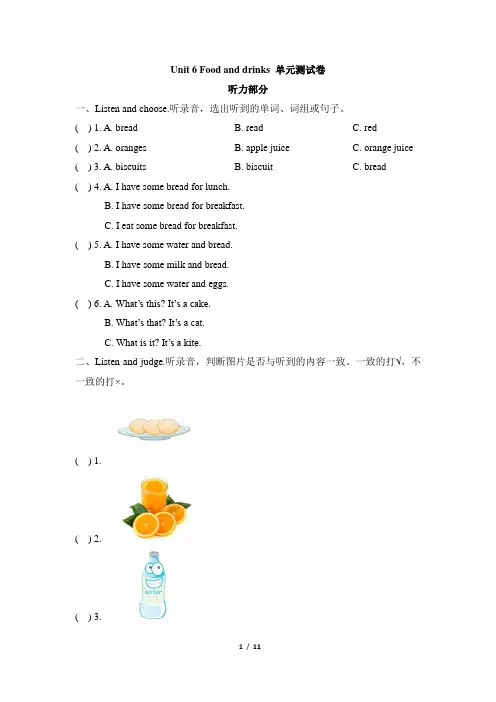
Unit 6 Food and drinks 单元测试卷听力部分一、Listen and choose.听录音,选出听到的单词、词组或句子。
( ) 1. A. bread B. read C. red( ) 2. A. oranges B. apple juice C. orange juice ( ) 3. A. biscuits B. biscuit C. bread ( ) 4. A. I have some bread for lunch.B. I have some bread for breakfast.C. I eat some bread for breakfast.( ) 5. A. I have some water and bread.B. I have some milk and bread.C. I have some water and eggs.( ) 6. A. What’s this? It’s a cake.B. What’s that? It’s a cat.C. What is it? It’s a kite.二、Listen and judge.听录音,判断图片是否与听到的内容一致。
一致的打√,不一致的打×。
( ) 1.( ) 2.( ) 3.( ) 4.( ) 5.三、Listen and choose.听录音,选出正确的应答句。
( ) 1. A. It’s hard. B. It’s sweet.( ) 2. A. Yes, I do. B. I don’t like noodles. ( ) 3. A. It’s hard. B. It’s super.( ) 4. A. I like candies. B. I have candies.( ) 5. A. I have some bread. B. Yes, I have some bread.四、Listen and write.听录音,填入所缺单词。
2018年小学六年级英语下册(牛津上海版深圳)Module 3 Unit 8《Reading sings》公开课课件
Talk and share
Where can you these signs?
at school
Talk and share
Where can you see this sign?
in the zoo
Talk and share
Where can you see this sign?
at the gas station
Un it 10 8
Module 3 Things we do
Reading signs 课件2
Talk and share
What are these signs?
Signs
pictures? symbols?
meanings?
dos and don’ts?
Talk and share
Where can you see these signs?
Where can you see this sign? What does it say?
I can see this sign in the park/at school/... It says … It means we should/shouldn’t/must …
Lucky number
No pets.
I can see this sign in … It says … It means …
More signs to learn
Do ye them?
No leaning.
No climbing.
I can see this sign in … It says … It means …
1
You can have4 a candy.
牛津上海版(试用本)二年级下册英语Module 2 Unit 1 Things I like doing_教案1
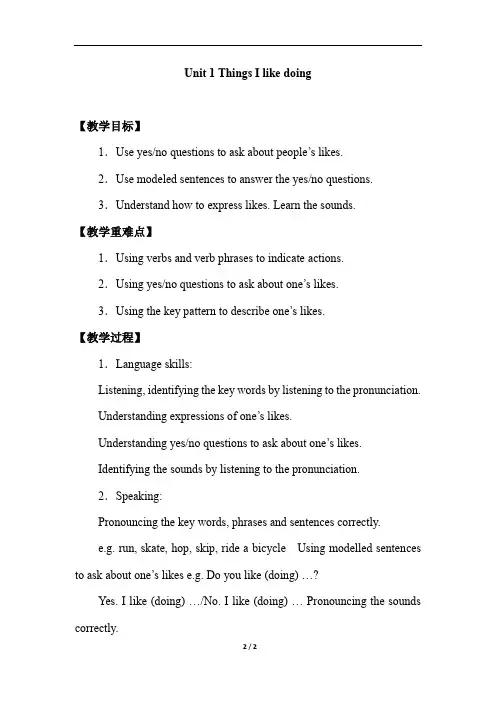
Unit 1 Things I like doing【教学目标】1.Use yes/no questions to ask about people’s likes.2.Use modeled sentences to answer the yes/no questions.3.Understand how to express likes. Learn the sounds.【教学重难点】1.Using verbs and verb phrases to indicate actions.2.Using yes/no questions to ask about one’s likes.3.Using the key pattern to describe one’s likes.【教学过程】1.Language skills:Listening, identifying the key words by listening to the pronunciation.Understanding expressions of one’s likes.Understanding yes/no questions to ask about one’s likes.Identifying the sounds by listening to the pronunciation.2.Speaking:Pronouncing the key words, phrases and sentences correctly.e.g. run, skate, hop, skip, ride a bicycle Using modelled sentences to ask about one’s likes e.g. Do you like (doing) …?Yes. I like (doing) …/No. I like (doing) … Pronouncing the sounds correctly.e.g. Scheme of work:3.Pre-task preparation:Review the words.Review the verbs the students have learnt, such as swim, sing and draw. Then have the students listen to the song on book.Encourage them to sing along and do the corresponding actions.以旧带新,注重语言的滚雪球似的积累。
(人教版新起点)2020年英语一年级下册:Unit 4《Food》单元教案
Unit 4 Food单元教学目标:1、语言技能目标(1)能够听懂、会说与食物有关的六个词汇:noodles, vegetables, eggs, fish, chicken, rice。
(2)能够听懂、会说有关需求食物的功能句:I’m hungry. I want …, 并能在恰当的情境中初步运用。
(3)能够借助日常生活图片识别、会说大写英文字母M、N、O、P。
2、情感目标(1)能够跟随录音大胆模仿说唱歌曲和歌谣。
(2)能够从本单元了解部分小动物的饮食特点,拓展知识面。
单元教学重点:1、能够听懂、会说与玩具有关的六个词汇:noodles, vegetables, egg, fish, chicken, rice。
2、能够听懂、会说有关需求食物的功能句:I’m hungry. I want …, 并能在恰当的情境中初步运用。
单元教学难点:1、能够简单表述食物名称,讨论对事物的喜好,如:Do you like ...? Yes,I do. / No, I don’t.2、能够听懂、会说有关需求食物的功能句:I’m hungry. I want …, 并能在恰当的情境中初步运用。
课时安排:五课时第一课时教学目标:1、能够听懂、会说与食物有关的六个词汇:noodles, vegetables, egg, fish, chicken, rice。
2、学生能将读音和图形联系起来。
教学准备:单词卡片,光盘教学重难点:1、学习6个食物单词的读音和图形。
2、noodles, vegetables的读音。
教学时间:年月日教学过程:一、Warm-up1、复习水果单词教师出示水果篮,里面装满以下玩具水果或水果图片:apple,banana, pear, orange, 教师提问:What fruit can you see? 学生回答。
2、谈话活动基于上一活动,教师提问:Do you like apples? 学生回答:Yes, I do. / No, I don’t.二、Presentation1、教师呈现本课食物图片,边呈现边说:I like fruits. But I also like eating them. 引导学生观察图片,初步感知新语言。
牛津上海版(深圳)三下Unit5《Toys》(第1课时)word教案

Unit 5 Toys一、学情分析三年级学生已经有了两年多的英语学习的积累,在一年级已经学过ball ,kite ,toy , bear等玩具主题的单词,对单元目标句型What do you like? I like…. 也有一定的感知,学生能够初步说出自己喜欢的部分玩具。
基于对学情的了解,本单元的课时是学生熟识而且喜欢的话题,但是需要在教学内容上作出调整,在教学活动中要提高语用输出的机会,让学生在语用任务中体验情感。
二、教材分析本单元是第二模块My favorite thi ngs 的第二单元,教材的内容是让学生能够和朋友用英语提问对方喜欢的玩具,基于对学情的了解,本单元的单元目标是让学生能用英语对自己和他人喜欢的玩具进行问答,我们进一步单元的提高教学目标:从Toys I like 的主题中引出My favorite toy 的话题,让学生能够综合地运用一、二年级学过的与玩具相关的语言,在听、说的基础上进一步提高语用要求,让学生能对自己喜欢的玩具进行简单的描述,。
学生能在模板的示范、教师的引导下,初步写一写自己最喜欢的玩具,形成初步的语篇输出,并为在四年级的英语语段输出打下基础三、单元设计整体思路和依据本单元是Module 2 Myfavourite things 第二个单元,本单元的主题为toys,需要学生能正确认读单词:ball, kite, robot, toy bear ,其中ball ,kite ,bear和句型What do you like ? 在一年级已经学过,在视听,学习文本的过程中,逐步引导学生从简单地回答what do you like? 的问题到能进一步谈论Myfavorite toys ,在情感上让学生经过三个课时的学习后,从I like toys. 到It ' s happy to share the toys.的情感提升,让学生学会分享自己喜爱的玩具我们设计三个围绕Traffic rules 的三课时分话题:第一课时:Toys I like第二课时:Toys we like第三课时:Toys we shareToys I likeToysToys we likeToys we shareL ——丄Read the toy story and it's happy to share the toys孩子们和老师一起分享一个玩具的故事,以故事新编的讨论引出分享玩具的情感体现。
牛津上海版(深圳)英语四年级下册Unit 6《Music》(第1课时)公开课课件
Module 2 Unit 6
Lesson 1
Warming
Do you like music?
Presentation
What are these? They are musical instruments.(乐器)
Presentation
What is this? It’s a guitar.
No, it isn’t. My guitar is at home.
Presentation Whose guitar is it?
It’s Joe’s guitar. Look at the name.
Practice in pairs Talk about which musical instruments(乐器) can you play to your partner with these sentences. I can play the…. Can you play the …? What can you play?
Presentation I like music. It’s wonderful. Do you like music, Jill? Yes, I do.
Presentation I can play the violin. Can you play the violin?
No, I can’t.
Summary 本课重点句型: I can play the violin. Can you play the violin? What can you play? Whose guitar is it? 学会常见乐器的名称并能就其进行提问,
学会whose的使用。
牛津上海版(深圳)四下Unit 2《Smell and taste》(Period 1)ppt课件
Touch the … It’s …(hard/soft/smooth/rough/…) Smell it. It’s … (nice/ bad) Taste it. It’s … (sweet/sour/bitter…)
A BC Guess! What are these?
A BC
Fruit A is big. It’s green and round. It’s hard and smooth. Taste it. It’s sweet. What is it?
Fruit B is small. It’s purple. It’s soft and smooth. It’s sweet and sour. What is it?
Fruit C is small. It’s red and rough. Taste it. It’s sweet and sour. What is it?
Fruit C is small. It’s red and rough. Taste it. It’s sweet and sour. What is it?
a watermelon
a grape some grapes
Grapes are ______and round. Some ______ are purple. Some are _______. They’re ______ and smooth. Taste the grapes. They’re _______ and _______. I like eating grapes in/at ______.
Fruit C is small. It’s red and rough. Taste it. It’s sweet and sour. What is it?
牛津上海版小学英语一年级上册《Unit 1 On the farm》ppt课件
KEY WORDS
Vocation 职业; Vacation 休假
▪ welcome, vocational, glad, meet, look, class, read, study, after, after class,
▪ see, let, every, love, hard, thank, visit, time, English, want, desk, chair.
▪ 4. Do you see the red building next to the library?
▪ 你看见紧挨着图书馆的那栋红楼吗? ▪ next to… “邻接着,紧挨着”
▪ 教师办公室紧挨着我们的教室。 ▪ The teachers’ room is next to our
classroom. ▪ My company is next to a shopping mall.
Unit 1
Unit 2 Unit 3 Unit 4 Unit 5
Unit 6
Unit 7
Unit 8
Unit 9 Unit 10 Unit 11 Unit 12
Grammar Link verb "be"; there be Pronouns Nouns Numerals, Time Articles degrees of adj. and adv. verb tenses 1 categories of sentences verb tenses 2 prepositions object clauses adverbial clauses
▪ 2. Read the passage again. ▪ 3. Finish the workbook exercises P2 (1)
2019年牛津上海版六年级英语下册Unit 5 What will I be like 公开课课件
3.She is beautiful.
3.She will be______
…
Look and learn
Jessica
beautiful good-looking
slim ---fat
singer
good at singing (poor at singing)
sing some songs
What will Jessica possibly be?
Look and think Jill
In 15 years’ time
Jill loves listening to music. She is good at singing. In 15 years’ time, Jill will be tall and slim. She will be 168 centimetres tall. She will weigh 52 kilograms. She will be good-looking.
☆
What is he good at?
He is good at sports.
What will Peter be like in 15 years’ time?
☆ ☆
Will he wear glasses? What will he do?
No, he will not.
Peter will be tall and strong.
Module 2
Unit 5
Changes
What will I be like?
Episode
2
Look and guess
Jessica
What is Jessica like now?