
新版湘少版三年级下册英语教案表格
课 时 教 案 备课时间:( )年( )期 ( )周 星期( ) 教出时间:( )周 星期( ) 总( )课时 共性教案 个性设计
1 Unit 1 How are you? Period 1 教学目标 能听懂、会说本课会话; 能运用“How are you?”进行问候,并对此做出回应; 力求在第一课堂就激发学生学习英语的兴趣。 二、教学重点及难点 重点:自我介绍, 运用“How are you?”向他人询问情况。 难点:根据自身的实际情况回答“I’m fine, thank you.”、“No, I’m not very well.” 三、教学步骤: Step 1 Warming up 师生问候。 T: Good morning, boys and girls. S: Good morning, Miss Zhang. 用中文或动作帮助学生回忆、理解。 Step 2 Presentation and drill T: Hello, boys and girls. I am your English teacher. I am Miss Zhang. 用动作帮助写生回忆、巩固“I am „”的意义。 T: Today we’ll learn Unit 1 “How are you?” 板书课题及主题句。带读单词“unit”、“one”. 会话教学 先教单词fine.教师指着自己对学生说:I’m fine today. 用表情来表示出自己今天很好(指身体)。并把fine一词写在黑板上,可向学生用汉语解释fine一词意思是身体好。 3.教师反复带读fine一词并检查学生的发音. 4. 教师和一个学生打招呼:Hello, how are you? 然后指着黑板上fine 一词,启发学生回答:I’m fine, thanks或 I’m fine, thank you. 5. 教师再和另一位学生重复刚才的会话. 6. 让一个学生向老师打招呼并问候,如: S: Hello, Miss„„ How are you? T: Fine ,thanks.教师接着问候学生:How are you启发学生回答,同时教I’m fine, thank you. 7. 教师把very well.写在黑板上.解释very well意思是身体好. 8. 教师带读very well ,并检查学生发音. 9. 师生之间进行打招呼问候,如 T: Morning, boys and girls. Ss: Morning, Mr. Zhang. How are you? T: Fine, thanks. How are you? Ss: Very well, thank you. 10. 同桌两人或前后两人进行会话练习. 课 时 教 案 备课时间:( )年( )期 ( )周 星期( ) 教出时间:( )周 星期( ) 总( )课时 共性教案 个性设计
2 11. 听会话录音,模仿语音语调.。 T: Hello, I’m Miss Zhang. 放慢速度,强调口型,帮助学生理解“How are you?”并能根据自身实际情况估出回答。 12.听课文A部分录音,跟读。 Step 3 Practice 游戏——A little actor 准备一个纸盒,装入写有Anne, Lingling, Peter, Mingming等人名的纸条。学生抽中谁,就扮演谁,进行角色表演。 游戏——Dragon game Step 4 Consolidation 创设情境,自由会话。 评价。 练习:《练习册》P1 课 时 教 案 备课时间:( )年( )期 ( )周 星期( ) 教出时间:( )周 星期( ) 总( )课时 共性教案 个性设计
3 Period 2 教学目标 能听懂、会说本课会话; 能运用“How are you?”询问对方情况,并对此问候做出相应的回应; 根据自身的实际情况选择性问答: “I’m fine, thank you.”“No, I’m not very well.” 教学重点及难点:根据自身实际情况回答。注意在不同场合、面对不同对象的语气要有所不同。 二、重点:能运用“How are you?”询问对方情况,并对此问候做出相应的回应; 根据自身的实际情况选择性问答: “I’m fine, thank you.”“No, I’m not very well.” 难点:根据自身实际情况回答。注意在不同场合、面对不同对象的语气要有所不同。 三、教学步骤 Step 1 Warming up 师生问候。 复习句型。 师生会话示范。 自由练习。 分角色表演。 Step 2 Presentation and drill 教师走到任意学生面前,很关心的询问“How are you?”。 T:How are you? 板书句型,带读,帮助学生理解并回答:“How are you?” 然后全班集体练读,分组练读,单个练读。 教师扮成学生,与班上同学对话。 T:Hello! How are you? S1:I’m fine, thank you. T: Hello! How are you? S2: I’m not very well. 通过几次对话帮助学生理解How are you?和在不同情况下的选择性回答。 Step 3 Practice 教师做口型,学生根据口型大声说出单词或句子。 听课文B、C部分录音,看课文,理解意思,然后有感情的朗读。 Step 4 Consolidation 创设情境,自由会话。 I’m fine, thank you. I’m not very well. Bad! Very bad!评价。 练习。《练习册》P2-4 课 时 教 案 备课时间:( )年( )期 ( )周 星期( ) 教出时间:( )周 星期( ) 总( )课时 共性教案 个性设计
4 Period 3 教学目标 能掌握字母Oo的读音和书写,了解Oo在单词中的发音; 能唱歌曲“Sing and act.” 通过唱唱玩玩,培养学生学习英语的兴趣。 二、教学重点及难点 重点:字母Oo及在单词中的发音;歌曲“Sing and act.” 难点:理解新单词,朗读句子。 三、教学步骤 Step 1 Warming up 师生问候。 自由会话和角色表演。 Step 2 Presentation and drill 出示字母卡片Nn。带读;教学生书写Nn, 分辨字母大小写,然后让学生按照范例正确书写字母,个别检查和辅导。让学生用身体语言来表演Nn,激发学生的学习兴趣。 出示新单词的卡片,强调字母Nn在单词中的发音,并让学生跟读体会。 T: Nn, Nn, Nn, banana, Nn, Nn, Nn, noodles, Nn, Nn, Nn, net, „ 听课文E部分录音,跟读字母,单词,句子,理解句子大意。 Step 3 Practice Song: 教师根据活力英语中的歌曲How are you.改编 Hello, Tom. Hello, Tom How are you? How are you? I’m fine, thank you. I’m fine, thank you. And you? And you? 鼓励学生自由创设情境,大胆进行会话。 评价。 课 时 教 案 备课时间:( )年( )期 ( )周 星期( ) 教出时间:( )周 星期( ) 总( )课时 共性教案 个性设计
5 Unit 2 Are you Lingling? 单元教学目标: 1、语言功能 用“Are you„„?”询问辩人;用“Thank you .”表示感谢;并作出回应“You are welcome!” 2、语言结构 Are you„„? Yes, I am/No, I’m not. Thank you. You’re welcome! 3、词 汇 掌握词汇:water bottle ,thank, welcome, a boy, a girl, a man, a woman, a doll 理解词汇:dog, day, duck, dance, Dino Dinosaur 4、语 音 字母D、d的读音及书写。 教学重点、难点:能运用 1、“Are you„„?”的句型,并能做出回答 2、掌握字母D、d的写法及发音 课时安排:三课时 Period 1 教学目标 1、能听懂、会说新单词 water bottle , thank, welcome; 2、能听懂、会说本课对话; 3、能运用“Are you„„?”询问辩人;用“Thank you.”表示感谢;并作出回应“You are welcome!” 4、渗透礼仪教育,培养学生助人为乐的美德。 教学重点及难点 重点:询问辩人,表示感谢,并作出回应。 难点:创设情境,在情景中寻找物品的失主。 教学步骤: Step 1 Warming up 师生问好。 唱英语歌曲“The more we’re together.” And “Hello” 询问学生姓名。 T: What’s your name?/Who are you? S: I’m„„ Step 2 Presentation and drill 随意走到学生的面前。 T: Are you Xiao Qing? 引导学生回答:Yes, I am./ No, I’m not. T: Thank you. 引导学生回答:You’re welcome. 游戏——接龙游戏。 S1:(回头对后面的一位同学说) Thank you. S2:You’re welcome. (回头对后面的一位同学说) Thank you. S3:You’re welcome. 2、出示书中人物头饰,引导学生提问并回答。 S1: Are you Peter?
湘少版三年级英语下册教案
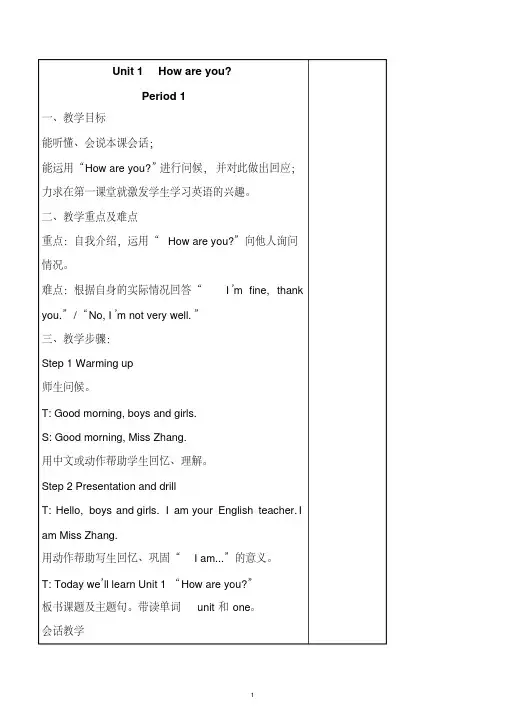
Period 1一、教学目标能听懂、会说本课会话;能运用“How are you?”进行问候,并对此做出回应;力求在第一课堂就激发学生学习英语的兴趣。
二、教学重点及难点重点:自我介绍,运用“How are you?”向他人询问情况。
难点:根据自身的实际情况回答“I’m fine, thank you.”/“No, I’m not very well.”三、教学步骤:Step 1 Warming up师生问候。
T: Good morning, boys and girls.S: Good morning, Miss Zhang.用中文或动作帮助学生回忆、理解。
Step 2 Presentation and drillT: Hello, boys and girls. I am your English teacher. I am Miss Zhang.用动作帮助写生回忆、巩固“I am...”的意义。
T: Today we’ll learn Unit 1“How are you?”板书课题及主题句。
带读单词unit和one。
会话教学Period 1一、教学目标能听懂、会说本课会话;能运用“How are you?”进行问候,并对此做出回应;力求在第一课堂就激发学生学习英语的兴趣。
二、教学重点及难点重点:自我介绍,运用“How are you?”向他人询问情况。
难点:根据自身的实际情况回答“I’m fine, thank you.”/“No, I’m not very well.”三、教学步骤:Step 1 Warming up师生问候。
T: Good morning, boys and girls.S: Good morning, Miss Zhang.用中文或动作帮助学生回忆、理解。
Step 2 Presentation and drillT: Hello, boys and girls. I am your English teacher. I am Miss Zhang.用动作帮助写生回忆、巩固“I am...”的意义。
湘少版小学英语三年级下册英语教案全册共33页
第1章(单元)第一节(课)第1 课时连续号1-3 完小三年级英语课教学设计
第2章(单元)第一节(课)第1 课时连续号4-6 商溪完小三年级英语课教学设计
第3章(单元)第一节(课)第1 课时连续号7-9 商溪完小三年级英语课教学设计
2
第4章(单元)第一节(课)第1 课时连续号10-11 商溪完小三年级英语课教学设计
第5章(单元)第一节(课)第1 课时连续号12-14 商溪完小三年级英语课教学设计
1
1
第6章(单元)第一节(课)第1 课时连续号15-17
商溪完小三年级英语课教学设计
第7章(单元)第一节(课)第1 课时连续号18-19 商溪完小三年级英语课教学设计
第8章(单元)第一节(课)第1 课时连续号20-21 商溪完小三年级英语课教学设计
第9章(单元)第一节(课)第1 课时连续号22-24 商溪完小三年级英语课教学设计
第10章(单元)第一节(课)第1 课时连续号25-27 商溪完小三年级英语课教学设计
第11章(单元)第一节(课)第1 课时连续号28-30 商溪完小三年级英语课教学设计
第12章(单元)第一节(课)第1 课时连续号31-33 商溪完小三年级英语课教学设计。
完整湘教版三年级英语下册教案全集.docx
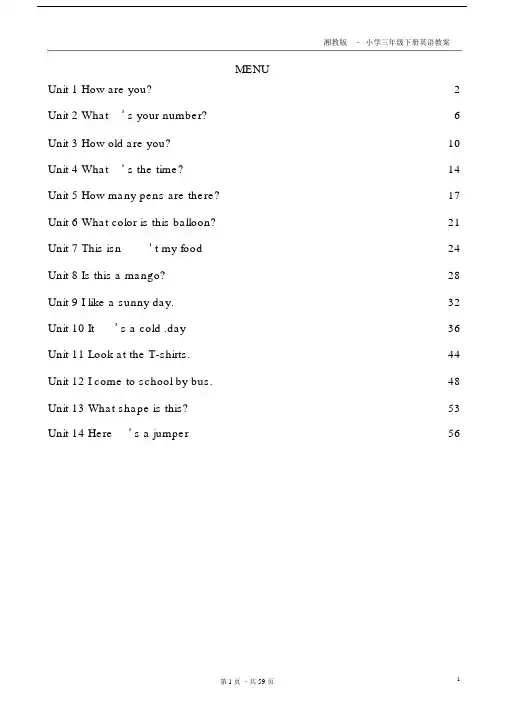
MENUUnit 1 How are you? (2)Unit 2 What’ s your number? (6)Unit 3 How old are you? (10)Unit 4 What’ s the time? (14)Unit 5 How many pens are there? (17)Unit 6 What color is this balloon? (21)Unit 7 This isn’ t my food (24)Unit 8 Is this a mango? (28)Unit 9 I like a sunny day. (32)Unit 10 It’ s a cold .day (36)Unit 11 Look at the T-shirts. (44)Unit 12 I come to school by bus. (48)Unit 13 What shape is this? (53)Unit 14 Here’ s a jumper (56)Unit 1 How are you?Period 1Teaching aims:1.Ss can be interested in English studying.2.listen and say the new words : fine, well.3.Ss can greet others with:---How are you?---I ’ m fine, thank you. / I’ m not very well.Teaching emphasis:1. Ask and answer:---How are you?---I ’ m fine, thank you. / I’ m not very well.Teaching difficulties:The meaning and the usage of“ You are kind.”.Teaching methods:Task teaching method, Audio-linguistic method.Teaching tools:some pictures, word cards, the tape and the recorder ,computer are the tools. Teaching steps:Step 1 Warming up1.Greetings.2.Sing the English song: Good morning to you.Step 2 Presentation and drill1.Look at the TV of greeting of a cat and a duck . Get the meaning of the dialog. C: Good morning, Miss Duck.D: Good morning, Miss Cat. How are you?C: I ’ m fine, thank you. How are you?D: Thank you. I’ m fine.2.Learn to say the dialog:---How are you?---I ’ m fine, thank you. / I’ m not very well.3.Practise speaking the dialog with drawing the face.4.Chain game:S1: How are you?S2: I ’ m fine. Thank you. How are you?S3: I ’ m fine. / I’ m not very well.⋯Step 3 Practice:Game1: Dubbing game.Game2: Making friends.Step 4 Consolidation:1.Situational conversation.2.Workbook P1.3.Home work: Listen ,read and recite the text PA.Design of the blackboard:Unit 1 How are you?---How are you?---I ’ m fine, thank you. ( a smiling face)/ I’ m not very well.( a no happing face)Period 2Teaching aims:1.Ss can get fun from English studing.2.Ss can listen and say the dialog freely.3.Ss can read the story D.Teaching emphasis:---How are you?---I ’ m fine, thank you. / I’ m not very well.Teaching difficulties:Get the meaning of the Part D.Teaching methods:Task teaching method, Audio-linguistic method.Teaching tools:some pictures, word cards, the tape and the recorder ,computer are the tools.Teaching steps:Step 1 Warming up1.Greetings.T: Good morning, boys and girls. How are you?Ss: Good morning, Miss Lin. I’ m fine, thank you. How are you?T:I ’ m fine. Thank you.2.Sing the song : Good morning to you.Step 2 Presentation and drill1.T make the dialog with Ss:T:Hello! How are you?S1: I ’ m fine, thank you. How are you?T:I ’ m net very well.How about you? ( Asking another student)S2: I ’ m fine. ( Explain the meaning of“ How about you?)2. Listen to the tape of Part B and read , then act out the dialog.3. Show the smiling faces and crying faces and practise speaking the sentences:I ’ m fineI. ’ m not very well.Quick response : How are you?Step 3 Practice:1.Game: Guess, guess, guess!How are you?I ’ m fine, thank you.I ’ m not very well.2.Read the story Part D and get the meaning of the story.3.Listen to the tape and repeat.4.Act out the story.Step 4 Consolidation:1.Situational conversation.2.Workbook P2-3.3.Home work: Listen ,read and recite the dialog.4.Greet freely.Design of the blackboard:Unit 1 How are you?---How are you?---I ’ m fine, thank you. ( a smiling face)/I ’ m not very well.( a no happing face)Period 3Teaching aims:1.Ss can be interested in English studying.2.Ss can master the pronunciation of letter: Oo, and canread the words and sentences.3. Ss can sing the song“ How are you?”Teaching emphasis:The pronunciation of letter: Oo.Teaching difficulties:Read the new words and sentences.Teaching methods:Task teaching method, Audio-linguistic method.Teaching tools:some pictures, word cards, the tape and the recorder ,computer are the tools. Teaching steps:Step 1 Warming up1.Greetings.2.Sing some English songs.Step 2 Presentation and drill1.Listen to the tape and repeat the new words of Part E.2.Show the cards of the words and read them.3.Read and write the letters: Oo.Step 3 Practice:1.Game: Minding the mine!Box, orange, ox, octopus.2.Listen to the tape and repeat the words and sentences. Step 4 Consolidation:1.Situational conversation.2.Workbook P4.3.Home work: Listen ,read and recite the text.Design of the blackboard:Unit 1 How are you?---How are you?---I’ m fine, thank you. ( a smiling face) /I ’ m not very well.( a no happing face)湘教版–小学三年级下册英语教案Unit 2 What ’s your number?Period 1Teaching aims:1.Ss can help each other.2.Ss can listen and say the new numbers: number, five, nine, seven.3. Ss can ask and answer the numbers with the sentences: What number is⋯? It’ s numbe Teaching emphasis:What number is⋯? It’ s number⋯.Teaching difficulties:I‘ m sorry. I don’ t know.Teaching methods:Task teaching method, Audio-linguistic method.Teaching tools:some pictures, word cards, the tape and the recorder ,computer are the tools.Teaching steps:Step 1 Warming up1.Greetings.T:Good morning, boys and girls. How are you?Ss: I ’ m fine, thank you.2.Sing the song : Ten little Indian boys.Step 2 Presentation and drill1.Show the picture of a car.T: What is this?Ss: It’ s a car.T: Yes, it’ sarmy. cLearn to say the word“ car”.2.T: Today we will have a model car race. Look, my car is number seven.Learn to say the new words: number, seven.3.Write the sentences and say the new sentences:What number is⋯?It ’ s number ⋯.4.The same way to learn to say the word: nine.5.Practise reading the words and sentences.6.Game: Guess, guess, guess.Guess the age of the girls and boys.7.Listen to the tape and repeat the text.Step 3 Practice:1. Game: Chain game.What number is your car?My car is number⋯.2. Listen to the tape and repeat the text. Explain the meaning of“ I am sorry. I don3.Act out and say the dialog.Step 4 Consolidation:1.Situational conversation.2.Workbook P1.3.Home work: Listen ,read and recite the text PADesign of the blackboard:Unit 2 What number is your car?What number is your car?five,seven,My car is number⋯.nine,carPeriod 2Teaching aims:1Ss can help each other.2.Ss can listen and say the new words: desk, count, one, two, three, four, six, eight, ten.3.Ss can listen and say and act out the Part D.4.Ss can express the phrase of nouns.Teaching emphasis:1.Mater the numbers from 1 to 10.2.Expression of the phrase of nouns.Teaching difficulties:Ss can read and recite Part D.Teaching methods:Task teaching method, Audio-linguistic method.Teaching tools:some pictures, word cards, the tape and the recorder ,computer are the tools.Teaching steps:Step 1 Warming up1.Greetings.2.Sing the song: How are you?Step 2 Presentation and drill1.Show the picture of a big apple tree.T: What is this ?Ss: It ’ s a tree.T: Yes, it’ s a big apple tree. Let’ s count them. One, two,⋯five. Yes, five apples. Write and learn to say the new words: count, one, two, three, four, six, eight, ten.2.Game: Picking apples.3.Point and learn to say the word: desk.4.Show the pictures of objects. Count together.5.Game: Quick response.Listen and show the pictures.Step 3 Practice:1.Listen to the tape and read the text.2.Act and say the numbers and the rhyme in Part C.3.Act it out.Step 4 Consolidation:1.Listen to the tape of Part D and get the meaning of the text.2.Listen and repeat.3.Practise acting out the story.4.Workbook.5.Home work: Listen ,read and recite the textDesign of the blackboard:Unit 2 What number is your car?one apple , two apples,three apples, four apples.six , eight, nine, ten.Period 3Teaching aims:1.Ss can get fun from English studying.2.Ss can master the pronunciation and writing of the letter: Pp. They can read the words and sentences.3.Ss can sing the song of Part F.Teaching emphasis:The pronunciation of letter Pp.Teaching difficulties:Read the words and sentences of Part E.Teaching methods:Task teaching method, Audio-linguistic method.Teaching tools:some pictures, word cards, the tape and the recorder ,computer are the tools.Teaching steps:Step 1 Warming up1.Greetings.2.Game: Telephone number.Step 2 Presentation and drill1.Show the letter card Pp and read and write it.2.Listen to the tape and read Part E.3.Game: Completing the sentences.Pretty Polly /has/ pink/ pached /pockets.Step 3 Practice:Game: Magic eyes.Step 4 Consolidation:1.Listen to the tape and sing the song of Part F.2.Workbook.3.Home work: Listen ,read and recite the text . Design of the blackboard:Unit 2 What number is your car?one, two, three, four, five,six, seven, eight, nine,ten.What number is⋯?It ’ s number ⋯.Unit 3 How old are you?Period 1Teaching aims:1.Ss can be polite to others.2. Ss can listen and say the new word : six.3. Ss can ask and answer : How old is he/she? He/She is⋯4. Ss can understand is“sickHe.” and“ his”.Teaching emphasis:Ask and answer : How old is he/she? He/She is⋯Teaching difficulties:The meaning of“ He is sick.”Teaching methods:Task teaching method, Audio-linguistic method.Teaching tools:some pictures, word cards, the tape and the recorder ,computer are the tools. Teaching steps:Step 1 Warming up1.Greetings.2. Sing the song of “ Ten little cute fingers. ” Step 2Presentation and drill1.Ask and answer:T: Hello! What’yours name?Boy: My name is⋯T: What ’ s his name? Class.Ss: His name is⋯T: How old are you?Boy: I am⋯T: How old is he? Class.Ss: He is⋯Write the sentences and read them:How old is he/she?He/She is ⋯Step 3 Practice:1.Listen to the tape and repeat the text.2.Practise reading in groups.3.Act out the dialogue.4.Game: Guess, guess, guess.Step 4 Consolidation:1.Situational conversation.1)New term.2)See a doctor.2. Workbook P1.3.Home work: Listen ,read and recite the text PADesign of the blackboard:Unit 3 How old is he?How old is he/she? six hisHe/She is ⋯He is sick.Period 2Teaching aims:1.Ss can be polite to others.2.Ss can listen and say the new words: one ,two , three, four, five, six, seven, eight, birthday.3.Ss can count in English.4.Ss can ask and answer about age. They can read the story.Teaching emphasis:1.Ask and answer about age.Teaching difficulties:Understand: Let’ s sing together.Teaching methods:Task teaching method, Audio-linguistic method.Teaching tools:some pictures, word cards, the tape and the recorder ,computer are the tools.Teaching steps:Step 1 Warming up1.Greetings.2.Sing the song“ Ten little Indian boys.”3.Make conversation:T:Good morning, S1. How are you?S1: I am eight.T: How old is S1?Ss: He is⋯Step 2 Presentation and drill1.Show a box. There is a picture of cake on it.2.T: What is this?Ss: This is a box.T: What ’ s in the box?Ss: ⋯T:Let ’ s see. Look, there isake cin the box. This is a birthday cake.Learn to say the new word: birthday.T:Today is Anne ’ s birthday. This birthday cake is for her. How old is she? Would you like to go to the party with me?3.Listen to the tape and answer the questions:T: How old is she? Let’ s count together. One,two three,four, five, six, seven, eight.T:How old is she?Ss: She is eight.4.Game: bouncing a ball.T: What ’ s the number?Step 3 Practice:1.Show a photo. T: This is my brother, Mingming.Ss: How old is he?T:He is ten.⋯2.T: Can you have many friends? Can you draw them? Please draw a friend and introduce him.S1: This is Peter. He is my friend.S2: How old is he?S1: He is six.⋯.Step 4 Consolidation:1.Read the Part D and answer: How old is dino?2.Listen to the tape and repeat the text.3.Read the text in part.4.Act out the dialog.5.Workboo.6.Home work: Listen ,read and recite the text.Design of the blackboard:Unit 3 How old is he?How old is he/she? six hisHe/She is ⋯He is sick.Period 3Teaching aims:1.Ss can be polite to others.2.Ss can master the pronunciation and writing of the letter Qq.3.Ss can read the new words and sentences.4.Ss can recite the rhyme of Part F.Teaching emphasis:the pronunciation of QqTeaching difficulties:Understand the rhyme of Part F.Teaching methods:Audio-linguistic method.Teaching tools:some pictures, word cards, the tape and the recorder ,computer are the tools.Teaching steps:Step 1 Warming up1.Greetings.2.Sing some English songs.Step 2 Presentation and drill1.Listen to the tape of Part E.2.Listen to the tape of Part E and repeat.3.Game: What’ s meaning?Step 3 Practice:1.Listen to the tape and repeat the word and sentences.2.Act it out.3.Write the letterQqStep 4 Consolidation:1.Read and recite the Part F.2.Workbook.3.Home work: Listen ,read and recite the text.Design of the blackboard:Unit 3 How old is he?How old is he/she?QqHe/She is ⋯Unit 4 What’ s the time?Period 1Teaching aims:1、 Knowledge: Enable the Ss listen, say, and read the new words and phrases.2、 Ability: Enable the Ss listen, say, and read the dialogue.3. Affection: Ss can have fun in English studying..Teaching emphasis:Use the sentence pattern: What’ s the time? It’ s⋯Teaching difficulties:The sentences: What’ s the time? Look at the clock.Teaching methods:Task teaching method, Audio-linguistic method.Teaching tools:Some pictures, word cards, the tape and the recorder, computer are the tools.Teaching steps:Step 1 Warming up1 Greetings.T:Hello, boys and girls! What number is it?Step 2 Presentation and drill1T: Hello, boys and girls. Let listen. What’s is it?2Yes. It ’ s a clock. Learn“ What’ s the time?”Ss watch the screen and say the time in English. Learn“ clock seven o ’ clock ”3Look and listen, learn to say the new words.Ask some Ss act Dongdong and Linglimg.4Listen and repeat.Step 3 Practice1、 Little teacher. Act in pairs.2、 Guess game: What’ s the time?3、 Chain game.Practise the dialogue.Step 4 Consolidation1、 Evaluation.2、 Do Ex.3、 Homework. Listen and repeat. Recite Part A.Design of the blackboard:Unit 5 What’ s the time?He’ s six/eight.How is he? He’ s sick.Teacher ’ s note:湘教版–小学三年级下册英语教案Period 2Teaching aims:1.Knowledge: Enable the Ss listen, say and read the dialogue;2.Ability: Enable the Ss use the time.3.Affection: Ss can love others and be polite to others.Teaching emphasis:Enable the Ss use the sentence pattern: What’ s the time?Teaching difficulties:The new words: night dayTeaching methods:Task teaching method, Audio-linguistic method.Teaching tools:Head-masks, some pictures, word cards, the tape and the recorder, computer are the tools.Teaching steps:Step 1 Warming up1.Greetings.2.Sing a song.Step 2 Presentation and drill1.T: Good morning! How are you? How old are you? What’ s the time?Let ’ s look and guess What time it is.” Then learn:2.Show a clock, Ss look and guess. Learn“ eleven o’ clock twelve o ’ clock3.Write the sentences pattern on the Bb and read them.4Read the new words and the new sentences in groups or individuals.5Let ’ s listen to the tape and repeat.Step 3 Practice1.Read together.2.Practise in pairs.3.Act it out.4 Make a story and act out the story in groups.Step 4 Consolidation1. Situation practice. Game: Show⋯o’ clock.2.Evaluation.3.Ex.4.Homework: Read and recite Part BC.Design of the blackboard:Unit 5 What’ s the time?eleven o ’ clock twelve o’ clock day night..Teacher ’ s note:Period 3Teaching aims:湘教版–小学三年级下册英语教案1.Knowledge: Enable the Ss listen, say and read the text;2.Enable the Ss sing and act.3 .Ability: Enable the Ss write the letter“ Ss”4.Affection: Ss can have fun from studying English.Teaching emphasis:Enable the Ss write the letter Ss”“Teaching difficulties:Understand the new words in the text.Teaching methods:Task teaching method, Audio-linguistic method.Teaching tools:Head-mask, some pictures, word cards, the tape and the recorder, computer are the tools. Teaching steps:Step 1 Warming up1.Greetings.2.Make conversations act the story.Step 2 Presentation and drill1. T: Show the letter card“ Ss” , and read, then write.Ss sayQq and the words, using the pictures.2.Introduce the new words: Ss sun sun sun.Learn: sun sand Sally sea seashells.Step 3 Practice1.Listen to the tape and repeat.2.Answer the questions.3.Read after T, then read together.Step 4 Consolidation1.Situation practise and free talk.2.Rhyme and act.3. Homework. Write the letter“ Ss” . Listen and recite the text.Design of the blackboard:Unit 5 What’ s the time?Sssun sand Sally sea seashellsTeacher ’ s note:Unit 5 How many pens are there?Period 1Teaching aims:1.Ss can get fun from English studying.2.Ss can count the numbers.3.Ss can ask and answer with:How many⋯ ? There are⋯.Teaching emphasis:Count in English fluently.Teaching difficulties:Ask and answer with:How many⋯ ? There are⋯.Teaching methods:Task teaching method, Audio-linguistic method.Teaching tools:A bag, some pictures, word cards, the tape and the recorder , computer are the tools.Teaching steps:Step 1 Warming up1.Greetings.2. Say some rhymes.3.Game: Dragon game.T: Number One, stand up. Number Two, open your book⋯.Step 2 Presentation and drill1. T: Hello, everyone! I am a magician. I have a lot of magic things in my bag. What’guess! If you are right,I’ ll give you a gift.T: What ’ s in the bag?S:Rulers.T:Yes, there are some rulers. How many rulers?S: One ruler./ Two rulers./⋯T:Please count the rulers.Ss: One, two, three, four, ⋯T:How many rulers are there?Ss: Five rulers.2.Learn to say the sentences.3.Guess and practise say the sentences.4.Look at the pictures and count the numbers.Step 3 Practice:1.Listen to the tape and repeat the text.2.Practise in groups and act it out.3.Game: Blowing up the blockhouse.Step 4 Consolidation:1.Situational conversation.2.Workbook P1.3.Home work: Listen ,read and recite the textPA Design of the blackboard:Unit 4 How many are there?How many rulers are there?There are five rulers.Period 2Teaching aims:1.Ss can get fun from the English studying.2.Ss can ask and answer with:How many⋯ ? There are⋯.3.Ss can read the story in part D.Teaching emphasis:Ask and answer with:How many⋯ ? There are ⋯.Teaching difficulties:Ss can read the rhyme in part C.Teaching methods:Task teaching method, Audio-linguistic method.Teaching tools:some pictures, word cards, the tape and the recorder ,computer are the tools.Teaching steps:Step 1 Warming up1.Greetings.2.Sing the English songs.Step 2 Presentation and drill1. Show a pencil-box and ask: What’ s this? What’ s in it? How many pens/rulers/⋯are the2.Look at the TV and guess the numbers of objects.3.Talk about their stationeries.Step 3 Practice:1.Listen to the tape and repeat it.2.Practise and act out the dialog.3.Game: Whispering.“There are six pens. ”“There are two book. ”“There are seven pencils.”4.Little teacher.Step 4 Consolidation:1.1)Read the story in Part D. Answer the questions: How many stars are there?2) Explain“ twinkle, I wish there could be more.”3)Listen to the tape and repeat the story.4)Act out the story.2.Situational conversation.3.Workbook.4.Home work: Listen ,read and recite the text .Design of the blackboard:Unit 4 How many are there?How many rulers are there?twinkleThere are five rulers.Period 3Teaching aims:1.Ss can get fun from English studying..2.Ss can master the pronunciation and writing of the letter Rr.3.Ss can read the new words and sentences.4.Ss can recite the rhyme of Part F.Teaching emphasis:the pronunciation of RrTeaching difficulties:Read the sentences in Part E.Teaching methods:Audio-linguistic method.Teaching tools:some pictures, word cards, the tape and the recorder ,computer are the tools. Teaching steps:Step 1 Warming up1.Greetings.2.Sing some English songs.Step 2 Presentation and drill1.Listen to the tape of Part E.2.Listen to the tape of Part E and repeat.3.Game: What’ s meaning?Step 3 Practice:1.Listen to the tape and repeat the word and sentences.2.Act it out.3.Write the letter Rr.Step 4 Consolidation:1.Read and recite the Part F.2.Workbook.3.Home work: Listen ,read and recite the text.Design of the blackboard:Unit 4 How many are there?How many rulers are there?Rr There are five rulers.Unit 6 What color is this balloon?Period 1Teaching aims:1、 Knowledge: Enable the Ss listen, say, and read the new words and phrases.2、 Ability: Enable the Ss use “What colour is this⋯?”3、 Affection: Enable Ss get fun from learning colours.Teaching emphasis:Use the sentence pattern: What colour is⋯?Teaching difficulties:The new words and sentences patterns.Teaching methods:Task teaching method, Audio-linguistic method.Teaching tools:Some pictures, word cards, the tape and the recorder, computer are the tools.Teaching steps:Step 1 Warming up1 Greetings.T: Hello, boys and girls! How are you? How old are you? What’ s the time?2 Sing an English song.Step 2 Presentation and drill1T: Hello, boys and girls. Look. There are many balloons. Do you like them? What colour is thisballoon? It’ s green.2. Learn“ green, balloon, What colour is this balloon?” Then learn“ pink, blue, red, ye3.Give the balloon to the Ss who read well: Take a green balloon.4.Look and listen, learn to say the dialog.5.Listen and repeat.Step 3 Practice1、 Little actor. Act the characters and say it together.2、 Guess game: What colour is this balloon?Step 4 Consolidation1、 Evaluation.2、 Do Ex.3、 Homework. Listen and repeat. Recite Part A.Design of the blackboard:Unit 6 What color is this balloon?What colour is this balloon?It ’ s green/pink, blue, red, yellow”.Teacher ’ s note:Period 2Teaching aims:1. Knowledge: Enable the Ss listen, say and read the phrases“ white cloud, a yellow banana, a green leaf, a red rose, a pink balloon”2.Ability: Enable the Ss use colours.3.Affection: Ss can love colours.Teaching emphasis:Enable the Ss use colours.Teaching difficulties:Talk about the colours of the things.Teaching methods:Task teaching method, Audio-linguistic method.Teaching tools:Some pictures, word cards, the tape and the recorder, computer are the tools.Teaching steps:Step 1 Warming up1.Greetings.2.Sing a song.Step 2 Presentation and drill1. T: Good morning!Let ’ s listen and guess what colour it is.(CAI )2. Ss listen and guess “ Whatcolour is this? ”It ’yellows. Yes, it ’asyellow banana. Learn “ whitecloud, a yellow banana, a green leaf, a red rose, a pink balloon”3. Write the phrases on the Bb and read them.4 Read the new phrases in groups or individuals.5 Let ’ s listen to the tape and repeat.Step 3 Practice1.Read together.2.Practise in pairs.3.Little teacher.4 Act, look and guess. Part C.Game: Little parrot.Step 4 Consolidation1Situation practice.2Evaluation.3Ex.4Homework: Read and recite Part BC.Design of the blackboard:Unit 6 What color is this balloon?What color is this?It ’ s red.white cloud, a yellow banana, a green leaf,a red rose, a pink balloonTeacher ’ s note:Period 3Teaching aims:1.Knowledge: Enable the Ss listen, say and read the text;2.Ability: Enable the Ss sing the song.3 Ability: Enable the Ss write the letter“ Tt”Teaching emphasis:Enable the Ss write the letter“ Tt”Teaching difficulties:Understand the new words in the text.Teaching methods:Task teaching method, Audio-linguistic method.Teaching tools:Some pictures, word cards, the tape and the recorder, computer are the tools. Teaching steps:Step 1 Warming up1.Greetings.2.Make conversations. Step2 Presentation and drill1. T: Show the letter card“ Tt” , and read, then write.Ss say Tt and the words, using the pictures.2.Introduce the new words: telephone, toy train, tracks, television.Step 3 Practice1.Listen to the tape and repeat.2.Answer the questions.3.Read after T, then read together.Step 4 Consolidation1.Situation practise and free talk.2.Draw the special fruit.3.Homework. Write the letter“ Tt ” . Listen and recite the text. Design of the blackboard:Unit6 What color is this balloon?Tt(四线格 )telephone, toy train, tracks, televisionTeacher ’ s note:Unit 7 This isn ’t my food.Period 1Teaching aims :1、 Ss can listen and read the new words: food, drink;2、 Ss can make sentences with“This isn’ t⋯”“ I t’ s your⋯”;Teach the Ss not to take other s’ .Teaching focus and difficulties:Focus:make sure to know the things with“This isn ’ t⋯”“It’ s your⋯” ; Difficulties: pronouce “isn ’t ” exactly.Teaching preperation:pen,pencil,teaching picture,tape etc.Teaching step:Step 1Warming upT(出示笔): This is my pencil.S(出示笔): This is my pen.⋯Step 2Presentation and drill1、 T(拿起一学生的): This isn’t my book. It’s your book. Here you are.S: Thank you.板并教学句型“ This isn’ t my book”.2、收集一些学生的放在台上,另外一些学生找些的主人。
【参考借鉴】湘少版三年级下册英语全册教案.doc
教材
分析
重点:能运用“HowareRou?”询问对方情况,并对此问候做出相应的回应;字母Oo及在单词中的发音。难点:根据自身实际情况回答。
教法
提示
阅读法、讲授法、电教法
教学准备
多媒体课件,单词卡片
教学过程设计
Step1Warmingup
游戏——Dragongame
Step4Consolidation
创设情境,自由会话。
教学后记
浏阳市小学教师统一备课纸(NO:)
科目
英语
年级
三
班级
时间
年月日
课题
Unit1HowareRou?
节次
二课时
教
学
目
标
能听懂、会说本课会话;
能运用“HowareRou?”询问对方情况,并对此问候做出相应的回应;
能掌握字母Oo的读音和书写,了解Oo在单词中的发音;
浏阳市小学教师统一备课纸(NO:)
科目
英语
年级
三
班级
时间
年月日
课题
Unit1HowareRou?
节次
二课时
教
学
目
标
能听懂、会说本课会话;
能运用“HowareRou?”进行问候,并对此做出回应;
力求在第一课堂就激发学生学习英语的兴趣。
教材
分析
重点:自我介绍,运用“HowareRou?”向他人询问情况。
教师做口型,学生根据口型大声说出单词或句子。
听课文B、C部分录音,看课文,理解意思,然后有感情的朗读。
Step3Practice
出示字母卡片Nn。带读;教学生书写Nn,分辨字母大小写,然后让学生按照范例正确书写字母,个别检查和辅导。让学生用身体语言来表演Nn,激发学生的学习兴趣。
(湘少版)三年级英语下册《Unit 3》教案设计
(湘少版)三年级英语下册《Unit 3》教案设计教学目标
知识目标
1.学生能够听懂、说出并掌握以下单词:coat, hat, socks, shoes。
2.学生能够听懂、理解并运用以下句型:What are you wearing? I am wearing a coat, hat, socks, shoes。
能力目标
1.学生能够进行简单的日常对话,表达自己的穿着。
2.学生能够进行简单的听、说、读、写交际活动。
情感目标
1.通过对话交际活动,让学生更好地认识自己和他人的穿着习惯,培养学生的观察能力。
2.通过口语交流,培养学生的表达和交际能力。
教学重点
1.语言目标的掌握,即掌握以下单词和句型的运用:coat, hat, socks, shoes, What are you wearing? I am wearing a coat, hat, socks, shoes。
2.培养学生的观察能力,让学生能够通过观察他人的穿着,进行交际活动。
教学难点
1.学生需要掌握新单词和句型,并能够灵活运用。
2.学生需要通过观察他人的穿着进一步表达自己的意思。
教学准备
1.教师准备足够数量的图片或卡片,用于展示不同衣服和颜色。
2.PPT或投影仪等教学工具。
3.课件或笔记本电脑等。
教学过程
Warm-up
1.教师向学生介绍当前课程的主题——。
精品教案-湘少版三年级英语下册全册教案1

Unit 1 How are you?Period 1一、教学目标能听懂、会说本课会话;能运用“How are you?”进行问候,并对此做出回应;力求在第一课堂就激发学生学习英语的兴趣。
二、教学重点及难点重点:自我介绍,运用“How are you?”向他人询问情况。
难点:根据自身的实际情况回答“I’m fine, thank you.”/“No, I’m not very well.”三、教学步骤:Step 1 Warming up师生问候。
T: Good morning, boys and girls.S: Good morning, Miss Zhang.用中文或动作帮助学生回忆、理解。
Step 2 Presentation and drillT: Hello, boys and girls. I am your English teacher. I am Miss Zhang.用动作帮助写生回忆、巩固“I am...”的意义。
T: Today we’ll learn Unit 1“How are you?”板书课题及主题句。
带读单词unit和one。
会话教学先教单词fine。
教师指着自己对学生说:I’m fine today. 用表情来表示出自己今天很好(指身体)。
并把fine一词写在黑板上,可向学生用汉语解释fine一词意思是身体好。
3.教师反复带读fine一词并检查学生的发音4.教师和一个学生打招呼:Hello, how are you? 然后指着黑板上fine 一词,启发学生回答:I’m fine, thanks.或I’m fine, thank you.5.教师再和另一位学生重复刚才的会话6.让一个学生向老师打招呼并问候,如:S: Hello, Miss...How are you?T: Fine, thanks.教师接着问候学生:How are you启发学生回答,同时教I’m fine, thank you.7.教师把very well写在黑板上。
XX三年级英语下册教案(新湘少版)
XX三年级英语下册教案(新湘少版)本资料为woRD文档,请点击下载地址下载全文下载地址www.5ykj.com Unit1AfamilyoutingPeriod1一、教学目标、知识目标:)能看懂、会读、会说新单词together,ride,grandparents;2)学习、运用新句型:Shallwe…we’ll…2、能力目标:)能向他人询问、回答出行计划;2)能理解课本A与B部分。
3、情感目标学会小组合作,团结友爱。
二、教学重难点)重点:理解并运用生单词;2)难点:运用新句型。
)课前准备、图片、卡片、教学录音等等。
2)教学过程Stepone:warmingup.Greetings.2.Freetalk.Talkabouttheirexperiencesinwinterholiday.Steptwo:presentationIntroducenewwordsandphrases.T:Doyouwanttodothesethings?watchamovie?Goshopping?T ake/haveawalk?Lookattheflowers?Playgames.Ido,yousay.ThenIsay,youdo.Thedialogue.Listenandfindoutwhotheyare.Listenandread.Answerthequestion:whatareLingling’sfamilygoingtodo?Listenandrepeat.Listenandact.Stepthree:consolidation.Talkaboutwhatyouaregoingtodothisevening.2.Talkaboutyourplanstotravelatweekendwithyourpartne r.Stepfour:homework.ListenandreadPartAandB.2.copythenewwordsthreetimes.五、板书设计Unit1AfamilyoutingtogetherridegrandparentPeriod2一、教学目标、知识目标:)能看懂、会读、会说新单词together,ride,grandparents;2)学习、运用新句型:Shallwe…we’ll…2、能力目标:)能向他人询问、回答出行计划;2)能理解课本D部分的阅读内容。
湘少版小学英语三年级下册全册教案
湘少版小学英语三年级下册全册教案目录《Unit 1 How are you》 (2)《Unit 2 Are you Lingling?》 (5)《Unit 3 What colour is this balloon》 (11)《Unit 4 Look at the T-shirts.》 (14)《Unit 5 What time is it》 (17)《Unit 6 How many pens are there》 (23)《Unit 7 Is this an orange》 (27)《Unit 8 I like a sunny day.》 (31)《Unit 9 What's the weather like》 (36)《Unit 10 Is he a farmer》 (40)《Unit 11 What's he》 (45)《Unit 12 I go to school by bus.》 (50)《Unit 1 How are you?》1教学目标能听懂、会说本课会话;能运用“How are you?”进行问候,并对此做出回应;力求在第一课堂就激发学生学习英语的兴趣。
2学情分析学生英语基础不太好,很多学生学英语之前从来没有接触过英语,而且家庭生活没有英语环境,重点抓基础。
3重点难点重点:自我介绍,运用“How are you?”向他人询问情况。
难点:根据自身的实际情况回答“I’m fine, thank you.”、“No, I’m not very well.”4教学过程1【导入】Unit 1 How are youStep 1 Warming up1、师生问候。
T: Good morning, boys and girls.S: Good morning, Miss Zhang.用中文或动作帮助学生回忆、理解。
2【讲授】Unit 1 How are you Period 1Step 2 Presentation and drillT: Hello, boys and girls. I am your English teache r. I am Miss Zhang用动作帮助学生回忆、巩固“I am …”的意义。
三年级下册英语教案-Unit5WhattimeisitPeriod3湘少版(三起)
三年级下册英语教案Unit 5 What time is it Period 3 湘少版(三起)教学内容本节课为湘少版(三起)三年级下册英语第五单元第三课时。
主要教学内容为询问和表达时间,学习句型包括 "What time is it?" 和 "It's o'clock." 通过学习,学生能够理解并运用这些句型进行日常对话,同时掌握与时间相关的词汇,如 "seven", "eight", "nine", "ten", "eleven", "twelve" 等。
教学目标1. 知识目标:学生能够听懂、会说、会读本节课的重点词汇和句型,并能运用所学知识询问和回答时间。
2. 能力目标:通过情景模拟和小组活动,提高学生的英语听说能力和合作学习能力。
3. 情感目标:培养学生的时间观念,激发学生学习英语的兴趣和热情。
教学难点1. 正确发音和记忆时间相关的词汇。
2. 理解并正确运用句型 "What time is it?" 和 "It'so'clock." 进行询问和回答时间。
教具学具准备1. 课本和教学挂图。
2. 录音机或音响设备。
3. 闹钟模型或实物。
4. 时间卡片或闪卡。
5. 小组活动道具(如时钟模型、时间表等)。
教学过程1. 课堂导入:通过播放与时间相关的歌曲或故事,吸引学生的注意力,引入本节课的主题。
2. 新知呈现:利用教学挂图或PPT展示本节课的重点词汇和句型,通过教师示范、学生跟读等方式进行学习。
3. 情景模拟:设置不同的生活场景,如起床、上课、吃饭等,让学生运用所学句型和词汇进行角色扮演和对话练习。
4. 小组活动:将学生分成小组,每组分配一个时钟模型或时间表,进行时间问答游戏或情景对话练习。
三年级下册英语教案-Unit5 Whattimeisit|湘少版
三年级下册英语教案Unit 5 What time is it|湘少版教学内容本单元主要围绕时间表达展开,教学内容包括认识时钟,学习如何用英语询问和回答时间。
重点词汇有:o'clock, half past, quarter to, quarter past等。
句型包括:“What time is it?” 和“It's o'clock.” 通过本单元的学习,学生应能熟练运用这些词汇和句型询问和表达时间。
教学目标1. 知识目标:学生能够正确识别和读出时钟上的时间,使用英语表达时间。
2. 能力目标:培养学生运用英语进行日常时间交流的能力。
3. 情感目标:通过小组活动,增强学生的合作意识和交流能力。
教学难点1. 正确理解和运用“half past”, “quarter to”, “quarter past”等词汇。
2. 在实际情境中灵活运用时间表达句型。
教具学具准备1. 教具:时钟模型,时间卡片,多媒体课件。
2. 学具:学生自带的迷你时钟或时间学习工具。
教学过程1. 课堂导入:通过播放一段关于时间的英文歌曲,吸引学生的注意力,引入本课主题。
2. 新知呈现:使用时钟模型和多媒体课件,展示和教授新的时间表达方式。
3. 小组活动:学生分组,用英语询问和回答各自时钟上的时间。
4. 角色扮演:学生模拟日常场景,如上课、吃饭等,用英语询问和表达时间。
板书设计1. 中心区域:展示本课的关键词汇和句型。
2. 左侧区域:列出重要语法点和例句。
3. 右侧区域:画出时钟模型,标注不同时间点。
作业设计1. 书面作业:完成时间相关的练习题。
2. 口头作业:与家长用英语进行时间问答练习。
课后反思课后反思主要关注学生的掌握程度和教学方法的有效性。
教师需要评估学生对时间表达的掌握情况,并根据学生的反馈调整教学策略,以确保教学目标的达成。
本教案旨在通过多样的教学活动和实际应用,帮助学生有效学习和掌握时间表达的英语知识。