
英语真题阅读理解试题及名师解析(18)
英语真题阅读理解试题及名师解析(18)ItissaidthatinEnglanddeathispressing,inCanadainevitableandinCaliforniaoptional.Smallwonder.Americans’lifeexpectancyhasnearlydoubledoverthepastcentury.Failinghipscanbereplaced,clinicaldepressioncontrolled,cataractsremovedina30-minutesurgicalprocedure.SuchadvancesoffertheagingpopulationaqualityoflifethatwasunimaginablewhenIenteredmedicine50yearsago.Butnotevenagreathealth-caresystemcancuredeath—andourfailuretoconfrontthatrealitynowthreatensthisgreatnessofours.Deathisnormal;wearegeneticallyprogrammedtodisintegrateandperish,evenunderidealconditions.Weallunderstandthatatsomelevel,yetasmedicalconsumerswetreatdeathasaproblemtobesolved.Shieldedbythird-partypayersfromthecostofourcare,wedemandeverythingthatcanpossiblybedoneforus,evenifit'suseless.Themostobviousexampleislate-stagecancercare.Physicians—frustratedbytheirinabilitytocurethediseaseandfearinglossofhopeinthepatient—toooftenofferaggressivetreatmentfarbeyondwhatisscientificallyjustified.In1950,theU.S.spent$12.7billiononhealthcare.In2002,thecostwillbe$1,540billion.Anyonecanseethistrendisunsustainable.Yetfewseemwillingtotrytoreverseit.Somescholarsconcludethatagovernmentwithfiniteresourcesshouldsimplystoppayingformedicalcarethatsustainslifebeyondacertainage—say83orso.FormerColoradogovernorRichardLammhasbeenquotedassayingthattheoldandinfirm“haveadutytodieandgetoutoftheway”sothatyounger,healthierpeoplecanrealizetheirpotential.Iwouldnotgothatfar.Energeticpeoplenowroutinelyworkthroughtheir60sandbeyond,andremaindazzlinglyproductive.At78,ViacomchairmanSumnerRedstonejokinglyclaimstobe53.SupremeCourtJusticeSandraDayO'Connorisinher70s,andformersurgeongeneralC.EverettKoopchairsanInternetstart-upinhis80s.Theseleadersarelivingproofthatpreventionworksandthatwecanmanagethehealthproblemsthatcomenaturallywithage.Asamere68-year-old,Iwishtoageasproductivelyastheyhave.Yettherearelimitstowhatasocietycanspendinthispursuit.Askaphysician,Iknowthemostcostlyanddramaticmeasuresmaybeineffectiveandpainful.IalsoknowthatpeopleinJapanandSweden,countriesthatspendfarlessonmedicalcare,haveachievedlonger,healthierlivesthanwehave.Asanation,wemaybeoverfundingthequestforunlikelycureswhileunderfundingresearchonhumblertherapiesthatcouldimprovepeople'slives.36.Whatisimpliedinthefirstsentence?[A]Americansarebetterpreparedfordeaththanotherpeople.[B]Americansenjoyahigherlifequalitythaneverbefore.[C]Americansareover-confidentoftheirmedicaltechnology.[D]Americanstakeavainprideintheirlonglifeexpectancy.37.Theauthorusestheexampleofcancerpatientstoshowthat[A]medicalresourcesareoftenwasted.[B]doctorsarehelplessagainstfataldiseases.[C]sometreatmentsaretooaggressive.[D]medicalcostsarebecomingunaffordable.38.Theauthor'sattitudetowardRichardLamm'sremarkisoneof[A]strongdisapproval.[B]reservedconsent.[C]slightcontempt.[D]enthusiasticsupport.39.IncontrastotheU.S.,JapanandSwedenarefundingtheirmedicalcare[A]moreflexibly.[B]moreextravagantly.[C]morecautiously.[D]morereasonably.40.Thetextintendstoexpresstheideathat[A]medicinewillfurtherprolongpeople'slives.[B]lifebeyondacertainlimitisnotworthliving.[C]deathshouldbeacceptedasafactoflife.[D]excessivedemandsincreasethecostofhealthcare.
名师解析36.Whatisimpliedinthefirstsentence?第一句话暗示什么?[A]Americansarebetterpreparedfordeaththanotherpeople.美国人对于死亡的准备超过其他人。[B]Americansenjoyahigherlifequalitythaneverbefore.美国人比先前享受更高的生活质量。[C]Americansareover-confidentoftheirmedicaltechnology.美国人对他们的医学技术过于自信。[D]Americanstakeavainprideintheirlonglifeexpectancy.美国人对于他们的长寿有一种虚荣的自豪感。【答案】C【考点】推断题。【分析】该题问的是篇首第一句的含义。这句话说的是“据说,在英国死亡是迫在眉睫的,在加拿大死亡是不可避免的,在加利福尼亚死亡是可以选择的。”从这句话中,我们可以看出美国人自认为美国拥有先进医疗技术,死亡是可以控制的。所以[C]项是正确的。[A]项毫无道理,因为从文章中可以看出美国人还是害怕死亡的。[B]项是将美国人的现状与过去相比,与本句无关。[D]项说的是美国人对于他们的长寿有一种虚荣的自豪感,也是不正确的,因为分析第一段就发现,作者谈论的,或者说作者自己进行解释的是美国人对医疗技术的自信,所以[D]不正确。37.Theauthorusestheexampleofcancerpatientstoshowthat作者用癌症病人的例子来说明[A]medicalresourcesareoftenwasted.医疗资源常常被浪费。[B]doctorsarehelplessagainstfataldiseases.医生对于致命的疾病也无计可施。[C]sometreatmentsaretooaggressive.有一些治疗过去大胆。[D]medicalcostsarebecomingunaffordable.医疗费用越来越支付不起。【答案】A【考点】作者意图题。【分析】在第二段中,作者用晚期癌症患者为例,指出医生们往往采取一些激进的缺乏科学根据的治疗方法。结合文章来看,我们发现它的作用是为了说明人们通常浪费了医疗资源,过度地投入在已经没有用处的的事情上。因此我们可以推断出作者的意图,即不应该浪费医疗资源在那些无可救药的人身上。[B]、[C]选项都不能表达作者意图。文中提及第三方支付人支付很多费用,因此[D]项内容是错误的。38.Theauthor’sattitudetowardRichardLamm’sremarkisoneof作者对待RichardLamm所说的话的态度是[A]strongdisapproval.强烈反对。[B]reservedconsent.有保留的赞同。[C]slightcontempt.略有蔑视。[D]enthusiasticsupport.热烈支持。【答案】B【考点】作者态度题。【分析】通过关键词“Lamm”可以定位到第三段“Lamm”所说的话,“老年人有义务死亡,以免挡住道路”。在第四段,作者对于“Lamm”的观点发表了看法,“Iwouldnotgothatfar.”(我不会走那么远。)接着,作者举出了许多例子,说明老
高考英语模拟试题及答案(十八)
高考英语模拟试题及答案(十八) 第一部分 阅读理解(共两节,满分 40 分)第一节 (共 15 小题;每小题 2 分,满分 30 分)阅读下列短文,从每题所给的 A、B、C 和 D 四个选项中,选出最佳选项。 A
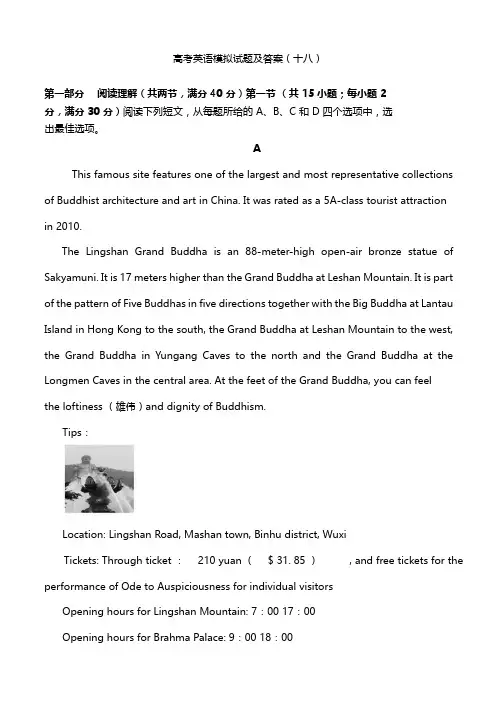
This famous site features one of the largest and most representative collections of Buddhist architecture and art in China. It was rated as a 5A-class tourist attraction in 2010. The Lingshan Grand Buddha is an 88-meter-high open-air bronze statue of Sakyamuni. It is 17 meters higher than the Grand Buddha at Leshan Mountain. It is part of the pattern of Five Buddhas in five directions together with the Big Buddha at Lantau Island in Hong Kong to the south, the Grand Buddha at Leshan Mountain to the west, the Grand Buddha in Yungang Caves to the north and the Grand Buddha at the Longmen Caves in the central area. At the feet of the Grand Buddha, you can feel the loftiness (雄伟)and dignity of Buddhism. Tips:
高考英语阅读理解提升全程训练(18)及答案[ 高考]
![高考英语阅读理解提升全程训练(18)及答案[ 高考]](https://360docs-1393072327.cos.ap-beijing.myqcloud.com/951518e526fff705cc170a6e.webp)
2014高考英语阅读理解提升全程训练(18)及答案阅读理解请认真阅读下列短文,从短文后各题所给的A、B、C、D四个选项中,选出最佳选项。
AWe know the famous ones—the Thomas Edison and the Alexander Graham Bells —but what about the less famous inventors? What about the people who invented the traffic light and the windshield wiper(雨刮器)?Shouldn’t we know who they are?Joan Mclean thinks so. In fact, Mclean, a profe ssor of physics at Mountain University in Range, feels so strongly about this matter that she’s deve loped a course on the topic. In addition to learning “who” invented “what”, however, Mclean also likes her students to learn the answers to the “why” and ”how” questions. According to Mclean,” When students learn the answers to these questions, they are better prepared to recognize opportunities for inventing and more motivated to give inventing a try.”So, just what is the story behind the windshield wiper? Well, Mary Anders on came up with the idea in 1902 after a visit to New York City. The day was cold and stormy, but Anderson still wanted to see the sights, so she jumped aboard a streetcar. Noticing that the driver was struggling to se e through the snow covering the windshield, she found herself wondering why there couldn’t be a built-in device for cleaning the window. Still wondering about this when she returned home to Birmingham, Alabama, Anderson started drafting out solutions. One of her ideas, a lever(操作杆)on the inside of a vehicle that would control an arm on the outside, became the first windshield wiper.Today we benefit from countless inventions and innovations,It’s hard to imagine driving without Garrett A Morgan’s traffic light. It’s equally impossible to picture a world without Katherine J. Blodgett’s innovation that makes glass invisible, Can you picture life without clear windows and eyeglasses?( ) 1. By mentioning “traffic light” and “windshield wiper”, the author indicates thatcountless inventions are .A. beneficial, because their inventors are famousB. beneficial, though their inventors are less famousC. not useful, because their inventors are less famousD. not useful, though their inventors are famous( ) 2. Professor Joan McLean’s course aims to_____.A. add color and variety to students’ campus lifeB. inform students of the windshield wiper’s inventionC. carry out the requirements by Mountain UniversityD. prepare students to try their own invention( ) 3. Tommy Lee’s i nvention of the unbreakable umbrella was _________.A. not eventually accepted by the umbrella producerB. inspired by the story behind the windshield wiperC. due to his dream of being caught in a rains tormD. not related to Professor Joan McLean’s lectures( ) 4. Which 0f the following can best serve as the title of this pas sage?A How to Help Students to Sell Their Inventions to Producers?B How to Design a Built-in Device for Cleaning the Window?C Shouldn’t We Know Who Invented the Windshield Wi per?D Shouldn’t We Develop Invention Courses in Universities?A篇第一篇文章是关于生活中离不开小发明,鼓励年轻人要善于把握发明的契机,推动社会的进步。
中考英语阅读理解18

Crazy Reading 18No cash? No problem!Think about the following questions.1.Does your name have any meaning? If so, what does it mean?2.How did your parents choose your name?3.What are some unusual names you ’ve heard?Write the letter of the word or phrase with the same meaning as the underlined word.1.2.________ My family influences how I act.3.________Typically, Canadian families have two children.4._______Even though I am from America, my ancestors were from Europe.5.______Each family has its own particular way of doing things.6.______in contrast to Thailand, Norway is almost always cold.7.______The president dictates the rules at our company.8.______Her way of dressing reflects her outgoing character.The naming of a child is a momentous decision for any family. So how do we end up with the names we have? Some parents seem to choose based simply on personal preference. In other families, grandparents or professional name-makers come up with a child ’s name. And in some cases, the time of a child ’s birth influences how the child ’s name is determined. How did our parents decide which method to use? In the end, it seems to depend on the culture we were born in.In many European cultures, names are typically chosen by parents and may be based on relatives or ancestors within a particular family. For example, in Italy, children are traditionally named after their grandparents. In families with several children, the parents generally use the father ’s parents ’ name first and then the mother ’s parents ’ names. Similarly, some people in Eastern Europe name their children after relatives who have died. This practice is seen as a means to protect the child from the Angel of Death.Traditionally in some Asian countries, however, parents do not choose the name of a child. Instead, thechild’s grandfather or a fortune-teller chooses the name. And in contrast to the tradition of naming children after relatives, the child’s name is chosen to influence the child’s character. For example, names may be based on a connection to certain elements in nature, like fire, water, earth ,wood, or metal. Or the name might include a written character meaning beauty, strength, or kindness.In certain African cultures, when a child is born plays a large part in determining the child’s name. In Ghana, the day a child is born determines the child’s name in Akan culture. But each day has different names for boys and girls. For instance, a boy born on Friday is named Kofi, whereas a girl born on the same day is named Afua. Both Kofi and Afua are names meaning “wanderer” or “explorer”, so children with these names are seen as travelers.No matter where the name comes from, a child’s name is the first gift in life. Whether it is chosen according to preference or dictated by tradition, the name reflects something about a child’s culture. For that reason, all names should be treasured and respected.1.What is the main idea of this reading?A.How names reflect a person’s cultureB.How Asian people name their childrenC.Some old traditions in choosing namesD.Choosing names in Italian culture2.In which culture are children most likely named after their grandparents?A.Italian B.JapaneseC.Mexican D.Akan3.In which culture do grandparents most likely choose the child’s name?A.Italian B.Eastern-EuropeanC.American D.Chinese4.In China, what should names relate to?A.A child’s ancestorsB.A chidl’s birth dateC.A child’s birth elementD.A child’s personality5.Which is true in Akan culture if a twin brother and sister are born on Friday?A.They will have different names.B.They will have to travel to a different city.C.They will both be named Afua.D.They will both be named Kofi.Find these idioms in the reading.play a large part to be a reason for or organize of something 起了很大作用He played a large part in the success of the conference.Come up with to discover; to produce 发现;想出It took a long time and a lot of work, but we came up with a solution. Be named after to have the same name as 用…的名字Her cat is named after her favorite singer.Fill inthe blanks. Use each of the above idioms once. Change the form of the words if needed.1.Cultural traditions _______ in how we act.2.John ______ his uncle.3.How did you _______ those results?Fill in the blanks with the correct words.Discuss the following questions.1.Which method of naming do you like best? Why?2.Do you know any other cultural traditions in naming? What are they?3.How will you choose your children ’s names?Write your own short paragraph by answering the questions below.————————————————————————————————————————————————————————————————————————————————————————————————————————————————————————————————————————————————————————————————————————————————————————————————————————————————————————————————————————————————————— A .Choose the best word to fill in the blank.1.She likes only one ______ flavor of ice cream.A .particularB .typicalC .generalD .mobile 2.The head researcher must _______ the idea before we go ahead with the experiment.A .dictateB .approveC .baseD .contrast3.I always visit _______ at Christmas.A .ancestorsB .culturesC .traditionsD .relatives4.Cultural traditions often ______ how we act during special holidays.A .baseB .dictateC .allowD .approve5.______ to traditional methods, many Asian families are now choosing names according to personal preference.A .As a meansB .TypicallyC .In contrastD .Similarly6.My ______ came from Germany to Britain about 100 years ago.A .relativesB .ancestorsC .childrenD .location7.What is your _____ , to eat in or go out for dinner?A .preferenceB .cultureC .traditionD .typically8.He always looks at his ______ in the mirror.A.reflect B.reflection C.reflected 9.The young man was _____ by a group of bad students.A.influence B.influential D.influenced 10.He ______ sleeps late on Saturdays.A.typically B.typical C.atypical。
高中英语BookIIUnit18Inventions总复习单元训练教师解析试题(共8页)

考点(kǎo diǎn)训练40 S2 B2 Unit 18 InventionsⅠ.句子填空(一共10小题;每一小题1.5分,满分是15分)1.I remember you mentioned the same thing on a __________(先前的) occasion.答案:previous’m not feeling very well today —__________ (否那么) I would do it myself.答案:otherwise3.Do you believe that there’s a __________ (联络,联结) between smoking and heart disease?答案:connection4.We shouldn’t __________ (排挤) different ideas just because we disagree on them.答案:reject5.There is a good __________ (可能性) of rain tonight.答案:possibility6.Great thinkers are__________ (意识到) this and try to combine new and old ideas in as many different ways as possible.答案:aware of7.The bus __________ (陷入) the mud,so all the passengers went off to push it out of the mud.答案:got stuck in8.Creative thinking is a conscious effort to __________ (摆脱) old thought patterns in order to explore new possibilities.答案:break away from’d better start earlier.We should __________ (顾及,考虑到) traffic delays.答案:allow for10.You shouldn’t have scolded him like that; __________ (毕竟(bìjìng)),he is still a child.答案:after allⅡ.单项选择(一共15小题;每一小题2分,满分是30分)1.—Tell us,Terry,how did you the wonderful idea?—_______.A e up with;By accidentB e into;By surfing the InternetC e into;By accident D.think of;From the sixth sense答案:A提示:by accident偶尔地,come up with 意为“想出〞。
中考阅读真题天天练 Day 18(解析版)

中中中中中中中中中 Day 18一、完形填空阅读下面短文, 从短文后所给各题的A. B. C. D四个选项中, 选出可以填入空白处的最佳选项。
One night many years ago, an angry voice woke me up from sleep. It was my drunken (喝醉的) father. Those days, he would always ___11___ home very late. Sometimes, he would also go on to fight with my mom.My earliest memory of these events began when I was around four years old. I was filled with ___12___ at that time. There were lots of ___13___ — crying, shouting, and doors slamming (砰地关上).Then, there was a ___14___ knock at the door. My father opened the door. There were two tall men in blue. They wanted to come inside to ___15___ everyone was okay. In a moment, my father was taken away. Everything became peaceful.My father came back the next day. He became very friendly and ___16___ brought my mom flowers. I knew that these men in blue had taken away my fear. From that day on, ___17___ I wanted to be was a policeman. And my dream has come true.I realized that police officers not only ___18___ the little boy in me, but made me a helpful person. Once, my colleague (同事) and I jumped into a river and got a driver ___19___ a sinking (下沉的) car. Another day, we kicked open the door into a house ____20____ the fire spread through the whole building.Police officers will always be my heroes, and I will always love my job.11. A. forget B. leave C. return D. miss12. A. surprise B. pleasure C. interest D. fear13. A. noises B. records C. choices D. results14. A. lively B. wrong C. weak D. sudden15. A. worry about B. cheer up C. make sure D. depend on16. A. still B. just C. even D. almost17. A. all B. none C. both D. neither18. A. believed B. saved C. followed D. remembered19. A. as for B. out of C. on to D. from among20. A. until B. after C. since D. before【答案】11. C 12. D 13. A 14. D 15. C 16. C 17. A 18. B 19. B 20. D【解析】【导语】本文主要讲述了作者通过小时候的经历而长大成为一名警察的故事。
英语阅读练习18
1.According to a recent survey, employees in many companies today work longer hours thanemployees did in 1997. They also take shorter vacations than employees in 1997 took. It seems that Americans are working harder today than ever before. Or are they? A management consultant, Bill Meyer, decided to find out. For three days, he observed an investment banker hard at work. Meyer wrote down everything that banker did during his long workday----the banker worked 80 hours a week. At the end of the three-day period, Meyer reviewed the banker’s activities with him. They discovered that the man spent 80 percent of his time doing busy work. For example, he attended unnecessary meetings, made repeated telephone calls, and spent time packing and unpacking his two big briefcases.Apparently, many people believe that the more time a person spends at work, the more she or he accomplished. However, the connection between time and productivity is not always positive. In fact, many studies indicate that after a certain point, anyone’s productivity and creativity begin to decrease. Furthermore, it is not always easy for individuals to realize that their performance is falling off.Part of the problem is understandable. When employers evaluate employees, they often consider the amount of time on the job in addition to job performance. Employees know this.Consequently, they work longer hours and take less vacation time than they did nine years ago. Although many working people can do their job effectively during a regular 40-hour work week, they feel they have to spend more time on the job after normal working hours so that the people who can promote them see them.A group of headhunters (people who search out executive personnel for companies) wereasked their opinion about a situation. They had a choice of two candidates for an executive position with an important company. The candidates had comparable qualifications for the job. For example, they were both reliable. One could do the job well in a 40-hour work week.The other could do the same job in an 80-hour week just as well. According to a headhunting expert, the 80-hour-week candidate would get the job. The time this candidate spends on the job may encourage their employees to spend more time at work, too. Employers believe that if the employees stay at work later, they may actually do more work.2.Helen KellerAll of us have read thrilling stories in which the hero had only a limited and specified time to live. sometimes it was as long as a year; sometimes as short as twenty-four hours, but always we were interested in discovering just how the doomed man chose to spend his last days or his last hours. I speak, of course, of free men who have a choice, not condemned criminals whose sphere of activities is strictly delimited.Such stories set up thinking, wondering what we should do under similar circumstances.What associations should we crowd into those last hours? As mortal beings, what happiness should we find in reviewing the past?What regrets?Sometimes I have thought it would be an excellent rule to live each day as if we should die tomorrow. Such an attitude would emphasize sharply the values of life. We should live each day with a gentleness, a vigor, and a keenness of appreciation which are often lost when time stretches before us in the constant panorama of more days and months and years to come.T here are those, of course, who would adopt the epicurean motto of “eat, drink, and be merry,” most people would be chastened by the certainty of impending death.3.We are not born with courage, but neither are we born with fear. Maybe some of our fearsare brought on by your own experiences, by what someone has told you, by what you’ve read in the papers. Some fears are valid, like walking alone in a bad part of town at two o’clock in the morning. But once you learn to avoid that situation, you won’t need to live in fear of it.Fears, even the most basic ones, can totally destroy our ambitions. Fear can destroy fortunes.Fear can destroy relationships. Fear, if left unchecked, can destroy our lives. Fear is one of the many enemies lurking inside us.Let me tell you about five of the other enemies we face from within. The first enemy that you’ve got to destroy before it destroys you is indifference. What a tragic disease thi s is!“Ho-hum, let it slide. I’ll just drift along.” Here’s one problem with drifting: you can’t drift your way to the top of the mountain.The second enemy we face is indecision. Indecision is the thief of opportunity and enterprise.It will steal your chances for a better future. Take a sword to this enemy.The third enemy inside is doubt. Sure, there’s room for healthy skepticism. You can’t believe everything. But you also can’t let doubt take over. Many people doubt the past, doubt the future, doubt each other, doubt the government, doubt the possibilities and doubt the opportunities. Worse of all, they doubt themselves. I’m telling you, doubt will destroy your life and your chances of success. It will empty both your bank account and your heart. Doubt is an enemy. Go after it. Get rid of it.The fourth enemy within is worry. We’ve all got to worry some. Just don’t let it conquer you.Instead, let it alarm you. Worry can be useful. If you step off the curb in New York City and a taxi is coming, you’ve got to worry. But you can’t let worry loose like a mad dog that drives you into a small corner. Here’s what you’ve got to do with your worries: drive them into a small corner. Whatever is out to get you, you’ve got to get it. Whatever is pushing on you, yo u’ve got to push back.The fifth interior enemy is overcaution. It is the timid approach to life. Timidity is not a virtue;it’s an illness. If you let it go, it’ll conquer you. Timid people don’t get promoted. They don’t advance and grow and become power ful in the marketplace. You’ve got to avoid over caution.Do battle with the enemy. Do battle with your fears. Build your courage to fight what’s holding y ou back, what’s keeping you from your goals and dreams. Be courageous in your life and in your pursuit of the things you want and the person you want to become.4.The past ages of man have all been carefully labeled by anthropologists. Descriptions like‘ Palaeolithic Man’, ‘Neolithic Man’, etc., neatly sum up whole periods. When the time comes for anthropologists to turn their attention to the twentieth century, they will surely choose the label ‘Legless Man’. Histories of the time will go something like this: ‘in the twentieth century, people forgot how to use their legs. Men and women moved about in cars, buses and trains from a very early age. There were lifts and escalators in all large buildings to prevent people from walking. This situation was forced upon earth dwellers of that time because of miles each day. But the surprising thing is that they didn’t use their legs even when they went on holiday. They built cable railways, ski-lifts and roads to the top of every huge mountain. All the beauty spots on earth were marred by the presence of large car parks. ’The future history books might also record that we were deprived of the use of our eyes. Inour hurry to get from one place to another, we failed to see anything on the way. Air travel gives you a bird’s-eye view of the world – or even less if the wing of the aircraft happens to get in your way. When you travel by car or train a blurred image of the countryside constantly smears the windows. Car drivers, in particular, are forever obsessed with the urge to go on and on: they never want to stop. Is it the lure of the great motorways, or what? And as for sea travel, it hardly deserves mention. It is perfectly summed up in the words of the old song: ‘I joined the navy to see the world, and what did I see? I saw the sea.’ The typical twentieth-century traveler i s the man who always says ‘I’ve been there. ’ You mention the remotest, most evocative place-names in the world like El Dorado, Kabul, Irkutsk and someone is bound to say ‘I’ve been there’ –meaning, ‘I drove through it at 100 miles an hour on the way to s omewhere else. ’When you travel at high speeds, the present means nothing: you live mainly in the future because you spend most of your time looking forward to arriving at some other place. But actual arrival, when it is achieved, is meaningless. You want to move on again. By traveling like this, you suspend all experience; the present ceases to be a reality: you might just as well be dead. The traveler on foot, on the other hand, lives constantly in the present. For him traveling and arriving are one and the same thing: he arrives somewhere with every step he makes. He experiences the present moment with his eyes, his ears and the whole of his body.At the end of his journey he feels a delicious physical weariness. He knows that sound.Satisfying sleep will be his: the just reward of all true travellers.5.Youth is not a time of life; it is a state of mind; it is not a matter of rosy cheeks, red lips andsupple knees; it is a matter of the will, a quality of the imagination, a vigor of the emotions; it is the freshness of the deep springs of life.Youth means a temperamental predominance of courage over timidity, of the appetite for adventure over the love of ease. This often exists in a man of 60 more than a boy of 20.Nobody grows old merely by a number of years. We grow old by deserting our ideals.Years may wrinkle the skin, but to give up enthusiasm wrinkles the soul. Worry, fear, self-distrust bows the heart and turns the spirit back to dust.Whether 60 or 16, there is in every human being’s heart the lure of wonders, the unfailing appetite for what’s next and the joy of the game of living. In the center of your heart and my heart, there is a wireless station; so long as it receives messages of beauty, hope, courage and power from man and from the infinite, so long as you are young.When your aerials are down, and your spirit is covered with snows of cynicism and the ice of pessimism, then you’ve grown old, even at 20; but as long as your aerials are up, to catch waves of optimism, there’s hope you may die young at 80.6.The Causes of European Separation in 16th CenturyFor a thousand years and more, the people of Europe had fought about many things, but they had been united in believing one thing: that there existed a single “Holy, Catholic and Apostolic Church” of which the Bishop of Rome, under the title of the Pope, was the visible and recognizable head in succession to St. Peter. But in 1517 a German monk, Martin Luther, challenged certain Catholic teachings and renounced his obedience to the papacy. Others had followed him, including Henry VIII.Thus Europe was divided in every which way, the southern and eastern two-thirds still Catholic, the northern and western one-third what was coming to be called Protestant,though English-ruled Ireland solidly Catholic and the Spanish-ruled Netherlands, particularly the northern part approximating to modern Holland, grew increasingly Protestant; while in virtually every country, whether officially Catholic or Protestant, those of the contrary faith fiercely attem pted to convert their neighbors and equally fiercely resisted their neighbor’s attempts to convert them. For this there was no simple, friendly solution to be reached on the principle of live-and-let-live. Each party believed that it had hold of the truth, the only truth that mattered, the one that led to eternal salvation, and its adversaries clung to falsehood which must necessarily head to eternal damnation: not only for themselves but for all who should permit them to survive and infect others with their errors. Toleration, even reasonable discussion, was impossible. God and the devil could not mix. Just as Elizabeth was to ardent Catholics that Jezebel, so to earnest Protestants the Pope was “that wolfish bloodsucker,” and their Catholic fellow-creatures mad dogs, toads and other such vermin to be cleansed off the face of the earth.These feelings, dangerous enough in themselves, were made more so by questions of geography and money. The Catholic countries bordering on the Mediterranean were by far the richest. From the beginning of the Middle Ages the Republic of Venice had controlled the trade routes to the East, bringing the wares carried out of Persia, China and the Indies by camel to her depots in Syria and reloading them in her high, gorgeously painted vessels for transshipment to Italy and beyond. Since the end of the fifteen century, first Portugal by sailing round Africa to India, then Spain by the discovery of America, had likewise been in a position to bring for sale to Europe all the rare and wonderful things for which Europe longed—silks and precious woods, sugar and spices, gold and silver, works of exquisite art and strange animals from peacock to tigers. In 1494, two years after Columbus’s first voyage to America, Pope Alexander VI had divided the unexplored world beyond the seas between Spain and Portugal as reward for their enterprise and to keep them from fighting. The other countries had respected this division so long as they remained Catholic.7.I was six years old, my sister, Sally Kay, was a submissive three-year-old girl. For some reasons,I thought we needed to earn some money. I decided we should "hire out" as maids.Wevisited the neighbors, offering to clean houses for them for a quarter cents. Reasonable as our offer was, there were no takers. But one neighbor telephoned my mother to let her know what Mary Alice and Sally Kay were doing.Mother had just hung up the phone when we came first into the back door into the kitchen of our apartment. "Girls," mother asked, "why were you two going around the neighborhood telling people you would clean their houses?" Mother wasn't angry with us. In fact, we learned afterwards she was amused that we had come up with such an idea.But, for some reason, we both denied having done any such thing. Shocked and terribly hurt that her dear little girls could be such "boldfaced (厚颜无耻的) liars" . Mother then told us that Mrs. Jones had just called and told her we had been to her house and said we would clean it for a quartercents.Faced with the truth, we admitted what we had done. Mother said we have fibbed, we have not told the truth. She was sure that we knew better. She tried to explain why a fib (小谎) hurt, but she didn't feel that we really understood.Years later, she told us that the lesson she came up with for trying to teach us to be truthful would probably have been found upon by child psychologists. The idea came to her in a flash,and a tender-hearted mother told us it was the most difficult lesson she ever taught us. It was a lesson we never forgot. After admonishing(警告,劝告) us, mother cheerfully began preparing for lunch. As we munching on sandwiches, she asked:" Would you two like to go to see the movies this afternoon?""Wow, would we ever?" We wondered what movie would be playing. Mother said:"The Matinee"."Oh, fantastic!We would be going to see The Matinee, would we lucky?" We got bathed and all dressed up. It was like getting ready for a birthday party. We hurried outside the apartment, not wanting to miss the bus that would take us downtown. On the landing, Mom stunned (使震惊) us by saying, "Girls, we are not going to the movies today. ”We didn't hear her right."What?" we objected. "What do you mean? Aren't we going to The Matinee? Mommy, you said th at we are going to the Matinee.”Mother stooped and gathered us in her arms. I couldn't understand why there were tears in her eyes. We still had the time to get the bus, but hugging us, she gently explained this is a fib. "It is important that what we say is true,"Mom said. "I fibbed to you just now and it felt awful to me. I don't ever want to fib again and I'm sure you don't want to fib again either. People must be able to believe each other. Do you understand? "We assured her that we understood. We would never forget. And since we had learned a lesson, why not go to the movie to see The Matinee. There were still time. Not today. Mother told us. We would go another time. That is how over fifty years ago, my sister and I learned to be truthful. We have never forgotten how much a fib can be hurt.8.The greatest recent changes have been in the lives of women. During the twentieth centurythere was an unusual shortening of the time of a woman’s life spent in caring for children. A woman marrying at the end of the 19th century would probably have been in her middle twenties, and would be likely to have seven or eight children, of whom four or five lived till they were five years old. By the time the youngest was fifteen, the mother would have been in her early fifties and would expect to live a further twenty years, during which custom, chance and health made it unusual for her to get paid work. Today women marry younger and have fewer children. Usually a woman’s youngest child will be fifteen when she is forty-five and is likely to take paid work until retirement at sixty. Even while she has the care of children ,her work is lightened by household appliances(家用电器)and convenience foods.This important change in women’s way of life has only recently begun to have its full effect on women’s economic pos ition. Even a few years ago most girls left school at the first opportunity and most of them took a full-time job. However, when they married, they usually left work at once and never returned to it. Today the school-leaving age is sixteen, many girls stay at school after that age,and though women tend to marry younger ,more married women stay at work at least until shortly before their first child is born. Many more afterwards, return to full or part-time work. Such changes have led to a new relationship in marriage, with both husband and wife accepting a greater share of the duties and satisfaction of family life, and with both husband and wife sharing more equally in providing the money and running the home, according to the abilities and interest of each of them. 9.The Smart RabbitOne day a rabbit was in the garden eating carrots. When he was about to go home he saw the farmer. So he needed to hide. But where could he hide? The carrots are under the ground only the leaves were out. He could not hide there but the farmer was coming closer to him, then he had an idea to dig a hole and cover the top of the hole with leaves and twigs and wait until the farmer leaves.But the farmer did not leave because he needed some carrots to make soup. Then the rabbit had another idea, he would dig under the lettuce patch and go home, he will get muddy if he did that but if that was the only way to go home he will do it. And that was the only way to go home. So he did it but by the time he got home he was very muddy and tired. So he went to bed. When he got up he took a bath, when he got out he had a nice meal with his family.10.Women are also underrepresented in the administration and this is because there are so fewwomen full professors. In 1985,Regent Beryl Milburn produced a report blasting the University of Texas System administration for not encouraging women.The University was rated among the lowest for the system.In a 1987 update ,Milburn commended the progress that was made and called for even more improvement. One of the positive results from her study was a System-wide program to inform women of available administrative jobs. College of Communication Associate Dean PatricaWitherspoon,said it is important that woman be flexible when it comesto relocating if they want to rise in the ranks. Although a woman may face a chilly climate on campus, many times in order for her to succeed, she must rise above the problems around her and concentrate on her work. Until women make up a greater percentage of the senior positions in the University and all academia,inequities will exist."Women need to spend their energies and time doing scholarly activities that are important here at the University." Spirduso said."If they do they will be successful in this system.If they spend their time in little groups mourning the sexual discrimination that they think exists here, they are wasting valuable study time."。
专题十八 阅读表达.pptx
about的宾语。
译文:我急切地躺在床上想象着我会在神奇的山顶发现什么。
重点词汇 dream about想象 magnificent adj.壮丽的,宏伟的 mysterious adj.神秘的 take
the risk of冒……风险 absolutely adv. 绝对地, 完全地
at all cost不惜任何代价
of stairs. What could these steps lead to?Curiosity got the best of me as I knew it would be starting
to get dark soon. I started climbing up those strangely mysterious steps.
怕。”可知答案。
3.She had rich imagination and she was brave.
Or:She was a brave and determined girl with rich imagination.
Or:She was imaginative and determined, and she dared to explore.
ent.
Helping customers and establishing connections with them is one of the things I love most about
my job. About two months ago, I helped a woman who was looking for a dress. She told me exactly what she was picturing—a blue dress with long sleeves and a lace neck. We didn t have any
大学英语18级音体美阅读理解SectionCPassageOne试题及参考答案
大学英语18级音体美阅读理解SectionCPassageOne试题及参考答案18级音体美阅读理解Section C Passage One试题试题1Passage One (10%)Questions 1 to 5 are based on the following passage.The endless debate about“ work—life balance ”often contains a hopeful footnote about stay at home dads.If American society and business won’t make it easier on future female leaders who choose to have children,there is still the ray of hope that increasing numbers of full—time fathers will.But based on today’s socioeconomic trends,this hope is,unfortunately,misguided.It’s true that th e number of men who have left work to do their thing as full—time parents has doubled in a decade,but it’s still very small:only 0.8%of married couples where the stay—at—home father was out of the labor force for a year.Even that percentage is likely inflated by men thrust into their caretaker role by a downsizing.This is simply not a large enough group to reduce the social stigma(污名)and force other adjustments necessary to supporting men in this decision.even if only work more than their family.Even shorter times away from work for working fathers are already difficult.A study found that 85%of new fathers take some time off after the birth of a child—but for all but a few.it’s a week or two at most.Meanwhile,the average for women who take leave is more than lo weeks.Such choices impact who moves up in the organization.While you’re away,someone else is doing yourwork,making your sales,taking care of your customers.That can’t help you at work.It can only hurt you.Women,of course,face the same issues of returning after a long absence.But with many more women than men choosing to leave the workforce entirely to raise families,returning from an extended parental lea ve doesn’t raise as many eyebrows as it does for men.Women would make more i f they didn’t break their earning trajectory(轨迹)by leaving the workforce,or if higher-paying professions were more family friendly.In the foreseeable future,Stay at home fathers may make all the difference for individual families. but their presence won’t reduce the numbers of high potential women who are forced to choose between family and career.1. What gives women a ray of hope to achieve work-life balance?A. More men taking an extended parental leave.B. People’s changing attitudes towards family.C. More women entering business management.D. The improvement of their socioeconomic status.2. Why does the author say the hope for more full—time fathers is misguided?A. Women are better at taking care of children.B. Many men value work more than their family.C. Their number is too small to make a difference.D. Not many men have the chance to stay at home.3. Why do few men take a long parental leave?A.A long leave will have a negative impact on their career.B. They just have too many responsibilities to fulfill at work.C. The economic loss will be too much for their family to bear.D. They are likely to get fired if absent from work for too lon9.4. What is the most likely reaction to men returning from an extended parental leave?A. Jealousy.B. SurpriseC. AdmirationD. Sympathy5.What does the author say about high-potential women in the not-too-distant future?A. They will benefit from the trend of more fathers staying at home.B. They will find high-paying professions a bit more family-friendly.C. They are unlikely to break their career trajectory to raise a family.D. They will still face the difficult choice between career and children.试题2Passage One (10%)Questions 1 to 5 are based on the following passage.Shoppers in the UK are spending less money on toilet paper to save money, research has shown.Penny-pinching UK consumers choose cheaper products from discounters such as Alcli and Lidl rather than luxury alternatives.This has wiped 6% off the value of the soft tissue paper market in the UK. It has shrunk from £1.19 billion in 2011 to £ 1.12 billion in 2015, according to a new report from market research company Mintel. Furthermore, the future of the market looks far from rosy, with sales expected to fall further to £.1.11 billion in 2016.In the last year alone, despite an increase in the UK population and a subsequent rise in the number of households, sales of toilet paper fell by 2, with the average household reducing their toilet roll spending from £43 in 2014 to £ 41 in 2015.Overall, almost three in five people say they try to limit their usage of paper-including facial tissue and kitchen roll-to save money. "Strength, softness and thickness remain the leading indicators of toilet paper quality, with just a small proportion of consumers preferring more luxurious alternatives, such as those with flower patterns or perfume," said Mintel analyst Jack Duckett. "These extra features are deemed unnecessary by the majority of shoppers, which probably reflects how these types of products are typically more expensive than regular toilet paper, even when on special offer."While consumers are spending less on toilet paper, they remain fussy-in theory at least-when it comes to paper quality. Top of Britons' toilet paper wish list is softness (57%)followed by strength (45% )and thickness (36%).One in 10 buyers rank toilet rolls made from recycled paper among their top considerations, highlighting how overall the environment is much less of a consideration for shoppers than product quality. In a challenge for manufacturers, 81 of paper product users said they would consider buying recycled toilet tissue if it were comparable in quality to standard paper.1. The market sales of toilet paper have decreased because?A ) Britons have cut their spending on it.B ) its prices have gone up over the years.C) its quality has seen marked improvement.D) Britons have developed the habit of saving2. what does the author think of the future of the tissue paper market in the UK?A ) It will expand in time.B ) It will remain gloomy.C ) It will experience ups and downs.D ) It will recover as population grows.3. What does Jack Duckett say about toilet paper?A ) Special offers would promote its sales.B ) Consumers are loyal to certain brands.C) Luxurious features add much to the price.D) Consumers have a variety to choose from.4. What do we learn about Britons concerning toilet paper?A) They are particular about the quality of toilet paper.B ) They emphasize the strength of toilet paper the most.C ) They prefer cheap toilet paper to recycled toilet paper.D) They reject using toilet paper with unnecessary features.5.What can we infer from the last paragraph?A) More and more Britons buy recycled toilet paper to protect the environment.B ) Toilet paper manufacturers are facing a great challenge in promoting its sales.C) T oilet paper manufacturers compete with one another to improve product quality.D) Environmental protection is not much of a concern when Britons buy toilet paper.试题3Passage One (10%)Question 1 to 5 are based on the following passage.Urbanization—migration away from the suburbs to the city center—will be thebiggest real estate trend in 2015, according to a new report.The report says America’s urbanization will continue to be the most significant issue affecting the industry, as cities across the country imitate the walkability and transit-oriented development making cities like New York and San Francisco so successful.As smaller cities copy the model of these “24-hour cities,” more affordable versions of these places will be created. The report refers to this as the coming of the “18-hour city,” and uses the term to refer to cities like Houston, Austin, Charlotte, and Nashville, which are “positioning themselves as highly competitive, in terms of livability, employment offerings, and recreational and cultural facilities.”Another trend that looks significant in 2015 is that America’s largest population group, M illennials(千禧一代), will continue to put off buying a house. Apartments will retain their appeal for a while for Millennials, haunted by what happened to home-owning parents.This trend will continue into the 2020s, the report projects. After that, survey r espondents disagree over whether this generation will follow in their parents’ footsteps, moving to the suburbs to raise families, or will choose to remain in the city center.Another issue affecting real estate in the coming year will be America’s failing infrastructure. Most roads, bridges, transit, water systems, the electric grid, and communications networks were installed 50 to 100 years ago, and they are largely taken for granted until they fail.The report’s writers state that America’s failure to in vest in infrastructure impacts not only the health of the real-estatemarket, but also our ability to remain globally competitive.Apart from the specific trends highlighted above, which cause some investors to worry, the report portrays an overall optimism borne by the recent healthy real-estate “up-cycle” and improving economy. Seventy-four percent of the respondents surveyed report a “good to excellent” expectation of real-estate profitability in 2015. While excessive optimism can promote bad investment patterns, resulting in a real-estate “bubble,” the report’s writers downplay that potential outcome in that it has not yet occurred.1. According to the new report, real estate development in 2015 will witness ______.A) an accelerating speed B) a shift to city centersC) a new focus on small cities D) an ever-increasing demand2. What characterizes “24-hour cities” like New York?A) People can live without private cars.B) People are generally more competitive.C) People can enjoy services around the clock.D) People are in harmony with the environment.3. Why are Millennials reluctant to buy a house?A) They can only afford small apartments.B) The house prices are currently too high.C) Their parents’ bad experience still haunts them.D) They feel attached to the suburban environment.4. What might hinder real estate development in the U.S.?A) The continuing economic recession in the country.B) The lack of confidence on the part of investors.C) The fierce global competition.D) The worsening infrastructure.5. How do most of the respondents in the survey feel aboutthe U.S. real-estate market in 2015?A) Pessimistic B) Hopeful C) Cautious D) Uncertain试题4Passage One (10%)Question 1 to 5 are based on the following passage.As a person who writes about food and drink for a living, I couldn’t tell you the first thing about Bill Perry or whether the beers he sells are that great. But I can tell you that I like this guy. That’s because he plans to ban tipping in favor of paying his servers an actual living wage.I hate tipping.I hate it because it’s an obligation disguised as an option.I hate it for the post-dinner math it requires of me. But mostly, I hate tipping because I believe l would be in a better place if pay decisions regarding employees were simply left up to their employers, as is the custom in virtually every other industry.Most of you probably think that you hate tipping, too. Research suggests otherwise. You actually love tipping! You like to feel that you have a voice in how much money your server makes. No matter how the math works out, you persistently view restaurants with voluntary tipping systems as being a better value, which makes it extremely difficult for restaurants and bars to do away with the tipping system.One argument that you tend to hear a lot from the pro-tipping crowd seems logical enough: the service is better when waiters depend on tips, presumably because they see a benefit to successfully veiling their contempt for you. Well, if this were true, we would all be slipping a few l00-dollar bills to our doctors on-the way out their doors, too. But as it turns out, waiters see only a tiny bump in tips when they do an exceptional jobcompared to a passable one. Waiters, keen observers of humanity that they are, are catching on to this; in one poll, a full 30% said they didn’t believe the job they did had any impact on the tips they received.So come on, folks: get on board with ditching the outdated tip system. Pay a little more upfront for your beer or burger. Support Bill Perry’s pub,and any other bar or restaurant that doesn’t ask you to do drunken math.1. What can we learn about Bill Perry from the passage?A. He runs a pub that serves excellent beer.B. He intends to get rid of the tipping practice.C. He gives his staff a considerable sum for tips.D. He lives comfortably without getting any tips.2. What is the main reason why the author hates tipping?A. It sets a bad example for other industries.B. It adds to the burden of ordinary customers.C. It forces the customer to compensate the waiter.D. It poses a great challenge for customers to do math.3. Why do many people love tipping according to the author?A. They help improve the quality of the restaurants they dine in.B. They believe waiters deserve such rewards for good service.C. They want to preserve a wonderful tradition of the industry.D. They can have some say in how much their servers earn.4. What have some waiters come to realize according to a survey?A. Service quality has little effect on tip size.B. It is in human nature to try to save on tips.C. Tips make it more difficult to please customers.D. Tips benefit the boss rather than the employees.5. What does the author argue for in the passage?A. Restaurants should calculate the tips for customers.B. Customers should pay more tips to help improve service.C. Waiters deserve better than just relying on tips for a living.D. Waiters should be paid by employers instead of customers.试题5Passage one(10%)Questions 1 to 5 are based on the following passage.As Artificial Intelligence(AI) becomes increasingly sophisticated, there are growing concerns that robots could become a threat. This danger can be avoided, according to computer science professor Stuart Russell, if we figure out how to turn human values into a programmable code.Russell argues that as robots take on more complicated tasks, it’s necessary to translate our morals into AI language.For example, if a robot does chores around the house, you wouldn’t want it to put the pet cat in the oven to ma ke dinner for the hungry children. “You would want that robot preloaded with a good set of values,” said Russell.Some robots are already programmed with basic human values. For example, mobile robots have been programmed to keep a comfortable distance from humans. Obviously there are cultural differences, but if you were talking to another person and they came up close in your personal space, you wouldn’t think that’s the kind of thing a properly brought-up person would do.It will be possible to create more sophisticated moral machines, if only we can find a way to set out human values as clear rules.Robots could also learn values from drawing patterns from large sets of data on human behavior. They are dangerous only if programmers are careless.The biggest concern with robots going against human values is that human beings fail to so sufficient testing and they’ve produced a system that will break some kind of taboo(禁忌).One simple check would be to program a robot to check the correct course of action with a human when presented with an unusual situation.If the robot is unsure whether an animal is suitable for the microwave, it has the opportunity to stop, send out beeps(嘟嘟声), and ask for directions from a human. If we humans aren’t quite sure about a decision,we go and ask somebody else.The most difficult step in programming values will be deciding exactly what we believe in moral, and how to create a set of ethical rules. But if we come up with an answer, robots could be good for humanity.1.What does the author say about the threat of robots?A)It may constitute a challenge to computer programmers.B)It accompanies all machinery involving high technology.C)It can be avoided if human values are translated into their language.D)It has become an inevitable peril as technology gets more sophisticated.2.What would we think of a person who invades our personal space according to the author?A)They are aggressive.B)They are outgoing.C)They are ignorant.D)They are ill-bred.3.How do robots learn human values?A)By interacting with humans in everyday life situations.B)By following the daily routines of civilized human beings.C)By picking up patterns from massive data on human behavior.D)By imitating the behavior of property brought-up human beings.4.What will a well-programmed robot do when facing an unusual situation?A)keep a distance from possible dangers.B)Stop to seek advice from a human being.C)Trigger its built-in alarm system at once.D)Do sufficient testing before taking action.5.What is most difficult to do when we turn human values into a programmable code?A)Determine what is moral and ethical.B)Design some large-scale experiments.C)Set rules for man-machine interaction.D)Develop a more sophisticated program.试题6Passage One(10%)Questions 1 to 5 are based on the following passage.Declining mental function is often seen as a problem of old age, but certain aspects of brain function actually begin their decline in young adulthood, a new study suggests.The study, which followed more than 2,000 healthy adults between the ages of 18 and 60, found that certain mental functions—including measures of abstract reasoning, mental speed and puzzle-solving—started to dull as early as age 27.Dips in memory, meanwhile, generally became apparentaround age 37.On the other hand, indicators of a person’s accumulated knowledge—like performance on tests of vocabulary and general knowledge—kept improving with age, according to findings published in the journal Neurobiology of Aging.The results do not mean that young adults need to start worrying about their memories. Most people’s minds function at a high level even in their later years, according to researcher Timothy Salthouse.“These patterns suggest that some types of mental flexibility decrease relatively early in adulthood, but that the amount of knowledge one has, and the effectiveness of integrating it with one’s abilities, may increase throughout all of adulthood if there are no diseases,” Salthouse said in a news release.The study included healthy, educated adults who took standard tests of memory, reasoning and perception at the outset and at some point over the next seven years.The tests are designed to detect subtle (细微的) changes in mental function, and involve solving puzzles, recalling words and details from stories, and identifying patterns in collections of letters and symbols.In general, Salthouse and his colleagues found, certain aspects of cognition (认知能力) generally started to decline in the late 20s to 30s.The findings shed light on normal age-related changes in mental function, which could aid in understanding the process of dementia (痴呆), according to the researchers.“By following individuals over time,” Salthouse said, “we gain insight in cognition changes, and may possibly discoverways to slow the rate of decline.”The researchers are currently analyzing the study participants’ health and lifestyle to see which factors might influence age-related cognitive changes.1. What is the common view of mental function?A)It varies fro m person to person. B)It weakens in one’s later years.C)It gradually expands with age. D)It indicates one’s health condition.2. What does the new study find about mental functions?A)Some diseases inevitably lead to their decline.B)They reach a peak at the age of 20 for most people.C)They are closely related to physical and mental exercise.D)Some of them begin to decline when people are still young.3. What does Timothy Salthouse say about people’s minds in most cases?A)They tend to decli ne in people’s later years.B)Their flexibility determines one’s abilities.C)They function quite well even in old age.D)Their functioning is still a puzzle to be solved.4. Although people’s minds may function less flexibly as they age, they _____.A)may be better at solving puzzlesB)can memorize things with more easeC)may have greater facility in abstract reasoningD)can put what they have learnt into more effective use5. According to Salthouse, their study may help us_____.A)find ways to slow down our mental declineB)find ways to boost our memoriesC)understand the complex process of mental functioningD)understand the relation between physical and mental health试题7Passage OneQuestions 1 and 5 are based on the following passage.Nobody really knows how big Lagos is. What's indisputable is that it's growing very quickly. Between now and 2050, the urban population of Africa could triple. Yet cities in sub-Saharan Africa are not getting richer the way cities in the rest of the world have. Most urban Africans live in slums (贫民窟); migrants are often not much better off than they were in the countryside. Why?The immediate problem is poverty. Most of Africa is urbanising at a lower level of income than other regions of the world did. That means there's little money around for investment that would make cities liveable and more productive. Without upgrades and new capacity, bridges, roads and power systems are unable to cope with expanding populations. With the exception of South Africa, the only light rail metro system in sub-Saharan Africa is in Addis Ababa, Ethiopia. Traffic jam leads to expense and unpredictability, things that keep investors away.In other parts of the world, increasing agricultural productivity and industrialisation went together. More productive farmers meant there was a surplus that could feed cities; in turn, that created a pool of labour for factories. But African cities are different. They are too often built around consuming natural resources. Government is concentrated in capitals, so is the money. Most urban Africans work for a small minority of the rich, who tend to be involved in either cronyish (有裙带关系的) businesses or politics. Since African agriculture is still broadly unproductive, food is imported, consuming a portionof revenue.So what can be done? Though African countries are poor, not all African cities are. In Lagos, foreign oil workers can pay as much as $65,000 per year in rent for a modest apartment in a safe part of town. If that income were better taxed, it might provide the revenue for better infrastructure. If city leaders were more accountable to their residents, they might favour projects designed to help them more. Yet even as new roads are built, new people arrive. When a city's population grows by 5% a year, it is difficult to keep up.1. What do we learn from the passage about cities in sub-Saharan Africa?A) They have more slums than other cities in the world.B) They are growing fast without becoming richer.C) They are as modernised as many cities elsewhere.D) They attract migrants who want to be better off.2. What does the author imply about urbanisation in other parts of the world?A) It benefited from the contribution of immigrants.B) It started when people's income was relatively high.C) It benefited from the accelerated rise in productivity.D) It started with the improvement of peopled livelihood.3. Why is sub-Saharan Africa unappealing to investors?A) It lacks adequate transport facilities.B) The living expenses there are too high.C) It is on the whole too densely populated.D) The local governments are corrupted.4. In what way does the author say African cities are different?A) They have attracted huge numbers of farm labourers.B) They still rely heavily on agricultural productivity.C) They have developed at the expense of nature.D) They depend far more on foreign investment.5. What might be a solution to the problems facing African cities?A) Lowering of apartment rent.B) Better education for residents.C) More rational overall planning.D) A more responsible government.试题8Passage OneQuestions 1 to 5 are based on the following passage.For the past several decades, it seems there's been a general consensus on how to get ahead in America: Get a college education, find a reliable job, and buy your own home. But do Americans still believe in that path, and if they do, is it attainable?The most recent National Journal poll asked respondents about the American dream, what it takes to achieve their goals, and whether or not they felt a significant amount of control over their ability to be successful. Overwhelmingly, the results show thattoday,the idea of the American dream—and what it takes to achieve it—looks quite different than it did in the late 20th century.By and large, people felt that their actions and hard work—not outside forces—were the deciding factor in how their lives turned out. But respondents had decidedly mixed feelings about what actions make for a better life in the current economy.In the last seven years, Americans have grown more pessimistic about the power of education to lead to success. Even though they see going to college as a fairly achievable goal, amajority—52 percent—think that young people do not need a four-year college education in order to be successful.Miguel Maeda, 42, who has a master's degree and works in public health, was the first in his family to go to college, which has allowed him to achieve a sense of financial stability his parents and grandparents never did.While some, like Maeda, emphasized the value of the degree rather than the education itself, others still see college as a way to gain new perspectives and life experiences. Sixty-year-old Will Fendley, who had a successful career in the military and never earned a college degree, thinks "personal drive" is far more important than just going to college. To Fendley, a sense of drive and purpose, as well as an effective high-school education, and basic life skills, like balancing a checkbook, are the necessary ingredients for a successful life in America.1. It used to be commonly acknowledged that to succeed in America, one had to have .A) an advanced academic degreeB) an ambition to get aheadC) a firm belief in their dreamD) a sense of drive and purpose2. What is the finding of the latest National Journal poll concerning the American dream?A) More and more Americans are finding it hard to realize.B) It remains alive among the majority of American people.C) Americans' idea of it has changed over the past few decades.D) An increasing number of young Americans are abandoning it.3. What do Americans now think of the role of collegeeducation in achieving success?A) It still remains open to debate.B) It has proved to be beyond doubt.C) It is no longer as important as it used to be.D) It is much better understood now than ever.4. How do some people view college education these days?A) It promotes gender equality.B) It needs to be strengthened.C) It adds to cultural diversity.D) It helps broaden their minds.5. What is one factor essential to success in America, according to Will Fendley?A) A desire to learn and to adapt.B) A strong sense of responsibility.C) A willingness to commit oneself.D) A clear aim and high motivation.18级音体美阅读理解Section C Passage One 答案试题1Passage One (10%)1-5: A C A B D试题2Passage One(10%)1-5: A B C A D试题3 (10%)Passage One: 1~5 : BACDB试题4.Passage One(10%): 1~5 : BCDAD试题5Passage one (10%)1. C。
高考英语阅读理解训练十八
高考英语阅读理解训练十八Passage 1Hilversum is a medium-sized city between the major cities of Amsterdam and Utrecht in the Gooi area of North Holland, the Netherlands. Unlike most of the Netherlands, Hilversum is actually in a hilly area with the soil mostly consisting of sand. Once called the Garden of Amsterdam, it still attracts travelers to come over to cycle and walk through the surrounding forests. They visit it for a relaxing day off from the urban madness. For Dutch people, Hilversum is all about textile (纺织)and media industries, and modern architecture.In history, Hilversum was largely an agricultural area. Daily life was marked by farming, sheep raising and wool production. A railway link to Amsterdam in 1874 attracted rich traders from Amsterdam to Hilversum. They built themselves large villas (别墅)in the wooded surroundings of the town. One of the families moving in was the Brenninkmeijers, currently the wealthiest family of the Netherlands. They moved in after big success in the textile industry and aided a substantial textile industry in Hilversum. But the textile boom lasted only several decades. The last factory closed in the 1960s.The change to a media economy started in 1920, when the Nederlandse Seintoestellen Fabriek (NSF)established a radio factory in Hilversum. Most radio stations settled in the large villas in the leafy areas of the town. Television gave another push to the local economy. Hilversum became the media capital of the Netherlands, and Dutch television stars moved into the leafy neighborhoods surrounding the town.In the early 1900s, modern architects W. M. Dudok and J. Duiker placed hundreds of remarkable buildings in Hilversum. These modern architectural masterpieces (杰作)are so many that Hilversum almost feels like an open air museum. Dudok alone shaped most of 20th century Hilversum and approximately 75 buildings still bear his unique characteristics. His masterpiece, Hilversum Town Hall, was built in 1928-1931. It has wide international fame and is included in many architecture textbooks. The building has a remarkable shape and looks like a combination of “blocks”. Actually,one may start his journey of modern architecture by walking or biking the W. M. Dudok Architectural Route in Hilversum.1. Hilversum is different from most of the Netherlands in that ______.A. it has a large populationB. it is cut off from big citiesC. it has many beautiful gardensD. it is in a hilly area with sandy soil2. What was the greatest contribution of the Brenninkmeijers to Hilversum?A. Building a railway link to Amsterdam.B. Helping its textile industry to develop.C. Constructing large villas for the poor.D. Assisting its agricultural industry.3. The beginning of the media industry in Hilversum was marked by the establishment of ______.A. a radio factoryB. the medial capitalC. a radio stationD. a TV station4. What is known about W. M. Dudok’s Hilversum Town Hall?A. It consists of approximately 75 buildings.B. It looks like an open air museum in the city.C. It is a classic example in architecture textbooks.D. It has shaped most of 20th century Hilversum.Passage 2“Two centuries ago, Lewis and Clark left St. Louis to explore the new lands acquired in the Louisiana Purchase,” George W. Bush said, announcing his desire for a program to send men and women to Mars. “They made that journey in the spirit of discovery. America has ventured forth into space for the same reasons.”Yet there are vital differences between Lewis and Clark’s expedition and a Mars mission. First, they were headed to a place where hundreds of thousands of people werealready living. Second, they were certain to discover places and things of immediate value to the new nation. Third, their venture cost next to nothing by today’s standards.A Mars mission may be the single most expensive non-wartime undertaking in U.S. history.Appealing as the thought of travel to Mars is, it does not mean the journey makes sense, even considering the human calling to explore. And Mars as a destination for people makes absolutely no sense with current technology.Present system for getting from Earth’s surface to low-Earth orbit are so fantastically expensive that merely launching the 1,000 tons or so of spacecraft and equipment a Mars mission would require could be accomplished only by cutting health-care benefits, education spending, or other important programs --- or by raising taxes. Absent some remarkable discovery, astronauts, geologists, and biologists once on Mars could do little more than analyze rocks and feel awestruck(敬畏的)staring into the sky of another world. Yet rocks can be analyzed by automated probes without risk to human life, and at a tiny fraction of the cost of sending people.It is interesting to note that when President Bush unveiled his proposal, he listed these recent major achievements of space exploration pictures of evidence of water on Mars, discovery of more than 100 planets outside our solar system, and study of the soil of Mars. All these accomplishments came from automated probes or automated space telescopes. Bush’s proposal, which calls for “reprogramming” some of NASA’s present budget into the Mars effort, might actually lead to a reduction in such unmanned science——the one aspect of space exploration that’s working really well.Rather than spend hundreds of billions of dollars to hurl tons toward Mars using current technology, why not take a decade or two or however much time is required researching new launch systems and advanced propulsion(推进力)? If new launch systems could put weight into orbit affordably, and advanced propulsion could speed up that long, slow transit to Mars, the dream of stepping onto the red planet might become reality. Mars will still be there when the technology is ready.1. What do Lewis and Clark’s expedition and a Mars mission have in common?A. Instant value.B. Human inhabitance.C. Venture cost.D. Exploring spirit.2. Bush’s proposal is challenged for the following reasons except that.A. its expenditure is too huge for the government to afford.B. American people’s well-being will suffer a lot if it is implementedC. great achievements have already been made in Mars exploration in America.D. unmanned Mars exploration sounds more practical and economical for the moment.3. Which cannot be concluded from the passage?A. Going to Mars using current technology is quite unrealistic.B. A Mars mission will in turn promote the development of unmanned program.C. Bush’s proposal is based on three recent great achievements of space exploration.D. The achievements in place exploration show how well unmanned science has developed.4. What is the main idea of the passage?A. Risky as it is, a Mars mission helps to retain America’s position as a technological leader.B. A Mars mission is so costly that it may lead to an economic disaster in America.C. Someday people may go to Mars but not until it makes technological sense.D. A Mars mission is unnecessary since the scientists once there won’t make great discoveries.Passage 3I never soon the night nor seen a star; I've seen neither spring nor fall nor winter.I was born at the end of the Reining Age (刹车时代), just as the Earth's rotation (旋转) was coming to a final stop.The Reining lasted for 42 years, three years longer than the Unity Government had planned. My mother once told me about the time our family witnessed the last sunset. The Sun had ever so slowly crept toward the horizon, almost as if it had stopped movingaltogether. In the end, it took three days and three nights to finally set. Naturally, that was the end of all "days" and all "nights". The Eastern Hemisphere (半球) was covered in weak light for a long time then, perhaps for a dozen years or so—with the Sun hiding just beyond the horizon—its rays reflected by half of the sky. It was during that long sunset that I was born.Dusk did not mean darkness. The Northern Hemisphere was lit up by the Earth Engines. These giant engines had been raised all across Asia and North America; only the solid plates beneath those two continents could resist the great pushing forces they exerted. There were about 12,000 Earth Engines built and distributed across the Asian and American plains.From my home 1 could see the bright plasma plumes (等离子气柱) of several hundred Earth Engines. Just imagine a titanic palace, one as large as the Parthenon on the Acropolis. Now imagine countless titanic pillars rising from that palace, reaching to the heavens, each releasing brilliant, bluish-white light like a titanic shining tube. And then there is you; you are a microbe on the palace's floor. This only begins to paint the picture of the world we lived in.This picture, however, is not yet complete. In order to survive the melting temperature of the expanding sun, we have to push the Earth away from it. First, the Earth must be stopped from rotating. Only the forces acting tangentially (正切地) to the Earth's rotation could slow it, so the Earth Engines had to be built to a specific angle. Those gigantic pillars of light were leaning to that angle. Now imagine what that meant for our palace, with its pillars all leaning on the point of falling down! Many who came from the Southern Hemisphere went mad when suddenly seeing this awesome view.Worse than the view was the burning heat released by the Earth Engines. Outdoors the temperature was stuck at around 160 to 180 degrees, forcing us to wear special suits just to leave the house. The extremely high temperatures often brought pouring rains. It was always a terrifying scene when the beam of an Earth Engine cut through dark clouds. The clouds scattered the brilliant, bluish-white light of the beam, erupting it intoendless rainbow light that covered the entire sky like white-hot magma (岩浆).To my generation, born in the Northern Hemisphere, all of this was perfectly normal and natural, just like the Sun, stars and Moon had been to generations before the Reining Age. We called the entire history of the human race that had come before us the Pre-Solar Age; what a fascinating and golden era that had truly been!The Reining Age left the earth with a horrifying result. The sea tides, quickened by the Earth Engines, had swallowed two out of every three cities in the Northern Hemisphere; then the global increase in temperatures melted the polar icecap, resulting in floods that spread to the Southern Hemisphere. Thirty years earlier my grandfather had witnessed giant 300-foot waves that had engulfed Shanghai. Even now, he could never tell us about it without his gaze slipping into a thousand-mile stare.Our planet had already changed beyond recognition before it even set out on its journey. Who knew what hardships were waiting for us on our long travels through outer space?1. What happened when the author was born?A. The earth had stopped turning for forty-two years.B. The sun was making its last fall towards the horizon.C. All the Earth Engines had not been finished.D. His family were suffering from the summer hotness.2. Which of the following about the Earth Engines is right?A. They were built in Asia and North America due to their huge number and weight.B. Their light and heat provided necessary energy for people to survive.C. They were all built to point straight upward to the sky to stop the earth rotating.D. Their existence brought both opportunities and inconvenience to people on the earth.3. What can we infer from the last three paragraphs?A. People born in the Southern Hemisphere could enjoy four different seasons.B. The author missed his Pre-Solar Age lifestyle very much.C. Grandfather would never forget the scene of Shanghai being swallowed.D. The author was discouraged but optimistic about the future of the earth.4. In this excerpt (节选) we can clearly see that the author is good at .A. describing mental activitiesB. visualizing vivid scenesC. doing experimental analysisD. expressing personal belief5. This excerpt is a part of .A. a documentary novelB. an academic essayC. a scientific research reportD. a science fiction6. What is the best title of this chapter?A. The Last Sunset.B. The Earth Engines.C. The Reining Age.D. The Post-Solar Life.Passage 4Golden Gate BridgeLocated in San Francisco, the Golden Gate Bridge started in the year 1933 to connect the San Francisco Peninsula with Marin County. It was finally thrown open to public traffic in 1937. It cost $25.7 million in the construction. Till the year 1957, the Golden Gate Bridge, at a length of 2,737 meters, was the longest suspension bridge in the world.Brooklyn BridgeThe Brooklyn Bridge is located in Brooklyn. It is one of the oldest suspension bridges in the United States, having been opened in the year 1883. The length of the bridge is 1,843 meters. The bridge has been featured in several Hollywood movies. George Washington BridgeAlso known as the Hudson River Bridge and the Columbus Bridge, the George Washington Bridge which connects Fort Lee to Manhattan came into use in 1931 aftera construction period of almost 4 years. It is a two level suspension bridge that cost about $52 million to build.Mackinac BridgeThis is the third biggest suspension bridge in the world at a length of 8,038 meters. The architect of this bridge was Dr. David B. Steinman, who directed the construction of the bridge which started in the year 1954 and opened to the public in 1958. People using this bridge are charged a certain amount of money.Navajo BridgeLocated in Arizona, this bridge crosses the Colorado River and is almost 250 meters long. The construction of this bridge started in the year 1927, ending two years later, costing $390,000. In the 1990s, a second bridge was built which was opened to the public in 1994. The first bridge is now used only by pedestrians.1. What do we know about the Golden Gate Bridge?A. It consists of two bridges.B. It costs the least of the five bridges.C. It is the longest suspension bridge in the world.D. It takes about 4 years to complete the construction.2. Which of the following bridges was built the earliest?A. Golden Gate Bridge.B. Brooklyn Bridge.C. George Washington Bridge.D. Navajo Bridge.3. What will you do if you drive across Mackinac Bridge?A. Have to pay some money.B. Use the second bridge.C. Cover nearly 250 meters.D. See the statue of Dr. David B. Steinman.Passage 5Can I talk about salary at work? In a word: Yes. As HR company Insperity put it in a recent blog post: Can your employees discuss their salaries or wages with their co-workers? Yes. Even if you have a company policy against it? Yes.The freedom to discuss your salary at work is a protected right under federal labor law. The National Labor Relations Act of 1935 protects your right to discuss the conditions of your employment,including issues related to safety and pay,even when you're not protected by a union.Talking about salary with colleagues can be uncomfortable,since there's such a taboo about discussing money matters,but it's an important step towards achieving equal pay for equal work. One barrier,however,stems from how we think of our own financial worth. Too many people I talk to wrongly consider their salary a reflection of their worthiness,a statement about their skills,experience,or value. At the end of the day,if we can all separate our self-worth from our salaries a bit more,it'll become easier to talk frankly with our colleagues.Asking about money outright can be tough,so one trick I've picked up along the way is to ask for your colleagues to confirm or deny. For instance,you might volunteer your salary first and ask “Does that sound about right to you?” by way of comparison. Or,let's say you're interviewing for a promotion to become a manager. You might ask a fellow manager about the kind of salary you should expect by saying,“I'm seeing salaries for this kind of position ranging from $65,000 to$70,000—does that seem accurate to you?” This way,even if your colleague isn't comfortable sharing their salary outright,they can help you identify if your expectations are on point or way off.1. What makes co-workers uncomfortable to talk about salaries?A. The safety issue.B. The federal 1abor law.C. The wrong idea about salaries.D. The reflection of their worthiness.2. What does “taboo” underlined in Paragraph 3 refer to?A. A prohibited practice.B. A religious belief.C. A general agreement.D. A social custom.3. What is mainly talked about in Paragraph 4?A. One of my interview experiences.B. My way of asking about money.C. The method of raising questions.D. An example of getting promoted.4. What can be the best title for the text?A. How to Discuss Salaries at WorkB. Ways of Talking about SalariesC. Do Salaries Stand for Self-worth?D. Can Salaries be Talked about at Work?参考答案Passage 11. D 推理判断题。
英语四级阅读训练附答案18篇
英语四级阅读训练附答案18篇英语四级阅读训练附答案18篇There are three kinds of goals: short-term,medium-range and long-term goals. Short-range goals are those that usually deal with current activities,which we can apply on a daily basis.Such goals can be achieved in a week or less,or two weeks,or possible months.It should be remembered that just as a building is no stronger than its foundation ,out long-term goals cannot amount to very munch without the achievement of solid short-term goals.Upon completing our short-term goals,we should date the occasion and then add new short-term goals that will build on those that have been completed.The intermediate goals bukld on the foundation of the short-range goals.They might deal with just one term of school or the entire school year,or they could even extend for several years.Any time you move a step at a time,you should never allow yourself to become discouraged or overwhelmed. As you complete each step,you will enforce the belief in your ability to grow adn succeed.And as your list of completion dates grow,your motivation and desire will increase.Long-range goals may be related to our dreams of the future. They might cover five years or more. Life is not a static thing.We should never allow a long-term goal to limit us or our course of action.1.Our long-term goals mean a lot__.a.if we complete our short-range goalsb.if we cannot reach solid short-term goalsc.if we write down the datesd.if we put forward some plans2.New short-term goals are bulid upon__.a.two yearsb.long-term goalsc.current activitiesd.the goals that have been completed3.When we complete each step of our goals ,__.a.we will win final successb.we are overwhelmedc.we should build up confidence of successd.we should strong desire for setting new goals4.Once our goals are drawn up,__.a.we should stick to them until we complete themb.we may change our goals as we have new ideas and opportunitiesc.we had better wait for the exciting news of successd.we have made great decision5.It is implied but not stated in the passage that ___.a.those who habe long-term goals will succeedb.writing down the dates may discourage youc.the goal is only a guide for us to reach our desinationd.every should have a goal答案:adcbcThere are two factors which determine an individual's intelligence. The first is the sort of brain he is born with. Human brains differ considerably, some being more capable than others. But no matter how good a brain he has to begin with, an individual will have a low order of intelligence unless he has opportunities to learn. So the second factor is what happens to the individual—the sort of environment in which he is reared. If an individual is handicapped envionmentally ,it is likely that his brain will fail to develop and he will never attain the level of intelligence of which he is capable.The importance of environment in determining an individual's intellingence can be demonstrated by the case history of the identical twins, Peter and Mark X. Being identical, the twins had identical brains at birth, and their growth processes werethe same. When the twins were three months old , their parents died, and they were placed in separate foster homes. Peter was reated by parents of low intelligence in an isolatedcommunity with poor educational pooprtunities.Mark was reared inthe home of well-to-do parents who had been to college. He was read to as a child , sent to good schools, and given every opportunity to be stimulated intellectually.This enviromental difference continued until the twins were in their late teens, when they were giben tesets to measure their intelligence. Mark's I.Q. was 125, twenty-five points higher than the average and fully forty points higher than his identical brother. Given equal opportunities , the twins , having identical brains,would have tested at roughly the same level.1.This selection can best be titled_________.a.Measuring Your Intelligenceb.Intelligence and Environmentc.The Case of Peter and Markd.How the brain Influences Intelligence2.The beststatement of the main idea of this passage is that _____.a.human brains differ considerablyb.the brain a person is born with is improtant in determining his intelligencec.environment is crucial in determining a person's intelligenced. persons having identical brains will have roughly the same intelligence3.According to the passage , the average I.Q.is _____.a.85b.100c.110d.1254.The case history of the twins appears to support the conclusion that _______.a.individual with identical brains seldom test at same levelb.an individual's intelligence is determined only by his enviroment/doc/31ed884ff38583d049649b6648d7c1c709a10b69.html ck of opportunity blocks the growth of intelligenced.changes of enviroment produce changes in the structure of the brain5.This passage suggests that an individual 's I.Q.______.a.can be predicted at birthb.stays the same throuthout his lifec.can be increased by educationd.is determined by his childhood答案:bcbccThe economy of the United states after 1952 was the econnomy of a well-fed,almost fully employed people. Despit occasional alarms, the country escaped any postwar depression and lived in a state of boom. A n economic survey of the year 1955, a ty pical year of the 1950’s, may be typical as illustrating the rapid economic growth of the decade. The national output was value at 10 percent above that of 1954 (1955 output was estimated at 392 billion dollars). The production of manufacturers was about 40 percent more than it had averaged in the years immediately following World War 2. The country’s business spent about 30billion doll ars for new factories and machinery. National income available for spending was almost a third greater than it had been it had been in 1950. Consumers spent about 256 billion dollars; that is about 700 million dollars a day ,or about twenty-five million dollars every hour , all round the clock. Sixty-five million people held jobs and only a little more than two million wanted jobs but could not find them . Only agriculture complained that it was not sharing in the room. To some observers this was an ominous echo of the mid-1920’s . As farmer’s shre of their products declined , marketing costs rose. But there were , among the observers of the national economy, a few who were not as confident as the majority . Those few seemed to fear that the boom could not last and would eventually lead to the oppsite-depression.1. What is the best title of the passage?a. The Agriculatural Tre nds of 1950’sb. The Unemployment Rate of 1950’sc. U.S. Economy in the 50’sd. The Federal Budget of 19522. In Line 4 , the word “boom” could best be replaced by______.a. nearby explosionb. thunderous noisec. general public supportd. rapid economic growth3. It can be inferred the national from the passage that most people in the United States in 1955 viewed the national economy with an air of _________.a. confidenceb. confusionc. disappointmentd. suspicion4. Which of the fo llowing were LEAST satisfied with the national economy in the 1950’s?a. Economistsb. Frmaersc. Politiciansd. Steelworkers5. The passage states that incom available for spending in the U.S. was greater in 1955 than in 1950 . How much was it ?a. 60%b. 50%c. 33%d. 90%答案:cdabcIn the 1960s, many young Americans were dissatisfied with American society. They wanted to end the Vietnam War and to make all of the people in the U.S. epual. Some of them decided to "drop out" of American society and form their own societies . They formed utopian communities , which they called "communes," where they could follow their philosophy of "do your own thing." A group of artists founded a commune in southern Colorado called "Drop City." Following the ideas of philosopher and architect Buckminster Fuller they built domeshaped houses from pieces of old cars. Other groups, such as author Ken Kesey's Merry Pranksters, the followers fo San Francisco poet Steve Gakin, and a group that called itself the Hog Farm, lived in old school huses and traveled around the United States. The Hog Farm become famous when they helped organize the Woodstock Rock Festival in 1969. Steve Gaskin's followers tried to settle down on a farm in Tennessee, but they had to leave when some members of the gruop were arrested for growing marijuana.Not all communes believed in the philosophy of "do you own thing," however . Twin Oaks , a commune founded in Virgiania in the late 1960s, was based on the ideas of psychologist B.F.Skinner. The people who lived at Twin Oaks were carefully controlled by Skinner's "conditioning" techniques to do things that were good for the community. In 1972, Italian architect Paolo Soleri began to build Arcosanti, a utopian city Arizsona where 2500 people will live closely together in one large building called an "archology" Soleri believes that people must live closely together so that they will all become one.1.Why did some young Americans decide to "drop out" of scoiety during the 1960s?a.They were not satisfied with American society.b.They wanted to grow marijuana.c.They wanted to go to the Vietnam War.d.They did not want all people to be equal.2.Where did the members of the Hog Farm commune live?a.In dome-shaped houseb.In old school husesc.On a farm inTennesseed.In an archology in Arizona3.Who gave the people of Drop City the idea to bulid dome-shaped house?a.Paolo Solerib.B.G.Skinnerc.Steve Gaskind.Buckminster Fuller4.What was the Twin Oaks commune base on ?a.The philosophy of "do your own thing"b.Virginaia in the late 1960sc.The ideas of psychologistd.The belief that people must live closely togerher.5.What is an "archology"? a.A person who studies archaeologyb.A large building where people live closely togetherc.A city in A rizonad.A technique to contorl people答案:abdcbWomen are also underrepresented in the administration and this is because there are so few women full professors. In 1985,Regent Beryl Milburn produced a report blasting the University of Texas System adminitration for not encouraging women.The University was rated among the lowest for the system.In a 1987 update ,Milburn commended the progress that was made and called for even more improvement.One of the positive results from her study was a System-wide program to inform women of available administrative jobs.College of Communication Associate Dean Patrica Witherspoon,said it is important that woman be flexible when it comesto relocating if they want to rise in the ranks.Although a woman may face a chilly climate on campus , many times in order for her to succeed , she must rise above the problems around her and concentrate on her work.Until women make up a greater percentage of the senior positions in the University and all academia,inequities will exist."Women need to spend their energies and time doing scholarly activities that are important here at the University." Spirduso said. "If they do that will be successful in this system.If they spend their time in little groups mourning the sexual discrimination that they think exists here, they are wasting valuable study time."1.According to Spirduso,women need to ____.a.produce a report on sexual discriminationb.call for further improvement in their working conditionsc.spend their energies and time fighting against sexual discriminationd.spend more time and energy doing scholarly activities 2.From this passage ,we know that _____.a.there are many women full professors in the University of Texasb.women play an important part in adminitrating the Universityc.the weather on the campus is chillyd.women make up a small percentage of the senior positions in the University3.Which of the following statements is true?a.the number of women professors in the University in 1987 was greater than that of 1985b.the number of women professors in the University in 1987 was smaller than that of 1985c.the number of women professors was the same as that of 1985d.more and more women professors thought that sexual discrimination did exit in the University4.One of the positive results from Milburn's study was that _____.a.women were told to con centrate on teir workb.women were given information about available administrative jobsc.women were encouraged to take on all the administrative jobs in the Unversityd.women were encouraged to do more scholarly activities5. The title for this passage should be _______.a.The University of Texas/doc/31ed884ff38583d049649b6648d7c1c709a10b69.html burn's Reportc.Women Professorsd.Sexual Discrimination in Academia答案:ddabdToday ,as in every other day of the year ,more than 3000 U.S. adlescents will smoke their first cigarette on their way to becoming regular smokers as adults. During their lifetime,it can be expected that of these 3000 about 23 will be murdered,30 will die in traffic accidents, and nearly 750 will be killed by a smoking-related disease. The number of deaths attributed to cigarette smoking outweithts all other factors, whether voluntary or involuntary, as a cause of death.Since the late 1970s, when daily smoking among high school seniors reached 30 precent , smoking rates among youth have declined . While the decline is impressive ,several important issues must be raised.First, in the past several years,smoking rates among youth have declined very little. Second,in the late 1970s ,smoking among male high school seniors exceeded that among female by nearly 10 percent . The statistic is reversing.Third ,several recent studies have indicate high school dropouts have excessively high smoking rates, as much as 75 percent .Finally, thouth significant declines in adolescent smoking have occurred in the past decade,no definite reasons for the decline exist. Within this context,the Naional Cancer Instiute (NCI) began its current effort to determine the most effecive measuresto reduce smoking levesl among youth.1.According to the author, the deaths among youth are mainly caused by _____.a.traffic accidentsb.smoking-related deseasec.murderd.all of these2.Every day there are over_____high school strdents who will become regular smoker.a.75b.23c.30d.30003.By "dropout" the author means______.a.students who failed the examinationb.students who left schoolc.students who lost their wayd.students who were driven out of school4.The reason for declining adolescent smoking is that ________.a.NCI has taken effective measuresb.smoking is prevented among high school seniorsc.there are many smokers who have died of cancerd.none of these5.What is implied but not stated by the author is that ________.a.smoking rates among youth have declined very littleb.there are now more female than male smokers among high school seniorsc.high smoking rates are due to the incease in wealthd.smoking at high school are from low socio-economic backgroundsAs the pace of life continues to increase ,we are fast losing the art of relaxation. Once you are in the habit of rushing through lift,being on the go from morning tillnight, it is hard to slow down. But relaxation is essential for a healthy mind and body.Stress is an natural part of everyday lift and there is no way to avoid it. In fact ,it is not the bad thing it is often supposed to be .A certain amount of stress is vital to provide motivation adn give purpose to life. It is only when the stress gets out of control that it can lead to poor performance and ill health.The amount of stress a person can withstand depends very much on the individual. Some people are not afraid of stress,and such characters are obviously prime material for managerial responsibilities. Others lose heart at the first signs of unusual difficulties. When exposed to stress,in whatever form,we react both chemically and physically. In fact we make choice between "fight" or "flight" and in more primitive days the choice made the difference between life or death. The crises we meet today are unlikely to be so extreme,but however little the stress,it involves the same response. It is when such a reaction lasts long,through continued exposure to stress,that health becomes endangered.Such serious conditions as high blood pressure and heart disease have established links with stress.Since we cannot remove stress from our lives(it would be unwise to do so even if we could),we need to find ways to deal with it.1.People are finding less and less time for relaxing themselves because_____.a.they do not know how to enjoy themselvesb.they do not believe that relaxation is important for healthc.they are travelling fast all the timed.they are becoming busier with their work2.According to the writer ,the most important character for a good manager is his ________.a.not fearing stressb.knowing the art of relaxationc.high sense of responsibilityd.having control over performance3.Which of the follwing statements is ture?a.We can find some ways to avoid stressb.Stress is always harmful to peoplec.It is easy to change the hagit of keeping oneself busy with work.d.Different people can withstand different amounts of stress4.In Paragraph 3, "such a reaction" refers back to_______.a."making a choice between 'flight' or 'fight'"b."reaction to stress both chemically and physically"c."responding to crises quickly"d."losing heart at the signs difficulties"5.In the last sentence of the passage,"do so " refers to ______.a."expose ourselves to stress"b."find ways to deal with stress"c."remove stress from our lives"d."established links between diseases and stress"答案:dadbcAs she walked round the huge department store,Edith reflected how difficult it was to choose a suitable Christmas present for her father.She wish that he was as easy to please as her mother, who was always delighted with perfumeBesides,shoppong at this time of the year was a most disgreeableexperience :people trod on your toes,poked you with their elbows and almost knocked you overin their haste to get to a bargain ahead of you.Partly to have a rest, Edith paused in front of a counter where some attracive ties were on display. "They are real silk," the assistant assured her, trying to tempt her. "Worth double the price." But edit knew from past experience that her choice of ties hardly ever pleased her father.She moved on reluctantly and then quite by chance, stopped where a small crowdof man had gathered round a counter. She found some good quality pipes on sale-----and the prices were very reasonable. Edith did not hesitate for long : although her father only smoked a pipe occasionally, she knew that this was a present which was bund to please him.When she got home,with her small well-chosen present concealed in her handbag, her parents were already at the supper table. Her mother was in an especially cheerful mood, "Your father has at last to decided to stop smoking." She informed her daughter.1.Edith's father _______.a.did not like presentb.never got presentc.preferred tiesd.was difficult to choose a present for2.The assistant spoke to Edith because she seemed_______.a.attractiveb.interested in tiesc.tiredd.in need of comfort3.Edith stopped at the next counter_________.a.puroselyb.suddenlyc.unwillinglyd.accidentally4.Edith's father smoked a pipe_______.a.when he was obligedb.on social occasionsc.from time to timed.when he was delighted5.Shopping was very disagreeable at that time of the year because_______.a.coustomers trod on each other's toesb.coustomers poked each other with their elbowsc.customers knocked each otherd.customers were doing their shopping in a great hurry答案:dbdcdSocial customs and ways of behaving change. Things which were considered impolite many years ago are now acceptable. Just a few years ago, it was considered impolite behaviour for a man to smoke on street. No man who thought of himself by smoking when a lady was in a room. Customs also differ from country to country. Does a man walk on the left or the right of a woman in your country? Or doesn't it matter? Should you use both hands when you are eating? Should leave one in your lap,or on the table? The Americans and the British not only speak the same language but also share a large number of social customs. For example, in both America and England people shake hands when they meet each other for the first time. Also, most Englishmen will open a door for a wonman or offer their seat to a woman , and so will most Americans. Promptness is important both in England and in America. That is , if a dinner invitation is for 7 o'clock , the dinner guest either arrives close to that time or calls up to explain his delay.The important thing to remember about social customs is not to do anything that might make other people feel uncomfortable-----especially if they are your guests. When the food was served , one of the guests strated to eat his peas with a knife . The other guests were amused or shocked , but the host calmly picked up his knife and began eating in the same way. It would have been bad manners to make his guest feel foolish or uncomfortable.1.If one has accepted a dinner invitation ,what should he do if he is tobe late for the dinner?a.He should find an excuseb.He should adk for excuse.c.He should say sorryd.He should telephone to explain his being late.2."It would have been bad manners to make his guests feel foolish or uncomfortable." "Bad manners " means ________.a.uglyb.dishonestc.impolited.shameful3.which of the following do you think is the best tiltle for this passage?a.Social Customs and Customsb.Social Lifec.American and British Customsd.Promptness Is Important 4.According to the text, the best host_______.a.tries his best to make his guests feel comfortableb.makes his guests feel excitedc.tries to avoid being naughty to his guestsd.tries to avoid being foolish5.The author of this article may agree with which of the following?a.The guest who ate his peas with a knifeb.The other guests who were amused or shockedc.The host who picked up his knife and began eating in the same wayd.None of the above答案:dcaacWhat is your favourite colour? Do you like yellow , orange ,red? If you do ,you must be an optimist, a leader, an active person who enjoys life, people and excitement. Do you prefer greys and blues? Then you are probably quiet,shy, and you would ratherfollow than lead. You tend to be a pessimist. At least, this is what psychologists tell us, and they should know,because they have been seriously studying the meaning of colours preference, as well as the effect that colours have on human beings. They tells us, among other facts,that we do not choose our favourite clour as we grow up----we are born with our preference.If you happen to love brown, you did so, as soon as you opened your eyes, or at least as soon as you could see clearly.Colours do influence our moods-there is no doubt about it .A yellow room makes most people feel more cheerful and more relaxed than a dark green one; and a red dress brings warmth and cheer to the saddest winter day. On the other hand ,black is depressing. A black bridge over the Thames River, near London, used to be the scene of more suicides than any other bridge in the area ----until it was repainter green.The number of suicide attempts immediately fell sharply ;perhaps it would have fallen even more if the bridge had been done in pink or baby blue.Light and bright colours make people not only hppier but more active. It is an established fact that factory workers work better,harder ,and have fewer accidents when their machines are painted orange rather than black or grey.1."You would rather follow than red" means_______.a.you don't like to follow othersb.you would be a member rather than a leaderc.you would be afraid of following othersd.you would like to be a leader rather than a follower2.If one enjoys life, one is sure to prefer________.a.red to yellowb.blue to orangec.red to greyd.blue to yellow3."They tell us, among other facts,that we don't choose our favourite colours as we grow up.""Among other facts" means______.a.besides other factsb.in regard to other factsc.not considering other factsd.according to other facts4.Which of the following is facts?a.People's preference of one colour to another is instinctb.People's preference of one colour to another is acquired as they grow up.c.More people happen to love brown because they saw something brown when they were bornd.Colours have little influence on our moods5.Those who committed suicide preferred the bridge over the Thames River near london to others because of _______.a.its shapeb.its structurec.its colourd.its building materials答案:bcaacIf the population of the earth goes on increasing at its present rate, there will eventually not be enough resources left to sustain life on the planet.By the middle of the 21st century,if present trends continue, we will have used up all the oil that drives our cars,for example.Even if scientists develop new ways of feeding the human race,the crowded conditions on earth will make it necessary for lus to look for open space somewhere else. But none of the other planets in our solar system are capable of supporting life at present. One possible solution to the problem, however,has recently been suggested by American scientist, Professor Carl Sagan.Sagan believes that before the earth's resources are compleetely exhausted it will be possible to change the atmophere of Venus and so create a new world almostas large as earth itself. The difficult is that Venus is much hotter than the earth and there is only a tiny amount of water there. Sagan proposes that algae organisms that can live in extremely hot or cold atmospheres and at the same time produce oxygen,should be bred in condition similar to those on Venus.As soon as this has been done, the algae will be placed in small rockets. Spaceship will then fly to Venus and fire the rockets into the atmosphere .In a fairly short time, the alge will break down the carbon dioxide into oxygen and carbon.When the algae have done theri work, the atmosphere will become cooler,but befor man can set foot on Venus it will be neccessary for the oxygen to produce rain. The surface of the planet will still be too hot for man to land on it but the rain will eventually fall and in a few years something like earth will be reproduced on Venus.1.Inte long run, the most insoluble problem caused by population growth on earth will probably be the lack of ______.a.foodb.oilc.spaced.resources2.Carl Sagan believes that Venus might be colonized from earth because _____a.it might be possible to change its atmosphereb.its atmosphere is the same as the earth'sc.there is a good supply of water on Venusd.the days on Venus are long enough3.On Venus there is a lot of ________.a.waterb.carbon dioxidec.carbon monoxided.oxygen4.Algae are plants that can____.。