
人教版9年级英语Unit1知识点
Unit1 必背知识点 2021-2022学年人教版英语 九年级全册

Unit1重点必背重点短语1. work with friends 和朋友-起学习2. make word cards制作单词卡片3. listen to tapes听磁带4. ask the teacher for help向老师求助5. study for a test备考6. watch videos看录像7. have conversations with ...交谈会话8. read aloud大声读9. speaking skills口语技巧10. spoken English英语口语11. give a report作报告12. at first 起初;起先13. word byword一字一字地:逐字14. be patient with 对.....有耐心15. so… that ...如此...以至于....,16. because of因为17. fall in love with 爱上18. as well 也21. something interesting有趣的事情22. instead of代替;而不是23. so tat..以便;为了24. take notes记笔记25. the meaning of ...的意思26. hide behind躲在.后27. make mistakes犯错误28. create an interest激发兴趣29. be born with天生具有30. have an ability to do做某事的能力31. depend on视....定:依靠;依赖32. learning habits 学习习惯33. have....in common有……共同点34. be interested in 对......感兴趣35. look up查阅;拾头看36. connect… with…-把.....和……联系起来37. pay attention to doing sth. 注意;关注38. worry about担心;担忧39. keep practicing一直练习40. get bored感到无聊/厌烦41. think about考虑42. keep a diary记日记43. even if 即使;尽管;纵然44. be afraid of害怕45. write down写下46. try to find out the answers尽力找出答案47. each other彼此;互相48. learn wisely明智地学49. It takes time 慢慢来50. take your time别急、慢慢来51. an English movie called...... 52. repeat out loud大声重复53. memorize sentence patterns 记句子结构54. explain......to.... ....解释55. by drawing mind maps通过画思维导图56. during or after class课间或课后重点句子1. I have to finish reading a book and give a report next Monday.我必须读完一本书并在下周一作报告。
人教版九年级英语上册知识点归纳
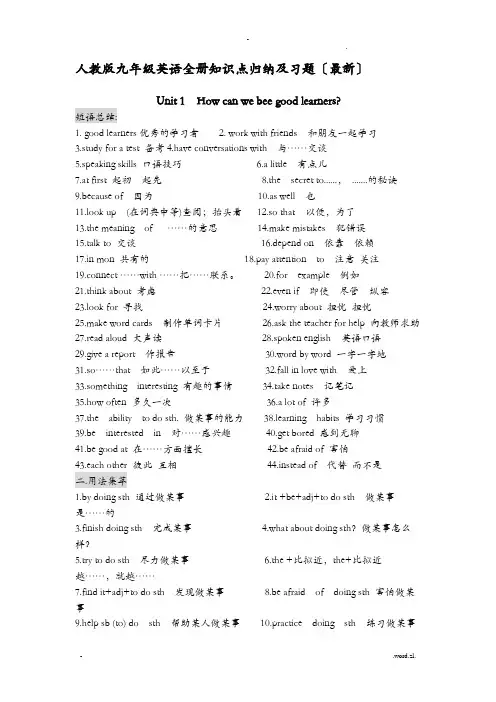
人教版九年级英语全册知识点归纳及习题〔最新〕Unit 1 How can we bee good learners?短语总结:1. good learners优秀的学习者2. work with friends 和朋友一起学习3.study for a test 备考4.have conversations with 与……交谈5.speaking skills 口语技巧6.a little 有点儿7.at first 起初起先8.the secret to......,.......的秘诀9.because of 因为10.as well 也11.look up (在词典中等)查阅;抬头看12.so that 以便,为了13.the meaning of ……的意思14.make mistakes 犯错误15.talk to 交谈16.depend on 依靠依赖17.in mon 共有的18.pay attention to 注意关注19.connect ……with ……把……联系。
20.for example 例如21.think about 考虑22.even if 即使尽管纵容23.look for 寻找24.worry about 担忧担忧25.make word cards 制作单词卡片26.ask the teacher for help 向教师求助27.read aloud 大声读28.spoken english 英语口语29.give a report 作报告30.word by word 一字一字地31.so……that 如此……以至于32.fall in love with 爱上33.something interesting 有趣的事情34.take notes 记笔记35.how often 多久一次36.a lot of 许多37.the ability to do sth. 做某事的能力38.learning habits 学习习惯39.be interested in 对……感兴趣40.get bored 感到无聊41.be good at 在……方面擅长42.be afraid of 害怕43.each other 彼此互相44.instead of 代替而不是二.用法集萃1.by doing sth 通过做某事2.it +be+adj+to do sth 做某事是……的3.finish doing sth 完成某事4.what about doing sth?做某事怎么样?5.try to do sth 尽力做某事6.the +比拟近,the+比拟近越……,就越……7.find it+adj+to do sth 发现做某事8.be afraid of doing sth 害怕做某事9.help sb (to) do sth 帮助某人做某事10.practice doing sth 练习做某事11.keep doing sth 一直做某事12.be afraid to do sth 害怕做某事13.begin to do sth 开场做某事14.want to do sth 想要做某事15.need to do sth 需要做某事16.remember to do sth 记得做某事17.shoot 射〔射着,射死等表结果〕18.shoot at〔瞄准〕射Unit1 检测题一.单项选择1.—_______ do you study English? —By listening to tapes.A. HowB. WhereC. WhenD. Why2.You can improve your English practicing more. A.by B.with C.ofD.in3. Why not practice your _________English in _________ English-speaking country?A. speaking, aB. speaking, anC. spoken, an4. ________conversations with others is one of the secrets to _________a successful learner.A. Practice, beeB. Practice, beingC. Practicing, being5 ---There’re a few new words in the article? ---What about _________in your dictionary?A. looking it upB. looking up itC. looking them up6. We’ll go out to play _________ it rains tomorrow. A. so B. unless C. because7. Can you ________which is the right answer to the question? A. look for B. find C. find out8. Jenny used to be afraid to ________in class, so she always ________nothing.A. speak, talkedB. speak, saidC. say, spoke9.— Why not listen to BBC news to improve your listening skills?—It’s ________ difficult _______ I can’t follow. A. too; to B. so; that C. such; that10. A good learner often thinks about ________he needs to practice more.A. thatB. whatC. how11.--I’m going to listen _______the tape. --OK. Remember to listen ________the key words.A. to, toB. to ,forC. for, to12. ________or not you can learn well depends on your learning habits.A. IfB. WeatherC. Whether13. I have finished _________my report. May I start to learn ________the guitar?A. writing, playingB. writing, to playC. to write, playing14. ---I often make mistakes _______grammar. ---Why not ask your teacher _______help?A. in, toB. in, forC. at, to15. _________write down the new words in your notebook?A. Would you likeB. How aboutC. Could you please16. ---Jack used to have ________writing practice. ---Yes, and he had learned _________.A. a lot of, a lot ofB. a lot of, a lotC. a lot, a lot of17. The more careful you are, ________mistakes you’ll make.A. fewer B. the fewer C. the less18. Good learners aren’t afraid _______mistakes. Instead, they learn ________mistakes.A. of making, inB. to make, fromC. to make, in19. For the first time, pay attention _________quickly to get the main ideas.A. to readB. readingC. to reading20.I discovered that listening tois the secret language learning.A.something intresting, toB.interesting something, toC.something interested, ofD.interested something of21.Jenny found it very easyEnglish well. A.learning B.to learn C.learnD.learned22. He_____ with the girl with golden hair and will soon get married____ her.A. falls in love; toB. is in love; toC. loves; withD. loves; to23. My father thinks _____ is a great way to learn English.A. study grammar.B. I study grammar.C. studying grammar.D. studies grammar24 Why not ___ your teacher for help when you can’t finish _____ it by yourself?A. ask; writeB. to ask; writingC. ask; writingD. asking; write25. I wonder if I can learn English well.— . All things are difficult before they are easy.A. I am afraid soB. You’re slowC. It takes timeD. It’s a piece of cake26 You’ll find _____________ easy to learn it well. A. that B. its C. it D. this27. –I don’t have a partner to practice English ______________.---Why not join an English language club to practice _______________?A. /; speakingB. with; to speakC. /; to speakD. with; speaking28. ---She hardly makes mistakes _________English grammar.---No, it seems that she was born ________the ability to learn languages.A. in, withB. with, inC. in, inD. with, with二用所给单词的适当形式填空。
人教版九年级全一册Unit1知识点和练习(无答案)

( 1)byby+Ving①—How do you study for a test? I study by working with a group.②We usually go to school by bike.③English is spoken by many people.By:1.“通过……的方式”2.表示“乘坐”3.用于被动语态,引导出动作的发出者。
跟踪练习1)He goes to school bike.A. by B. on C. in D. at2)-- How do you study English so well?By lots of books.A.readB. lookC. watchingD. reading(2)aloud / loud/ loudlyaloud出声地;大声地。
常与read/call等词连用,不用于比较级;(Don’t read aloud in the library.)loud高声地;大声地;喧闹地。
指说话声和笑声,常与talk/speak/laugh/sing等词连用,常用于比较级;( We can’t hear you. Please speak louder.)loudly高声地;喧闹地。
可以和loud互换,但含有“吵闹”的意思,不悦耳。
( I feel very annoyed when they argue loudly.)跟踪练习①老师要求我大声朗读课文。
The teacher asked me to thetext .②请大声点说,以便我能听清楚。
Please so that I canhear you clearly.③不要这么大声,婴儿在睡觉。
Don’t so . Thebaby is sleeping. (3)practice doing sth. 练习做某事eg. We practice ____ English every day.(我们每天练习说英语。
人教版九年级英语上册Unit1单词及重点短语(附例句)
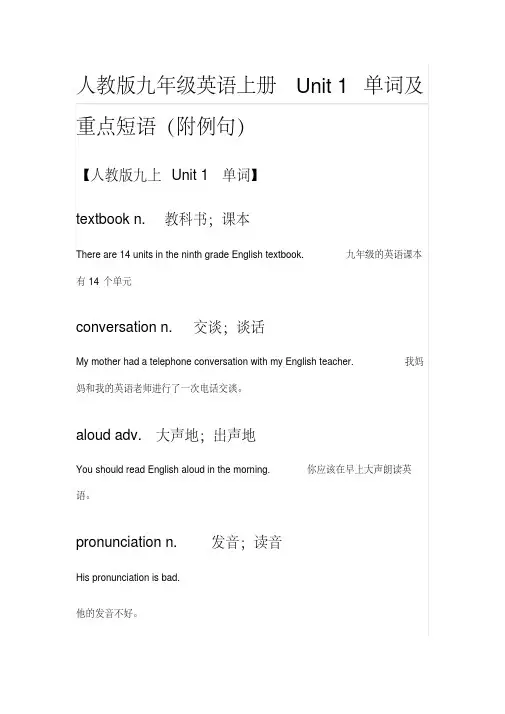
人教版九年级英语上册Unit 1单词及重点短语(附例句)【人教版九上Unit 1单词】textbook n.教科书;课本There are 14 units in the ninth grade English textbook. 九年级的英语课本有14个单元conversation n.交谈;谈话My mother had a telephone conversation with my English teacher. 我妈妈和我的英语老师进行了一次电话交谈。
aloud adv.大声地;出声地You should read English aloud in the morning. 你应该在早上大声朗读英语。
pronunciation n. 发音;读音His pronunciation is bad.他的发音不好。
sentence n.句子My sister is too young to speak out a complete sentence. 我妹妹太小了,还不能说出一个完整的句子。
patient adj.有耐心的n.病人Doctors always take care of every patient patiently. 医生总是耐心地照顾每个病人。
She is patient with everything.她对一切都很有耐心。
expression n.表达(方式);表示There was an expression of joy on her face when she heard the excitingnews.当她听到这个令人兴奋的消息时,脸上露出了喜悦的表情。
discover v.发现;发觉Scientists are working to discover a better way to fight air pollution. 科学家们正在努力寻找防治空气污染的更好方法。
人教版中考英语一轮复习:九年级英语Unit1-Unit 14 各单元重点语法知识点复习提纲(全面!)
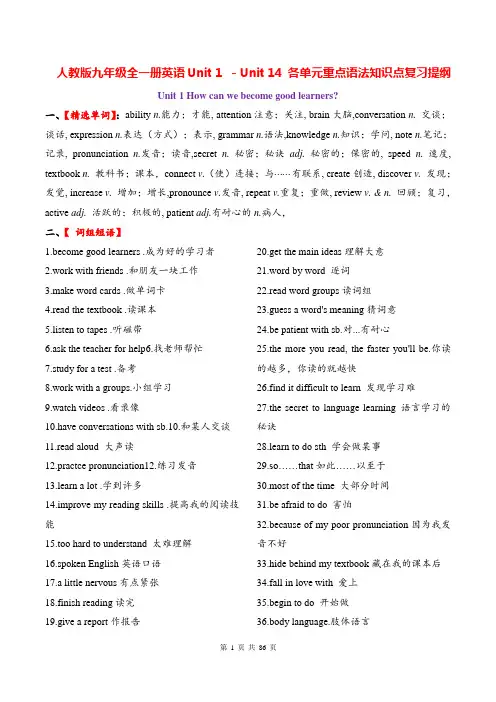
人教版九年级全一册英语Unit 1 -Unit 14 各单元重点语法知识点复习提纲Unit 1 How can we become good learners?一、【精选单词】:ability n.能力;才能, attention注意;关注, brain大脑,conversation n. 交谈;谈话, expression n.表达(方式);表示, grammar n.语法,knowledge n.知识;学问, note n.笔记;记录, pronunciation n.发音;读音,secret n. 秘密;秘诀adj. 秘密的;保密的, speed n. 速度, textbook n. 教科书;课本,connect v.(使)连接;与⋯⋯有联系, create创造, discover v. 发现;发觉, increase v. 增加;增长,pronounce v.发音, repeat v.重复;重做, review v. & n. 回顾;复习,active adj. 活跃的;积极的, patient adj.有耐心的n.病人,二、【词组短语】1.become good learners .成为好的学习者2.work with friends .和朋友一块工作3.make word cards .做单词卡4.read the textbook .读课本5.listen to tapes .听磁带6.ask the teacher for help6.找老师帮忙7.study for a test .备考8.work with a groups.小组学习9.watch videos .看录像10.have conversations with sb.10.和某人交谈11.read aloud 大声读12.practce pronunciation12.练习发音13.learn a lot .学到许多14.improve my reading skills .提高我的阅读技能15.too hard to understand 太难理解16.spoken English英语口语17.a little nervous有点紧张18.finish reading读完19.give a report作报告20.get the main ideas理解大意21.word by word 逐词22.read word groups读词组23.guess a word's meaning猜词意24.be patient with sb.对...有耐心25.the more you read, the faster you'll be.你读的越多,你读的就越快26.find it difficult to learn 发现学习难27.the secret to language learning 语言学习的秘诀28.learn to do sth 学会做某事29.so……that如此……以至于30.most of the time 大部分时间31.be afraid to do 害怕32.because of my poor pronunciation因为我发音不好33.hide behind my textbook藏在我的课本后34.fall in love with 爱上35.begin to do 开始做36.body language.肢体语言37.expressions on their faces.面部表情38.listen for just the key words只留心听关键词39.as well as和...一样好/也40.something interesting一些有趣的东西eful sentences有用的句子42.a piece of cake小菜一碟/很容易的事情43.it serves you right.活该44.look them up查询他们45.so that以便46.have a better understanding of对...有一个更好的理解47.repeat out loud大声重复出来48.take notes记笔记49.do grammar exercises做语法练习50.keep a diary in English用英语记日记51.increase my reading speed提高我的阅读速度52.make mistakes in grammar/spelling在语法/拼写方面犯错53.get the pronunciation right把发音弄准确54.get much writing practice进行许多书写练习55.have a partner to practice English with找个一块练英语的伙伴56.a successful learner 一个成功的学习者57.be born with 与生俱来/天生具有58.the ability to learn 学习能力59.whether or not 不管还是60.depend on依靠61.learning habits学习习惯62.have ... in common 在...有共性63.creat an interest in sth.在.....创造兴趣64.be interested in感兴趣65.pay attention to关心,注意66.connect ...with把... 和...相连接67.get bored厌烦68.learn from mistakes从错误中学习.69.think about 考虑70.be good at擅长71.even if即使72.practice makes perfect熟能生巧73.keep practicing坚持练习74.develop their study skills培养他们的学习技巧75.it is not enough to do sth干……还不够76.write down写下77.draw mind maps画思维导图78.look for ways to do寻找做……的办法79.explain sth to sb.向某人解释……80.ask each other相互问81.find out the answers找到答案82.knowledge comes from questioning.知识来源于质疑83.a lifelong journey.一生的旅行84.learn wisely.智慧地学习?85.three good ways to .三个做……好办法86.be stressed out紧张的87.develop smart study skills.培养聪明的学习技巧88.on one's own.某人亲自89.bit by bit.一点一点的/逐渐地90.the last minute to do.做……的最后时刻91.at once.立刻,马上92.prepare well for sth准备好93.worry about.担心94.over and over again一次就一次地95.have a listening test.进行一次听力考试三、【重点句型】1. What about listening to tapes?听磁带怎么样?2. How do you study for a test?你怎样为考试而学习的?3. I study by making word cards.我通过制作单词卡片来学习。
Unit 1 单元词汇复习详解-人教版九年级英语全册

will get.
A. the more careless B.the more careful
C. the harder
D. the worse
4. Just search the Internet and you can get almost all the B you need.
A. message B. information C. picture D. story
Explaination
辨析: connect A with B & connect A to B 1. 用with指把A与B连接在一起,A、B之间不分主次。
Tim connected this(电线) wire with that one. 2. 用to指把A连接在B上,说话者以B为主,为A为辅。
Exercises
根据句意及汉语和首字母提示填写单词 1. The pain in his leg made him cry a loud (大声 地). 2. Dave had a long c onversation (谈话)on the phone with his teacher
yesterday. 3. —Mom, I forgot where I put my t extbook ( 课本) .Could you help me
pronounce n. pronunciation n. 发音;读法 I don't know how to pronounce this word. We should practice pronunciation every morning.
Explaination1. increase vi.
—I learn English D practicing conversations with friends.
人教版初中九年级英语Unit1-Unit2知识梳理
7. 老师说得太快了,以至于大部分时间我都理解 不了她的话。 The teacher spoke _so_ _q_u_i_c_k_ly_ _t_h_a_t I did not understand her most of the time.
8. 我发现听有趣的东西是语言学习的秘诀。 I discovered that l_i_st_e_n_i_n_g_to _so_m__e_t_h_in_g_ _i_n_te_r_e_s_ti_n_g_is the secret t_o_language learning. 9. 我没有一位可以一起练习英语的搭档。 I don't have a partner _to_ _p_r_a_ct_i_c_e _E_n_g_l_is_h_ _w_i_th_.
25.处罚;惩罚 v. _p_u_n_i_sh_→n. 惩罚 _p_u_n_i_s_h_m_e_n_t_ 26.温暖;暖和n. _w_a_r_m__th_→adj. _w__a_rm__ 27.传播;展开 v. 蔓延;传播n. s_p_r_e_a_d_→ (过去式/过去分词) _sp_r_e_a_d_
重点短语 1. 查阅;抬头看 _lo_o_k__u_p_
2.天生具有 b__e_b_o_r_n__w_i_th_ 3.关注;注意 _p_a_y_a_t_t_e_n_ti_o_n_t_o_
4.把……和……连接起来 _c_o_n_n_e_c_t_. _. _.w_i_t_h_ 5.增加(体重);发胖 _p_u_t__o_n
九年级 Unit1-Unit2
重点单词 1. 大声地;出声地 adv. a_l_o_u_d_→adv. 大声地 _lo_u_d_l_y_ 2.发音;读音n. _p_r_o_n_u_n_c_i_a_ti_o_n_→v. 发音 _p_r_o_n_o_u_n_c_e_ 3.有耐心的adj. 病人n. _p_a_t_i_en__t →n. 耐心 _p_a_t_ie_n_c_e_ 4.表情; 表达方式;表示n. _e_x_p_r_e_ss_i_o_n_→v. 表达 _e_x_p_r_e_ss_
人教版九年级上册英语unit1知识点总结
人教版九年级上册英语unit1知识点总结Unit 1 Knowledge Points in People's Education Press Ninth Grade English TextbookIntroduction:The first unit of the People's Education Press Ninth Grade English textbook covers various essential knowledge points. This article aims to summarize these points, providing a comprehensive understanding of Unit 1. Let's explore the highlights of the unit.1. Greetings and Introductions:Unit 1 begins with basic greetings and introductions. Students learn how to greet others and introduce themselves and others using phrases such as "Hello," "What's your name?" and "Nice to meet you." Practicing these phrases helps students develop their conversational skills.2. Personal Pronouns:The unit also focuses on personal pronouns, including "I," "you," "he," "she," "it," "we," and "they." Students learn how to use these pronouns correctly in sentences and conversations. Understanding personal pronouns is essential for effective communication in English.3. Present Simple Tense:The Present Simple tense is a crucial grammatical concept covered in Unit 1. Students learn how to form sentences using this tense, along with the third-person singular form. They also practice using adverbs of frequency, such as "usually" and "sometimes," to describe routine actions.4. Possessive Adjectives:Unit 1 introduces possessive adjectives like "my," "your," "his," "her," "its," "our," and "their." Students understand how to use these adjectives to show ownership or possession. Mastery of possessive adjectives is vital for accurate and meaningful communication.5. Countries and Nationalities:This unit expands students' knowledge of different countries and nationalities. They learn how to say their nationality and ask about others' nationalities using the question structure "What nationality are you?" This topic fosters cultural sensitivity and promotes understanding among students.6. Numbers and Dates:Unit 1 also covers numbers and dates. Students learn to express and understand cardinal and ordinal numbers, allowing them to discuss dates and quantities accurately. This knowledge facilitates interactions involving time, schedules, and various numerical information.7. Describing Appearance and Personality:Students explore vocabulary related to appearance and personality traits. They learn descriptive adjectives to discuss physical features and use adjectives such as "friendly," "honest," and "hardworking" to describe personality traits. These skills enhance students' ability to describe themselves and others.8. Identifying Objects:The unit provides practice in identifying objects by their shape, color, and material. Students learn to use words like "round," "blue," and "plastic" to describe objects accurately. This knowledge helps them communicate effectively when describing something or searching for specific items.9. Daily Routines:Unit 1 also includes vocabulary related to daily routines. Students learn words and phrases for activities they usually do, such as "get up,""brush teeth," and "go to school." This section enhances their ability to talk about their daily lives and understand others' routines.10. Asking and Answering Questions:The unit teaches students how to ask and answer "Wh-" questions, enabling them to engage in meaningful conversations. Mastering this skill enhances their ability to gather information, express opinions, and seek clarification.Conclusion:Unit 1 of the People's Education Press Ninth Grade English textbook covers a wide range of essential knowledge points. From greetings and introductions to asking questions and describing objects and routines, students acquire valuable language skills. By grasping these knowledge points, students can effectively communicate in English, laying the foundation for successful language learning in the future.。
人教版九年级上unit1知识点详解和练习
Unit1Howcanwebecomegoodlearners?短语归纳workwithfriends 和朋友一起学习 giveareport 作报告 asktheteacherforhelp 向老师求助 wordbyword 一字一字地 Studyforatest 备考 howoften 多久一次 haveconversationswith 与……交谈 fallinlovewith 爱上…… Speakingskillls 口语技巧 takenotes 记笔记 Thesecretto……的秘密 theabilitytodosth 做某事的能力 Becauseof 因为 getbored 感到无聊 Aswell 也 beafraidof 害怕 Lookup 查阅,抬头看 eachother 彼此,互相 Sothat 以便,为了 insteadof 代替,而不是 Themeaningof……的意思 begoodat 擅长于 Makemistakes 犯错误 learninghabits 学习习惯 Dependon 视……而定,依靠,依赖 spokenEnglish 英语口语 Incommon 共有的 readaloud 大声读 Payattentionto 注意,关注 Connect……with……把……和……联系起来 用法集萃Bydoingsth 通过做某事 keepdoingsth 一直做某事 Whataboutdoingsth?做某事怎么样?Wanttodosth 想要做某事 It+be+adj+todosth 做某事是……的 needtodosth 需要做某事 Finishdoingsth 完成某事 remembertodosth 记得做某事 Trytodo 尽力做某事 Begintodo 开始做某事 The+比较级,the+比较级越……,就越……practicedoingsth 练习做某事 Beafraidtodosth 害怕做某事 Findit+adj+todosth 发现做某事……SectionA 知识点详解1.byaskingtheteacherforhelp 通过向老师求助1)by,“通过;靠”,后加名词/代词/动名词。
人教版九年级英语全一册知识梳理第一单元《Unit 1 Grammar》
Unit 1《HOW CAN WE BECOME GOOD LEARNERS?》语法精讲(一)介词by的用法1. by表示方式、方法或手段,后接名词或动名词,意为“使用某物;(做某事)靠...;乘(车、船)等”(用how 提问) 。
➩ Do you learn English by reading aloud?你通过大声朗读来学习英语吗?➩ I often go to school by bike. 我经常骑自行车去上学。
➩ — How can I turn on this light? 我怎么开这盏灯?— By turning this button. 转这个按钮。
2. by表示时间,意为“到……时(为止);在……以前、不迟于”。
如:➩ I have to go to bed by ten o'clock. 我必须10点前睡觉。
➩ Can you finish your work by the end of the day? 你能在今天前完成你的工作吗?3. by表示地点、位置,意为“靠近;在……旁边”。
如:➩ The boy often reads books by the river. 这个男孩经常在河边读书。
常连用的短语:by the way 顺便问一下by accident= by chance 偶然地by mistake 错误地by the time 到……为止by oneself 独自地by hand 用手by the end of 到.... 末尾go/pass by 通过;经过by与with, in的区别:◆with 的用法:表示用某种工具(1). with +工具We like to write with a pen.(2). with +人体部位We see with our eyes.◆in 的用法:通常与“衣着、声音、书写材料”等名称连用in+语言in English 用英语in ink 用墨水speak in a loud voice大声地讲in red 穿红色的衣服(二)动名词用法小结1. 动名词在句中作主语(1). 动名词作主语时,谓语动词用第三人称单数形式。