
牛津深圳版英语八下Unit 2《Body language》(Period 3)ppt课件
牛津深圳版八年级下册英语期中试卷 2套(Word版,含答案)
第 1 页 共 22 页 牛津深圳版八年级下册英语期中试卷1
满分∶ 120分 时间∶ 100 分钟
一、根据汉语提示写单词 (10分)
1. Her body ___________is making other people feel welcome. (语言)
2. There are about 30 Chinese ___________in each line. (文字)
3. I gave him some ________before he dived into the river. (警告)
4. Can you ________yourself in three words? (描述)
5. ______________elephants are huge and grey. (亚洲的)
6. The dove is a ______________of peace. (象征, 符号)
7. Many _____________ live in the village by the sea. (渔民)
8. They went to the cinema ___________________(分别地).
9. I think we should meet their___________ needs of food and water. (基本的)
10. If you want to succeed in getting the job, you must make a good __________on the
interviewers. (印象)
二、用所给词的适当形式填空 (10分)
11. Shaanxi is in ____________China. You can see pandas there. (centre)
12. This is my ____________chance. I won't miss it. (two)
(完整版)深圳牛津版英语最新八年级(上)课文(带翻译)
初二(上)
课文 (翻译)
1—4
Unit 1 Look it up! 查阅
这里是两篇来自百科全书的文章。
Here are two articles['ɑːtɪk(ə)l]文章 from an encyclopaedia [ɪn,saɪklə'pidɪə]百科全书.
达芬奇·莱昂纳多
Da Vinci, Leanardo
达芬奇·莱昂纳多(1452-1519)是意大利画家、发明家、音乐家、工程师和科学家。
Leanardo da Vinci (1452—1519) was an Italian painter['peɪntə]画家,
inventor[ɪn'ventə]发明家, musician [mjuː'zɪʃ(ə)n]音乐家, engineer [endʒɪ'nɪə] 工程师and scientist.
达芬奇出生在农村。从很小的时候, 他就表现出极大的智慧和艺术能力。随着年龄的增长, 他学会了做很多不同的事情。他的画是非常有名的, 其中一副, 《蒙娜丽莎》, 也许是世界上最有名的画作。他还有许多发明。例如, 他的笔记本里有一些关于飞行器的有趣的图纸。
Da Vinci was born in出生于 the countryside['kʌntrɪsaɪd]农村.From an early age从早期开始, he showed great intelligence[ɪn'telɪdʒ(ə)ns] 智慧and artistic ability[ɑː'tɪstɪk] [ə'bɪləti]艺术才能.As当;随着 he grew older, he learnt to do many different things.His
paintings['peɪntɪŋ]画作 are very famous, and one, the Mona Lisa, is perhaps the most
牛津深圳版(广州沈阳)广东省深圳高级中学2020第二学期八年级下 Moldule 2 Unit1-Unit2单元测试(含答案)
广东省深圳高级中学2020第二学期牛津深圳版
英语八年级下 U1-U2单元测试卷
班级 姓名 分数
I. 单项选择(共35小题,每小题1分,共35分)
i. 从下面每小题的A、B、 C三个选项中选出可以替换划线部分的最佳选项。
( )1. I enjoy reading because it gives me knowledge and brings me joy.
A. sadness B. happiness C. surprise
( )2.—What does the expression on his face mean?
—It means he is very happy.
A. look B. sound C. thought
( )3. —I reminded you about the party today, but you still forgot it.
—I’m very sorry for that.
A. made ... leave B. made ... organize C. made ... remember
( )4. —Don’t worry. I believe nothing will take place because we’ve been ready for everything.
—That’s good. But we’d better be careful.
A. happen B. matter C. change
( )5. —Look at me, Doris. Raise your spirits and everything will be OK.
—You’re right. I should be confident.
Units1-4期中复习--词汇运用+2022-2023学年牛津深圳版 八年级英语下册【附答案】
1 深圳牛津八年级下册期中复习U1-4词汇运用
U1 Help those in need
Ⅰ. 根据要求写出相应单词
1. permit(名词)____________ 2. serious(副词)____________ 3. illness(形容词)____________
4. organize(名词)____________ 5. express(名词)____________ 6. pain(形容词)____________
7. difficult(名词) ____________ 8. joy(形容词)
____________
Ⅱ. 用所给词的适当形式填空
1. friendship
1)I have a close ____________ with my aunt.
2)Mary and I have been ____________ since we met each other at the first time.
3)Mr. Li is always ____________ to us.
2. disabled
1)We should help the ____________ people.
2)He was not ____________ to go home tonight.
3. serious
1)Luckily, the accident was not ____________.
2)—Is she ____________ ill at present? —Yes. The doctor says that they will try to
save her life.
4. courage
1)Tom has enough _________ to overcome the illness.
牛津英语深圳版 9AB C1 Body language 课文改写&语法冠词练习题01
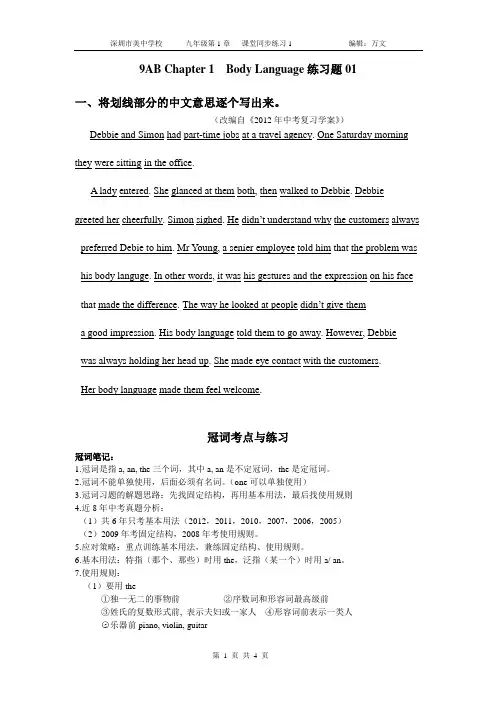
深圳市美中学校 九年级第1章 课堂同步练习1 编辑:万文
第 1 页 共 4 页 9AB Chapter 1 Body Language练习题01
一、将划线部分的中文意思逐个写出来。
(改编自《2012年中考复习学案》)
Debbie and Simon had part-time jobs at a travel agency. One Saturday morning
they were sitting in the office.
A lady entered. She glanced at them both, then walked to Debbie. Debbie
greeted her cheerfully. Simon sighed. He didn’t understand why the customers always
preferred Debie to him. Mr Young, a senier employee told him that the problem was
his body languge. In other words, it was his gestures and the expression on his face
that made the difference. The way he looked at people didn’t give them
a good impression. His body language told them to go away. However, Debbie
was always holding her head up. She made eye contact with the customers.
深圳牛津版八年级下册课文翻译

第一单元:义务性工作
三名青少年主动提出在学校放假期间做一些义务性工作。他们写了以下报告。
我在一个儿童医院做了一些义务性工作。那里的孩子们都遭受着严重疾病的折磨。我们为他们组织了一次绘画比赛。
我遇到了一个叫辛迪的女孩。她想画一幅她家附近的公园的图画。我去了那个公园,拍了一些照片。辛迪用它们来画画。
贝蒂
有很多失去父母的孩子。我和妈妈一起见了几个这样的孩子。我们教他们讲故事。这帮助他们表达自己感情。一个孩子说:“我的朋友们不理解我的痛苦。”
我们和一个叫薇薇安的女孩共度时光。她的父母在一次车祸中丧生,她很伤心,也非常孤独。她需要友谊。我和妈妈将继续去看望薇薇安。
马克
我想帮助残疾儿童。他们行动困难。我教他们唱歌,因为音乐能带给他们快乐和宁静。
我遇到了一个叫蒂姆的男孩。他在一次事故中双腿受伤,但是他很有勇气。我们需要帮助像蒂姆这样的孩子,使他们鼓起勇气。在将来我会继续做义务性工作。
安妮
第二单元:肢体语言
黛比和西蒙是学生。他们两个都在一家旅行社做兼职工作。
一位穿着讲究的女士进入了办公室。她看了看黛比和西蒙,然后朝黛比走了过去,黛比高兴地向她打招呼。
西蒙叹着气走开了。
“怎么啦?”杨先生问。
“人们总是选择黛比而不是我。我不能理解。”
“我能理解。这是你交流方式的问题。”
“那怎么可能呢?西蒙问,“我都没有机会说话。”
“交流不仅仅是说话。你的肢体语言也是很重要的。”
“肢体语言?”
“它是你站和坐的方式、你的手势和面部的表情。你的整个外观都在传递信息。你没给人留下一个你好印象,西蒙。你低着头,从不微笑并且你不朝他们转头。 看看黛比,她一直在高抬着头,她总是微笑,看上去友好。她的肢体语言使人们觉得(自己)受欢迎,因此人们去她那儿求助。”
西蒙决定改善自己的肢体语言,他坐直身体并试着向人微笑。
几分钟过后,一个漂亮的女孩走了进来。她朝西蒙走了过去。一会儿之后,她带着微笑离开了。
杨先生立即走了过来说,“你给她留下了一个好印象,西蒙。”
2020—2021学年牛津深圳版初中英语八年级下学期Units1-4 基础知识专项练习
八年级下Units1-4 基础知识专项练习
词汇
一、根据短文内容及首字母提示,填写所缺单词。(每空限填一词)
Want to speak with your body? Use body language! A “V” gesture shows happiness, victory or (1)
p__________. Opening the mouth wide shows surprise. This is body language.
When you speak with others, body language is important. Scientists say we do 65 per cent of our
communication with body language. For example, when you (2) c__________ your arms, it may mean you feel
cold, and it can also mean you are angry. Sitting up straight shows you are confident. Sometimes you don’t say a
word, but your body language (3) e__________ your feelings.
In different cultures, the same body language may have different (4) m__________. Nodding your head in
most countries means “yes”. But in some parts of Turkey, it means “no”. If you want to make a good (5)
i__________ on local people when you travel abroad, you should pay attention to your body language.
期末复习之阅读理解16篇(深圳名校真题)八年级英语下学期期末复习查缺补漏冲刺满分(牛津深圳版)
期末复习之阅读理解16篇
(深圳名校真题)
(2223八年级下·广东深圳·期末)After wearing masks in public for three years, many Japanese are taking
classes to learn how to smile again.
Smiling is meant to be a natural response, but it appears that hiding behind a mask for three years has left
many Japanese unable to smile naturally. Some of them now paying smiling trainers to teach them how to show
their white teeth again in a natural way. They take special classes where they are taught how to exercise different
parts of their faces and even their neck muscles (肌肉) to smile properly and express happiness without looking
strange.
“A smile is a smile only when it is shown on your face,” Keiko Kawano, a successful businesswoman who
used to be a radio host, told the Japan Times. “Even if you’re thinking about smiling or that you’re happy, if you
八年级英语上册 Unit 3 Lesson 1 Idioms with Body Parts text教案 牛津深圳版五四制
Unit 3 Lesson 1 Idioms with Body Parts text
教学目标:
Teaching objectives:
Ⅰ. Knowledge and skills:
1. Students will be able to master some sentence patterns.
2. Students will be able to talk about idioms with body parts.
Ⅱ.Progress and Methods:
1. Students will be able to develop their abilities of learning independently,
cooperation with others and sharing with others.
2. Students will be able to learn how to use the knowledge into practice.
3. Students will be able to develop their abilities of listening, speaking and reading.
Ⅲ.Emotions and values:
1. Students will be able to arouse the interest of learning English.
2. Students will be able to develop the communicative skills about how to use the new
words and phrases.
Language focus and difficult points:
To talk about idioms with body parts.
牛津英语深圳版 9AB C1 Body language 课文划线翻译练习题
深圳市美中学校 九年级第1章 课堂同步练习2 编辑:万文
第 1 页 共 2 页 9AB C1 Body language课堂同步练习2
一、将下面的文章以划线部分为单位,翻译成中文
9AB Chapter 1 Body Language
(引言)Debbie and Simon have part-time jobs at a travel agency. It is Saturday morning.
They are at work in the office.
(第1段)Debbie and Simon looked up as a well-dressed lady enterd. The lady
glanced at them both, and then walked over to Debbie. Debbie greeted her cheerfully.
(第2段)“Hello,” the lady said. “I want to go by train from Shenzhen to Guangzhou…”
(第3段)Simon sighed. Mr Young, a senior employee, was standing beside him.
(第4段) “What’s up, Simon? You don't look very happy.”
(第5段) “The customers always prefer Debbie to me. I can’t understand it.”
(第6段) “I can. It’s the way you communicate.”
(第7段) “How can that be?” Simon asked. “ I don’t even get a chance to speak to them.”