
仁爱版七下英语Unit6-topic1重要知识点和语法点归纳
Unit 6-Our Local Area
Topic 1 Is there a computer in your study?
一、重点词汇
1.first第一,one的序数词 2.second第二,two的序数词
3.floor 层,on the second floor在第二层 地板,on the floor在地板上
4.front前面(的),反义词back后面,后面的
5.put放(动词)现在分词——putting 6.left左边(的)反义词right 右边(的)
7.away(副词)离开,不能在句子中做谓语,be away离开 8.study n.书房 v.学习
二、重点短语
1. go upstairs上楼 go downstairs下楼 2. in the front of the house 在屋子(里面的)前面
3.in front of the house 在屋子(外面的)前面 4.talk about sth谈论,议论,讨论某事
5. talk with sb. 与某人交谈 6.put them /it away 把它们/它收起来
7. look after = take care of照顾 8. play with sb. 与某人一起玩 play with sth.玩弄某物
9. in the tree(树本身以外物品)在树上 on the tree 在树上(树本身长出来的花、果、叶等)
10.on the wall在墙上 (表面) in the wall 在墙上(镶嵌在墙上,如:门、窗)
11. tell sb about sth 告诉某人某事 =tell sb sth 12.have a look (at sth.)看一看(某物)
13.and so on等等 14.in the center of the yard在院子中央
15.on the left/right of the yard在院子的左边/右边 16.only a little只有一点点
17.an apple tree一棵苹果树 two apple trees 两颗苹果树
三、重点句型
1.Welcome to my new home.欢迎到我新家。
2.It’s on the second floor. 卧室在二楼。在哪一层楼用介词on。on表示在……上面。
second是序数词,前面要用定冠词the, 意为第二(的),并且floor 用单数。
on the first floor美式英语一楼floor地板,此处指“楼房的层”。
英式英语用the ground floor 表示一楼
巧辩异同 two与second : two是基数词,后用可数名词复数。
second是序数词,第二(的),指排列顺序,后用可数名词单数。
3.There is a study next to my bedroom.挨着我的卧室有一个书房。
4.Why not go upstairs and have a look ? = Why don’t you go upstairs and have a look ?为什么不上楼看一看呢?
Why not+v.原形? =Why don’t you+v.原形?为什么不……?
5.There is one next to my family photo on the wall.在墙上紧挨着我的全家福有一个钟表。
6.Don't put them here.Put them away, please.不要把它们放在这儿。把它们收起来。
①put sth away =put away sth把某物收起来,表示物体的代词it, them必须放在动与副词之间。
②祈使句Put them here.变为否定句Don't put them here.(有何发现?)
7.You must look after your things.你必须保管好你的东西。
8.There are beautiful many flowers in the garden.But there aren’t anytrees.花园里有许多美丽的花。但是没有树。9.I love playing on the computer in the study. 我喜欢在书房玩电脑。 (love doing sth.=like doing sth. 喜欢做某事) 10.There are so many books on the shelves.架子上有如此多的书。so many+可数名词复数“如此/那么多的”
11.Some birds are singing in the tree.一些鸟正在树上唱歌。
注意区别:There are some birds singing in the tree.树上有一些鸟在唱歌。
12.Now I’m helping my father clean the study.我现在正在帮助爸爸打扫书房。
help sb. (to) do sth. = help sb. with sth.帮助某人做某事
13.Write to me about your home.给我写信告诉有关你家的情况。
14.——Is there a teacher in the front of the classroom?——Yes,there is./No,there isn’t.
15.方位短语:①in the center of=in the middle of在...中间
②in front of 在...前面(指外部)There is tree in front of the house.房子前面有一棵树。
③in the front of(内部)在...前面 (指内部)The driver is sitting in the front of the bus.司机坐在公共汽车的前面。
④at the back of 在...后面 (指内部)
She is cleaning the blackboard at the back of the classroom.There is a house at the back of the yard.
⑤ next to 紧邻 , 挨着
⑥behind在……后面(反义词in front of…)behind the chair/door
⑦ under 在…下面 under the chair /tree ⑧on the left/right of在...的左边/右边
16.There are two bedrooms and a a small study.
17.There is a lamp, a computer, some books and so on.
—Is there a computer in your study? —Yes, there is.
18.Don't put them here. Put them away.
19.There are many beautiful flowers in the garden,
20.but there aren’t any trees in it. 花园里有许多漂亮的花,但是却没有树。
四、重点语法
There be…句型的用法
There be 句型表示“某处存在某物或某人,表示一种客观存在,
而have“有”,表示“某人拥有某物/某人”表主观拥有,其主语是人。
There is a dog in the picture. The dog has two big eyes.
当have表示“包括”、“存在”的含义时,There be 句型与其可互换。
eg. A week has seven days. =There are seven days in a week.
肯定句:There is a computer in your study.
否定句--在“be”后加“not”: There isn’t a computer in your study.
一般疑问句--将“be”提到“there”之前: Is there a computer in your study?
----Yes, there is./ No, there isn’t.
特殊疑问句:There be句型的特殊疑问句形式有以下三种变化:
① 对主语提问:当主语是人时,用"Who's+介词短语?";
当主语是物时,用"What's + 介词短语?"。
注:无论原句的主语是单数还是复数,对之提问时一般都用is(回答时却要根据实际情况来决定)。 如: There are many things over there. →What's over there?
There is a little girl in the room. →Who is in the room?
② 对地点状语提问:提问地点用"Where is / are+主语?"
“There + be+主语+地点状语”表示“某处有某物”;
例: There is a computer on the desk. → Where is the computer?
There are four children on the playground. →Where are the four children?
地点状语也可放在句首,有时可用“,”与后面的部分隔开。
There are some pictures on the wall.=On the wall, there are some pictures.
③ 对数量提问:一般有两种句型结构:
How many+复数名词+are there+介词短语?
How much+不可数名词+is there+介词短语?
there be .......遵循..就近原则....。.There be如果后面接两个名词作主语,那么“be”的人称和数与邻 近的名词一致。
即be ..用.is..还是..are...,取决于离该动词最近的那个名词。如果该名词是单数或不可数名词就用................................is..,如果是复数就用........are...。.
★就近原则: There is a lamp , a computer, some books and so on.
There are two boys and a girl under the tree.
2020年春仁爱版英语七年级下册词组及重点句型
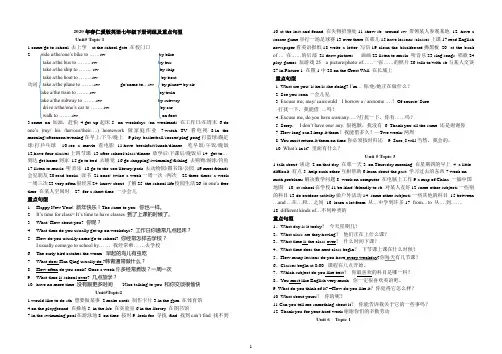
1 2020年春仁爱版英语七年级下册词组及重点句型
Unit5 Topic 1
e/go to school 去上学 at the school gate 在校门口
2.
ride a/the/one’s bike to ……sw by bike
take a/the bus to …….. sw by bus
take a/the ship to …….. sw by ship
take a/the boat to ……..sw by boat
动词 take a/the plane to ……..sw go/come to…sw by plane= by air
take a/the train to ……..sw by train
take a/the subway to ……..sw by subway
drive a/the/one’s car to ……..sw by car
walk to ……..sw on foot
e on 加油,赶快 4.get up起床5. on weekdays /on weekends 在工作日/在周末 6.do
one’s (my/ his /her/our/their….) homework做家庭作业 7.watch TV看电视8.in the
morning/afternoon/evening在早上/下午/晚上 9.play basketball/soccer/ping-pong打篮球/踢足球/打乒乓球 10.see a movie看电影 11.have breakfast/lunch/dinner 吃早饭/午饭/晚饭12.have four classes上四节课 13.after school/class/dinner 放学后/下课后/晚饭后14. get to….到达get home到家 15.go to bed 去睡觉 16.go shopping/swimming/fishing 去购物/游泳/钓鱼
仁爱版七年级下册英语:Unit 6 Topic 1 Section ABCD学案(无答案)
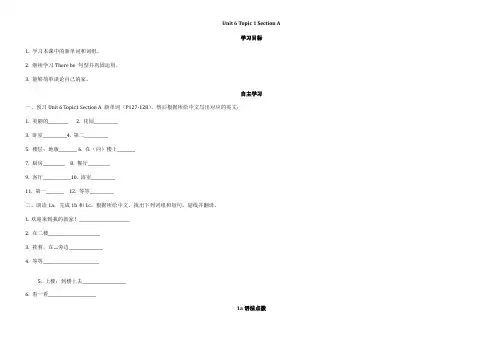
Unit 6 Topic 1 Section A
学习目标
1. 学习本课中的新单词和词组。
2. 继续学习There be 句型并巩固运用。
3. 能够简单谈论自己的家。
自主学习
一、预习Unit 6 Topic1 Section A 新单词(P127-128),然后根据所给中文写出对应的英文:
1. 美丽的__________ 2. 花园____________
3. 卧室____________4. 第二____________
5. 楼层;地板_________ 6. 在(向)楼上_________
7. 厨房___________ 8. 餐厅___________
9. 客厅______________10. 浴室____________
11. 第一_________ 12. 等等____________
二、朗读1a,完成1b和1c。根据所给中文,找出下列词组和短句,划线并翻译。
1. 欢迎来到我的新家!_________________________
2. 在二楼__________________________
3. 挨着;在....旁边_________________
4. 等等____________________________
5. 上楼;到楼上去______________________
6. 看一看________________________
1a语法点拨 1. --Where is your bedroom? --It’s on the second floor. There is a study next to my bedroom.
你的卧室在哪儿? 它在二楼,有一个书房紧挨着我的卧室。
(1)on the second floor “在二楼”,second 在此是序数词,意为“第二”,前面需要加定冠词the。second 还可作名词,意为“秒”,表时间。
2017七年级英语下册Unit6 Topic1知识点总结

2017七年级英语下册Unit6 Topic1知识点总结
2017七年级英语下册Unit6 Topic1知识点总结
重点语法 There be 句型和方位介词短语。
重点句型 There are two bedrooms and a a small
study.
Ta lamp, a compubooks and-Ia compuur study?
-Don't puPut them away.
重点讲解
1 Id fl在哪一层楼,用介词on。on表示在 上面。second是序数词,前面要用定冠词the, 意为第二(的)。
巧辩异同 two与second
two是基数词,second是序数词, 第二 或 第二的 ,指排列顺序。
2 in 在 里面,是方位介词。in the boxlaI? 表示某地存在 吗?其肯定回答是:否定回答N它的复数形式为A? 其肯定回答是:are. 否定回答Na巧辩异同 there be与 have
(1) there be 有 ,指(某地)存在 有 。
(2) have 有 ,指人或某物 拥有 。The is a dogure.
The dog has two big注:there be 遵循就近原则。be 用is还是are,取决于离该动词最近的那个名词。如果该名词是单数或不可数名词就用is,如果是复数就用are。ave a look看看。后面接名词时要用at. 如have a look
at your waalk about 谈论,议论 ,后接名词或动名词。
talk with/to 与某人交谈
6 用来询问某地有某物,其结构为:What s+介词短语,回答时应用there be句型。lay with 和 玩耍 ,
玩 play with sb. 与某人一起玩ut away 把 放好
仁爱英语七年级下册Unit 6 Topic 1基础训练(含答案)
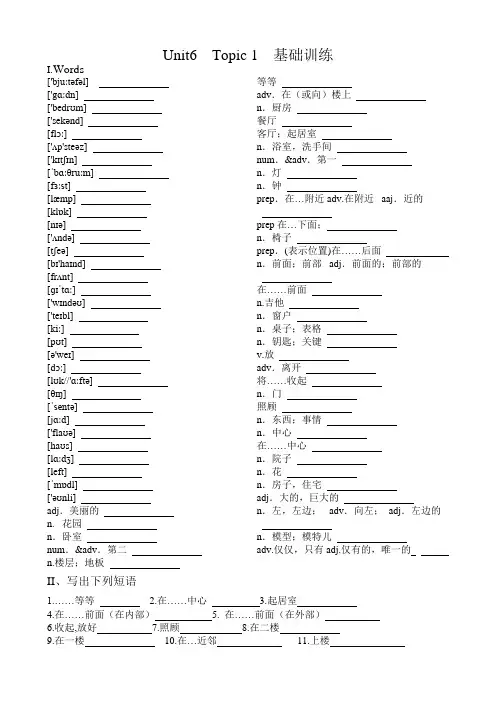
Unit6 Topic 1 基础训练
I.Words
['bjuːtəfəl]
['gɑːdn]
['bedrʊm]
['sekənd]
[flɔː]
['ʌp'steəz]
['kɪtʃɪn]
[ˈbɑːθruːm]
[fɜːst]
[læmp]
[klɒk]
[nɪə]
['ʌndə]
[tʃeə]
[bɪ'haɪnd]
[frʌnt]
[ɡɪˈtɑː]
['wɪndəʊ]
['teɪbl]
[kiː]
[pʊt]
[ə'weɪ]
[dɔː]
[lʊk//'ɑːftə]
[θɪŋ]
[ˈsentə]
[jɑːd]
['flaʊə]
[haʊs]
[lɑːdʒ]
[left]
[ˈmɒdl]
['əʊnli]
adj.美丽的
(仁爱版)英语七年级下册知识点归纳与总结

精品文档
. (仁爱版)英语七年级下册知识点归纳
Unit 5 Topic1
重点语法 一般现在时(常与频度副词___never____, ___seldom____,
___sometimes____,___often____, ___usually_,____always______等连用)
重点句型 —How do you usually come to school?
—I usually come to school by subway.
—How often do you go to the library?
—__once_____(一次)/____twice___(两次)/___three ___times____(三次)a week
Very often/Every day/Seldom
重点详解
1.I always come to school by bus.
by+交通工具名称,表示使用某种交通方式,中间不加限定词,如果交通工具前有_a/an___, __the_,形物代_ 等限定词,就不能用by,而是用___in__或是__on__.
on the train=__by__ train on his bike=__by__ bike in my car=_by___ car.
Eg: I go to school by bike. (on my bike)
Ps: 之前说的take+a/an/the+交单,但是这是一个动词词组,不能和By+交单对等互换。
系动词 包含Be
句子结构:1 主谓宾: I love you。
2 主谓:I go。
3 主系表: you are beautiful。
巧辩异同 on foot 与 walk on foot “走路”,是介词短语,不能作谓语,只作方式状语,位于句末。walk “走路”,是动词,可以作谓语。
2015 最新仁爱英语七年级下册各话题单词 Unit 6 Topic 1

Unit6 Topic 1 There is a study next
to my bedroom
beautiful adj.美丽的
garden n. 花园,菜园
bedroom n.卧室,寝室
second num.& adj.第二; n. 秒
floor n.楼层;地板
and so on 等等
upstairs adv.在(或向)楼上
kitchen n.厨房
dining room 餐厅
living room 客厅;起居室
bathroom n.浴室,洗手间
first adv.& adj.第一
lamp n.灯
clock n.钟
near prep.在……附近 adv. 在附近
aaj.近的
under prep.& adv.在……下面;少于
chair n.椅子
behind prep.(表示位置)在……后面
front n.前面;前部 aaj.前面的;前部的
in front of 在……前面
guitar n.吉他
window n.窗户
table n.桌子;表格
key n.钥匙;答案;关键
put v.放
away adv.离开
put away将……收起
door n.门
look after 照顾 thing n.东西;事情
center n.中心
in the center of 在……中心
yard n.院子
flower n.花
house 房子
large adj.大的,巨大的
left n.左,左边; adv.向左; adj.左边的
model n.模型;模特儿
only adv. 仅仅,只有;adj. 仅有的,唯一的
仁爱英语七年级下册Unit-6-Topic-1基础训练(含答案)
Unit6 Topic 1 基础训练
I.Words['bjuːtəfəl]
['gɑːdn]
['bedrʊm]
['sekənd]
[flɔː]
['ʌp'steəz]
['kɪtʃɪn]
[ˈbɑːθruːm]
[fɜːst]
[læmp]
[klɒk]
[nɪə]
['ʌndə]
[tʃeə]
[bɪ'haɪnd]
[frʌnt]
[ɡɪˈtɑː]
['wɪndəʊ]
['teɪbl]
[kiː]
[pʊt]
[ə'weɪ]
[dɔː]
[lʊk//'ɑːftə]
[θɪŋ]
[ˈsentə]
[jɑːd]
['flaʊə]
[haʊs]
[lɑːdʒ]
[left]
[ˈmɒdl]
['əʊnli]
adj.美丽的
仁爱版英语七年级下册Unit6topic1sectionD说课稿
仁爱版英语七年级下册Unit 6 topic 1 section D 说课稿
一. 教材分析
仁爱版英语七年级下册Unit 6 topic 1 section D 主要讲述了在业余时间,人们喜欢做什么以及不同人喜欢不同的业余活动。本节课的主要语言点是:一般现在时态的肯定句和否定句以及一般疑问句,特殊疑问词what about和would like to的用法。通过本节课的学习,学生能够掌握一般现在时态的肯定句和否定句以及一般疑问句的结构和用法,并能够运用特殊疑问词what about和would like to询问别人的业余活动并做出回答。
二. 学情分析
面对七年级的学生,他们已经掌握了基本的英语语法知识,如一般现在时态的肯定句和否定句以及一般疑问句的结构和用法。但是对于特殊疑问词what about和would like to的用法还不够熟悉。因此,在教学过程中,需要引导学生理解和运用这两个特殊疑问词。
三. 说教学目标
1. 知识目标:学生能够掌握一般现在时态的肯定句和否定句以及一般疑问句的结构和用法,并能够运用特殊疑问词what about和would like to询问别人的业余活动并做出回答。
2. 能力目标:学生能够在日常生活中运用所学知识进行简单的交流,如询问和介绍自己的业余活动。
3. 情感目标:通过本节课的学习,学生能够培养对不同业余活动的兴趣,丰富自己的课余生活。
四. 说教学重难点
1. 教学重点:一般现在时态的肯定句和否定句以及一般疑问句的结构和用法。
2. 教学难点:特殊疑问词what about和would like to的用法。
五. 说教学方法与手段
在本节课的教学过程中,我将采用情境教学法、交际法以及任务型教学法。通过创设情境,引导学生进行角色扮演和小组讨论,让学生在实际语境中感知和运用所学知识。同时,利用多媒体教学手段,如图片、视频等,丰富教学内容,激发学生的学习兴趣。
仁爱英语七年级Unit 6 Topic 3 知识点,语法,写作背默(背诵版)
专题6.2.Unit6 Topic3知识点,语法,写作背默
祈使句
表示请求、命令、禁止、劝告或建议的句子,特点是省略了主语。
祈使句无主语, 主语you常省去; 动词原形谓语当, 句首加don't否定变;
●肯定结构:
1. Do型(即:动词原形(+宾语)+其它成分)。如:Please have a seat here. 请这边坐。
有的祈使句在意思明确的情况下,动词可省略。
如:This way, please. = Go this way, please. 请这边走。
2. Be型(即:Be + 表语(名词或形容词)+其它成分) 如:Be a good boy! 要做一个好孩子!
3. Let型(即:Let + 宾语 + 动词原形 + 其它成分) 如:Let me help you. 让我来帮你。
●否定结构:
1. Do型和Be型的否定式都是在句首加don't构成。 如:Don't forget me! 不要忘记我!
Don't be late for school! 上学不要迟到!
2. Let型的否定式有两种:
“Don't + let + 宾语 + 动词原形 + 其它成分”
“Let + 宾语 + not + 动词原形 + 其它成分 如:Don't let him go. / Let him not go. 别让他走。
3. 有些可用no开头,用来表示禁止性的祈使句。
如:No smoking! 禁止吸烟!No fishing! 禁止钓鱼!
问路
1问路用语:Is there a … near here?
How can I get to …?
Where is …?
Which is the way to …?
Could you (please)tell me the way to …?
仁爱版丨七年级下册英语5~7单元重点短语与重点句型
仁爱版丨七年级下册英语5~7单元重点短语与重点句型
七年级(下)
Unit 5 Topic 1
重点短语:
1. on foot 步行
go
…on foot = walk ( to )…
2. at the school gate
在学校大门口
3. on weekdays
在平日 ,在工作日
4. on weekends=on the weekend 在周末
5. after school 放学后
6. after class 下课后
7. after breakfast / lunch / supper
早餐 / 午餐 / 晚餐后
8. in one's free time
在某人空闲时间
9. have a rest 休息一下
10. read books 读书
11. go swimming 去游泳
12. listen to music 听音乐 13. watch TV 看电视
14. do(one’s) homework 做作业
15. go to the zoo / park
去动物园 / 公园
16. once a week 一周一次
17. every day 每天
18. have classes 上课
19. for a little while 一会儿
20. go to bed 上床睡觉
21. come on 快点,加油,来吧
22. get up 起床 23. talk with / to sb.与某人谈话
24. at school 在学校、在上课
25. go to school 去上学
26. and so on ……等等
重点句型:
1. --Happy New Year!
--The same to you.
2. --Your new bike looks very nice.
--Thank you.
3. --How do you usually come to school?