
年人教版中考英语九年级英语总复习教案
2018年人教版中考英语九年级英语
总复习教案
课时授课计划授课日期___年___月___日星期___
课时授课计划授课日期___年___月___日星期___
课时授课计划授课日期___年___月___日星期___
课时授课计划授课日期___年___月___日星期___
课时授课计划授课日期___年___月___日星期___
课时授课计划授课日期___年___月___日星期___
课时授课计划授课日期___年___月___日星期___
易混淆词组:
1)Thanks for doing sth. 因为某事而感谢你
造句:
2)Thanks to… =Because of…多亏了…由于…
造句:
3.How’sthe weather inBeijing ? It’srainy.北京的天气怎么样?有雨
划线部分=_________ the weather________ ?
请写出下列各词的形容词形式:
sun-______ , cloud-______, snow-______,
rain-______ 同义词_______, fog-______, wind-______.
It’srainy. 同义句:
There________________. 或It___________________.
4.I’m pretty good ! 我很好!
划线部分提问______it ________?:你怎么样?(两人见面时)
同义句:How____________________________?
5. Someare takingphotos,others arelying on th ebeach.一些人正在拍照, 另一些正躺在沙滩上。
Some …others …一些…, 另一些…
造句:
易混淆词组:
1)one…theother … (两者中)一个…另一个…
造句:
2)another(三个或更多中的)另一个
造句:
6. Iam surprisedthey can play in this heat. 是我吃惊的是他们能在这么热的天打排球。
1)be surprised at sth.吃惊于某事…
造句:
2)be surprised to dosth .吃惊的做…
造句:
3)toone’s surprised 是某人吃惊的是
造句:
III. 练习
词汇
1.It’s_______/ /(hotter)today thanyesterday .
2.She likes taking part in manydifferent__________/æk'tv t z/.
3. Howwas the________/'weðə/yesterday ?
4.He ________ /'st dd/(studied)for the math test.
5.Yesterday she boughttwo__________/ska:vz/ for her
课时授课计划授课日期___年___月___日星期___
stop todosth停下来做另一件事
造句:
3.Do you remember thepopsingerwith funny glasses andlong curly hair ? 你还记得那个戴着滑稽眼镜留着重卷发的流行歌手吗?
词组remember to dosth .记得做某事
造句:
I remembered the singerwith funny glasses and long curlyhair.
划线部分提问:________singer _______ you remember ?
4.He doesn’t wear glasses any more.他不再戴眼镜了。
同义句:He______ ______________ glasses.
5. I think he is sogreat.我认为他很棒。
否定句:I_______think he_______ sogreat .
拓展:I suppose hewill arrive late .否定:
6.What kind of noodleswouldyou like?Beef andt omatonoodles.你想要哪种面条?西红柿牛肉面。
would like (sb)to do sth 想要(某人)做某事
造句:
同义词组:①____________ ②____________
将划线的句子用同义词组替换:What kink of noodles______________?
选择:Wouldyou like_____ some coffee? A.some B. any C. a few
7.用食物或饮料名称填空:
Supperis ready. Mom cooked many kindsof ________. Look ,toomany _______ are in the bowl .A nd there is lotsof________ and_________ontheplates.Dad like ________ ,soMon repaired abit of.Oh, howdelicious!
III. 练习
词汇
1. Give ________/ri:zənz/ fortalking like that.
2.Doyou know the man with________ /gla:s z/? 3. She is more _________ /'ppjulə/ (popular) thanhim inour class.
4. She is of medium _________/ha t/.
5. She is_________/'hevə/than her sister.
6.Would youlike two_______/pə'tetəuz/?
选择
1.What _____hissister______?She istall. A.is, look B.does,likeC.does,looklike
课时授课计划授课日期___年___月___日星期___
课时授课计划授课日期___年___月___日星期___
Must I stay at home ?No, you _______ . 或No, you _________.
3. What else doyou have todo ?你们还有其他必须要做的吗?
改写:_____________ ______ do you have to do ?
拓展:翻译:今天的报上还有其它内容吗?
Isthere __________________________ ?
4. I havetoomany rules in my house . 我家的规矩太多了。
区分:too many +可数名词表太多
造句:
too much+不可数名词表太多
造句:
much too +形容词表太…
造句:
填空:Hewas_________thirsty and drank_________ water.
5. I showed each student six things. 我给每个学生看了6样东西。
改写:I showed 6 things ______each_____ the ________ .
填空:Each student ________ (have) 6things now .
Each of thestudents ________ (have) …
The studentseach_________(have) …
III. 练习
词汇
1. As we learn a language, weshouldknowabout its_______ /'kΛltſə/.
2.Don’t talk too_______/'laudl/!Your baby sister i ssleeping .
3.Look ! He is ________/fatη/with his friends. 4.It’s ________ /sed/there used to be achurch here.5.What _______ /els/do I have to do beforeclass starts ?
6. He must behome _______ /ba/10o’clock.
7.We shouldn’tbreak the school _______ /ru:lz/duri ng the school days.
8. Please _______// (order)food by yourselves. 选择
1. ______ the story?It’sgreat!
A. What doyou think B.How do you like C.Aand B
2. You ______ do it if you reallydon’twant t o.
A.needn’t
B. mustn’t
C. can’t
D. couldn’t
3. Wouldyoumind not_____ here? I’m doing my ho mwork.
课时授课计划授课日期___年___月___日星期___
课时授课计划授课日期___年___月___日星期___。
九年级英语中考复习教案(全)
九年级英语中考复习教案(全)
目标
- 复和巩固九年级英语的知识点和技能
- 准备学生参加中考
教学内容
1. 语法复
- 动词时态
- 名词性从句
- 形容词和副词的比较级和最高级
- 定语从句
- 状语从句
2. 阅读理解
- 短文理解
- 完形填空
- 阅读策略
3. 写作技巧
- 书信写作
- 日记写作
- 描写人物和地方
- 表达观点
4. 听力训练
- 听力对话
- 听力短文
教学方法
- 教师讲授和解析
- 学生互动和合作
- 练和应用
教学步骤
1. 复上一节课的知识点和练题
2. 讲解新的知识点和相关规则
3. 给学生提供相关的题和例句
4. 学生个别练和小组合作
5. 批改和讲解练题的答案
6. 答疑和巩固复内容
教学评价
- 练题的成绩和进步情况
- 学生参与度和表现
- 学生的口头和书面表达能力
- 学生对知识的理解和应用能力
- 学生对复内容的掌握程度
教学资源
- 九年级英语教材
- 复参考书籍和题集
- 录音设备和听力材料
教学时间
- 每次课程持续时间:60分钟
- 教学总时间:根据计划安排,一般为10~20次课程
注意事项
- 教学过程中要鼓励学生积极参与和提问
- 注重学生的听力和口语训练
- 确保学生掌握重点和难点知识
- 及时反馈学生的研究情况和进展
以上为《九年级英语中考复习教案(全)》的大致内容和教学计划。
根据具体情况,可以适当调整教学内容和时间安排,确保学生能够全面复习并准备好中考。
初中英语中考复习 中考英语(人教新课标)一轮复习教案:九年级全册Unit 11-14

第30课时课题:9年级(U11-14)一、目标:1. 能运用“使役动词make ”带“去to 不定式”和形容词作“宾语补足语”的基本用法;2. 能理解“过去完成时态”的基本用法;3. 识记下列重点单词和短语:(U11)drive, examine, weight, courage, agreement, drive sb. mad, the more …the more, be friends/f riendly with sb., neither...nor …, to start/begin with, be hard on sb./be strict with sb.; (U12) backpack, ring, worker, above, alive, airport, till/until, west, market, fool, lady, officer, by the time …, give sb. a lift, in line with, show up, by the end of, sell out; (U13)bottom, coal, ugly, advantage, cost, gate, bottle, president, be harmful to, at the top of, turn off, pay for, take action, throw away, bring back; (U14) survey, row, keyboard, double, shall, ours, senior, text, manager, gentleman, congratulate, thirsty, look back at, go by, first of all, be thankful to sb., ah ead of, along with, set out二、重点:1. “动词不定式一般式to + v .”作“宾语补足语”时带不带“to ”的用法;2. 理解“过去完成时态”表示 “过去的过去”的用法:三、知识梳理:1. 词汇:(1)职业名称: 演员 主席/女主席 厨师 导演 医生 司机 农夫 actor chairman/-womancook director doctor driver farmer 领导 主人/师傅 经理 军官 物主乘客先锋 leader master manager officer owner passenger pioneer 邮递员警察/女警察总统/校长 囚犯 学生 科学家 秘书 postman policeman/-woman president prisoner pupil scientist secretary士兵 陌生人 学生 老师 侍者 工人soldierstrangerstudentteacherwaiterworker地址 机场 区域 军队 澡堂卧室建筑物addressairportareaarmybathroom bedroom building中考一轮 复习教学参考资料2. 句型与语法:(1)使役动词make的两个用法:五、巩固练习:(一)词汇练习(略)1.英汉互译下列单词:(1)职业名称:士兵老师侍者工人stranger student(2)最常用表“处所”的名词:卧室address airport area army bathroom building 首都电影院教室ceiling coast college company国家农场concert corner countryside floor gym 医院湖泊陆地图书馆heaven kitchen lab(oratory)会议博物馆办公室公园market nature palace运动场餐馆河流房间学校place pond剧院村庄世界动物园supermarket toilet university(3)表示“感觉、感情”方面的形容词:生气的兴奋的angry crazy excited glad happy interested 紧张的有病mad nice patient surprisedexamine(v.)→_____________(n.) comfortable(adj.) →_____(反义形容词) weight(n.) →_____________(v.) agree(v.) →____________________(v.) expect(v.) →____________(adj.) →_______________(反义形容词)work(n. & v.) →__________(n.) discovery(n.) →_________________(v.) alive(adj.) →________(v.) →______(-ly形式adj.) →______(-ing形式adj.) believable(adj.) →_________(v.) disappear(v.) →____________(反义词) wooden(adj.) →___________(n.) advantage(n.) →____________(反义词)scientific(adj.) →__________(n.) congratulate(v.) →______________(n.)thank(n.) →_____________(adj.) ahead(adv.) →_________________(n.)(二)语法练习1. 语法填空:(1) A: What ______(make) you angry?B: When people throw rubbish on the streets, it makes me ______(anger).C: Me, too. It takes me ______(want) to tell them clean up the streets.(2) I was made ______(cry) by sad movies.(3) _____ the time Mary ____(get) up, Tim had already gone into the bathroom.(4) ____ dinner time, I had already remembered all the news words of the class.(5) A: The river was so dirty. Even the river bottom _____(be) full of rubbish.B: But it ____(use) to be clean!A: Yes, but people _______(throw) litter(垃圾) into the river.B: So I think everyone in the town should _____(help) (to) clean up the river.(6) I ____(be) about to go to school ____ I found that I had left my homework in my bedroom.(7) As I ___________ (talk) with my classmates, I saw our math coming into the classroom.2. 将下列句子译成汉语:(1) When he put the noodles into a bowl, he realized that he had forgotten to add the green beans. __________________________________________________(2) Before she got a chance to say goodbye, he had got into the building.________________________________________________________3. 用英语回答下列问题:(1) What do you remember about Grade 7?________________________________________________________(2) What happened in Grade 8 that was special?________________________________________________________(3) What did you use to do that you don’t do now?________________________________________________________(4) How have you changed since you started junior high school?________________________________________________________(5) How do you think things will be different in senior high school?________________________________________________________(6) What are your plans for next year?________________________________________________________(7) What are you looking forward to?________________________________________________________(三)综合练习1. 听下面的独白,从每小题中所给的A、B、C三个选项中选出符合对话内容的最佳选项。
2022年人教版九年级英语中考总复习-被动语态教案
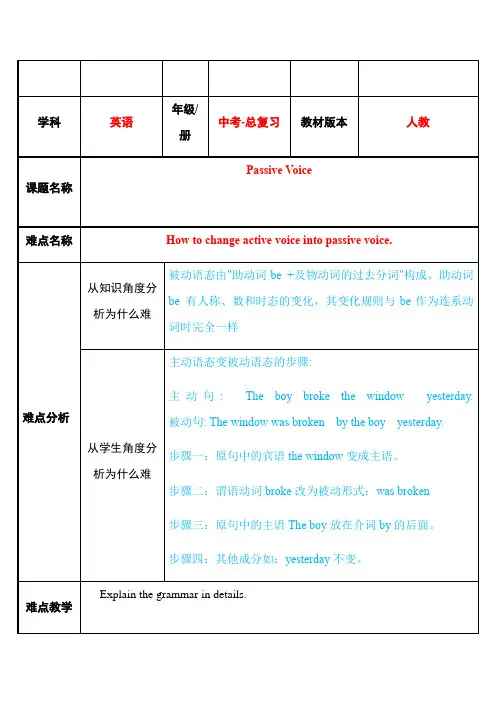
(2)一般过去时:__was/were______+taught
(3)一般将来时:will/ shall+__be__+taught
(4)含有情态动词:情态动词+be+taught
知识讲解
(难点突破)
二、主动语态变被动语态的方法
1.把主动语态的_____变为被动语态的主语;
2.某些不及物动词与介词.副词搭配构成短语动词,带有宾语时,则有了动作的承受者,这时应把它们看作一个整体,变为被动语态,不能丢掉其中的介词,常用的有look after, take care of, cut down, laugh at, talk about, turn on等。
学科
英语
年级/册
中考-总复习
教材版本
人教
课题名称
Passive Voice
难点名称
How to change active voice into passive voice.
难点分析
从知识角度分析为什么难
被动语态由"助动词be +及物动词的过去分词"构成。助动词be有人称、数和时态的变化,其变化规则与be作为连系动词时完全一样
1.His mother told him not to waste time on surfing the Internet.
__________________________________________________________
2.Father gave me a toy at Christmas.
从学生角度分析为什么难
主动语态变被动语态的步骤:
主动句: The boy broke the window yesterday.被动句: The window was broken by the boy yesterday.
中考英语名词复习 教案教学设计(人教版英语中考复习)
中考英语名词复习教案教学设计(人教版英语中考复习)第一章:名词的分类和作用一、教学目标1. 了解名词的分类:可数名词、不可数名词、专有名词。
2. 掌握名词的基本作用:表示人、事物、地点和抽象概念。
3. 能够正确使用名词进行简单的句子构建。
二、教学内容1. 名词的分类及其特点。
2. 名词的基本作用及其用法。
三、教学步骤1. 引入:通过展示图片,让学生猜测并说出图片中的人或物,引出名词的概念。
2. 讲解:讲解名词的分类和基本作用,结合实际例子进行说明。
3. 练习:让学生分组进行练习,用所学的名词进行句子构建。
四、作业布置1. 分类写出五个可数名词和五个不可数名词。
2. 用所学的名词编写五个简单句子。
第二章:名词的所有格一、教学目标1. 掌握名词所有格的用法。
2. 能够正确使用名词所有格表示归属关系。
二、教学内容1. 名词所有格的用法。
2. 名词所有格的表达方式。
三、教学步骤1. 引入:通过展示图片,让学生猜测并说出图片中的人或物,引出名词所有格的概念。
2. 讲解:讲解名词所有格的用法和表达方式,结合实际例子进行说明。
3. 练习:让学生分组进行练习,用所学的名词所有格进行句子构建。
四、作业布置1. 写出五个名词所有格的例子。
2. 用所学的名词所有格编写五个简单句子。
第三章:名词的复数形式一、教学目标1. 掌握名词的复数形式的变化规则。
2. 能够正确使用名词的复数形式。
二、教学内容1. 名词复数形式的变化规则。
2. 名词复数形式的用法。
三、教学步骤1. 引入:通过展示图片,让学生猜测并说出图片中的人或物,引出名词复数形式的概念。
2. 讲解:讲解名词复数形式的变化规则和用法,结合实际例子进行说明。
3. 练习:让学生分组进行练习,用所学的名词复数形式进行句子构建。
四、作业布置1. 写出五个名词复数形式的例子。
2. 用所学的名词复数形式编写五个简单句子。
第四章:名词的宾格一、教学目标1. 掌握名词的宾格用法。
九年级中考英语总复习计划及思路 教案
九年级中考英语总复习计划及思路教案一、教学目标:1. 知识与技能:通过复习,使学生掌握九年级英语教材中的重点单词、短语、句型和语法知识,提高学生的英语应用能力。
3. 情感态度与价值观:激发学生学习英语的兴趣,培养学生的自信心,使学生树立决战中考的决心。
二、教学内容:1. 单词和短语:复习九年级英语教材中的重点单词和短语,要求学生能够熟练掌握并正确运用。
2. 句型和语法:回顾和巩固九年级英语教材中的主要句型和语法知识,提高学生的语法运用能力。
3. 听说读写技能:通过各种练习,提高学生的英语听说读写综合能力,为中考做好充分准备。
三、教学过程:1. 课堂导入:简要回顾上节课复习的内容,激发学生对本节课复习内容的兴趣。
2. 知识梳理:对本节课要复习的单词、短语、句型和语法进行系统地讲解和梳理,帮助学生理清思路。
3. 课堂练习:设计各种形式的练习题,让学生在课堂上及时巩固所学知识。
5. 课后作业:布置适量作业,让学生课后巩固复习内容。
四、教学评价:1. 课堂表现:观察学生在课堂上的参与程度、听说读写能力的发挥等情况,及时给予鼓励和指导。
2. 作业完成情况:检查学生作业的完成质量,发现问题及时反馈并指导学生改正。
3. 中考模拟试题:定期进行中考模拟试题测试,了解学生的复习效果,为下一步教学提供依据。
五、教学资源:1. 教材:九年级英语教材。
2. 教辅资料:中考英语总复习资料、单词卡片、语法图表等。
3. 多媒体设备:投影仪、电脑、音响等。
4. 网络资源:英语学习网站、在线英语课程等。
六、教学策略:1. 分类复习:将九年级英语教材中的知识点进行分类,有针对性地进行复习,提高复习效率。
2. 案例分析:通过分析典型病例,让学生了解中考英语考试中的常见错误,避免在实际考试中出现类似错误。
3. 互动教学:鼓励学生积极参与课堂讨论,提高学生的思维能力和解决问题的能力。
4. 个性化辅导:针对不同学生的学习需求,给予个性化的辅导,帮助学生克服学习困难。
人教版中考英语一轮复习第十四讲 九年级Units 1-2教案

人教版中考英语一轮复习第十四讲九年级Units 1-2教案一. 教材分析人教版中考英语一轮复习第十四讲主要涉及九年级Units 1-2的内容。
这部分教材主要讲述了日常生活中的交际用语和一些基本的语法知识。
通过这部分的学习,学生可以提高自己的英语交际能力,并为接下来的学习打下坚实的基础。
二. 学情分析九年级的学生已经具备了一定的英语基础,对于日常的交际用语和基本语法知识有一定的了解。
但是,部分学生在口语表达和听力方面还存在一定的困难,需要通过大量的练习来提高。
此外,学生对于英语学习的兴趣和动机也需要进一步激发和培养。
三. 教学目标1.知识目标:学生能够掌握九年级Units 1-2中的日常交际用语和基本语法知识。
2.能力目标:学生能够流利地运用所学的交际用语进行日常交流,提高自己的英语听说能力。
3.情感目标:激发学生对英语学习的兴趣和动机,培养良好的学习习惯。
四. 教学重难点1.重点:九年级Units 1-2中的日常交际用语和基本语法知识。
2.难点:对于一些特殊语境下的交际用语和复杂语法的理解和运用。
五. 教学方法采用任务型教学法,通过大量的听说练习和小组合作活动,激发学生的学习兴趣,提高学生的英语交际能力。
同时,结合语法讲解和练习,巩固学生的语法知识。
六. 教学准备1.教材:人教版九年级英语教材。
2.多媒体设备:电脑、投影仪、音响等。
3.教学资源:相关音频、视频、图片等。
七. 教学过程1.导入(5分钟)通过播放一段英语歌曲或视频,引导学生进入英语学习的状态。
然后,教师用简单的英语问候学生,询问他们的日常情况,激发学生的英语交际欲望。
2.呈现(10分钟)教师通过展示九年级Units 1-2的教材内容,引导学生复习已学的日常交际用语和基本语法知识。
在呈现过程中,教师可以用图片、实物等辅助教学,帮助学生更好地理解和记忆。
3.操练(15分钟)教师学生进行小组合作活动,模拟真实的日常交际场景,让学生运用所学的交际用语进行交流。
英语九年级复习教案七篇
英语九年级复习教案七篇英语九年级复习教案七篇英语九年级复习教案怎么写?英语的词汇量非常庞大(约990,000个),但如果要估计具体数字,必须先判断哪些能够算作其单词。
不过与其他语言不同,并没有一个权威学术机构来规定何为正式的词汇。
下面是小编为大家带来的英语九年级复习教案七篇,希望大家能够喜欢!英语九年级复习教案(精选篇1)教学目标:1.能初步会听、说、读并拼写单词:a doll, a ball, a CD, a car, a robot2.能初步听懂、会读、会运用句型:What’s this/that,并会用It’s a 来回答。
3.能初步听懂、会读、会说、会运用句型This is for you./It’s for you.来相互赠与礼物。
4.学会新年节日祝福,礼貌用语。
会表达谢意:Thank you.5.明白中西方新年文化差异。
教学重点:1.能初步会听、说、读并拼写单词: a robot2.能初步听懂、会读、会运用句型:What’s this/that,并会用It’s a 来回答。
3.能初步听懂、会读、会说、会运用句型This is for you./It’s for you.来相互赠与礼物。
教学难点:1.能初步听懂、会读、会运用句型:What’s this/that,并会用It’s a 来回答。
能初步听懂、会读、会说、会运用句型This is for you./It’s for you.来相互赠与礼物。
教学准备:挂图,卡片,PPT教学过程:Step 1 Greeting.1.课前准备:Sing songs and say rhymesAre you Mike Nice clothes …Row, row, row your boat…让学生自己说说学过小诗和歌曲,让学生逐渐进入学习英语的气氛中提示学生说小诗Let’s learn。
T: Do you like EnglishSs: Yes, I do.T: Let’s learn English Now.2.GreetingStep 2 Presentation1.Brain storm(脑筋急转弯)a. What letter is an animal(动物) B(bee)b. What letter is a question Y(why为什么)c. Why are the letter G and letter S in“gloves”close(亲密) to each other(互相,彼此) Because there is love between them !2.绕口令a. I scream, you scream, we all scream for ice-cream!我叫喊,你叫喊,我们都喊着要冰淇淋!b. Can you can a can as a canner can can a can你能够像罐头工人一样装罐头吗3.引入课题T:Let’s have are rest, enjoy a song, please. Guess the name.Happy New Year!让学生通过猜歌名直接引出课题。
九年级中考英语总复习计划及思路 教案
九年级中考英语总复习计划及思路教案第一章:课程标准与考试大纲解析1.1 课程标准解读:了解九年级英语课程标准的要求,掌握课程标准中的知识点和能力要求。
1.2 考试大纲解析:分析中考英语考试大纲,明确考试范围、题型及分值分布。
1.3 复习计划制定:根据课程标准和考试大纲,制定九年级中考英语总复习计划,确保复习全面、有序。
第二章:词汇与短语复习2.1 词汇复习:梳理九年级英语课程中的核心词汇,进行循环记忆和巩固。
2.2 短语复习:总结常用短语和固定搭配,通过例句理解和运用。
2.3 词汇游戏与练习:设计词汇游戏和练习题,提高学生的词汇运用能力。
第三章:语法复习3.1 语法点梳理:系统复习九年级英语课程中的主要语法点,如时态、语态、句式等。
3.2 语法练习:编写针对性的语法练习题,巩固语法知识。
3.3 语法讲解与示例:通过讲解和示例,帮助学生理解和运用语法知识。
第四章:听力复习4.1 听力技巧指导:教授听力技巧,提高学生的听力理解能力。
4.2 听力材料选择:挑选适合九年级学生的听力材料,进行专项训练。
4.3 听力练习与评估:定期进行听力练习,评估学生的听力水平,针对性地进行提高。
第五章:阅读理解复习5.1 阅读技巧指导:教授阅读理解技巧,提高学生的阅读速度和理解能力。
5.2 阅读材料选择:挑选适合九年级学生的阅读材料,进行专项训练。
5.3 阅读练习与评估:定期进行阅读练习,评估学生的阅读水平,针对性地进行提高。
第六章:写作复习6.1 写作技巧指导:教授写作技巧,提高学生的写作能力和逻辑思维能力。
6.2 写作话题选择:挑选适合九年级学生的写作话题,进行专项训练。
6.3 写作练习与评估:定期进行写作练习,评估学生的写作水平,针对性地进行提高。
第七章:口语复习7.1 口语技巧指导:教授口语表达技巧,提高学生的口语交流能力。
7.2 口语材料选择:挑选适合九年级学生的口语材料,进行专项训练。
7.3 口语练习与评估:定期进行口语练习,评估学生的口语水平,针对性地进行提高。
英语总复习教案九年级
英语总复习教案九年级 英语总复习教案九年级怎么写?英语在下列国家和地区是第一语言:英国、美国、加拿大、澳大利亚、新西兰、爱尔兰、巴哈马、巴巴多斯、百慕大群岛、圭亚那、牙买加、圣基茨和尼维斯和特立尼达和多巴哥。下面是作者为大家带来的英语总复习教案九年级七篇,希望大家能够喜欢! 英语总复习教案九年级篇1 任务:My favourite sport 目的:通过编谜语复习和巩固与有关运动项目的英语名称,扩大学生的词汇量,培养其英语的兴趣。 材料:调查表一份 语言技能:Reading and writing 语言知识:与运动相关的词汇 提示词语几句型: 1. 必备词汇与句型 (1) football, basketball, volleyball, ping pong, tennis,… (2) What is my favourite sport, do you kno w? (3) It’s from England. It is round. Many people like it… 2. 扩展词汇与句型 Sports: badminton, bowling, boxing, horse riding, jogging, shot-put, golf, cycling, shooting, hikin g,… Seasons: in spring, in summer, in autumn, in wint er Place: inside the door (indoor sports), outside the door (outdoor sports), on the playground, in th e sports field,… Style: teamwork, in pairs, individual, … Sports change with the season. People play diferebt games in different seasons. 活动形式:3-4人小组 操作过程: (1) 学生自由组合成3-4人小组,讨论确定小组 成员中最喜欢的运动项目; (2) 教师制作如下表格,复印若干份,分发给 各小组: (3) 各小组利用课余时间,上网或去图书馆查阅所喜欢的运动项目的相关资料,并根据要求填写表格; (4) 小组成员合作根据表格填写的内容编写一则谜语,然后叫给教师,由教师作一些必要的修改。例如: The ground must be 26 metres long and 14 metres wide. There can be ten players in a team but not more than five players in team may play at one time. To score a point a player must throw the ball, but they must not carry it. There are four twelve-minute periods for the match. What is my favour sports, do you know? (5) 把谜语张贴在教室橱窗内,供其他组成员 猜测。 英语总复习教案九年级篇2 初中英语 Unit 1 A Trip to Beijing 一、教学内容分析 本单元以A Trip to Beijing为话题,学生通过本单元学习,能够表达请求许可,能够询问及表达两地距离,掌握一百以上数字的读法与写法,初步学习比较等级的形式及用法; 学会制定计划以及用英语购买票。 1 、 Lesson 1 要求学生通过学习李明与妈妈关于去北京旅行的对话,通过技能训练掌握表示意愿以及请求许可的表达方式。 2、 Lesson 2 以打电话的形式,要求学生学习如何邀请别人一起旅行以及一些旅行安排的表达方式。 3、 Lesson 3要求学生通过学习本课能够询问及表达两地的距离,并掌握100以上数字的读法与写法。 4、 Lesson 4以唱歌和对话的形式要求学生复习各种交通方式,并通过对比初步学习比较等级的形式及用法。 5、 Lesson 5通过学习本课掌握一周七天的读法与写法,重点掌握如何作旅行计划,学会征询别人的意见。 6、 Lesson 6通过学习Jenny和Li Ming做旅行准备的对话,重点复习this, that, these, those的用法,及谈论数量,提供帮助的表达方式。 7、 Lesson 7通过本课学习购票的表达方式及劝阻他人不做某事的表达法,同时要求学生学会书面讲述令自己兴奋的一次经历。 8、 Lesson 8帮助学生复习运用本单元所学内容。 二、教学目标 句式: 1. Talk about distance —How far is it from … to …? —It’s … kilometers. / It’s about … 2. Asking for permission May I …? Yes, you may. , you may not. 3. Showing Intentions Do you want …? I want…. Let’s take a …, …is faster than…. 4. Others How many … do you have? Please (don’t) # 三、教学过程: (一)通过谈话引出正题:大家暑假去没去旅游,谁能说说旅游情况?注意:用英语会话。 (二)导入课文,学习相关句子。 重点句子 1. —May I go on a trip to Beijing? —Yes, you may. / No, you may not. 1. How far is it from China to Canada? It’s about eight thousand five hundred kilometer. 2. A train is slower than a plane, but faster than a bus. 3. What do you think of it? 4. I want to go to the Great Wall. 5. May I help you? Sure. 6. How much for a ticket on the T58 from Shijiazhuang to Beijing, please? 7. Please don’t run or jump. (三)具体实施 the students and get them to talk about their holidays. T: I haven’t seen you for long ages, boys and girls! How is it going? S: Quite well. How are you? T: I’m fine, too. Thanks. Did you have a nice holiday? S: Yes. T: Would you like to share your experience with me? … What did you do? S: I read a lot. T: You must have learnt a lot. some other students to talk about their holidays. And then show some places of interest and continue talking with the students to make them understand the phrase go on a trip to. T: I had a nice holiday too. I went on a trip to Beijing. Look! There are some pictures about this city. Show the students the following pictures. T: How about the first picture? S: It’s Tian’anmen Square. T: That’s right! The second one? S: It’s Gugong. (In Chinese) T: In English It is named the Palace Museum. S: The Palace Museum. T: How about the last one? S: It’s Changcheng. T: It’s the Great Wall in English. S: The Great Wall. T: There are so many beautiful places in Beijing. And Beijing is the capital city of our country. Would you like to travel to Beijing? (To one student) S: Yes. T: Would you like to go on a trip to Beijing too? the student to answer. Make sure the students know the meaning of go on a trip to. S: Yes. I’d like to go on a trip to Beijing. T:…(略) the students to learn to talk about permission by using the phrase: to go on a trip to. The teacher can show them some pictures of places of interest to help them to discuss. T: What city would you like to go on a trip to, Beijing or Guilin? S: I’d like to go on a trip to Guilin. more students the same question to let them learn the phrase go on a trip to well T: Gulin is a very beautiful place. May I go on a trip with you? the student to answer: Yes, you may. Or No, you may not. Explain the meaning in Chinese if necessary. S: Yes, you may. T: (To another student) I have no money to go on a trip to Guilin.
人教版九年级英语复习教案
人教版九年级英语复习教案九年级英语复习教案一学习目标1.通过交流和表达,进一步掌握学习英语的技巧与方法。
2.掌握下列知识点:■重点词汇:f1ashcard,vocabulary,pronunciation,a1oud■重点短语:①study for②make flashcard③make vocabulary lists④ask the teacher for help⑤read aloud ⑥study with a group■重点句型:①How do you study for a test? ②What abou tlistening to tapes?■语法:by+μing的用法预习导学预习单词,完成下列各词。
1.抽认卡2.词汇3.Aloud(近义词)4.发音(名词)5.ever(反义词)6.1isten(现在分词)7.study(过去分词)8. (如何)do you study for a test?合作研讨一、重点单词与短语1.pronunciation n.发音;发音法,其动词形式pronounce【跟踪训练】(1)她认识很多法语单词,但发音不正确。
She knows a lot of French;words,but them incorrectl.2.Aloud adv.出声地;大声地例如:read aloud大声朗读【辨析】aloud/loud/loudlyaloud出声地;大声地。
常与read,cail等动词连用,loud高声地;大声地;喧闹地。
常用于talk,speak等动词之后;loudly高声地;喧闹地。
一般可以和10ud互换,但含有“吵闹”的意思。
【跟踪训练】(2)老师要求我大声朗读课文。
The teacher asked me to the text .(3)请大声点说,以便我能听清楚。
Please so that I can hear you clearly.(4)不要这么大声说,婴儿在睡觉。