
外研版七年级英语上册 Module 6 A trip to the zoo Unit 1 Does it eat meat导学案无答案
Module 6 Unit 1 Does it eat meat课型:听说课【学习目标】1、熟悉本课所学新词汇;2、能用does it eat meat?这一句型造句及其一般疑问句以及它的肯定,否定回答;3、培养并加强学生对动物的热爱。
意识到保护动物,热爱动物就是热爱人类本身。
【课前准备】1、下列动物名称,你能记住吗?看谁记得又快又对!tiger camel elephant lion giraffe kangaroo monkeypanda snake wolf polar bear zebra还有这些单词呢,别忘了呀!trip zoo guide thousand visit every aimal more2、在课文中找出下列词组:一万六千人五千动物来自亚洲吃肉吃竹子住在欧洲每天住在北极欢迎到北京来3、语言点导学:观察:------Do you often watch TV? 你经常看电视吗?------Yes , I do . 是的,经常看。
------Does the panda eat bamboo?熊猫吃竹子吗?------Yes , it does . 是的,吃。
思考:当主语是第三人称单数时,一般疑问句句首的助动词是,原句中的动词的第三人称单数形式改成了。
4、尝试:A 将下列句子改为一般疑问句并作肯、否定回答。
1)He often buys a cake for his birthday .2) He never plays computer games .3) Tim listens to music every day .4) The tiger comes from Europe .B 你能用本节课所学单词再造几个类似的一般疑问句吗?C 问题准备:通过预习,你还有哪些词、句存在问题?请在书上做记号或记录下来。
【课堂活动】1、交流检查课前准备部分,师生互问探讨解决问题。
2、口头练兵场:1)看图说活:This is a panda .It comes from China .It eats bamboo .This is a/an …2)两人一组操练如下句型:-------What’s this? ------It’s a panda .-------Does it come from China? ------Yes ,it does .------Does it eat meat ? ------No ,it doesn’t .It eats bamboo .3、听录音,完成Activity 2、3、4、6、7.4、学习成果展示:动物是我们的朋友,对于我们的朋友,你知道些什么呢?讲给同学们听一听吧!5、课堂练习舞台A Write questions and short answers .Panda/ eat/ bamboo ? Does panda eat bamboo ? Yes ,it does .1)camel / live / desert?2)elephant / work/ dorest ?3)kangaroo/ eat meat ?4)monkey/ come/ Africa/ from ?5)snake/ like/ water ?6)wolf/ live/ jungle ?B Complete the sentences .Kangaroos (live)in the grassland .1)I (like) visiting the zoo .2) The zoo (have) 5000 animals .3)The tiger (not eat) grass .4)Elephants (be) very big animals .5)Polar bears (not have)very long necks .6)The panda (be)my favourite animal .7)A camel (not often drink).8)We (like) the panda .当堂小节反馈:回想本课所学内容,你学到了哪些,还有哪些疑问?Unit 1 Does it eat meat?练习题I.根据汉语完成句子1、The (骆驼) lives in the desert .2、I like the (大象) very much .3、You can see a (狮子) in the zoo .4、The (狼)eats meat and some little animals .5、The (长颈鹿)has got a long neck .6、Lots of people (参观) the zoo every day .7、The (熊猫) comes from China .8、The (老虎)is the king of the forest .9、China is covered by many (森林) .10、There are 3 (千) students .II.根据括号后的要求改写句子1、The zebra is from Africa .(改为同义句)The zebra Africa .2、There are lots of animals in the zoo . (改为同义句)Lots of animals .3、The polar bear likes to swim . (改为一般疑问句并作否定回答)The polar bear to swim ?No , .4、The panda lives in China . (用Australia改为选择疑问句)the panda in China ?5、There are sixteen animals in the zoo . (就划线部分提问)are there in the zoo ?6、The panda comes from Sichuan .( 改为一般疑问句并作肯定回答)the panda from Sichuan ?III、用所给单词的适当形式填空1、These boys (come) from South America . They (speak)English .2、 Tom often (watch)TV on Sunday .3、They (not do) their homework at home every day .4、— What about (read) the novel ?— OK .5、When every student (start) their lessons ?6、I don’t like (run) .7、What time he usually (go) to the gym ?8、Can the wolf (swim) ?9、Kangaroos are from (Australian) .10、The polar (熊)comes from Arctic .IV、请从方框中选择适当的句子补全下列对话A.What about you ?B.Why do you like it best ?C.Let’s see the animals in the zoo .D.Because it’s the king of the forest , I think .E.No , I don’t .A:Tomorrow is Sunday . (1)B:Great idea !what animals do you like ?A:I like the panda , the giraffe and the camel . (2)B:I like the monkey and the lion .What’s your favourite animal ?A:The panda .B: (3)A:Because it is very cute (可爱的) ,and it’s from China .I like China very much .Do you like the panda?B: (4) Actually , my favourite animal is the lion .A:Why ?B: (5)Module 6 A trip to the zooGrammar课型:后置语法课【学习目标】学会一般疑问句及其简略回答。
【课前朗读】朗读学生学过的单词、短语、句型、课文等。
【课堂活动】1、跟同学们说一说自己喜欢的运动,尤其是篮球,从而引出下列句子。
I like sports .My favourite sport is basketball .I play basketball every day .问学生:你能把我刚才说的话用第三人称再说一遍吗?She likes sports .Her favourite sport is basketball .She plays basketball every day .让同学们仔细观察这几个句子的结构特点,找几个同学分析一下,再问:她喜欢运动吗?她最喜欢的运动是什么?从而引出本节课的语法目标:一般疑问句。
Does she like sports?Is her favourite sport basketball?Does she play sports every day ?2、句型展示:把一般疑问句分为两类:谓语为系动词的句子和谓语为实义动词的句子。
其中谓语为实义动词的句子又分为动词是原形和第三人称单数的句子两类,本节课只学习谓语动词时第三人称单数的句子。
3、总结归纳先让学生作出初步归纳,老师跟上适当讲解和补充,让学生进一步明确一般疑问句的结构与特点。
4、专项练习第一组,出示例句(谓语动词为系动词的句子)1)This is an English girl .2)My teacher is working now .3)There are camels from Africa .小组讨论,再找一个同学分析这几个句子的特点,并紧紧跟上练习题加以巩固。
当堂练习:1)We are in Class One , Grade One .2)They are going to school by bus today .3)There are many animals in the zoo .4)Tom’s family name is White .第二组,出示例句(谓语动词为第三人称单数形式的句子)1)She speaks English very well .2)He gets up at six o’clcck .3)It lives in Africa .小组讨论,再找一个同学分析这几个句子的特点,并紧紧跟上练习题加以巩固。
七年级英语上册Module6AtriptothezooUnit1Doesiteatmeat教案外研

七年级英语上册Module 6 A trip to the zoo Unit 1 Does it eat meat教案(新版)外研版编辑整理:尊敬的读者朋友们:这里是精品文档编辑中心,本文档内容是由我和我的同事精心编辑整理后发布的,发布之前我们对文中内容进行仔细校对,但是难免会有疏漏的地方,但是任然希望(七年级英语上册Module 6 A trip to the zoo Unit 1 Does it eat meat 教案(新版)外研版)的内容能够给您的工作和学习带来便利。
同时也真诚的希望收到您的建议和反馈,这将是我们进步的源泉,前进的动力。
本文可编辑可修改,如果觉得对您有帮助请收藏以便随时查阅,最后祝您生活愉快业绩进步,以下为七年级英语上册Module 6 A trip to the zoo Unit 1 Does it eat meat教案(新版)外研版的全部内容。
Module 6 Unit1 Does it eat meat?一、教学目标(一)知识与能力1.知识目标:trip, zoo, tiger, elephant, lion, giraffe, monkey,panda, guide,visit, animal, zebra, Australia, Europe, Asia, bamboo.2。
能力目标:培养学生从材料中获取有效信息的能力.掌握制作海报的方法。
3.情感目标:通过学习让学生领悟到大自然不仅有人类的存在,而且还要使生养我们的这个地球平衡发展,保护和珍惜野生动物,使我们的家园更美丽和谐。
(二)态度与情感:增强学生对濒临灭绝的动物的保护之情二、教学重难点1、重点句型:一般现在时(主语第三人称单数)的一般疑问句以及肯定和否定形式。
重点话题:Talk about one’s favourite animal。
2、难点1 有关动物的名词及它们在句中的正确运用.2掌握一般现在时(主语第三人称单数)的一般疑问句以及肯定和否定形式。
外研版七年级英语上册教案Module 6 Unit 1(外研)
Module 6 A trip to the zooUnit 1 Does it eat meat?本模块以A trip to the zoo为话题,介绍了世界各地的动物以及其栖息地、习性等,通过Unit 1的学与练,要求学生通过听、读、说的练习,学会谈论动物。
旨在让学生通过这一学习与体验的过程,唤起学生热爱动物、保护动物的意识。
能够就动物进行提问与回答,能够介绍动物的产地和习性。
【知识目标】Key vocabulary: animal, tiger, camel, elephant, lion, giraffe, monkey, panda, bear, zebra…Key structures: --- Does the panda eat bamboo?--- Yes, it does. It eats bamboo--- Does the tiger come from Europe?--- No, it doesn’t. It comes from Asia【能力目标】学习主语为第三人称单数时的一般现在时的一般疑问句的用法以及它的肯定和否定回答。
【情感目标】以动物中心,以介绍自己喜爱的动物、以及它的居住地和生活习性为话题。
【教学重点】1、重点句型:一般现在时(主语是第三人称单数)的一般疑问句及简略回答。
2、重点话题:Talk about animals.【教学难点】1、熟练掌握本单元词汇。
2、掌握一般现在时(主语第三人称单数)的一般疑问句以及肯定和否定回答。
3、能用恰当地道的英语问答有关动物的问题以及介绍自己的最喜爱的动物。
Tape recorder, MultimediaStep 1. Warm-up1. Greetings.2. Talk about animals with students.T: Hello! Boys and girls! As we all know, animals are our friends. There are many kinds of animals on the earth. What animals do you know? What animal do you like?S: Cats, dogs, pandas, snakes, monkeys, elephants, tigers…3. Guess what are they.T: It’s the king(王) of the forest. It’s scared(恐怖).S: It is a tiger.Step 2. Lead-in1.Tell students I’m a guide now, I’ll show them to visit Beijing Zoo.2.Let students answer the questions.Do you like animals?Where can you find the animals?Which zoo have you been to?Have you been to Beijing Zoo?Step 3. New words1. Show some pictures. And learn new words and phrases. After that, get students to talk about the animals in the pictures.2. Then show a map of the world. Help the Ss to ask:A: Does the lion come from Africa?B: Yes, it does.A: Does it eat grass?B: No, it doesn’t.世界地图:3. Show a picture of a panda which is eating bamboo. Get the students to work in pairs and have a conversation.Eg. --- Does the panda come from China? /England?--- Does it eat bamboo?--- Yes, it does. / No, it doesn’t.Step 3. Pair workShow some pictures, let students talk in pairs.Eg. --- There are three giraffes.--- Yes, and there are some zebras.Step 4. Pre-listening1.Listen and circle the words you hear.bear elephant giraffe lion monkeypanda tiger zebra zoo2.Make a dialogue about animals.Eg. --Does the panda come from China /eat bamboo?--Yes, it does. / No, it doesn’t.3.Make a conversation according to offered information about origin, food and habit. Step 5. Oral drillsWork in pairsDoes the _______ come from _____?Does it eat ___________________?Does it like to ___________________?Step 6. Listening1.Listen and answer some questions.What animals are there in Beijing Zoo?Does the lion eat meat?Is the panda Lingling’s favourite animals?2.Read through the text and check the true sentences.3.Ask and answer the questions.Step 7. Post-listeningComplete the tableStep 8. Language points1.The zoo has many kinds of animals, such as bears, …a. kinds of “各种各样的”,表示种类kind of 单独用,表示“有点”,后接形容词或副词。
外研版七年级英语上册Module 6 A trip to the zoo Unit 1 Does it eat meat教案
Module 6 A trip to the zooUnit 1 Does it eat meat?一、学习目标:1. 重点单词:2. 重点短语:such as, come from, look at, over there, a little, all over the world, as well as, be good at, many kinds of3.重点句子:1.— That’s a giraffe.— Yes, and there are some giraffes2.—Do lions eat meat?—Yes, they do.3.—Does it eat meat?—No, it doesn’t. It eats plants.4.—Do pandas eat plants and leaves?—Sure. They love bamboo.5. Shall we go and…?6. That’s very funny.7. It doesn’t eat meat.8. The tiger lives in Asia.二、重点及难点:Presen t simple questions.三、教学设计:Unit 1 Does it eat meat?ⅠTeaching modelListening and speakingⅡTeaching meth odInteractive approachⅢTeaching aims1. To find specific information in the listening.2. To recognize t he third person singular endings –s.3. To ask and answer questions about animals.4. To enable students to talk about animals.ⅣTeaching ObjectivesKey vocabulary: bear, elephant, giraffe, lion, monk ey, panda, tiger, zebra, zoo, guide, animal, such, as, come, different, country, other, dangerous,ugh, also, plant, look, tall, le af (pl. leaves), sure, bamboo, cute,shall, them, which, over, funny, callKey structures:1.— That’s a giraffe. — Yes, and there are some giraffes2.—Do lions eat meat? —Yes, they do.3.—Does it eat meat? —No, it doesn’t. It eats plants.4.—Do pandas eat plants and leaves? —Sure. They love b amboo.5. Shall we go and…?6. That’s very funny.ⅤTeaching aidsTape recorder , OHP , video , a clockⅥTeachi ng StepsStep 1 Warming-up1. Lead inT: Hello, boys and girls!Ss: Hello, Mr. Zhang.T: Today, we are going to learn Module 6 A trip to the zoo. Have you been to thezoo?Ss: Yes.T: D o you know Beijing zoo?S1: Yes, I went there last year. I saw many animals…S2:…T: OK. Today I’ll take you to visit Beijing zoo. Are you happy?Ss: Yes.T: Please look at the screen and get to know some information about Beijing Zoo. Ss: …(Look at the scre en and try to know some information about it.)2. Show some pictures to ask and answer: What can you see?3. Call back the answer from the whole class and check the answer.Step 2 Practice1. Show some pictures of the animals.2. Introduce the new words.3. Look at the pictures. Ask and answer: What can you see?4. Call back the answers from the whole class and check the answer .5. Read the words.Step 3 Work in pairs1. Listen and check ( √) the words in Activity 1 you hear.2. Now work in pairs and say what you can see.—That’s a giraffe.—Yes, and there are some giraffesStep 4 Listen and read.1. Ask the students to read the conversation silently.2. Play the recording and ask the students to listen and read the conversation.3. Read the conversation.4. Act it out.5. Ask the students to complete the table in Activity 3.6. Call back the answer from the whole class and check the answer.Keys: 1. meat, other animals 2. meat, plants 3. plants 4. bambooStep 5 Underline the correct words.1. Ask the students to read through the passage.2. Underline the correct words.3. Call back the answer from the whole class and check the answer.Keys: 1. many 2. countries 3. such 4. dangerous 5. plants 6. different7. tall 8. plants 9. bamboo 10. panda’sStep 6 Listen and repeat.1. Play the recording once without stopping.2. Play the recording again and stop at the end of each line. Ask the whole class to repeat.3. Play the recording again and stop at the end of each line. Ask individual students to repeat.4. Ask the students to practice the sounds in pairs.Step 7 Listen and choose / s/ or / z /1. Play the recording once without stopping.2. Play the recording again and stop at the end of each line. Ask the whole class to repeat.3. Play the recording again and stop at the end of each line. Ask individual students to repeat.4. Ask the students to practice the sounds in pairs.Step 8 Work in pairs .Talk about your lessons .1. Go through the language in the substitution table with the class.2. Pair them to ask and answer.A: What’s your favourite animal? Does it eat plants?B: Yes, it does.A: Does it come from China?B: Yes, it does.A: Is it the panda?3. Circulate and monitor their production.Step 9 Do exercises:A.首字母填空:1. Beijing Zoo has many kinds of a______.2. The lions are d__________ because they eat meat.3. Pandas are black and white and eat b__________.4. The b_______ eat meat and plants.5. An e__________ is tall and ea ts plants.Answers:1. animals2.dangerous3.bamboo4.bears5. elephantB.翻译下列句子:1.这些动物来自不同的国家。
七年级英语上册 Module 6 A trip to the zoo Unit 1 Does it eat meat课件1 (新版)外研版
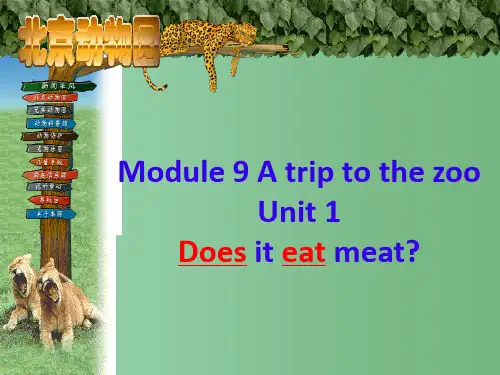
kangaroo elephant
giraffe
panda
polar bear
wolf
lion
tiger
camel
Daming Lingling
Q: What’s Daming’s favourite animal?
Name:__P_a_n_d__a____
From: __C_h_i_n_a____
Food:__B_a_m__b_o__o___ The panda es from China. A: Does the panda e from China ? B: Yes , it does . A: Does the panda eat meat ? B: No, it doesn’t. It eats bamboo.
Name:__G_i_r_a_ff_e____
From: __A__m__e_r_ic_a_
Food:___L_e_a_v_e_s____
These giraffes e from America. A: Do these giraffes e from America? B: No, they don’t. B: Yes, they do. A: Do these giraffes eat leaves ? B: Yes, they do. /No, they don;t
Name:__W__o_l_f_____
From: __C__h_in__a___
Food:___M__e_a_t_____
The wolf e froms China. A: Does the wolf e from China? B: Yes, it does. / No, it doesn’t. A: Does the wolf eat meat ? B: Yes, it does. /No, it doesn’t. It eats…
2019-2020学年度外研版初中七年级上英语Module 6 A trip to the zooUnit 1 Does it eat meat巩固辅导六十七
2019-2020学年度外研版初中七年级上英语Module 6 A trip to the zooUnit 1 Doesit eat meat巩固辅导六十七第1题【单选题】—is your PE lesson?—Four o"clock.A、How muchB、What dayC、How manyD、What time【答案】:【解析】:第2题【单选题】We have computer class Friday morning.A、inB、onC、atD、of【答案】:【解析】:第3题【单选题】—Where is the tiger from?—It __________ from Asia.A、comesB、comeC、beD、isn’t【答案】:【解析】:第4题【单选题】—Do lions eat fruit?—No, __________.A、he don’tB、they don’tC、it notD、it doesn’t【答案】:【解析】:第5题【填空题】—When do you often have your first l______in the morning? —At 8: 00.【答案】:【解析】:第6题【填空题】从Ⅱ栏中选出适合回答Ⅰ栏的答语Ⅰ(1)What’s your favourite animal? ______(2)Do pandas come from China? ______ (3)What about going to see giraffes? ______ (4)Does the bear eat meat? ______(5)Where is the panda? ______Ⅱa. Good idea.b. The monkey.c. Over there.d. Yes, it does.e. Yes, they do.【答案】:【解析】:第7题【填空题】I like a______and I can draw pictures well.【答案】:【解析】:第8题【阅读理解】阅读理解Today is Sunday. It’s fine today. Lingling goes to the zoo with her mother. They can see many animals. There are tigers, lions, pandas, snakes and many more. Look! The pandas are over there. They’re from Sichuan, China. Look at the baby panda! It’s climbing the tree. How cute (可爱的) it is!Next, they go to see the lions. The lions are so strong (强壮的). Their mouths are too big. The tigers are next to them. They are from Asia. They are yellow and black. At last, they go to see the monkeys. Some are climbing mountains, and some are eating bananas. The monkey is Lingling’s favourite animal. It’s so fun!Lingling sees a lot of animals at the zoo and she is so happy today!The weather is __________ today.A、fineB、coldC、hotD、rainLingling and her mother __________ on Sunday.A、go to schoolB、go to the zooC、go to the parkD、do houseworkThe pandas are from __________.A、AsiaB、AustraliaC、AfricaD、Europe__________ are eating bananas.A、PandasB、LionsC、MonkeysD、TigersHow many animals are mentioned (提及) in the passage?A、Three.B、Four.C、Five.D、Six.【答案】:【解析】:第9题【句型转换】The zoo has many kinds of animals. ( 改成同义句)______ ______ many kinds of animals ______ ______ ______. 【答案】:【解析】:第10题【翻译】那边有一只狗。
外研版七年级英语上册module6unit1 Does it eat meat 课件 (共9页)

Unit 1 Does it eat meat?
学习目标
1.学习有关动物名称的单词. 2.一般现在时的第三人称单数做主 语的疑问句及其回答. 3.能用所学知识谈论自己喜欢的动 物。
核对导学案 Page25
一.词组检测
1. different countries 2. over there 3. be (come) from 4.all kinds of 5.welcome to 6.look at 7 black and white 8 for example/such as 二.首字母填空 1. zoo 2. leaves 3.world 4.Pandas 5.trip 6.Lions 三. 词形转换 1.zoos 2.monkeys 3.wolves 4.visitor 5.there 6.Australian n
1熊 2 大象 3 长颈鹿 4 狮子 5 猴子 6 熊猫 7 老虎
bear elephant giraffe lion monkey panda tiger
8 斑马
9 动物园 10 导游
zebra
zoo guide
பைடு நூலகம்
11 动物
12 这样的 如此的 13 像…一样
animal
such as
14 比如
15 来自
Summary
(总结评价)
1. 回扣学习目标。 2. 小组及个人本堂课的表现总结。
1.复习巩固所学的单词和词组。
2.预习Module 6 Unit 2.
一.完成单词 1.bamboo 2.elephant 3 .every 4. Monkeys 5. desert 二.单选 1.A 2.A 3.B 4.B 5.C 6.A 7.C 8.A 三.所给词填空 1.thousand 2.visit 3.giraffes 4.doesn’t eat 5.to play 6.lives 7.Does eat 8.gets 四. 句型转换 1.do best 2. comes from 3.Does eat 4.No doesn’t 五.能力提升CAFBE
最新外研版初中英语七年级上册Module6Unit1Doesiteatmeat公开课教学设计(1)
最新外研版初中英语七年级上册Module6Unit1Doesiteatmeat公开课教学设计(1)七年级英语上册 Module 6 A trip to the zoo Unit 1 Doesit eat meat一、学习目标:1. 重点单词:bear, elephant, giraffe, lion, monkey, panda, tiger, zebra, zoo, guide, animal, such, as, come, different, count ry, other, dangerous, ugh, also, plant, look, tall, leaf (pl. leaves), sure, bamboo, cute, shall, them, which, over, funny, call, Africa, Asia, Europe, little, only, about, kilo (= kilogram ), people, African, grass, large, usually, alone, strong, catch, even2. 重点短语:such as, come from, look at, over there, a little, all over the world, as well as,be good at, many kinds of3.重点句子:1. —That’s a giraffe.— Yes, and there are some giraffes2.—Do lions eat meat?—Yes, they do.3.—Does it eat meat?—No, it doesn’t. It eats plants.4.—Do pandas eat plants and leaves?—Sure. They love bamboo.5. Shall we go and…?6. That’s very funny.7. It doesn’t eat meat.8. The tiger lives in Asia.二、重点及难点:Present simple questions.三、教学设计:Unit 1 Does it eat meat?ⅠTeaching modelListening and speakingⅡTeaching methodInteractive approachⅢTeaching aims1. To find specific informa tion in the listening.2. To recognize the third person singular endings –s.3. To ask and answer questions about anima ls.4. To enable students to talk about animals.ⅣTeaching ObjectivesKey vocabulary: bear, eleph ant, giraffe, lion, monkey, panda, tiger, zebra, zoo, guide, animal, such, as, come, different, country, other, dangerous, ugh, also, plant, look, tall,leaf (pl. leaves), sure, bamboo, cute, shall, them, which,over, funny, callKey structures:1. —That’s a giraffe. — Yes, and there are some giraffes2.—Do lions eat meat? —Yes, they do.3.—Does it eat meat? —No, it doesn’t. It eats plants.4.—Do pandas eat plants and leaves? —Sure. They love bamboo.5. Shall we go and…?6. That’s very funny.ⅤTeaching aidsTape recorder , OHP , video , a clockⅥ Teaching StepsStep 1 Warming-up1. Lead in。
新外研版七年级英语上册Module 6 Unit 1《Does it eat meat》 学案
Module 6 A trip to the zoo 学案Unit 1Does it eat meat?一.短语:1.欢迎来到__________________2.让我们_______________3.例如(列举)______________4.来自_______________5.在……的前面______________6.在那边_______________7.在那里,在那边____________ 8.看_______________9.…是危险的/可爱的/有趣的___________________________二.知识归纳:1.(例句)Welcome to Beijing Zoo.欢迎来到北京动物园。
【归纳】welcome +to+________, 意为“_____________”.(例句)welcome home.【归纳】welcome后接__________,要省略介词______.Exercise: 同学们,欢迎来到希望公园。
Everybody,_______ ______ Hope park.2. (例句) They eat other animals. 他们吃其他的动物She has two brothers. One is a doctor, and the other is a teache r她有两个哥哥,一个是医生,另一个是老师。
I don’t like this one .Please give me another one.我不喜欢这个,请给我另一个。
【归纳】(1)other意为___________,后接______________. (2)the other意为____________,表示特指。
(3)another意为_______,表示三者或三者以上的另一个,或不确定数量的另一个,表泛指。
Exercise :(1)Have you got any ______ novels?A.anotherB.other C .the other(2)My family has two dogs. One is white, and ______ is black.A.anotherB.other C .the other3. (例句) Is there a panda called Tony…..?有叫托尼的熊猫吗…..?Is there a boy called Xiaoming …..? 有叫小明的男孩吗?【归纳】Is t here ….. called …..?意为___________________,called To ny为过去分词短语作后置定语,修饰前面的名词.Exercise : I like reading books ______ by Luxun.A. writeB. wroteC. written三.针对性训练( )1.Here ____your books.A. isB.amC.are( )2.Where _____ the tiger come from?—It _____ from Europe.A.do,comesB.does,comeC.does ,comes( )3.Could I have _____ cake?A.anotherB.other C .the other4.The panda eats plants.(改为否定句和一般疑问句)The panda _____ _____ plants._____ the panda ______ plants?5.Lily is from America.(同义句)Lily ______ ______ Amer ica./ Lily ____ ________6.今天下午我们去购物好吗?_____ _____ _____ shopping this afternoon?。
初中英语_Module 6 Unit 1 Does it eat meat教学设计学情分析教材分析课后反思
教学设计一.教学内容分析本课是外研社初中一年级(上)第六模块A trip to the zoo 第一单元的一节听说课。
本课以动物习性为中心话题,通过特定语境,使学生对本模块语言和文化进行初步感知和体验,了解关于动物分布、食物以及爱好的词汇与常用表达方法等,并初步掌握一般现在时单数第三人称一般疑问句及其回答。
本课内容为完成本模块的任务即talking about animals做好了铺垫,在模块教学中具有举足轻重的地位。
二.教学目标分析1.语言技能目标听:能够听懂接近自然语速、熟悉话题的简单语段,识别出动物的名称,获取主要信息。
说:能正确说出动物名称;谈论动物及其习性。
读:能够连贯、流利地进行对话;并抓住不同动物的生活习性。
2.语言知识目标(1)话题:动物(animals)(2)A.正确认读、听懂、理解并掌握以下单词和短语:bear, elephant, lion, giraffe等动物名称。
B.理解单词和短语:such as, come from3.情感态度目标在教学过程中,学生们通过参与有意义的活动,体验与他人合作,共同完成任务的乐趣。
在学习中培养学生热爱动物和保护动物的意识。
4.学习策略目标自学策略:个人对所学动物内容能整理归纳。
合作学习策略:积极与他人交流,共同完成学习任务。
其他:朗读模仿课文遇到困难时,有效地寻求帮助。
5.文化意识目标了解动物习性,特别是加深对动物热爱和保护的意识。
三.学习者特征分析学生对动物的词汇和话题学过一些,具备一定基础,同时动物是这个年龄段孩子喜欢的话题。
但学生对动物分布、习性所知甚少,在表达过程中会出现词汇难,信息量大的困难。
因此,本课主要采用二人合作、小组合作的形式,降低学习难度,提高学生英语学习兴趣和积极性。
四.教学资源与工具设计教师教学资源:主要包括教材提供的资源、多媒体教学设备和PPT教学课件。
学生学习资源和工具:多媒体教师、教材、PPT教学课件。
其中在课件制作上插入了网络下载图片和视频。
外研版英语(新标准)七年级上册《Module 6 A trip to the zoo》教学设计
七年级上英语Module 6 A trip to the zooUnit 1 Does it eat meat ?学习目标:1.新词汇bear, elephant, giraffe, lion, monkey, panda, tiger, zebra, zoo, guide, animal, such as,Come from, different, country, other, dangerous, ugh, also, plant ,look at, tall, leaf, sure, bamboo, cute, shall, them, which, over there , funny,call2.重点句式Welcome to... ; There is/are...;Do/Does sb./sth.do sth.? ;——Yes,sth.do/does.或No,sb./sth.don’t/doesn’t.3、能听懂有关动物的对话,对有关动物的话题进行回答。
课堂准备:1、下列动物名称,你能记住吗?看谁记得又快又对!bear, elephant, giraffe, lion, monkey, panda, tiger, zebra,2.还有这些单词呢,别忘了呀!zoo, guide, animal, such as, come from, different, country, other, dangerous, ugh, also, plant ,look at, tall, leaf, sure, bamboo, cute, shall, them, which, over there , funny, call3、在课文中找出下列词组:一次动物园之旅欢迎到例如来自我最喜欢的动物在那边自学交流:口头练兵场:(Activity1,2先预习课文再完成这个任务)看图说活:There are three giraffes. Yes, and there are some zebras.合作探究:1.观察:It eats meat. ---Does it eat meat? -----No, it doesn’t. 2思考:当主语是第三人称单数时,变疑问的步骤。