
外研版(三起点)六年级英语上册《Module9_模块整体教案》
1 / 4
Module9模块整体教案
模块教材分析
本模块主要学习如何表达自己的意愿和喜好。Unitl围绕联合国大厦展开学
习活动,学会运用“want to do sth”来表达自己的意愿。Simon向Daming介绍位
于纽约的联合国大厦。通过Simon的介绍,Daming了解到许多国家都加入了联
合国组织。Daming觉得联合国大厦看起来非常髙大。最后Simon带着Daming
参观了大厦内部。同时学习一般现在时问句及其答句的描述:Do you want to go
inside? Yes, please. Unit 2介绍了中国的几座有名的城市,并用到句型Do you
want to visit...?及其肯定、否定回答:Yes, Ido. /No,I don’t.
模块教学目标
☆知识目标
1.能理解并会听说
Unit1Activity1Look,listenandsay.Activity3Listenandsay.Activity4Practise.&Unit2Activi
ty1Look,listenandsay.Activity5Listenandsay.Then chant Activity 6 Look, ask and
answer.中的单词及句子。
2.能听、说、读、写Unit 1 Activity 2 Listen, read and act out.中的单词和句
子。
3.能听说、认读Unit 2 Activity 2 Listen and read.中的句子。
4.能理解Unit 2 Activity 3 Read and complete.中的句子,并仿写句子。
5.能够用正确的语调说出Unit2 Activity 4 Listen and learn to say.中的句子。
☆能力目标
1.能用一般现在时问句及其答句进行交流。
2.通过对单词、句型的学习和操练,表达自己的意愿和喜好。
3.在朗读句子时能正确读出句子的升降调。
2 / 4
4.通过学习培养学生听、说、读、写和灵活运用语目的能力。
☆情感、策略和文化目标
1.积极运用所学的英语与同学交流周末活动。
2.积极主动地学习并参与英语课上的各种活动。
3.了解联合国大厦和更多的名胜古迹。积极找寻名胜古迹的资料,向同学展
示。第一课时:
Unit 1 1. Look, listen and say.
2. Listen, read and act out.
第二课时:
Unit 1 3. Listen and say.
4. Practise.
Unit 2 5. Listen and say. Then chant
第三课时:
Unit 2 1. Look, listen and say.
2. Listen and read.
3. Read and complete.
第四课时:
Unit 2 4. Listen and to say.
6. Look, ask and answer.
7. Ask and write.
语法提示
3 / 4
want的用法: want是实义动词,对want提问要借助于do或does来构成一
般疑问句。
1. want sth想要某物
2. want to do sth想要做某事
3. want sb to do sth想要某人做某事
下面一一说明:
want sth中的sth—般是名词,如apple, pencil, book, money等。eg:
I want some water.我想要点水。
I want an apple.我想吃一个苹果。
I want two books.我想要两本书。
want to do sth其中的do是动词原形,表达主语想要做的动作。eg:
I want to drink some water.我想要喝点水。
I want to eat an apple.我想要吃一个苹果。
I want to have two books.我想要两本书。I want my mother to drink some
water.我想让我妈妈喝点水。
I want you to eat an apple.我想让你吃一个苹果。
I want my teacher to buy two books.我想让我的老师买两本书。
注意:
1.表示主观上的“想要”、“希望”,是一种有意识的行为,其后可直接跟不定
式,但不能跟动名词。eg:
我想买台电脑。
正:I want to buy a computer.
4 / 4
误:I want buying a computer.
2.有时表示“想要或希望某人做某事”,其后可接不定式的复合结构,但在否
定句,有时也可接现在分词的复合结构。eg:
I want you to try.我希望你试试。
I don’t want the boy going [to go] alone.我不想让这个男孩子一个人去。
【外研版】(三起)英语六年级上册:Module 9 全套精品ppt课件 M9U2

Shanghai is famous.
famous place lake
_______is famous.
Kunming is a beautiful _______. place It is in the _______ south of China. lake It's got a beautiful________.
滇池,Dianchi Lake
Gunlin is a beautiful _______. place It is in the _______ south of China. mountains and lakes There are lots of _________________ in Guilin.
广西桂林 桂林山水甲天下 Guilin's scenery is the best in the world.
Sam thinks they should go to all these places. ________
good idea . Ms Smart: That's a ________
P55(6) Do a survey and w___.
Where do they want to go?
They want to go to Shanghai,kunming and Guilin.
Who wants to go to this place?
Sam
Kunming
Dad
Guilin
Amy
Shanghai
P55(5) Ask and answer
I want to go to the park.
2.go to the shop 3. play football 4.eat an ice-cream 5.go to the zoo 6.visit the Great Wall 7. go swimming
六年级英语上册M9Unit1DoyouwanttovisittheUNbuilding教案外研版三起
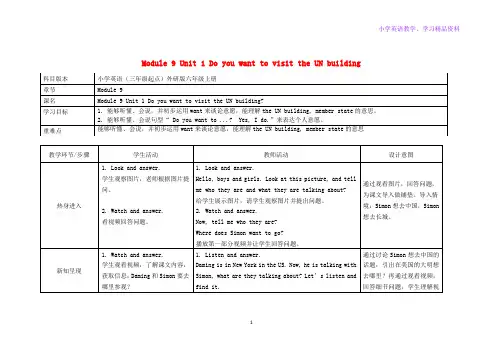
It means联合国in Chinese.
向学生解释UN的意思。
Q2: Where is it?
A2: It’s in New York.
联合国在哪里?
联合国在纽约。
3. Listenand answer more questions.
Q3:How many countries are there in the UN?
2. 能够听懂、会说句型“Do you want to...?Yes, I do.”来表达个人意愿。
重难点
能够听懂、会说,并初步运用want来谈论意愿,能理解the UN building, member state的意思
教学环节/步骤
学生活动
教师活动
设计意图
热身进入
1.Look and answer.
A3:There are 193 countries in the UN.
联合国有多少个国家?
有193个国家。
4. Choose the answer.
What does “member states” mean here?
选择“member states”的中文是什么意思。
5. Listen and repeat.
新知呈现
1.Watchand answer.
学生观看视频,了解课文内容,获取信息:Daming和Simon要去哪里参观?
2.Listenandanswer the question.
学生听课文第一段录音,并回答问题。
3.Listen and answer.
观看课文第二段录音,了解关于联合国更多的信息。
听录音跟读课文。
通过讨论Simon想去中国的话题,引出在美国的大明想去哪里?再通过观看视频,回答细节问题,学生理解视频内容,能够描述视频中的场景,对本课重点句型“Do you want to…? Yes, I(we)do.”的句型进行学习和练习。
外研版(三起点)小学六年级英语上册Module9_Unit2_教学课件

>>Warm-up
Review
Do you want to visit...?
>>Lead-in
1 Look, listen and say.
Do you want too you want to visit the Huangshan Mountain?
(单击图片可播放动画)
>>Presentation
There are lots of beautiful places to go in China.
>>Presentation
Talk about the places you want to go and your reason.
I want to visit Sanya. It’s warm and beautiful. …
>>Presentation
Do you want to visit …?
>>Practice
3 Read and complete.
Boy: Do you want to drink milk?
Girl: No, I want to drink orange juice.
Boy: D__o_y_o_u__w_a_n_t _to__go t_o_t_h_e_c_in_e_ma?
1.Write about yourself.
2.Write about your partner.
>>Practice
7 Write and say.
I often go swimming… He often goes swimming…
外研版英语(三起)六年级上册 Module 9 课件
the Changjiang River
It’s more than six thousand kilometers long.
Do you want to go to the Changjiang River?
Yes, I do.
No, I don’t.
the Huangshan Mountain
There’s a famous mountain in Anhui. Do you want to go to Huangshan Mountain?
Yes, I do.
No, I don’t.
课文学习
1 Look, listen and say.
Do you want to visit the Changjiang River? Do you want to visit the Huangshan Mountain?
Yes, I do. No, I don’t.
The UN is great. It wants to bring _______ to the world.
( danger / safe / hope / peace )
外研版英语六年级上册
Module 9 Unit 2 I want to go to Shanghai.
Discuss Where do you want to go?
重点句型
如何表达想要做某事
“I want to go to Shanghai.”意为“我想去上 海。” 句型为:主语+want(s)+to+动词原形+ 其他.表示“想要做某事”。
Example
I want play chess with you.
外研版(三起)六年级上册英语-Module9 Unit 2I want to go to Shanghai.课件
Summary(小结)
words
1.want to意思
为“想要”
2.want to do
的意思为“想要做 …”
sentences
1.I want to go to Shanghai. 2.We should go to all these places.
Homework
Where do they want to go on holiday?
It's in the south of China. It's got a beau它. 有一个美丽的湖。
There are lots of mountains and lakes in
Guilin.
在桂林有许多山和湖。
Read and fill in the blanks
Listen, read and imitate
Read and answer
Do you want to go to the cinema? No,I want to go to the park.
Group work
A: Do you want to …..? B: No, I don't.Do you? A:Yes, I do.
to...对话。 • 情感目标: • 通过谈论中国著名城市,培养学习兴趣。
Free talk.
四人一组描述自己的愿望,想要做的事。
I want to fly. I want to sleep. I want to visit America.
I want to...
我想做......
Listen and say
What's the bird doing? He's_f_ly_i_n_g_to_ C_hi_n_a_now.
外研社英语(三起)六年级上册第九模块教学课件

Words.
all around
all around the world
They are from all around the world.
他们来自世界各地。
worlds
在四周,到处 all around 到处,遍及 member state 成员国 inside 在……里面, should 应该
的礼物时)? Why ?
He wants to take a photo .
Because it’s beautiful..
1这99是5年一10座月展21现日,成中昆国铁向路联雄合姿国的赠象送巨牙型雕青刻铜。重 2书露物器昌好也它分经01长出—“是盛祝常长精51长织年中潘—9世世愿,龙吸达 美7长19纪 界,国基“40兆对引,2年米月城米宝 爱赠文和吉创许和,、2风鼎 好,祥造送共平8多壁中日宽光” 和一.设给同尊它观毯国平国,5图个计表以联将”米众一的向家案更达祝独合一。的人。样联加主.了贺特国块巨民都美合席中联,红7幅的好是0国国合习构周共绸艺的人世国赠近思同年布术新民成界送平心巧华世缓壁对立艺了和愿纪妙诞缓毯联5术0一。联的,周合的拉,珍幅合希年国工礼下上品冀国.的艺,鼎,.秘美这十志
Yes! Yes!
Do you want to visit China
?
Yes! Yes!
Simon wants to visit
.
A. the UK
B. China
C. the great Wall
1. Where is the UN building? The UN building is in New York.
.
Do you want to play basketball?
外研版(三起点)小学六年级英语上册Module9_Unit1_优秀教案
Module9 Unit1 优课教案Do you want to visit the UN building?一、教材分析新标准英语三起点第九模块第一单元Do you want to visit the UN building?本单元的教学内容是一篇关于Simon向Daming 介绍联合国对话。
主要围绕Daming在美国的见闻这一主题,谈论可能要做事情的话题。
二、学情分析本课的教学对象是六年级学生,学生从三年级开始学英语,通过三年的学习大部分孩子已有了一些英语基础。
大部分学生能用英语简单的表达,所以,我在教学过程中基于本课内容的特点和六年级学生的年龄心理特征,采用任务型教学法,以任务为主导的教学法,让学生在真实的语境中进行合作交流,学习新知。
三、学习目标(一)知识目标1.学习并掌握“Do you want to visit the UN building?”、和“I want to…”的表达方法;2.能学会运用所学的句子说明可能要做的事情。
3.通过学习能够对联合国有一定的了解和认识。
(二)能力目标1.通过学习培养学生的观察能力与理解能力。
2.在各种训练活动中,培养学生运用语言的能力;(三)情感目标1.通过学习,使学生对世界联合国有初步的认识。
2.渗透爱国、爱世界,做一个对祖国,对世界都有用的人。
四、学习重点、难点(一)学习重点1.让学生能够理解并掌握句子“Do you want to …”、和“I want to…”2.通过学习能够对联合国有一定的了解和认识。
(二)学习难点运用所学的句子说明可能要做的事情五、教学过程六、课后反思整篇课文语句不难,新单词也不多,而学生们对联合国的知识还是比较缺乏,我没有直接进入课文而是通过要给学生展示一些中国和英国的景点,让学生在讨论这些景点的同时运用I wan to,和Do you want to,句型。
主要是对“want to”的学习运用,通过本单元的学习,进一步复习巩固一般现在时等以前学习的内容;扩展学习谈论可能要做事情的话题。
2021六年级英语上册Module9Unit2IwanttogotoShanghai教案外研版三起
Unit 2 I want to go to Shanghai.【教学目标】:知识与技能:Do you want to go to Guilin ?Yes , I do . / No , I don’t过程与方法:直观教学法,表演法,对话法情感、态度和价值观:询问他人的意愿并表达自己的意愿。
【重点】:Do you want to go to Guilin ?Yes , I do . / No , I don’t【难点】:本单元的chant部分【课时安排】:1课时【教学过程】:(一)导入:一.复习:出示SB第一单元活动1的挂图,把学生分成三组,分别扮演Daming , Simon , Simon 的父亲,根据挂图表演故事。
二.任务呈现与课文导入:1.出示一张中国地图,提问:What is it ?(It’s a map of China .)2.老师指着地图上的一些地方问学生:Where is it ?(It’s ) 引导学生说出这些地方的名称。
接着问学生:Do you want to go to Guilin ? Why not ?引导学生说出种种理由。
3.告诉学生:有一家外国人到中国来玩。
他们在谈论假期安排时每个人都有不同的意见,让我们来听听他们都说了写什么?学习过今天的课文,同学们也要使用学到的语言说一说自己的旅行计划。
(二)探究新知:1.老师放录音,让学生看着中国地图听。
听第一遍录音时,老师要求学生找出录音中提及的几个中国地名。
(Beijing , Hong Kong , Harbin , Kunming , Guilin )2.录音原文:Dad : There are lots of beautiful places to go in China .Boy : I want to go to Beijing , Beijing is very and very famous .Girl : I want to go to Hong Kong . It’s very big too . and there are lots of tall buildings .Mum : There are lots of shops in Hong Kong , too . But I also want to go to Harbin , Harbin is very cold in winter , but the snow is very beautiful .Dad : Kunming is a beautiful place , It’s in the south of China , and it’s got a beautiful lake .Girl : And there are lots of mountains and lakes in Guilin .Boy : I think we should go to all of these places .Mum : That’s a good idea .3.放第二遍录音,让学生试着找出每个人想去的地方是哪里,如:The boy wants to go to Beijing . The girl wants to go to Hong Kong , The woman wants to go to Hong Kong and Harbin .4.再放录音,让学生模仿录音中的语音和语调跟读。
外研版(三起)-英语-六年级上册-英语外研版六年级上 Module 9 Unit 1 教材讲解 教案
Module 9Unit 1 Do you want to visit the UN building?你们想要参观联合国大厦吗?Listen and say.听一听,说一说。
(教材第52页)课文全译A:Do you want to visit the UN building in New York?A:你们想要参观纽约的联合国大厦吗?B and C:Yes,we do!B和C:是的,我们想!A:I want to show Daming one of the presents from China.A:我想要给大明看一件来自中国的礼物。
B:OK!B:好的!活动指导1.活动类型:信息交流活动;小组合作活动。
2.活动目的:学会在自然的情景中运用“Do you want to…?”句型询问对方的意愿,以及运用“l want to…”句型表达自己的意愿。
3.参考词汇:want,visit the UN building,the Great Wall,show,take a photo。
4.注意事项:三人一组,可选取身边的景点、名胜以及准备送给朋友的礼物进行问答练习。
Practise.练一练。
(教材第52页)课文全译Point and say what they want to do.指一指并说一说他们想要做什么。
活动指导1.活动类型:信息交流活动;个体单独活动。
2.活动目的:学会在自然的情景中运用“…want(s)to…”句型表达他人的意愿。
3.参考词汇:he,want(s),visit the UN building,take a photo,show。
4.注意事项:根据第二部分课文内容,将人物与对应的图片连线,并描述出人物想要做的事。
注意句中动词第三人称单数的变化。
答案链接上左图一下右图上中图一下左图上右图一下中图Simon wants to show Daming one of the presents from China.Simon and Daming want to visit the UN building.Daming wants to take a photo.。
(外研版三起)六年级英语上册Module9第一课时Unit1教案
(外研版三起)六年级英语上册Module 9 第一课时 Unit 1 教案教学内容:本节课我们将学习外研版六年级英语上册Module 9 Unit 1的内容。
这一单元的主题是“过去时态”,主要包括动词过去式的构成和用法。
我们将通过阅读、听力、口语和写作等多种活动来掌握这一语法点。
教学目标:1. 知识与技能:学生能够理解并正确使用动词过去式。
2. 过程与方法:通过小组合作、角色扮演等活动,提高学生的英语听说能力。
3. 情感态度价值观:培养学生对英语学习的兴趣和自信心。
教学难点:1. 动词过去式的构成规则。
2. 过去时态的运用。
教具学具准备:1. 教材:外研版六年级英语上册。
2. 多媒体设备:用于播放听力材料。
3. 小组活动道具:用于角色扮演。
教学过程:1. 导入:通过图片或故事引导学生回顾过去的事件,激发学生对过去时态的兴趣。
2. 新课呈现:讲解动词过去式的构成规则,并通过例句展示其用法。
3. 实践活动:学生进行小组合作,运用过去时态描述过去的事件。
4. 巩固练习:通过听力、口语和写作练习,加深学生对过去时态的理解。
板书设计:1. Module 9 Unit 1 过去时态2. 重点词汇和短语:如“yesterday”, “last week”, “went to”等。
3. 动词过去式的构成规则:如“add ed”, “double the last letter and add ed”等。
4. 过去时态的句子结构:如“I went to the park yesterday.”作业设计:1. 词汇练习:完成教材中的单词表。
2. 句子练习:用过去时态描述过去的事件。
3. 阅读理解:阅读一篇关于过去事件的短文,并回答问题。
课后反思:本节课通过多种教学活动,使学生掌握了过去时态的基本用法。
在教学过程中,教师应注重学生的个体差异,给予充分的指导和支持。
同时,教师还需关注学生的学习兴趣和情感态度,营造积极的学习氛围。