
人教版新目标英语九年级 Unit11单元知识点小结
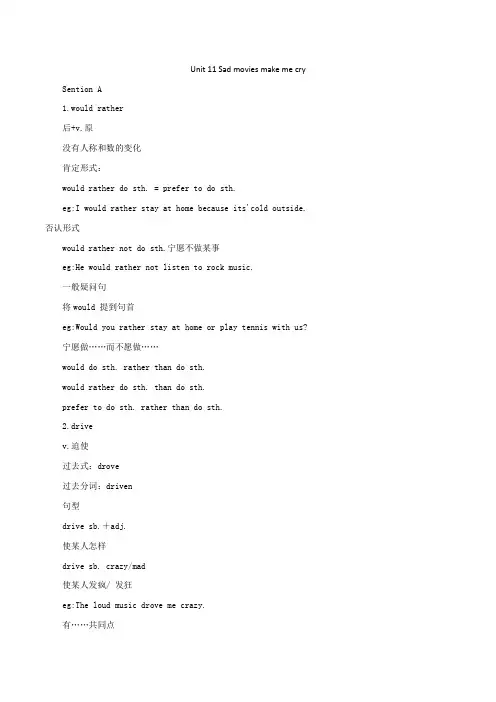
1 Unit 11 Sad movies make me cry. 重点短语
句子重难点解析 1. Yes, she was, and waiting for her drove me crazy. 是的,等她让我发疯了。 drive sb. + adj. 使某人怎样 (drive sb. crazy/mad 使某人发疯/发狂) He nearly drove Alice mad with his fussing. 他的小题大做简直快把爱丽丝逼疯了。 ① That thing almost __________________________ . 那件事几乎要使我发狂了。 ② You'll ____________________________ some day. 你总有一天会把妈妈急疯了的。 2. Then she won't feel left out. 那么她就不 会感到自己被人遗忘。 feel left out (感到)被忽略;被冷落 Mary talked to her so that she wouldn't feel left out. 玛丽和她交谈,以免让她觉得被冷落。 No one speaks to him, he always ___________________________. 他总是觉得被人冷落。 3. He slept badly and didn't feel like eating.他的睡眠很糟糕,他也不想吃东西。 feel like doing 想要做某事(=want to do = would like to do)
1. for the first time 第一次 2. the first time ... 第一次…… 3. be supposed to do ... 应该做…… 4. be expected to do sth. 被期望做…… 5. shake hands with sb. 和……握手 6. hold out 伸出 7. to one's surprise 令……意外的是 8. be relaxed about ... 对……感到放松 9. rush around 匆忙赶路 10. value the time 珍惜时间 11. in one's everyday life 在日常生活中 12. drop by 顺便拜访;随便进入 13. after all 毕竟、终究 14. get mad with sb. 生……的气 15. make an/every effort to do sth. 努力做…… 16. heavy traffic 繁忙的交通 17. It's no big deal! 小事一桩! 18 clean ... off 把……擦掉 19. be worth doing 值得做
20. table manners 餐桌礼仪 21. stick ... into ... 把……伸进…… 22. take off 脱下;(飞机)起飞 23. as ... as possible 尽可能…… 24. be worth the trouble 值得麻烦 25. point at 指着 26. point to 指向 27. go out of one's way to do sth. 特地/努力做…… 28. make sb. feel at home 使……感到宾至如归 29. be comfortable doing sth. 自在地做…… 30. feel good about doing sth. 做……感觉良好 31. behave well / badly 表现好/不好 32. good / bad behavior 良好/恶劣举止 33. Chinese customs 中国的习俗 34. at the table 在桌上 35. at table 就餐 36. show up 出现;显现;赶到;使……出丑 37. show off 炫耀;显摆 38. show ... around ... 带……参观…… 2
I do not feel like dancing now. 我现在不想跳舞。 I don't ______________________ anything now. 我现在什么都不想吃。 =I don't ________________ anything now. = I ____________________ to eat anything now. 4. His face was always pale as chalk. 他总是面色苍白。 (as) pale as chalk (一种明喻修辞结构,意思是脸色“惨白;苍白”。) You looked as pale as chalk when you went into hospital. 你进医院时面色苍白。 You look ______________________ today. What's wrong? 今天你看着面色苍白,哪里不舒服? ★ 英语常用pale来描述人不健康的面色 “煞白;苍白;灰白”等。 5. One day, a doctor was called in to examine the king. 一天,医生被传唤去给国王检查身体。 call in 召来,叫来,找来 I think we should call in a specialist. 我想我们应当去请一位专家来。 ① He only waited two minutes before he _________________ . 他只等了两分钟就被叫了进去。 ② ____________ the doctor at once. 马上去请医生来。 6. Neither medicine nor rest can help him. 药物和休息对他都无帮助。 ⑴ neither...nor... 既不……也不……(作连词,连接主语时,使用就近原则) 类似的有:either... or...; not only...; but also...; There be...等。 ① Neither he nor I _________(be)from Beijing. ② Either you or the twins _________________(be, go)there next week. ③ Not only the students but also the teacher ________________________(already know)the news. ④ There ______(be)one child and fifty old people found after the earthquake in the past 10 days. ⑤ Both my sister and I _________ teachers. ⑥ Either you or Tom _________(have)to clean the room. ⑵ both, either & neither(作代词,常构成... of ) neither of... 两者都不(作主语,谓语用单数) both of... 两者都(作主语,谓语用复数数) either of... 两者中的任何一个(作主语,谓语用单数) ⑦ Either of his parents ______(be)a doctor. 他的父母中有一个是医生。 ⑧ Neither of his parents ______(be)a doctor. 他的父母都不是医生。 ⑨ Both of his parents ______(be)doctors. 他的父母都是医生。 7. I'm always worried about losing my power. Many people are trying to take my position. 我总在担心失去我的权力,很多人都想要取代我的位置。 3
⑴ be worried about = worry about 担心 ① We ___________________________ my grandpa's health. 我们总是担心我爷爷的健康。 ⑵ take one's position 取代某人的位置(=take one's place) ② He _____________________ as I couldn't attend the speech. 由于我不能出席演讲,他替代了我的席位。 8. How could he have missed scoring that goal? 他怎么会错过进球? ⑴ could have done 表示“过去本能做…但未做”,含“责备”意义。 ① How _______ he _________________ such a fool? 他怎么这么糊涂? ② How _______ she _________________ what kind of man he was? 她怎么会忘记他是哪种人呢? ⑵ miss doing sth. 错过做某事 ③ Because of the traffic jam I ____________________ the flight. 由于交通堵塞,我错过乘坐这次航班。 9. He was really worried that his coach might kick him off the team. 他真的很担心教练会踢他离开团队。 kick sb. off 开除某人 Tim made a big mistake, and the manager ________________________ the company. 蒂姆犯了一个很大的错误,经理把他开除。 10. But whatever it was, don't be too hard on yourself. 但不管结果怎样,不要对自己要 求太苛刻。 be hard on sb. 严格要求……;对……过于严厉 ① He ________________________ their students. 他对学生严格要求。 ② Perhaps ________________________ my daughter. 或许我对我女儿要求过头了。 11. The next day, Peter went to soccer practice with courage rather than fear in his heart. 第二天,皮特并没有害怕,而是勇敢地去 参加足球训练。
最新人教版英语九年级Unit11单元知识点总结大全(带答案)

最新人教版英语九年级Unit11单元知识点总结大全(带答案)Unit 11 Sad movies make me cry.Sad movies always make me cry。
It's not just me。
though。
Many people feel the same way。
For the first time。
I watched a sad movie with my friends。
We were supposed to watch a comedy。
but we decided to watch a sad movie instead。
To our surprise。
we all cried at the end。
We shook hands with each other。
XXX.In my everyday life。
I try to value my time as much as possible。
I don't like to rush around and hold out my hand to greet people。
I'm relaxed about most things。
but I make every effort to behave well and have good manners。
Chinese customs are important to me。
so I always XXX hand.When I have guests over。
I go out of my way to make them feel at home。
I want them to be XXX they want。
After all。
it'stheir visit。
not mine。
I drop by their house and show up with a smile。
九年级英语全册Unit11Sadmoviesmakemecry知识点汇总新版人教新目标版
侧重看质量、水平等是否过关
10.neither...nor
既不……也不……
就近原那么
eg:Neither he nor I am well educated
在三天的时间里
“in+一段时间〞常用于将来时态
eg: It is about 20 minutes' bus ride from my home to school
n.重量
常用短语
put on weight 体重增加;长胖
lose weight 减肥
3.let...down
使……失望
动词+ห้องสมุดไป่ตู้词
宾语是人称代词时,放在两词间
let短语
let out 下课;散会
let alone 不打搅
let in 允许进入
let through 允许……通过
4.kick sb. off
辨析
even though
引导的从句内容是真实的
尽管,虽然
eg:Even though it's hard work, I enjoy it.
even if
引导的从句是假设性的
即使,就算,哪怕
eg:They'll stand by you even if you don't succeed.
2.weight
开除某人
eg: The boss kicked him off last week.
kick短语
kick on 开始工作
kick down 踢倒
kick against对抗
kick back 踢回,还击
5.be(too) hard on sb.
九年级英语知识点Unit11
九年级英语知识点Unit11Unit 11: English Grammar for 9th GradersIntroduction:In 9th grade English, students will encounter various important grammar concepts that will help them enhance their understanding and usage of the English language. This unit will focus on key knowledge points that students need to grasp to improve their language skills. Below are the crucial topics covered in Unit 11:1. Verb Tenses:Verb tenses play a significant role in expressing time and indicating the sequence of events. Here, we will discuss the four main verb tenses: Present, Past, Future, and Present Perfect. Each tense has its own rules and usage, and this section will provide a thorough explanation of each tense, examples, and exercises for better understanding.2. Passive Voice:The passive voice is frequently used in English to emphasize the action or the object rather than the subject performing the action. In this section, we will explore the formation and usage of passive voicesentences, including the conversion of active voice sentences to passive voice and vice versa.3. Conditionals:Conditionals are sentences that express consequences or hypothetical situations. There are four types of conditionals: zero, first, second, and third conditional. We will delve into each conditional type, explaining the structure, usage, and providing examples to clarify how they are employed in conversations and writing.4. Reported Speech:Reported speech is used to convey someone else's words in indirect form. In this section, we will focus on transforming direct speech into reported speech, including changes in verb tenses, pronouns, and time expressions. Extensive examples and exercises will help students practice and master this important skill.5. Modals:Modals are auxiliary verbs used to express various meanings such as ability, possibility, necessity, and permission. This section will discuss the different modals, their usage, and how they can be appliedin different contexts. Students will also have the opportunity to practice using modals in sentences to solidify their understanding.6. Question Forms and Tags:Asking questions and using question tags are essential skills for effective communication. This section will cover different question forms (Wh-questions, Yes/No questions, and alternative questions) as well as question tags. Students will learn how to correctly construct questions and tags, using appropriate word order and intonation.Conclusion:Unit 11 of the 9th-grade English curriculum covers crucial grammar knowledge points to strengthen students' understanding and application of the English language. Mastery of these concepts will enhance their overall proficiency and enable them to communicate effectively in both spoken and written English. It is important for students to practice these grammar skills regularly and seek further guidance when needed to solidify their knowledge.。
新目标九年级英语Unit11知识点 重点句子

Unit11知识点重点句子一、重点词汇(单词)1.friendship 友谊, , power 权力, wealth 财富, lemon 柠檬, fame 名声2.king 君主, queen 王后,3.palace 王宫(children's palace;Palace Museum(故宫博物院) 或者Forbidden City(紫禁城);the Summer Palace;the Old Summer Palace 圆明园;the temple of heaven天坛)4.pale苍白的, , grey 阴沉的;5.Prime adj.首相的, 最好的;首要的;n. 精华;初期;全盛时期;青年;vt. 使准备好;填装;--prime minister; premier 总理,首相6.examine 检查, -- examination n. (physical examination)7.nor 也不【解析】1.)(与neither连用)也不Neither he nor his friends came back. 他和他的朋友都没有回来。
2)(与not连用)也不;又不 --倒装He can't do it, nor can I, nor can you, nor can anybody.他不能做这事,我也不能,你也不能,任何人都不能。
3) 也不I don't want to go, nor will I.我不想去,也不会去。
二、固定搭配(词组)1.使……失望let...downEg: Don’t let me down.2. 开除kick sb. off3. 而不是rather than(rather than的用法)4. 齐心协力pull together5. 在肩上on one’s shoulder6. 停止做某事stop doing stop to do sth.7. 敲门knock on the door = knock at the doorEg: There is a knock on the door.= Somebody /Someone is knocking on/at the door.8. 与…… 交流communicate with9. 向……学习learn from10. 继续做某事continue to docontinue to do继续做另一件事情(已经完成一件工作)After he finished reading a novel, he continued to play games with his friends.他读完小说后跟朋友们继续玩游戏。
人教版九年级英语 unit11知识点
人教版九年级英语 unit11知识点Unit 11 Knowledge Points in the 9th Grade English TextbookIn the ninth grade English textbook of People's Education Press, Unit 11 covers various language points that are important for students to master. These knowledge points are essential for improving students' English proficiency and enhancing their understanding of the language. In this article, we will explore some of these knowledge points and discuss their significance in language learning.1. Vocabulary and PhrasesVocabulary is the foundation of language learning. In Unit 11, students are introduced to a variety of vocabulary and phrases related to different topics. For example, they learn words related to travel, such as "suitcase," "journey," and "destination." By familiarizing themselves with these words, students expand their vocabulary and are able to express themselves more accurately.2. GrammarGrammar plays a crucial role in language construction. Unit 11 introduces several important grammar points, such as the past perfect tense and the reported speech. The past perfect tense is used to describean action that happened before another past action. By understanding and practicing the usage of this tense, students can effectively convey temporal sequences in their writing and speaking.Reported speech, on the other hand, is used to convey statements or opinions made by someone else. Mastering reported speech helps students accurately quote and attribute information in their communication. Through exercises and examples in Unit 11, students can learn how to transform direct speech into reported speech and vice versa.3. Reading ComprehensionDeveloping reading comprehension skills is essential for students to understand and interpret written texts. Unit 11 provides various reading passages that cover different topics, allowing students the opportunity to practice reading for meaning. By engaging with these texts, students can improve their reading speed, expand their vocabulary, and enhance their overall comprehension abilities.4. Listening and SpeakingUnit 11 also focuses on developing students' listening and speaking skills. Listening exercises include short conversations, interviews, and presentations, allowing students to practice their listeningcomprehension in various contexts. Through these exercises, students can learn how to extract important information from oral texts and improve their overall listening skills.Speaking activities in Unit 11 provide students with opportunities to express their thoughts and ideas on specific topics. By discussing travel experiences, giving presentations, and engaging in group discussions, students can practice their speaking skills and become more confident in their ability to express themselves orally.In conclusion, Unit 11 of the ninth grade English textbook introduces various knowledge points that are crucial for language learning. Vocabulary, grammar, reading comprehension, listening, and speaking skills are all covered in this unit. By mastering these knowledge points, students can significantly improve their English proficiency and enhance their overall language abilities.。
新目标人教版九年级英语(10—14单元)知识点总结
新目标人教版九年级英语(10—14单元)知识点总结(Unit 10- Unit 14)汇总Unit 10 XXX.一.重点词组1. be XXX被期望/要求做某事;应该2. XXX握手3. drop by顺便拜访4. after all毕竟;终归5. pick up拾起;捡起接某人6. make a noise发出噪音7. table manners餐桌礼仪8. get used to惯于9. XXX对…随意/放松10. get mad大动肝火;气愤11.clean…off把…擦掉12.take off脱下(衣服);(飞机等)起飞13.make an effort作出努力14.make sb XXX使某人感到宾至如归15.cut up切开;切碎16.be expected to do被期待做…17.make friends with与…交朋友18.XXX…就…19.to one’s surprise令某人吃惊的是20. be different from与…不同21.on time按时in time及时二.重点语法1.(1)suppose:猜测;假定XXX透露施展阐发“推测;假定”,that可省例:XXX.(2)be XXX被期望做某事,应该做某事。
相当于should 和ought to例:XXX.XXX to say hello to the foreigners.【练】You are supposed _____ hands when you meet for the first time.A. to shakeB. shakeC. shakingD. shook2. make plans to do == plan to do.打算做某事例She has made plans to go to Beijing.=She has planed to go to Beijing.go out of one’s way to do特意,专门做某事例:He went out of his way to make me happy.3. In Switzerland,it’XXX.阐发:it是方式主语,不定式是真正的主语。
九年级人教英语unit11知识点
九年级人教英语unit11知识点Unit 11 is an important unit in the ninth grade English curriculum. It covers various topics that are essential for students to build a solid foundation in English language learning. In this article, we will explore the key points of Unit 11 and discuss their significance in the learning process.Vocabulary is the first key aspect of Unit 11. The unit introduces students to new words and phrases related to traveling, such as "passport," "sightseeing," and "tourist attraction." Learning new vocabulary helps students to expand their language skills and improve their communication abilities. It is crucial for students to understand the meaning and usage of these words in different contexts.Next, grammar plays a vital role in Unit 11. The unit focuses on the present perfect tense, which is used to express actions or situations that started in the past and have a connection to the present. Mastering this tense is essential for students as it enables them to communicate about their experiences and achievements effectively. Additionally, understanding the rules of subject-verb agreement and sentence structure is fundamental in constructing grammatically sound sentences.Reading comprehension is another critical component of Unit 11. Students are exposed to various reading passages, such as travel brochures, articles, and personal narratives. Through reading, students can improve their reading skills, expand their vocabulary, and gain knowledge about different cultures and countries. Reading also enhances critical thinking and analytical skills, as students are required to infer and interpret information from the text.Unit 11 also places emphasis on listening skills. Listening exercises provide students with opportunities to expose themselves to various accents and intonations, helping them to develop their listening comprehension abilities and familiarize themselves with different English-speaking environments. Additionally, listening activities enhance students' understanding of spoken English, enabling them to communicate effectively in real-life situations.Writing is another crucial aspect of Unit 11. The unit provides opportunities for students to practice different forms of writing, such as travel diaries, postcards, and descriptions of tourist attractions. Through writing, students can express their thoughts and ideas while applying the grammar and vocabulary they have learned. Writing practice also encourages creativity and helps students to improve their overall language proficiency.Unit 11 also includes speaking activities to enhance students' oral communication skills. Students engage in dialogues, role-plays, and presentations related to traveling and experiences. These activities allow students to practice using the target vocabulary and grammar structures in a conversational setting. Speaking exercises help students to develop fluency, pronunciation, and confidence in expressing themselves in English.In conclusion, Unit 11 covers various essential aspects of English language learning, including vocabulary, grammar, reading comprehension, listening skills, writing, and speaking. Mastering these key points is crucial for students to build a strong foundation in English. Unit 11 not only provides students with language skills but also exposes them to different cultures and experiences. By engaging in the various activities within Unit 11, students can enhance their overall language proficiency and become effective communicators in the English language.。
人教版新目标英语九年级Unit 11 词汇详解
新目标英语九年级Unit 11 词汇详解1.restroom D.J[6rest7ru8m, -7rum] K.K.[6rWst7rum, -7r&m](名词)A room equippedwith toilets and lavatories for public use.公共厕所:配备有便池与洗手池供公众使用的房间2.shampoo D.J. [☞✌❍☐◆] K.K. [.#m6pu] n.(名词)【复数】sham.poosAny of various liquid orcream preparations of soap or detergent used to wash the hair and scalp.洗发精,洗发水:任一种用来清洗头发和头皮的液态或膏状肥皂或清洗药剂Any of various cleaning agents for rugs, upholstery, or cars.清洗剂:任一种用于抹布、地毯或汽车的清洁剂The act or process of washing or cleaning with shampoo.清洗:用洗发精或清洗剂清洁的行为或过程v.tr.intr.(及物动词和不及物动词)sham.pooed,sham.poo.ing,sham.poos To wash or undergo washing with shampoo.3.drugstore [♎❒✈♈♦♦] n.药房 D.J.[6dr(g7st%8r, -7stour] K.K.[6dr(g7st%r,-7stor] n.[美]杂货店(出售药物、糖果、饮料及其他杂物的店铺)4.department [♎♓☐♦❍☜⏹♦][di6p$8tm*nt] [d!6p$tm*nt] n.Abbr. dept., dpt., dep., D.(名词)缩写dept.,dpt.,dep.,D.A distinct, usually specialized division of a large organization, especially:部门,科系:一个大组织的确定的、通常是专门的部门,尤其指:A principal administrative division of a government:(政府)部门:政府主要的行政部门:the fire department; the department of public works.消防部门;公共事务部A division of a business specializing in a particular product or service:(商业)部门:专营某种特定产品或服务的商业部门:the personnel department.人事部门A division of a school or college dealing with a particular field of knowledge:(学校)系:学校(或学院)研究某一特定领域的部门:the physics department.物理系Department One of the principal executive divisions of the federal government of the United States, headed by a cabinet officer. Department 部:美国联邦政府的一个主要行政部门,由内阁官员领导A section of a department store selling a particular line of merchandise:(百货商店)部:百货商店卖某一特定种类的商品的地方:the home furnishings department.家具部An administrative district in France.(法国的)行政区Informal An area of particular knowledge or responsibility; a specialty: 【非正式用语】专业,职责:某一领域的专门知识或责任;专长:Getting the kids to bed is my department.哄孩子们上床睡觉是我的专长5.escalator [ ♏♦☜●♏♓♦☜][6esk*7leit*] [6Wsk*7let+] <美>电动扶梯, 自动扶梯 Amoving stairway consisting of steps attached to a continuously circulating belt.自动扶梯:附着在一个连续循环的带子上的带有台阶的移动楼梯An escalator clause.调整条款:规定(工资、价格等)定期按生活费用、生产成本等变动作上下调整的条款6.magic [ ❍✌♎✞♓]n.魔法Some people still believe in magic.有些人仍然相信魔法。
人教新目标九年级英语 Unit11 教材解读
Unit11 教材解读1.0Textbook Analysis教材解读本单元以“情感(Feelings)”为话题,就生活的各个方面,谈论事物对情感的影响,学会倾诉烦恼以及寻找合适的解决办法。
Section A第一部分以周围的环境,事物,朋友关系为主要内容,要求学生运用已学过的与情感相关的词汇来表达自己的感受;第二部分以寓言故事第一章节的形式引出问题“有权力,财富和荣誉就能快乐吗?”让学生思考,和学生共同探讨和反思“究竟怎样才能获得真正的快乐”。
在语法方面,让学生巩固并熟练运用表达情绪和感受的形容词和动词,结合make sb. do sth. 和make sb. +adj. 结构来表达个人的情绪等相关内容。
在话题上,Section B第一部分延伸了寓言故事的发展和结局。
通过预测,听力和讨论,引导学生建立正确的人生观;第二部分回归生活,从学生遇到问题到解决,延伸到建立积极的情感态度。
在语言上,进一步丰富与学习相关的话题词汇。
在技能上,将听说能力综合,让学生了解习语(idioms)和短语(phrases)在英语学习中的重要性,由读促写。
在教学策略上,要引导学生善于分享生活中快乐和难过的经历,总结经验教训以及寻求适合的解决办法。
1.1S ection A 1a 活动1a是Lead-in部分。
引导学生谈论两家餐馆的环境,通过不同环境给人的不同感受及其理由分析呈现sth. make sb.+adj.的句子结构以及巩固与情感相关的词汇使用,激活学生表达相关感受的语言,为1b的听力练习和1c的口语对话操练作好语言和话题的铺垫。
1.2S ection A 1b-1c 活动1b-1c是Listening and speaking的部分。
在1a的Free-talk基础上直接过渡到听力练习,强化用于描述事物和表达情感的形容词的使用,熟悉役动词make表达情感的基本结构。
听后让学生以两人一组的对话形式谈论各自对两家餐馆的看法和理由。
人教版英语九年级unit11知识点归纳
人教版英语九年级unit11知识点归纳Unit 11 of the 9th-grade English textbook published by the People's Education Press covers various topics and grammar points. In this article, we will summarize the key points from this unit without going into the specifics of each lesson.Vocabulary:Unit 11 introduces a range of new vocabulary words, including nouns, verbs, and adjectives. It is essential to familiarize yourself with these words to understand the reading passages and to improve overall vocabulary.Phrasal Verbs:Phrasal verbs are a vital part of English communication. In this unit, you will encounter various phrasal verbs such as "look up," "bring up," and "takes after." Remember that the meaning of phrasal verbs often differs from the individual meanings of the words involved.Grammar:Unit 11 focuses on specific grammar points that are essential for effective English communication. Let us explore some of these grammar topics in greater detail:1. Passive Voice:The passive voice is a commonly used construction in English. It is formed by using the appropriate form of the verb "to be" followed by the past participle of the main verb. Understanding how to form passive sentences and when to use them is crucial in accurately conveying information.2. Reported Speech:When reporting what someone else has said, we often need to change the tense and pronouns used. This unit dedicates attention to understanding and using reported speech correctly. Keep in mind that changes in tenses, pronouns, and other elements occur depending on the original speaker's words.3. Conditional Sentences:Unit 11 also covers conditional sentences, which express a hypothetical situation and its probable consequence. There are different types of conditional sentences, including the zero and first conditionals. Understanding how to form and use these conditional sentences is key to expressing hypothetical situations accurately.Reading Skills:Effective reading skills are crucial in comprehending information presented in written texts. In this unit, you will practice skimming and scanning techniques to quickly identify the main idea, keywords, and relevant information. Remember, developing your reading skills will not only help you understand texts better but also improve your overall language proficiency.Listening Skills:Improving listening skills is vital for successful communication. Throughout this unit, you will have opportunities to enhance your listening skills by listening to dialogues, narratives, and news reports. Active listening involves paying attention to details, understanding the central message, and identifying key facts or arguments.Writing Skills:Unit 11 also touches upon writing skills, including how to write a formal letter or email. Learning how to structure your writing, use appropriate vocabulary and grammar, and convey your message clearly and concisely is essential for effective written communication.Speaking Skills:Developing speaking skills is crucial for real-time communication. This unit offers opportunities to practice speaking through dialogues, role-plays, and discussions. Remember to focus on fluency, pronunciation, and using vocabulary and grammar accurately while expressing your ideas confidently.In conclusion, Unit 11 of the 9th-grade English textbook provides various opportunities for students to improve their vocabulary, grammar, reading, listening, writing, and speaking skills. By paying attention to the key points discussed and practicing them regularly, students can enhance their English language proficiency and confidently communicate in various real-life situations.。