
江苏省扬州中学2019届高三3月月考 英语
扬州中学高三英语双周练2019.03.09说明:本试卷分为第I卷(选择题)和第II卷(非选择题)两部分,第I卷第一至第三部分(选择题)答案请涂在机读答题卡相应位置上。
第I卷选择题(三部分,共85分)第一节,听下面五段对话,每段对话后有一个小题,从题中所给的A、B、C三个选项中选出最佳选项,并标在试卷的相应位置,听完每项对话后,你都有10秒的时间回答有关小题和阅读下一小题。
每段对话仅读一遍。
现在你有5秒钟的时间阅读第一小题的有关内容。
1. What will the man do?A. He will go to the Great Wall.B. He will stay with the woman.C. He will stay at home.2. What is the woman planning to do the weekend after next?A. Climb mountains.B. Go skating.C. Go swimming.3. When must the book reports be handed in?A. Not later than November 13.B. Not earlier than November 13.C. On November 30.4. What will Mr. Smith do at 10:00 a. m. tomorrow?A. Go to hospital.B. Meet James Chen.C. Attend a meeting.5. What will the man do on Friday?A. Attend the sales conference.B. Attend the market conference.C. Attend the seminar.第二节: 听下面五段对话或独白,每段对话和独白后有几个小题。
从题中所给的A、B、C三个选项中选出最佳选项,并标在试卷的相应位置。
听每段对话和独白前,你将有时间阅读各个小题,每小题5秒钟。
听完后,各小题将给出5秒钟的做答时间。
每段对话和独白读两遍。
听下面一段对话,回答第6和第7两个小题。
现在你有10秒钟的时间阅读这两个小题。
6. What will the man do tonight?A. Give a speech.B. Attend a party.C. Study a current event.7. What shouldn’t the man talk about?A. Other’s salary.B. Other’s family.C. Other’s jobs.听下面一段对话,回答第8至10三个小题。
现在你有15秒钟的时间阅读这三个小题。
8. What is the man doing?A. He is studying.B. He is asking the woman out.C. He is visiting the woman.9. What will Mary do this weekend?A. Take care of Jack.B. Go to the park.C. Study for a test.10. When will the speakers meet this weekend?A. At 7:00.B. At 8:00.C. At 9:00.听下面一段对话,回答第11至第13三个小题。
现在你有15秒钟的时间阅读这三个小题。
11. When will the man probably leave for Guangzhou?A. On October 1.B. On October 12.C. On October 22.12. Where did the woman visit last year?A. China.B. Singapore.C. Japan.13. What do we know about Ms. Tan?A. She is the man’s secretary.B. She will attend a fair.C. She is hard to get along with.听下面一段对话,回答第14至第16三个小题。
现在你有15秒钟的时间阅读这三个小题。
14. How will Peter and his wife spend their holiday this year?A. They will go abroad.B. They will stay at home.C. It remains to be decided.15. How much can the man save by traveling sea?A. By 20%.B. By 50%.C. By 70%.16. What does can the man’s wife always worry about?A. Their money.B. Their home.C. Their children.听下面一段独白,回答第17至第20四个小题。
现在你有20秒钟的时间阅读这四个小题。
17. When did the speaker finish her cooking course?A. At the age of 20.B. At the age of 21.C. At the age of 23.18. What happened to her after she finished her cooking course?A. She became a famous cook overnight.B. She immediately decided to travel around the world.C. The dishes she cooked turned out unpopular.19. What did she learn to cook in Italy?A. Pizza and spaghetti.B. Pizza and salad.C. Pizza and hot foot.20. Where is the speaker now?A. In Italy.B. In China.C. In America.第二部分:英语知识运用(共两节, 满分30分)第一节:单项填空(共10小题,每小题1分,满分10分)从A、B、C、D四个选项中,选出可以填入空白处的最佳选项,并在答题卡上将该项涂黑。
21. There is no doubt that the Diaoyu Islands are _______ part of China and what some Japanese have done recently is actually ________ offence against Chinese people.A. a; /B. a; theC. the; /D. /; an22. The drilling in Antarctica dragged on slowly because of lack of money, equipment breakdowns, environmental ______ and severe cold.A. concernsB. assumptionC. occupationsD. ignorance23. Many people like to talk about generation gaps. I don’t think there is in my family, though.A. itB. someC. noneD. one24. I really appreciate to drive me home,but I am afraid that I have to finish my work first now.A. you to offerB. it you offerC. your offeringD. this you are offering25. Telephone users sometimes complain about unreliable service and they consider unfair charges.A. whichB. thatC. whatD. how26. The sentence,which puzzled John,was also me and we had to turn to our English teacher for help.A. beyondB. overC. afterD. off27. The recent financial crisis _______ into consideration, the Japanese boss ______ back on the number of workers working for him.A. taken; cutB. was taken; cutC. taking; cutsD. to take; cutting28. True happiness does not the possession of money, but the joy of achievement.A. contribute toB. consist inC. result inD. add to29. I could have helped the old man ______ yesterday morning.A. did I comeB. if I cameC. had I comeD. if I should come30. ----When can I come for the photos? I need them tomorrow afternoon.----They be ready by 12 o’clock.A. canB. shouldC. mightD. need31. Red Sorghum was adapted from Mo Yan’s 1986 novel of the same name, ______ to life a visual landscape of red sorghum and a fiery ______ sun.A. brought; settingB. bringing; settingC. having brought; setD. bringing; set32. The salmon we ate at the restaurant yesterday is terrific. I’d like to have it again even if it costs ______.A. much more twiceB. as much twiceC. twice as muchD. as twice much33. My wife ______the night shift when my plane ______. That’s why no one is to meet me at the airport today.A. will be working; arrivesB. was working; arrivedC. will have worked; has arrivedD. is working; is arriving34. I’d love to stay in the community I grew up, but ambition can drive me to the city to be “t he big companies are”.A. that; whereB. where; thatC. in which; whichD. where; where35. —Do you think you will be able to finish your writing by five o’clock today?—______. I’ll be busy with experiments all day.A. Not a chanceB. Not a littleC. Not to mention itD. Not a big deal第二节完型填空(共20小题;每小题1分,满分20分)阅读下面短文,从短文后各题所给的四个选项(A、B、C和D)中,选出最佳选项,并在答题卡上涂黑。
江苏省扬州市第三中学2019-2020学年高二英语月考试题含解析

江苏省扬州市第三中学2019-2020学年高二英语月考试题含解析一、选择题1. He B for two weeks , so he had a lot of work to .A was absence , makeB was absent , make upC had absence , make outD had absent , make参考答案:B略2. --- How do you think I should respond to his words?--- You can do it ______ you like.A. no matter howB. howeverC. no matter whatD. whatever参考答案:B3. ________ an important decision more on emotion than on reason, you will regret it sooner or later.A. BasedB. BasingC. BaseD. To base参考答案:B4. AIDS is a disease that ____the body’s immune system .A. breaks down B .get down C. breaks out D. come down参考答案:A5. The managers discussed the plan that they would like to see _____ the next year.A. carry outB. carrying outC. carried outD. to carry out参考答案:C略6. The 18 college students in Fudan University should show their greatest respect to their hero — Zhang Ninghai instead of being cold and unfeeling.A. lyB. slightlyC. fluentlyD. painfully参考答案:A7. The story of Li Tianyi, the son of ________ famous military singer, driving a BMW without a licence and attacking a couple on the road has drawn the attention of ________ public.A.the; the B./; the C.a; an D.a; the参考答案:D8. and class began.A. In came the teacherB. The teacher in cameC. In came heD. Came in the teacher 参考答案:A9. Scientists have many theories about how the universe_______into being.A. cameB. was comingC. hadcome D. would come参考答案:A略33. —The box looks so heavy. Shall I give you a hand?— Thank you. _______.A. It’s up to youB. It couldn’t be betterC. It all dependsD. If you prefer参考答案:B略11. ---The boy said he could lift the heavy stone.--- ______ is no doubt about that.A. ThereB. ItC. ThisD. What参考答案:A12. This was the first time we _______ a film in the cinema together as a family.A. seeB. sawC. had seenD. have seen参考答案:C13. 【2018·江苏】There is a good social life in the village, and I wish I _______ a second chance to become more involved.A. hadB. will haveC. would have hadD. have had参考答案:A考查虚拟语气。
江苏省扬州中学2019届高三下学期3月月考数学试题 Word版含答案
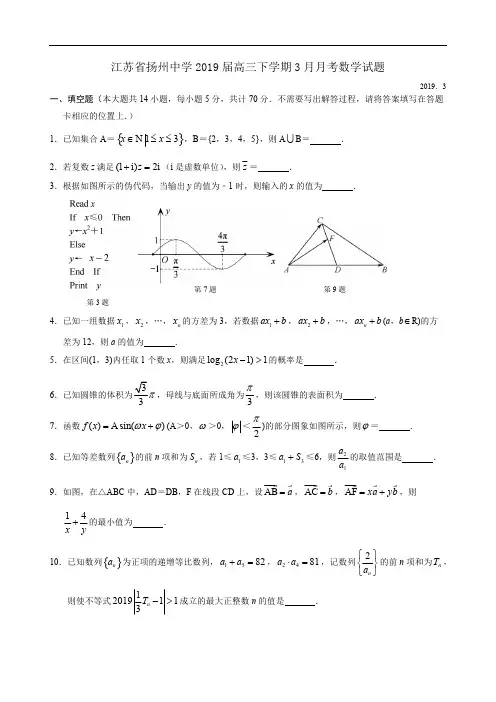
江苏省扬州中学2019届高三下学期3月月考数学试题2019.3一、填空题(本大题共14小题,每小题5分,共计70分.不需要写出解答过程,请将答案填写在答题卡相应的位置上.)1.已知集合A =,B ={2,3,4,5},则A B = .{}N 13x x ∈≤≤ 2.若复数z 满足(i 是虚数单位),则= .(1i)2i z +=z 3.根据如图所示的伪代码,当输出y 的值为﹣1时,则输入的x 的值为.第7题 第9题第3题4.已知一组数据,,…,的方差为3,若数据,,…,(a ,b R)的方1x 2x n x 1ax b +2ax b +n ax b +∈差为12,则a 的值为 .5.在区间(1,3)内任取1个数x ,则满足的概率是.2log (21)1x ->6,母线与底面所成角为,则该圆锥的表面积为 .3π7.函数(A >0,>0,<)的部分图象如图所示,则= .()Asin()f x x ωϕ=+ωϕ2πϕ8.已知等差数列的前n 项和为,若1≤≤3,3≤≤6,则的取值范围是 .{}n a n S 1a 13a S +21a a 9.如图,在△ABC 中,AD =DB ,F 在线段CD 上,设,,,则AB a = AC b = AF xa yb =+ 的最小值为 .14x y +10.已知数列为正项的递增等比数列,,,记数列的前n 项和为,{}n a 1582a a +=2481a a ⋅=2n a ⎧⎫⎨⎬⎩⎭n T 则使不等式成立的最大正整数n 的值是 .12019113n T ->11.已知双曲线(a >0,b >0)的左、右焦点分别为F 1、F 2,直线MN 过F 2,且与双曲线右22221x y a b-=支交于M 、N 两点,若cos ∠F 1MN =cos ∠F 1F 2M ,,则双曲线的离心率等于 .11F M 1F N 2=12.已知a >0,函数在[﹣1,1]上的最大值为2,则a =.2()3f x x x a =+--13.在边长为8的正方形ABCD 中,M 是BC 的中点,N 是AD 边上的一点,且DN =3NA ,若对于常数m ,在正方形ABCD 的边上恰有6个不同的点P ,使,则实数m 的取值范围是 PM PN m ⋅= .14.已知函数有两个不同的极值点,,若不等式恒成立,2()2ln f x ax x x =-+1x 2x 1()f x λ>+2()f x 则实数的取值范围是 .λ二、解答题(本大题共6小题,共计90分.请在答题纸指定区域内作答,解答应写出文字说明,证明过程或演算步骤.)15.(本题满分14分)已知函数.()2cos(2)cos 213f x x x π=+-+(1)求的对称中心;()f x (2)若锐角△ABC 中角A ,B ,C 所对的边分别为a ,b ,c ,且=0,求的取值范围.(A)f b c16.(本题满分14分)如图,三角形PCD 所在的平面与等腰梯形ABCD 所在的平面垂直,AB =AD =CD ,AB ∥CD ,CP ⊥CD ,M 为PD 的中点.12(1)求证:AM ∥平面PBC ;(2)求证:BD ⊥平面PBC .17.(本题满分14分)如图,某人工景观湖外围有两条相互垂直的直线型公路l l ,l 2,且l l 和l 2交于点O .为了方便游客游览,计划修建一条连接公路与景观湖的直线型公路AB .景观湖的轮廓可以近似看成一个圆心为O ',半径为2百米的圆,且公路AB 与圆O '相切,圆心O '到l l ,l 2的距离均为5百米,设∠OAB =,AB 长为θL 百米.(1)求L 关于的函数解析式;θ(2)当为何值时,公路AB 的长度最短?θ18.(本题满分16分)过椭圆W :的左焦点F 1作直线l 1交椭圆于A ,B 两点,其中A(0,1),另一条过F 1的2212x y +=直线l 2交椭圆于C ,D 两点(不与A ,B 重合),且D 点不与点(0,﹣1)重合.过F 1作x 轴的垂线分别交直线AD ,BC 于E ,G .(1)求B 点坐标和直线l 1的方程;(2)比较线段EF 1和线段GF 1的长度关系并给出证明.19.(本题满分16分)设函数,[0,].()sin cos f x a x x x =-x ∈2π(1)当a =1时,求证:≥0;()f x(2)如果≥0恒成立,求实数a 的最小值.()f x 20.(本题满分16分)正数数列、满足:≥,且对一切k ≥2,k ,是与的等差中项,是{}n a {}n b 1a 1b N *∈k a 1k a -1k b -k b 与的等比中项.1k a -1k b -(1)若,,求,的值;22a =21b =1a 1b (2)求证:是等差数列的充要条件是为常数数列;{}n a {}n a (3)记,当n ≥2(n )时,指出与的大小关系并说明理由.n n n c a b =-N *∈23n c c c +++ 1c 附加题21.(本题满分10分)设二阶矩阵A ,B 满足,,求.1 1 2A3 4-⎡⎤=⎢⎥⎣⎦1 1 0(BA)0 1-⎡⎤=⎢⎥⎣⎦1B -22.(本题满分10分)在平面直角坐标系xOy 中,射线l :(x ≥0),曲线C 1的参数方程为(为参y =3cos 2sin x y αα=⎧⎨=⎩α数),曲线C 2的方程为;以原点为极点,x 轴的非负半轴为极轴建立极坐标系,曲线22(2)4x y +-=C 3的极坐标方程为.8sin ρθ=(1)写出射线l 的极坐标方程以及曲线C 1的普通方程;(2)已知射线l 与C 2交于O ,M ,与C 3交于O ,N ,求的值.MN 23.(本题满分10分)为迎接2022年冬奥会,北京市组织中学生开展冰雪运动的培训活动,并在培训结束后对学生进行了考核.记X 表示学生的考核成绩,并规定X ≥85为考核优秀.为了了解本次培训活动的效果,在参加培训的学生中随机抽取了30名学生的考核成绩,并作成如下茎叶图.(1)从参加培训的学生中随机选取1人,请根据图中数据,估计这名学生考核优秀的概率;(2)从图中考核成绩满足X [70,79]的学生中任取3人,设Y 表示这3人重成绩满足∈≤10的人数,求Y的分布列和数学期望.X 85-24.(本题满分10分)已知.2220122(1)(N )n n n x a a x a x a x n ++=++++∈ (1)求的值;12212n n a a a a --++- (2)求的值.122121111n na a a a --++- 参考答案。
2020届江苏省扬州中学高三英语月考试题及答案

2020届江苏省扬州中学高三英语月考试题及答案第一部分阅读(共两节,满分40分)第一节(共15小题;每小题2分,满分30分)阅读下列短文,从每题所给的A、B、C、D四个选项中选出最佳选项AWhen it comes to the greatest inventions of the world, China’s name is sure to be mentioned several times. There are hundreds of things which were invented by the Chinese.AlcoholShocked? I was because when they said alcohol I thought about either the US or the UK. China had never crossed my mind. In China, alcohol was made by two legendary persons named Yi Di and Du Kang who belonged to the Xia Dynasty. This period was about 2000 BC - 1600 BC. Research says that in ancient China, beer with 4% alcoholic content was widely consumed by people.TeaChina is the proud inventor of tea which was first drunk by Shen Nong, a Chinese emperor around 2737 BC. Tea production was rapidly developed, making tea a popular drink during the Tang and Song Dynasties.The Mechanical ClockHave you ever wondered what on earth we would be doing without any idea of time? A clock really is an invention without which things were incomplete. The credit of making the first mechanical clock goes to ancient China. The first mechanical clock was invented by Yi Xing in the Tang Dynasty. This was during 618 and 907.Silk FabricSilk, the favorite fabric of many girls out there, is also a Chinese invention. Although we all know that silk is made by silkworms, it was Chinese people who first invented a way to harvest the silk and then use it to make clothes. The oldest silk which has been found so far is in Henan Province and dates back to 3630 BC.1.We can learn from Paragraph 2 that ________.A.people in the US like alcoholB.beer was popular in the Xia DynastyC.Yi Di and Du Kang invented alcohol by accidentD.the author didn’t know alcohol is a Chinese invention2.The author asks the question in Paragraph 4 to show ________.A.ancient Chinese inventors were wiserB.many things in our lives are incompleteC.ancient Chinese people never wasted timeD.the invention of the mechanical clock is important3.Which of the following invention has a longer history?A.Tea.B.Alcohol.C.Silk fabric.D.The mechanical clock.BThink ofJapanin the spring and the image that comes to mind is likely the country’s famous cherry blossoms, also known as “Sakura” — white and pink flowers, blooming across cities and mountains.The flowers, which experience a “peak bloom” that only lasts a few days, have been loved inJapanfor more than a thousand years. Crowds celebrate with viewing parties,flockingto the most popular locations to take photos and have picnics underneath the branches.But this year, cherry blossom season has come and gone in the blink of an eye, in one of the earliest blooms on record. Scientists warn it’s a symptom of the larger climate crisis threatening ecosystems everywhere.Yasuyuki Aono, a researcher atOsakaPrefectureUniversity, has gathered records fromKyotoback to 812 AD from historical documents and diaries. In the central city ofKyoto, cherry blossoms peaked on March 26, the earliest in more than 1,200 years, Aono said. And in the capitalTokyo, cherry blossoms reached full bloom on March 22, the second-earliest date on record.The peak bloom dates shift every year, depending on numerous factors including weather and rainfall, but have shown a general trend of moving earlier and earlier. InKyoto, the peak date stayed around mid-April for centuries, but began moving into early April during the 1800s. The date has only dipped into late March a handful of times in recorded history.“Sakura blooms are very temperature sensitive,” said Aono. “Flowering and full bloom could be earlier or later depending on the temperature alone,” he said. “The temperature was low in the 1820s, but it has risen by about 3.5 degrees Celsius to this day.”This year’s seasons in particular influenced the blossom dates, he added. The winter was very cold, but the spring came fast and unusually warm.4. What is the best title of the passage?A. Cherry blossom celebrations.B. Warning of a climate crisis.C. A strong love for cherry blossom.D. Cherry blossom season coming earlier.5. What does the underlined word “flocking” mean?A. Blocking.B. Flooding.C. Running.D. Following.6. What can we infer from paragraph 5?A. The peak blossom dates fall on a fixed date.B. The cherry blossom rarely peaks in March.C. The peak bloom dates mainly depend on weather and rainfall.D. Cherry blossom peaks around mid-April inTokyo.7. What is the author’s purpose in writing the passage?A. To inform people the date of cherry blossom.B. To show a study on cherry blossom dates.C. To present a Japanese tradition of cherry blossom celebration.D. To make people aware of the influence of climate change on cherry blossom.CLearning to say “yes, and”When I first heard about the improvisation (即兴交流) class, I was hesitating. As a quiet and shy girl, I feared improvising in front of strangers. However,I knew I wanted to work as a science communicator after finishing my Ph.D., so it seemed like a perfect opportunity to learn how to speak and communicate with others effectively. I signed up, knowing the experience would give me help.During our first class, we learned an important concept of improvisation: “yes, and.” It means that, as improvisers, we’d better accept what fellow performers say. If someone says that rhinos (犀牛) are librarians, for example, then rhinos are librarians. We do not question the logic; we say “yes” and then continue with the scene as if nothing is wrong.The first few scenes were hard, but as weeks turned into months, I became more comfortable andeven started to enjoy our classes. I became better at listening, relating to my conversation partners, and communicating clearly in the moment. Once when I was giving a presentation about my science, an audience member surprised me with a question that didn’t grow out of the information I’d presented. Instead of getting confused and nervous, I took the “yes, and” approach—accepting the question and letting my mind focus on why it was asked. That helped me find an appropriate answer. I got pretty excited about it.The benefits of improvisation go beyond communication. Before attending the class, I would get stuck when my experiments produced unexpected data, thinking that I had made a mistake. But now, instead of getting discouraged, I will stay open to the possibility that the results are real, keep exploring the data and end up identifying a new type of cell—one that isn’t behaving as expected.I think all scientists can benefit from this lesson. If the data say rhinos are librarians, then it’s worth findingout whether rhinos are, in fact, librarians. As scientists, our job isn’t to challenge data that support a preconceived (先入为主的) story, but to say “yes, and.”8. Why did the author attend the improvisation class?A. To get a different experience.B. To finish her Ph.D. at university.C. To give up her job as a science communicator.D. To improve her speaking and communicating ability.9. What was the author’s change after attending the improvisation class?A. She formed her own idea quickly.B. She came up with lots of creative responses.C. She paid more attention to the logic of answers.D. She became a good listener before giving an opinion.10. The author mentions applying the “yes, and” approach to her scientific experiments to ______.A. explain the process of using the methodB. prove the benefits of the improvisation classC. share her own research experiences with readersD. attract fellow scientists to attend the improvisation class11. What can be inferred about scientists from the last paragraph?A. They should attend the improvisation class.B. They should question all preconceived ideas.C. They should carry on research by admitting earlier data.D. They should try to improve their professional knowledge.DIt’s become an accepted part of keeping up to date with extended family and friends, but if schoolchildren were in their parents’ shoes, the majority wouldn’t share posts of their sons and daughters online. Over 55% saidthey would not upload news about, or images of, their children to their social media feeds, according to survey of over 16,000 pupils by Votes for Schools.While some were concerned about being embarrassed or the longevity of content which could remain online indefinitely, others expressed concern about their personal data beingcompromised. One of the pupils surveyed said, “Although our parents mean well, sometimes theconsequenceof a post can be disastrous.”In response to thesurvey, children’s mental health charity Place2Be and law firm Mishcon de Reya have produced three films ahead of the Christmas holidays – the best period for parental oversharing.In one video, about safety online, 10-year-old Adavan said, “If you share anything with your family, you know who’s going to see it. But if you share it publicly, there are millions of people who can see your picture.”Joe Hancock, a security lead at Mishcon de Reya, encouraged parents to share wisely. “Simple steps, such as checking your privacy settings and asking others not to share content of your children on their accounts if they have not updated their privacy settings, are a good start. And, as we found out from the children during filming, having their permission is key,” he said.The study marks a shift away from the usual debate about teaching children to use the Internet safely. Sandra Davis, head of the law firm’s family department, said, “Children are the experts on the real and immediate impact of sharenting(晒娃)– the full extent of which we cannot know yet. We must ensure we listen to children and take their views into consideration now in order to avoid any unintendedconsequences further down the line.”12.What’s most pupils’ attitude towards sharing posts about children?A. Skeptical.B. Unconcerned.C. Tolerant.D. Unwilling.13.What does the author intend to do in Paragraph 2?A. Summarize the previous paragraph.B. Provide some advice for parents.C. Predict the consequence of sharing posts.D. Give reasons for the result of the survey.14.What should parents first pay attention to according to Joe Hancock?A. Safety.B. Consequence.C. Wisdom.D. Health.15.What can we learn from the last paragraph?A. Parents should take children’s opinions into account.B. Parents should teach children to use the Internet safely.C. Children must make sure to listen to their parents.D. Children should avoid unintended consequences of sharenting.第二节(共5小题;每小题2分,满分10分)阅读下面短文,从短文后的选项中选出可以填入空白处的最佳选项。
江苏省扬州市扬州中学2019届高三第二学期3月质量检测语文试卷(附解析)
2019届江苏省扬州市扬州中学高三第二学期3月质量检测语 文注意事项:1.答题前,先将自己的姓名、准考证号填写在试题卷和答题卡上,并将准考证号条形码粘贴在答题卡上的指定位置。
2.选择题的作答:每小题选出答案后,用2B 铅笔把答题卡上对应题目的答案标号涂黑,写在试题卷、草稿纸和答题卡上的非答题区域均无效。
3.非选择题的作答:用签字笔直接答在答题卡上对应的答题区域内。
写在试题卷、草稿纸和答题卡上的非答题区域均无效。
4.考试结束后,请将本试题卷第I 卷(选择题)一、选择题1.在下面一段话空缺处依次填入词语,最恰当的一组是( )老子的哲学,是夹缝中生存的技术,是盘根错节的社会中 的智慧,是专制社会中唯一能保护自己肉体存在的法术,其 就是通过压缩主体精神与人格,取得 的空间,一句话,有专制,必有老子思想。
A .胸有成竹 诀窍 忍辱负重 B .游刃有余 诀窍 苟且偷生 C .胸有成竹 门道 苟且偷生 D .游刃有余 门道 忍辱负重2.下列各句中,诗句与节日不对应...的一项是( ) A .年年乞与人间巧,不道人间巧已多。
(七夕节) B .棹影斡波飞万剑,鼓声劈浪鸣千雷。
(端午节) C .雨中禁火空斋冷,江上流莺独坐听。
(重阳节) D .月色灯山满帝都,香车宝盖隘通衢。
(元宵节)3.下列语段空缺处应填入的语句,排列正确的一项是( )。
比方路边有一棵苍松,你看见它只觉得可以砍来造船;我见到它可以让人纳凉;旁人也许说它很宜于入画,或者说它是高风亮节的象征。
这几个人反应不同,都由于感受力有强有弱。
①同一美颜,同一和声,而各个人所见到的美与和的程度又随天资境遇而不同。
②这两个字涵义极广。
③见颜色而知其美,闻声音而知其和,也是感受。
④眼见颜色,耳闻声音,是感受。
⑤人生乐趣一半得之于活动,也还有一半得之于感受。
⑥所谓“感受”是被动的,是容许自然界事物感动我的感官和心灵。
A .⑤⑥②④③①B .⑤②④⑥③①C .⑥②④③①⑤D .⑥②①④③⑤4.给下面这幅漫画起一个标题,最合适的一项是( )A .烛光里的温暖B .21世纪“卖火柴的小女孩”C .办法总比困难多D .眼界有多大,世界就有多大5.下列有关名著的说明,不正确的两项......是( ) A .《红楼梦》全书以贾宝玉和林黛玉的爱情和贾府的由盛而衰为线索,把众多人物和复杂、纷繁的事件组织在一起,这些人物、事件交错发展,彼此制约,构成了一个巨大的艺术结构。
江苏省扬州中学2019高三5月第四次模拟考试英语试题(含答案)

江苏省扬州中学高三第四次模拟考试第一卷(选择题,共85分)第一部分:听力(共两节,满分20分)第一节(共5小题;每小题1分,满分5分)听下面5段对话。
每段对话后有一个小题,从题中所给的A、B、C三个选项中选出最佳选项,并标在试卷的相应位置。
听完每段对话后,你有10秒钟的时间来回答有关小题和阅读下一小题。
每段对话仅读一遍。
1. How long has the man run in his old running shoes?A. 300 miles.B. 400 miles.C. 500 miles.2. Why does the man think the woman should join him?A. He thinks she will have more fun.B. He wants to meet her roommate.C. He thinks it’s safer to go in a large group.3. Who are the speakers?A. Teacher and student.B. Boss and employee.C. Salesperson and client.4. What does the man say about his neighbor?A. He is humorous.B. He is not handsome.C. He is very successful.5. What makes the man appreciate his dog?A. The dog protects his house.B. The dog is easy to take care of.C. The dog helps him get exercise.第二节(共15小题:每小题1分,满分15分)听下面5段对话或独白。
每段对话或独白后有几个小题,从题中所给的A、B、C三个选项中选出最佳选项,并标在试卷的相应位置。
江苏省扬州中学2019届高三考前最后一卷(5月)+英语答案
江苏省扬州中学2019届高三考前调研测试英语试题参考答案第一部分听力(共两节,每题1分,满分20分)1-5 CBACA 6-10 CBAAC 11-15 BBCAB 16-20 BACAB第二部分英语知识运用第一节单项填空 (共15小题;每小题1分,满分15分)21—25 BBDAC 26—30 ABDAB 31—35 CDADC第二节完形填空(共20小题;每小题1分,共20分)36—40 BCCDA 41—45 BADCD 46—50 ABCBB 51—55 ABDCB第三部分阅读理解(共15小题;每小题2分,满分30分)56—57 CA 58—60 BBD 61—64 AADC 65—70 BDCABB第四部分任务型阅读(共10小题;每小题1分,满分10分)71. limited 72. unfair /careless/casual 73. staying/keeping74. sight 75. plan/intention/aim/goal 76. instead77. practice/exercise/training 78. time 79. divided/split80. news第五部分书面表达(满分25分)One possible version:Nowadays it is not uncommon to see people like Mark have this sensation—closely associated with so many “friends” online, yet feeli ng remote from people around them.Quite a few factors make for this phenomenon, of which the most notable one, I believe, is people’s addiction to their smart phones, social media… in a word, the virtual world. By sharing and updating online, people seem to be most gratified to attract a great number of followers. Meanwhile, they find little freshness in their surroundings. Thus, they are blind to and withdraw from the people and things in real life.A s to Mark’s experience, I feel genuine sympathy for him. To get out of such a dilemma, I would suggest that he cut down on his time spent online, so that he can hang out with his friends more often. More importantly, step forward first to communicate with others when they are deeply lost in the virtual world.书面表达评分标准一、评分原则:1.本题总分为25分,按5个档次给分。
2019届江苏省扬州中学高三上学期10月月考英语试题(解析版)
、江苏省扬州中学2019届高三10月月考英语(满分120分,考试时间120分钟)第一部分:听力(共两节,满分20分)第一节听下面5段对话。
每段对话后有一个小题,从题中所给的A、B、C三个选项中选出最佳选项,并标在试卷的相应位置。
听完每段对话后,你都有10秒钟的时间来回答有关小题和阅读下一小题。
每段对话仅读一遍。
1.音频What does the woman think of the movie?A. It’s amusing.B. It’s exciting.C. It’s disappointing.【答案】C【解析】【分析】W: Have you seen the movie “Hangover”? We went to see it last night.M: How was it?W: Jason thought it was extremely amusing, but I was a bit disappointed.【详解】此题为听力题,解析略。
2.音频How will Susan spend most of her time in France?A. Traveling around.B. Studying at a school.C. Looking after her aunt.【答案】A【解析】【分析】M: Susan, I heard you are going to France. How long will you be staying there?W: A whole year. My aunt lives there. I’m going to do a one-month course at a language school and spend the rest of the time traveling.【详解】此题为听力题,解析略。
3.音频What are the speakers talking about?A. Going out.B. Ordering drinks.C. Preparing for a party.【答案】C【解析】【分析】M: Let’s see what drinks you’ve got for the party tonig ht.W: Everything! Beer, wine, soft drinks like Coke, 7-Up…you name it, I’ve got it! Have you ordered the cake?M: Of course.【详解】此题为听力题,解析略。
江苏省扬州中学教育集团树人学校2019-2021年三年中考三模英语试卷分类汇编:任务型阅读
江苏省扬州中学教育集团树人学校2019-2021年三年中考三模英语试卷分类汇编任务型阅读江苏省扬州市树人学校2021年九年级第三次模拟考试英语试卷五、任务型阅读(共10空:每空1分, 计10分)阅读下面短文, 根据短文中的信息完成文后表格。
在答题卡标有题号的横线上, 写出空缺处所填单词的正确形式。
(每空一词)Years ago, Linda Henkel, an American scientist was travelling at the Grand Canyon (美国大峡谷). "When I was at the canyon's edge, someone came to the front, took & picture and walked away, " she recalls as she shares her travelling experience. "He didn't even look at the scenery! It s just like, 'Got it —Done!' "Henkel is surprised by how much people depend on pictures for their memories. These days, people take pictures before dinner, during friends' birthday parties, and so on. They believe taking pictures will help them remember the moment However, according to Henke research, it, s not true that taking pictures will be good for people's memories.In her study, Henke)took a group of college students to visit a museum. She asked them to look at 15 exhibits (展览)carefully and then to take photos of 15 others. The next day, she tested the students, memory of the tour. She found that the students remembered fewer details about the exhibits they had photographed.Henkel explains that when people depend on their cameras, they won't pay more attention to the event themselves. As a result, they often fail to remember their experiences well.So taking pictures may prevent our brains from remembering things and places. But shouldn't looking over the pictures wake up our memories? Henkel says this is true. However, it happens only if we spend enough time doing it." In order to remember, we have to review (回顾)the photos carefully, " Henkel says, Unfortunately, most people never take the time to look over their digital pictures. Why? There are just too many of them!答案:56. Introduction 57. scientist 58. without 59. surprise 60. can't61. showed 62. remembered 63. less 64. pre vent/ stop 65. remind江苏省扬州中学教育集团树人学校2020届九年级第三次模拟考试英语试题五、任务型阅读(共l0空;每空l分,计l0分)阅读下列短文,根据短文中的信息完成文后表格。
【全国百强校】江苏省扬州市扬州中学2019届高三第二学期4月质量检测语文试题(解析版)
江苏省高三年级4月质量检测语文试卷2019.4一、语言文字运用(12 分)1.在下面一段话空缺处依次填入词语,最恰当...的一组是中华几千年的文明史中,的文人多如牛毛,而像苏东坡这样诗文书画和人品道德都趋于完美都富于魅力者实在也是。
所以,我总觉得自从有了苏东坡后,除去李白之外的其他中国文人都在他的光照对比下显得。
A. 名垂青史凤毛鳞角黯然失色B. 名噪一时九牛一毛黯然失色C. 名噪一时凤毛麟角相形见绌D. 名垂青史九牛一毛相形见绌【答案】A【解析】【详解】试题分析:本题考核正确使用词语(包括熟语)的能力。
这类题目解答时应首先明确成语的意思,然后结合语境辨析正误。
名垂青史:把姓名事迹记载在历史书籍上,形容功业巨大,永垂不朽,名声永留史册。
彪炳史册:形容伟大的业绩流传千秋万代。
文段中说的是中华几千年文明史中有名的文人,用“名垂青史”更恰当。
凤毛麟角:凤凰的羽毛,麒麟的角,比喻珍贵而稀少的人或物。
九牛一毛:很多牛身上的一根毛,比喻微不足道。
文段中说像苏东坡这样的人才少,用“凤毛麟角”恰当。
黯然失色:本指心怀不好,脸色难看,后多比喻相形之下很有差距,远远不如。
相形见绌:跟另一人或事物比较之后,显出了不足。
文段中说的是中国很多文人与苏轼比有差距,用“黯然失色”恰当。
故此题答案为A项。
【点睛】本题考查近义成语辨析的能力。
成语的测试重点是:感情色彩的误用,望文生义,适用对象弄错,具有双重含义的成语,语境或逻辑错误。
本题以选词填空的形式考查成语的使用能力,解答的基本原则是同中求异,具体方法:从色彩方面辨析,包括感情色彩和语体色彩两方面;从词的意义方面辨析,包括词义的范围大小、词义的侧重点、词义的轻重、词义的具体与概括等方面;从运用上辨析,包括习惯搭配、词性和句法功能、适用的对象等。
2.在下面一段文字横线处填入语句,衔接最恰当的一项是()一般来说,受功利之“用”驱使的读书可归为“要读书”一类,而怀有“体”之情怀的读书则可称之为“好读书”。
江苏省扬州中学2023-2024学年高三上学期1月月考试题 英语 Word版含答案
江苏省扬州中学2023-2024学年度第一学期高三阶段检测英语2024.1本试卷分四个部分。
满分150分,考试用时120分钟。
第一部分听力(共两节,满分30分)第一节(共5小题;每小题1.5分,满分7.5分)听下面5段对话。
每段对话后有一个小题,从题中所给的A、B、C三个选项中选出最佳选项。
听完每段对话后,你都有10秒钟的时间来回答有关小题和阅读下一小题。
每段对话仅读一遍。
1.What will the woman do next?A. Attend a meeting.B. Pick up the man's client.C. Send the man to his office.2. What does the man think of the campus?A. It’s beautiful.B. It's a Greek campus.C. It’s an ancient campus.3. What is the woman?A. A salesperson.B. A hotel clerk.C. A waitress.4. What type of book is the woman reading?A. Science fiction.B. Horror fiction.C. Romantic fiction.5. When will the man probably meet Dr. Banks?A. At 8:20.B. At 8:50.C. At 9:20.第二节(共15小题;每小题1.5分,满分22.5分)听下面5段对话或独白。
每段对话或独白后有几个小题,从题中所给的A、B、C三个选项中选出最佳选项,并标在试卷的相应位置。
听每段对话或独白前,你将有时间阅读各个小题,每小题5秒钟;听完后,各小题将给出5秒钟的作答时间。
每段对话或独白读两遍。
听第6段材料,回答第6、7题。